Generalization of Tensor Factorization
          and Applications

                            Kohei Hayashi
                                 Collaborators:
T. Takenouchi, T. Shibata, Y. Kamiya, D. Kato, K. Kunieda, K. Yamada, K. Ikeda,
                            R. Tomioka, H. Kashima


                            May 14, 2012


                                                                                  1 / 29
Relational data
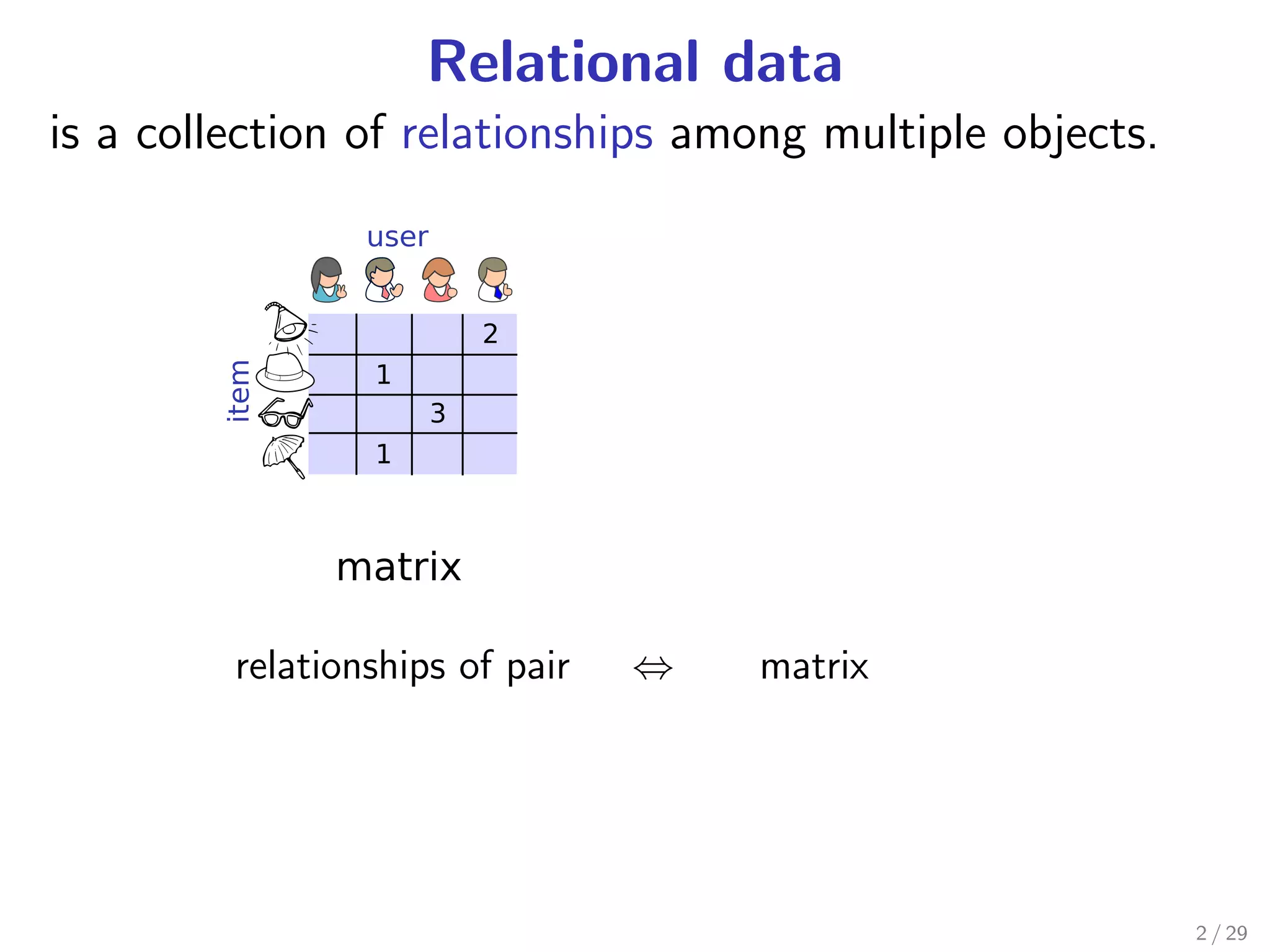
is a collection of relationships among multiple objects.


         relationships of pair   ⇔   matrix


                                                           2 / 29
Relational data
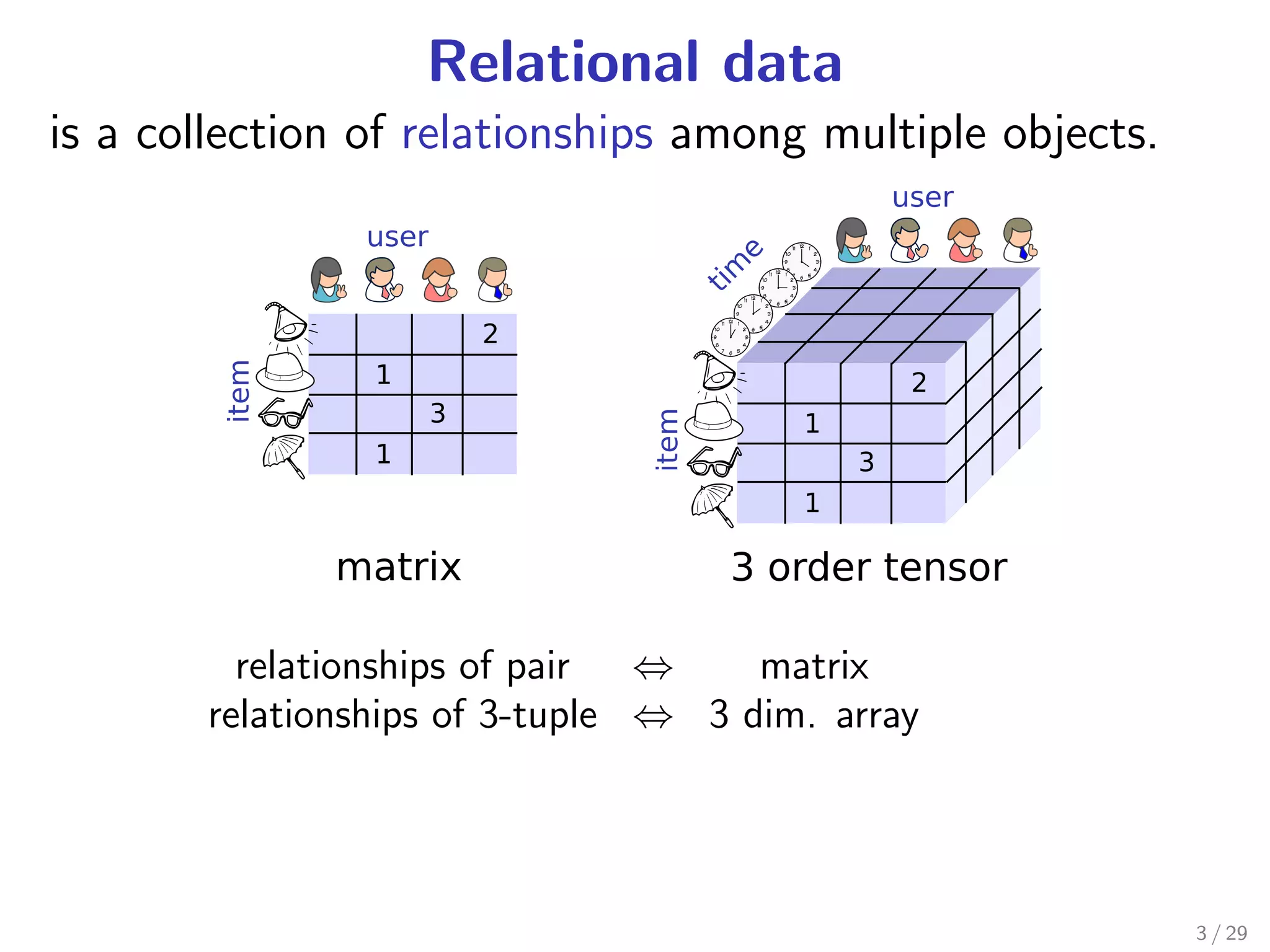
is a collection of relationships among multiple objects.


         relationships of pair ⇔     matrix
       relationships of 3-tuple ⇔ 3 dim. array


                                                           3 / 29
Relational data
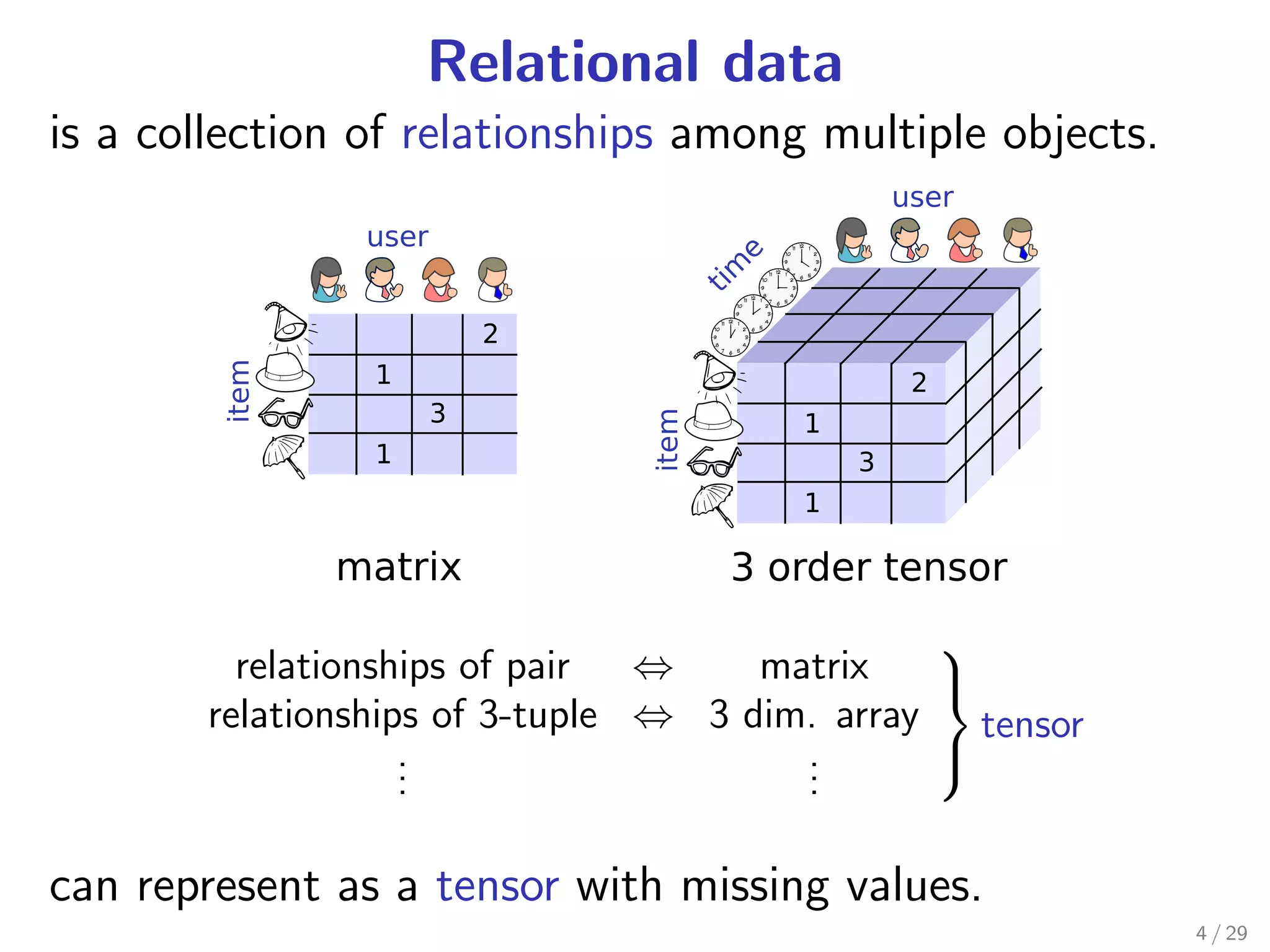
is a collection of relationships among multiple objects.


                                              
         relationships of pair ⇔     matrix   
       relationships of 3-tuple ⇔ 3 dim. array tensor
                   .
                   .                   .
                                       .      
                   .                   .

can represent as a tensor with missing values.
                                                           4 / 29
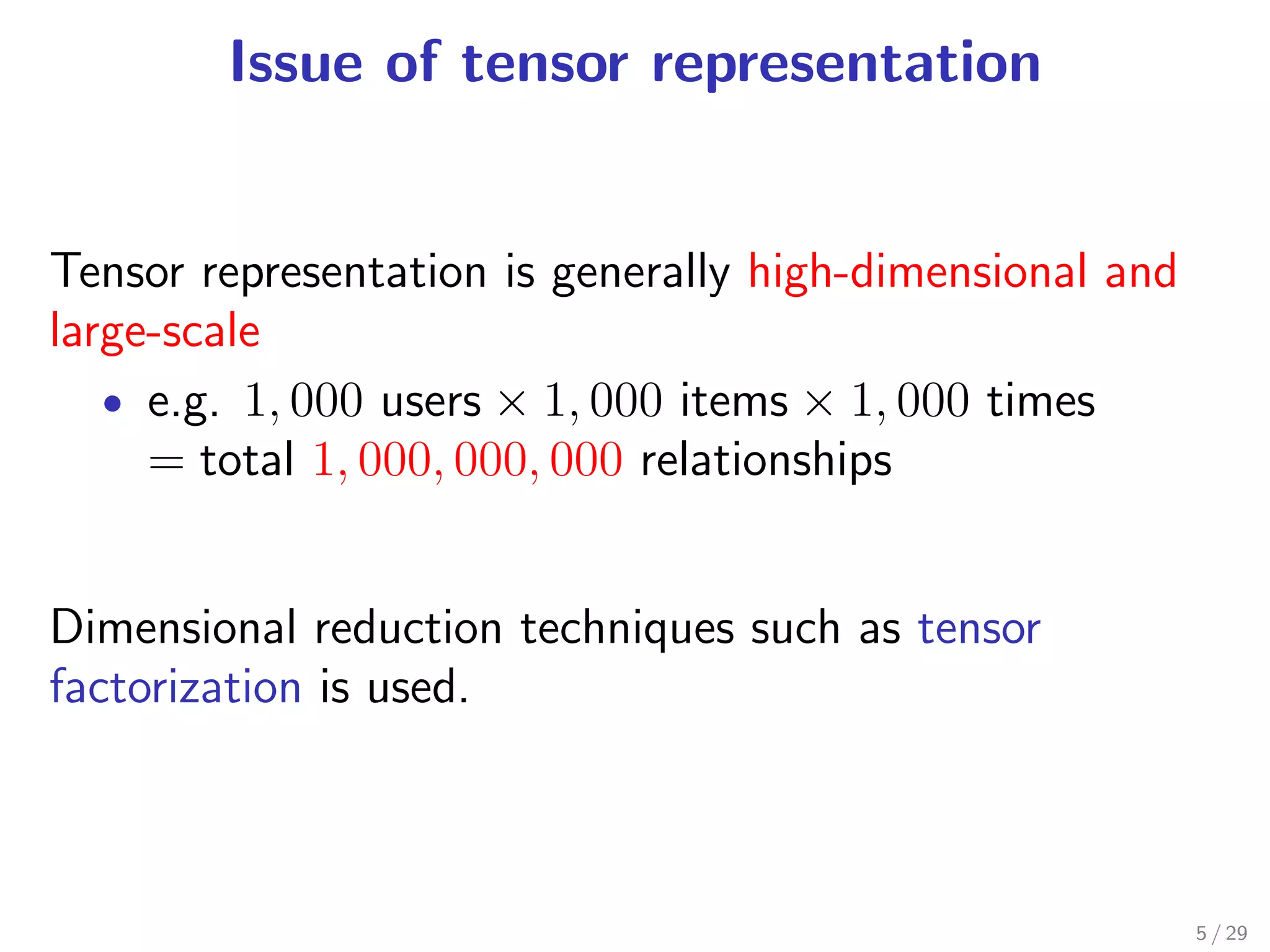
Issue of tensor representation


Tensor representation is generally high-dimensional and
large-scale
   • e.g. 1, 000 users × 1, 000 items × 1, 000 times
     = total 1, 000, 000, 000 relationships


Dimensional reduction techniques such as tensor
factorization is used.


                                                          5 / 29
Tensor factorization


Tucker decomposition [Tucker 1966]: a tensor factorization
method assuming
  1 observation noise is Gaussian
   .

  2 underlying tensor is low-dimensional
   .


These assumptions are general ... but are not always
true.


                                                             6 / 29
Contributions
Generalize Tucker decomposition and propose two new
models:
  1 Exponential family tensor factorization (ETF)
   .
       [Joint work with Takenouchi, Shibata, Kamiya, Kunieda, Yamada, and
       Ikeda]
          • Generalize the noise distribution.
          • Can handle a tensor containing mixed discrete and
             continuous values.
  2.   Full-rank tensor completion (FTC)
       [Joint work with Tomioka and Kashima]
          • Kernelize Tucker decomposition
          • Complete missing values without reducing the
             dimensionality.

                                                                            7 / 29
Outline


1.   Tucker decomposition
2.   Exponential family tensor factorization (ETF)
3.   Full-rank tensor completion (FTC)
4.   Conclusion


                                                     8 / 29
Outline


1.   Tucker decomposition
2.   Exponential family tensor factorization (ETF)
3.   Full-rank tensor completion (FTC)
4.   Conclusion


                                                     9 / 29
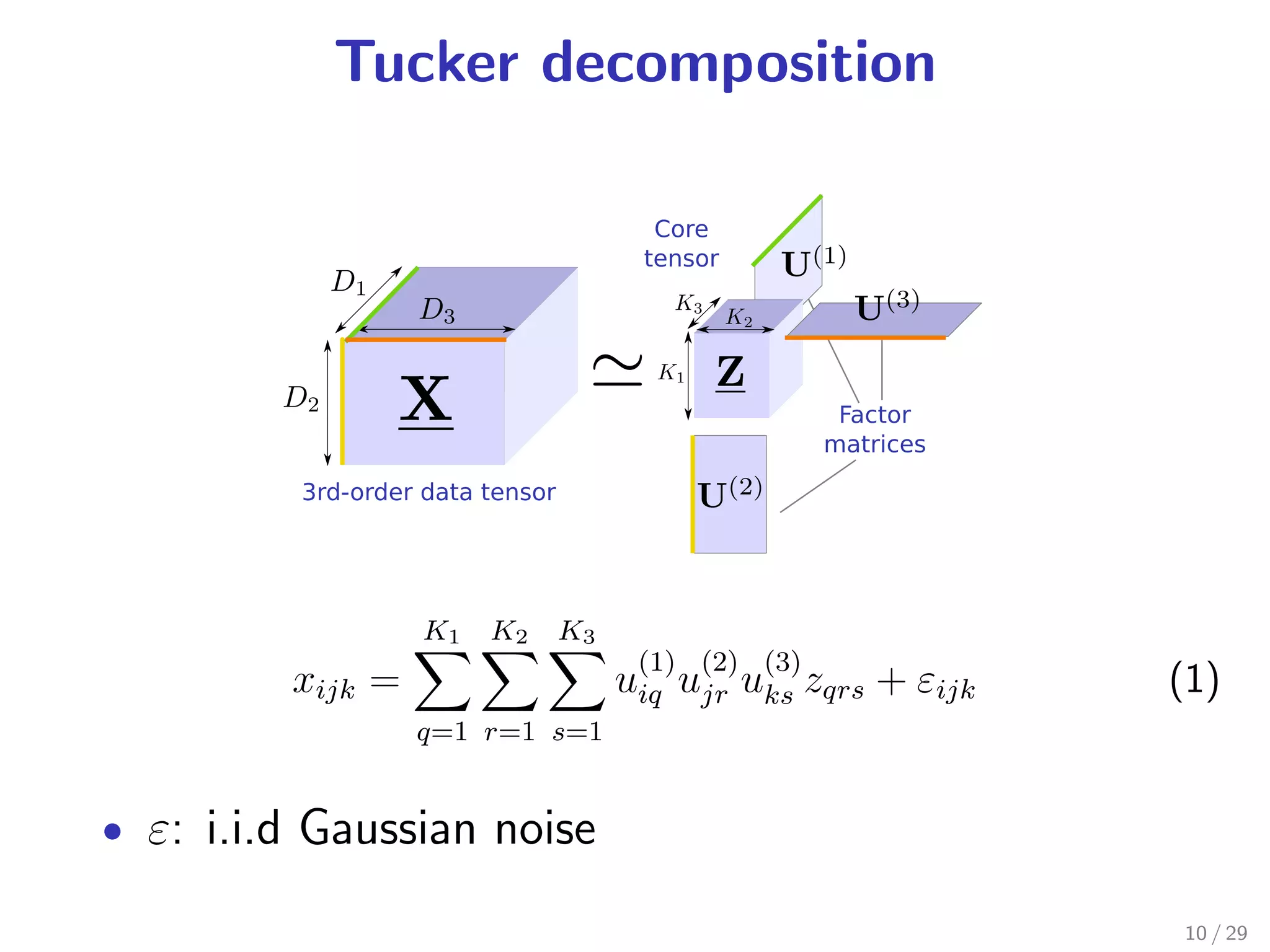
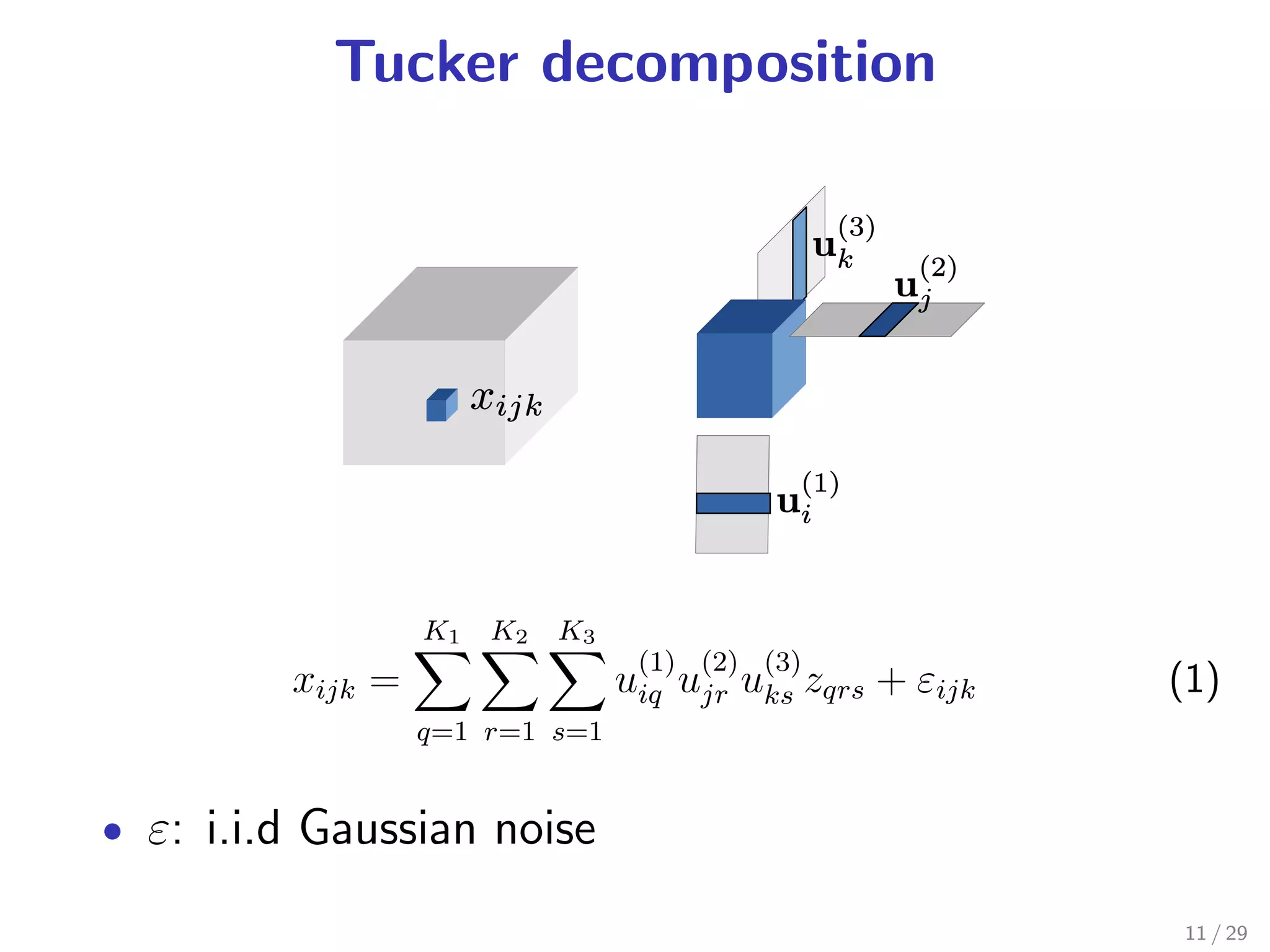
Tucker decomposition


                  K1   K2   K3
                                  (1) (2) (3)
         xijk =                  uiq ujr uks zqrs + εijk   (1)
                  q=1 r=1 s=1


• ε: i.i.d Gaussian noise

                                                           10 / 29
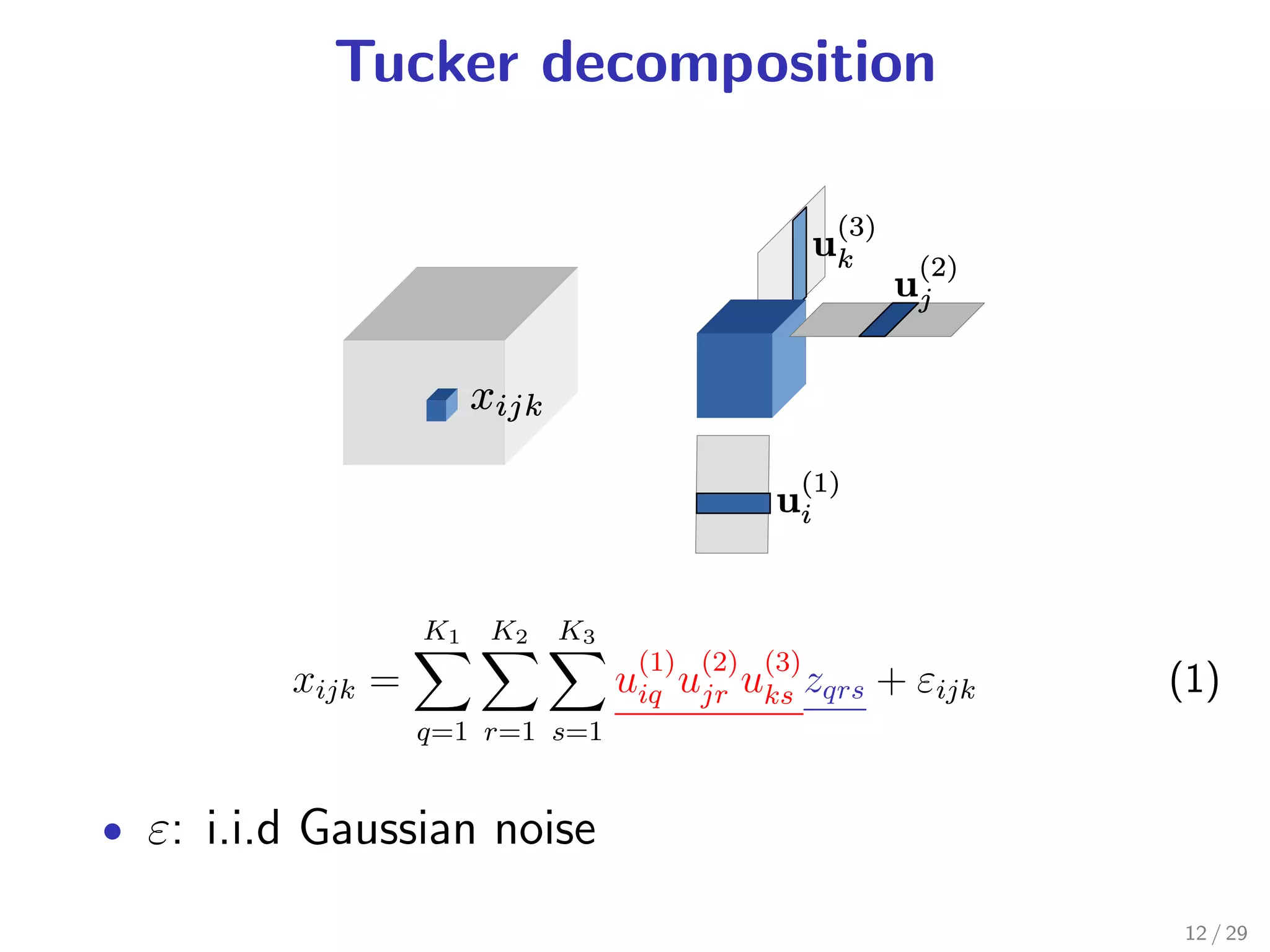
Tucker decomposition


                  K1   K2   K3
                                  (1) (2) (3)
         xijk =                  uiq ujr uks zqrs + εijk   (1)
                  q=1 r=1 s=1


• ε: i.i.d Gaussian noise

                                                           11 / 29
Tucker decomposition


                  K1   K2   K3
                                  (1) (2) (3)
         xijk =                  uiq ujr uks zqrs + εijk   (1)
                  q=1 r=1 s=1


• ε: i.i.d Gaussian noise

                                                           12 / 29
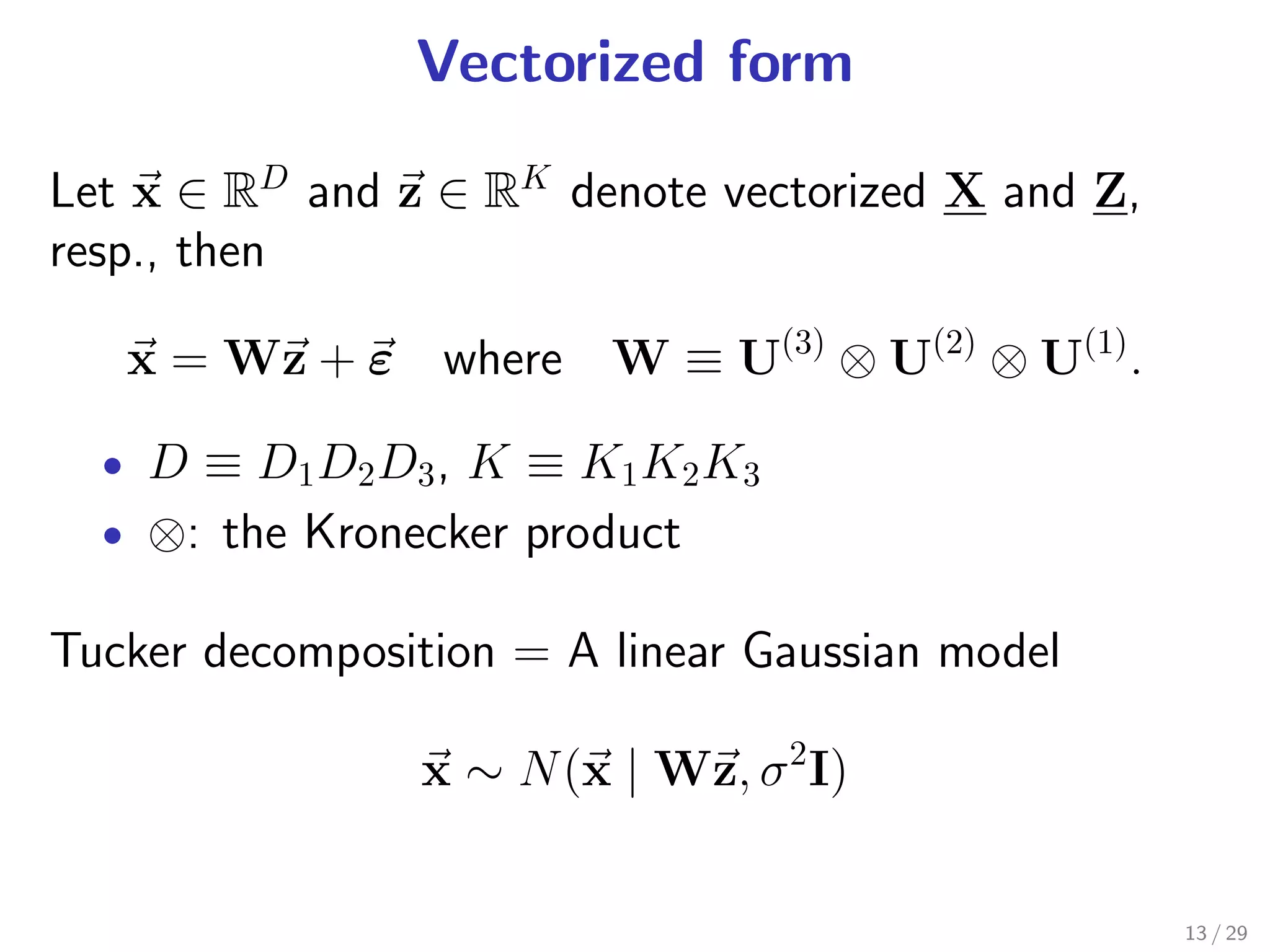
Vectorized form

Let x ∈ RD and z ∈ RK denote vectorized X and Z,
resp., then

   x = Wz + ε where W ≡ U(3) ⊗ U(2) ⊗ U(1) .

  • D ≡ D1 D2 D3 , K ≡ K1 K2 K3
  • ⊗: the Kronecker product

Tucker decomposition = A linear Gaussian model

                x ∼ N (x | Wz, σ 2 I)


                                                   13 / 29
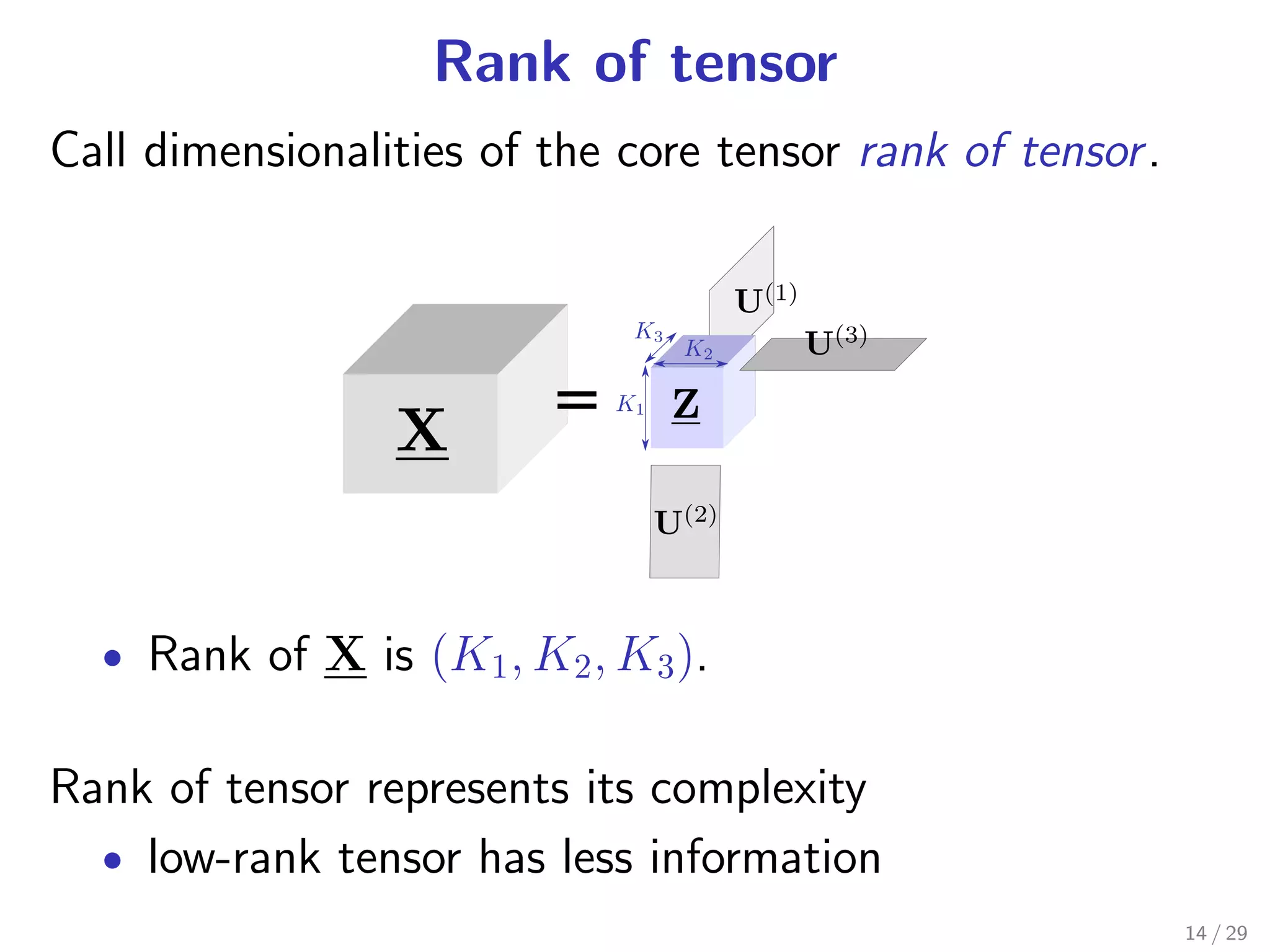
Rank of tensor
Call dimensionalities of the core tensor rank of tensor .


  • Rank of X is (K1 , K2 , K3 ).


Rank of tensor represents its complexity
  • low-rank tensor has less information
                                                            14 / 29
Outline


1.   Tucker decomposition
2.   Exponential family tensor factorization (ETF)
3.   Full-rank tensor completion (FTC)
4.   Conclusion


                                                     15 / 29
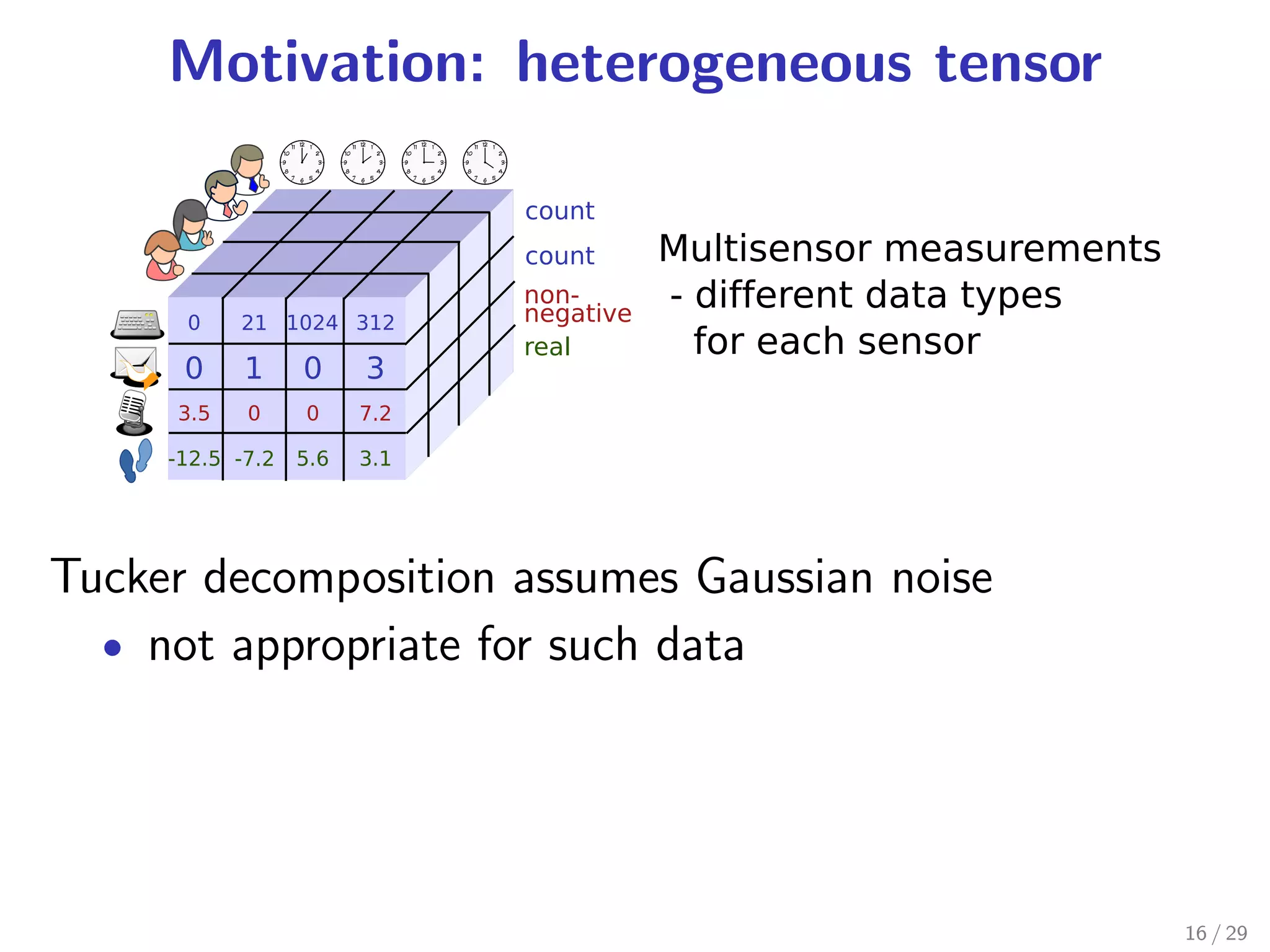
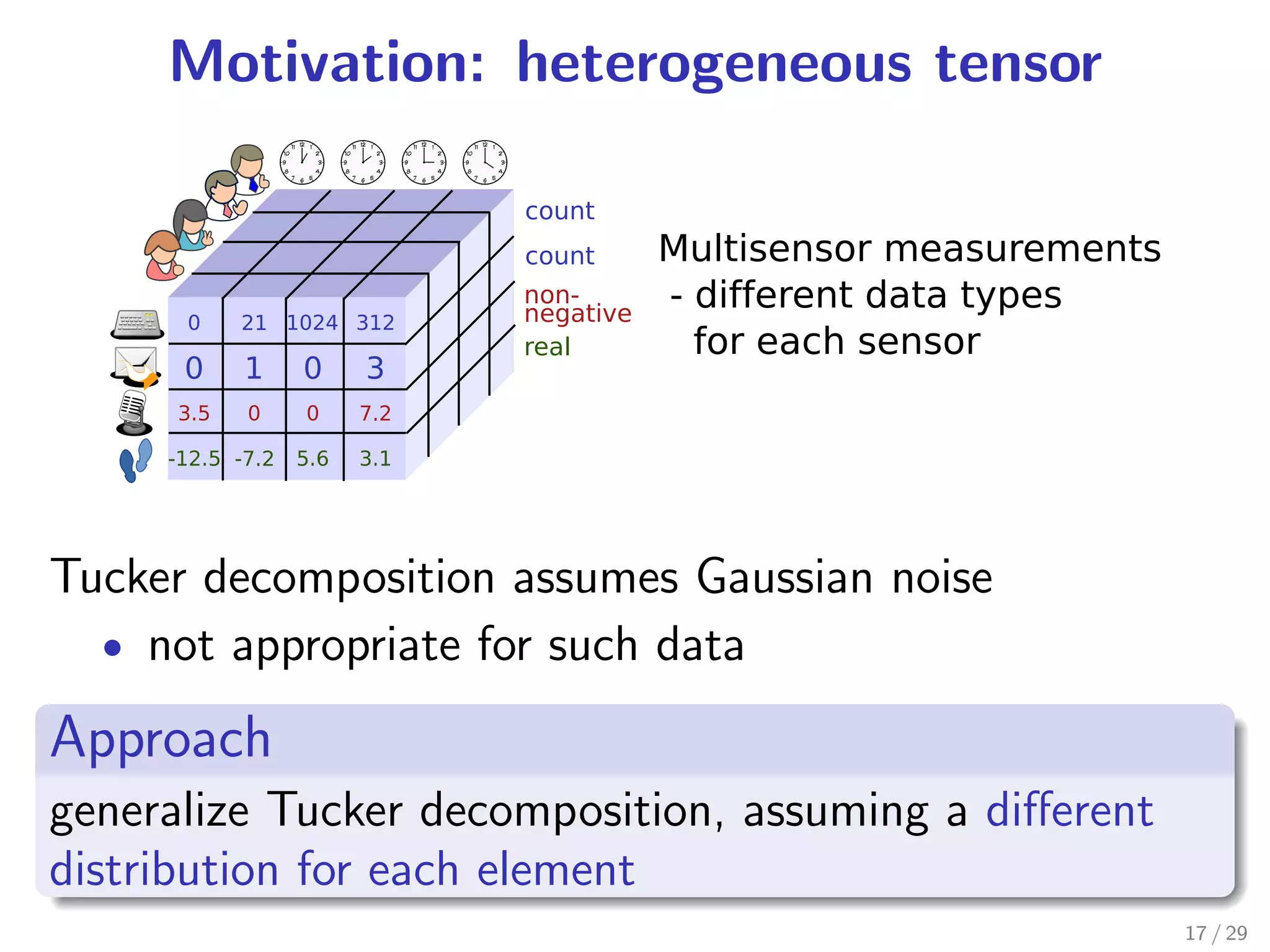
Motivation: heterogeneous tensor


Tucker decomposition assumes Gaussian noise
  • not appropriate for such data


                                              16 / 29
Motivation: heterogeneous tensor


Tucker decomposition assumes Gaussian noise
   • not appropriate for such data
.
Approach
.
generalize Tucker decomposition, assuming a different
distribution for each element
.
                                                       17 / 29
Exponential family tensor factorization
.
Likelihood
.
                            D
        x∼                       Expond (xd | θd ),                    θ ≡ Wz
                           d=1           exp. family                  Tucker decomp.

.       where Expon(x | θ) ≡ exp [xθ − ψ(θ) + F (x)]

exponential family : a class of distributions
                           Gaussian                    Poisson                   Bernoulli
                     0.4


                                                                           0.7
    Density
           Density


                                                 0.2
                     0.2


                                                                           0.5
    (θ = 0)
                     0.0


                                                 0.0


                                                                           0.3

    ψ(θ)                   θ2−4 −2
                             /2      0   2   4
                                                       exp[θ] 4
                                                        0 2       6    8
                                                                                 ln(10.0 0.5 1.0 1.5
                                                                                 −0.5
                                                                                       + exp[θ])
                                     x

                                                                                                       18 / 29
.
Priors
.
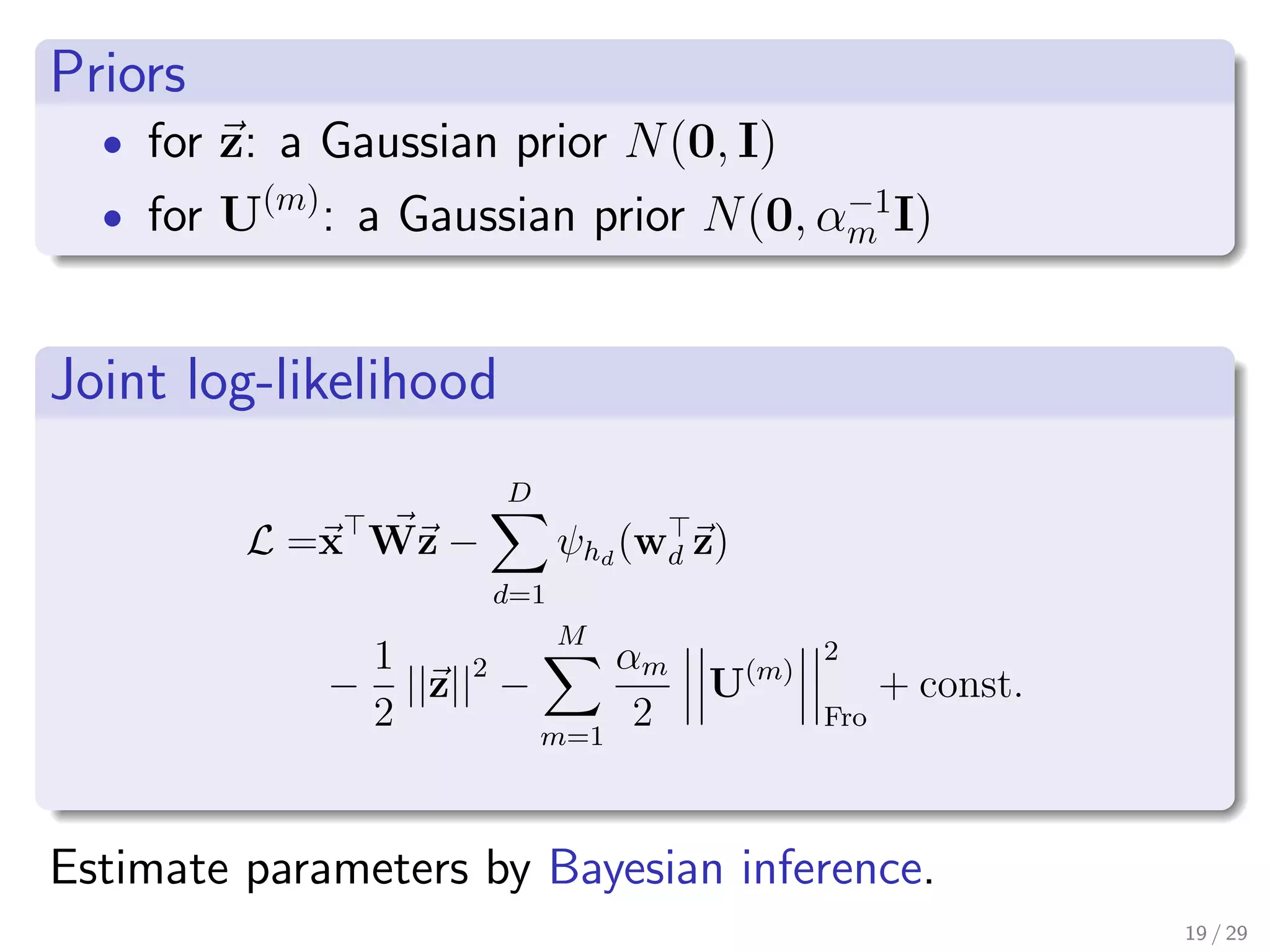
  • for z: a Gaussian prior N (0, I)
          (m)                        −1
. • for U : a Gaussian prior N (0, αm I)

.
Joint log-likelihood
.
                       D
         L =x Wz −           ψhd (wd z)
                       d=1
                             M
                 1              αm        2
             −     ||z||2 −        U(m)         + const.
                 2          m=1
                                 2        Fro

.
Estimate parameters by Bayesian inference.
                                                           19 / 29
Bayesian inference
Marginal-MAP estimator:

        argmax           exp[L(z, U(1) , . . . , U(M ) )]dz
       U(1) ,...,U(M )


  • The integral is not analytical.

Develop efficient yet accurate approximation with
Laplace approximation and Gaussian process.
  • Computational cost is still higher than Tucker
    dcomp.
  • For a long and thin tensor (e.g. time series), online
    algorithm is applicable (see thesis.)
                                                              20 / 29
Experiments


              21 / 29
Anomaly detection by ETF
    Purpose Find irregular parts of tensor data
    Method Apply distance-based outlier
            DB (p, D) [Knorr+ VLDB’00] to the estimated
            factor matrix U(m)
.
Definition of DB (p, D)
.
“An object O is a DB (p, D) outlier if at least fraction p
. the objects lies at a distance greater than D from O.”
of


                                                          22 / 29
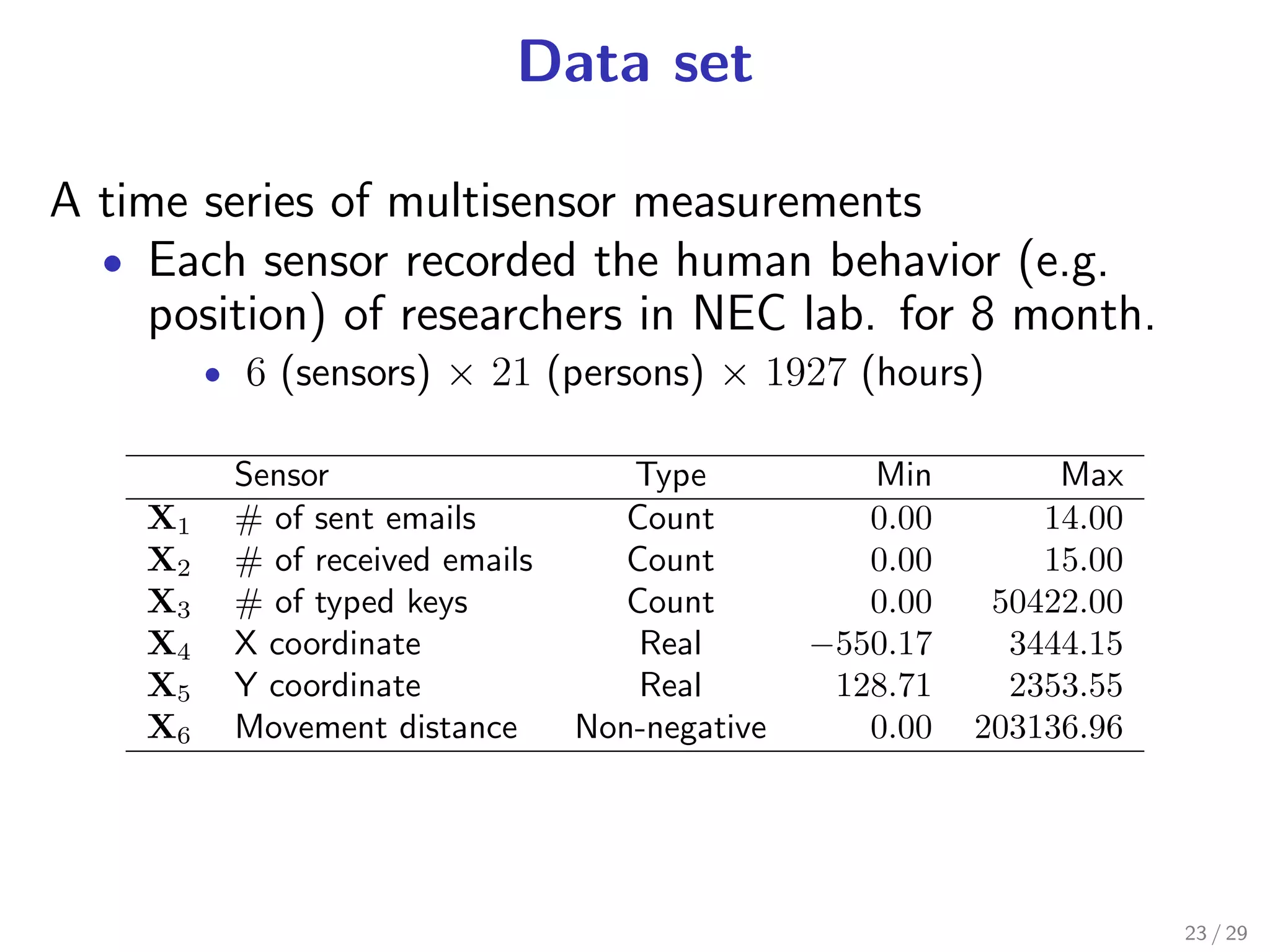
Data set

A time series of multisensor measurements
  • Each sensor recorded the human behavior (e.g.
     position) of researchers in NEC lab. for 8 month.
         • 6 (sensors) × 21 (persons) × 1927 (hours)

          Sensor                    Type           Min         Max
    X1    # of sent emails          Count          0.00       14.00
    X2    # of received emails      Count          0.00       15.00
    X3    # of typed keys           Count          0.00    50422.00
    X4    X coordinate               Real       −550.17     3444.15
    X5    Y coordinate               Real        128.71     2353.55
    X6    Movement distance      Non-negative      0.00   203136.96


                                                                      23 / 29
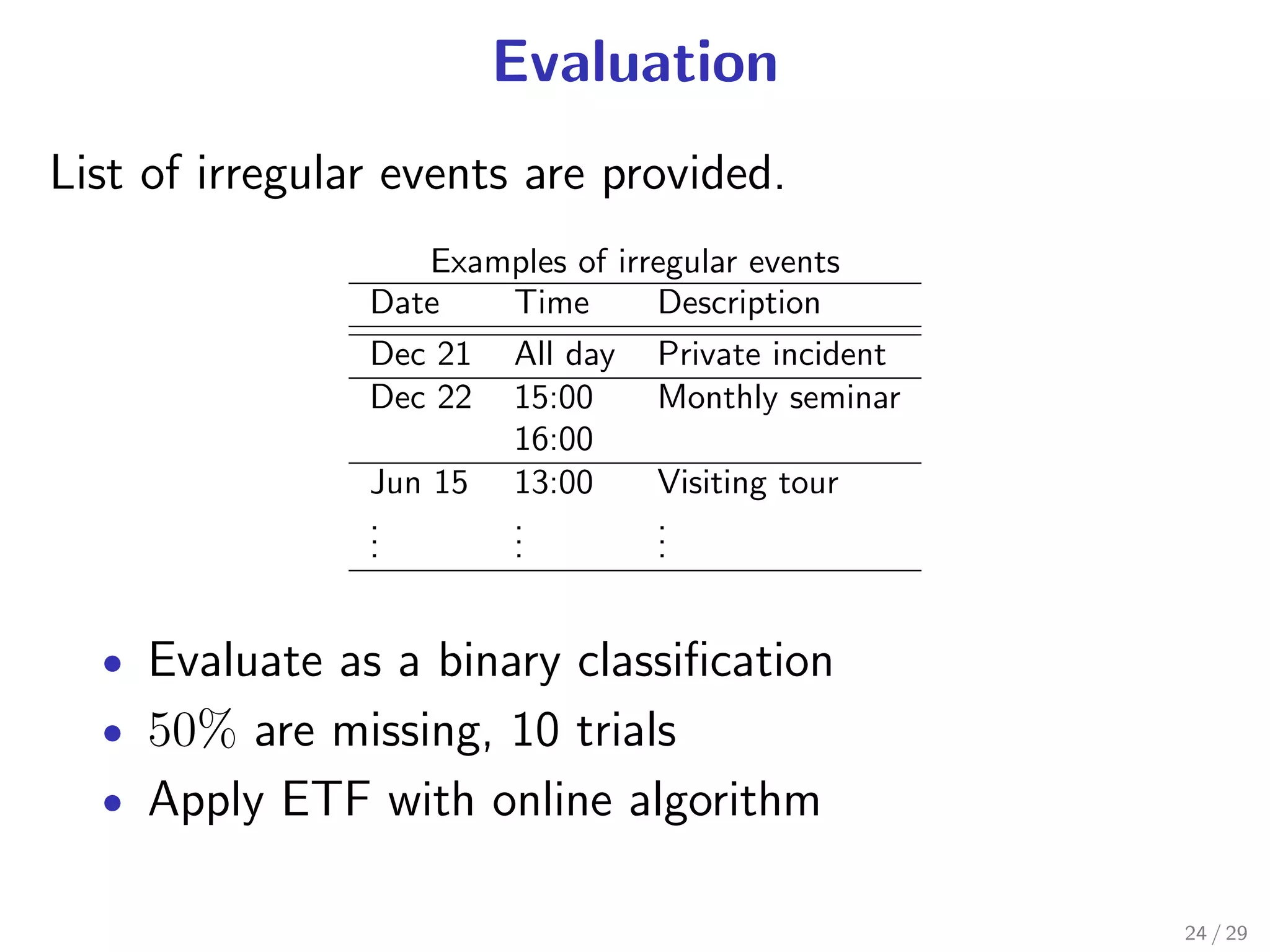
Evaluation
List of irregular events are provided.
                    Examples of irregular events
                Date    Time       Description
                Dec 21 All day Private incident
                Dec 22 15:00       Monthly seminar
                        16:00
                Jun 15 13:00       Visiting tour
                .
                .       .
                        .          .
                                   .
                .       .          .


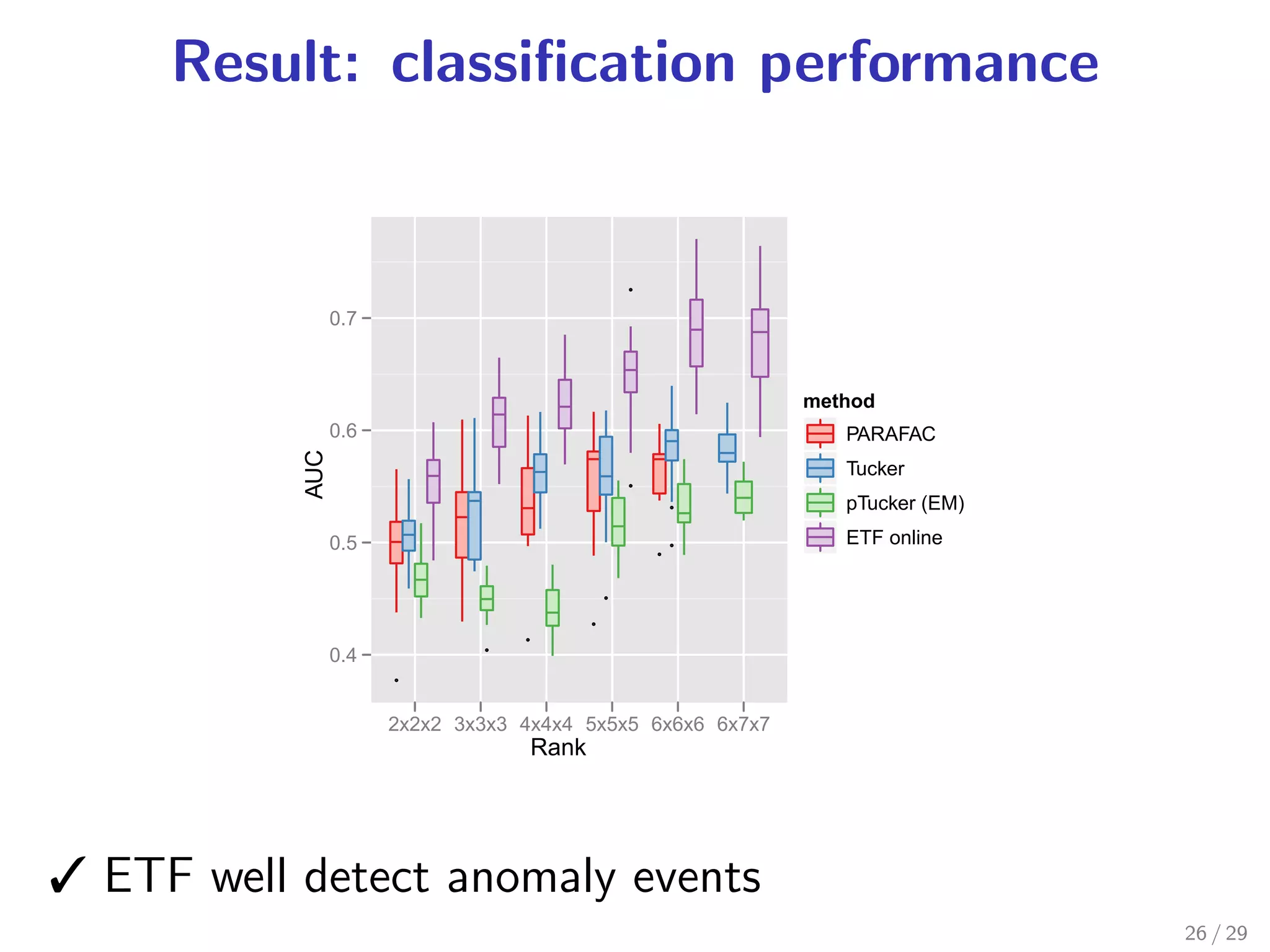
  • Evaluate as a binary classification
  • 50% are missing, 10 trials
  • Apply ETF with online algorithm


                                                     24 / 29
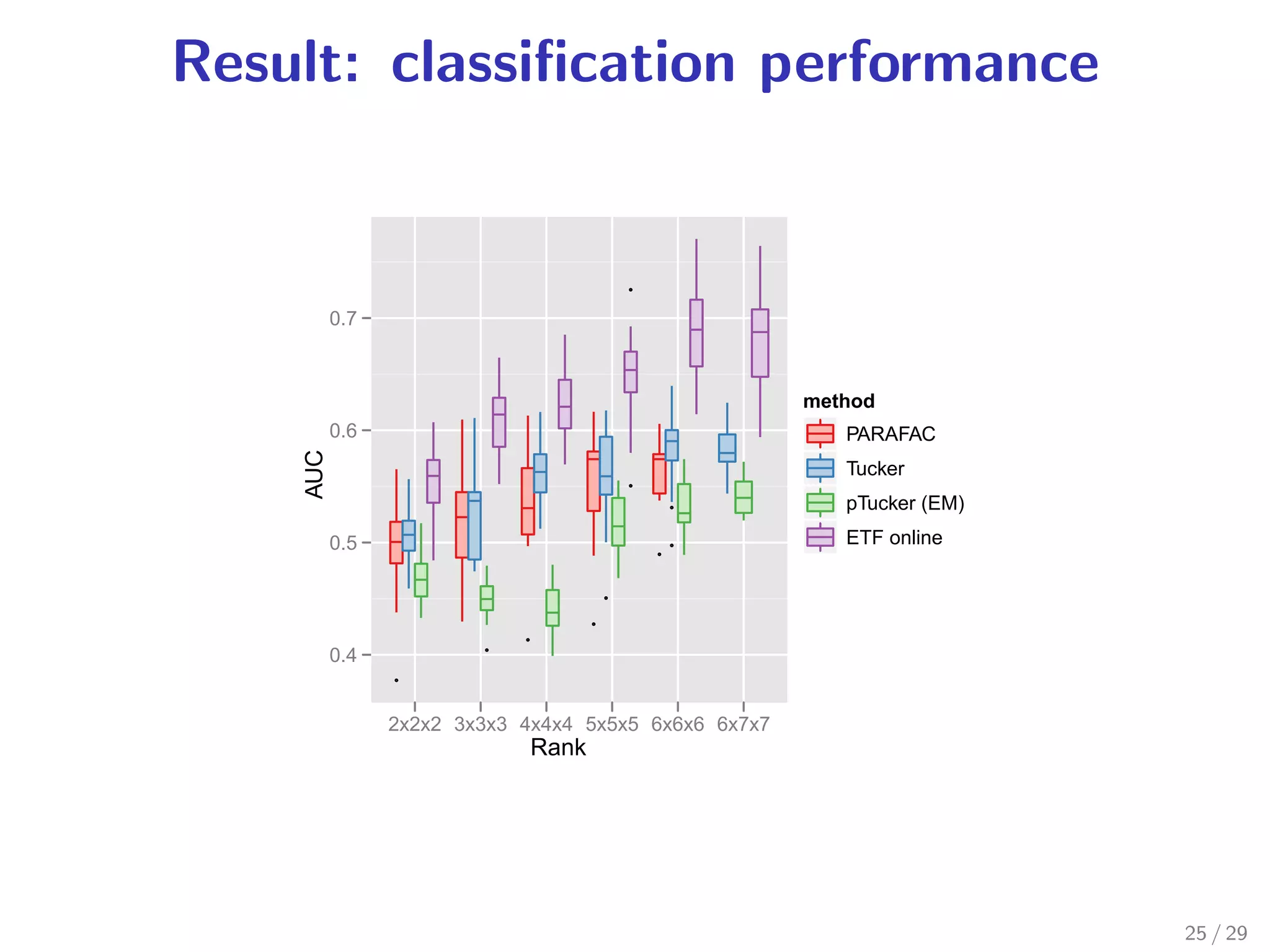
Result: classification performance


          0.7


                                                      method
          0.6                                            PARAFAC
    AUC


                                                         Tucker
                                                         pTucker (EM)

          0.5                                            ETF online


          0.4


                2x2x2 3x3x3 4x4x4 5x5x5 6x6x6 6x7x7
                             Rank


                                                                        25 / 29
Result: classification performance


                 0.7


                                                             method
                 0.6                                            PARAFAC
           AUC


                                                                Tucker
                                                                pTucker (EM)

                 0.5                                            ETF online


                 0.4


                       2x2x2 3x3x3 4x4x4 5x5x5 6x6x6 6x7x7
                                    Rank


 ETF well detect anomaly events
                                                                               26 / 29
Skip the rest


                27 / 29

Generalization of Tensor Factorization and Applications

  • 1.
    Generalization of TensorFactorization and Applications Kohei Hayashi Collaborators: T. Takenouchi, T. Shibata, Y. Kamiya, D. Kato, K. Kunieda, K. Yamada, K. Ikeda, R. Tomioka, H. Kashima May 14, 2012 1 / 29
  • 2.
    Relational data is acollection of relationships among multiple objects. relationships of pair ⇔ matrix 2 / 29
  • 3.
    Relational data is acollection of relationships among multiple objects. relationships of pair ⇔ matrix relationships of 3-tuple ⇔ 3 dim. array 3 / 29
  • 4.
    Relational data is acollection of relationships among multiple objects.  relationships of pair ⇔ matrix  relationships of 3-tuple ⇔ 3 dim. array tensor . . . .  . . can represent as a tensor with missing values. 4 / 29
  • 5.
    Issue of tensorrepresentation Tensor representation is generally high-dimensional and large-scale • e.g. 1, 000 users × 1, 000 items × 1, 000 times = total 1, 000, 000, 000 relationships Dimensional reduction techniques such as tensor factorization is used. 5 / 29
  • 6.
    Tensor factorization Tucker decomposition[Tucker 1966]: a tensor factorization method assuming 1 observation noise is Gaussian . 2 underlying tensor is low-dimensional . These assumptions are general ... but are not always true. 6 / 29
  • 7.
    Contributions Generalize Tucker decompositionand propose two new models: 1 Exponential family tensor factorization (ETF) . [Joint work with Takenouchi, Shibata, Kamiya, Kunieda, Yamada, and Ikeda] • Generalize the noise distribution. • Can handle a tensor containing mixed discrete and continuous values. 2. Full-rank tensor completion (FTC) [Joint work with Tomioka and Kashima] • Kernelize Tucker decomposition • Complete missing values without reducing the dimensionality. 7 / 29
  • 8.
    Outline 1. Tucker decomposition 2. Exponential family tensor factorization (ETF) 3. Full-rank tensor completion (FTC) 4. Conclusion 8 / 29
  • 9.
    Outline 1. Tucker decomposition 2. Exponential family tensor factorization (ETF) 3. Full-rank tensor completion (FTC) 4. Conclusion 9 / 29
  • 10.
    Tucker decomposition K1 K2 K3 (1) (2) (3) xijk = uiq ujr uks zqrs + εijk (1) q=1 r=1 s=1 • ε: i.i.d Gaussian noise 10 / 29
  • 11.
    Tucker decomposition K1 K2 K3 (1) (2) (3) xijk = uiq ujr uks zqrs + εijk (1) q=1 r=1 s=1 • ε: i.i.d Gaussian noise 11 / 29
  • 12.
    Tucker decomposition K1 K2 K3 (1) (2) (3) xijk = uiq ujr uks zqrs + εijk (1) q=1 r=1 s=1 • ε: i.i.d Gaussian noise 12 / 29
  • 13.
    Vectorized form Let x∈ RD and z ∈ RK denote vectorized X and Z, resp., then x = Wz + ε where W ≡ U(3) ⊗ U(2) ⊗ U(1) . • D ≡ D1 D2 D3 , K ≡ K1 K2 K3 • ⊗: the Kronecker product Tucker decomposition = A linear Gaussian model x ∼ N (x | Wz, σ 2 I) 13 / 29
  • 14.
    Rank of tensor Calldimensionalities of the core tensor rank of tensor . • Rank of X is (K1 , K2 , K3 ). Rank of tensor represents its complexity • low-rank tensor has less information 14 / 29
  • 15.
    Outline 1. Tucker decomposition 2. Exponential family tensor factorization (ETF) 3. Full-rank tensor completion (FTC) 4. Conclusion 15 / 29
  • 16.
    Motivation: heterogeneous tensor Tuckerdecomposition assumes Gaussian noise • not appropriate for such data 16 / 29
  • 17.
    Motivation: heterogeneous tensor Tuckerdecomposition assumes Gaussian noise • not appropriate for such data . Approach . generalize Tucker decomposition, assuming a different distribution for each element . 17 / 29
  • 18.
    Exponential family tensorfactorization . Likelihood . D x∼ Expond (xd | θd ), θ ≡ Wz d=1 exp. family Tucker decomp. . where Expon(x | θ) ≡ exp [xθ − ψ(θ) + F (x)] exponential family : a class of distributions Gaussian Poisson Bernoulli 0.4 0.7 Density Density 0.2 0.2 0.5 (θ = 0) 0.0 0.0 0.3 ψ(θ) θ2−4 −2 /2 0 2 4 exp[θ] 4 0 2 6 8 ln(10.0 0.5 1.0 1.5 −0.5 + exp[θ]) x 18 / 29
  • 19.
    . Priors . •for z: a Gaussian prior N (0, I) (m) −1 . • for U : a Gaussian prior N (0, αm I) . Joint log-likelihood . D L =x Wz − ψhd (wd z) d=1 M 1 αm 2 − ||z||2 − U(m) + const. 2 m=1 2 Fro . Estimate parameters by Bayesian inference. 19 / 29
  • 20.
    Bayesian inference Marginal-MAP estimator: argmax exp[L(z, U(1) , . . . , U(M ) )]dz U(1) ,...,U(M ) • The integral is not analytical. Develop efficient yet accurate approximation with Laplace approximation and Gaussian process. • Computational cost is still higher than Tucker dcomp. • For a long and thin tensor (e.g. time series), online algorithm is applicable (see thesis.) 20 / 29
  • 21.
    Experiments 21 / 29
  • 22.
    Anomaly detection byETF Purpose Find irregular parts of tensor data Method Apply distance-based outlier DB (p, D) [Knorr+ VLDB’00] to the estimated factor matrix U(m) . Definition of DB (p, D) . “An object O is a DB (p, D) outlier if at least fraction p . the objects lies at a distance greater than D from O.” of 22 / 29
  • 23.
    Data set A timeseries of multisensor measurements • Each sensor recorded the human behavior (e.g. position) of researchers in NEC lab. for 8 month. • 6 (sensors) × 21 (persons) × 1927 (hours) Sensor Type Min Max X1 # of sent emails Count 0.00 14.00 X2 # of received emails Count 0.00 15.00 X3 # of typed keys Count 0.00 50422.00 X4 X coordinate Real −550.17 3444.15 X5 Y coordinate Real 128.71 2353.55 X6 Movement distance Non-negative 0.00 203136.96 23 / 29
  • 24.
    Evaluation List of irregularevents are provided. Examples of irregular events Date Time Description Dec 21 All day Private incident Dec 22 15:00 Monthly seminar 16:00 Jun 15 13:00 Visiting tour . . . . . . . . . • Evaluate as a binary classification • 50% are missing, 10 trials • Apply ETF with online algorithm 24 / 29
  • 25.
    Result: classification performance 0.7 method 0.6 PARAFAC AUC Tucker pTucker (EM) 0.5 ETF online 0.4 2x2x2 3x3x3 4x4x4 5x5x5 6x6x6 6x7x7 Rank 25 / 29
  • 26.
    Result: classification performance 0.7 method 0.6 PARAFAC AUC Tucker pTucker (EM) 0.5 ETF online 0.4 2x2x2 3x3x3 4x4x4 5x5x5 6x6x6 6x7x7 Rank ETF well detect anomaly events 26 / 29
  • 27.