Sparse Representations
                                                   k


                                              Joel A. Tropp

                                    Department of Mathematics
                                    The University of Michigan
                                       jtropp@umich.edu


Research supported in part by NSF and DARPA                      1
Introduction


Sparse Representations (Numerical Analysis Seminar, NYU, 20 April 2007)   2
Systems of Linear Equations

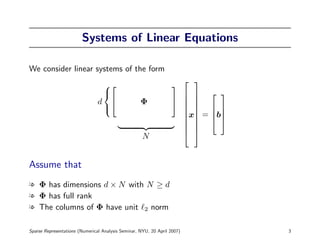
We consider linear systems of the form
                                                                           
                                                                
                                                                      
                                d                  Φ               
                                                                       
                                 
                                                                    x = b
                                                                       
                                                                     
                                                                     
                                                                     
                                                     N


Assume that
l Φ has dimensions d × N with N ≥ d
l Φ has full rank
l The columns of Φ have unit 2 norm

Sparse Representations (Numerical Analysis Seminar, NYU, 20 April 2007)         3
The Trichotomy Theorem

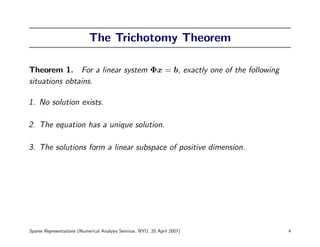
Theorem 1. For a linear system Φx = b, exactly one of the following
situations obtains.

1. No solution exists.

2. The equation has a unique solution.

3. The solutions form a linear subspace of positive dimension.


Sparse Representations (Numerical Analysis Seminar, NYU, 20 April 2007)   4
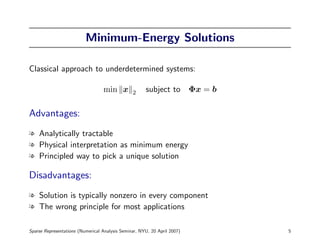
Minimum-Energy Solutions

Classical approach to underdetermined systems:

                                  min x         2     subject to Φx = b

Advantages:
l Analytically tractable
l Physical interpretation as minimum energy
l Principled way to pick a unique solution

Disadvantages:
l Solution is typically nonzero in every component
l The wrong principle for most applications

Sparse Representations (Numerical Analysis Seminar, NYU, 20 April 2007)   5
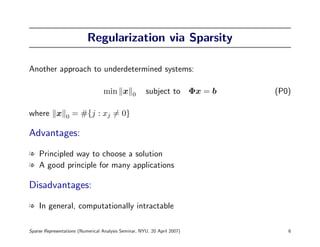
Regularization via Sparsity

Another approach to underdetermined systems:

                                  min x         0     subject to Φx = b   (P0)

where x          0   = #{j : xj = 0}

Advantages:

l Principled way to choose a solution
l A good principle for many applications

Disadvantages:

l In general, computationally intractable

Sparse Representations (Numerical Analysis Seminar, NYU, 20 April 2007)      6
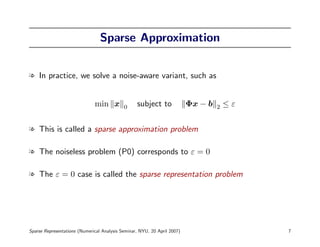
Sparse Approximation


l In practice, we solve a noise-aware variant, such as


                              min x         0     subject to              Φx − b   2   ≤ε


l This is called a sparse approximation problem

l The noiseless problem (P0) corresponds to ε = 0

l The ε = 0 case is called the sparse representation problem


Sparse Representations (Numerical Analysis Seminar, NYU, 20 April 2007)                     7
Applications


Sparse Representations (Numerical Analysis Seminar, NYU, 20 April 2007)   8
Variable Selection in Regression

l The oldest application of sparse approximation is linear regression

l The columns of Φ are explanatory variables

l The right-hand side b is the response variable

l Φx is a linear predictor of the response

l Want to use few explanatory variables

    l Reduces variance of estimator
    l Limits sensitivity to noise


Reference: [Miller 2002]

Sparse Representations (Numerical Analysis Seminar, NYU, 20 April 2007)   9
Seismic Imaging


       "In deconvolving any observed seismic trace, it is
    rather disappointing to discover that there is a
    nonzero spike at every point in time regardless of the
    data sampling rate. One might hope to find spikes only
    where real geologic discontinuities take place."


References: [Claerbout–Muir 1973]

Sparse Representations (Numerical Analysis Seminar, NYU, 20 April 2007)   10
Transform Coding

l Transform coding can be viewed as a sparse approximation problem


                                                         DCT
                                                        −−
                                                        −→


                                                         IDCT
                                                       ←−−
                                                        −−


Reference: [Daubechies–DeVore–Donoho–Vetterli 1998]

Sparse Representations (Numerical Analysis Seminar, NYU, 20 April 2007)   11
Algorithms


Sparse Representations (Numerical Analysis Seminar, NYU, 20 April 2007)   12
Sparse Representation is Hard

Theorem 2. [Davis (1994), Natarajan (1995)] Any algorithm that
can solve the sparse representation problem for every matrix and
right-hand side must solve an NP-hard problem.


Sparse Representations (Numerical Analysis Seminar, NYU, 20 April 2007)   13
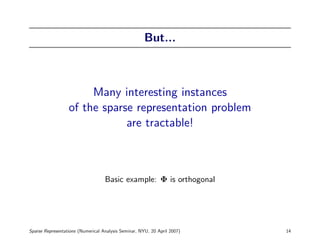
But...


                       Many interesting instances
                  of the sparse representation problem
                              are tractable!


                                   Basic example: Φ is orthogonal


Sparse Representations (Numerical Analysis Seminar, NYU, 20 April 2007)   14
Algorithms for Sparse Representation

l Greedy methods make a sequence of locally optimal choices in hope of
  determining a globally optimal solution

l Convex relaxation methods replace the combinatorial sparse
  approximation problem with a related convex program in hope that the
  solutions coincide

l Other approaches include brute force, nonlinear programming, Bayesian
  methods, dynamic programming, algebraic techniques...


Refs: [Baraniuk, Barron, Bresler, Cand`s, DeVore, Donoho, Efron, Fuchs,
                                      e
Gilbert, Golub, Hastie, Huo, Indyk, Jones, Mallat, Muthukrishnan, Rao,
Romberg, Stewart, Strauss, Tao, Temlyakov, Tewfik, Tibshirani, Willsky...]

Sparse Representations (Numerical Analysis Seminar, NYU, 20 April 2007)   15
Orthogonal Matching Pursuit (OMP)

Input: The matrix Φ, right-hand side b, and sparsity level m
Initialize the residual r0 = b
For t = 1, . . . , m do

A. Find a column most correlated with the residual:
                               ωt = arg maxj=1,...,N | rt−1, ϕj |

B. Update residual by solving a least-squares problem:
                                       yt = arg miny b − Φt y             2

                                                 rt = b − Φt yt

where Φt = [ϕω1 . . . ϕωt ]

Output: Estimate x(ωj ) = ym(j)

Sparse Representations (Numerical Analysis Seminar, NYU, 20 April 2007)       16
1   Minimization

Sparse Representation as a Combinatorial Problem

                                  min x         0     subject to Φx = b   (P0)


Relax to a Convex Program

                                  min x         1     subject to Φx = b   (P1)


l Any numerical method can be used to perform the minimization
l Projected gradient and interior-point methods seem to work best

References: [Donoho et al. 1999, Figueredo et al. 2007]

Sparse Representations (Numerical Analysis Seminar, NYU, 20 April 2007)     17
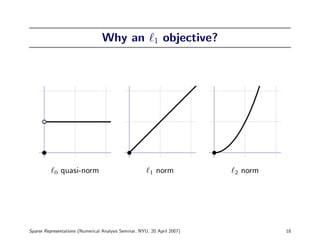
Why an                    1   objective?


           0   quasi-norm                               1   norm             2   norm


Sparse Representations (Numerical Analysis Seminar, NYU, 20 April 2007)                 18
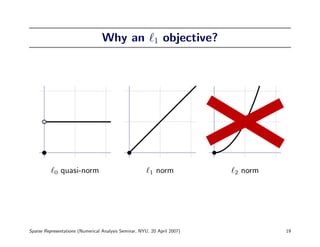
Why an                    1   objective?


           0   quasi-norm                               1   norm             2   norm


Sparse Representations (Numerical Analysis Seminar, NYU, 20 April 2007)                 19
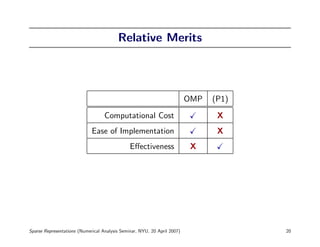
Relative Merits


                                                                          OMP   (P1)
                                   Computational Cost                            X
                             Ease of Implementation                              X
                                               Effectiveness                X


Sparse Representations (Numerical Analysis Seminar, NYU, 20 April 2007)                20
When do the
                  algorithms work?


Sparse Representations (Numerical Analysis Seminar, NYU, 20 April 2007)   21
Key Insight


                  Sparse representation is tractable
                 when the matrix Φ is sufficiently nice


                              (More precisely, column submatrices
                           of the matrix should be well conditioned)


Sparse Representations (Numerical Analysis Seminar, NYU, 20 April 2007)   22
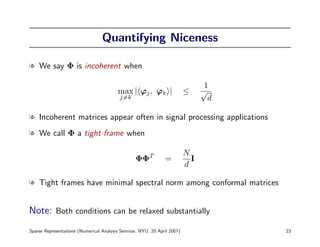
Quantifying Niceness

l We say Φ is incoherent when

                                                                                 1
                                         max | ϕj , ϕk |                  ≤     √
                                          j=k                                     d

l Incoherent matrices appear often in signal processing applications
l We call Φ a tight frame when

                                                                          N
                                                  ΦΦT          =            I
                                                                          d

l Tight frames have minimal spectral norm among conformal matrices


Note: Both conditions can be relaxed substantially
Sparse Representations (Numerical Analysis Seminar, NYU, 20 April 2007)               23
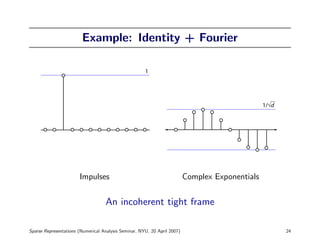
Example: Identity + Fourier

                                                      1


                                                                                                 1/√d


                       Impulses                                           Complex Exponentials


                                   An incoherent tight frame

Sparse Representations (Numerical Analysis Seminar, NYU, 20 April 2007)                                 24
Finding Sparse Solutions

Theorem 3. [T 2004] Let Φ be incoherent. Suppose that the linear
system Φx = b has a solution x that satisfies
                                                                  √
                                                             1
                                             x     0   <     2   ( d + 1).

Then the vector x is

1. the unique minimal                  0   solution to the linear system, and

2. the output of both OMP and                          1   minimization.


References: [Donoho–Huo 2001, Greed is Good, Just Relax]

Sparse Representations (Numerical Analysis Seminar, NYU, 20 April 2007)         25
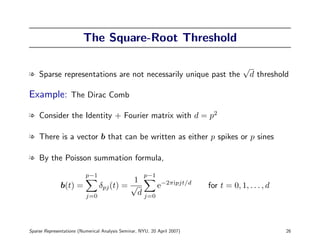
The Square-Root Threshold

                                                                                      √
l Sparse representations are not necessarily unique past the                              d threshold

Example: The Dirac Comb

l Consider the Identity + Fourier matrix with d = p2

l There is a vector b that can be written as either p spikes or p sines

l By the Poisson summation formula,
                          p−1                        p−1
                                    1
              b(t) =     δpj (t) = √       e−2πipjt/d                     for t = 0, 1, . . . , d
                     j=0
                                     d j=0


Sparse Representations (Numerical Analysis Seminar, NYU, 20 April 2007)                             26
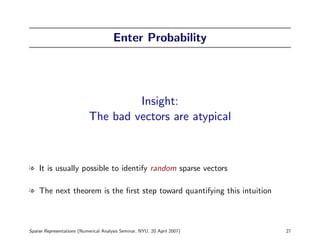
Enter Probability


                                     Insight:
                            The bad vectors are atypical


l It is usually possible to identify random sparse vectors

l The next theorem is the first step toward quantifying this intuition


Sparse Representations (Numerical Analysis Seminar, NYU, 20 April 2007)   27
Conditioning of Random Submatrices

Theorem 4. [T 2006] Let Φ be an incoherent tight frame with at least
twice as many columns as rows. Suppose that

                                                               cd
                                                   m ≤              .
                                                              log d

If A is a random m-column submatrix of Φ then

                                                                  1
                              Prob          A∗ A − I <                    ≥ 99.44%.
                                                                  2

The number c is a positive absolute constant.


Reference: [Random Subdictionaries]

Sparse Representations (Numerical Analysis Seminar, NYU, 20 April 2007)               28
Recovering Random Sparse Vectors

                                           Model (M) for b = Φx
                The matrix Φ               is an incoherent tight frame
     Nonzero entries of x                  number m ≤ cd/ log N
                                           have uniformly random positions
                                           are independent, zero-mean Gaussian RVs


Theorem 5. [T 2006] Let b = Φx be a random vector drawn according
to Model (M). Then x is
1. the unique minimal                  0   solution w.p. at least 99.44% and
2. the unique minimal                  1   solution w.p. at least 99.44%.
Reference: [Random Subdictionaries]

Sparse Representations (Numerical Analysis Seminar, NYU, 20 April 2007)              29
Methods of Proof

l Functional success criterion for OMP

l Duality results for convex optimization

l Banach algebra techniques for estimating matrix norms

l Concentration of measure inequalities

l Banach space methods for studying spectra of random matrices

    l   Decoupling of dependent random variables
    l   Symmetrization of random subset sums
    l   Noncommutative Khintchine inequalities
    l   Bounds for suprema of empirical processes

Sparse Representations (Numerical Analysis Seminar, NYU, 20 April 2007)   30
Compressive
                                      Sampling


Sparse Representations (Numerical Analysis Seminar, NYU, 20 April 2007)   31
Compressive Sampling I


l In many applications, signals of interest have sparse representations

l Traditional methods acquire entire signal, then extract information

l Sparsity can be exploited when acquiring these signals

l Want number of samples proportional to amount of information

l Approach: Introduce randomness in the sampling procedure

l Assumption: Each random sample has unit cost


Sparse Representations (Numerical Analysis Seminar, NYU, 20 April 2007)   32
Compressive Sampling II


                                                                              14.1
                                                                              –2.6
                                                                              –5.3
                                                                              10.4
                                                                               3.2
         sparse signal ( )             linear measurement process         data (b = Φx )


l Given data b = Φx, must identify sparse signal x

l This is a sparse representation problem with a random matrix


References: [Cand`s–Romberg–Tao 2004, Donoho 2004]
                 e

Sparse Representations (Numerical Analysis Seminar, NYU, 20 April 2007)                    33
Compressive Sampling and OMP

Theorem 6. [T, Gilbert 2005] Assume that

l x is a vector in RN with m nonzeros and
l Φ is a d × N Gaussian matrix with d ≥ Cm log N

l Execute OMP with b = Φx to obtain estimate x

The estimate x equals the vector x with probability at least 99.44%.


Reference: [Signal Recovery via OMP]

Sparse Representations (Numerical Analysis Seminar, NYU, 20 April 2007)   34
Compressive Sampling with                                            1   Minimization

Theorem 7. [Various] Assume that

l Φ is a d × N Gaussian matrix with d ≥ Cm log(N/m)

With probability 99.44%, the following statement holds.

l Let x be a vector in RN with m nonzeros
l Execute 1 minimization with b = Φx to obtain estimate x

The estimate x equals the vector x.


References: [Cand`s et al. 2004–2006], [Donoho et al. 2004–2006],
                 e
[Rudelson–Vershynin 2006]

Sparse Representations (Numerical Analysis Seminar, NYU, 20 April 2007)                      35
Related
                                    Directions


Sparse Representations (Numerical Analysis Seminar, NYU, 20 April 2007)   36
Sublinear Compressive Sampling


l There are algorithms that can recover sparse signals from random
  measurements in time proportional to the number of measurements

l This is an exponential speedup over OMP and                             1   minimization

l The cost is a logarithmic number of additional measurements


References: [Algorithmic dimension reduction, One sketch for all]
Joint with Gilbert, Strauss, Vershynin

Sparse Representations (Numerical Analysis Seminar, NYU, 20 April 2007)                      37
Simultaneous Sparsity


l In some applications, one seeks solutions to the matrix equation

                                                       ΦX = B

    where X has a minimal number of nonzero rows

l We have studied algorithms for this problem


References: [Simultaneous Sparse Approximation I and II ]
Joint with Gilbert, Strauss

Sparse Representations (Numerical Analysis Seminar, NYU, 20 April 2007)   38
Projective Packings


l The coherence statistic plays an important role in sparse representation

l What can we say about matrices Φ with minimal coherence?

l Equivalent to studying packing in projective space

l We have theory about when optimal packings can exist

l We have numerical algorithms for constructing packings


References: [Existence of ETFs, Constructing Structured TFs, . . . ]
Joint with Dhillon, Heath, Sra, Strohmer, Sustik

Sparse Representations (Numerical Analysis Seminar, NYU, 20 April 2007)   39
To learn more...
Web: http://www.umich.edu/~jtropp
E-mail: jtropp@umich.edu

Partial List of Papers
l   “Greed is good,” Trans. IT, 2004
l   “Constructing structured tight frames,” Trans. IT, 2005
l   “Just relax,” Trans. IT, 2006
l   “Simultaneous sparse approximation I and II,” J. Signal Process., 2006
l   “One sketch for all,” to appear, STOC 2007
l   “Existence of equiangular tight frames,” submitted, 2004
l   “Signal recovery from random measurements via OMP,” submitted, 2005
l   “Algorithmic dimension reduction,” submitted, 2006
l   “Random subdictionaries,” submitted, 2006
l   “Constructing packings in Grassmannian manifolds,” submitted, 2006

Coauthors:            Dhillon, Gilbert, Heath, Muthukrishnan, Rice DSP, Sra, Strauss,
Strohmer, Sustik, Vershynin

Sparse Representations (Numerical Analysis Seminar, NYU, 20 April 2007)                 40

Tro07 sparse-solutions-talk

  • 1.
    Sparse Representations k Joel A. Tropp Department of Mathematics The University of Michigan jtropp@umich.edu Research supported in part by NSF and DARPA 1
  • 2.
    Introduction Sparse Representations (NumericalAnalysis Seminar, NYU, 20 April 2007) 2
  • 3.
    Systems of LinearEquations We consider linear systems of the form          d  Φ         x = b           N Assume that l Φ has dimensions d × N with N ≥ d l Φ has full rank l The columns of Φ have unit 2 norm Sparse Representations (Numerical Analysis Seminar, NYU, 20 April 2007) 3
  • 4.
    The Trichotomy Theorem Theorem1. For a linear system Φx = b, exactly one of the following situations obtains. 1. No solution exists. 2. The equation has a unique solution. 3. The solutions form a linear subspace of positive dimension. Sparse Representations (Numerical Analysis Seminar, NYU, 20 April 2007) 4
  • 5.
    Minimum-Energy Solutions Classical approachto underdetermined systems: min x 2 subject to Φx = b Advantages: l Analytically tractable l Physical interpretation as minimum energy l Principled way to pick a unique solution Disadvantages: l Solution is typically nonzero in every component l The wrong principle for most applications Sparse Representations (Numerical Analysis Seminar, NYU, 20 April 2007) 5
  • 6.
    Regularization via Sparsity Anotherapproach to underdetermined systems: min x 0 subject to Φx = b (P0) where x 0 = #{j : xj = 0} Advantages: l Principled way to choose a solution l A good principle for many applications Disadvantages: l In general, computationally intractable Sparse Representations (Numerical Analysis Seminar, NYU, 20 April 2007) 6
  • 7.
    Sparse Approximation l Inpractice, we solve a noise-aware variant, such as min x 0 subject to Φx − b 2 ≤ε l This is called a sparse approximation problem l The noiseless problem (P0) corresponds to ε = 0 l The ε = 0 case is called the sparse representation problem Sparse Representations (Numerical Analysis Seminar, NYU, 20 April 2007) 7
  • 8.
    Applications Sparse Representations (NumericalAnalysis Seminar, NYU, 20 April 2007) 8
  • 9.
    Variable Selection inRegression l The oldest application of sparse approximation is linear regression l The columns of Φ are explanatory variables l The right-hand side b is the response variable l Φx is a linear predictor of the response l Want to use few explanatory variables l Reduces variance of estimator l Limits sensitivity to noise Reference: [Miller 2002] Sparse Representations (Numerical Analysis Seminar, NYU, 20 April 2007) 9
  • 10.
    Seismic Imaging "In deconvolving any observed seismic trace, it is rather disappointing to discover that there is a nonzero spike at every point in time regardless of the data sampling rate. One might hope to find spikes only where real geologic discontinuities take place." References: [Claerbout–Muir 1973] Sparse Representations (Numerical Analysis Seminar, NYU, 20 April 2007) 10
  • 11.
    Transform Coding l Transformcoding can be viewed as a sparse approximation problem DCT −− −→ IDCT ←−− −− Reference: [Daubechies–DeVore–Donoho–Vetterli 1998] Sparse Representations (Numerical Analysis Seminar, NYU, 20 April 2007) 11
  • 12.
    Algorithms Sparse Representations (NumericalAnalysis Seminar, NYU, 20 April 2007) 12
  • 13.
    Sparse Representation isHard Theorem 2. [Davis (1994), Natarajan (1995)] Any algorithm that can solve the sparse representation problem for every matrix and right-hand side must solve an NP-hard problem. Sparse Representations (Numerical Analysis Seminar, NYU, 20 April 2007) 13
  • 14.
    But... Many interesting instances of the sparse representation problem are tractable! Basic example: Φ is orthogonal Sparse Representations (Numerical Analysis Seminar, NYU, 20 April 2007) 14
  • 15.
    Algorithms for SparseRepresentation l Greedy methods make a sequence of locally optimal choices in hope of determining a globally optimal solution l Convex relaxation methods replace the combinatorial sparse approximation problem with a related convex program in hope that the solutions coincide l Other approaches include brute force, nonlinear programming, Bayesian methods, dynamic programming, algebraic techniques... Refs: [Baraniuk, Barron, Bresler, Cand`s, DeVore, Donoho, Efron, Fuchs, e Gilbert, Golub, Hastie, Huo, Indyk, Jones, Mallat, Muthukrishnan, Rao, Romberg, Stewart, Strauss, Tao, Temlyakov, Tewfik, Tibshirani, Willsky...] Sparse Representations (Numerical Analysis Seminar, NYU, 20 April 2007) 15
  • 16.
    Orthogonal Matching Pursuit(OMP) Input: The matrix Φ, right-hand side b, and sparsity level m Initialize the residual r0 = b For t = 1, . . . , m do A. Find a column most correlated with the residual: ωt = arg maxj=1,...,N | rt−1, ϕj | B. Update residual by solving a least-squares problem: yt = arg miny b − Φt y 2 rt = b − Φt yt where Φt = [ϕω1 . . . ϕωt ] Output: Estimate x(ωj ) = ym(j) Sparse Representations (Numerical Analysis Seminar, NYU, 20 April 2007) 16
  • 17.
    1 Minimization Sparse Representation as a Combinatorial Problem min x 0 subject to Φx = b (P0) Relax to a Convex Program min x 1 subject to Φx = b (P1) l Any numerical method can be used to perform the minimization l Projected gradient and interior-point methods seem to work best References: [Donoho et al. 1999, Figueredo et al. 2007] Sparse Representations (Numerical Analysis Seminar, NYU, 20 April 2007) 17
  • 18.
    Why an 1 objective? 0 quasi-norm 1 norm 2 norm Sparse Representations (Numerical Analysis Seminar, NYU, 20 April 2007) 18
  • 19.
    Why an 1 objective? 0 quasi-norm 1 norm 2 norm Sparse Representations (Numerical Analysis Seminar, NYU, 20 April 2007) 19
  • 20.
    Relative Merits OMP (P1) Computational Cost X Ease of Implementation X Effectiveness X Sparse Representations (Numerical Analysis Seminar, NYU, 20 April 2007) 20
  • 21.
    When do the algorithms work? Sparse Representations (Numerical Analysis Seminar, NYU, 20 April 2007) 21
  • 22.
    Key Insight Sparse representation is tractable when the matrix Φ is sufficiently nice (More precisely, column submatrices of the matrix should be well conditioned) Sparse Representations (Numerical Analysis Seminar, NYU, 20 April 2007) 22
  • 23.
    Quantifying Niceness l Wesay Φ is incoherent when 1 max | ϕj , ϕk | ≤ √ j=k d l Incoherent matrices appear often in signal processing applications l We call Φ a tight frame when N ΦΦT = I d l Tight frames have minimal spectral norm among conformal matrices Note: Both conditions can be relaxed substantially Sparse Representations (Numerical Analysis Seminar, NYU, 20 April 2007) 23
  • 24.
    Example: Identity +Fourier 1 1/√d Impulses Complex Exponentials An incoherent tight frame Sparse Representations (Numerical Analysis Seminar, NYU, 20 April 2007) 24
  • 25.
    Finding Sparse Solutions Theorem3. [T 2004] Let Φ be incoherent. Suppose that the linear system Φx = b has a solution x that satisfies √ 1 x 0 < 2 ( d + 1). Then the vector x is 1. the unique minimal 0 solution to the linear system, and 2. the output of both OMP and 1 minimization. References: [Donoho–Huo 2001, Greed is Good, Just Relax] Sparse Representations (Numerical Analysis Seminar, NYU, 20 April 2007) 25
  • 26.
    The Square-Root Threshold √ l Sparse representations are not necessarily unique past the d threshold Example: The Dirac Comb l Consider the Identity + Fourier matrix with d = p2 l There is a vector b that can be written as either p spikes or p sines l By the Poisson summation formula, p−1 p−1 1 b(t) = δpj (t) = √ e−2πipjt/d for t = 0, 1, . . . , d j=0 d j=0 Sparse Representations (Numerical Analysis Seminar, NYU, 20 April 2007) 26
  • 27.
    Enter Probability Insight: The bad vectors are atypical l It is usually possible to identify random sparse vectors l The next theorem is the first step toward quantifying this intuition Sparse Representations (Numerical Analysis Seminar, NYU, 20 April 2007) 27
  • 28.
    Conditioning of RandomSubmatrices Theorem 4. [T 2006] Let Φ be an incoherent tight frame with at least twice as many columns as rows. Suppose that cd m ≤ . log d If A is a random m-column submatrix of Φ then 1 Prob A∗ A − I < ≥ 99.44%. 2 The number c is a positive absolute constant. Reference: [Random Subdictionaries] Sparse Representations (Numerical Analysis Seminar, NYU, 20 April 2007) 28
  • 29.
    Recovering Random SparseVectors Model (M) for b = Φx The matrix Φ is an incoherent tight frame Nonzero entries of x number m ≤ cd/ log N have uniformly random positions are independent, zero-mean Gaussian RVs Theorem 5. [T 2006] Let b = Φx be a random vector drawn according to Model (M). Then x is 1. the unique minimal 0 solution w.p. at least 99.44% and 2. the unique minimal 1 solution w.p. at least 99.44%. Reference: [Random Subdictionaries] Sparse Representations (Numerical Analysis Seminar, NYU, 20 April 2007) 29
  • 30.
    Methods of Proof lFunctional success criterion for OMP l Duality results for convex optimization l Banach algebra techniques for estimating matrix norms l Concentration of measure inequalities l Banach space methods for studying spectra of random matrices l Decoupling of dependent random variables l Symmetrization of random subset sums l Noncommutative Khintchine inequalities l Bounds for suprema of empirical processes Sparse Representations (Numerical Analysis Seminar, NYU, 20 April 2007) 30
  • 31.
    Compressive Sampling Sparse Representations (Numerical Analysis Seminar, NYU, 20 April 2007) 31
  • 32.
    Compressive Sampling I lIn many applications, signals of interest have sparse representations l Traditional methods acquire entire signal, then extract information l Sparsity can be exploited when acquiring these signals l Want number of samples proportional to amount of information l Approach: Introduce randomness in the sampling procedure l Assumption: Each random sample has unit cost Sparse Representations (Numerical Analysis Seminar, NYU, 20 April 2007) 32
  • 33.
    Compressive Sampling II 14.1 –2.6 –5.3 10.4 3.2 sparse signal ( ) linear measurement process data (b = Φx ) l Given data b = Φx, must identify sparse signal x l This is a sparse representation problem with a random matrix References: [Cand`s–Romberg–Tao 2004, Donoho 2004] e Sparse Representations (Numerical Analysis Seminar, NYU, 20 April 2007) 33
  • 34.
    Compressive Sampling andOMP Theorem 6. [T, Gilbert 2005] Assume that l x is a vector in RN with m nonzeros and l Φ is a d × N Gaussian matrix with d ≥ Cm log N l Execute OMP with b = Φx to obtain estimate x The estimate x equals the vector x with probability at least 99.44%. Reference: [Signal Recovery via OMP] Sparse Representations (Numerical Analysis Seminar, NYU, 20 April 2007) 34
  • 35.
    Compressive Sampling with 1 Minimization Theorem 7. [Various] Assume that l Φ is a d × N Gaussian matrix with d ≥ Cm log(N/m) With probability 99.44%, the following statement holds. l Let x be a vector in RN with m nonzeros l Execute 1 minimization with b = Φx to obtain estimate x The estimate x equals the vector x. References: [Cand`s et al. 2004–2006], [Donoho et al. 2004–2006], e [Rudelson–Vershynin 2006] Sparse Representations (Numerical Analysis Seminar, NYU, 20 April 2007) 35
  • 36.
    Related Directions Sparse Representations (Numerical Analysis Seminar, NYU, 20 April 2007) 36
  • 37.
    Sublinear Compressive Sampling lThere are algorithms that can recover sparse signals from random measurements in time proportional to the number of measurements l This is an exponential speedup over OMP and 1 minimization l The cost is a logarithmic number of additional measurements References: [Algorithmic dimension reduction, One sketch for all] Joint with Gilbert, Strauss, Vershynin Sparse Representations (Numerical Analysis Seminar, NYU, 20 April 2007) 37
  • 38.
    Simultaneous Sparsity l Insome applications, one seeks solutions to the matrix equation ΦX = B where X has a minimal number of nonzero rows l We have studied algorithms for this problem References: [Simultaneous Sparse Approximation I and II ] Joint with Gilbert, Strauss Sparse Representations (Numerical Analysis Seminar, NYU, 20 April 2007) 38
  • 39.
    Projective Packings l Thecoherence statistic plays an important role in sparse representation l What can we say about matrices Φ with minimal coherence? l Equivalent to studying packing in projective space l We have theory about when optimal packings can exist l We have numerical algorithms for constructing packings References: [Existence of ETFs, Constructing Structured TFs, . . . ] Joint with Dhillon, Heath, Sra, Strohmer, Sustik Sparse Representations (Numerical Analysis Seminar, NYU, 20 April 2007) 39
  • 40.
    To learn more... Web:http://www.umich.edu/~jtropp E-mail: jtropp@umich.edu Partial List of Papers l “Greed is good,” Trans. IT, 2004 l “Constructing structured tight frames,” Trans. IT, 2005 l “Just relax,” Trans. IT, 2006 l “Simultaneous sparse approximation I and II,” J. Signal Process., 2006 l “One sketch for all,” to appear, STOC 2007 l “Existence of equiangular tight frames,” submitted, 2004 l “Signal recovery from random measurements via OMP,” submitted, 2005 l “Algorithmic dimension reduction,” submitted, 2006 l “Random subdictionaries,” submitted, 2006 l “Constructing packings in Grassmannian manifolds,” submitted, 2006 Coauthors: Dhillon, Gilbert, Heath, Muthukrishnan, Rice DSP, Sra, Strauss, Strohmer, Sustik, Vershynin Sparse Representations (Numerical Analysis Seminar, NYU, 20 April 2007) 40