CUBISM
CUBISM
• An early-20th-century avant-garde art
movement that revolutionized
European painting and sculpture, and
inspired related movements
in music, literature and architecture.
CUBISM
•It is considered the most influential
art movement of the 20th century.
CUBISM
•It was the first style of abstract art
which evolved at the beginning of
the 20th century in response to a
world that was changing with
unprecedented speed.
CUBISM
•It was pioneered by Georges
Braque and Pablo Picasso, joined
by Jean Metzinger, Albert Gleizes,
Robert Delaunay, Henri Le
Fauconnier, Fernand
Léger and Juan Gris.
PABLO PICASSO
• Spanish painter, sculptor,
printmaker, ceramist,
stage direction, poet, etc.
• Co-founder of the Cubism
Period
• Invention of constructed
sculpture
CUBISM
• In Cubist artwork, objects are analyzed,
broken up and reassembled in an abstracted
form—instead of depicting objects from one
viewpoint, the artist depicts the subject from a
multitude of viewpoints to represent the
subject in a greater context.
CUBISM
•Cubism spread rapidly across the
globe and in doing so evolved to
greater or lesser extent.
CUBISM
•Cubism began between 1907 and
1911.
CUBISM
•The first organized group exhibition
by Cubists took place at the Salon
des Indépendants in Paris during
the spring of 1911 in a room called
'Salle 41'
CUBISM
•Two Phases of Cubism
•Analytical Cubism (up to 1912)
•Synthetic Cubism (1912 – onwards)
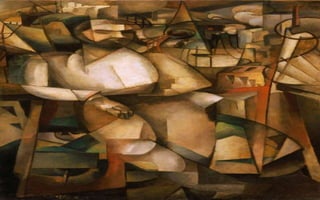
ANALYTICAL CUBISM
• The artist analyzed the subject from
many different viewpoints and
reconstructed it within a geometric
framework, the overall effect of which
was to create an image that evoked a
sense of the subject.
ANALYTICAL CUBISM
•These fragmented images were
unified by the use of a subdued and
limited palette of colours.
ANALYTICAL CUBISM
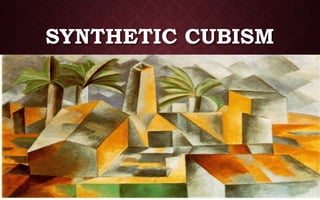
SYNTHETIC CUBISM
•It moved away from the unified
monochrome surfaces of Analytic
Cubism to a more direct, colorful
and decorative style.
SYNTHETIC CUBISM
•Although synthetic cubist images
appear more abstract in their use of
simplified forms, the other elements
of their composition are applied
quite traditionally.
SYNTHETIC CUBISM
CUBIST SCULPTURE
•Cubist sculpture developed in
parallel with Cubist painting,
beginning in Paris around 1909 with
its proto-Cubist phase, and evolving
through the early 1920s.
CUBIST SCULPTURE
• Cubist sculpture essentially is the dynamic
rendering of three-dimensional objects in the
language of non-Euclidean geometry by
shifting viewpoints of volume or mass in terms
of spherical, flat and hyperbolic surfaces.
ALEXANDER ARCHIPENKO
• Studied Egyptian and
Archaic Greek Figures
• “Most important
sculptor of his time”
CUBIST ARCHITECTURE
•Cubism formed an important link
between early-20th-century art
and architecture.
CUBIST ARCHITECTURE
• Architectural interest in Cubism centered
on the dissolution and reconstitution of
three-dimensional form, using simple
geometric shapes, juxtaposed without
the illusions of classical perspective.
CUBIST ARCHITECTURE
• There is only one country in the world
where Cubism was really applied to
architecture –
namely Bohemia (today Czech Republic)
and especially its capital, Prague.
CUBIST ARCHITECTURE
• Czech architects were the first and only
ones in the world to ever design original
Cubist buildings.
• Flourished between 1910-1914
CUBIST ARCHITECTURE
• In their theoretical rules, the Cubist architects
expressed the requirement of dynamism,
which would surmount the matter and calm
contained in it, through a creative idea, so that
the result would evoke feelings of dynamism
and expressive plasticity in the viewer.
CUBIST ARCHITECTURE

Cubism

  • 4.
  • 5.
    CUBISM • An early-20th-centuryavant-garde art movement that revolutionized European painting and sculpture, and inspired related movements in music, literature and architecture.
  • 6.
    CUBISM •It is consideredthe most influential art movement of the 20th century.
  • 7.
    CUBISM •It was thefirst style of abstract art which evolved at the beginning of the 20th century in response to a world that was changing with unprecedented speed.
  • 8.
    CUBISM •It was pioneeredby Georges Braque and Pablo Picasso, joined by Jean Metzinger, Albert Gleizes, Robert Delaunay, Henri Le Fauconnier, Fernand Léger and Juan Gris.
  • 9.
    PABLO PICASSO • Spanishpainter, sculptor, printmaker, ceramist, stage direction, poet, etc. • Co-founder of the Cubism Period • Invention of constructed sculpture
  • 10.
    CUBISM • In Cubistartwork, objects are analyzed, broken up and reassembled in an abstracted form—instead of depicting objects from one viewpoint, the artist depicts the subject from a multitude of viewpoints to represent the subject in a greater context.
  • 11.
    CUBISM •Cubism spread rapidlyacross the globe and in doing so evolved to greater or lesser extent.
  • 12.
  • 13.
    CUBISM •The first organizedgroup exhibition by Cubists took place at the Salon des Indépendants in Paris during the spring of 1911 in a room called 'Salle 41'
  • 14.
    CUBISM •Two Phases ofCubism •Analytical Cubism (up to 1912) •Synthetic Cubism (1912 – onwards)
  • 15.
    ANALYTICAL CUBISM • Theartist analyzed the subject from many different viewpoints and reconstructed it within a geometric framework, the overall effect of which was to create an image that evoked a sense of the subject.
  • 16.
    ANALYTICAL CUBISM •These fragmentedimages were unified by the use of a subdued and limited palette of colours.
  • 17.
  • 18.
    SYNTHETIC CUBISM •It movedaway from the unified monochrome surfaces of Analytic Cubism to a more direct, colorful and decorative style.
  • 19.
    SYNTHETIC CUBISM •Although syntheticcubist images appear more abstract in their use of simplified forms, the other elements of their composition are applied quite traditionally.
  • 20.
  • 21.
    CUBIST SCULPTURE •Cubist sculpturedeveloped in parallel with Cubist painting, beginning in Paris around 1909 with its proto-Cubist phase, and evolving through the early 1920s.
  • 22.
    CUBIST SCULPTURE • Cubistsculpture essentially is the dynamic rendering of three-dimensional objects in the language of non-Euclidean geometry by shifting viewpoints of volume or mass in terms of spherical, flat and hyperbolic surfaces.
  • 23.
    ALEXANDER ARCHIPENKO • StudiedEgyptian and Archaic Greek Figures • “Most important sculptor of his time”
  • 24.
    CUBIST ARCHITECTURE •Cubism formedan important link between early-20th-century art and architecture.
  • 25.
    CUBIST ARCHITECTURE • Architecturalinterest in Cubism centered on the dissolution and reconstitution of three-dimensional form, using simple geometric shapes, juxtaposed without the illusions of classical perspective.
  • 26.
    CUBIST ARCHITECTURE • Thereis only one country in the world where Cubism was really applied to architecture – namely Bohemia (today Czech Republic) and especially its capital, Prague.
  • 27.
    CUBIST ARCHITECTURE • Czecharchitects were the first and only ones in the world to ever design original Cubist buildings. • Flourished between 1910-1914
  • 28.
    CUBIST ARCHITECTURE • Intheir theoretical rules, the Cubist architects expressed the requirement of dynamism, which would surmount the matter and calm contained in it, through a creative idea, so that the result would evoke feelings of dynamism and expressive plasticity in the viewer.
  • 29.