
SUBMITTED BY: Archy Bhatt, 2501
Subject: Art Appreciation
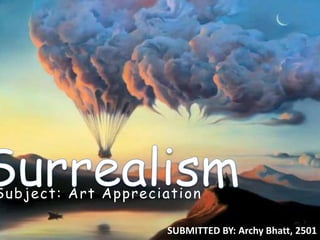
SURREALISM 1920-1965
Surrealism is a cultural movement that began in
the early 1920s, and is best known for its
visual artworks and writings.
ORIGIN
The word 'surrealist' was coined by Guillaume Apollinaire and first
appeared in the preface to his play Les Mamelles de Tirésias, which
was written in 1903.
World War I scattered the writers and artists who had been based in
Paris, and in the interim many became involved with Dada, believing
that excessive rational thought and bourgeois values had brought the
conflict of the war upon the world. The Dadaists protested with anti-
art gatherings, performances, writings and art works. After the war,
when they returned to Paris, the Dada activities continued.
During the war, André Breton, who had trained in medicine and
psychiatry, served in a neurological hospital where he used Sigmund
Freud's psychoanalytic methods with soldiers suffering from shell-shock.
Leader André Breton was explicit in his assertion that Surrealism was, above
all, a revolutionary movement.
Freud's work with free association, dream analysis, and the unconscious was of
utmost importance to the Surrealists in developing methods to liberate
imagination.
Beside the use of dream analysis, they emphasized that “one could combine
inside the same frame, elements not normally found together to produce
illogical and startling effects.”
As they developed their
philosophy, they
believed that
Surrealism would
advocate the idea that
ordinary and depictive
expressions are vital
and important, but that
the sense of their
arrangement must be
open to the full range
of imagination.
• SURREALISM could be called
“a juxtaposition of two more
or less distant realities. The
more the relationship
between the two juxtaposed
realities is distant and true,
the stronger the image will
be - the greater its emotional
power and poetic reality.“
• The group aimed to
revolutionize human
experience, in its personal,
cultural, social, and political
aspects. They wanted to free
people from false rationality,
and restrictive customs and
structures.
The main AIM was to "resolve the previously contradictory
conditions of dream and reality."
Artists painted unnerving, illogical scenes with photographic
precision, created strange creatures from everyday objects
and developed painting techniques that allowed the
unconscious to express itself.
Surrealist works feature the element of
surprise, unexpected juxtapositions and non
sequitur.
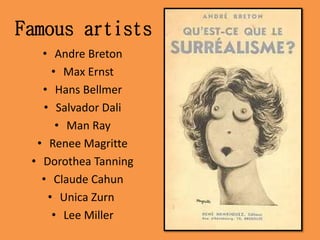
Famous artists
• Andre Breton
• Max Ernst
• Hans Bellmer
• Salvador Dali
• Man Ray
• Renee Magritte
• Dorothea Tanning
• Claude Cahun
• Unica Zurn
• Lee Miller
Two Children are
Threatened by a
Nightingale (1924)
by Max Ernst
• The combination of three-
dimensional objects with painted
canvas anticipates Ernst's pioneering
collage techniques.
• The composition is typically
Surrealist - fraught with mystery and
dream-inspired symbols: a man on a
rooftop is shown carrying a woman
away; the women on the left holds
weapons and appears to be in
distress; and Ernst claimed that the
startled nightingale referenced both
the death of his sister, and a
hallucination he experienced when
he was ill in bed. Oil on wood with painted wood elements
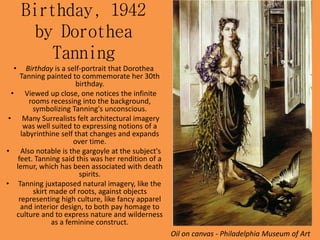
Birthday, 1942
by Dorothea
Tanning
• Birthday is a self-portrait that Dorothea
Tanning painted to commemorate her 30th
birthday.
• Viewed up close, one notices the infinite
rooms recessing into the background,
symbolizing Tanning's unconscious.
• Many Surrealists felt architectural imagery
was well suited to expressing notions of a
labyrinthine self that changes and expands
over time.
• Also notable is the gargoyle at the subject's
feet. Tanning said this was her rendition of a
lemur, which has been associated with death
spirits.
• Tanning juxtaposed natural imagery, like the
skirt made of roots, against objects
representing high culture, like fancy apparel
and interior design, to both pay homage to
culture and to express nature and wilderness
as a feminine construct.
Oil on canvas - Philadelphia Museum of Art
Surrealism

Surrealism

  • 1.
    SUBMITTED BY: ArchyBhatt, 2501 Subject: Art Appreciation
  • 2.
    SURREALISM 1920-1965 Surrealism isa cultural movement that began in the early 1920s, and is best known for its visual artworks and writings.
  • 3.
    ORIGIN The word 'surrealist'was coined by Guillaume Apollinaire and first appeared in the preface to his play Les Mamelles de Tirésias, which was written in 1903. World War I scattered the writers and artists who had been based in Paris, and in the interim many became involved with Dada, believing that excessive rational thought and bourgeois values had brought the conflict of the war upon the world. The Dadaists protested with anti- art gatherings, performances, writings and art works. After the war, when they returned to Paris, the Dada activities continued. During the war, André Breton, who had trained in medicine and psychiatry, served in a neurological hospital where he used Sigmund Freud's psychoanalytic methods with soldiers suffering from shell-shock.
  • 4.
    Leader André Bretonwas explicit in his assertion that Surrealism was, above all, a revolutionary movement. Freud's work with free association, dream analysis, and the unconscious was of utmost importance to the Surrealists in developing methods to liberate imagination. Beside the use of dream analysis, they emphasized that “one could combine inside the same frame, elements not normally found together to produce illogical and startling effects.” As they developed their philosophy, they believed that Surrealism would advocate the idea that ordinary and depictive expressions are vital and important, but that the sense of their arrangement must be open to the full range of imagination.
  • 5.
    • SURREALISM couldbe called “a juxtaposition of two more or less distant realities. The more the relationship between the two juxtaposed realities is distant and true, the stronger the image will be - the greater its emotional power and poetic reality.“ • The group aimed to revolutionize human experience, in its personal, cultural, social, and political aspects. They wanted to free people from false rationality, and restrictive customs and structures.
  • 6.
    The main AIMwas to "resolve the previously contradictory conditions of dream and reality." Artists painted unnerving, illogical scenes with photographic precision, created strange creatures from everyday objects and developed painting techniques that allowed the unconscious to express itself.
  • 7.
    Surrealist works featurethe element of surprise, unexpected juxtapositions and non sequitur.
  • 8.
    Famous artists • AndreBreton • Max Ernst • Hans Bellmer • Salvador Dali • Man Ray • Renee Magritte • Dorothea Tanning • Claude Cahun • Unica Zurn • Lee Miller
  • 9.
    Two Children are Threatenedby a Nightingale (1924) by Max Ernst • The combination of three- dimensional objects with painted canvas anticipates Ernst's pioneering collage techniques. • The composition is typically Surrealist - fraught with mystery and dream-inspired symbols: a man on a rooftop is shown carrying a woman away; the women on the left holds weapons and appears to be in distress; and Ernst claimed that the startled nightingale referenced both the death of his sister, and a hallucination he experienced when he was ill in bed. Oil on wood with painted wood elements
  • 10.
    Birthday, 1942 by Dorothea Tanning •Birthday is a self-portrait that Dorothea Tanning painted to commemorate her 30th birthday. • Viewed up close, one notices the infinite rooms recessing into the background, symbolizing Tanning's unconscious. • Many Surrealists felt architectural imagery was well suited to expressing notions of a labyrinthine self that changes and expands over time. • Also notable is the gargoyle at the subject's feet. Tanning said this was her rendition of a lemur, which has been associated with death spirits. • Tanning juxtaposed natural imagery, like the skirt made of roots, against objects representing high culture, like fancy apparel and interior design, to both pay homage to culture and to express nature and wilderness as a feminine construct. Oil on canvas - Philadelphia Museum of Art