Cubism is an early-20th-century avant-garde art movement
that revolutionized European painting and sculpture, and
inspired related movements
in music, literature and architecture.


Pablo Picasso is one of the artists who
pioneered this movement.


There are Three periods of Cubism:

Early Cubism (1908-1910)
Analytic Cubism (1910-12)
Synthetic Cubism (1912-1914)
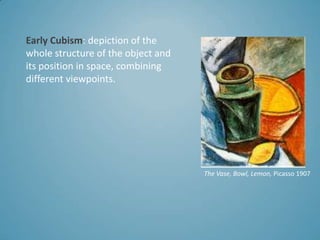
Early Cubism: depiction of the
whole structure of the object and
its position in space, combining
different viewpoints.


                                    The Vase, Bowl, Lemon, Picasso 1907
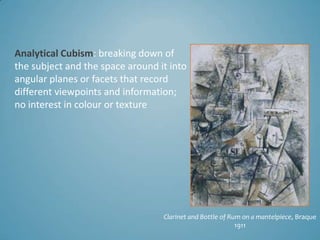
Analytical Cubism: breaking down of
the subject and the space around it into
angular planes or facets that record
different viewpoints and information;
no interest in colour or texture


                                  Clarinet and Bottle of Rum on a mantelpiece, Braque
                                                           1911
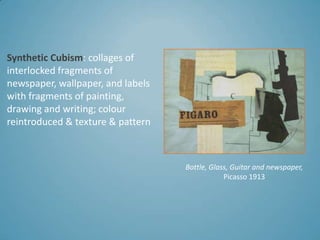
Synthetic Cubism: collages of
interlocked fragments of
newspaper, wallpaper, and labels
with fragments of painting,
drawing and writing; colour
reintroduced & texture & pattern


                                   Bottle, Glass, Guitar and newspaper,
                                               Picasso 1913
Originated by Pablo Picasso and Georges
 Braque paintings
Emphasizes flat, two-dimensional surface
Cubism rejects perspective,
   chiaroscuro(The treatment of light and shade
  in drawing and painting)

 It Contains Geometric forms without realistic detail.

Refutes art as the imitation of nature
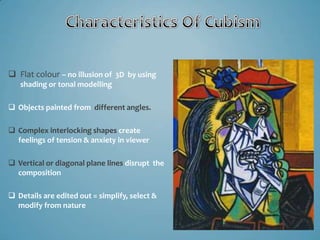
 Flat colour – no illusion of 3D by using
   shading or tonal modelling

 Objects painted from different angles.

 Complex interlocking shapes create
  feelings of tension & anxiety in viewer

 Vertical or diagonal plane lines disrupt the
  composition

 Details are edited out = simplify, select &
  modify from nature
Characteristics of Cubism:

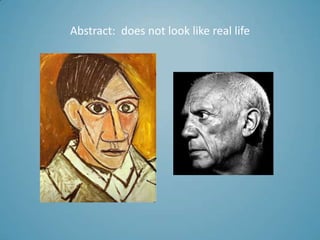
 Abstract

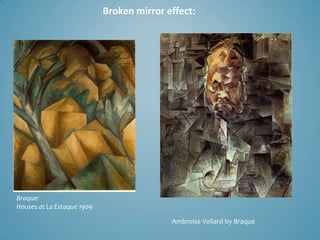
 Broken Mirror Effect

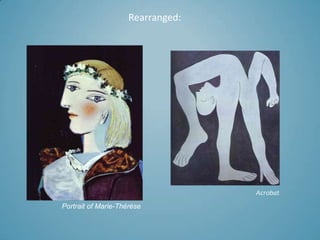
 Rearranged

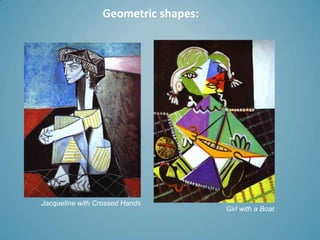
 Geometric

 More than one view

 Simplified Shapes
Abstract: does not look like real life
Broken mirror effect:


                                                           Three Musicians

Braque:
Houses at La Estaque 1909

                                           Ambroise Vollard by Braque
Rearranged:


                                   Acrobat
Portrait of Marie-Thérèse
Geometric shapes:


Jacqueline with Crossed Hands
                                     Girl with a Boat
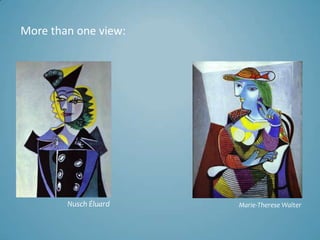
More than one view:


        Nusch Éluard   Marie-Therese Walter
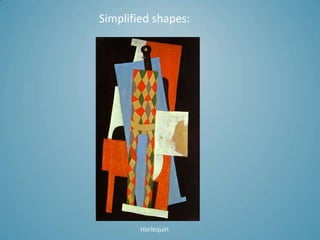
Simplified shapes:


        Harlequin
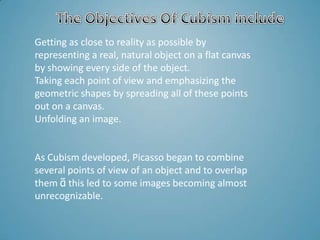
Getting as close to reality as possible by
representing a real, natural object on a flat canvas
by showing every side of the object.
Taking each point of view and emphasizing the
geometric shapes by spreading all of these points
out on a canvas.
Unfolding an image.


As Cubism developed, Picasso began to combine
several points of view of an object and to overlap
them ᾶ this led to some images becoming almost
unrecognizable.
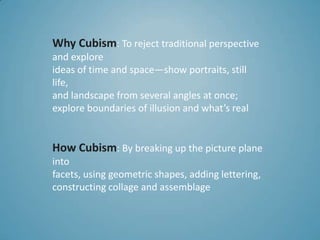
Why Cubism: To reject traditional perspective
and explore
ideas of time and space—show portraits, still
life,
and landscape from several angles at once;
explore boundaries of illusion and what’s real


How Cubism: By breaking up the picture plane
into
facets, using geometric shapes, adding lettering,
constructing collage and assemblage
Cubism

Cubism

  • 2.
    Cubism is anearly-20th-century avant-garde art movement that revolutionized European painting and sculpture, and inspired related movements in music, literature and architecture. Pablo Picasso is one of the artists who pioneered this movement. There are Three periods of Cubism: Early Cubism (1908-1910) Analytic Cubism (1910-12) Synthetic Cubism (1912-1914)
  • 3.
    Early Cubism: depictionof the whole structure of the object and its position in space, combining different viewpoints. The Vase, Bowl, Lemon, Picasso 1907
  • 4.
    Analytical Cubism: breakingdown of the subject and the space around it into angular planes or facets that record different viewpoints and information; no interest in colour or texture Clarinet and Bottle of Rum on a mantelpiece, Braque 1911
  • 5.
    Synthetic Cubism: collagesof interlocked fragments of newspaper, wallpaper, and labels with fragments of painting, drawing and writing; colour reintroduced & texture & pattern Bottle, Glass, Guitar and newspaper, Picasso 1913
  • 6.
    Originated by PabloPicasso and Georges Braque paintings Emphasizes flat, two-dimensional surface Cubism rejects perspective, chiaroscuro(The treatment of light and shade in drawing and painting)  It Contains Geometric forms without realistic detail. Refutes art as the imitation of nature
  • 7.
     Flat colour– no illusion of 3D by using shading or tonal modelling  Objects painted from different angles.  Complex interlocking shapes create feelings of tension & anxiety in viewer  Vertical or diagonal plane lines disrupt the composition  Details are edited out = simplify, select & modify from nature
  • 8.
    Characteristics of Cubism: Abstract  Broken Mirror Effect  Rearranged  Geometric  More than one view  Simplified Shapes
  • 9.
    Abstract: does notlook like real life
  • 10.
    Broken mirror effect: Three Musicians Braque: Houses at La Estaque 1909 Ambroise Vollard by Braque
  • 11.
    Rearranged: Acrobat Portrait of Marie-Thérèse
  • 12.
    Geometric shapes: Jacqueline withCrossed Hands Girl with a Boat
  • 13.
    More than oneview: Nusch Éluard Marie-Therese Walter
  • 14.
  • 15.
    Getting as closeto reality as possible by representing a real, natural object on a flat canvas by showing every side of the object. Taking each point of view and emphasizing the geometric shapes by spreading all of these points out on a canvas. Unfolding an image. As Cubism developed, Picasso began to combine several points of view of an object and to overlap them ᾶ this led to some images becoming almost unrecognizable.
  • 16.
    Why Cubism: Toreject traditional perspective and explore ideas of time and space—show portraits, still life, and landscape from several angles at once; explore boundaries of illusion and what’s real How Cubism: By breaking up the picture plane into facets, using geometric shapes, adding lettering, constructing collage and assemblage