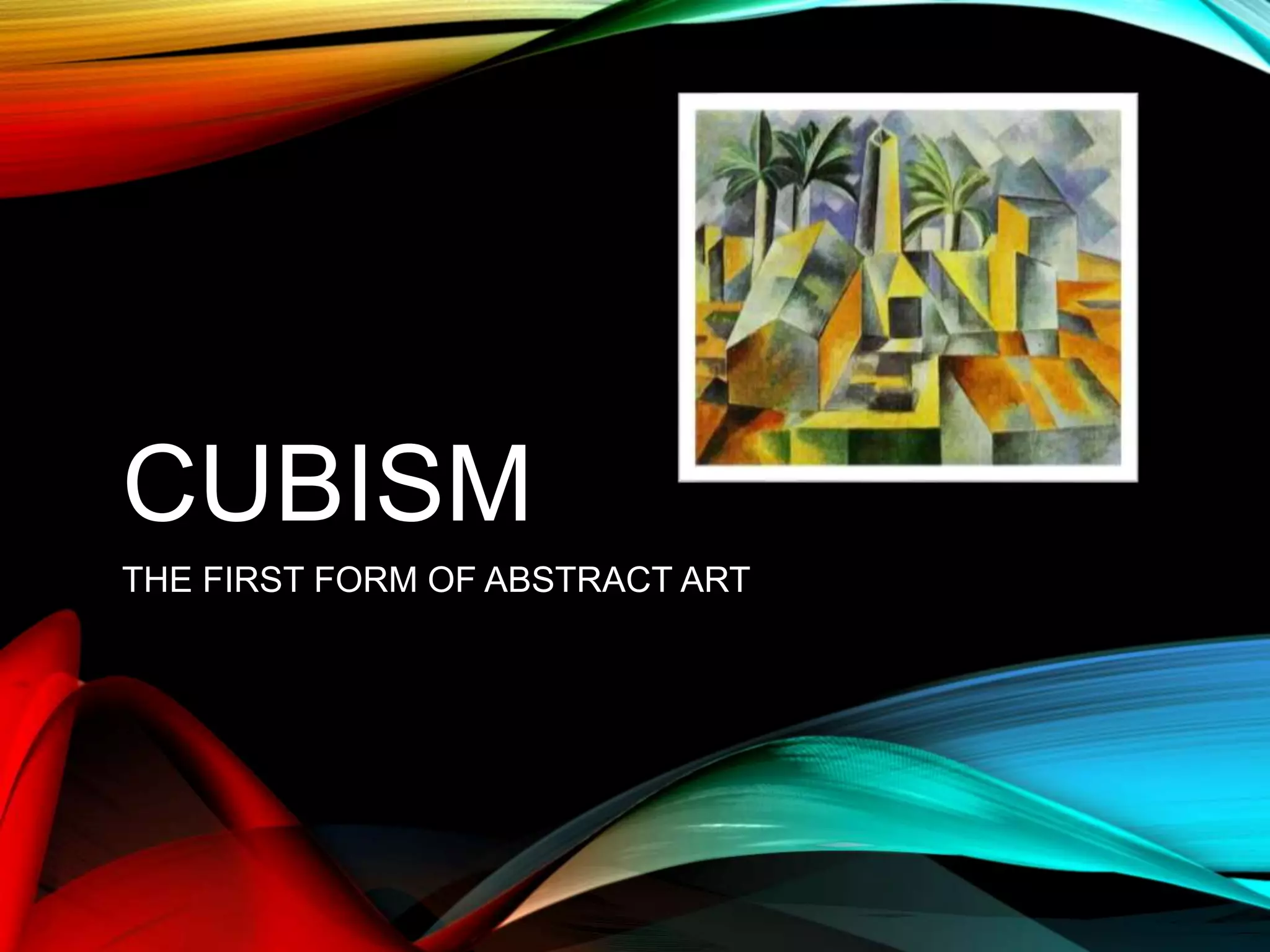
CUBISM
THE FIRST FORM OF ABSTRACT ART
INTRODUCTION TO CUBISM:
Cubism is a form
of abstract art which
emphasizes the two-
dimensionality of the
canvas.
PAUL CÉZANNE-
BIBEMUS QUARY-
1895
MORE ABOUT CUBISM:
• The Cubist art movement began in Paris around 1907. led by
Pablo Picasso and Georges Braque.
• The Cubists broke from centuries of tradition in their painting
by rejecting the single viewpoint.
• The name Cubism derived its name from remarks that were
made by the painter Henri Matisse and the critic Louis
Vauxcelles, who derisively described Braque's 1908 work
"Houses at L‘Estaque" as composed of cubes, rejecting the
single viewpoint.
INFLUENCES ON
CUBISM:
• Paul Cézanne changed
styles and habits.
• Variations of tone and colour.
• Geometric shapes: cylinder,
sphere, cone.
• “My one and only master...
Cézanne was like the father
of us all.” - Pablo Picasso.
The Guitar Player – Pablo Picasso –
CHARACTERISTICS:
- Objects are shown from
multiple perspectives at
once.
- Everything is portrayed with
geometric shapes.
- It portrayed a “new way of
seeing”, which, infused
observations and memories
into paintings.
TYPES OF
CUBISM:
 ANALYTICAL CUBISM
 SYNTHETIC CUBISM
ANALYTICAL CUBISM:
(Or, that period of cubism where it’s really hard to
tell what anything is, and who the artist is ! )
Characteristics of Analytical Cubism:
• Objects are “analyzed” from
many perspectives.
• Artist incorporates many (if not
all) of these perspectives in the
painting itself.
• The painting, instead of directly
showing the subject, “evokes a
sense of the subject.”
Fruit Dish-
Ace of Clubs-
George Braque-
1913.
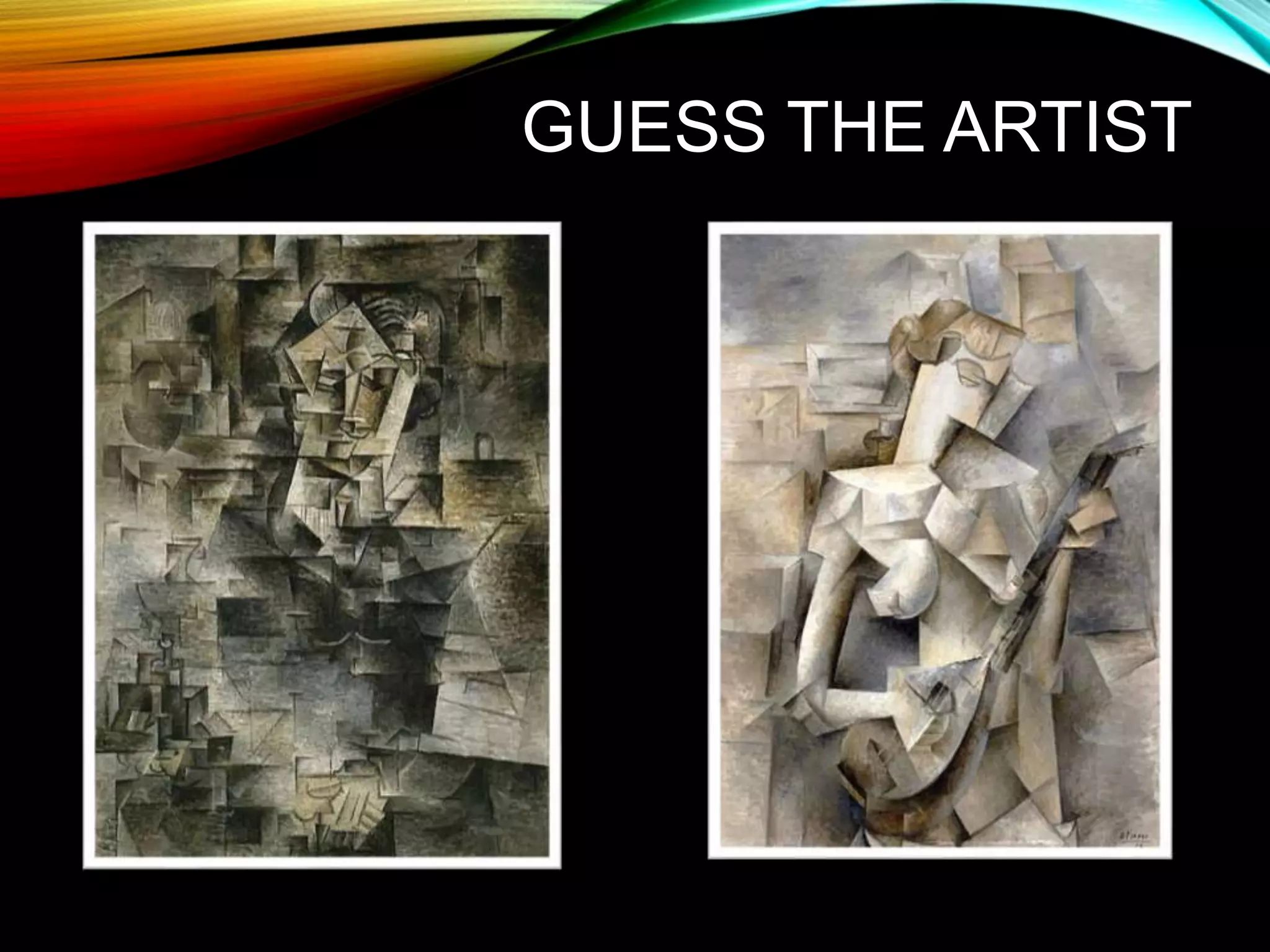
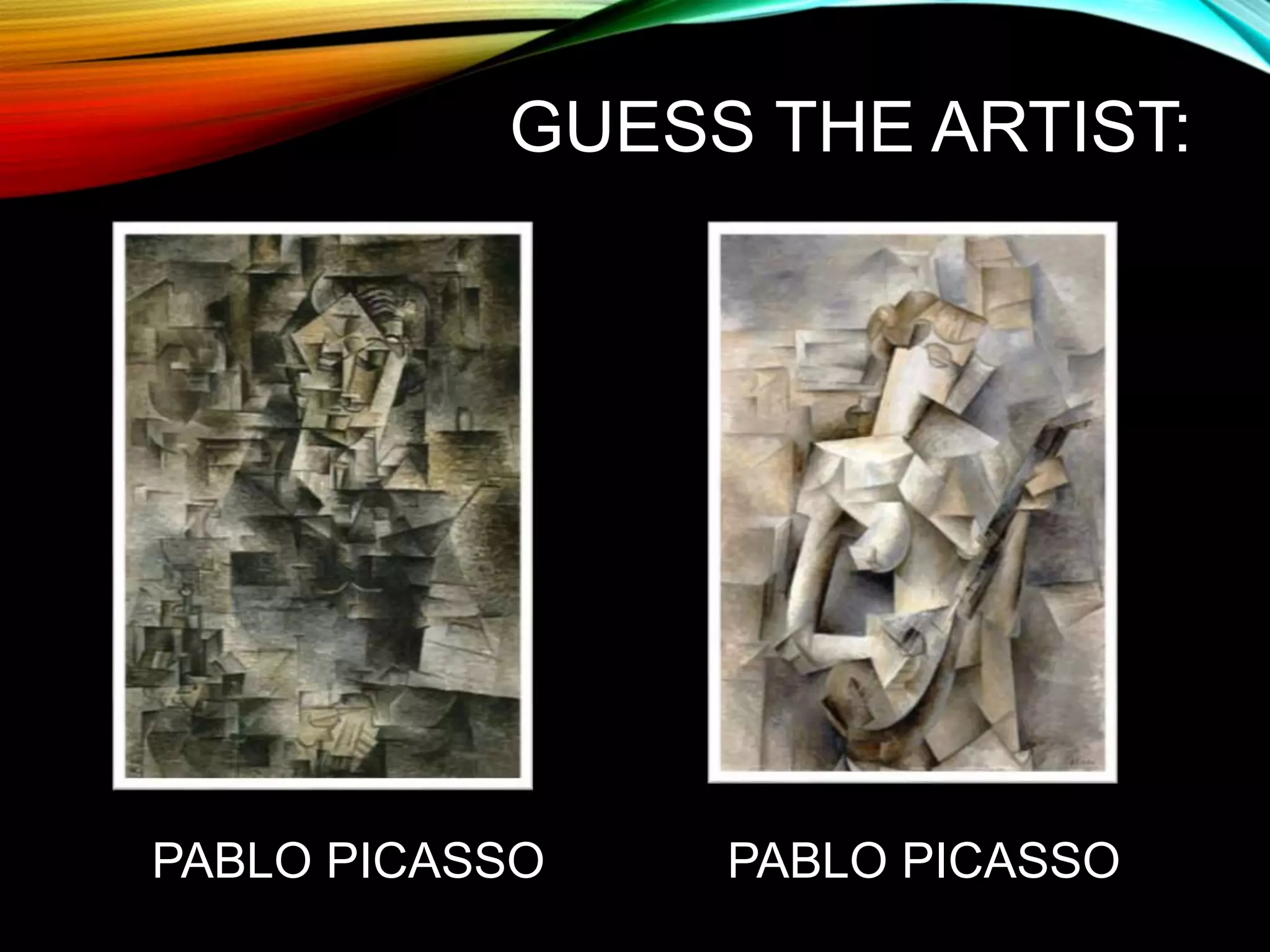
Girl with a Mandolin
Pablo Picasso –
1910
Portrait of Daniel-
Pablo Picasso –
1910.
Still Life With a
Violin – Georges
Braque – 1912
GUESS THE ARTIST
GUESS THE ARTIST:
PABLO PICASSOPABLO PICASSO
SYNTHETIC CUBISM
Characteristics of
Synthetic Cubism:
• Objects are still drawn
from multiple perspectives,
BUT…
• They are more discernable,
• And they are more colorful.
(or, thank God, I can actually tell what I’m looking
at in this painting!)
SOLDIERS PLAYING
CARDS – FERNAND
LEGER – 1917
SYNTHETIC CUBISM
BLACK FISH –
GEORGES
BRAQUE 1942
THE THREE
MUSICIANS-
PABLO
PICASSO-
1921.
CUBISM AND
ARCHITECTURE:
 It forms an important link between early 20th century art and
architecture.
 Most of the connections are made by reference to shared
formal characteristics.
 Architectural interest in cubism centred on the dissolution and
reconstitution of a 3 dimensional form, using simple
geometrical shapes.
 Diverse elements could be super imposed, made transparent
or penetrate one another.
 Cubism had become an influential factor in the development
of modern architecture from 1912.
ARCHITECTURAL
INFLUENCE
 It led to simplification of
building design, the use of
materials appropriate to
industrial production and
the increased use of glass.
 Faceting of a form,
spatial ambiguity,
transparency and
multiplicity.
Housing in Onmae by VIDZ Architects
ARCHITECTURAL
INFLUENCE
PALACE OF ASSEMBLY,
CHANDIGARH- LE CORBUSIER.
Rotterdam’s Cube Houses- Dutch
architect Piet Blom.
GUIDED BY:
 PROF. J. B. DESHMUKH (J. D. SIR)
PRESENTED BY:
 AMRUTA BEDMUTHA
 KUNAL BAGUL
 NIKITA BHOJ
 ROMA ROCHWANI
REFERENCES:
 www.google.com
 www.slideshare.in
…THANK YOU...


Cubism architectural.

  • 1.
    CUBISM THE FIRST FORMOF ABSTRACT ART
  • 2.
    INTRODUCTION TO CUBISM: Cubismis a form of abstract art which emphasizes the two- dimensionality of the canvas. PAUL CÉZANNE- BIBEMUS QUARY- 1895
  • 3.
    MORE ABOUT CUBISM: •The Cubist art movement began in Paris around 1907. led by Pablo Picasso and Georges Braque. • The Cubists broke from centuries of tradition in their painting by rejecting the single viewpoint. • The name Cubism derived its name from remarks that were made by the painter Henri Matisse and the critic Louis Vauxcelles, who derisively described Braque's 1908 work "Houses at L‘Estaque" as composed of cubes, rejecting the single viewpoint.
  • 4.
    INFLUENCES ON CUBISM: • PaulCézanne changed styles and habits. • Variations of tone and colour. • Geometric shapes: cylinder, sphere, cone. • “My one and only master... Cézanne was like the father of us all.” - Pablo Picasso. The Guitar Player – Pablo Picasso –
  • 5.
    CHARACTERISTICS: - Objects areshown from multiple perspectives at once. - Everything is portrayed with geometric shapes. - It portrayed a “new way of seeing”, which, infused observations and memories into paintings.
  • 6.
    TYPES OF CUBISM:  ANALYTICALCUBISM  SYNTHETIC CUBISM
  • 7.
    ANALYTICAL CUBISM: (Or, thatperiod of cubism where it’s really hard to tell what anything is, and who the artist is ! ) Characteristics of Analytical Cubism: • Objects are “analyzed” from many perspectives. • Artist incorporates many (if not all) of these perspectives in the painting itself. • The painting, instead of directly showing the subject, “evokes a sense of the subject.”
  • 8.
    Fruit Dish- Ace ofClubs- George Braque- 1913.
  • 9.
    Girl with aMandolin Pablo Picasso – 1910
  • 10.
    Portrait of Daniel- PabloPicasso – 1910.
  • 11.
    Still Life Witha Violin – Georges Braque – 1912
  • 12.
  • 13.
    GUESS THE ARTIST: PABLOPICASSOPABLO PICASSO
  • 14.
    SYNTHETIC CUBISM Characteristics of SyntheticCubism: • Objects are still drawn from multiple perspectives, BUT… • They are more discernable, • And they are more colorful. (or, thank God, I can actually tell what I’m looking at in this painting!) SOLDIERS PLAYING CARDS – FERNAND LEGER – 1917
  • 15.
    SYNTHETIC CUBISM BLACK FISH– GEORGES BRAQUE 1942
  • 16.
  • 17.
    CUBISM AND ARCHITECTURE:  Itforms an important link between early 20th century art and architecture.  Most of the connections are made by reference to shared formal characteristics.  Architectural interest in cubism centred on the dissolution and reconstitution of a 3 dimensional form, using simple geometrical shapes.  Diverse elements could be super imposed, made transparent or penetrate one another.  Cubism had become an influential factor in the development of modern architecture from 1912.
  • 18.
    ARCHITECTURAL INFLUENCE  It ledto simplification of building design, the use of materials appropriate to industrial production and the increased use of glass.  Faceting of a form, spatial ambiguity, transparency and multiplicity. Housing in Onmae by VIDZ Architects
  • 19.
    ARCHITECTURAL INFLUENCE PALACE OF ASSEMBLY, CHANDIGARH-LE CORBUSIER. Rotterdam’s Cube Houses- Dutch architect Piet Blom.
  • 20.
    GUIDED BY:  PROF.J. B. DESHMUKH (J. D. SIR) PRESENTED BY:  AMRUTA BEDMUTHA  KUNAL BAGUL  NIKITA BHOJ  ROMA ROCHWANI REFERENCES:  www.google.com  www.slideshare.in
  • 21.