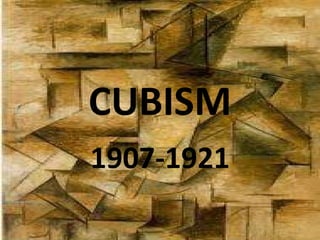
CUBISM 1907-1921
Time Period: Inventions  Assembly line was first used in production
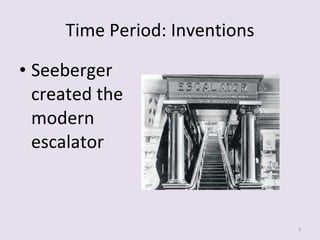
Time Period: Inventions Seeberger created the modern escalator
Time Period: Inventions First radio transmission was sent and Booth invented the vacuum cleaner
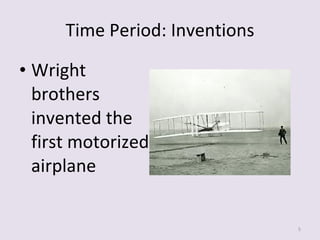
Time Period: Inventions Wright brothers invented the first motorized airplane
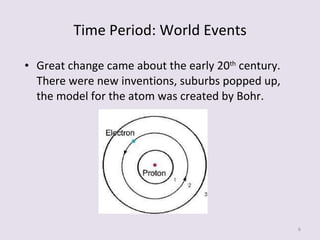
Time Period: World Events Great change came about the early 20 th  century. There were new inventions, suburbs popped up, the model for the atom was created by Bohr.
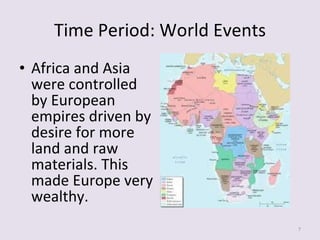
Time Period: World Events Africa and Asia  were controlled by European empires driven by desire for more land and raw materials. This made Europe very wealthy.
Time Period: World Events  The first silent movie was made and the New York Subway opened
Time Period: World Events Along with this many countries like Mexico, Russia and China demanded change bringing about revolutions.
Time Period: World Events Einstein theory explains that there is no absolute position, or speed or momentum. To find out how fast something moves or where it is we must explain our answer by comparing two objects.
Influences Fauvism was a large influence. The artists of the movement used bright colors and shapes to express themselves Cézanne was a famous fauvist painter at the time. His scenes usually involved simplifying nature. Some of his art had a great impact on cubist artists like Braque and Picasso He was fascinated by the architecture-like form of a mountain and this greatly inspired many of his nature pieces
Cézanne’s Art “ All nature is made up of the cone, the cylinder, and the sphere.”
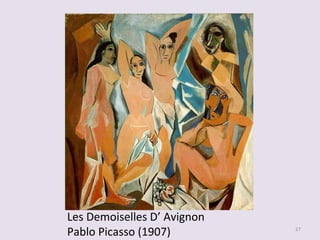
Influences A large influence for Picasso was African tribal masks He like many other cubist artists liked their bold shapes, power and energy These masks inspired him to make his first cubist piece, Les Demoiselles d’Avignon  This particular mask greatly resembles one of the women’s faces in Picasso’s first painting
Pablo Picasso (1881-1973)
Blue and Rose Period (1901-1906)
Georges Braque (1882-1963)
Fauvist Phase
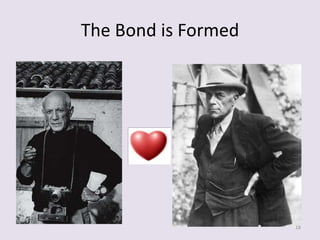
The Bond is Formed
Cubism Duo “ Picasso and I were like mountaineers roped together.”-Braque
Juan Gris (1887-1927)
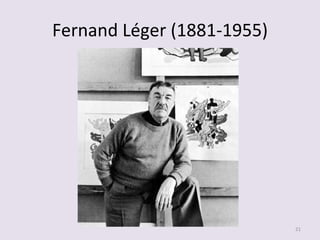
Fernand Léger (1881-1955)
Main Goal The goal for Braque and Picasso’s new movement was to create a movement that represented the nature of the modern world. They wanted to show the way people thought and felt at the time. They wanted an art form showed reality so they chose simple objects as their subjects. Thus Cubism was born.
Subject Traditional perspective abandoned More immediate surroundings/objects Still Life (many musical instruments) Simple movement, simple subjects
Style Angular, geometric shapes Less intricate Muted, distinct colors Rough lines Faceting Brighter colors later Flat objects
Early Cubism (1906-1908) Primitive Conceptual not Perceptual Flattened, angular figures De-personalization Geometric shapes
Houses at L’estaque Georges Braque (1906)
Les Demoiselles D’ Avignon Pablo Picasso (1907)
Large Nude Georges Braque (1907-08)
Three Women Pablo Picasso (1907-08)
High Cubism (1909-1913) Junction of Picasso and Braque Tried to eliminate distinctions among works Picasso tended to be more linear, angular, immediate in presentation Braque more painterly, lyrical, suave and cohesive
Still Life Violin and Pitcher Georges Braque (1910)
The Poet Pablo Picasso (1911)
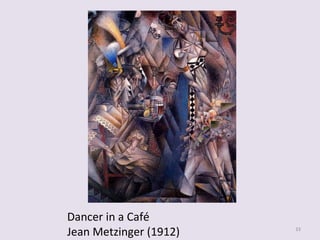
Dancer in a Café Jean Metzinger (1912)
The Wedding Leger (1911-1912)
Guitar Pablo Picasso (1912-13)
Fruit Dish, Ace of Clubs Braque (1913)
Who Made What?
Late Cubism (1914-1921) Elements of collage Added to reality of object rather than just depicting it Lightened with color Line and color serve as separate functions Less distortion of perception
Woman with a Guitar Braque (1914)
Harlequin with Guitar Juan Gris (1918)
Guitar and Clarinet Juan Gris (1920)
Materials   Cubist artists wanted to have their art emphasize the flat canvas, to depict the difference between a painting and reality Cubist artists used paint and other materials like newspaper and fabric (typically used in collages) to give the art texture Early cubist painters used dull, basic paint colors in their pieces, however, later artists like Léger used bright colored paints
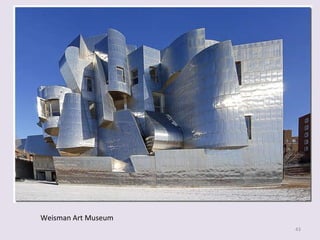
Weisman Art Museum

Cubism

  • 1.
  • 2.
    Time Period: Inventions Assembly line was first used in production
  • 3.
    Time Period: InventionsSeeberger created the modern escalator
  • 4.
    Time Period: InventionsFirst radio transmission was sent and Booth invented the vacuum cleaner
  • 5.
    Time Period: InventionsWright brothers invented the first motorized airplane
  • 6.
    Time Period: WorldEvents Great change came about the early 20 th century. There were new inventions, suburbs popped up, the model for the atom was created by Bohr.
  • 7.
    Time Period: WorldEvents Africa and Asia were controlled by European empires driven by desire for more land and raw materials. This made Europe very wealthy.
  • 8.
    Time Period: WorldEvents The first silent movie was made and the New York Subway opened
  • 9.
    Time Period: WorldEvents Along with this many countries like Mexico, Russia and China demanded change bringing about revolutions.
  • 10.
    Time Period: WorldEvents Einstein theory explains that there is no absolute position, or speed or momentum. To find out how fast something moves or where it is we must explain our answer by comparing two objects.
  • 11.
    Influences Fauvism wasa large influence. The artists of the movement used bright colors and shapes to express themselves Cézanne was a famous fauvist painter at the time. His scenes usually involved simplifying nature. Some of his art had a great impact on cubist artists like Braque and Picasso He was fascinated by the architecture-like form of a mountain and this greatly inspired many of his nature pieces
  • 12.
    Cézanne’s Art “All nature is made up of the cone, the cylinder, and the sphere.”
  • 13.
    Influences A largeinfluence for Picasso was African tribal masks He like many other cubist artists liked their bold shapes, power and energy These masks inspired him to make his first cubist piece, Les Demoiselles d’Avignon This particular mask greatly resembles one of the women’s faces in Picasso’s first painting
  • 14.
  • 15.
    Blue and RosePeriod (1901-1906)
  • 16.
  • 17.
  • 18.
  • 19.
    Cubism Duo “Picasso and I were like mountaineers roped together.”-Braque
  • 20.
  • 21.
  • 22.
    Main Goal Thegoal for Braque and Picasso’s new movement was to create a movement that represented the nature of the modern world. They wanted to show the way people thought and felt at the time. They wanted an art form showed reality so they chose simple objects as their subjects. Thus Cubism was born.
  • 23.
    Subject Traditional perspectiveabandoned More immediate surroundings/objects Still Life (many musical instruments) Simple movement, simple subjects
  • 24.
    Style Angular, geometricshapes Less intricate Muted, distinct colors Rough lines Faceting Brighter colors later Flat objects
  • 25.
    Early Cubism (1906-1908)Primitive Conceptual not Perceptual Flattened, angular figures De-personalization Geometric shapes
  • 26.
    Houses at L’estaqueGeorges Braque (1906)
  • 27.
    Les Demoiselles D’Avignon Pablo Picasso (1907)
  • 28.
    Large Nude GeorgesBraque (1907-08)
  • 29.
    Three Women PabloPicasso (1907-08)
  • 30.
    High Cubism (1909-1913)Junction of Picasso and Braque Tried to eliminate distinctions among works Picasso tended to be more linear, angular, immediate in presentation Braque more painterly, lyrical, suave and cohesive
  • 31.
    Still Life Violinand Pitcher Georges Braque (1910)
  • 32.
    The Poet PabloPicasso (1911)
  • 33.
    Dancer in aCafé Jean Metzinger (1912)
  • 34.
    The Wedding Leger(1911-1912)
  • 35.
  • 36.
    Fruit Dish, Aceof Clubs Braque (1913)
  • 37.
  • 38.
    Late Cubism (1914-1921)Elements of collage Added to reality of object rather than just depicting it Lightened with color Line and color serve as separate functions Less distortion of perception
  • 39.
    Woman with aGuitar Braque (1914)
  • 40.
    Harlequin with GuitarJuan Gris (1918)
  • 41.
    Guitar and ClarinetJuan Gris (1920)
  • 42.
    Materials Cubist artists wanted to have their art emphasize the flat canvas, to depict the difference between a painting and reality Cubist artists used paint and other materials like newspaper and fabric (typically used in collages) to give the art texture Early cubist painters used dull, basic paint colors in their pieces, however, later artists like Léger used bright colored paints
  • 43.