Cubism was a
movement that
began in France
in the early 20th
Century by
Spanish artist
Pablo Picasso
and . . .
Picasso
Cubism
Cubism was a
movement that
began in France
in the early 20th
Century by
Spanish artist
Pablo Picasso
and French artist
Georges Braque.
Picasso
Braque
Cubism
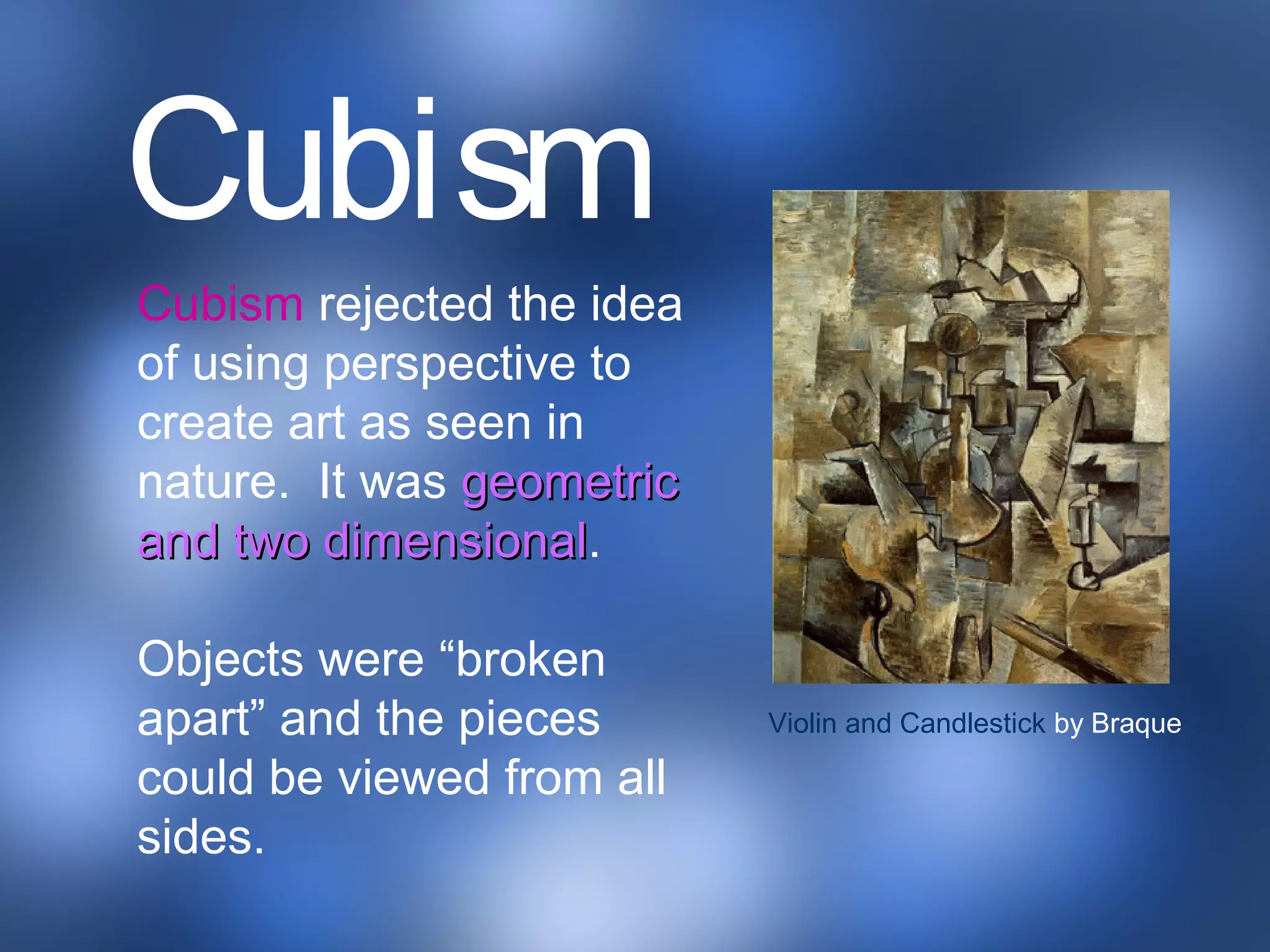
Cubism rejected the idea
of using perspective to
create art as seen in
nature. It was geometricgeometric
and two dimensionaland two dimensional.
Objects were “broken
apart” and the pieces
could be viewed from all
sides.
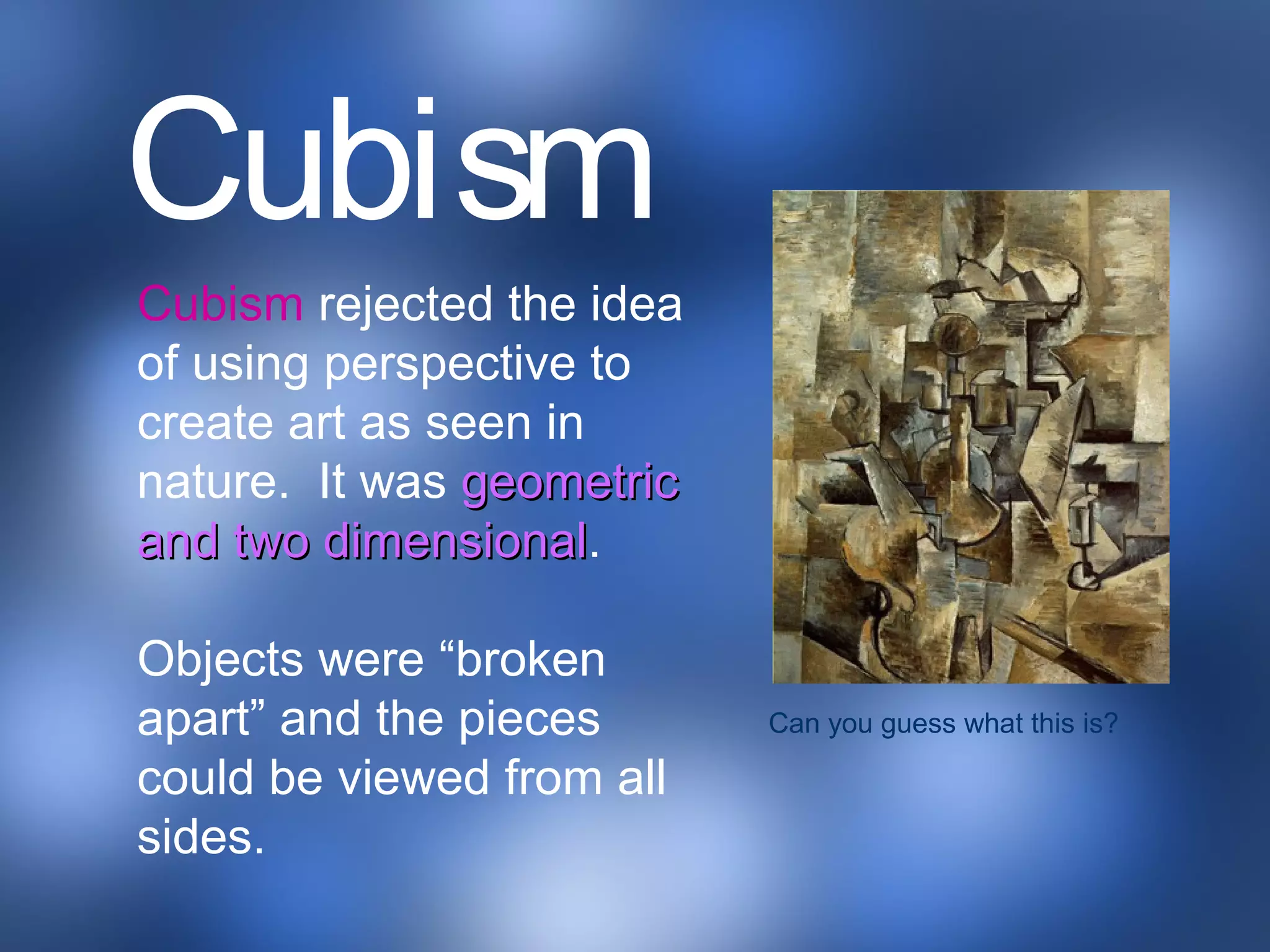
Can you guess what this is?
Cubism
Cubism rejected the idea
of using perspective to
create art as seen in
nature. It was geometricgeometric
and two dimensionaland two dimensional.
Objects were “broken
apart” and the pieces
could be viewed from all
sides.
Violin and Candlestick by Braque
Cubism
Picasso’s early work
was done in a more
traditional style.
He went through
different periods
when he created
different kinds of art.
Self Portrait by Picasso
Cubism
It is easy to see
how his portrait
changed into
more geometrical
shapes during his
work with
Cubism.
Self Portrait by Picasso
Cubism
The Old
Guitarist
is a
famous
piece
from his
Blue
Period.
The Old Guitarist by Pablo Picasso
Cubism
The Boy
with a Pipe
from his
Rose
Period, sold
for more
than $100
million!
Cubism
Picasso is
best known
for Cubism.
In some of
his pieces
objects are
geometrical
but still easily
identified.
Enamel Saucepan by Pablo Picasso
Cubism
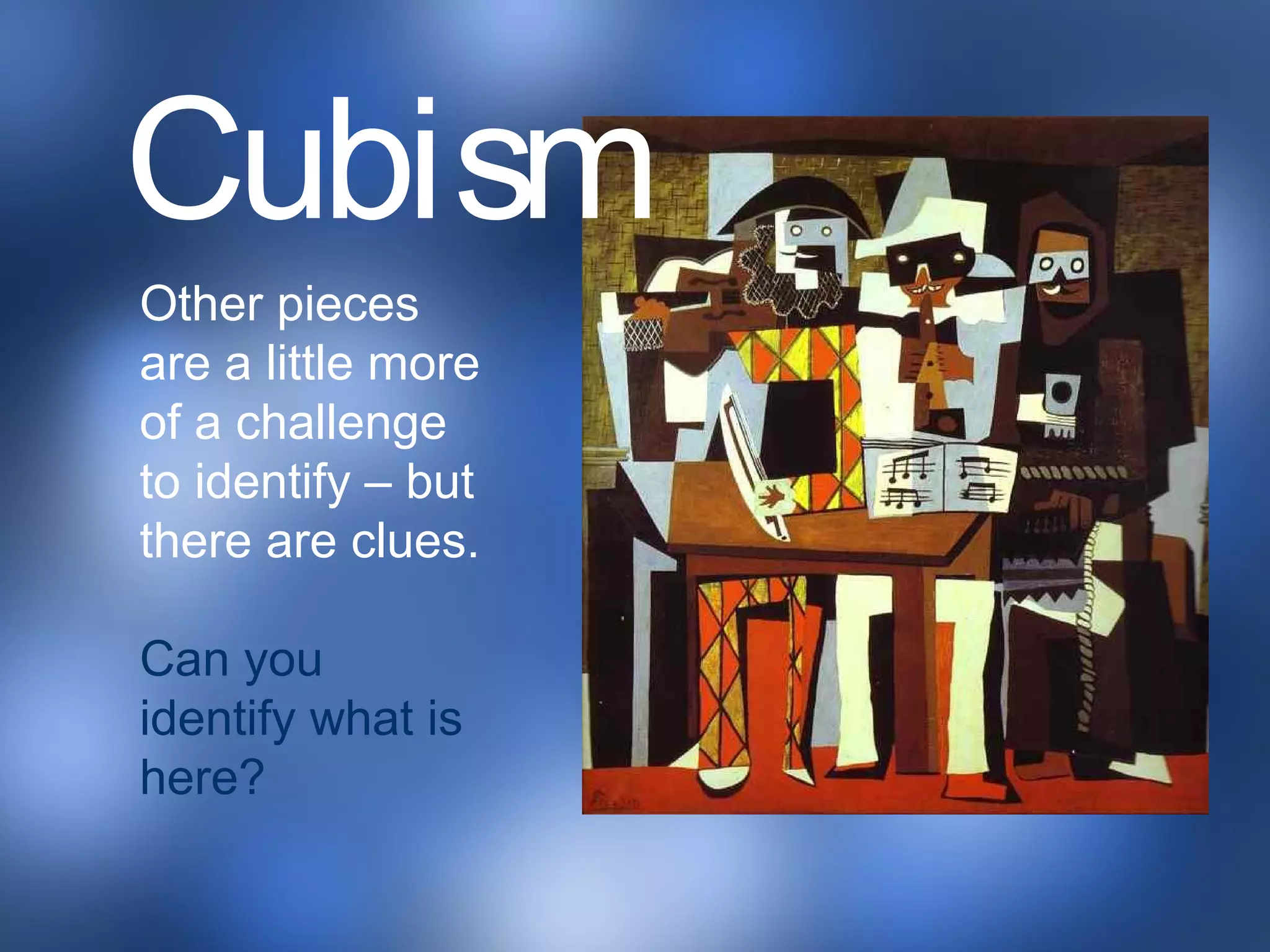
Other pieces
are a little more
of a challenge
to identify – but
there are clues.
Can you
identify what is
here?
Cubism
Other pieces
are a little more
of a challenge
to identify – but
there are clues.
Can you
identify what is
here?
Three Musicians by Pablo Picasso
Cubism
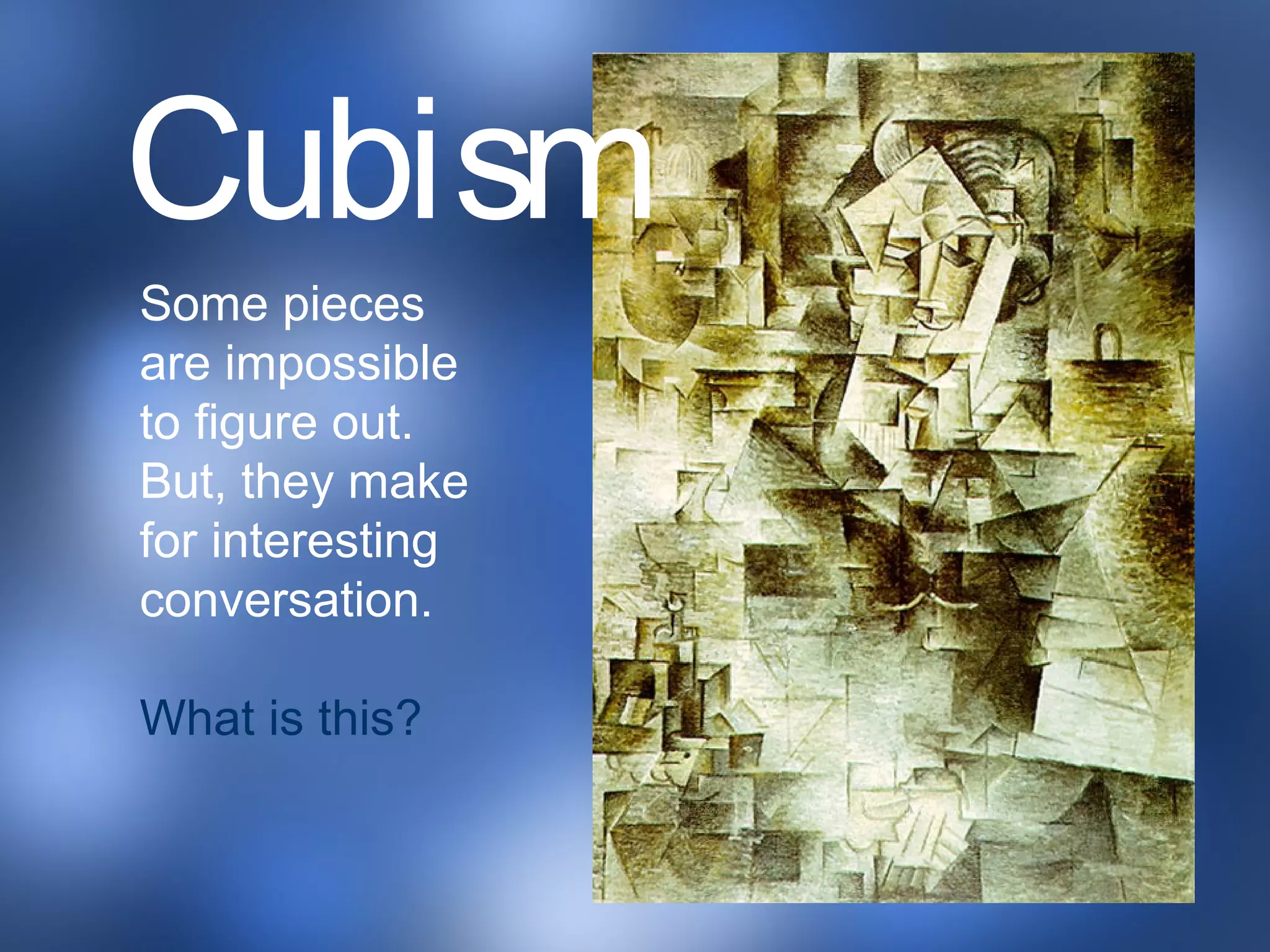
Some pieces
are impossible
to figure out.
But, they make
for interesting
conversation.
What is this?
Cubism
Some pieces
are impossible
to figure out.
But, they make
for interesting
conversation.
What is this?
A Portrait of David-Henry Kahnweiler
by Pablo Picasso
Cubism
Cubism
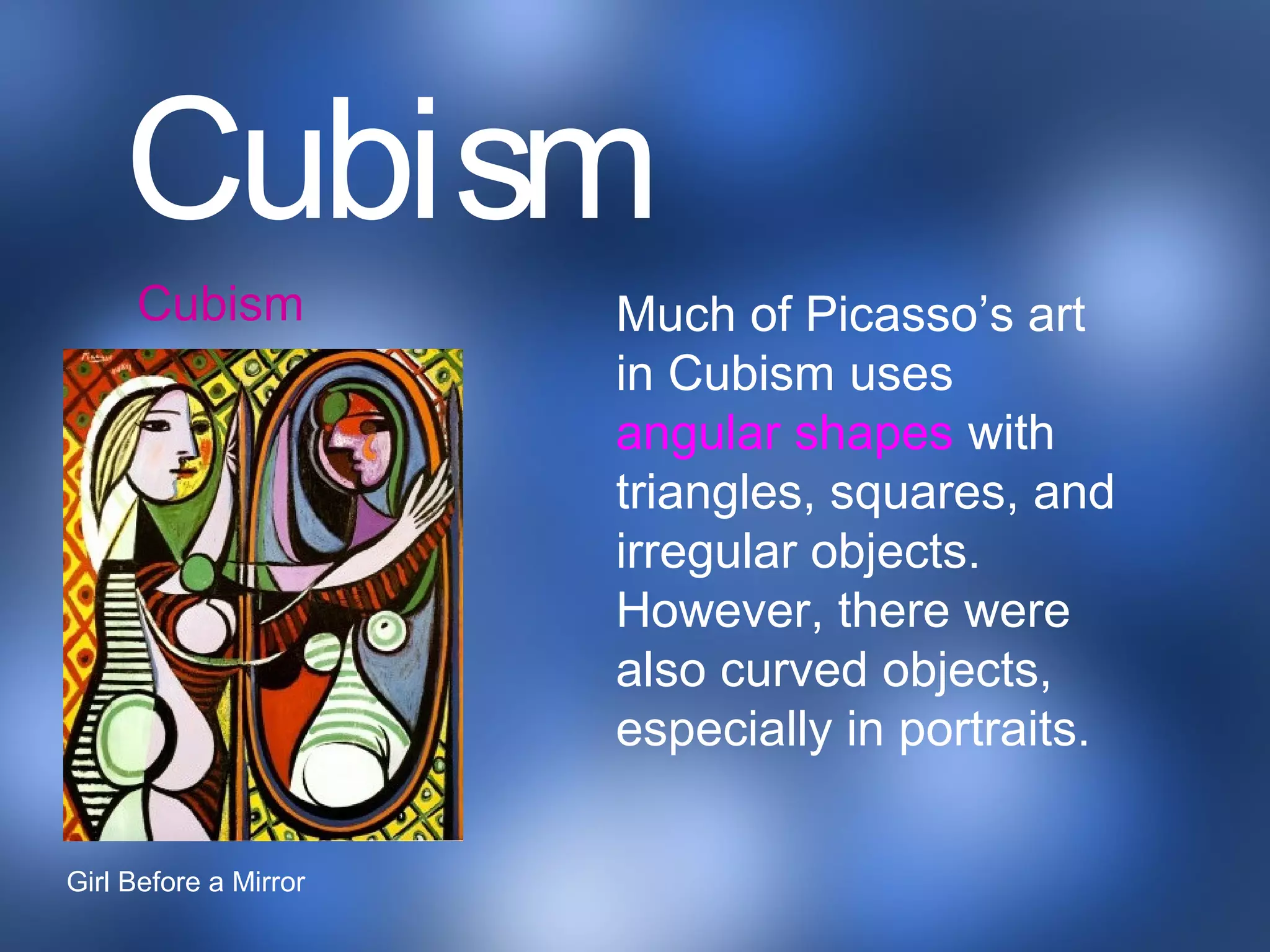
Girl Before a Mirror
Cubism
Much of Picasso’s art
in Cubism uses
angular shapes with
triangles, squares, and
irregular objects.
However, there were
also curved objects,
especially in portraits.
Cubism
Girl Before a Mirror
Cubism
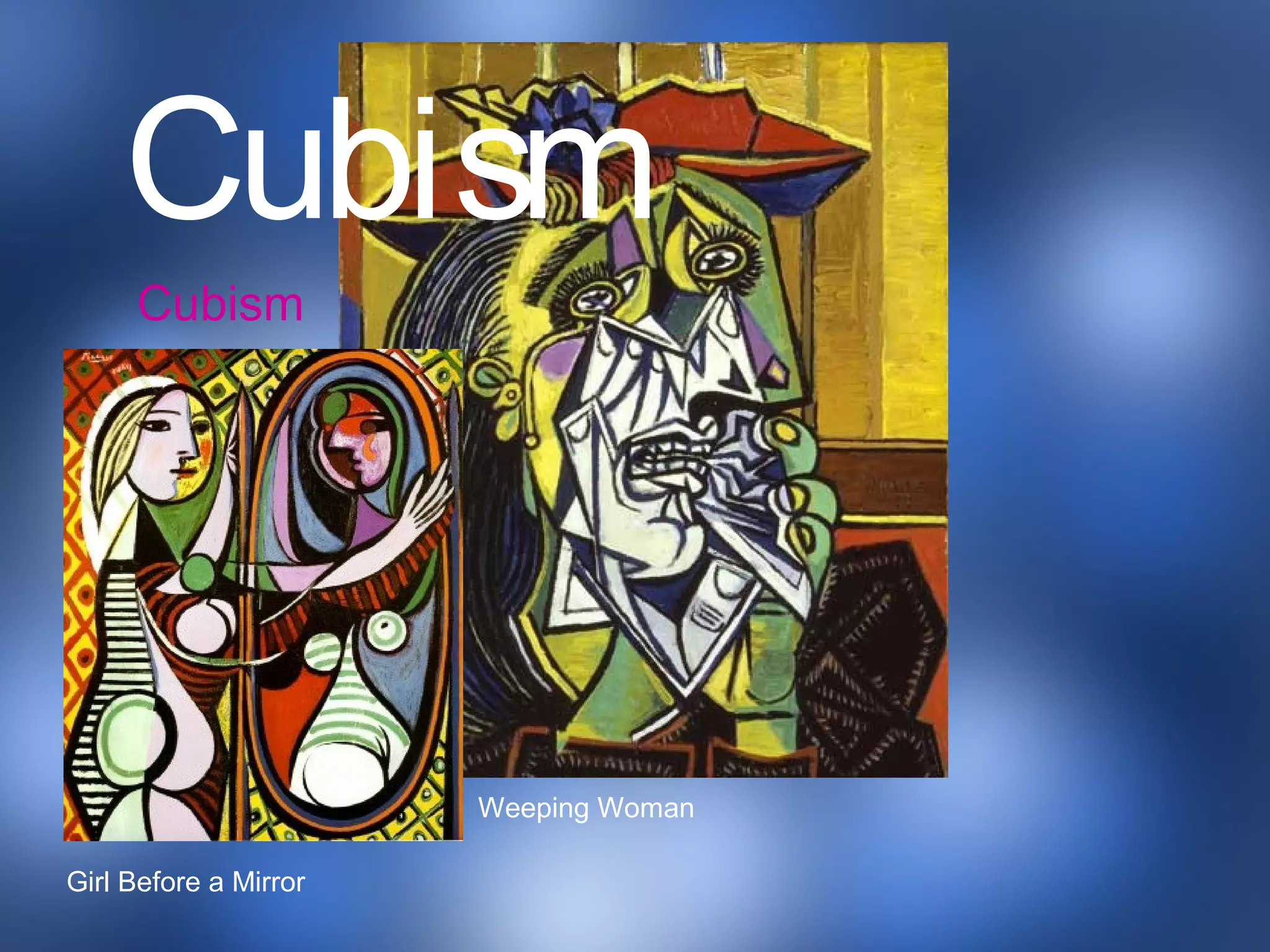
Weeping Woman
Cubism
Girl Before a Mirror
Cubism
Weeping Woman
Jacqueline with Flowers
Cubism was
popular in the
Czech Republic.
It inspired
work in
architecture
. . .
Cubism Museum
Prague,
Czech Republic
Cubism
Cubism was
popular in the
Czech Republic.
It inspired
work in
architecture,
pottery . . .
Cubism Museum
Prague,
Czech Republic
Cubism
Cubism was
popular in the
Czech Republic.
It inspired
work in
architecture,
pottery, and
furniture. Cubism Museum
Prague,
Czech Republic
Cubism
a
So now you know about Cubism in art. But, if
you want to know more, you can always
research Realism, Surrealism,
Expressionism, Constructivism,
Fauvism, Pointillism, Dadaism,
Impressionism, Mannerism,
Modernism, Post-Modernism,
Neo-Expressionism, and
Romanticism. . . for starters..
Cubism
a
For more Presentations
check these links to
phillipmartin.info and
pppst.com.
To make your own
presentations, check out
my clip art site.

Cubism

  • 1.
    Cubism was a movementthat began in France in the early 20th Century by Spanish artist Pablo Picasso and . . . Picasso Cubism
  • 2.
    Cubism was a movementthat began in France in the early 20th Century by Spanish artist Pablo Picasso and French artist Georges Braque. Picasso Braque Cubism
  • 3.
    Cubism rejected theidea of using perspective to create art as seen in nature. It was geometricgeometric and two dimensionaland two dimensional. Objects were “broken apart” and the pieces could be viewed from all sides. Can you guess what this is? Cubism
  • 4.
    Cubism rejected theidea of using perspective to create art as seen in nature. It was geometricgeometric and two dimensionaland two dimensional. Objects were “broken apart” and the pieces could be viewed from all sides. Violin and Candlestick by Braque Cubism
  • 5.
    Picasso’s early work wasdone in a more traditional style. He went through different periods when he created different kinds of art. Self Portrait by Picasso Cubism
  • 6.
    It is easyto see how his portrait changed into more geometrical shapes during his work with Cubism. Self Portrait by Picasso Cubism
  • 7.
    The Old Guitarist is a famous piece fromhis Blue Period. The Old Guitarist by Pablo Picasso Cubism
  • 8.
    The Boy with aPipe from his Rose Period, sold for more than $100 million! Cubism
  • 9.
    Picasso is best known forCubism. In some of his pieces objects are geometrical but still easily identified. Enamel Saucepan by Pablo Picasso Cubism
  • 10.
    Other pieces are alittle more of a challenge to identify – but there are clues. Can you identify what is here? Cubism
  • 11.
    Other pieces are alittle more of a challenge to identify – but there are clues. Can you identify what is here? Three Musicians by Pablo Picasso Cubism
  • 12.
    Some pieces are impossible tofigure out. But, they make for interesting conversation. What is this? Cubism
  • 13.
    Some pieces are impossible tofigure out. But, they make for interesting conversation. What is this? A Portrait of David-Henry Kahnweiler by Pablo Picasso Cubism
  • 14.
    Cubism Girl Before aMirror Cubism Much of Picasso’s art in Cubism uses angular shapes with triangles, squares, and irregular objects. However, there were also curved objects, especially in portraits.
  • 15.
    Cubism Girl Before aMirror Cubism Weeping Woman
  • 16.
    Cubism Girl Before aMirror Cubism Weeping Woman Jacqueline with Flowers
  • 17.
    Cubism was popular inthe Czech Republic. It inspired work in architecture . . . Cubism Museum Prague, Czech Republic Cubism
  • 18.
    Cubism was popular inthe Czech Republic. It inspired work in architecture, pottery . . . Cubism Museum Prague, Czech Republic Cubism
  • 19.
    Cubism was popular inthe Czech Republic. It inspired work in architecture, pottery, and furniture. Cubism Museum Prague, Czech Republic Cubism
  • 20.
    a So now youknow about Cubism in art. But, if you want to know more, you can always research Realism, Surrealism, Expressionism, Constructivism, Fauvism, Pointillism, Dadaism, Impressionism, Mannerism, Modernism, Post-Modernism, Neo-Expressionism, and Romanticism. . . for starters.. Cubism
  • 21.
    a For more Presentations checkthese links to phillipmartin.info and pppst.com. To make your own presentations, check out my clip art site.