Expressioni
smBy : Michelle Ann M. Espinosa
OBJECTIVES
At the end of the lesson, students will be
able to:
• Know the definition and history of
expressionism.
• Cite the different arts and artists of
Expressionism.
• Identify some Filipino expressionist artists.
• Create an artwork based on the art
movement stated above.
Expressionism
• From 1905 - 1933
• Expressionism emerged simultaneously in
various cities across Germany as a response
to a widespread anxiety about humanity's
increasingly discordant relationship with
the world and accompanying lost feelings of
authenticity and spirituality.
The term “Expressionism”
• The term "Expressionism" is thought to have
been coined in 1910 by Czech art historian
Antonín Matějček, who intended it to denote
the opposite of Impressionism.
• Whereas the Impressionists sought to express
the majesty of nature and the human form
through paint, the Expressionists, according
to Matejcek, sought only to express inner life,
often via the painting of harsh and realistic
subject matter.
Expressionism
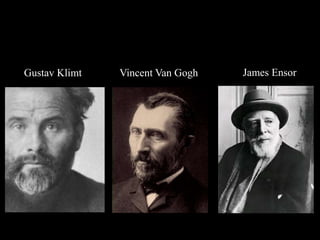
• Vincent van Gogh, Edvard Munch,
and James Ensor proved particularly
influential to the Expressionists,
encouraging the distortion of form and the
deployment of strong colors to convey a
variety of anxieties and yearnings.
Vincent Van Gogh James EnsorGustav Klimt
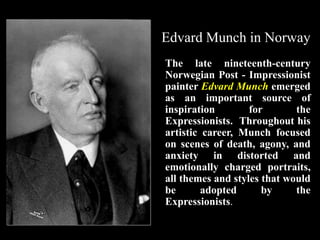
Edvard Munch in Norway
The late nineteenth-century
Norwegian Post - Impressionist
painter Edvard Munch emerged
as an important source of
inspiration for the
Expressionists. Throughout his
artistic career, Munch focused
on scenes of death, agony, and
anxiety in distorted and
emotionally charged portraits,
all themes and styles that would
be adopted by the
Expressionists.
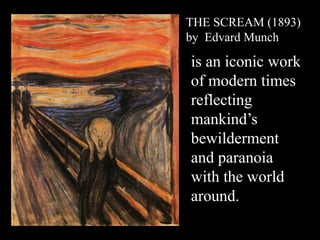
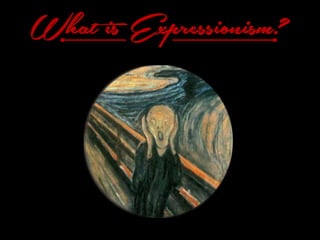
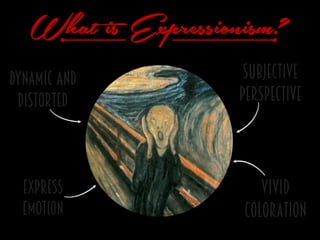
THE SCREAM (1893)
by Edvard Munch
is an iconic work
of modern times
reflecting
mankind’s
bewilderment
and paranoia
with the world
around.
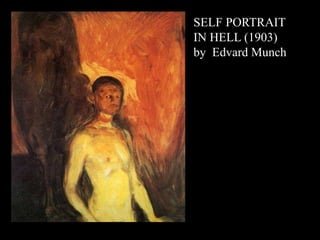
SELF PORTRAIT
IN HELL (1903)
by Edvard Munch
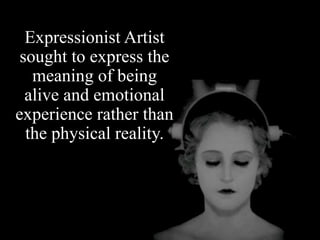
Expressionist Artist
sought to express the
meaning of being
alive and emotional
experience rather than
the physical reality.
Key Ideas
1. The arrival of Expressionism announced
new standards in the creation and judgment
of art. Art was now meant to come forth
from within the artist, rather than from a
depiction of the external visual world, and
the standard for assessing the quality of a
work of art became the character of the
artist's feelings rather than an analysis of
the composition.
Key Ideas
2. Expressionist artists often employed
swirling, swaying, and exaggeratedly
executed brushstrokes in the depiction of
their subjects. These techniques were meant
to convey the turgid emotional state of the
artist reacting to the anxieties of the modern
world.
Key Ideas
3. Through their confrontation with the urban world
of the early twentieth century, Expressionist
artists developed a powerful mode of social
criticism in their serpentine figural renderings and
bold colors.
Their representations of the modern city included
alienated individuals (a psychological by-product
of recent urbanization) as well as prostitutes, who
were used to comment on capitalism's role in the
emotional distancing of individuals within cities.
Important Art
and
Artists of Expressionism
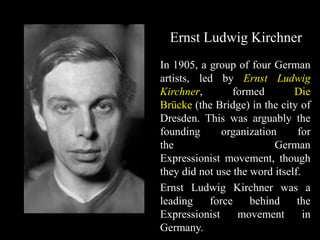
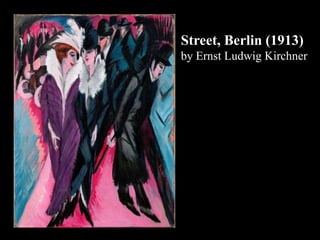
Ernst Ludwig Kirchner
In 1905, a group of four German
artists, led by Ernst Ludwig
Kirchner, formed Die
Brücke (the Bridge) in the city of
Dresden. This was arguably the
founding organization for
the German
Expressionist movement, though
they did not use the word itself.
Ernst Ludwig Kirchner was a
leading force behind the
Expressionist movement in
Germany.
Street, Berlin (1913)
by Ernst Ludwig Kirchner
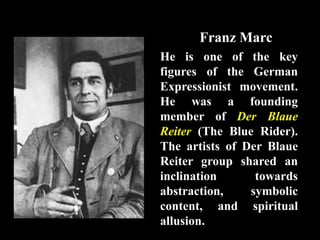
Franz Marc
He is one of the key
figures of the German
Expressionist movement.
He was a founding
member of Der Blaue
Reiter (The Blue Rider).
The artists of Der Blaue
Reiter group shared an
inclination towards
abstraction, symbolic
content, and spiritual
allusion.
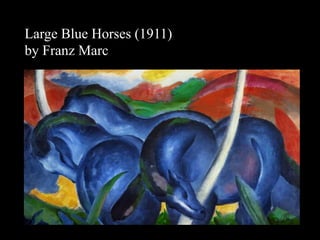
Large Blue Horses (1911)
by Franz Marc
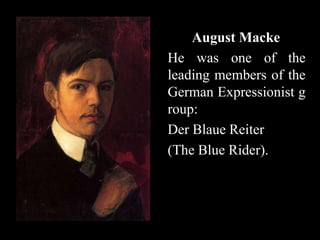
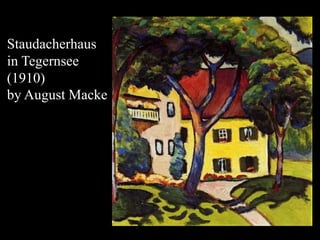
August Macke
He was one of the
leading members of the
German Expressionist g
roup:
Der Blaue Reiter
(The Blue Rider).
Staudacherhaus
in Tegernsee
(1910)
by August Macke
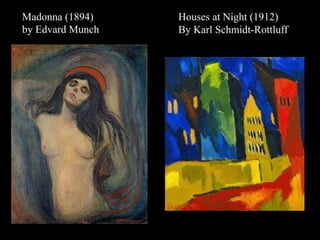
Madonna (1894)
by Edvard Munch
Houses at Night (1912)
By Karl Schmidt-Rottluff
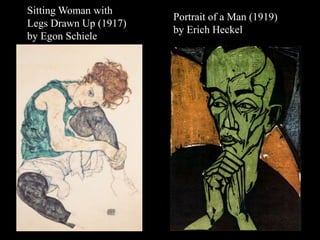
Sitting Woman with
Legs Drawn Up (1917)
by Egon Schiele
Portrait of a Man (1919)
by Erich Heckel
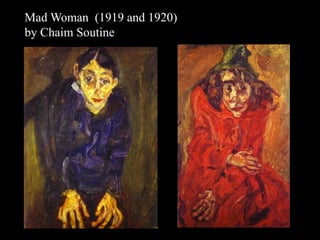
Mad Woman (1919 and 1920)
by Chaim Soutine

Expressionism Art Movement

  • 1.
  • 2.
    OBJECTIVES At the endof the lesson, students will be able to: • Know the definition and history of expressionism. • Cite the different arts and artists of Expressionism. • Identify some Filipino expressionist artists. • Create an artwork based on the art movement stated above.
  • 3.
    Expressionism • From 1905- 1933 • Expressionism emerged simultaneously in various cities across Germany as a response to a widespread anxiety about humanity's increasingly discordant relationship with the world and accompanying lost feelings of authenticity and spirituality.
  • 4.
    The term “Expressionism” •The term "Expressionism" is thought to have been coined in 1910 by Czech art historian Antonín Matějček, who intended it to denote the opposite of Impressionism. • Whereas the Impressionists sought to express the majesty of nature and the human form through paint, the Expressionists, according to Matejcek, sought only to express inner life, often via the painting of harsh and realistic subject matter.
  • 5.
    Expressionism • Vincent vanGogh, Edvard Munch, and James Ensor proved particularly influential to the Expressionists, encouraging the distortion of form and the deployment of strong colors to convey a variety of anxieties and yearnings.
  • 6.
    Vincent Van GoghJames EnsorGustav Klimt
  • 7.
    Edvard Munch inNorway The late nineteenth-century Norwegian Post - Impressionist painter Edvard Munch emerged as an important source of inspiration for the Expressionists. Throughout his artistic career, Munch focused on scenes of death, agony, and anxiety in distorted and emotionally charged portraits, all themes and styles that would be adopted by the Expressionists.
  • 8.
    THE SCREAM (1893) byEdvard Munch is an iconic work of modern times reflecting mankind’s bewilderment and paranoia with the world around.
  • 9.
    SELF PORTRAIT IN HELL(1903) by Edvard Munch
  • 12.
    Expressionist Artist sought toexpress the meaning of being alive and emotional experience rather than the physical reality.
  • 13.
    Key Ideas 1. Thearrival of Expressionism announced new standards in the creation and judgment of art. Art was now meant to come forth from within the artist, rather than from a depiction of the external visual world, and the standard for assessing the quality of a work of art became the character of the artist's feelings rather than an analysis of the composition.
  • 14.
    Key Ideas 2. Expressionistartists often employed swirling, swaying, and exaggeratedly executed brushstrokes in the depiction of their subjects. These techniques were meant to convey the turgid emotional state of the artist reacting to the anxieties of the modern world.
  • 15.
    Key Ideas 3. Throughtheir confrontation with the urban world of the early twentieth century, Expressionist artists developed a powerful mode of social criticism in their serpentine figural renderings and bold colors. Their representations of the modern city included alienated individuals (a psychological by-product of recent urbanization) as well as prostitutes, who were used to comment on capitalism's role in the emotional distancing of individuals within cities.
  • 16.
  • 17.
    Ernst Ludwig Kirchner In1905, a group of four German artists, led by Ernst Ludwig Kirchner, formed Die Brücke (the Bridge) in the city of Dresden. This was arguably the founding organization for the German Expressionist movement, though they did not use the word itself. Ernst Ludwig Kirchner was a leading force behind the Expressionist movement in Germany.
  • 18.
    Street, Berlin (1913) byErnst Ludwig Kirchner
  • 19.
    Franz Marc He isone of the key figures of the German Expressionist movement. He was a founding member of Der Blaue Reiter (The Blue Rider). The artists of Der Blaue Reiter group shared an inclination towards abstraction, symbolic content, and spiritual allusion.
  • 20.
    Large Blue Horses(1911) by Franz Marc
  • 21.
    August Macke He wasone of the leading members of the German Expressionist g roup: Der Blaue Reiter (The Blue Rider).
  • 22.
  • 23.
    Madonna (1894) by EdvardMunch Houses at Night (1912) By Karl Schmidt-Rottluff
  • 24.
    Sitting Woman with LegsDrawn Up (1917) by Egon Schiele Portrait of a Man (1919) by Erich Heckel
  • 25.
    Mad Woman (1919and 1920) by Chaim Soutine