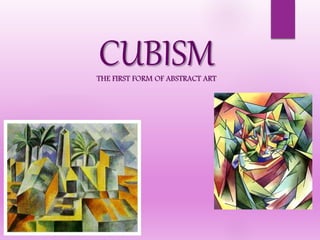
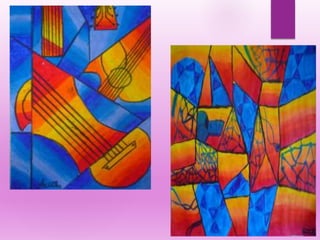
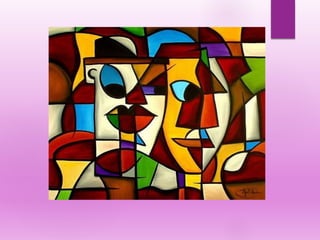
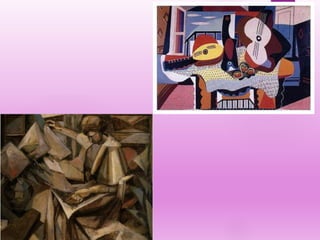
CUBISMTHE FIRST FORM OF ABSTRACT ART
What is Cubism
Cubism is a nonobjective school of painting and sculpture developed in
Paris in the early 20th century, characterized by the reduction and
breakup of natural forms into abstract, often geometric structures usually
rendered as a set of discrete planes. Cubism was an art movement that
revolutionized European painting and sculpture, and inspired related
movements in music and literature.
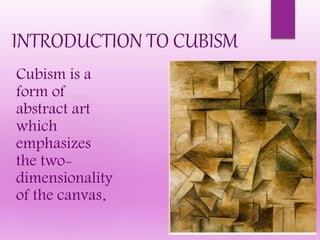
INTRODUCTION TO CUBISM
Cubism is a
form of
abstract art
which
emphasizes
the two-
dimensionality
of the canvas.
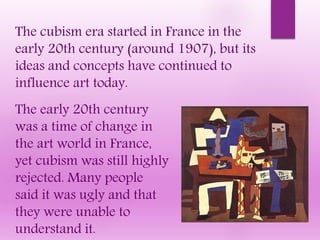
The cubism era started in France in the
early 20th century (around 1907), but its
ideas and concepts have continued to
influence art today.
The early 20th century
was a time of change in
the art world in France,
yet cubism was still highly
rejected. Many people
said it was ugly and that
they were unable to
understand it.
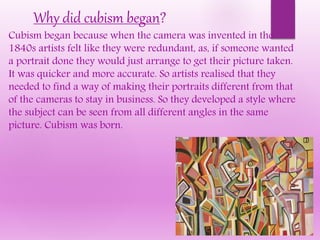
Cubism began because when the camera was invented in the
1840s artists felt like they were redundant, as, if someone wanted
a portrait done they would just arrange to get their picture taken.
It was quicker and more accurate. So artists realised that they
needed to find a way of making their portraits different from that
of the cameras to stay in business. So they developed a style where
the subject can be seen from all different angles in the same
picture. Cubism was born.
Why did cubism began?
CUBISM
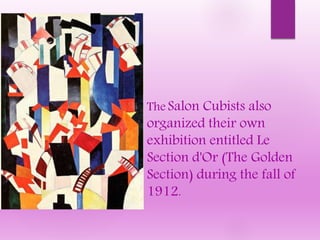
-the art movement
Cubism was a 20th century avant-garde art
movement, pioneered by Pablo Picasso and Georges
Braque, that revolutionized European painting and
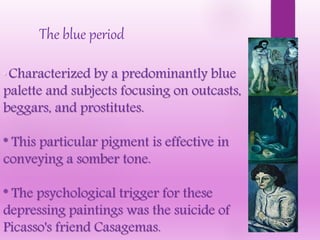
sculpture, and inspired related movements in music
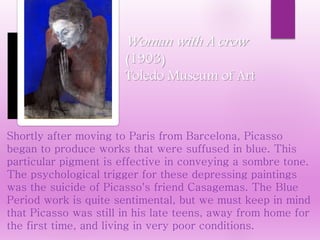
and architecture.
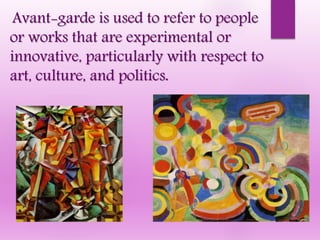
Avant-garde is used to refer to people
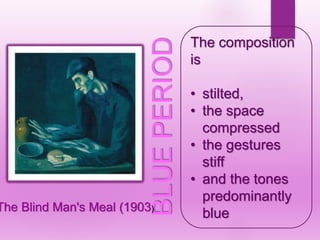
or works that are experimental or
innovative, particularly with respect to
art, culture, and politics.
• The scientific and philosophical changes at the
time influenced the subject matter within
cubist artwork and peoples ability to accept the
changes cubism was making in the art world.
• Cubism offered a visual equivalent of a
fundamental aspect of the 20th century
experience
How did Cubism get its name?
• Cubism got its name from remarks from the
painter Henri Matisse and critic Louis
Vauxcelles.
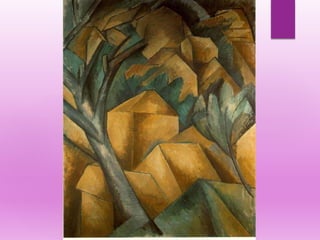
• They saw Braque’s work "Houses at L'Estaque"
and mocked it saying “everything is broken
down into cubes.”
Cubism began as an idea and then it
became a style. Based on Paul
Cézanne's three main ingredients -
geometricity, simultaneity (multiple
views) and passage - Cubism tried to
describe, in visual terms, the concept of
the Fourth Dimension.
Cubism is a kind of Realism. It is a
conceptual approach to realism in art,
which aims to depict the world as it is and
not as it seems. This was the "idea." For
example.
IDEA OF CUBISM
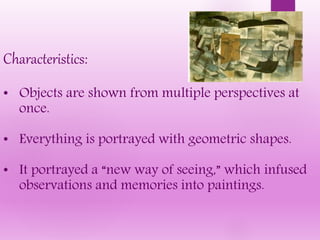
Characteristics:
• Objects are shown from multiple perspectives at
once.
• Everything is portrayed with geometric shapes.
• It portrayed a “new way of seeing,” which infused
observations and memories into paintings.
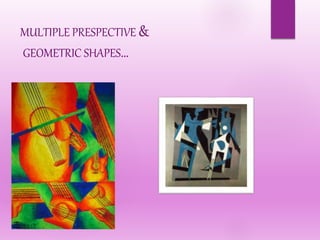
MULTIPLE PRESPECTIVE &
GEOMETRIC SHAPES…
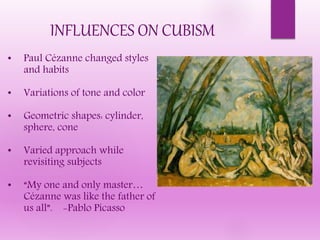
INFLUENCES ON CUBISM
• Paul Cézanne changed styles
and habits
• Variations of tone and color
• Geometric shapes: cylinder,
sphere, cone
• Varied approach while
revisiting subjects
• “My one and only master…
Cézanne was like the father of
us all”. -Pablo Picasso
INFLUENCES ON CUBISM
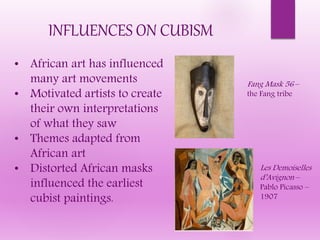
• African art has influenced
many art movements
• Motivated artists to create
their own interpretations
of what they saw
• Themes adapted from
African art
• Distorted African masks
influenced the earliest
cubist paintings.
Fang Mask 56 –
the Fang tribe
Les Demoiselles
d’Avignon –
Pablo Picasso –
1907
CUBISM-Phases
Phases of
Cubism
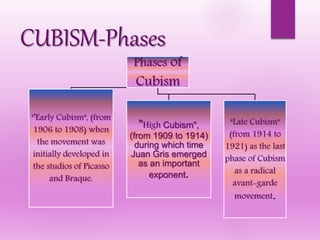
‘’Early Cubism", (from
1906 to 1908) when
the movement was
initially developed in
the studios of Picasso
and Braque.
"High Cubism",
(from 1909 to 1914)
during which time
Juan Gris emerged
as an important
exponent.
"Late Cubism"
(from 1914 to
1921) as the last
phase of Cubism
as a radical
avant-garde
movement.
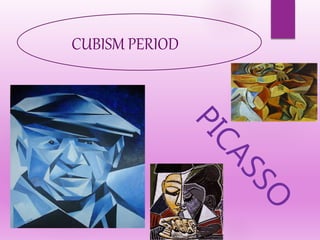
CUBISM PERIOD
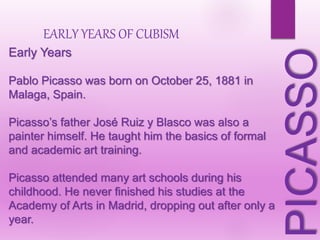
Early Years
Pablo Picasso was born on October 25, 1881 in
Malaga, Spain.
Picasso’s father José Ruiz y Blasco was also a
painter himself. He taught him the basics of formal
and academic art training.
Picasso attended many art schools during his
childhood. He never finished his studies at the
Academy of Arts in Madrid, dropping out after only a
year.
PICASSO
EARLY YEARS OF CUBISM
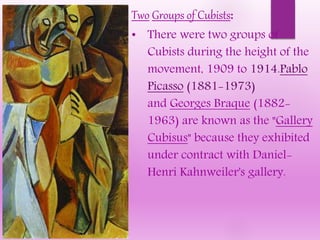
Two Groups of Cubists:
• There were two groups of
Cubists during the height of the
movement, 1909 to 1914.Pablo
Picasso (1881-1973)
and Georges Braque (1882-
1963) are known as the "Gallery
Cubisus" because they exhibited
under contract with Daniel-
Henri Kahnweiler's gallery.
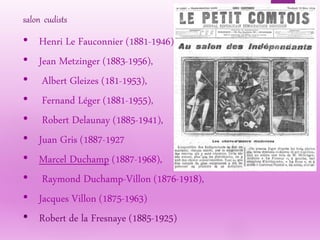
• Henri Le Fauconnier (1881-1946),
• Jean Metzinger (1883-1956),
• Albert Gleizes (181-1953),
• Fernand Léger (1881-1955),
• Robert Delaunay (1885-1941),
• Juan Gris (1887-1927
• Marcel Duchamp (1887-1968),
• Raymond Duchamp-Villon (1876-1918),
• Jacques Villon (1875-1963)
• Robert de la Fresnaye (1885-1925)
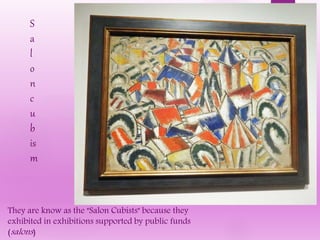
salon cudists
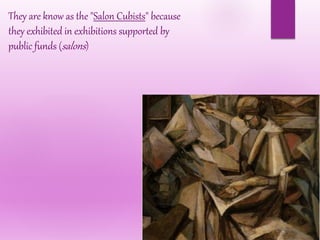
They are know as the "Salon Cubists" because
they exhibited in exhibitions supported by
public funds (salons)
1.Analytic Cubism, was both
radical and influential as a short but highly
significant art movement between 1907 and
1911 in France.
2. Synthetic Cubism, the movement spread and
remained vital until around 1919, when the
Surrealist movement gained popularity.
MOVEMENTS IN CUBISM
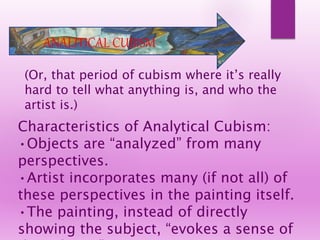
(Or, that period of cubism where it’s really
hard to tell what anything is, and who the
artist is.)
Characteristics of Analytical Cubism:
•Objects are “analyzed” from many
perspectives.
•Artist incorporates many (if not all) of
these perspectives in the painting itself.
•The painting, instead of directly
showing the subject, “evokes a sense of
ANALITICAL CUBISM
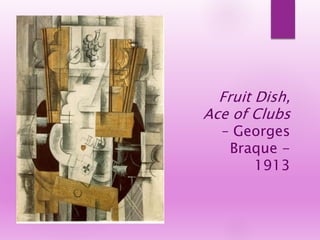
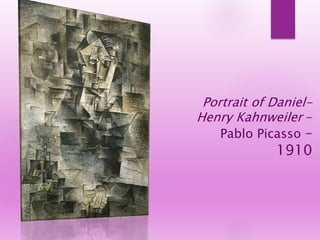
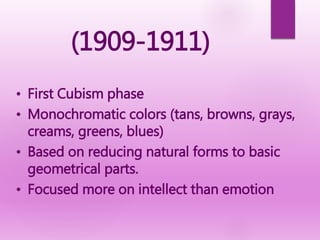
• First Cubism phase
• Monochromatic colors (tans, browns, grays,
creams, greens, blues)
• Based on reducing natural forms to basic
geometrical parts.
• Focused more on intellect than emotion
(1909-1911)
Fruit Dish,
Ace of Clubs
– Georges
Braque -
1913
Portrait of Daniel-
Henry Kahnweiler –
Pablo Picasso –
1910
SYNTHETIC CUBISM
(or, thank God, I can actually tell what I’m looking at
in this painting!)
Characteristics of Synthetic Cubism:
•Objects are still drawn from multiple
perspectives, BUT…
•They are more discernable,
•And they are more colorful.
• Grew out of analytical
• Wider use of color
• Wider use of materials
• Papier Colle introduced
Type of collage
• Appealing and easier to interpret
• Less intricate
• Added substances like sand to paint to
make it appear thicker
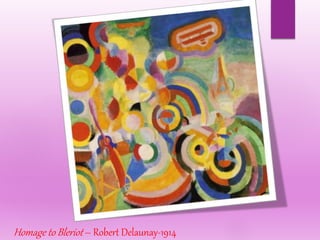
Homage to Bleriot – Robert Delaunay-1914
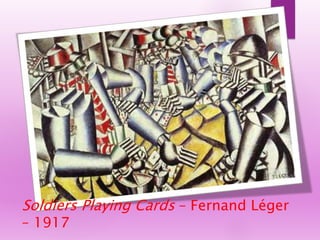
Soldiers Playing Cards – Fernand Léger
– 1917
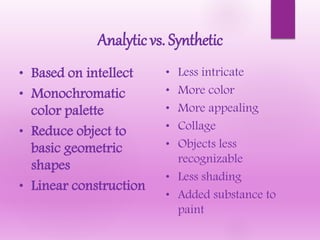
Analytic vs. Synthetic
• Based on intellect
• Monochromatic
color palette
• Reduce object to
basic geometric
shapes
• Linear construction
• Less intricate
• More color
• More appealing
• Collage
• Objects less
recognizable
• Less shading
• Added substance to
paint
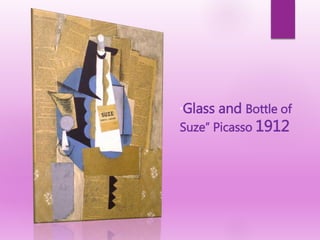
“Glass and Bottle of
Suze” Picasso 1912
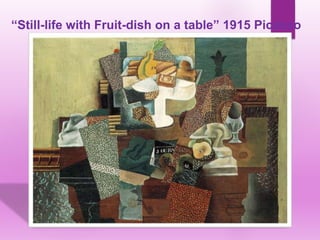
“Still-life with Fruit-dish on a table” 1915 Picasso
They are know as the "Salon Cubists" because they
exhibited in exhibitions supported by public funds
(salons)
S
a
l
o
n
c
u
b
is
m
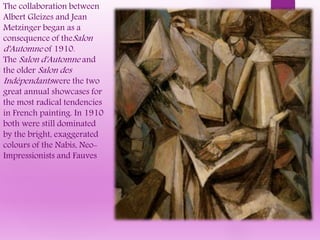
The collaboration between
Albert Gleizes and Jean
Metzinger began as a
consequence of theSalon
d'Automne of 1910.
The Salon d'Automne and
the older Salon des
Indépendantswere the two
great annual showcases for
the most radical tendencies
in French painting. In 1910
both were still dominated
by the bright, exaggerated
colours of the Nabis, Neo-
Impressionists and Fauves
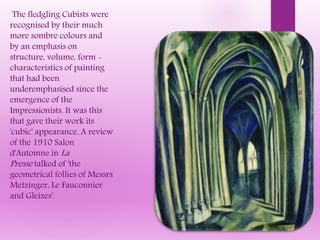
The fledgling Cubists were
recognised by their much
more sombre colours and
by an emphasis on
structure, volume, form -
characteristics of painting
that had been
underemphasised since the
emergence of the
Impressionists. It was this
that gave their work its
'cubic' appearance. A review
of the 1910 Salon
d'Automne in La
Presse talked of 'the
geometrical follies of Messrs
Metzinger, Le Fauconnier
and Gleizes'.
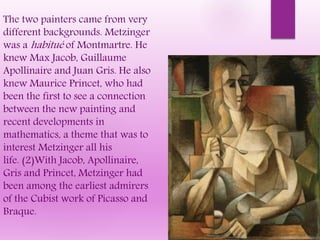
The two painters came from very
different backgrounds. Metzinger
was a habitué of Montmartre. He
knew Max Jacob, Guillaume
Apollinaire and Juan Gris. He also
knew Maurice Princet, who had
been the first to see a connection
between the new painting and
recent developments in
mathematics, a theme that was to
interest Metzinger all his
life. (2)With Jacob, Apollinaire,
Gris and Princet, Metzinger had
been among the earliest admirers
of the Cubist work of Picasso and
Braque.
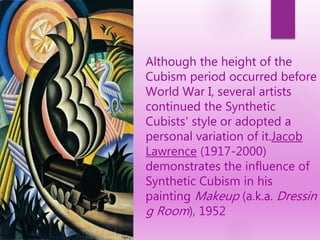
Although the height of the
Cubism period occurred before
World War I, several artists
continued the Synthetic
Cubists' style or adopted a
personal variation of it.Jacob
Lawrence (1917-2000)
demonstrates the influence of
Synthetic Cubism in his
painting Makeup (a.k.a. Dressin
g Room), 1952
So
lo
n
c
u
bi
s
m
The Salon Cubists tended to follow the Picasso-
Braque Early Cubism style through their exposure
to this period of the two artists' work (1908 to
1910). They participated in public exhibitions
(salons) as opposed to private galleries, such as the
Salon d'Automne (the Autumn Salon) and the
Salon des Indépendants (which occured in the
spring salon).
The Salon Cubists also
organized their own
exhibition entitled Le
Section d'Or (The Golden
Section) during the fall of
1912.
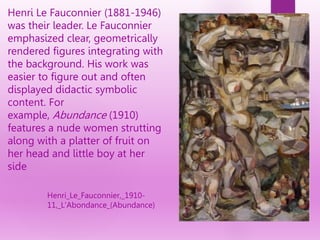
Henri Le Fauconnier (1881-1946)
was their leader. Le Fauconnier
emphasized clear, geometrically
rendered figures integrating with
the background. His work was
easier to figure out and often
displayed didactic symbolic
content. For
example, Abundance (1910)
features a nude women strutting
along with a platter of fruit on
her head and little boy at her
side
Henri_Le_Fauconnier,_1910-
11,_L'Abondance_(Abundance)
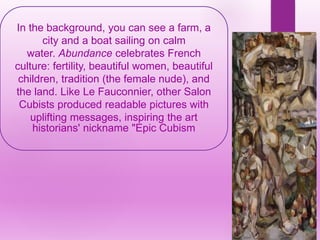
In the background, you can see a farm, a
city and a boat sailing on calm
water. Abundance celebrates French
culture: fertility, beautiful women, beautiful
children, tradition (the female nude), and
the land. Like Le Fauconnier, other Salon
Cubists produced readable pictures with
uplifting messages, inspiring the art
historians' nickname "Epic Cubism
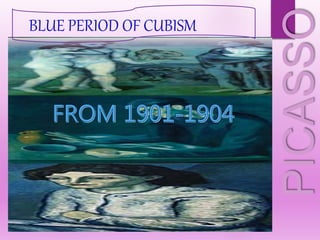
BLUE PERIOD OF CUBISM
PICASSO
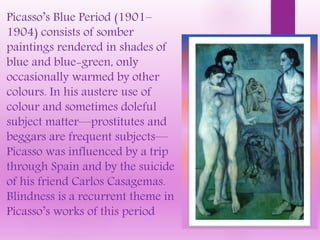
Picasso’s Blue Period (1901–
1904) consists of somber
paintings rendered in shades of
blue and blue-green, only
occasionally warmed by other
colours. In his austere use of
colour and sometimes doleful
subject matter—prostitutes and
beggars are frequent subjects—
Picasso was influenced by a trip
through Spain and by the suicide
of his friend Carlos Casagemas.
Blindness is a recurrent theme in
Picasso’s works of this period
* Characterized by a predominantly blue
palette and subjects focusing on outcasts,
beggars, and prostitutes.
* This particular pigment is effective in
conveying a somber tone.
* The psychological trigger for these
depressing paintings was the suicide of
Picasso's friend Casagemas.
The blue period
Shortly after moving to Paris from Barcelona, Picasso
began to produce works that were suffused in blue. This
particular pigment is effective in conveying a sombre tone.
The psychological trigger for these depressing paintings
was the suicide of Picasso's friend Casagemas. The Blue
Period work is quite sentimental, but we must keep in mind
that Picasso was still in his late teens, away from home for
the first time, and living in very poor conditions.
Woman with A crow
(1903)
Toledo Museum of Art
The composition
is
• stilted,
• the space
compressed
• the gestures
stiff
• and the tones
predominantly
blue
BLUEPERIOD
The Blind Man's Meal (1903)
CUBISM-rose
period
The Rose Period
1901 - 1904
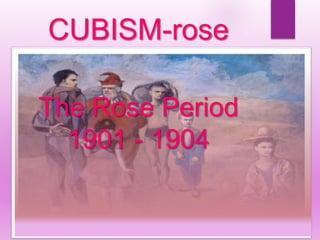
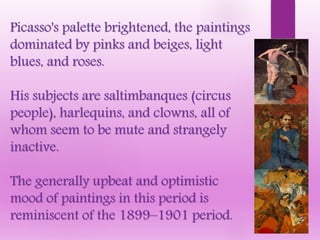
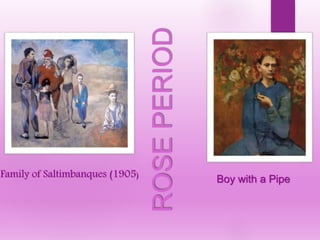
Picasso's palette brightened, the paintings
dominated by pinks and beiges, light
blues, and roses.
His subjects are saltimbanques (circus
people), harlequins, and clowns, all of
whom seem to be mute and strangely
inactive.
The generally upbeat and optimistic
mood of paintings in this period is
reminiscent of the 1899–1901 period.
Shortly after moving to Paris from Barcelona, Picasso began
to produce works that were suffused in blue. This particular
pigment is effective in conveying a sombre tone. The
psychological trigger for these depressing paintings was the
suicide of Picasso's friend Casagemas. The Blue Period work
is quite sentimental, but we must keep in mind that Picasso
was still in his late teens, away from home for the first time,
and living in very poor conditions.
ROSE PERIOD
ROSEPERIODFamily of Saltimbanques (1905)
Boy with a Pipe
George Braque(1882-1963)
• French painter
• Saw solid reality of objects
• Impressionist, Fauvist, then Cubist
• Painted mainly scenery
• Introduced faux bois. (The
appearance of stenciling in his
paintings)
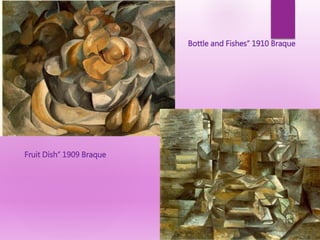
Bottle and Fishes” 1910 Braque
Fruit Dish” 1909 Braque
• Worked together until end of synthetic cubism
• Thought more about forging language of cubism
than about aesthetic value of subject.
• Common concern for accurate representation of
reality
• Always relied on intuition
• Limited role of light
• Reduced palette to neutral range of grays
• Work could not be differentiated in early Cubism
• Braque and Picasso split in 1914 at the start of
WWI
Braque and Picasso
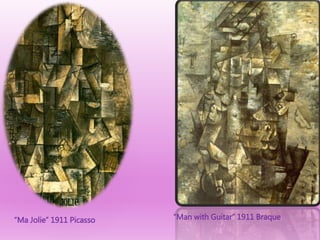
“Ma Jolie” 1911 Picasso “Man with Guitar” 1911 Braque
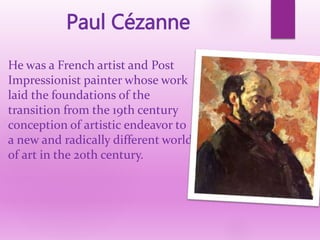
He was a French artist and Post
Impressionist painter whose work
laid the foundations of the
transition from the 19th century
conception of artistic endeavor to
a new and radically different world
of art in the 20th century.
Paul Cézanne
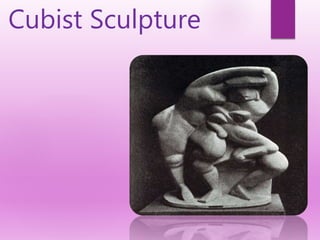
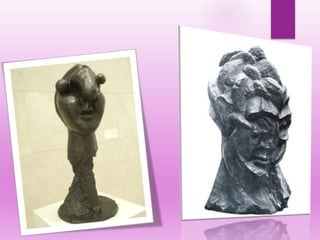
Cubist Sculpture
• Alexander Archipenko
• Style
• Mostly dark colors (Blacks)
• Not very abstracted
• Mostly contorted or misshapen human
bodies
• Famous Cubist Works
• Seated Female Nude (1909)
• The Draped Woman (1911)
• Reclining Nude (1912)
• Die Sitzende (1912)
• Carrousel Pierrot (1913)
• The Gondolier (1914)
• The Boxers (1914)
• Walking (1914
Archipenko (cont.)
Famous Cubist Works (cont.)
Female Torso (1914)
Woman Combing Her Hair (1915)
Walking Soilders (1917)
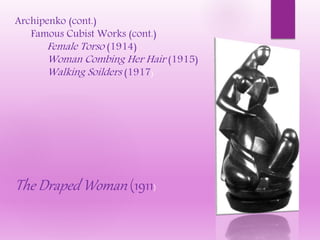
The Draped Woman (1911)
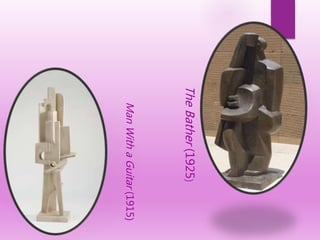
ManWithaGuitar(1915)
TheBather(1925)
How Long Has Cubism Been a
Movement?
There are four periods of Cubism:
 Early Cubism or Cézannisme (1908-1910)
• Analitical Cubism (1910-12)
 Synthetic Cubism (1912-1914)
 Late Cubism (1915-present)
Off-branches of Cubism
Kinetic Cubism/Cubo-Futurism
Developed in Russia around 1910
Based off of Synthetic Cubism/ reinterpretation of
French Cubism and Italian Futurism
More emphasis on movement and action
Bold colors and lines
Fragmentation of objects on canvas surface
Key artists:
Malevich
Popova
Goncharova
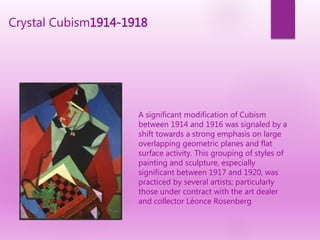
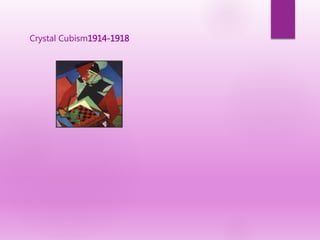
Crystal Cubism1914-1918
A significant modification of Cubism
between 1914 and 1916 was signaled by a
shift towards a strong emphasis on large
overlapping geometric planes and flat
surface activity. This grouping of styles of
painting and sculpture, especially
significant between 1917 and 1920, was
practiced by several artists; particularly
those under contract with the art dealer
and collector Léonce Rosenberg
Orphism/Orphic Cubism (1910)
Roots in Analytical Cubism but uses
bright circles
Delaunays pioneered this technique
(Prisma Electrico, Rythme Couleur,
ect.)
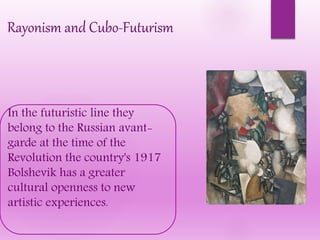
Rayonism and Cubo-Futurism
In the futuristic line they
belong to the Russian avant-
garde at the time of the
Revolution the country's 1917
Bolshevik has a greater
cultural openness to new
artistic experiences.
They have influences of Cézanne and Picasso.
The Cubo-Futurism was influenced by Futurism Manifesto
of Marinetti, given the social dimension and sense of
rupture, and the belief in progress through the machine. In
addition to this influence, the Russian avant-garde added
the Marxist ideology.
The Cubo-Futurism comes around 1912, as a synthesis of
Cubism.
Artists:
- Natalia Goutchanova (1881-1962)
- Mikhail Larionov (1881-1964)
- Vladimir Mayakovsky (1893 -1930)
- Vladimir Tatlin (1885-1953)
- Casimir Malevich (1878-1935)
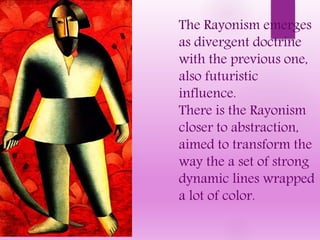
The Rayonism emerges
as divergent doctrine
with the previous one,
also futuristic
influence.
There is the Rayonism
closer to abstraction,
aimed to transform the
way the a set of strong
dynamic lines wrapped
a lot of color.
The "Manifesto of Rayonism"
was written by Larionov in
1913 and was exhibited in
Paris in 1914.
After their extinction their
legacy served as the influence
to Suprematism and
Constructivism to
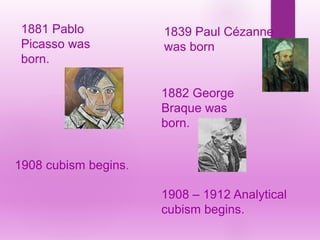
1908 cubism begins.
1908 – 1912 Analytical
cubism begins.
1881 Pablo
Picasso was
born.
1882 George
Braque was
born.
1839 Paul Cézanne
was born
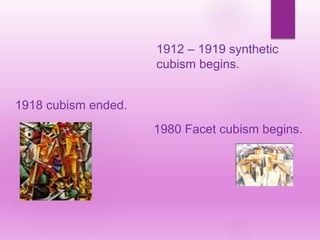
1918 cubism ended.
1980 Facet cubism begins.
1912 – 1919 synthetic
cubism begins.
Crystal Cubism1914-1918
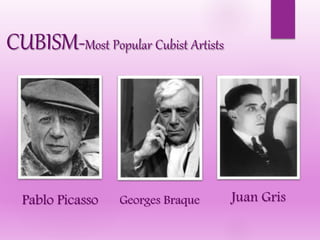
CUBISM-Most Popular Cubist Artists
Pablo Picasso Juan GrisGeorges Braque
After Cubist Period
After the world war 1, Picasso, reflecting society's
disillusionment and shock with the technological
horrors of the war, reverted to a Classicist mode of
representation.
* During the '30s Picasso became tangentially connected
with the Surrealist movement.
* After 1935 he returned to Classicism.
* By the late '30s, Picasso was the most famous artist in
the world.
Cubism formed an
important link between
early-20th-century art
and architecture.] The
historical, theoretical,
and socio-political
relationships between
avant-garde practices in
painting, sculpture and
architecture had early
ramifications
in France,Germany,
the Netherlands and Czec
hoslovakia.
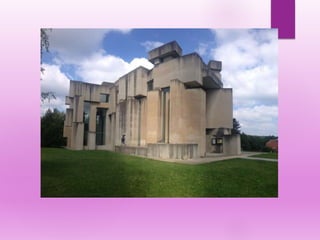
Cubism in architecture
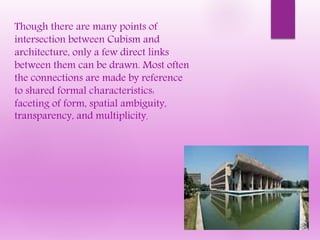
Though there are many points of
intersection between Cubism and
architecture, only a few direct links
between them can be drawn. Most often
the connections are made by reference
to shared formal characteristics:
faceting of form, spatial ambiguity,
transparency, and multiplicity.
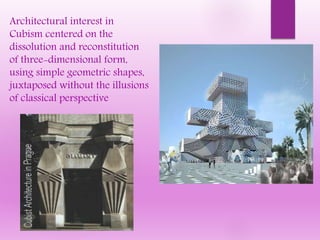
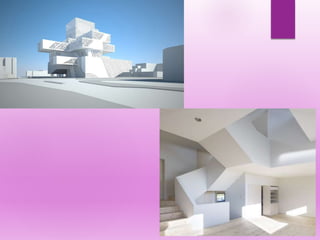
Architectural interest in
Cubism centered on the
dissolution and reconstitution
of three-dimensional form,
using simple geometric shapes,
juxtaposed without the illusions
of classical perspective
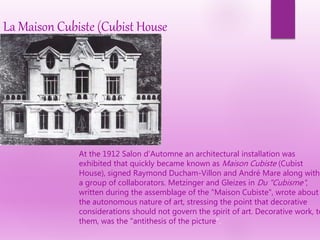
La Maison Cubiste (Cubist House
At the 1912 Salon d'Automne an architectural installation was
exhibited that quickly became known as Maison Cubiste (Cubist
House), signed Raymond Ducham-Villon and André Mare along with
a group of collaborators. Metzinger and Gleizes in Du "Cubisme",
written during the assemblage of the "Maison Cubiste", wrote about
the autonomous nature of art, stressing the point that decorative
considerations should not govern the spirit of art. Decorative work, to
them, was the "antithesis of the picture".
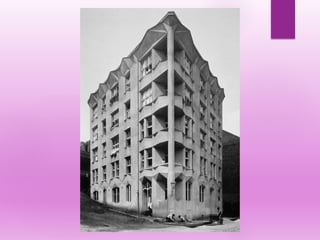
Czech Cubist architecture
The original Cubist
architecture is very rare.
There is only one country
in the world where Cubism
was really applied to
architecture –
namely Bohemia (today Cz
ech Republic) and
especially its
capital, Prague.] Czech
architects were the first
and only ones in the world
to ever design original
Cubist buildings
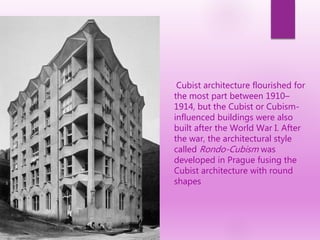
Cubist architecture flourished for
the most part between 1910–
1914, but the Cubist or Cubism-
influenced buildings were also
built after the World War I. After
the war, the architectural style
called Rondo-Cubism was
developed in Prague fusing the
Cubist architecture with round
shapes
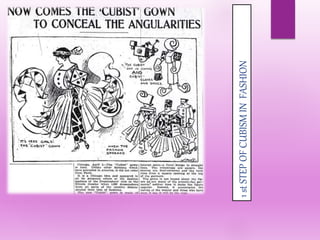
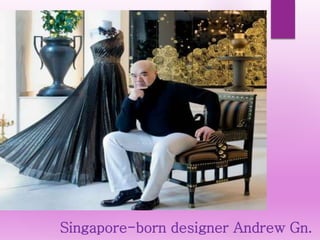
1stSTEPOFCUBISMINFASHION
CUBISM IN FASHION
WORLD
Paris is at the center of the fashion world
this week, as the Spring Summer 2014
ready-to-wear collections are premiering
in the French capital from September 24
to October 2, 2013. We caught up with
designer Andrew Gn, whose new
collection debuted in Paris on
September 29.
Singapore-born designer Andrew Gn.
The designer offers more insights into the
inspirations behind his latest designs here
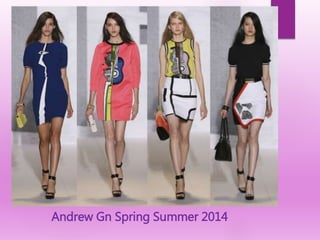
What is the signature piece of this Spring Summer 2014 collection?
"A dress in an intense shade of blue, embroidered
with a cubist-style profile (below, on the left). This
Spring/Summer 2014 collection pays homage to
extraordinary modern designers and artists such
as Gio Ponti, Carlo Mollino, Fernand Léger,
Georges Braque, Pablo Picasso and Peter Doig."
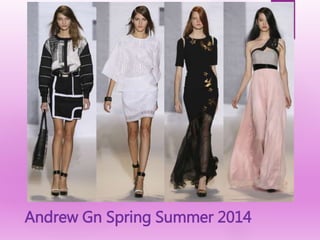
Andrew Gn Spring Summer 2014
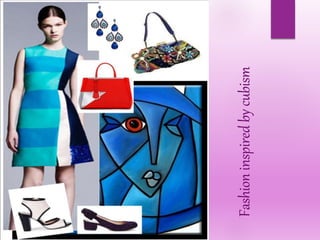
Fashioninspiredbycubism
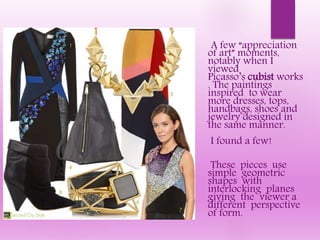
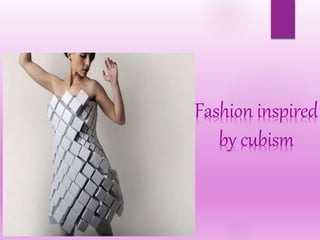
A few “appreciation
of art” moments,
notably when I
viewed
Picasso’s cubist works
. The paintings
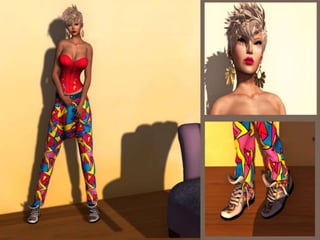
inspired to wear
more dresses, tops,
handbags, shoes and
jewelry designed in
the same manner.
I found a few!
These pieces use
simple geometric
shapes with
interlocking planes
giving the viewer a
different perspective
of form.
Fashioninspiredbycubism
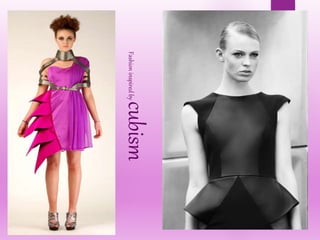
Fashion inspired
by cubism
Some images
Cubism history nd till date

Cubism history nd till date

  • 1.
    CUBISMTHE FIRST FORMOF ABSTRACT ART
  • 2.
    What is Cubism Cubismis a nonobjective school of painting and sculpture developed in Paris in the early 20th century, characterized by the reduction and breakup of natural forms into abstract, often geometric structures usually rendered as a set of discrete planes. Cubism was an art movement that revolutionized European painting and sculpture, and inspired related movements in music and literature.
  • 3.
    INTRODUCTION TO CUBISM Cubismis a form of abstract art which emphasizes the two- dimensionality of the canvas.
  • 4.
    The cubism erastarted in France in the early 20th century (around 1907), but its ideas and concepts have continued to influence art today. The early 20th century was a time of change in the art world in France, yet cubism was still highly rejected. Many people said it was ugly and that they were unable to understand it.
  • 5.
    Cubism began becausewhen the camera was invented in the 1840s artists felt like they were redundant, as, if someone wanted a portrait done they would just arrange to get their picture taken. It was quicker and more accurate. So artists realised that they needed to find a way of making their portraits different from that of the cameras to stay in business. So they developed a style where the subject can be seen from all different angles in the same picture. Cubism was born. Why did cubism began?
  • 6.
    CUBISM -the art movement Cubismwas a 20th century avant-garde art movement, pioneered by Pablo Picasso and Georges Braque, that revolutionized European painting and sculpture, and inspired related movements in music and architecture.
  • 7.
    Avant-garde is usedto refer to people or works that are experimental or innovative, particularly with respect to art, culture, and politics.
  • 8.
    • The scientificand philosophical changes at the time influenced the subject matter within cubist artwork and peoples ability to accept the changes cubism was making in the art world. • Cubism offered a visual equivalent of a fundamental aspect of the 20th century experience
  • 9.
    How did Cubismget its name? • Cubism got its name from remarks from the painter Henri Matisse and critic Louis Vauxcelles. • They saw Braque’s work "Houses at L'Estaque" and mocked it saying “everything is broken down into cubes.”
  • 10.
    Cubism began asan idea and then it became a style. Based on Paul Cézanne's three main ingredients - geometricity, simultaneity (multiple views) and passage - Cubism tried to describe, in visual terms, the concept of the Fourth Dimension. Cubism is a kind of Realism. It is a conceptual approach to realism in art, which aims to depict the world as it is and not as it seems. This was the "idea." For example. IDEA OF CUBISM
  • 11.
    Characteristics: • Objects areshown from multiple perspectives at once. • Everything is portrayed with geometric shapes. • It portrayed a “new way of seeing,” which infused observations and memories into paintings.
  • 12.
  • 13.
    INFLUENCES ON CUBISM •Paul Cézanne changed styles and habits • Variations of tone and color • Geometric shapes: cylinder, sphere, cone • Varied approach while revisiting subjects • “My one and only master… Cézanne was like the father of us all”. -Pablo Picasso
  • 14.
    INFLUENCES ON CUBISM •African art has influenced many art movements • Motivated artists to create their own interpretations of what they saw • Themes adapted from African art • Distorted African masks influenced the earliest cubist paintings. Fang Mask 56 – the Fang tribe Les Demoiselles d’Avignon – Pablo Picasso – 1907
  • 15.
    CUBISM-Phases Phases of Cubism ‘’Early Cubism",(from 1906 to 1908) when the movement was initially developed in the studios of Picasso and Braque. "High Cubism", (from 1909 to 1914) during which time Juan Gris emerged as an important exponent. "Late Cubism" (from 1914 to 1921) as the last phase of Cubism as a radical avant-garde movement.
  • 16.
  • 17.
    Early Years Pablo Picassowas born on October 25, 1881 in Malaga, Spain. Picasso’s father José Ruiz y Blasco was also a painter himself. He taught him the basics of formal and academic art training. Picasso attended many art schools during his childhood. He never finished his studies at the Academy of Arts in Madrid, dropping out after only a year. PICASSO EARLY YEARS OF CUBISM
  • 18.
    Two Groups ofCubists: • There were two groups of Cubists during the height of the movement, 1909 to 1914.Pablo Picasso (1881-1973) and Georges Braque (1882- 1963) are known as the "Gallery Cubisus" because they exhibited under contract with Daniel- Henri Kahnweiler's gallery.
  • 19.
    • Henri LeFauconnier (1881-1946), • Jean Metzinger (1883-1956), • Albert Gleizes (181-1953), • Fernand Léger (1881-1955), • Robert Delaunay (1885-1941), • Juan Gris (1887-1927 • Marcel Duchamp (1887-1968), • Raymond Duchamp-Villon (1876-1918), • Jacques Villon (1875-1963) • Robert de la Fresnaye (1885-1925) salon cudists
  • 20.
    They are knowas the "Salon Cubists" because they exhibited in exhibitions supported by public funds (salons)
  • 21.
    1.Analytic Cubism, wasboth radical and influential as a short but highly significant art movement between 1907 and 1911 in France. 2. Synthetic Cubism, the movement spread and remained vital until around 1919, when the Surrealist movement gained popularity. MOVEMENTS IN CUBISM
  • 22.
    (Or, that periodof cubism where it’s really hard to tell what anything is, and who the artist is.) Characteristics of Analytical Cubism: •Objects are “analyzed” from many perspectives. •Artist incorporates many (if not all) of these perspectives in the painting itself. •The painting, instead of directly showing the subject, “evokes a sense of ANALITICAL CUBISM
  • 23.
    • First Cubismphase • Monochromatic colors (tans, browns, grays, creams, greens, blues) • Based on reducing natural forms to basic geometrical parts. • Focused more on intellect than emotion (1909-1911)
  • 24.
    Fruit Dish, Ace ofClubs – Georges Braque - 1913
  • 25.
    Portrait of Daniel- HenryKahnweiler – Pablo Picasso – 1910
  • 26.
    SYNTHETIC CUBISM (or, thankGod, I can actually tell what I’m looking at in this painting!) Characteristics of Synthetic Cubism: •Objects are still drawn from multiple perspectives, BUT… •They are more discernable, •And they are more colorful.
  • 27.
    • Grew outof analytical • Wider use of color • Wider use of materials • Papier Colle introduced Type of collage • Appealing and easier to interpret • Less intricate • Added substances like sand to paint to make it appear thicker
  • 28.
    Homage to Bleriot– Robert Delaunay-1914
  • 29.
    Soldiers Playing Cards– Fernand Léger – 1917
  • 30.
    Analytic vs. Synthetic •Based on intellect • Monochromatic color palette • Reduce object to basic geometric shapes • Linear construction • Less intricate • More color • More appealing • Collage • Objects less recognizable • Less shading • Added substance to paint
  • 31.
    “Glass and Bottleof Suze” Picasso 1912
  • 32.
    “Still-life with Fruit-dishon a table” 1915 Picasso
  • 33.
    They are knowas the "Salon Cubists" because they exhibited in exhibitions supported by public funds (salons) S a l o n c u b is m
  • 34.
    The collaboration between AlbertGleizes and Jean Metzinger began as a consequence of theSalon d'Automne of 1910. The Salon d'Automne and the older Salon des Indépendantswere the two great annual showcases for the most radical tendencies in French painting. In 1910 both were still dominated by the bright, exaggerated colours of the Nabis, Neo- Impressionists and Fauves
  • 35.
    The fledgling Cubistswere recognised by their much more sombre colours and by an emphasis on structure, volume, form - characteristics of painting that had been underemphasised since the emergence of the Impressionists. It was this that gave their work its 'cubic' appearance. A review of the 1910 Salon d'Automne in La Presse talked of 'the geometrical follies of Messrs Metzinger, Le Fauconnier and Gleizes'.
  • 36.
    The two painterscame from very different backgrounds. Metzinger was a habitué of Montmartre. He knew Max Jacob, Guillaume Apollinaire and Juan Gris. He also knew Maurice Princet, who had been the first to see a connection between the new painting and recent developments in mathematics, a theme that was to interest Metzinger all his life. (2)With Jacob, Apollinaire, Gris and Princet, Metzinger had been among the earliest admirers of the Cubist work of Picasso and Braque.
  • 37.
    Although the heightof the Cubism period occurred before World War I, several artists continued the Synthetic Cubists' style or adopted a personal variation of it.Jacob Lawrence (1917-2000) demonstrates the influence of Synthetic Cubism in his painting Makeup (a.k.a. Dressin g Room), 1952
  • 38.
    So lo n c u bi s m The Salon Cubiststended to follow the Picasso- Braque Early Cubism style through their exposure to this period of the two artists' work (1908 to 1910). They participated in public exhibitions (salons) as opposed to private galleries, such as the Salon d'Automne (the Autumn Salon) and the Salon des Indépendants (which occured in the spring salon).
  • 39.
    The Salon Cubistsalso organized their own exhibition entitled Le Section d'Or (The Golden Section) during the fall of 1912.
  • 40.
    Henri Le Fauconnier(1881-1946) was their leader. Le Fauconnier emphasized clear, geometrically rendered figures integrating with the background. His work was easier to figure out and often displayed didactic symbolic content. For example, Abundance (1910) features a nude women strutting along with a platter of fruit on her head and little boy at her side Henri_Le_Fauconnier,_1910- 11,_L'Abondance_(Abundance)
  • 41.
    In the background,you can see a farm, a city and a boat sailing on calm water. Abundance celebrates French culture: fertility, beautiful women, beautiful children, tradition (the female nude), and the land. Like Le Fauconnier, other Salon Cubists produced readable pictures with uplifting messages, inspiring the art historians' nickname "Epic Cubism
  • 42.
    BLUE PERIOD OFCUBISM PICASSO
  • 43.
    Picasso’s Blue Period(1901– 1904) consists of somber paintings rendered in shades of blue and blue-green, only occasionally warmed by other colours. In his austere use of colour and sometimes doleful subject matter—prostitutes and beggars are frequent subjects— Picasso was influenced by a trip through Spain and by the suicide of his friend Carlos Casagemas. Blindness is a recurrent theme in Picasso’s works of this period
  • 44.
    * Characterized bya predominantly blue palette and subjects focusing on outcasts, beggars, and prostitutes. * This particular pigment is effective in conveying a somber tone. * The psychological trigger for these depressing paintings was the suicide of Picasso's friend Casagemas. The blue period
  • 45.
    Shortly after movingto Paris from Barcelona, Picasso began to produce works that were suffused in blue. This particular pigment is effective in conveying a sombre tone. The psychological trigger for these depressing paintings was the suicide of Picasso's friend Casagemas. The Blue Period work is quite sentimental, but we must keep in mind that Picasso was still in his late teens, away from home for the first time, and living in very poor conditions. Woman with A crow (1903) Toledo Museum of Art
  • 46.
    The composition is • stilted, •the space compressed • the gestures stiff • and the tones predominantly blue BLUEPERIOD The Blind Man's Meal (1903)
  • 47.
  • 48.
    Picasso's palette brightened,the paintings dominated by pinks and beiges, light blues, and roses. His subjects are saltimbanques (circus people), harlequins, and clowns, all of whom seem to be mute and strangely inactive. The generally upbeat and optimistic mood of paintings in this period is reminiscent of the 1899–1901 period.
  • 49.
    Shortly after movingto Paris from Barcelona, Picasso began to produce works that were suffused in blue. This particular pigment is effective in conveying a sombre tone. The psychological trigger for these depressing paintings was the suicide of Picasso's friend Casagemas. The Blue Period work is quite sentimental, but we must keep in mind that Picasso was still in his late teens, away from home for the first time, and living in very poor conditions. ROSE PERIOD
  • 50.
    ROSEPERIODFamily of Saltimbanques(1905) Boy with a Pipe
  • 51.
    George Braque(1882-1963) • Frenchpainter • Saw solid reality of objects • Impressionist, Fauvist, then Cubist • Painted mainly scenery • Introduced faux bois. (The appearance of stenciling in his paintings)
  • 52.
    Bottle and Fishes”1910 Braque Fruit Dish” 1909 Braque
  • 53.
    • Worked togetheruntil end of synthetic cubism • Thought more about forging language of cubism than about aesthetic value of subject. • Common concern for accurate representation of reality • Always relied on intuition • Limited role of light • Reduced palette to neutral range of grays • Work could not be differentiated in early Cubism • Braque and Picasso split in 1914 at the start of WWI Braque and Picasso
  • 54.
    “Ma Jolie” 1911Picasso “Man with Guitar” 1911 Braque
  • 55.
    He was aFrench artist and Post Impressionist painter whose work laid the foundations of the transition from the 19th century conception of artistic endeavor to a new and radically different world of art in the 20th century. Paul Cézanne
  • 56.
  • 57.
    • Alexander Archipenko •Style • Mostly dark colors (Blacks) • Not very abstracted • Mostly contorted or misshapen human bodies • Famous Cubist Works • Seated Female Nude (1909) • The Draped Woman (1911) • Reclining Nude (1912) • Die Sitzende (1912) • Carrousel Pierrot (1913) • The Gondolier (1914) • The Boxers (1914) • Walking (1914
  • 58.
    Archipenko (cont.) Famous CubistWorks (cont.) Female Torso (1914) Woman Combing Her Hair (1915) Walking Soilders (1917) The Draped Woman (1911)
  • 59.
  • 61.
    How Long HasCubism Been a Movement? There are four periods of Cubism:  Early Cubism or Cézannisme (1908-1910) • Analitical Cubism (1910-12)  Synthetic Cubism (1912-1914)  Late Cubism (1915-present)
  • 62.
    Off-branches of Cubism KineticCubism/Cubo-Futurism Developed in Russia around 1910 Based off of Synthetic Cubism/ reinterpretation of French Cubism and Italian Futurism More emphasis on movement and action Bold colors and lines Fragmentation of objects on canvas surface Key artists: Malevich Popova Goncharova
  • 63.
    Crystal Cubism1914-1918 A significantmodification of Cubism between 1914 and 1916 was signaled by a shift towards a strong emphasis on large overlapping geometric planes and flat surface activity. This grouping of styles of painting and sculpture, especially significant between 1917 and 1920, was practiced by several artists; particularly those under contract with the art dealer and collector Léonce Rosenberg
  • 64.
    Orphism/Orphic Cubism (1910) Rootsin Analytical Cubism but uses bright circles Delaunays pioneered this technique (Prisma Electrico, Rythme Couleur, ect.)
  • 65.
    Rayonism and Cubo-Futurism Inthe futuristic line they belong to the Russian avant- garde at the time of the Revolution the country's 1917 Bolshevik has a greater cultural openness to new artistic experiences.
  • 66.
    They have influencesof Cézanne and Picasso. The Cubo-Futurism was influenced by Futurism Manifesto of Marinetti, given the social dimension and sense of rupture, and the belief in progress through the machine. In addition to this influence, the Russian avant-garde added the Marxist ideology. The Cubo-Futurism comes around 1912, as a synthesis of Cubism. Artists: - Natalia Goutchanova (1881-1962) - Mikhail Larionov (1881-1964) - Vladimir Mayakovsky (1893 -1930) - Vladimir Tatlin (1885-1953) - Casimir Malevich (1878-1935)
  • 67.
    The Rayonism emerges asdivergent doctrine with the previous one, also futuristic influence. There is the Rayonism closer to abstraction, aimed to transform the way the a set of strong dynamic lines wrapped a lot of color.
  • 68.
    The "Manifesto ofRayonism" was written by Larionov in 1913 and was exhibited in Paris in 1914. After their extinction their legacy served as the influence to Suprematism and Constructivism to
  • 69.
    1908 cubism begins. 1908– 1912 Analytical cubism begins. 1881 Pablo Picasso was born. 1882 George Braque was born. 1839 Paul Cézanne was born
  • 70.
    1918 cubism ended. 1980Facet cubism begins. 1912 – 1919 synthetic cubism begins.
  • 71.
  • 72.
    CUBISM-Most Popular CubistArtists Pablo Picasso Juan GrisGeorges Braque
  • 73.
    After Cubist Period Afterthe world war 1, Picasso, reflecting society's disillusionment and shock with the technological horrors of the war, reverted to a Classicist mode of representation. * During the '30s Picasso became tangentially connected with the Surrealist movement. * After 1935 he returned to Classicism. * By the late '30s, Picasso was the most famous artist in the world.
  • 75.
    Cubism formed an importantlink between early-20th-century art and architecture.] The historical, theoretical, and socio-political relationships between avant-garde practices in painting, sculpture and architecture had early ramifications in France,Germany, the Netherlands and Czec hoslovakia. Cubism in architecture
  • 76.
    Though there aremany points of intersection between Cubism and architecture, only a few direct links between them can be drawn. Most often the connections are made by reference to shared formal characteristics: faceting of form, spatial ambiguity, transparency, and multiplicity.
  • 77.
    Architectural interest in Cubismcentered on the dissolution and reconstitution of three-dimensional form, using simple geometric shapes, juxtaposed without the illusions of classical perspective
  • 78.
    La Maison Cubiste(Cubist House At the 1912 Salon d'Automne an architectural installation was exhibited that quickly became known as Maison Cubiste (Cubist House), signed Raymond Ducham-Villon and André Mare along with a group of collaborators. Metzinger and Gleizes in Du "Cubisme", written during the assemblage of the "Maison Cubiste", wrote about the autonomous nature of art, stressing the point that decorative considerations should not govern the spirit of art. Decorative work, to them, was the "antithesis of the picture".
  • 79.
    Czech Cubist architecture Theoriginal Cubist architecture is very rare. There is only one country in the world where Cubism was really applied to architecture – namely Bohemia (today Cz ech Republic) and especially its capital, Prague.] Czech architects were the first and only ones in the world to ever design original Cubist buildings
  • 80.
    Cubist architecture flourishedfor the most part between 1910– 1914, but the Cubist or Cubism- influenced buildings were also built after the World War I. After the war, the architectural style called Rondo-Cubism was developed in Prague fusing the Cubist architecture with round shapes
  • 84.
  • 85.
    CUBISM IN FASHION WORLD Parisis at the center of the fashion world this week, as the Spring Summer 2014 ready-to-wear collections are premiering in the French capital from September 24 to October 2, 2013. We caught up with designer Andrew Gn, whose new collection debuted in Paris on September 29.
  • 86.
  • 87.
    The designer offersmore insights into the inspirations behind his latest designs here What is the signature piece of this Spring Summer 2014 collection? "A dress in an intense shade of blue, embroidered with a cubist-style profile (below, on the left). This Spring/Summer 2014 collection pays homage to extraordinary modern designers and artists such as Gio Ponti, Carlo Mollino, Fernand Léger, Georges Braque, Pablo Picasso and Peter Doig."
  • 88.
    Andrew Gn SpringSummer 2014
  • 89.
    Andrew Gn SpringSummer 2014
  • 90.
  • 91.
    A few “appreciation ofart” moments, notably when I viewed Picasso’s cubist works . The paintings inspired to wear more dresses, tops, handbags, shoes and jewelry designed in the same manner. I found a few! These pieces use simple geometric shapes with interlocking planes giving the viewer a different perspective of form.
  • 92.
  • 95.
  • 96.