Cubism, movement in modern art, especially in painting, invented by Spanish artist Pablo Picasso and French artist Georges Braque in 1907 and 1908.
Although the look of cubism and the ideas behind it evolved over time, cubism retained certain general characteristics throughout.
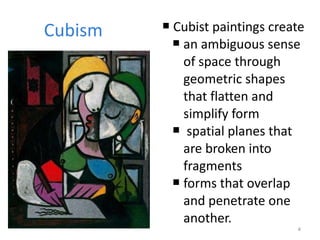
Cubism Cubist paintings create  an ambiguous sense of space through geometric shapes that flatten and simplify form spatial planes that are broken into fragments  forms that overlap and penetrate one another.
Art historians generally consider cubism to have been the most influential art movement of the first half of the 20th century.
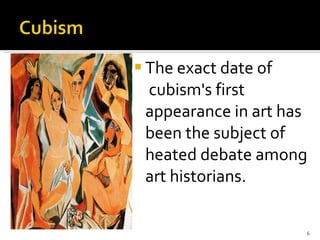
The exact date of   cubism's first appearance in art has been the subject of heated debate among art historians.
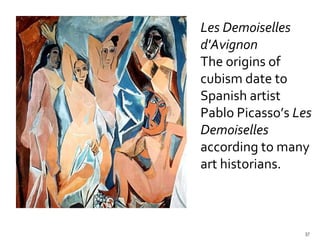
Cubism Some see its onset in Picasso's  Les   Demoiselles d'Avignon  (1907, Museum of Modern Art, New York City) It is a painting of women composed of jagged shapes, flattened figures, and forms borrowed from African masks.
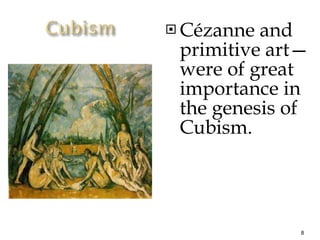
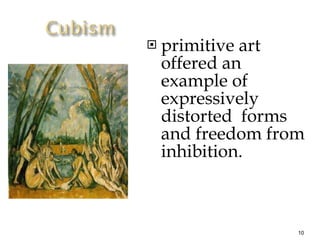
Cézanne and primitive art—were of great importance in the genesis of Cubism.
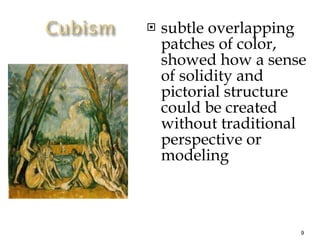
subtle overlapping patches of color, showed how a sense of solidity and pictorial structure could be created without traditional perspective or modeling
primitive art offered an example of expressively distorted  forms and freedom from inhibition.
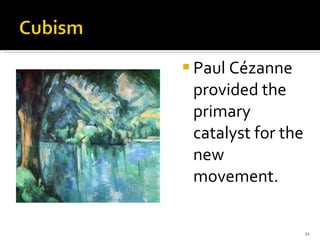
Paul Cézanne provided the primary catalyst for the new movement.
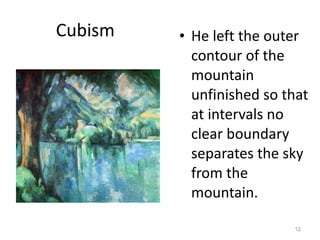
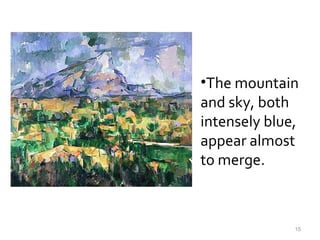
Cubism He left the outer contour of the mountain unfinished so that at intervals no clear boundary separates the sky from the mountain.
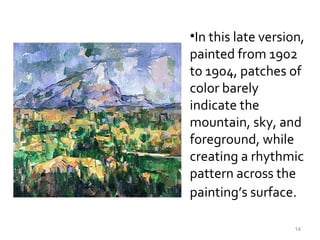
Mont Sainte-Victoire  by Cézanne  The images he produced became flatter, less realistic, and more abstract.
In this late version, painted from 1902 to 1904, patches of color barely indicate the mountain, sky, and foreground, while creating a rhythmic pattern across the painting’s surface.
The mountain and sky, both intensely blue, appear almost to merge.
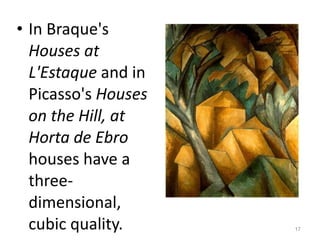
Cubism Picasso and Braque executed a series of landscapes in 1908. They were very close to Cézanne's, both in their color scheme (dark greens and light browns) and in their drastic simplification of form into geometric shapes.
In Braque's  Houses at L'Estaque  and in Picasso's  Houses on the Hill, at Horta de Ebro  houses have a three-dimensional, cubic quality.
It was upon seeing these paintings that French art critic Louis Vauxelles coined the term  cubism .
Cubist ideas and motifs were also used in sculpture, and to a more limited and superficial degree in the applied arts and occasionally in architecture.
Cubism a complex phenomenon, but in essence it involved what Juan Gris (its leading exponent apart from the two founders) called ‘a new way of representing the world’.
Cubism Abandoning the idea of a single fixed viewpoint that had dominated European painting for centuries, Cubist pictures used a multiplicity of viewpoints, so that many different aspects of an object could be simultaneously depicted in the same picture.
Cubism Braque and Picasso's mature Cubist work is usually divided into two phases—Analytical Cubism (1909–11) and Synthetic Cubism (1912–14). I
In the ‘Analytical’ phase, the relatively solid massing of their earliest Cubist paintings gave way to  a process of composition in which the forms of the object depicted are fragmented into a large number of small, intricately hinged planes that fuse with one another and with the surrounding space.
Analytical cubism ( started in 1912) fragments the physical world into intersecting geometric planes and interpenetrating volumes.
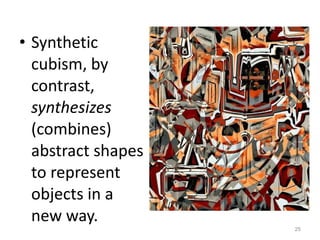
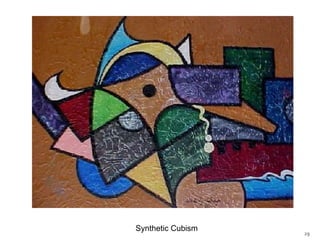
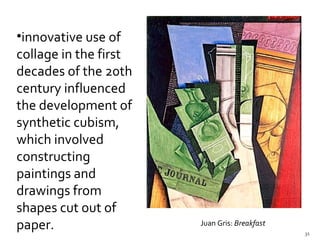
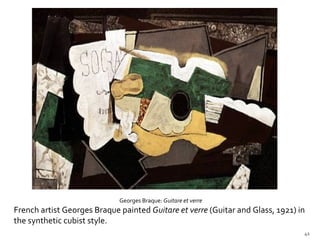
Synthetic cubism, by contrast,  synthesizes  (combines) abstract shapes to represent objects in a new way.
Analytical Cubism
Georges Braque Le Viaduc à L'Estaque , (The Viaduct at L'Estaque), 1908, Paris Oil on canvas, 72.5 x 59 cm,
Synthetic Cubism
Synthetic Cubism
This fascination with pictorial structure led to color being downplayed. archetypal Analytical Cubist paintings are virtually monochromatic, painted in muted browns or warm greys.
innovative use of collage in the first decades of the 20th century influenced the development of synthetic cubism, which involved constructing paintings and drawings from shapes cut out of paper.  Juan Gris:  Breakfast
Cubism proved immensely adaptable and was the starting point or an essential component of several other movements, including Constructivism, Futurism, Orphism, Purism, and Vorticism, as well as a spur to the imagination of countless individual artists.
These included not only painters, but also sculptors, who adapted Cubist ideas in various ways, notably by the opening up of forms so that voids as well as solids form distinct shapes.
Picasso’s  The Three Musicians   (1921)  Features two characters from Italian  commedia dell’arte  theater—Harlequin in the diamond-patterned costume and Pierrot in white.
Picasso’s  The Three Musicians   (1921)  Some experts believe that Harlequin represents Picasso himself.
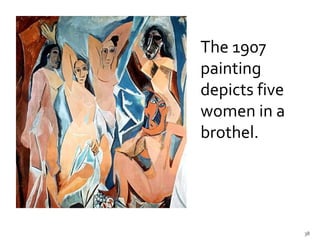
Les Demoiselles d'Avignon   The origins of cubism date to Spanish artist Pablo Picasso’s  Les Demoiselles  according to many art historians.
The 1907 painting depicts five women in a brothel.
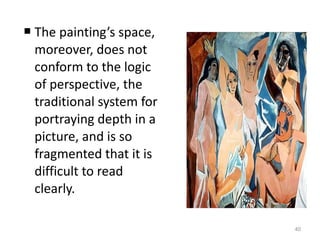
Picasso's  Les Demoiselles D'Avignon  (1907) does violence to the human form by means of radical simplifications, arbitrary and harsh color combinations, and extreme distortions of human anatomy and proportions.
The painting’s space, moreover, does not conform to the logic of perspective, the traditional system for portraying depth in a picture, and is so fragmented that it is difficult to read clearly.
Georges Braque:  Guitare et verre   French artist Georges Braque painted  Guitare et verre  (Guitar and Glass, 1921) in the synthetic cubist style.
one of the greatest and most influential artists of the 20th century and the creator (with Georges Braque) of Cubism.
Science and Charity 1897 Pablo Picasso
First Communion 1896 Pablo Picasso
Pablo Picasso The Gourmet (The White Child) 1901  Pablo Picasso Mother and Child 1905
Lady in Blue 1901 Pablo Picasso
Three Women  Pablo Picasso Oil on canvas; 200 x 185 cm
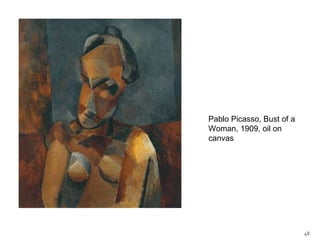
Pablo Picasso, Bust of a Woman, 1909, oil on canvas
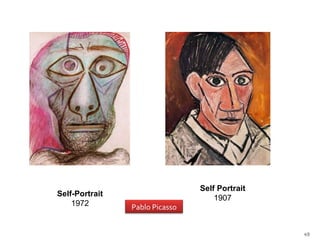
Self Portrait 1907 Self-Portrait 1972 Pablo Picasso
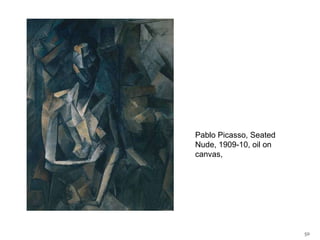
Pablo Picasso, Seated Nude, 1909-10, oil on canvas,
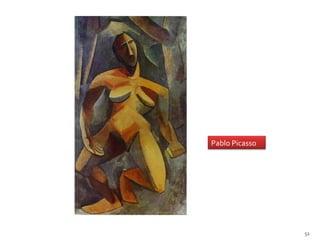
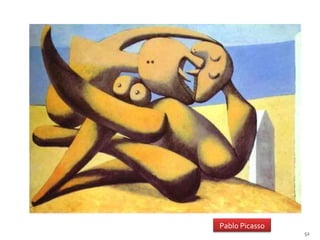
Pablo Picasso
Pablo Picasso
Friendship Pablo Picasso
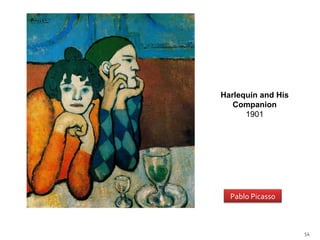
Harlequin and His Companion 1901 Pablo Picasso
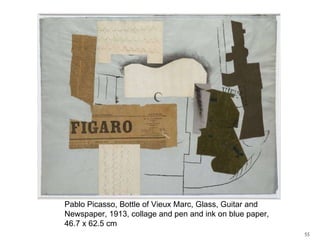
Pablo Picasso, Bottle of Vieux Marc, Glass, Guitar and Newspaper, 1913, collage and pen and ink on blue paper, 46.7 x 62.5 cm
Albert Gleizes (French, 1881-1953), Portrait of Jacques Nayral, 1911
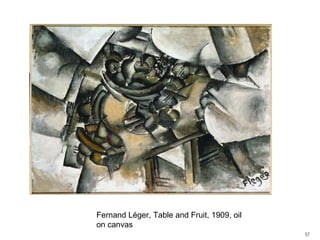
Fernand Léger, Table and Fruit, 1909, oil on canvas
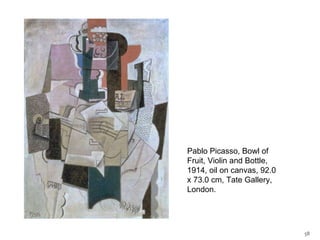
Pablo Picasso, Bowl of Fruit, Violin and Bottle, 1914, oil on canvas, 92.0 x 73.0 cm, Tate Gallery, London.
Pablo Picasso, Still Life, 1914, painted wood and upholstery fringe, relief, 25.4 x 45.7 x 9.2 cm,
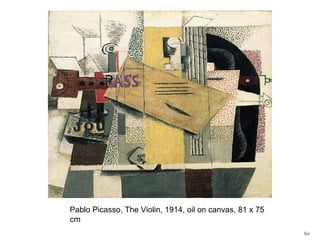
Pablo Picasso, The Violin, 1914, oil on canvas, 81 x 75 cm
Pablo Picasso, Studio of the Milliner, 1926, oil on canvas, 172 x 265 cm
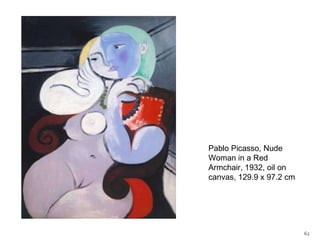
Pablo Picasso, Nude Woman in a Red Armchair, 1932, oil on canvas, 129.9 x 97.2 cm
Composition with a Skull 1908 The Swallows 1932 Pablo Picasso
Reclining Female Nude with Starry Sky 1936 Pablo Picasso
Bust of a Woman 1935 Mother and Child 1901 Pablo Picasso
Guernica Pablo Picasso, 1937  Oil on canvas 349 × 776 cm, 137.4 × 305.5 in  Museo Reina Sofia, Madrid
George Braque (1882-1963) His paintings consist primarily of still lifes that are remarkable for their robust construction, low-key colour harmonies, and serene, meditative quality.
Georges Braque, Large Nude, Paris, spring 1908, oil on canvas, 55 1/4 x 39 1/2 inches
Georges Braque, Castle at La Roche-Guyon, La Roche-Guyon, summer 1909, oil on canvas, 36 1/4 x 28 3/4 inches (92 x 73 cm), Stedelijk van Abbe Museum, Eindhoven, Netherlands.
Raymond Duchamp-Villon (French, 1876-1918),  The Large Horse
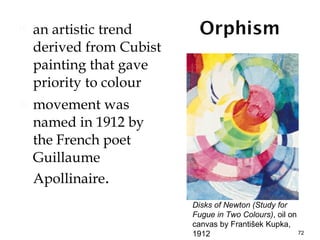
an artistic trend derived from Cubist painting that gave priority to colour movement was named in 1912 by the French poet Guillaume Apollinaire . Disks of Newton (Study for Fugue in Two Colours) , oil on canvas by František Kupka, 1912
Apollinaire regarded the colourful Cubist-inspired paintings of Robert Delaunay as initiating a new style that brought musical qualities to painting Endless Rhythms, 1934
He named this style Orphism in reference to Orpheus, the legendary poet and singer of ancient Greek mythology, who was a popular symbol of the ideal, mystically inspired artist.  Other painters working in this style included Fernand Léger, Francis Picabia, and Marcel Duchamp.
The pig carousel, 1922
Simultaneous Windows On The City, 1912
Relief-Rhythm, 1933 Champs de Mars. La tour rouge, 1911
The Joy Of Life, 1930
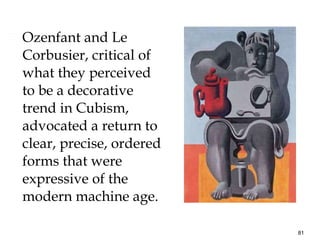
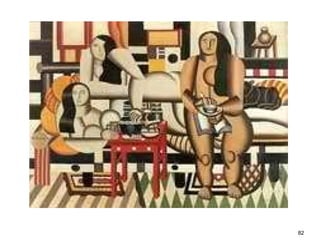
In painting, a variant of Cubism developed in France about 1918 by the painter Amédée Ozenfant and the architect and painter Le Corbusier (Charles-Édouard Jeanneret).
Ozenfant and Le Corbusier, critical of what they perceived to be a decorative trend in Cubism, advocated a return to clear, precise, ordered forms that were expressive of the modern machine age.
Le Corbusier,  Les Mains Le Corbusier,  Trois Bouteilles
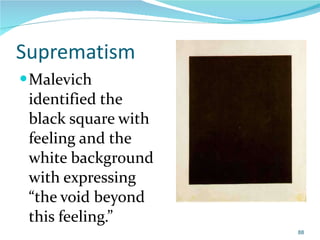
Suprematism first movement of pure geometrical abstraction in painting, originated by Kazimir S. Malevich in Russia in about 1913.
In his first Suprematist work, a pencil drawing of a black square on a white field, all the elements of objective representation that had characterized his earlier, Cubist-Futurist style, had been eliminated .
Suprematism Malevich identified the black square with feeling and the white background with expressing “the void beyond this feeling.”
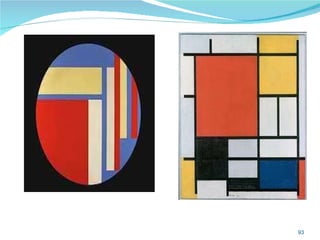
NEO-PLASTICISM An art movement advocating pure abstraction and simplicity — form reduced to the rectangle, and color to the primary colors, along with black and white.
Piet Mondrian (Dutch, 1872-1944) was the group's leading figure. He published a manifesto titled Neo-Plasticism in 1920.
Charles Demuth  I Saw the Figure 5 in Gold
Precisionism smooth, sharply defined painting style used by several American artists in representational canvases executed primarily during the 1920s.
Favourite subjects for these artists include: skylines (both urban and rural) buildings and machinery industrial landscape of factories and smokestacks,  country landscape of grain elevators and barns.
Among the artists associated with Precisionism were Charles Demuth, Charles Sheeler, Ralston Crawford, Preston Dickinson, Niles Spencer, and Georgia O'Keeffe. Red Canna , Georgia O’Keefe, 1923
Georgia O’Keefe Black and Purple Ralston Crawford Corpus Christi

Cubism

  • 2.
    Cubism, movement in modern art, especially inpainting, invented by Spanish artist Pablo Picasso and French artist Georges Braque in 1907 and 1908.
  • 3.
    Although the lookof cubism and the ideas behind it evolved over time, cubism retained certain general characteristics throughout.
  • 4.
    Cubism Cubist paintingscreate an ambiguous sense of space through geometric shapes that flatten and simplify form spatial planes that are broken into fragments forms that overlap and penetrate one another.
  • 5.
    Art historians generallyconsider cubism to have been the most influential art movement of the first half of the 20th century.
  • 6.
    The exact date of  cubism'sfirst appearance in art has been the subject of heated debate among art historians.
  • 7.
    Cubism Some seeits onset in Picasso's Les Demoiselles d'Avignon (1907, Museum of Modern Art, New York City) It is a painting of women composed of jagged shapes, flattened figures, and forms borrowed from African masks.
  • 8.
    Cézanne and primitiveart—were of great importance in the genesis of Cubism.
  • 9.
    subtle overlapping patchesof color, showed how a sense of solidity and pictorial structure could be created without traditional perspective or modeling
  • 10.
    primitive art offeredan example of expressively distorted forms and freedom from inhibition.
  • 11.
    Paul Cézanne providedthe primary catalyst for the new movement.
  • 12.
    Cubism He leftthe outer contour of the mountain unfinished so that at intervals no clear boundary separates the sky from the mountain.
  • 13.
    Mont Sainte-Victoire by Cézanne The images he produced became flatter, less realistic, and more abstract.
  • 14.
    In this lateversion, painted from 1902 to 1904, patches of color barely indicate the mountain, sky, and foreground, while creating a rhythmic pattern across the painting’s surface.
  • 15.
    The mountain andsky, both intensely blue, appear almost to merge.
  • 16.
    Cubism Picasso andBraque executed a series of landscapes in 1908. They were very close to Cézanne's, both in their color scheme (dark greens and light browns) and in their drastic simplification of form into geometric shapes.
  • 17.
    In Braque's Houses at L'Estaque and in Picasso's Houses on the Hill, at Horta de Ebro houses have a three-dimensional, cubic quality.
  • 18.
    It was uponseeing these paintings that French art critic Louis Vauxelles coined the term cubism .
  • 19.
    Cubist ideas andmotifs were also used in sculpture, and to a more limited and superficial degree in the applied arts and occasionally in architecture.
  • 20.
    Cubism a complexphenomenon, but in essence it involved what Juan Gris (its leading exponent apart from the two founders) called ‘a new way of representing the world’.
  • 21.
    Cubism Abandoning theidea of a single fixed viewpoint that had dominated European painting for centuries, Cubist pictures used a multiplicity of viewpoints, so that many different aspects of an object could be simultaneously depicted in the same picture.
  • 22.
    Cubism Braque andPicasso's mature Cubist work is usually divided into two phases—Analytical Cubism (1909–11) and Synthetic Cubism (1912–14). I
  • 23.
    In the ‘Analytical’phase, the relatively solid massing of their earliest Cubist paintings gave way to a process of composition in which the forms of the object depicted are fragmented into a large number of small, intricately hinged planes that fuse with one another and with the surrounding space.
  • 24.
    Analytical cubism (started in 1912) fragments the physical world into intersecting geometric planes and interpenetrating volumes.
  • 25.
    Synthetic cubism, bycontrast, synthesizes (combines) abstract shapes to represent objects in a new way.
  • 26.
  • 27.
    Georges Braque LeViaduc à L'Estaque , (The Viaduct at L'Estaque), 1908, Paris Oil on canvas, 72.5 x 59 cm,
  • 28.
  • 29.
  • 30.
    This fascination withpictorial structure led to color being downplayed. archetypal Analytical Cubist paintings are virtually monochromatic, painted in muted browns or warm greys.
  • 31.
    innovative use ofcollage in the first decades of the 20th century influenced the development of synthetic cubism, which involved constructing paintings and drawings from shapes cut out of paper. Juan Gris: Breakfast
  • 33.
    Cubism proved immenselyadaptable and was the starting point or an essential component of several other movements, including Constructivism, Futurism, Orphism, Purism, and Vorticism, as well as a spur to the imagination of countless individual artists.
  • 34.
    These included notonly painters, but also sculptors, who adapted Cubist ideas in various ways, notably by the opening up of forms so that voids as well as solids form distinct shapes.
  • 35.
    Picasso’s TheThree Musicians (1921) Features two characters from Italian commedia dell’arte theater—Harlequin in the diamond-patterned costume and Pierrot in white.
  • 36.
    Picasso’s TheThree Musicians (1921) Some experts believe that Harlequin represents Picasso himself.
  • 37.
    Les Demoiselles d'Avignon The origins of cubism date to Spanish artist Pablo Picasso’s Les Demoiselles according to many art historians.
  • 38.
    The 1907 paintingdepicts five women in a brothel.
  • 39.
    Picasso's LesDemoiselles D'Avignon (1907) does violence to the human form by means of radical simplifications, arbitrary and harsh color combinations, and extreme distortions of human anatomy and proportions.
  • 40.
    The painting’s space,moreover, does not conform to the logic of perspective, the traditional system for portraying depth in a picture, and is so fragmented that it is difficult to read clearly.
  • 41.
    Georges Braque: Guitare et verre French artist Georges Braque painted Guitare et verre (Guitar and Glass, 1921) in the synthetic cubist style.
  • 42.
    one of thegreatest and most influential artists of the 20th century and the creator (with Georges Braque) of Cubism.
  • 43.
    Science and Charity1897 Pablo Picasso
  • 44.
    First Communion 1896Pablo Picasso
  • 45.
    Pablo Picasso TheGourmet (The White Child) 1901 Pablo Picasso Mother and Child 1905
  • 46.
    Lady in Blue1901 Pablo Picasso
  • 47.
    Three Women Pablo Picasso Oil on canvas; 200 x 185 cm
  • 48.
    Pablo Picasso, Bustof a Woman, 1909, oil on canvas
  • 49.
    Self Portrait 1907Self-Portrait 1972 Pablo Picasso
  • 50.
    Pablo Picasso, SeatedNude, 1909-10, oil on canvas,
  • 51.
  • 52.
  • 53.
  • 54.
    Harlequin and HisCompanion 1901 Pablo Picasso
  • 55.
    Pablo Picasso, Bottleof Vieux Marc, Glass, Guitar and Newspaper, 1913, collage and pen and ink on blue paper, 46.7 x 62.5 cm
  • 56.
    Albert Gleizes (French,1881-1953), Portrait of Jacques Nayral, 1911
  • 57.
    Fernand Léger, Tableand Fruit, 1909, oil on canvas
  • 58.
    Pablo Picasso, Bowlof Fruit, Violin and Bottle, 1914, oil on canvas, 92.0 x 73.0 cm, Tate Gallery, London.
  • 59.
    Pablo Picasso, StillLife, 1914, painted wood and upholstery fringe, relief, 25.4 x 45.7 x 9.2 cm,
  • 60.
    Pablo Picasso, TheViolin, 1914, oil on canvas, 81 x 75 cm
  • 61.
    Pablo Picasso, Studioof the Milliner, 1926, oil on canvas, 172 x 265 cm
  • 62.
    Pablo Picasso, NudeWoman in a Red Armchair, 1932, oil on canvas, 129.9 x 97.2 cm
  • 63.
    Composition with aSkull 1908 The Swallows 1932 Pablo Picasso
  • 64.
    Reclining Female Nudewith Starry Sky 1936 Pablo Picasso
  • 65.
    Bust of aWoman 1935 Mother and Child 1901 Pablo Picasso
  • 66.
    Guernica Pablo Picasso,1937 Oil on canvas 349 × 776 cm, 137.4 × 305.5 in Museo Reina Sofia, Madrid
  • 67.
    George Braque (1882-1963)His paintings consist primarily of still lifes that are remarkable for their robust construction, low-key colour harmonies, and serene, meditative quality.
  • 68.
    Georges Braque, LargeNude, Paris, spring 1908, oil on canvas, 55 1/4 x 39 1/2 inches
  • 69.
    Georges Braque, Castleat La Roche-Guyon, La Roche-Guyon, summer 1909, oil on canvas, 36 1/4 x 28 3/4 inches (92 x 73 cm), Stedelijk van Abbe Museum, Eindhoven, Netherlands.
  • 70.
    Raymond Duchamp-Villon (French,1876-1918), The Large Horse
  • 72.
    an artistic trendderived from Cubist painting that gave priority to colour movement was named in 1912 by the French poet Guillaume Apollinaire . Disks of Newton (Study for Fugue in Two Colours) , oil on canvas by František Kupka, 1912
  • 73.
    Apollinaire regarded thecolourful Cubist-inspired paintings of Robert Delaunay as initiating a new style that brought musical qualities to painting Endless Rhythms, 1934
  • 74.
    He named thisstyle Orphism in reference to Orpheus, the legendary poet and singer of ancient Greek mythology, who was a popular symbol of the ideal, mystically inspired artist. Other painters working in this style included Fernand Léger, Francis Picabia, and Marcel Duchamp.
  • 75.
  • 76.
  • 77.
    Relief-Rhythm, 1933 Champsde Mars. La tour rouge, 1911
  • 78.
    The Joy OfLife, 1930
  • 80.
    In painting, avariant of Cubism developed in France about 1918 by the painter Amédée Ozenfant and the architect and painter Le Corbusier (Charles-Édouard Jeanneret).
  • 81.
    Ozenfant and LeCorbusier, critical of what they perceived to be a decorative trend in Cubism, advocated a return to clear, precise, ordered forms that were expressive of the modern machine age.
  • 84.
    Le Corbusier, Les Mains Le Corbusier, Trois Bouteilles
  • 86.
    Suprematism first movementof pure geometrical abstraction in painting, originated by Kazimir S. Malevich in Russia in about 1913.
  • 87.
    In his firstSuprematist work, a pencil drawing of a black square on a white field, all the elements of objective representation that had characterized his earlier, Cubist-Futurist style, had been eliminated .
  • 88.
    Suprematism Malevich identifiedthe black square with feeling and the white background with expressing “the void beyond this feeling.”
  • 91.
    NEO-PLASTICISM An artmovement advocating pure abstraction and simplicity — form reduced to the rectangle, and color to the primary colors, along with black and white.
  • 92.
    Piet Mondrian (Dutch,1872-1944) was the group's leading figure. He published a manifesto titled Neo-Plasticism in 1920.
  • 94.
    Charles Demuth I Saw the Figure 5 in Gold
  • 95.
    Precisionism smooth, sharplydefined painting style used by several American artists in representational canvases executed primarily during the 1920s.
  • 96.
    Favourite subjects forthese artists include: skylines (both urban and rural) buildings and machinery industrial landscape of factories and smokestacks, country landscape of grain elevators and barns.
  • 97.
    Among the artistsassociated with Precisionism were Charles Demuth, Charles Sheeler, Ralston Crawford, Preston Dickinson, Niles Spencer, and Georgia O'Keeffe. Red Canna , Georgia O’Keefe, 1923
  • 98.
    Georgia O’Keefe Blackand Purple Ralston Crawford Corpus Christi