By: 
Shiva Shrestha 
Lecturer 
Hetauda School Of Management 
Hetauda 
Shiva Shrestha, HSM, Hetauda 7 November 2014 1
 Definition 
 Types of Decisions 
 Decision Making Conditions 
 Decision Making Process 
 Models of Decision Making Process 
 Decision Trees 
 Decision Styles 
 Decision Theories 
 Group Decision Making 
 Improving Decision Making 
Shiva Shrestha, HSM, Hetauda 7 November 2014 2
 Decision is “ an act of making choices” 
 A decision is a choice among alternative 
course of action of dealing with a problem. 
 In fact, it is a complete mental activity. 
 Decision are the response to problem and the 
results of a process of thought and deliberation. 
 Decision making is the act of choosing one 
alternative from among a set of alternatives. 
 Decision Theory provides an analytical and 
systematic approach to the study of Decision 
making. 
Shiva Shrestha, HSM, Hetauda 7 November 2014 3
 Decision Alternatives: There is a finite 
number of decision alternatives available 
with the decision-maker at each point in 
time when a decision is made. The number 
and type of such alternatives may depend 
on the previous decision made and on what 
has happened subsequent to those 
decisions. These alternatives are also called 
courses of action[ action, acts or strategies] 
and are under control and known to the 
decision maker. 
Shiva Shrestha, HSM, Hetauda 7 November 2014 4
 State Of Nature: A possible future condition 
( consequence or event) resulting from the 
choice of a decision alternatives depends 
upon certain factors beyond the control of 
the decision maker. For example: If the 
decision is to carry an umbrella or not, the 
consequence [ get wet or do not] depends on 
what action nature takes. 
 Payoff: A numerical value resulting from each 
possible combination of alternatives and state 
of nature is called payoff. The payoff values 
are always conditional values because of 
unknown state of nature. 
Shiva Shrestha, HSM, Hetauda 7 November 2014 5
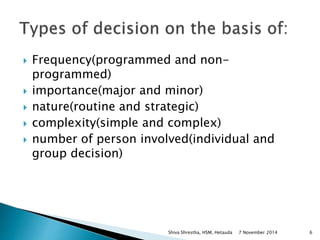
 Frequency(programmed and non-programmed) 
 importance(major and minor) 
 nature(routine and strategic) 
 complexity(simple and complex) 
 number of person involved(individual and 
group decision) 
Shiva Shrestha, HSM, Hetauda 7 November 2014 6
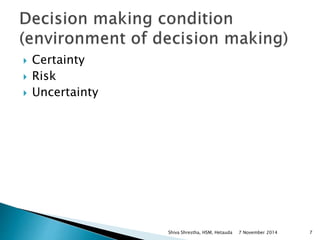
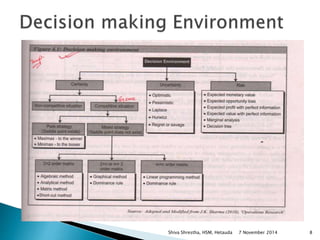
 Certainty 
 Risk 
 Uncertainty 
Shiva Shrestha, HSM, Hetauda 7 November 2014 7
Shiva Shrestha, HSM, Hetauda 7 November 2014 8
Shiva Shrestha, HSM, Hetauda 7 November 2014 9
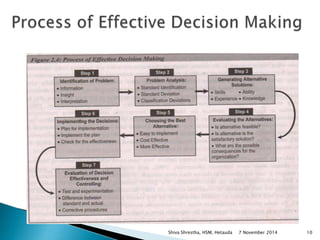
Shiva Shrestha, HSM, Hetauda 7 November 2014 10
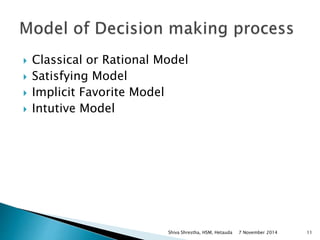
 Classical or Rational Model 
 Satisfying Model 
 Implicit Favorite Model 
 Intutive Model 
Shiva Shrestha, HSM, Hetauda 7 November 2014 11
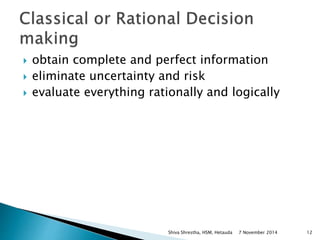
 obtain complete and perfect information 
 eliminate uncertainty and risk 
 evaluate everything rationally and logically 
Shiva Shrestha, HSM, Hetauda 7 November 2014 12
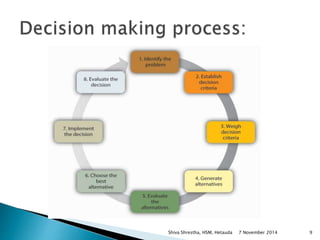
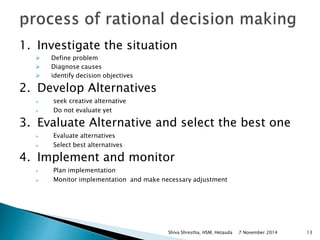
1. Investigate the situation 
 Define problem 
 Diagnose causes 
 identify decision objectives 
2. Develop Alternatives 
 seek creative alternative 
 Do not evaluate yet 
3. Evaluate Alternative and select the best one 
 Evaluate alternatives 
 Select best alternatives 
4. Implement and monitor 
 Plan implementation 
 Monitor implementation and make necessary adjustment 
Shiva Shrestha, HSM, Hetauda 7 November 2014 13
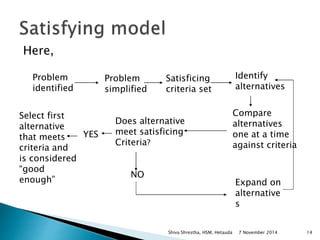
Here, 
Expand on 
alternative 
s 
Does alternative 
meet satisficing 
Criteria? 
Problem 
identified 
Select first 
alternative 
that meets 
criteria and 
is considered 
“good 
enough” 
Problem 
simplified 
Satisficing 
criteria set 
Identify 
alternatives 
Compare 
alternatives 
one at a time 
against criteria 
YES 
NO 
Shiva Shrestha, HSM, Hetauda 7 November 2014 14
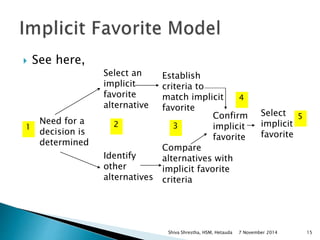
 See here, 
Need for a 
decision is 
determined 
Select an 
implicit 
favorite 
alternative 
Identify 
other 
alternatives 
Establish 
criteria to 
match implicit 
favorite 
Confirm 
implicit 
favorite 
Compare 
alternatives with 
implicit favorite 
criteria 
Select 
implicit 
favorite 
1 2 3 
4 
5 
Shiva Shrestha, HSM, Hetauda 7 November 2014 15
 When high level of uncertainty exists 
 When the variables are less scientifically 
predictable 
 When facts are limited 
 When the facts do not point the way to go 
 When analytical data are of little use 
Shiva Shrestha, HSM, Hetauda 7 November 2014 16
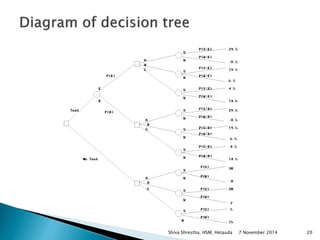
 graphic form of a number of possible future 
events that may affect a decision. 
 it is one the devices for representing a 
diagrammatic presentation of sequential and 
multi-dimensional aspects of a particular 
decision problem for systematic analysis and 
evaluation is decision tree. 
Shiva Shrestha, HSM, Hetauda 7 November 2014 17
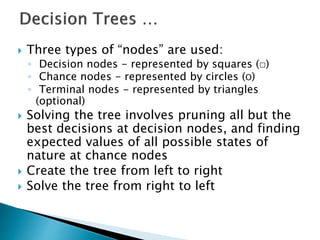
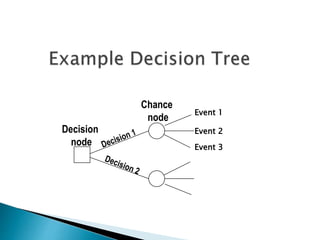
 Three types of “nodes” are used: 
◦ Decision nodes - represented by squares (□) 
◦ Chance nodes - represented by circles (Ο) 
◦ Terminal nodes - represented by triangles 
(optional) 
 Solving the tree involves pruning all but the 
best decisions at decision nodes, and finding 
expected values of all possible states of 
nature at chance nodes 
 Create the tree from left to right 
 Solve the tree from right to left
Decision 
node 
Chance 
node 
Event 1 
Event 2 
Event 3
Shiva Shrestha, HSM, Hetauda 7 November 2014 20
 GDM refers the decision which are taken by a 
group of organizational members. 
 Group can make higher quality decision than 
individual. 
 GDM is appropriate for non programmed 
decision.
 Generates more information ,ideas and 
solutions. 
 Generates the more alternatives . 
 Increase the acceptance of the solution. 
 Builds the leadership skills.
 Require better group management skill. 
 Create conflict between the supervisor and 
subordinates. 
 Time consuming. 
 Unclear responsibility.
 To improve the decision making following 
guidelines can be used by manager. 
1. Improving individual decision making. 
2. Improving group decision making.
 Increase the information input. 
 Proper communication. 
 Select appropriate timing 
 change the personal habit. 
 Avoid the prejudice and biasness. 
 Calculate the risk.
 Following technique are used to improve the 
GDM. 
a. Interacting group. 
b. Brainstorming. 
c. Delphi technique . 
d. Nominal group technique 
e. Electronic meeting
 Involving 5 to 10 person 
 individual generates ideas. 
 All the generated ideas are written in the 
board. 
 No ideas can be criticized.
 Similar to brainstorming. 
 It is the structure technique used to generate 
the creative and innovative ideas. 
 That idea will be accepted which holds the 
highest rank.
 This method is traditional method. 
 In this method all the member meet face to 
face and convey their information orally or 
non orally. 
 All member provide equal opportunity to 
provoke their experience.
 There is no face to face contact. 
 Each member writes comment, suggestion 
and solution of the problem. 
 All the comment are sent to the central 
location. 
 Each member is sent the written comment of 
all other member. 
 Each member provides feedback on others 
comment and forward to central location.
 Thank you !!! 
Shiva Shrestha, HSM, Hetauda 7 November 2014 31

CTDM: 7Th semester : Unit 2 decision theory

  • 1.
    By: Shiva Shrestha Lecturer Hetauda School Of Management Hetauda Shiva Shrestha, HSM, Hetauda 7 November 2014 1
  • 2.
     Definition Types of Decisions  Decision Making Conditions  Decision Making Process  Models of Decision Making Process  Decision Trees  Decision Styles  Decision Theories  Group Decision Making  Improving Decision Making Shiva Shrestha, HSM, Hetauda 7 November 2014 2
  • 3.
     Decision is“ an act of making choices”  A decision is a choice among alternative course of action of dealing with a problem.  In fact, it is a complete mental activity.  Decision are the response to problem and the results of a process of thought and deliberation.  Decision making is the act of choosing one alternative from among a set of alternatives.  Decision Theory provides an analytical and systematic approach to the study of Decision making. Shiva Shrestha, HSM, Hetauda 7 November 2014 3
  • 4.
     Decision Alternatives:There is a finite number of decision alternatives available with the decision-maker at each point in time when a decision is made. The number and type of such alternatives may depend on the previous decision made and on what has happened subsequent to those decisions. These alternatives are also called courses of action[ action, acts or strategies] and are under control and known to the decision maker. Shiva Shrestha, HSM, Hetauda 7 November 2014 4
  • 5.
     State OfNature: A possible future condition ( consequence or event) resulting from the choice of a decision alternatives depends upon certain factors beyond the control of the decision maker. For example: If the decision is to carry an umbrella or not, the consequence [ get wet or do not] depends on what action nature takes.  Payoff: A numerical value resulting from each possible combination of alternatives and state of nature is called payoff. The payoff values are always conditional values because of unknown state of nature. Shiva Shrestha, HSM, Hetauda 7 November 2014 5
  • 6.
     Frequency(programmed andnon-programmed)  importance(major and minor)  nature(routine and strategic)  complexity(simple and complex)  number of person involved(individual and group decision) Shiva Shrestha, HSM, Hetauda 7 November 2014 6
  • 7.
     Certainty Risk  Uncertainty Shiva Shrestha, HSM, Hetauda 7 November 2014 7
  • 8.
    Shiva Shrestha, HSM,Hetauda 7 November 2014 8
  • 9.
    Shiva Shrestha, HSM,Hetauda 7 November 2014 9
  • 10.
    Shiva Shrestha, HSM,Hetauda 7 November 2014 10
  • 11.
     Classical orRational Model  Satisfying Model  Implicit Favorite Model  Intutive Model Shiva Shrestha, HSM, Hetauda 7 November 2014 11
  • 12.
     obtain completeand perfect information  eliminate uncertainty and risk  evaluate everything rationally and logically Shiva Shrestha, HSM, Hetauda 7 November 2014 12
  • 13.
    1. Investigate thesituation  Define problem  Diagnose causes  identify decision objectives 2. Develop Alternatives  seek creative alternative  Do not evaluate yet 3. Evaluate Alternative and select the best one  Evaluate alternatives  Select best alternatives 4. Implement and monitor  Plan implementation  Monitor implementation and make necessary adjustment Shiva Shrestha, HSM, Hetauda 7 November 2014 13
  • 14.
    Here, Expand on alternative s Does alternative meet satisficing Criteria? Problem identified Select first alternative that meets criteria and is considered “good enough” Problem simplified Satisficing criteria set Identify alternatives Compare alternatives one at a time against criteria YES NO Shiva Shrestha, HSM, Hetauda 7 November 2014 14
  • 15.
     See here, Need for a decision is determined Select an implicit favorite alternative Identify other alternatives Establish criteria to match implicit favorite Confirm implicit favorite Compare alternatives with implicit favorite criteria Select implicit favorite 1 2 3 4 5 Shiva Shrestha, HSM, Hetauda 7 November 2014 15
  • 16.
     When highlevel of uncertainty exists  When the variables are less scientifically predictable  When facts are limited  When the facts do not point the way to go  When analytical data are of little use Shiva Shrestha, HSM, Hetauda 7 November 2014 16
  • 17.
     graphic formof a number of possible future events that may affect a decision.  it is one the devices for representing a diagrammatic presentation of sequential and multi-dimensional aspects of a particular decision problem for systematic analysis and evaluation is decision tree. Shiva Shrestha, HSM, Hetauda 7 November 2014 17
  • 18.
     Three typesof “nodes” are used: ◦ Decision nodes - represented by squares (□) ◦ Chance nodes - represented by circles (Ο) ◦ Terminal nodes - represented by triangles (optional)  Solving the tree involves pruning all but the best decisions at decision nodes, and finding expected values of all possible states of nature at chance nodes  Create the tree from left to right  Solve the tree from right to left
  • 19.
    Decision node Chance node Event 1 Event 2 Event 3
  • 20.
    Shiva Shrestha, HSM,Hetauda 7 November 2014 20
  • 21.
     GDM refersthe decision which are taken by a group of organizational members.  Group can make higher quality decision than individual.  GDM is appropriate for non programmed decision.
  • 22.
     Generates moreinformation ,ideas and solutions.  Generates the more alternatives .  Increase the acceptance of the solution.  Builds the leadership skills.
  • 23.
     Require bettergroup management skill.  Create conflict between the supervisor and subordinates.  Time consuming.  Unclear responsibility.
  • 24.
     To improvethe decision making following guidelines can be used by manager. 1. Improving individual decision making. 2. Improving group decision making.
  • 25.
     Increase theinformation input.  Proper communication.  Select appropriate timing  change the personal habit.  Avoid the prejudice and biasness.  Calculate the risk.
  • 26.
     Following techniqueare used to improve the GDM. a. Interacting group. b. Brainstorming. c. Delphi technique . d. Nominal group technique e. Electronic meeting
  • 27.
     Involving 5to 10 person  individual generates ideas.  All the generated ideas are written in the board.  No ideas can be criticized.
  • 28.
     Similar tobrainstorming.  It is the structure technique used to generate the creative and innovative ideas.  That idea will be accepted which holds the highest rank.
  • 29.
     This methodis traditional method.  In this method all the member meet face to face and convey their information orally or non orally.  All member provide equal opportunity to provoke their experience.
  • 30.
     There isno face to face contact.  Each member writes comment, suggestion and solution of the problem.  All the comment are sent to the central location.  Each member is sent the written comment of all other member.  Each member provides feedback on others comment and forward to central location.
  • 31.
     Thank you!!! Shiva Shrestha, HSM, Hetauda 7 November 2014 31