 Decision making is not easy
 It must be done amid
◦ ever-changing factors
◦ unclear information
◦ conflicting points of view
2
 Decision Characteristics
 Decision-making Models
 Steps Executives Take Making Important
Decisions
 Participative Decision Making
 Techniques for Improving Decision Making in
Today’s Organizations
3
 Decision : choice made from available
alternatives
 Decision Making : process of
identifying problems and opportunities
and resolving them
4
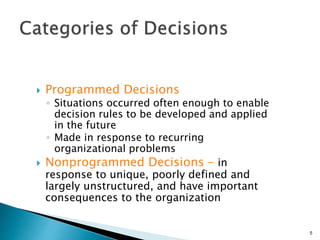
 Programmed Decisions
◦ Situations occurred often enough to enable
decision rules to be developed and applied
in the future
◦ Made in response to recurring
organizational problems
 Nonprogrammed Decisions – in
response to unique, poorly defined and
largely unstructured, and have important
consequences to the organization
5
 Many decisions that managers deal
with every day involve at least some
degree of uncertainty and require
nonprogrammed decision making
 May be difficult to make
 Made amid changing factors
 Information may be unclear
 May have to deal with conflicting points of view
6
● Certainty
● all the information the decision maker needs is fully available
● Risk
● decision has clear-cut goals
● good information is available
● future outcomes associated with each alternative are subject
to chance
● Uncertainty
● managers know which goals they wish to achieve
● information about alternatives and future events is
incomplete
● managers may have to come up with creative approaches to
alternatives
● Ambiguity
● by far the most difficult decision situation
● goals to be achieved or the problem to be solved is unclear
● alternatives are difficult to define
● information about outcomes is unavailable
7
8
Organizational
Problem
Problem
Solution
Low High
Possibility of Failure
Certainty Risk Uncertainty Ambiguity
Programmed
Decisions
Nonprogrammed
Decisions
 Depends on the manager’s personal preference
 Whether the decision is programmed or non-
programmed
 Extent to which the decision is characterized by
risk, uncertainty, or ambiguity
9
10
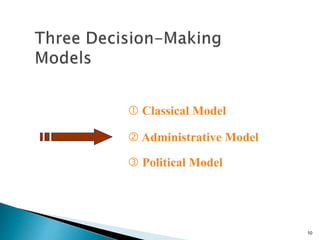
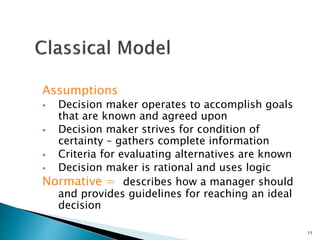
 Classical Model
 Administrative Model
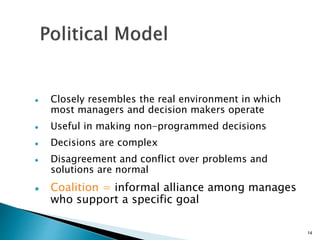
 Political Model
Assumptions
 Decision maker operates to accomplish goals
that are known and agreed upon
 Decision maker strives for condition of
certainty – gathers complete information
 Criteria for evaluating alternatives are known
 Decision maker is rational and uses logic
Normative = describes how a manager should
and provides guidelines for reaching an ideal
decision
11
Logical decision in the organization’s best economic interests
 Two concepts are instrumental in shaping the
administrative model
● Bounded rationality: people have limits or
boundaries on how rational they can be
● Satisficing: means that decision makers choose the
first solution alternative that satisfies minimal
decision criteria
12
How nonprogrammed decisions are made--uncertainty/ambiguity
by Herbert A. Simon
Managers actually make decisions in difficult situations
characterized by non-programmed decisions, uncertainty,
and ambiguity
● Decision goals often are vague, conflicting and lack
consensus among managers;
● Rational procedures are not always used
● Managers’ searches for alternatives are limited
● Managers settle for a satisficing rather than a maximizing
solution
● intuition, looks to past experience
Descriptive = how managers actually make decisions--
not how they should
13
How nonprogrammed decisions are made--uncertainty/ambiguity
● Closely resembles the real environment in which
most managers and decision makers operate
● Useful in making non-programmed decisions
● Decisions are complex
● Disagreement and conflict over problems and
solutions are normal
● Coalition = informal alliance among manages
who support a specific goal
14
Closely resembles the real environment
15
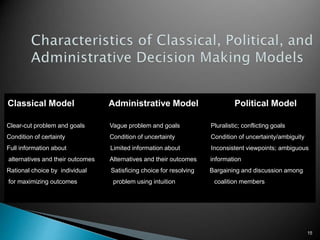
Classical Model Administrative Model Political Model
Clear-cut problem and goals Vague problem and goals Pluralistic; conflicting goals
Condition of certainty Condition of uncertainty Condition of uncertainty/ambiguity
Full information about Limited information about Inconsistent viewpoints; ambiguous
alternatives and their outcomes Alternatives and their outcomes information
Rational choice by individual Satisficing choice for resolving Bargaining and discussion among
for maximizing outcomes problem using intuition coalition members
16
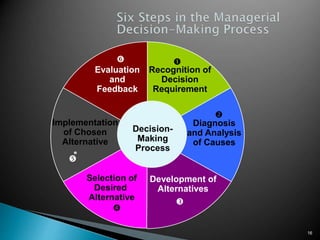
Evaluation
and
Feedback
Diagnosis
and Analysis
of Causes
Recognition of
Decision
Requirement
Development of
Alternatives
Selection of
Desired
Alternative
Implementation
of Chosen
Alternative
Decision-
Making
Process
 





 Diagnosis = analyze underlying causal
factors associated with the decision situation
 Managers make a mistake if they jump into
generating alternatives without first exploring
the cause of the problem more deeply
17
 What is the state of disequilibrium affecting us?
 When did it occur?
 Where did it occur?
 How did it occur?
 To whom did it occur?
 What is the urgency of the problem?
 What is the interconnectedness of events?
 What result came from which activity?
18
 Risk Propensity = willingness to undertake
risk with the opportunity of gaining an
increased payoff
 Implementation = using managerial,
administrative, and persuasive abilities to
translate the chosen alternative into action
19
 Differences among people with respect to
how they perceive problems and make
decisions
 Not all managers make decisions the same
◦ Directive style
◦ Analytical style
◦ Conceptual style
◦ Behavioral style
20
21
Situation:
· Programmed/non-
programmed
· Classical, administrative,
political
· Decision steps
Decision Choice:
·Best Solution to
Problem
Personal Decision
Style:
·Directive
·Analytical
·Conceptual
·Behavioral
 People who prefer simple, clear-cut solutions
to problems
 Make decisions quickly
 May consider only one or two alternatives
 Efficient and rational
 Prefer rules or procedures
22
 Complex solutions based on as much data as
they can gather
 Carefully consider alternatives
 Base decision on objective, rational data from
management control systems and other
sources
 Search for best possible decision based on
information available
23
 Consider a broad amount of information
 More socially oriented than analytical style
 Like to talk to others about the problem and
possible solutions
 Consider many broad alternatives
 Relay on information from people and systems
 Solve problems creatively
24
 Have a deep concern for others as individuals
 Like to talk to people one-on-one
 Understand their feelings about the problem
and the effect of a given decision upon them
 Concerned with the personal development of
others
 May make decisions to help others achieve their
goals
25
 Helps gauge the appropriate amount of
participation for subordinates in process
● Leader Participation Styles
 Five levels of subordinate participation in decision
making ranging from highly autocratic to highly
democratic
26
Vroom-Jago
Model
Diagnostic Questions
 Decision participation depends on the
responses to seven diagnostic questions
about
● the problem
● the required level of decision quality
● the importance of having subordinates commit to
the decision
27
Vroom-Jago
Model
 How significant is the decision?
 How important is subordinate commitment?
 What is the level of the leader’s expertise?
 If the leader were to make the decision alone at what
level would subordinates be committed to the
decision?
 What level is the subordinate’s support for the team
or organization’s objectives?
 What is the member’s level of knowledge or expertise
relative to the problem?
 How skilled or committed are group members to
working together?
28
29
New
Decision
Approaches
for Turbulent
Times
New Decision Approaches
for Turbulent Times
 A decision tree is a graph that uses a branching
method to illustrate every possible outcome of a
decision.
 Decision trees can be drawn by hand or created with
a graphics program or specialized software.
Informally, decision trees are useful for focusing
discussion when a group must make a decision.
Programmatically, they can be used to assign
monetary/time or other values to possible outcomes
so that decisions can be automated. Decision tree
software is used in data mining to simplify complex
strategic challenges and evaluate the cost-
effectiveness of research and business decisions.
Variables in a decision tree are usually represented by
circles.
30
 Decision trees are a comprehensive tool for
modeling all possible decision options.
 While influence diagrams produce a compact
summary of a problem, decision trees can
show the problem in greater detail.
 Decision trees describe events in
chronological order but can be much larger
than influence diagrams.
 It utilizes a network of two types of nodes:
decision (choice) nodes, and states of nature
(chance) nodes
 Square represents decisions to be made.
 Circles represents chance events. Chance
nodes, are random variables and they represent
uncertain quantities that are relevant to the
decision problem.
 Branches from a square correspond to the
choices available to the decision maker.
 Branches from a circle represent the possible
outcome of a chance event.
 The consequence is specified at the ends of the
branches.
 Venture capitalist's situation in decision
weather to invest in a new business.
 Objective: to make money.
Do not Invest
Typical Return Earned on Less Risky Investment
Venture Succeeds
Venture Fails
Large Return On Investment
Funds Lost
Invest
 The options represented by branches from a
decision node must be such that the decision
maker can choose only one option.
 Each chance node must have branches that
correspond to a set of mutually exclusive and
collectively exclusive outcomes ( only one of
them can happen, No other possibilities exit)
 A Decision Tree must show all the possible
paths that the decision maker might follow
through time. Including all possible decision
alternatives.
 Some times the nodes might occur in a time
sequence.
 The sequence of decisions is shown in the tree
from left to right.
 An email management decision tree might begin with a box
labeled “Receive new message.” From that, one branch
leading off might lead to “Requires immediate response.”
From there, a “Yes” box leads to a single decision: “Respond.”
A “No” box leads to “Will take less than three minutes to
answer” or “Will take more than three minutes to answer.”
From the first box, a box leads to “Respond” and from the
second box, a branch leads to “Mark as task and assign
priority.” The branches might converge after that to “Email
responded to? File or delete message.”
35

decision making.ppt

  • 2.
     Decision makingis not easy  It must be done amid ◦ ever-changing factors ◦ unclear information ◦ conflicting points of view 2
  • 3.
     Decision Characteristics Decision-making Models  Steps Executives Take Making Important Decisions  Participative Decision Making  Techniques for Improving Decision Making in Today’s Organizations 3
  • 4.
     Decision :choice made from available alternatives  Decision Making : process of identifying problems and opportunities and resolving them 4
  • 5.
     Programmed Decisions ◦Situations occurred often enough to enable decision rules to be developed and applied in the future ◦ Made in response to recurring organizational problems  Nonprogrammed Decisions – in response to unique, poorly defined and largely unstructured, and have important consequences to the organization 5
  • 6.
     Many decisionsthat managers deal with every day involve at least some degree of uncertainty and require nonprogrammed decision making  May be difficult to make  Made amid changing factors  Information may be unclear  May have to deal with conflicting points of view 6
  • 7.
    ● Certainty ● allthe information the decision maker needs is fully available ● Risk ● decision has clear-cut goals ● good information is available ● future outcomes associated with each alternative are subject to chance ● Uncertainty ● managers know which goals they wish to achieve ● information about alternatives and future events is incomplete ● managers may have to come up with creative approaches to alternatives ● Ambiguity ● by far the most difficult decision situation ● goals to be achieved or the problem to be solved is unclear ● alternatives are difficult to define ● information about outcomes is unavailable 7
  • 8.
    8 Organizational Problem Problem Solution Low High Possibility ofFailure Certainty Risk Uncertainty Ambiguity Programmed Decisions Nonprogrammed Decisions
  • 9.
     Depends onthe manager’s personal preference  Whether the decision is programmed or non- programmed  Extent to which the decision is characterized by risk, uncertainty, or ambiguity 9
  • 10.
    10  Classical Model Administrative Model  Political Model
  • 11.
    Assumptions  Decision makeroperates to accomplish goals that are known and agreed upon  Decision maker strives for condition of certainty – gathers complete information  Criteria for evaluating alternatives are known  Decision maker is rational and uses logic Normative = describes how a manager should and provides guidelines for reaching an ideal decision 11 Logical decision in the organization’s best economic interests
  • 12.
     Two conceptsare instrumental in shaping the administrative model ● Bounded rationality: people have limits or boundaries on how rational they can be ● Satisficing: means that decision makers choose the first solution alternative that satisfies minimal decision criteria 12 How nonprogrammed decisions are made--uncertainty/ambiguity by Herbert A. Simon
  • 13.
    Managers actually makedecisions in difficult situations characterized by non-programmed decisions, uncertainty, and ambiguity ● Decision goals often are vague, conflicting and lack consensus among managers; ● Rational procedures are not always used ● Managers’ searches for alternatives are limited ● Managers settle for a satisficing rather than a maximizing solution ● intuition, looks to past experience Descriptive = how managers actually make decisions-- not how they should 13 How nonprogrammed decisions are made--uncertainty/ambiguity
  • 14.
    ● Closely resemblesthe real environment in which most managers and decision makers operate ● Useful in making non-programmed decisions ● Decisions are complex ● Disagreement and conflict over problems and solutions are normal ● Coalition = informal alliance among manages who support a specific goal 14 Closely resembles the real environment
  • 15.
    15 Classical Model AdministrativeModel Political Model Clear-cut problem and goals Vague problem and goals Pluralistic; conflicting goals Condition of certainty Condition of uncertainty Condition of uncertainty/ambiguity Full information about Limited information about Inconsistent viewpoints; ambiguous alternatives and their outcomes Alternatives and their outcomes information Rational choice by individual Satisficing choice for resolving Bargaining and discussion among for maximizing outcomes problem using intuition coalition members
  • 16.
    16 Evaluation and Feedback Diagnosis and Analysis of Causes Recognitionof Decision Requirement Development of Alternatives Selection of Desired Alternative Implementation of Chosen Alternative Decision- Making Process       
  • 17.
     Diagnosis =analyze underlying causal factors associated with the decision situation  Managers make a mistake if they jump into generating alternatives without first exploring the cause of the problem more deeply 17
  • 18.
     What isthe state of disequilibrium affecting us?  When did it occur?  Where did it occur?  How did it occur?  To whom did it occur?  What is the urgency of the problem?  What is the interconnectedness of events?  What result came from which activity? 18
  • 19.
     Risk Propensity= willingness to undertake risk with the opportunity of gaining an increased payoff  Implementation = using managerial, administrative, and persuasive abilities to translate the chosen alternative into action 19
  • 20.
     Differences amongpeople with respect to how they perceive problems and make decisions  Not all managers make decisions the same ◦ Directive style ◦ Analytical style ◦ Conceptual style ◦ Behavioral style 20
  • 21.
    21 Situation: · Programmed/non- programmed · Classical,administrative, political · Decision steps Decision Choice: ·Best Solution to Problem Personal Decision Style: ·Directive ·Analytical ·Conceptual ·Behavioral
  • 22.
     People whoprefer simple, clear-cut solutions to problems  Make decisions quickly  May consider only one or two alternatives  Efficient and rational  Prefer rules or procedures 22
  • 23.
     Complex solutionsbased on as much data as they can gather  Carefully consider alternatives  Base decision on objective, rational data from management control systems and other sources  Search for best possible decision based on information available 23
  • 24.
     Consider abroad amount of information  More socially oriented than analytical style  Like to talk to others about the problem and possible solutions  Consider many broad alternatives  Relay on information from people and systems  Solve problems creatively 24
  • 25.
     Have adeep concern for others as individuals  Like to talk to people one-on-one  Understand their feelings about the problem and the effect of a given decision upon them  Concerned with the personal development of others  May make decisions to help others achieve their goals 25
  • 26.
     Helps gaugethe appropriate amount of participation for subordinates in process ● Leader Participation Styles  Five levels of subordinate participation in decision making ranging from highly autocratic to highly democratic 26 Vroom-Jago Model
  • 27.
    Diagnostic Questions  Decisionparticipation depends on the responses to seven diagnostic questions about ● the problem ● the required level of decision quality ● the importance of having subordinates commit to the decision 27 Vroom-Jago Model
  • 28.
     How significantis the decision?  How important is subordinate commitment?  What is the level of the leader’s expertise?  If the leader were to make the decision alone at what level would subordinates be committed to the decision?  What level is the subordinate’s support for the team or organization’s objectives?  What is the member’s level of knowledge or expertise relative to the problem?  How skilled or committed are group members to working together? 28
  • 29.
  • 30.
     A decisiontree is a graph that uses a branching method to illustrate every possible outcome of a decision.  Decision trees can be drawn by hand or created with a graphics program or specialized software. Informally, decision trees are useful for focusing discussion when a group must make a decision. Programmatically, they can be used to assign monetary/time or other values to possible outcomes so that decisions can be automated. Decision tree software is used in data mining to simplify complex strategic challenges and evaluate the cost- effectiveness of research and business decisions. Variables in a decision tree are usually represented by circles. 30
  • 31.
     Decision treesare a comprehensive tool for modeling all possible decision options.  While influence diagrams produce a compact summary of a problem, decision trees can show the problem in greater detail.  Decision trees describe events in chronological order but can be much larger than influence diagrams.
  • 32.
     It utilizesa network of two types of nodes: decision (choice) nodes, and states of nature (chance) nodes  Square represents decisions to be made.  Circles represents chance events. Chance nodes, are random variables and they represent uncertain quantities that are relevant to the decision problem.  Branches from a square correspond to the choices available to the decision maker.  Branches from a circle represent the possible outcome of a chance event.  The consequence is specified at the ends of the branches.
  • 33.
     Venture capitalist'ssituation in decision weather to invest in a new business.  Objective: to make money. Do not Invest Typical Return Earned on Less Risky Investment Venture Succeeds Venture Fails Large Return On Investment Funds Lost Invest
  • 34.
     The optionsrepresented by branches from a decision node must be such that the decision maker can choose only one option.  Each chance node must have branches that correspond to a set of mutually exclusive and collectively exclusive outcomes ( only one of them can happen, No other possibilities exit)  A Decision Tree must show all the possible paths that the decision maker might follow through time. Including all possible decision alternatives.  Some times the nodes might occur in a time sequence.  The sequence of decisions is shown in the tree from left to right.
  • 35.
     An emailmanagement decision tree might begin with a box labeled “Receive new message.” From that, one branch leading off might lead to “Requires immediate response.” From there, a “Yes” box leads to a single decision: “Respond.” A “No” box leads to “Will take less than three minutes to answer” or “Will take more than three minutes to answer.” From the first box, a box leads to “Respond” and from the second box, a branch leads to “Mark as task and assign priority.” The branches might converge after that to “Email responded to? File or delete message.” 35