ASEEM R.
aseem128@gmail.com
Presented
By,
Should we
build this
plant?
• Introduction
• Importance of investment decision
• Classification of projects
• Evaluation criteria
• Net Present Value
• Profitability Index
• NPV Vs. PI
• Conclusion
Contents
An efficient allocation of capital is the most
important finance function in the modern
times.
It involves decisions to commit the firms fund
to the long term assets.
Capital budgeting or investment decisions are
of considerable importance to the firm, since
they tend to determine its value by
influencing its growth, profitability and
risk.
Introduction
Capital budgeting is the process of evaluating
and selecting long-term investments that are
consistent with the firm’s goal of maximizing
owner wealth.
In other words Capital budgeting is the firms
decision to invest its current funds most
efficiently in the long term assets in
anticipation of an expected flow of benefits
over a series of year.
Capital Budgeting
Features of Investment decisions
The exchange of current fund for future
benefits.
The funds are invested in long term asset.
The future benefit will occur to the firm
over series of years.
In investment analysis Cash flow is more
important than accounting profit.
Importance of investment decision
1. They influence the firms growth in the long run.
2. They affect the risk of the firm
3. They involve commitment of large amount of funds.
4. They are irreversible or reversible at substantial loss.
5. They are among the most difficult decision to make.
• Mutually exclusive investments
• Independent investments.
• Contingent investment
It serves the same purpose and compete
with each other. If one investment is undertaken,
others will have to be excluded.
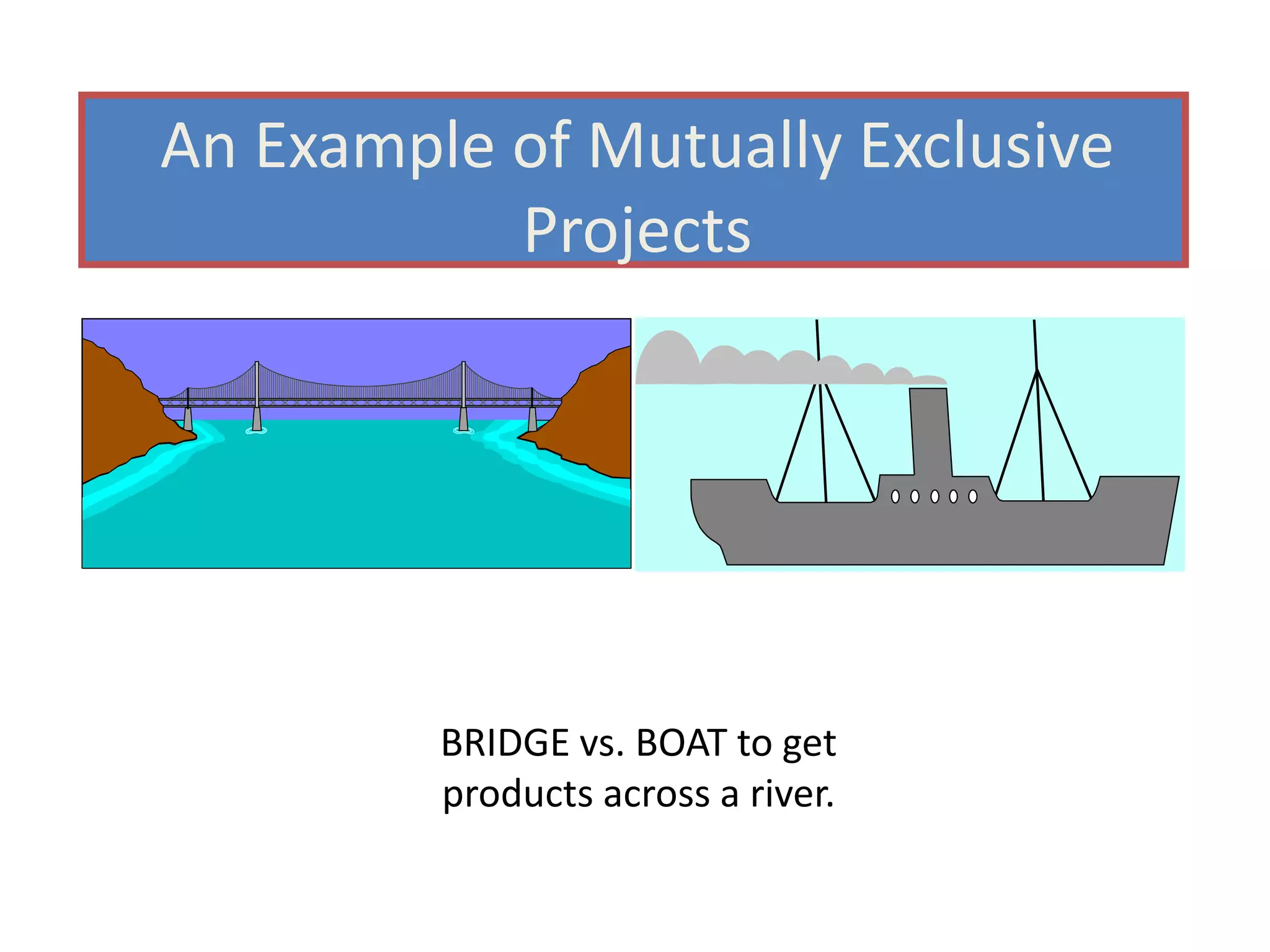
An Example of Mutually Exclusive
Projects
BRIDGE vs. BOAT to get
products across a river.
Independent projects are projects whose
cash flows are unrelated to (or independent of) one
another; the acceptance of one does not eliminate
the others from further consideration.
Eg: If a heavy engineering company may be
considering expansion of its plant capacity to
produce additional products, or start a new
production facility to manufacture a new product-
light commercial vehicles. Depending on their
profitability and availability of funds, the company
can undertake both investments.
contingent investments are dependent
projects, the choice of one investment necessitates
undertaking one or more other investments.
Eg: If a company decides to build a factory in
remote, backward area, it may have to invest in
house, roads, hospitals, schools etc. for the
employees to attract the work force. Thus building
of factory also requires investment in facilities for
employees.
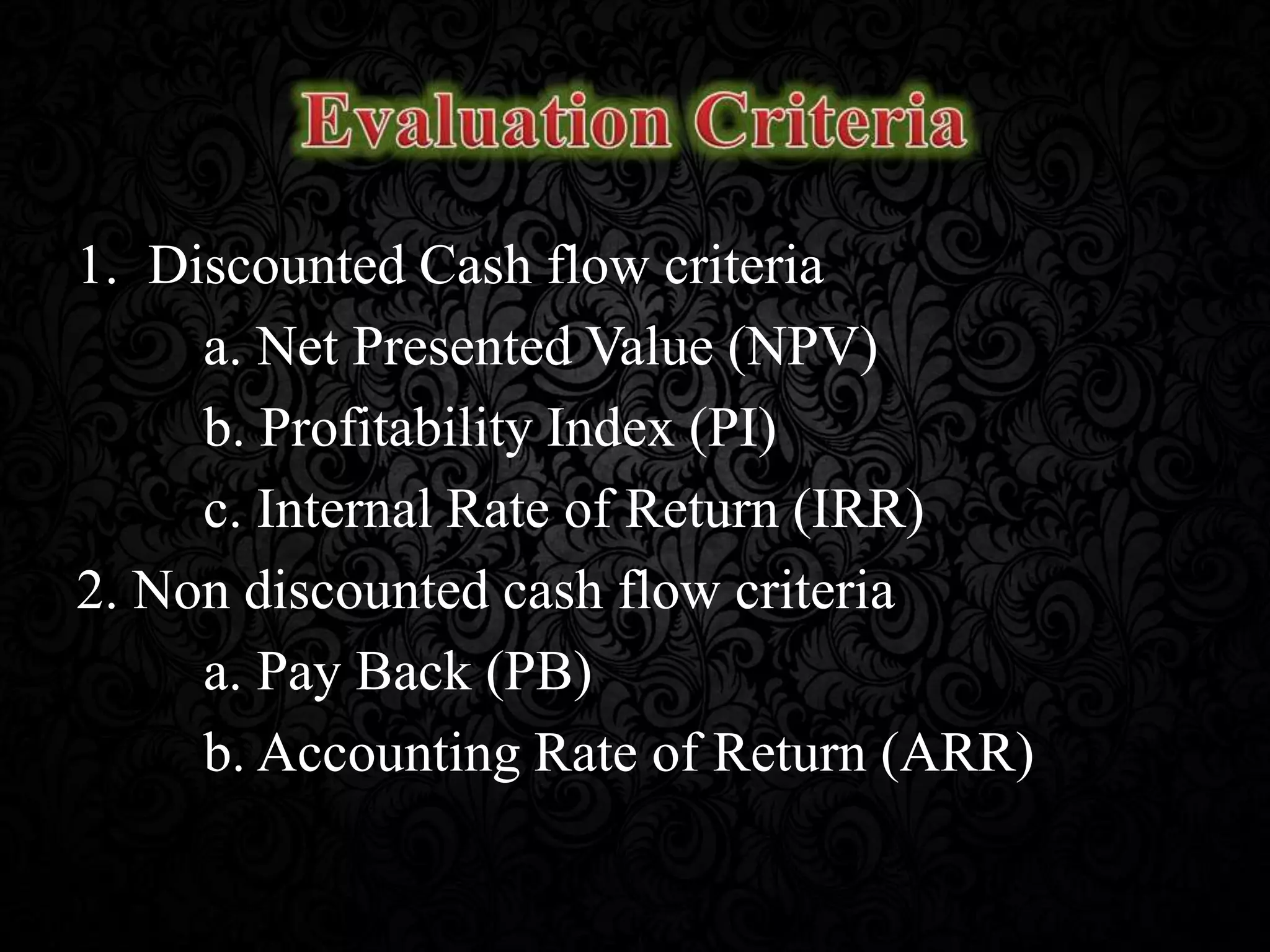
1. Discounted Cash flow criteria
a. Net Presented Value (NPV)
b. Profitability Index (PI)
c. Internal Rate of Return (IRR)
2. Non discounted cash flow criteria
a. Pay Back (PB)
b. Accounting Rate of Return (ARR)
 It is a modern method of evaluating
investment proposals.
This method take into consideration the time
value of money and attempt to calculate the
return on investment by introducing the
factor of time element.
It recognises the fact that a rupee earned
today is worth more than the same rupee
earned tomorrow.
The net present value of all inflow and out
flows of cash occurring during the entire life of
the project is determined separately for each
year.
1. Cash flows of the investment project should
be forecasted based on realistic assumption.
2. Appropriate discount rate should be identified
to discount the forecasted cash flows. The
appropriate discount rate is the project
opportunity cost of capital, which equal to the
required rate of return expected by the
investors on investment of equivalent risk.
3. Present value of cash flows should be
calculated using the opportunity cost of capital
as the discount rate.
4. NPV should be found out by subtracting
present value of cash out flows from present
value of cash inflows.
Decision Rule:
 If NPV is positive, ACCEPT.
 If NPV is negative, REJECT.
• It recognises the time value of money and is
suitable to applied in a situation with uniform
cash outflows and uneven cash inflows or cash
flows at different period of time.
• It take into account the entire earnings over life
of the project and true profitability of the
investment proposal can be evaluated.
• It take into consideration the objectives of
maximum profitability.
• It may not give good result while comparing
projects with unequal lives as the project
having higher Net Present Value but realised in
a longer life span may not be desirable as a
project having something lesser net present
value achieved in a much shorter span of life
of the asset.
• It may not easy to determine an appropriate
discount rate.
• It may not be give good result while
comparing projects with unequal investment of
funds.
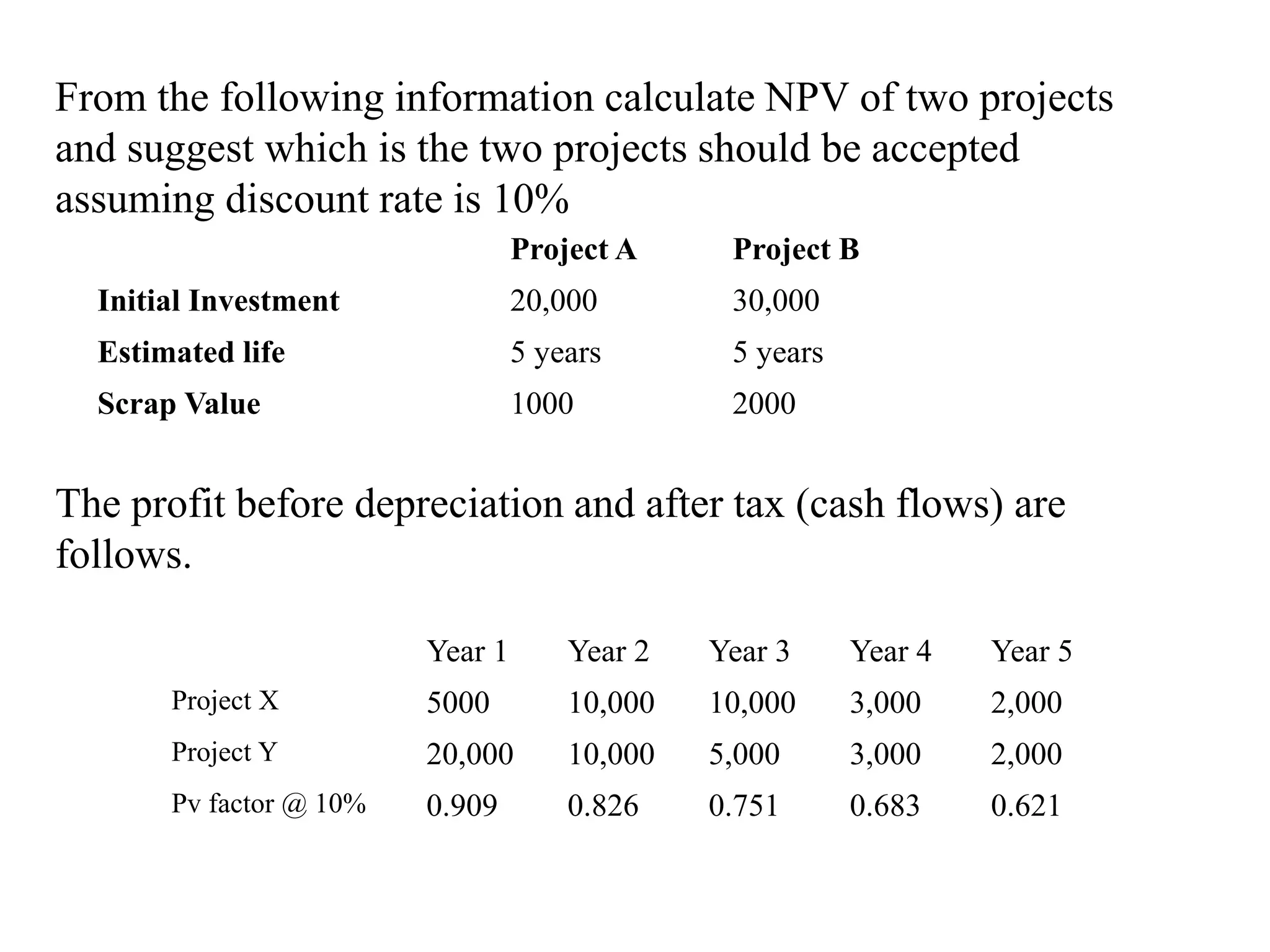
From the following information calculate NPV of two projects
and suggest which is the two projects should be accepted
assuming discount rate is 10%
The profit before depreciation and after tax (cash flows) are
follows.
Project A Project B
Initial Investment 20,000 30,000
Estimated life 5 years 5 years
Scrap Value 1000 2000
Year 1 Year 2 Year 3 Year 4 Year 5
Project X 5000 10,000 10,000 3,000 2,000
Project Y 20,000 10,000 5,000 3,000 2,000
Pv factor @ 10% 0.909 0.826 0.751 0.683 0.621
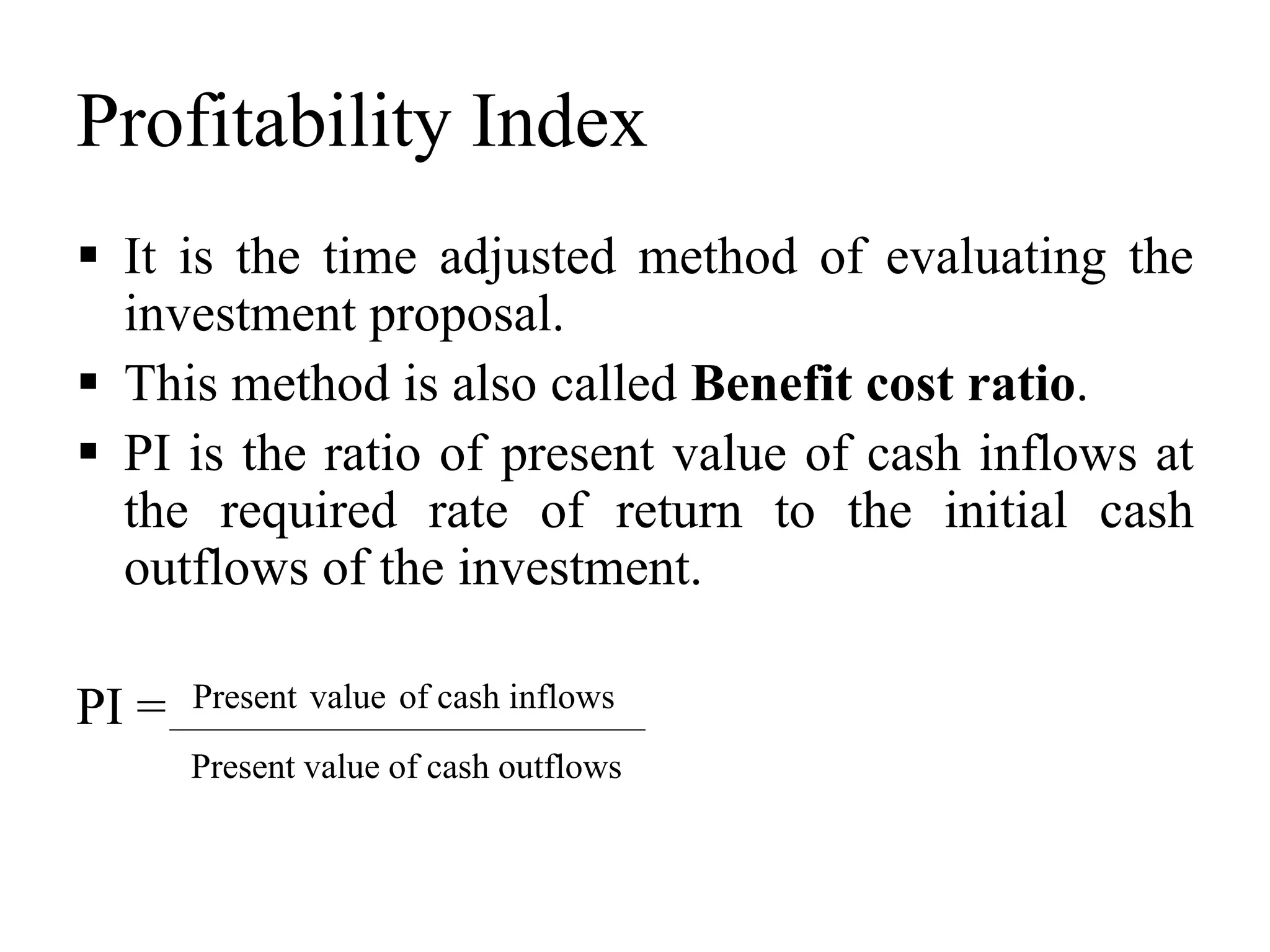
Profitability Index
 It is the time adjusted method of evaluating the
investment proposal.
 This method is also called Benefit cost ratio.
 PI is the ratio of present value of cash inflows at
the required rate of return to the initial cash
outflows of the investment.
PI = Present value of cash inflows
Present value of cash outflows
OR
PI =
Present value of cash inflows
Cost of investment
• Accept the project when PI greater than one
PI>1
• Reject the project when PI less than one PI<1
• May accept project when PI is equal to one
P=1
• PI tells about an investment increasing or
decreasing the firm value.
• PI takes into consideration all cash flows of the
project.
• PI takes time value of money into
consideration.
• PI is also helpful in ranking and picking
projects while rationing of capital.
• The PI of a firm might not, sometimes, provide
the correct decision while being used to
compare mutually exclusive project under
consideration.
• It is not easy to determine an appropriate
discount rate.
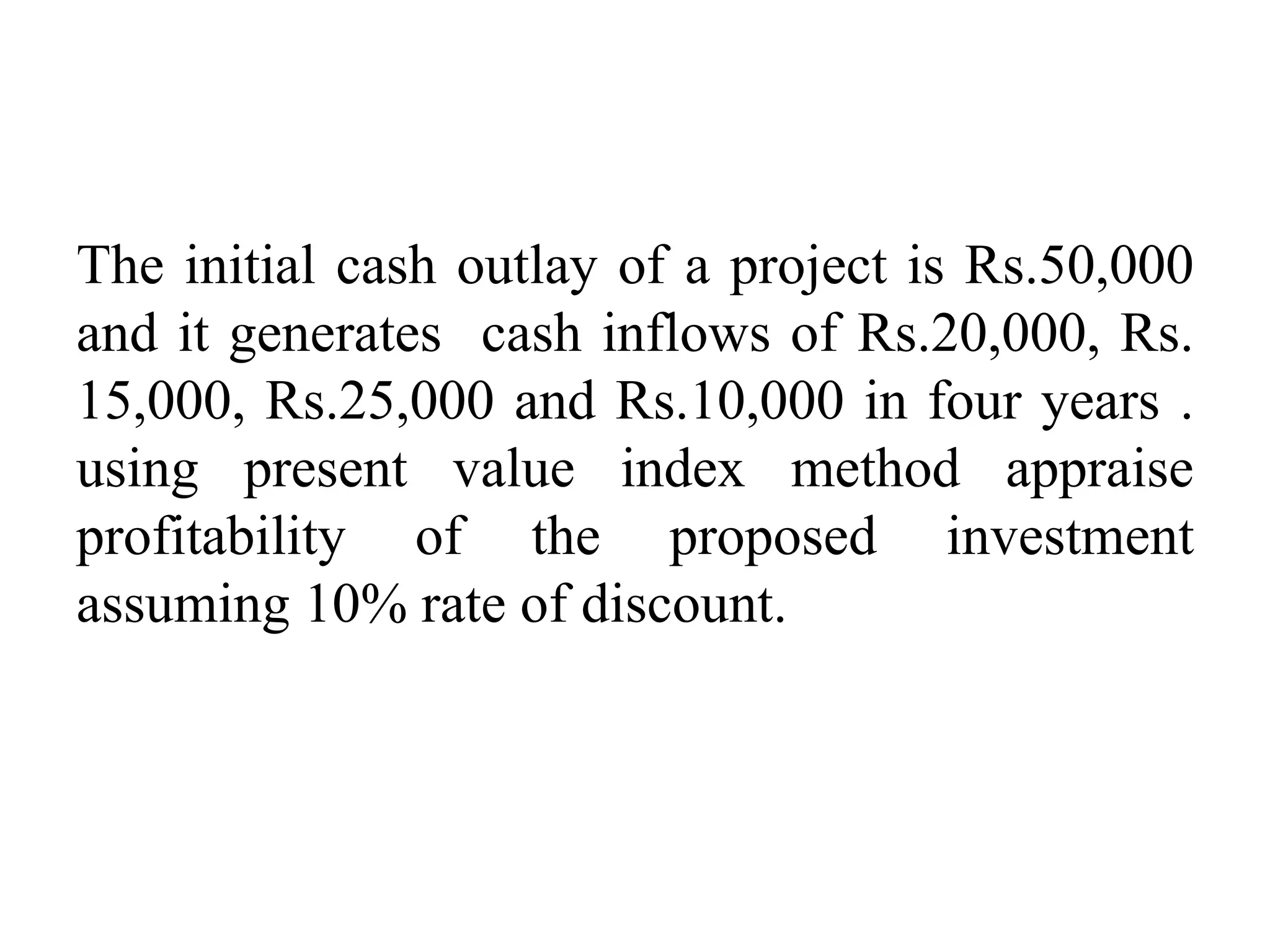
The initial cash outlay of a project is Rs.50,000
and it generates cash inflows of Rs.20,000, Rs.
15,000, Rs.25,000 and Rs.10,000 in four years .
using present value index method appraise
profitability of the proposed investment
assuming 10% rate of discount.
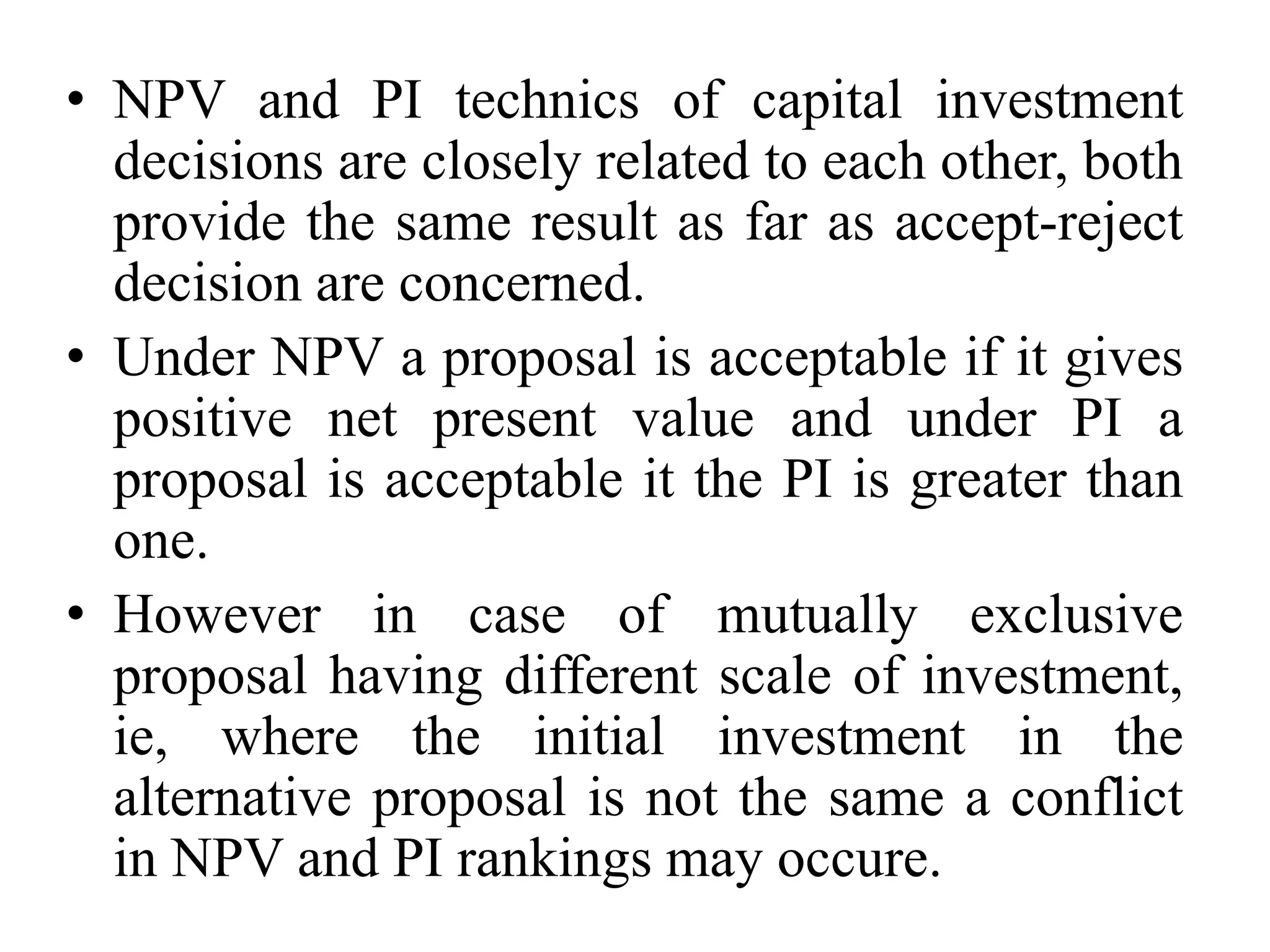
• NPV and PI technics of capital investment
decisions are closely related to each other, both
provide the same result as far as accept-reject
decision are concerned.
• Under NPV a proposal is acceptable if it gives
positive net present value and under PI a
proposal is acceptable it the PI is greater than
one.
• However in case of mutually exclusive
proposal having different scale of investment,
ie, where the initial investment in the
alternative proposal is not the same a conflict
in NPV and PI rankings may occure.
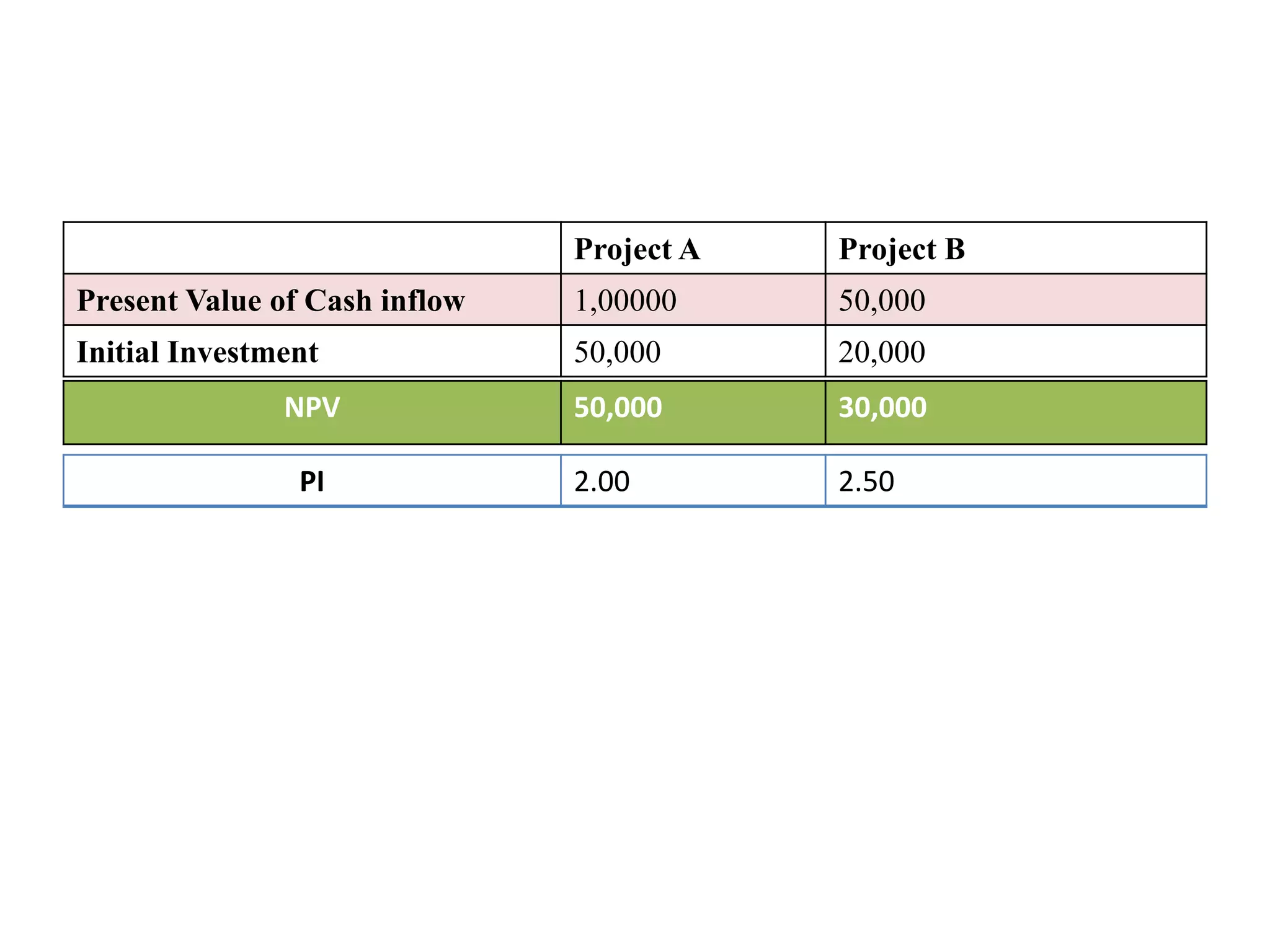
Project A Project B
Present Value of Cash inflow 1,00000 50,000
Initial Investment 50,000 20,000
NPV 50,000 30,000
PI 2.00 2.50
• In case of mutually exclusive decisions, the
NPV method should be preferred, because one
should always select the project giving largest
positive net present value using appropriate
cost of capital or predetermined cutoff rate.
• The reason is that the objective of the firm is to
maximize share holders wealth and the project
with largest NPV is more reliable as compared
to the IRR and PI.
• In fact NPV is the best operational criterion for
ranking mutually exclusive proposals
Conclusion
Bibliography
 I M Pandey, Financial management. Vikas publishing house pvt ltd,
New Delhi, 2013.
 M Khan, P K Jain. Financial Management. Tata McGraw-Hill
publishing company ltd, New Delhi, 2005.
 J. Van Horne, John M. Wachowiz, Fundamentals of Fianacial
management. Pearson Education, New Delhi, 2014.
 Shashi K Gupta, Neeti Gupta. Financial management. New central
Agency, New Delhi, 2013
Net Present Value Vs Profitability Index

Net Present Value Vs Profitability Index

  • 1.
  • 2.
    • Introduction • Importanceof investment decision • Classification of projects • Evaluation criteria • Net Present Value • Profitability Index • NPV Vs. PI • Conclusion Contents
  • 3.
    An efficient allocationof capital is the most important finance function in the modern times. It involves decisions to commit the firms fund to the long term assets. Capital budgeting or investment decisions are of considerable importance to the firm, since they tend to determine its value by influencing its growth, profitability and risk. Introduction
  • 4.
    Capital budgeting isthe process of evaluating and selecting long-term investments that are consistent with the firm’s goal of maximizing owner wealth. In other words Capital budgeting is the firms decision to invest its current funds most efficiently in the long term assets in anticipation of an expected flow of benefits over a series of year. Capital Budgeting
  • 5.
  • 6.
    The exchange ofcurrent fund for future benefits. The funds are invested in long term asset. The future benefit will occur to the firm over series of years. In investment analysis Cash flow is more important than accounting profit.
  • 7.
    Importance of investmentdecision 1. They influence the firms growth in the long run. 2. They affect the risk of the firm 3. They involve commitment of large amount of funds. 4. They are irreversible or reversible at substantial loss. 5. They are among the most difficult decision to make.
  • 8.
    • Mutually exclusiveinvestments • Independent investments. • Contingent investment
  • 9.
    It serves thesame purpose and compete with each other. If one investment is undertaken, others will have to be excluded.
  • 10.
    An Example ofMutually Exclusive Projects BRIDGE vs. BOAT to get products across a river.
  • 11.
    Independent projects areprojects whose cash flows are unrelated to (or independent of) one another; the acceptance of one does not eliminate the others from further consideration. Eg: If a heavy engineering company may be considering expansion of its plant capacity to produce additional products, or start a new production facility to manufacture a new product- light commercial vehicles. Depending on their profitability and availability of funds, the company can undertake both investments.
  • 12.
    contingent investments aredependent projects, the choice of one investment necessitates undertaking one or more other investments. Eg: If a company decides to build a factory in remote, backward area, it may have to invest in house, roads, hospitals, schools etc. for the employees to attract the work force. Thus building of factory also requires investment in facilities for employees.
  • 13.
    1. Discounted Cashflow criteria a. Net Presented Value (NPV) b. Profitability Index (PI) c. Internal Rate of Return (IRR) 2. Non discounted cash flow criteria a. Pay Back (PB) b. Accounting Rate of Return (ARR)
  • 14.
     It isa modern method of evaluating investment proposals. This method take into consideration the time value of money and attempt to calculate the return on investment by introducing the factor of time element. It recognises the fact that a rupee earned today is worth more than the same rupee earned tomorrow.
  • 15.
    The net presentvalue of all inflow and out flows of cash occurring during the entire life of the project is determined separately for each year.
  • 16.
    1. Cash flowsof the investment project should be forecasted based on realistic assumption. 2. Appropriate discount rate should be identified to discount the forecasted cash flows. The appropriate discount rate is the project opportunity cost of capital, which equal to the required rate of return expected by the investors on investment of equivalent risk.
  • 17.
    3. Present valueof cash flows should be calculated using the opportunity cost of capital as the discount rate. 4. NPV should be found out by subtracting present value of cash out flows from present value of cash inflows.
  • 18.
    Decision Rule:  IfNPV is positive, ACCEPT.  If NPV is negative, REJECT.
  • 19.
    • It recognisesthe time value of money and is suitable to applied in a situation with uniform cash outflows and uneven cash inflows or cash flows at different period of time. • It take into account the entire earnings over life of the project and true profitability of the investment proposal can be evaluated. • It take into consideration the objectives of maximum profitability.
  • 20.
    • It maynot give good result while comparing projects with unequal lives as the project having higher Net Present Value but realised in a longer life span may not be desirable as a project having something lesser net present value achieved in a much shorter span of life of the asset. • It may not easy to determine an appropriate discount rate.
  • 21.
    • It maynot be give good result while comparing projects with unequal investment of funds.
  • 22.
    From the followinginformation calculate NPV of two projects and suggest which is the two projects should be accepted assuming discount rate is 10% The profit before depreciation and after tax (cash flows) are follows. Project A Project B Initial Investment 20,000 30,000 Estimated life 5 years 5 years Scrap Value 1000 2000 Year 1 Year 2 Year 3 Year 4 Year 5 Project X 5000 10,000 10,000 3,000 2,000 Project Y 20,000 10,000 5,000 3,000 2,000 Pv factor @ 10% 0.909 0.826 0.751 0.683 0.621
  • 23.
    Profitability Index  Itis the time adjusted method of evaluating the investment proposal.  This method is also called Benefit cost ratio.  PI is the ratio of present value of cash inflows at the required rate of return to the initial cash outflows of the investment. PI = Present value of cash inflows Present value of cash outflows
  • 24.
    OR PI = Present valueof cash inflows Cost of investment
  • 25.
    • Accept theproject when PI greater than one PI>1 • Reject the project when PI less than one PI<1 • May accept project when PI is equal to one P=1
  • 26.
    • PI tellsabout an investment increasing or decreasing the firm value. • PI takes into consideration all cash flows of the project. • PI takes time value of money into consideration. • PI is also helpful in ranking and picking projects while rationing of capital.
  • 27.
    • The PIof a firm might not, sometimes, provide the correct decision while being used to compare mutually exclusive project under consideration. • It is not easy to determine an appropriate discount rate.
  • 28.
    The initial cashoutlay of a project is Rs.50,000 and it generates cash inflows of Rs.20,000, Rs. 15,000, Rs.25,000 and Rs.10,000 in four years . using present value index method appraise profitability of the proposed investment assuming 10% rate of discount.
  • 30.
    • NPV andPI technics of capital investment decisions are closely related to each other, both provide the same result as far as accept-reject decision are concerned. • Under NPV a proposal is acceptable if it gives positive net present value and under PI a proposal is acceptable it the PI is greater than one. • However in case of mutually exclusive proposal having different scale of investment, ie, where the initial investment in the alternative proposal is not the same a conflict in NPV and PI rankings may occure.
  • 31.
    Project A ProjectB Present Value of Cash inflow 1,00000 50,000 Initial Investment 50,000 20,000 NPV 50,000 30,000 PI 2.00 2.50
  • 32.
    • In caseof mutually exclusive decisions, the NPV method should be preferred, because one should always select the project giving largest positive net present value using appropriate cost of capital or predetermined cutoff rate. • The reason is that the objective of the firm is to maximize share holders wealth and the project with largest NPV is more reliable as compared to the IRR and PI.
  • 33.
    • In factNPV is the best operational criterion for ranking mutually exclusive proposals
  • 34.
  • 35.
    Bibliography  I MPandey, Financial management. Vikas publishing house pvt ltd, New Delhi, 2013.  M Khan, P K Jain. Financial Management. Tata McGraw-Hill publishing company ltd, New Delhi, 2005.  J. Van Horne, John M. Wachowiz, Fundamentals of Fianacial management. Pearson Education, New Delhi, 2014.  Shashi K Gupta, Neeti Gupta. Financial management. New central Agency, New Delhi, 2013