
SHIVA SHRESTHA 
Lecturer 
Hetauda School Of Management 
Hetauda, Makawanpur 
Shiva Shrestha, HSM, Hetauda 12 September 2014 1
 Definition 
 Some viewpoints about critical Thinking 
 Critical Thinking process, connections and skills 
 Importance of critical thinking 
 Inquiry skills used in critical thinking 
 Checklist of observable behaviors 
 Costs of fallacious reasoning 
 Relationship between critical thinking & decision 
making 
Shiva Shrestha, HSM, Hetauda 12 September 2014 2
What is Critical thinking? 
The word Critical comes from two words ‘Skeri’ 
and ‘Kriterion’ which means to cut and 
standard of judging. 
“Critical thinking is skilled and active 
interpretation evaluation of observation and 
communications, information. It is the formation of 
logical inferences. It includes important activities 
such as Sensation, Biological, Psychological, 
Cognitive and Communications.” 
Shiva Shrestha, HSM, Hetauda 12 September 2014 3
Shiva Shrestha, HSM, Hetauda 12 September 2014 4
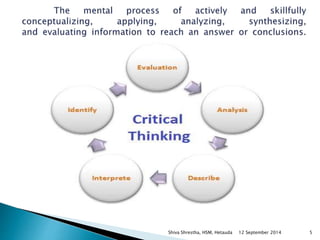
Shiva Shrestha, HSM, Hetauda 12 September 2014 5
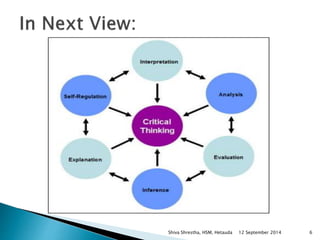
Shiva Shrestha, HSM, Hetauda 12 September 2014 6
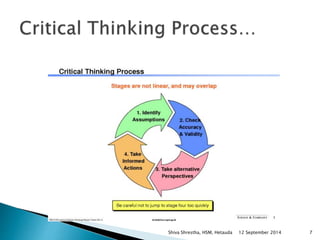
Shiva Shrestha, HSM, Hetauda 12 September 2014 7
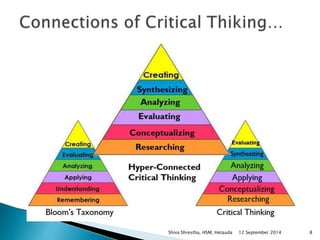
Shiva Shrestha, HSM, Hetauda 12 September 2014 8
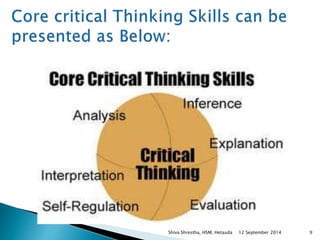
Shiva Shrestha, HSM, Hetauda 12 September 2014 9
1. It is learned ability that must be taught 
2. It is higher order thinking 
3. It is based on standards 
4. It is a kind of scientific method applied by 
ordinary people to ordinary world. 
Shiva Shrestha, HSM, Hetauda 12 September 2014 10
 Critical thinking is the ability to think clearly and 
rationally. It includes the ability to engage in 
reflective and independent thinking. Someone 
with critical thinking skills is able to do the 
following : 
 understand the logical connections between ideas 
 identify, construct and evaluate arguments 
 detect inconsistencies and common mistakes in 
reasoning 
 solve problems systematically 
 identify the relevance and importance of ideas 
 reflect on the justification of one's own beliefs and 
values etc. 
Shiva Shrestha, HSM, Hetauda 12 September 2014 11
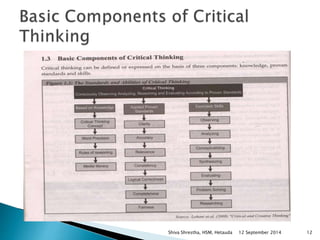
Shiva Shrestha, HSM, Hetauda 12 September 2014 12
Shiva Shrestha, HSM, Hetauda 12 September 2014 13
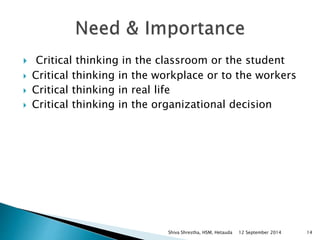
 Critical thinking in the classroom or the student 
 Critical thinking in the workplace or to the workers 
 Critical thinking in real life 
 Critical thinking in the organizational decision 
Shiva Shrestha, HSM, Hetauda 12 September 2014 14
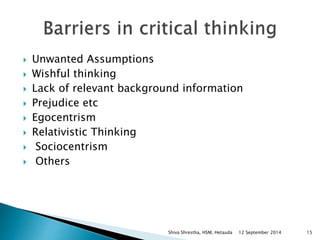
 Unwanted Assumptions 
 Wishful thinking 
 Lack of relevant background information 
 Prejudice etc 
 Egocentrism 
 Relativistic Thinking 
 Sociocentrism 
 Others 
Shiva Shrestha, HSM, Hetauda 12 September 2014 15
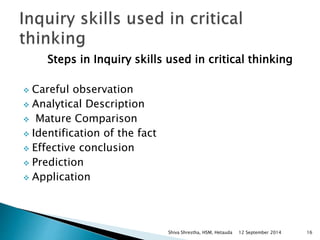
Steps in Inquiry skills used in critical thinking 
 Careful observation 
 Analytical Description 
 Mature Comparison 
 Identification of the fact 
 Effective conclusion 
 Prediction 
 Application 
Shiva Shrestha, HSM, Hetauda 12 September 2014 16
 Are the investigation or fact finding process that 
a critical thinker should apply 
 What and how an investigator should behave to 
identify the fact? 
 What are the factors or steps that are to be 
followed and to analyze and solve the problem? 
 Observe and describe the problem or situation or 
behavior of others carefully and completely. 
 Continued…………….
 Check for business assumptions ‘if any’ on the 
basis of available information and critically 
examines the problem. 
 Match the existing problem or situation 
observing ones personal belief. 
 Consider the importance of the problem or 
situation on the basis of size and type of 
impact. 
 understand perception emotion and feeling of 
others and identify the influence. 
 ask themselves about potential results or 
solutions about the problem.
 Think for developing different alternatives 
way of solution considering their personal 
potential. 
 Compare and contrast the different 
alternative way of solution on the basis of 
their individual advantages and 
disadvantages. 
 Decides or select the best way of solution . 
 look for overall 
aspects(Positive,negative,short term and long 
term effect) . 
 Consider the planning for negative events. 
 Check once more even if you feel that is 
correct.
 “A fallacy is a type of argument that may 
seem to be correct ,but that proves ,an 
examination, not to be so.” 
 Mistakes/errors in reasoning 
Definition 
“A fallacy is a type of argument that may 
seem to be correct but that proves, on 
examination, not to be so “.
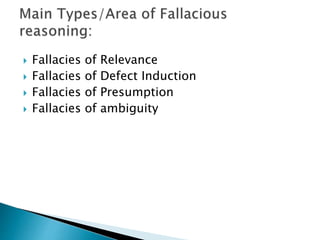
 Fallacies of Relevance 
 Fallacies of Defect Induction 
 Fallacies of Presumption 
 Fallacies of ambiguity
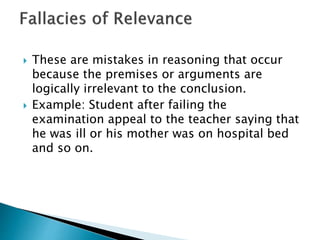
 These are mistakes in reasoning that occur 
because the premises or arguments are 
logically irrelevant to the conclusion. 
 Example: Student after failing the 
examination appeal to the teacher saying that 
he was ill or his mother was on hospital bed 
and so on.
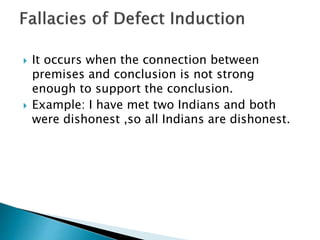
 It occurs when the connection between 
premises and conclusion is not strong 
enough to support the conclusion. 
 Example: I have met two Indians and both 
were dishonest ,so all Indians are dishonest.
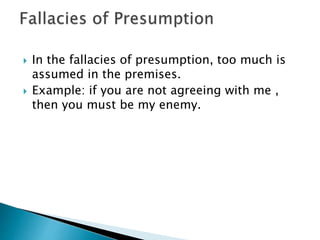
 In the fallacies of presumption, too much is 
assumed in the premises. 
 Example: if you are not agreeing with me , 
then you must be my enemy.
 It occurs due to the equivocal use of word or 
phrases. 
 It arises from that occurrence of some form 
of ambiguity in either the premises or the 
conclusion or both. 
 Example: sodium and chlorine , the atomic 
components of salts, are both deadly 
poisons. Therefore ,salt is a deadly poison.
i) Appeals to pity(Appeal for emotion) 
ii) The appeal to the force 
iii) Arguments against the person 
iv) Appeal to common practice 
v) False or wrong analogy 
vi) Arguments from ignorance etc 
Shiva Shrestha, HSM, Hetauda 12 September 2014 26
 “Critical thinking is skilled and active 
interpretation ad evaluation of observations 
and communications, information and 
argumentation.” 
 Decision making is the process of selecting 
best alternative. 
 Critical thinking is necessary for sound 
decision making. 
 Process, Technique and tools are common in 
both . 
Shiva Shrestha, HSM, Hetauda 12 September 2014 27
Shiva Shrestha, HSM, Hetauda 12 September 2014 28
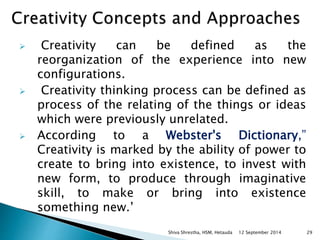
 Creativity can be defined as the 
reorganization of the experience into new 
configurations. 
 Creativity thinking process can be defined as 
process of the relating of the things or ideas 
which were previously unrelated. 
 According to a Webster's Dictionary,” 
Creativity is marked by the ability of power to 
create to bring into existence, to invest with 
new form, to produce through imaginative 
skill, to make or bring into existence 
something new.’ 
Shiva Shrestha, HSM, Hetauda 12 September 2014 29
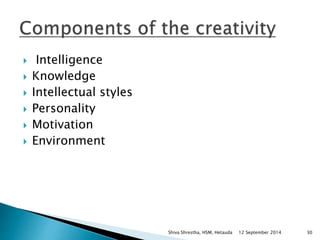
 Intelligence 
 Knowledge 
 Intellectual styles 
 Personality 
 Motivation 
 Environment 
Shiva Shrestha, HSM, Hetauda 12 September 2014 30
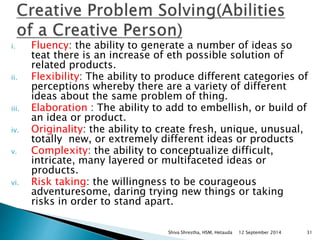
i. Fluency: the ability to generate a number of ideas so 
teat there is an increase of eth possible solution of 
related products. 
ii. Flexibility: The ability to produce different categories of 
perceptions whereby there are a variety of different 
ideas about the same problem of thing. 
iii. Elaboration : The ability to add to embellish, or build of 
an idea or product. 
iv. Originality: the ability to create fresh, unique, unusual, 
totally new, or extremely different ideas or products 
v. Complexity: the ability to conceptualize difficult, 
intricate, many layered or multifaceted ideas or 
products. 
vi. Risk taking: the willingness to be courageous 
adventuresome, daring trying new things or taking 
risks in order to stand apart. 
Shiva Shrestha, HSM, Hetauda 12 September 2014 31
Shiva Shrestha, HSM, Hetauda 12 September 2014 32
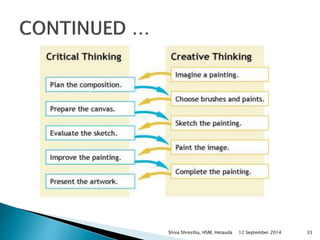
Shiva Shrestha, HSM, Hetauda 12 September 2014 33
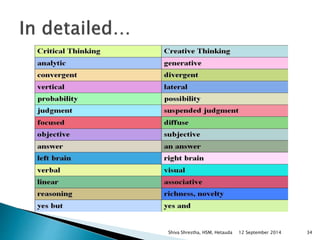
Shiva Shrestha, HSM, Hetauda 12 September 2014 34
THANK YOU! 
Shiva Shrestha, HSM, Hetauda 12 September 2014 35

7th semester BIM: Unit 1 critical thinking

  • 1.
    SHIVA SHRESTHA Lecturer Hetauda School Of Management Hetauda, Makawanpur Shiva Shrestha, HSM, Hetauda 12 September 2014 1
  • 2.
     Definition Some viewpoints about critical Thinking  Critical Thinking process, connections and skills  Importance of critical thinking  Inquiry skills used in critical thinking  Checklist of observable behaviors  Costs of fallacious reasoning  Relationship between critical thinking & decision making Shiva Shrestha, HSM, Hetauda 12 September 2014 2
  • 3.
    What is Criticalthinking? The word Critical comes from two words ‘Skeri’ and ‘Kriterion’ which means to cut and standard of judging. “Critical thinking is skilled and active interpretation evaluation of observation and communications, information. It is the formation of logical inferences. It includes important activities such as Sensation, Biological, Psychological, Cognitive and Communications.” Shiva Shrestha, HSM, Hetauda 12 September 2014 3
  • 4.
    Shiva Shrestha, HSM,Hetauda 12 September 2014 4
  • 5.
    Shiva Shrestha, HSM,Hetauda 12 September 2014 5
  • 6.
    Shiva Shrestha, HSM,Hetauda 12 September 2014 6
  • 7.
    Shiva Shrestha, HSM,Hetauda 12 September 2014 7
  • 8.
    Shiva Shrestha, HSM,Hetauda 12 September 2014 8
  • 9.
    Shiva Shrestha, HSM,Hetauda 12 September 2014 9
  • 10.
    1. It islearned ability that must be taught 2. It is higher order thinking 3. It is based on standards 4. It is a kind of scientific method applied by ordinary people to ordinary world. Shiva Shrestha, HSM, Hetauda 12 September 2014 10
  • 11.
     Critical thinkingis the ability to think clearly and rationally. It includes the ability to engage in reflective and independent thinking. Someone with critical thinking skills is able to do the following :  understand the logical connections between ideas  identify, construct and evaluate arguments  detect inconsistencies and common mistakes in reasoning  solve problems systematically  identify the relevance and importance of ideas  reflect on the justification of one's own beliefs and values etc. Shiva Shrestha, HSM, Hetauda 12 September 2014 11
  • 12.
    Shiva Shrestha, HSM,Hetauda 12 September 2014 12
  • 13.
    Shiva Shrestha, HSM,Hetauda 12 September 2014 13
  • 14.
     Critical thinkingin the classroom or the student  Critical thinking in the workplace or to the workers  Critical thinking in real life  Critical thinking in the organizational decision Shiva Shrestha, HSM, Hetauda 12 September 2014 14
  • 15.
     Unwanted Assumptions  Wishful thinking  Lack of relevant background information  Prejudice etc  Egocentrism  Relativistic Thinking  Sociocentrism  Others Shiva Shrestha, HSM, Hetauda 12 September 2014 15
  • 16.
    Steps in Inquiryskills used in critical thinking  Careful observation  Analytical Description  Mature Comparison  Identification of the fact  Effective conclusion  Prediction  Application Shiva Shrestha, HSM, Hetauda 12 September 2014 16
  • 17.
     Are theinvestigation or fact finding process that a critical thinker should apply  What and how an investigator should behave to identify the fact?  What are the factors or steps that are to be followed and to analyze and solve the problem?  Observe and describe the problem or situation or behavior of others carefully and completely.  Continued…………….
  • 18.
     Check forbusiness assumptions ‘if any’ on the basis of available information and critically examines the problem.  Match the existing problem or situation observing ones personal belief.  Consider the importance of the problem or situation on the basis of size and type of impact.  understand perception emotion and feeling of others and identify the influence.  ask themselves about potential results or solutions about the problem.
  • 19.
     Think fordeveloping different alternatives way of solution considering their personal potential.  Compare and contrast the different alternative way of solution on the basis of their individual advantages and disadvantages.  Decides or select the best way of solution .  look for overall aspects(Positive,negative,short term and long term effect) .  Consider the planning for negative events.  Check once more even if you feel that is correct.
  • 20.
     “A fallacyis a type of argument that may seem to be correct ,but that proves ,an examination, not to be so.”  Mistakes/errors in reasoning Definition “A fallacy is a type of argument that may seem to be correct but that proves, on examination, not to be so “.
  • 21.
     Fallacies ofRelevance  Fallacies of Defect Induction  Fallacies of Presumption  Fallacies of ambiguity
  • 22.
     These aremistakes in reasoning that occur because the premises or arguments are logically irrelevant to the conclusion.  Example: Student after failing the examination appeal to the teacher saying that he was ill or his mother was on hospital bed and so on.
  • 23.
     It occurswhen the connection between premises and conclusion is not strong enough to support the conclusion.  Example: I have met two Indians and both were dishonest ,so all Indians are dishonest.
  • 24.
     In thefallacies of presumption, too much is assumed in the premises.  Example: if you are not agreeing with me , then you must be my enemy.
  • 25.
     It occursdue to the equivocal use of word or phrases.  It arises from that occurrence of some form of ambiguity in either the premises or the conclusion or both.  Example: sodium and chlorine , the atomic components of salts, are both deadly poisons. Therefore ,salt is a deadly poison.
  • 26.
    i) Appeals topity(Appeal for emotion) ii) The appeal to the force iii) Arguments against the person iv) Appeal to common practice v) False or wrong analogy vi) Arguments from ignorance etc Shiva Shrestha, HSM, Hetauda 12 September 2014 26
  • 27.
     “Critical thinkingis skilled and active interpretation ad evaluation of observations and communications, information and argumentation.”  Decision making is the process of selecting best alternative.  Critical thinking is necessary for sound decision making.  Process, Technique and tools are common in both . Shiva Shrestha, HSM, Hetauda 12 September 2014 27
  • 28.
    Shiva Shrestha, HSM,Hetauda 12 September 2014 28
  • 29.
     Creativity canbe defined as the reorganization of the experience into new configurations.  Creativity thinking process can be defined as process of the relating of the things or ideas which were previously unrelated.  According to a Webster's Dictionary,” Creativity is marked by the ability of power to create to bring into existence, to invest with new form, to produce through imaginative skill, to make or bring into existence something new.’ Shiva Shrestha, HSM, Hetauda 12 September 2014 29
  • 30.
     Intelligence Knowledge  Intellectual styles  Personality  Motivation  Environment Shiva Shrestha, HSM, Hetauda 12 September 2014 30
  • 31.
    i. Fluency: theability to generate a number of ideas so teat there is an increase of eth possible solution of related products. ii. Flexibility: The ability to produce different categories of perceptions whereby there are a variety of different ideas about the same problem of thing. iii. Elaboration : The ability to add to embellish, or build of an idea or product. iv. Originality: the ability to create fresh, unique, unusual, totally new, or extremely different ideas or products v. Complexity: the ability to conceptualize difficult, intricate, many layered or multifaceted ideas or products. vi. Risk taking: the willingness to be courageous adventuresome, daring trying new things or taking risks in order to stand apart. Shiva Shrestha, HSM, Hetauda 12 September 2014 31
  • 32.
    Shiva Shrestha, HSM,Hetauda 12 September 2014 32
  • 33.
    Shiva Shrestha, HSM,Hetauda 12 September 2014 33
  • 34.
    Shiva Shrestha, HSM,Hetauda 12 September 2014 34
  • 35.
    THANK YOU! ShivaShrestha, HSM, Hetauda 12 September 2014 35