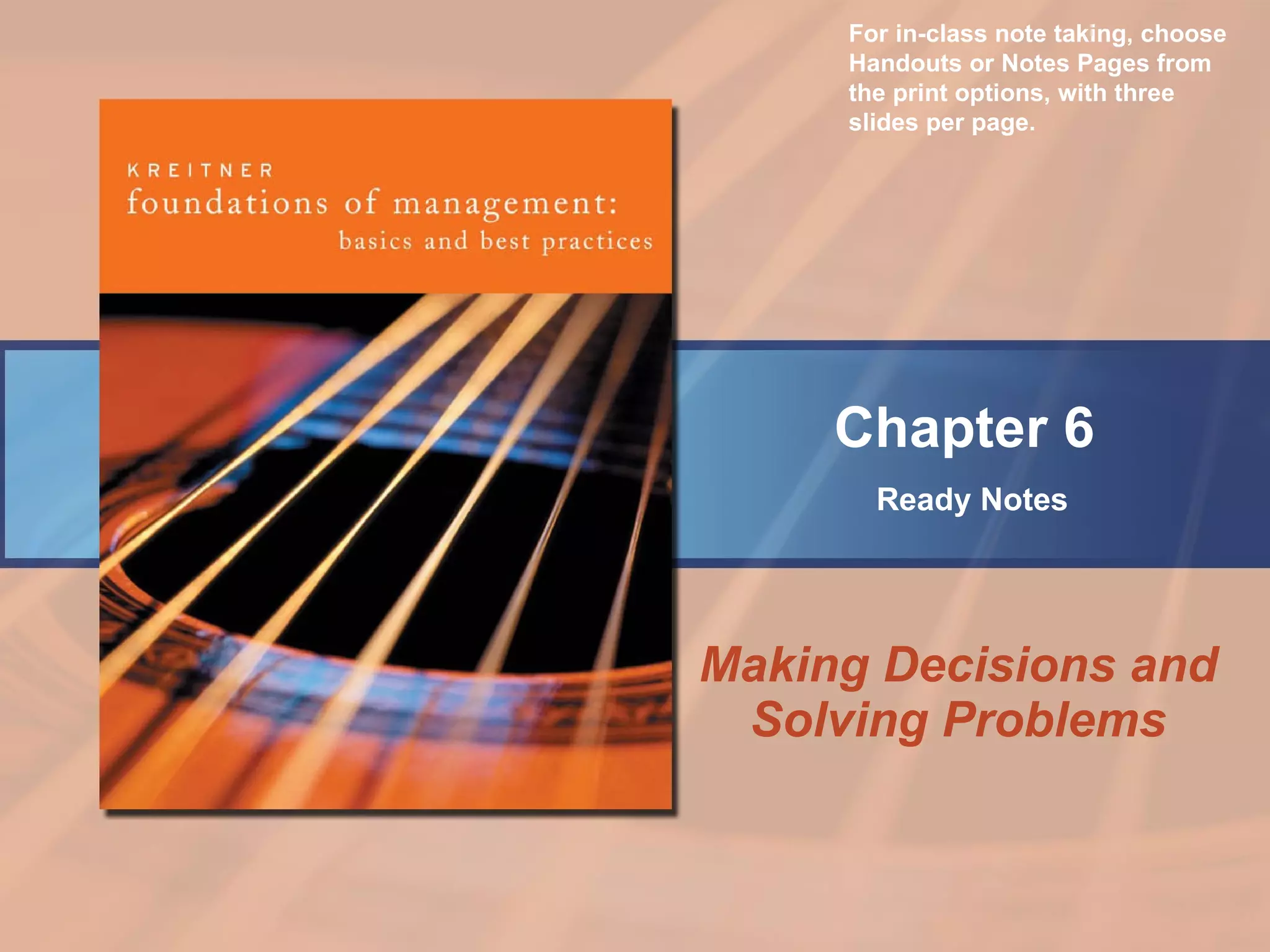
Making Decisions and Solving Problems Chapter 6   Ready Notes For in-class note taking, choose Handouts or Notes Pages from the print options, with three slides per page.
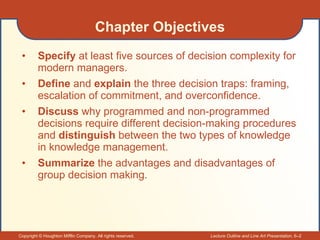
Chapter Objectives Specify  at least five sources of decision complexity for modern managers. Define  and  explain  the three decision traps: framing, escalation of commitment, and overconfidence. Discuss  why programmed and non-programmed decisions require different decision-making procedures and  distinguish  between the two types of knowledge in knowledge management. Summarize  the advantages and disadvantages of group decision making.
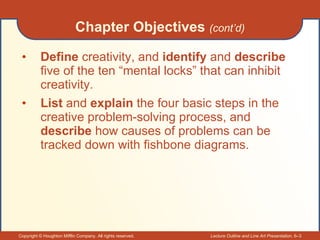
Chapter Objectives  (cont’d) Define  creativity, and  identify  and  describe  five of the ten “mental locks” that can inhibit creativity. List  and  explain  the four basic steps in the creative problem-solving process, and  describe  how causes of problems can be tracked down with fishbone diagrams.
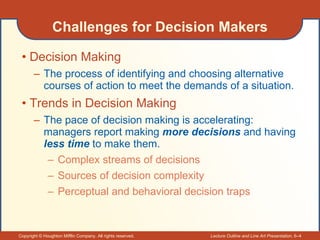
Challenges for Decision Makers Decision Making The process of identifying and choosing alternative courses of action to meet the demands of a situation. Trends in Decision Making The pace of decision making is accelerating: managers report making  more decisions  and having  less time  to make them. Complex streams of decisions Sources of decision complexity Perceptual and behavioral decision traps
Challenges for Decision Makers  (cont’d) Dealing with Complex Streams of Decisions Multiple criteria  to be satisfied by a decision. Intangibles  that often determine decision alternatives. Risk and uncertainty  about decision alternatives. Long-term implications  of the effects of the choice of a particular alternative. Interdisciplinary input  increases the number of persons to be consulted before a decision is made.
Challenges for Decision Makers  (cont’d) Dealing with Complex Streams of Decisions  (cont’d) Pooled decision making  increases the number of persons playing a part in the decision process. Value judgments by differing participants  in the process create disagreement over whether a decision is right or wrong, good or bad, and ethical or unethical. Unintended consequences  occur because the results of purposeful actions cannot always be predicted.
Avoiding Perceptual and Behavioral Decision Traps Framing Error The way in which information is presented influences one’s interpretation of it, which, in turn, may alter a decision based on the information. Escalation of Commitment Continuing on a course of action that locks a person into losing position—“Throwing good money after bad.” Overconfidence Believing too much in one’s own capabilities.
Coping with Uncertainty Types (Conditions) of Uncertainty Certainty:  exists when a solid factual basis allows prediction of decision’s outcome. Risk:  exists when a decision is made on the basis of incomplete but reliable information. Objective probabilities: based on reliable data. Subjective probabilities: based on judgment. Uncertainty:  exists when no reliable data exists on which to base a decision.
Making Decisions Types of Decisions Programmed decisions: repetitive and routine decisions. Decision’s rule identifies the situation and specifies how the decision will be made. Nonprogrammed decisions Decisions made in complex and nonroutine situations. Problem hasn’t arisen before. It is difficult to define problem’s nature and structure. Problem is important and requires a unique solution.
Making Decisions  (cont’d) Nonprogrammed decisions—questions to ask: What decision needs to be made? When does it have to be made? Who will decide? Who needs to be consulted? Who will ratify or veto the decision? Who will need to be informed?
A General  Decision-Making Model Rational (Logical) Decision Model Steps Scanning the situation—identifying a signal that a decision should be made. Receipt of authoritative communications from superiors. Cases referred for decision by subordinates. Cases originating from the manager. Classify the decision as routine, apply the appropriate decision rule; as nonprogrammed, begin comprehensive problem solving. Monitor and follow-up as necessary.
Figure 6.3 A General-Decision Making Model
A General  Decision-Making Model  (cont’d) Knowledge Management (KM): A Tool for Improving the Quality of Decisions Developing a system to improve the creation and sharing of knowledge critical for decision making. Tacit knowledge:  personal, intuitive, and undocumented private information. Explicit knowledge:  readily sharable public information in verbal, textual, visual, or numerical form.
A General  Decision-Making Model  (cont’d) Improving the Flow of Knowledge The flow of constructive tacit knowledge between coworkers is a priority. Knowing what you know, what you don’t know, and how to find what you know yields better and more timely decisions.
A General  Decision-Making Model  (cont’d) Improving the Flow of Knowledge  (cont’d) Organizational learning Organization cultures Training Communication Empowerment Participative management Virtual Training Communication
Groups and Decision Making Group Involvement in Decisions Analyzing the problem Identifying components of the situation Estimating components of the situation Designing alternatives Choosing an alternative
Groups and Decision Making  (cont’d) The Problem of Dispersed Accountability Results in loss of personal/individual accountability. Individual accountability is required when the decision will have significant organizational impact. the decision has ethical and legal ramifications. a competitive award is tied to the decision.
Managerial Creativity What is Creativity? It is the reorganization of experience into new configurations. A function of knowledge, imagination, and evaluation Three domains of creativity Art (ah!) as in beauty Discovery (aha!) as in enlightenment. Humor (haha!) as in joyful pleasure.
Learning to Be More Creative: Mental Locks That Stifle Creativity Looking for the “right” answer. Always trying to be logical. Strictly following the rules. Insist on being practical. Avoiding ambiguity. Fear and avoiding publicity. Forgetting how to play. Becoming too specialized. Not wanting to look foolish. Saying “I’m not creative.
Problem Solving Problem Solving The conscious process of closing the gap between actual and desired situations. Steps in Managerial Problem-Solving Identifying the problem Generating alternative solutions Selecting a solution Implementing and evaluating the solution
Problem Solving  (cont’d) Identifying The Problem Involves asking the right questions. What Is a Problem? Defined by the gap between actual and desired state of affairs. Stumbling Blocks for Problem Finders Defining the problem according to a possible solution. Focusing on narrow, low-priority areas. Diagnosing problems in terms of their symptoms rather than causes.
Problem Solving  (cont’d) Cause The variable(s) responsible for the problem. Pinpointing Causes with Fishbone Diagrams A TQM process improvement tool that shows possible problem causes and their interactive relationships.
Problem Solving  (cont’d) Generating Alternative Solutions Brainstorming Free association Edisonian Attribute listing Scientific method Creative Leap
Problem Solving  (cont’d) Selecting a Solution Resolving the problem Satisfice: to settle for a solution that is good enough rather than the best possible. Solving the problem Optimize: systematically identifying the solution with the best combination of benefits Dissolving the problem Change the situation in which the problem occurs so that the problem (and the conditions that cause it) no longer exists.
Creative Problem Solving  (cont’d) Implementing and Evaluating the Solution Effective and efficient resolution removes the gap between actual and desired states. If problem persists, recycling through the problem-solving steps becomes necessary. Trying other feasible solutions. Redefining the problem and beginning the problem-solving cycle again. The end result is continuous improvement.

Decision Making & Problem Solving

  • 1.
    Making Decisions andSolving Problems Chapter 6 Ready Notes For in-class note taking, choose Handouts or Notes Pages from the print options, with three slides per page.
  • 2.
    Chapter Objectives Specify at least five sources of decision complexity for modern managers. Define and explain the three decision traps: framing, escalation of commitment, and overconfidence. Discuss why programmed and non-programmed decisions require different decision-making procedures and distinguish between the two types of knowledge in knowledge management. Summarize the advantages and disadvantages of group decision making.
  • 3.
    Chapter Objectives (cont’d) Define creativity, and identify and describe five of the ten “mental locks” that can inhibit creativity. List and explain the four basic steps in the creative problem-solving process, and describe how causes of problems can be tracked down with fishbone diagrams.
  • 4.
    Challenges for DecisionMakers Decision Making The process of identifying and choosing alternative courses of action to meet the demands of a situation. Trends in Decision Making The pace of decision making is accelerating: managers report making more decisions and having less time to make them. Complex streams of decisions Sources of decision complexity Perceptual and behavioral decision traps
  • 5.
    Challenges for DecisionMakers (cont’d) Dealing with Complex Streams of Decisions Multiple criteria to be satisfied by a decision. Intangibles that often determine decision alternatives. Risk and uncertainty about decision alternatives. Long-term implications of the effects of the choice of a particular alternative. Interdisciplinary input increases the number of persons to be consulted before a decision is made.
  • 6.
    Challenges for DecisionMakers (cont’d) Dealing with Complex Streams of Decisions (cont’d) Pooled decision making increases the number of persons playing a part in the decision process. Value judgments by differing participants in the process create disagreement over whether a decision is right or wrong, good or bad, and ethical or unethical. Unintended consequences occur because the results of purposeful actions cannot always be predicted.
  • 7.
    Avoiding Perceptual andBehavioral Decision Traps Framing Error The way in which information is presented influences one’s interpretation of it, which, in turn, may alter a decision based on the information. Escalation of Commitment Continuing on a course of action that locks a person into losing position—“Throwing good money after bad.” Overconfidence Believing too much in one’s own capabilities.
  • 8.
    Coping with UncertaintyTypes (Conditions) of Uncertainty Certainty: exists when a solid factual basis allows prediction of decision’s outcome. Risk: exists when a decision is made on the basis of incomplete but reliable information. Objective probabilities: based on reliable data. Subjective probabilities: based on judgment. Uncertainty: exists when no reliable data exists on which to base a decision.
  • 9.
    Making Decisions Typesof Decisions Programmed decisions: repetitive and routine decisions. Decision’s rule identifies the situation and specifies how the decision will be made. Nonprogrammed decisions Decisions made in complex and nonroutine situations. Problem hasn’t arisen before. It is difficult to define problem’s nature and structure. Problem is important and requires a unique solution.
  • 10.
    Making Decisions (cont’d) Nonprogrammed decisions—questions to ask: What decision needs to be made? When does it have to be made? Who will decide? Who needs to be consulted? Who will ratify or veto the decision? Who will need to be informed?
  • 11.
    A General Decision-Making Model Rational (Logical) Decision Model Steps Scanning the situation—identifying a signal that a decision should be made. Receipt of authoritative communications from superiors. Cases referred for decision by subordinates. Cases originating from the manager. Classify the decision as routine, apply the appropriate decision rule; as nonprogrammed, begin comprehensive problem solving. Monitor and follow-up as necessary.
  • 12.
    Figure 6.3 AGeneral-Decision Making Model
  • 13.
    A General Decision-Making Model (cont’d) Knowledge Management (KM): A Tool for Improving the Quality of Decisions Developing a system to improve the creation and sharing of knowledge critical for decision making. Tacit knowledge: personal, intuitive, and undocumented private information. Explicit knowledge: readily sharable public information in verbal, textual, visual, or numerical form.
  • 14.
    A General Decision-Making Model (cont’d) Improving the Flow of Knowledge The flow of constructive tacit knowledge between coworkers is a priority. Knowing what you know, what you don’t know, and how to find what you know yields better and more timely decisions.
  • 15.
    A General Decision-Making Model (cont’d) Improving the Flow of Knowledge (cont’d) Organizational learning Organization cultures Training Communication Empowerment Participative management Virtual Training Communication
  • 16.
    Groups and DecisionMaking Group Involvement in Decisions Analyzing the problem Identifying components of the situation Estimating components of the situation Designing alternatives Choosing an alternative
  • 17.
    Groups and DecisionMaking (cont’d) The Problem of Dispersed Accountability Results in loss of personal/individual accountability. Individual accountability is required when the decision will have significant organizational impact. the decision has ethical and legal ramifications. a competitive award is tied to the decision.
  • 18.
    Managerial Creativity Whatis Creativity? It is the reorganization of experience into new configurations. A function of knowledge, imagination, and evaluation Three domains of creativity Art (ah!) as in beauty Discovery (aha!) as in enlightenment. Humor (haha!) as in joyful pleasure.
  • 19.
    Learning to BeMore Creative: Mental Locks That Stifle Creativity Looking for the “right” answer. Always trying to be logical. Strictly following the rules. Insist on being practical. Avoiding ambiguity. Fear and avoiding publicity. Forgetting how to play. Becoming too specialized. Not wanting to look foolish. Saying “I’m not creative.
  • 20.
    Problem Solving ProblemSolving The conscious process of closing the gap between actual and desired situations. Steps in Managerial Problem-Solving Identifying the problem Generating alternative solutions Selecting a solution Implementing and evaluating the solution
  • 21.
    Problem Solving (cont’d) Identifying The Problem Involves asking the right questions. What Is a Problem? Defined by the gap between actual and desired state of affairs. Stumbling Blocks for Problem Finders Defining the problem according to a possible solution. Focusing on narrow, low-priority areas. Diagnosing problems in terms of their symptoms rather than causes.
  • 22.
    Problem Solving (cont’d) Cause The variable(s) responsible for the problem. Pinpointing Causes with Fishbone Diagrams A TQM process improvement tool that shows possible problem causes and their interactive relationships.
  • 23.
    Problem Solving (cont’d) Generating Alternative Solutions Brainstorming Free association Edisonian Attribute listing Scientific method Creative Leap
  • 24.
    Problem Solving (cont’d) Selecting a Solution Resolving the problem Satisfice: to settle for a solution that is good enough rather than the best possible. Solving the problem Optimize: systematically identifying the solution with the best combination of benefits Dissolving the problem Change the situation in which the problem occurs so that the problem (and the conditions that cause it) no longer exists.
  • 25.
    Creative Problem Solving (cont’d) Implementing and Evaluating the Solution Effective and efficient resolution removes the gap between actual and desired states. If problem persists, recycling through the problem-solving steps becomes necessary. Trying other feasible solutions. Redefining the problem and beginning the problem-solving cycle again. The end result is continuous improvement.