By:
SAMIR ANJARIYA
 Decision
 Types of Decision
 Rational Decision
 Models of Decision making Behavior
 Environment of Decision making
 Barriers in Decision Making
Alternatives
(Variety of actions)
Purpose
(Cause of action)
Selection
(Application of action)
 Decision making means “To Choose wisely from Alternative actions for a
certain Purpose”
 Decision can be defined as “An selected Action which is applied to specific
Problem for achieving desired Outcome“
 Programmed & Non Programmed
 Major & Minor
 Routine & Strategic
 Simple & Complex
 Individual & Group
 Programmed Decisions:
 Policy, Rule or Procedure
 Not De novo
 Repetitive, Routine and Easiest
 E.g. Determining salary payments, recording office supply and so on.
 Non Programmed decision:
 Novel, Non repetitive
 Problem has not arisen before
 No cut and dry method, Custom tailored treatment
 E.g. Allocation of organizational resources, about failing product line, improvisation of
community relations.
 Futurity:
 Decision commitment in future
 Long range impact
 E.g.
Major: Replacement of manpower by machinery, Diversification of the existing product
lines.
Minor: Storage of raw material
 Impact:
 No. of affected areas
 Size of cluster to be affected
 E.g.
Major: Change in basis of overhead allocation in preparing department profit and loss
account
Minor: Shift to bound ledger to loose leaf ledger
 Qualitative:
 Involves subjective factors
 Basic principles of conduct, Ethical values, Social & Political beliefs.
 E.g. Paying bribe to anyone for illegal gratification.
 Recurrence:
 Repetition of event
 Major: Rare, no precedents , made at high level.
 Minor: Often, routine decisions, made at Lower level.
 Routine Decisions:
 Supportive of company’s operations
 Relate to the present, to achieve highest efficiency
 Need less deliberation, Made at lower level
 E.g. Provision for air conditioning, Lighting, Parking, Cafeteria Service, etc.
 Strategic Decisions:
 Relate to future
 Need more deliberation
 Need more money, Made at Higher level
 E.g. Lowering prices, Changing product line, Introduction of automation.
 Simple Decisions:
 Variables of consideration are Few
 Complex Decisions:
 Variables of consideration are More
 Mechanistic Decisions:
 Problem is simple and high certainty
 Judgmental Decisions:
 Problem is simple and low certainty
 Analytical Decisions:
 Problem is complex, High certainty
 Adaptive Decisions:
 Problem is complex and low certainty
Simple Complex
High
Low
Problem
Certainty
Mechanistic Analytical
Judgmental Adaptive
 Individual Decisions:
 Problem is routine
 Analysis of variables is simple
 Definite procedures are existed already
 Group Decisions:
 Important and Strategic decisions
 Interdepartmental decisions
 Methods: Dialectic method
Devils Advocacy
 Advantages:
‐ Increased acceptance
‐ Easier coordination
‐ Easier communication
‐ More information processed
• Disadvantages:
‐ Group decisions take longer
‐ Groups can be indecisive
‐ Compromise
‐ Dominated
‐ Prior commitments
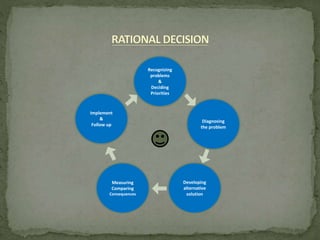
Recognizing
problems
&
Deciding
Priorities
Diagnosing
the problem
Developing
alternative
solution
Measuring
Comparing
Consequences
Implement
&
Follow up
 Deviation from past experience:
 E.g. This years sales are falling behind last year’s,
Expenses have suddenly increased,
Too many defective products are suddenly coming off the assembly line.
 Deviation from the plan:
 E.g. Profit levels are lower than anticipated,
A department is exceeding its budget,
A project is off schedule.
 Other people causes problem:
 E.g. Customers may complain about late deliveries,
Workers may complain about poor working conditions and so on.
 Competitors outperform the organization:
 E.g. Other company includes new processes or improves operating procedures.
 Some problems which can be solved by subordinates because they are close to them,
 Some problems may need to be referred upward because they affect other departments,
 Some problems may be differed because it may be not the best time to act.
 E.g. In many product development areas, delaying decision may be advisable until the
outcome of anticipated technical breakthrough is known.
 Some problems are procrastinated and allowed to be solved without any effort.
 There would be very few problems requiring the manager’s attention.
 Every problem should be correctly diagnosed.
 Sometimes symptoms of problem can mislead manager,
 Sometimes it happens that problem occurs in one part and manager finds problems into
another.
 E.g. When sales decline, manager may thinks causes in the sense of poor selling
procedures, sharp competition or saturation of old market but real problem may be the
tight fisted control of the firm and inabilities to fulfill customers demands.
 A manager must make a thorough study of all the sub-parts of his organization which are
connected with the sub-parts in which problem is located.
 For every problem there is always a alternative solution there.
 In every course of action alternative exists.
 To raise production :
 Build a new plant
 Buy better equipment
 Add an extra shift
 Authorize overtime.
 Developing alternatives==Feasibility==Limiting factors.
 Review Past experience==not always reliable with new culture
 Saturation: Manager must make himself thoroughly familiar with the problem.
 Deliberation: Manager must think problem from several viewpoints.
 Incubation: If deliberation does not help then turn off conscious search and relax.
 Illumination: Flash of insight take place and generates a new good idea.
 Accommodation: Manager refines his ideas into a usable proposal.
 Brain storming: 5 to 10 people indulge in an uninhibited search for solution.
 Brain stilling: Develop right half which controls intuition, Opposed to the left half which
controls logic and analytical capabilities.
 Comparison of Quality and Acceptability.
 Tangible consequences: Which can be quantitatively measured or mathematically
demonstrated.
 Intangible consequences: Which cannot be quantitatively measured or mathematically
demonstrated.
 Problem occurs though, Good in quality, poor in acceptability. Vice versa.
 In technical matters (Engineering, production, finance, purchase) Quality is more
important than Acceptability.
 In Human matters (Working condition, office layout) Acceptability is more important than
Quality.
 Translation of decision into an action.
 Communication of decision to the employees in clear and unambiguous terms.
 Required employees acceptance, if not take steps to win their cooperation.
 Employee association with decision making.
 As a safeguard against incorrect decision, while converting a decision into an action,
manager should institute a system of follow-up so that he can modify his decision at the
earliest opportunity.
 As per Herbert A. Simon Four principle stages:
 Intelligence- Searching the environment conditions calling for decision.
 Design- Inventing, developing, and analyzing possible course of action.
 Choice- Selecting particular course of action from alternatives.
 Review- Assessing past choices.
 Economic Man Model (Econologic Model)
 Administrative Man Model (Bounded Rationality Model)
 Social Man Model
 Man is completely Rational in his decisions.
 He always selects that alternative which gives him the greatest advantage.
 Planned, orderly and logical manner.
 Many critics about this model as it lacks realism.
 Man does not have enough capacity to:
 gather all necessary information.
 mentally store this information.
 accurately recall information anytime he likes.
 do a series of complex calculations.
 rank all consequences on the basis of their merits.
 Developed by Herbert Simon.
 Uses only limited rationality.
 Decision making by this model:
 Not having the ability to maximize attempts to satisfice.
 Search for alternatives is sequential and incremental.
 Search for alternatives is guided by experience.
 Steps included in Decision making process:
 Set the goal/Define the problem.
 Establish appropriate criteria to judge acceptability.
 Identify feasible solution.
 If no then lower the criteria and refresh search.
 If identified, evaluate it to determine acceptability.
 If acceptable, implement it.
 If unacceptable, initiate search for new solution.
 Evaluate degree of difficulty.
 Developed by classical psychologists.
 Freud: “Man being a bundle of feelings, emotions and instincts is guided by his
unconscious desires”
 Also a subject of social pressures and influences.
 Solomon Asch: “This world is full of irrational conformists”
 Strong social pressures can force managers to choose obviously wrong alternatives.
 Certainty
 Risk
 Decision Tree
 Uncertainty
 Decision maker can specify the consequences of a particular decision or act.
 Certainty about future events is difficult.
 Managerial decisions must be made in awareness that future conditions may vary widely
from those contemplated when the decision is being made.
 E.g. When a company has to make shipments to a number of customers from a numbers
of warehouses, it is possible to obtain the relevant facts for the problem those are types
of transport available, cost per unit for each source to each destination and so on. Also to
develop a least cost distribution pattern.
 As the number of possible alternatives increases, finding the one with highest payoff
becomes more and more difficult.
 Specified with known probability values.
 Value of probability associated with the event is a measure of the likelihood of the
occurrence of that event.
 Evaluation of alternatives is done by calculating the expected value of payoff associated
with each alternative.==sum of the value of each possible outcomes times its associated
probability.
Alternatives available
No. of buses needed
1 2
P=0.7 P=0.3
Total expected pay off
1. Run one bus
2. Run two buses
Rs. 500 Rs. 500
Rs. 0 Rs. 1000
Rs. 500
Rs. 300
 Approach involves linking a number of event branches.
 Process starts with minimum two alternatives to be evaluated.
 Probability must be ascertained as well as its monetary value.
Expected Pay off Buses run Buses Need
Rs. 500 1 1
Rs. 500 1 2
Re. 0 2 1
Rs. 1000 2 2
Decision
Point
Run 1 bus
1 bus
needed
2 buses
needed
Run 2 buses
1 bus
needed
2 buses
needed
Possible actions Possible events Net cash flow Total expected pay off
Rs. 500
Rs. 500
Rs. 0
Rs. 1000
(500*0.7) + (500*0.3) = Rs. 500
(0*0.7) + (1000*0.3) = Rs. 300
 Uncertainty exists when the decision maker does not know the probabilities associated
with possible outcomes.
 Since pay offs are identified but probabilities are unknown under conditions of
uncertainty, the criterion of maximizing the expected pay off cannot be used in evaluating
the decision alternatives.
 Maximin: Maximizes the minimum pay off. (Limited production in two years)
 Maximax: Maximizes the maximum pay off. (Immediate production and promotion)
 Minimax regret: Minimizes the maximum pay off. (Limited production now)
 Incomplete information
 Un-supporting Environment
 Non-acceptance by subordinates
 Ineffective communication
 Incorrect Timing
Decision making

Decision making

  • 1.
  • 2.
     Decision  Typesof Decision  Rational Decision  Models of Decision making Behavior  Environment of Decision making  Barriers in Decision Making
  • 3.
    Alternatives (Variety of actions) Purpose (Causeof action) Selection (Application of action)  Decision making means “To Choose wisely from Alternative actions for a certain Purpose”  Decision can be defined as “An selected Action which is applied to specific Problem for achieving desired Outcome“
  • 4.
     Programmed &Non Programmed  Major & Minor  Routine & Strategic  Simple & Complex  Individual & Group
  • 5.
     Programmed Decisions: Policy, Rule or Procedure  Not De novo  Repetitive, Routine and Easiest  E.g. Determining salary payments, recording office supply and so on.  Non Programmed decision:  Novel, Non repetitive  Problem has not arisen before  No cut and dry method, Custom tailored treatment  E.g. Allocation of organizational resources, about failing product line, improvisation of community relations.
  • 6.
     Futurity:  Decisioncommitment in future  Long range impact  E.g. Major: Replacement of manpower by machinery, Diversification of the existing product lines. Minor: Storage of raw material  Impact:  No. of affected areas  Size of cluster to be affected  E.g. Major: Change in basis of overhead allocation in preparing department profit and loss account Minor: Shift to bound ledger to loose leaf ledger
  • 7.
     Qualitative:  Involvessubjective factors  Basic principles of conduct, Ethical values, Social & Political beliefs.  E.g. Paying bribe to anyone for illegal gratification.  Recurrence:  Repetition of event  Major: Rare, no precedents , made at high level.  Minor: Often, routine decisions, made at Lower level.
  • 8.
     Routine Decisions: Supportive of company’s operations  Relate to the present, to achieve highest efficiency  Need less deliberation, Made at lower level  E.g. Provision for air conditioning, Lighting, Parking, Cafeteria Service, etc.  Strategic Decisions:  Relate to future  Need more deliberation  Need more money, Made at Higher level  E.g. Lowering prices, Changing product line, Introduction of automation.
  • 9.
     Simple Decisions: Variables of consideration are Few  Complex Decisions:  Variables of consideration are More  Mechanistic Decisions:  Problem is simple and high certainty  Judgmental Decisions:  Problem is simple and low certainty  Analytical Decisions:  Problem is complex, High certainty  Adaptive Decisions:  Problem is complex and low certainty Simple Complex High Low Problem Certainty Mechanistic Analytical Judgmental Adaptive
  • 10.
     Individual Decisions: Problem is routine  Analysis of variables is simple  Definite procedures are existed already  Group Decisions:  Important and Strategic decisions  Interdepartmental decisions  Methods: Dialectic method Devils Advocacy  Advantages: ‐ Increased acceptance ‐ Easier coordination ‐ Easier communication ‐ More information processed • Disadvantages: ‐ Group decisions take longer ‐ Groups can be indecisive ‐ Compromise ‐ Dominated ‐ Prior commitments
  • 11.
  • 12.
     Deviation frompast experience:  E.g. This years sales are falling behind last year’s, Expenses have suddenly increased, Too many defective products are suddenly coming off the assembly line.  Deviation from the plan:  E.g. Profit levels are lower than anticipated, A department is exceeding its budget, A project is off schedule.  Other people causes problem:  E.g. Customers may complain about late deliveries, Workers may complain about poor working conditions and so on.  Competitors outperform the organization:  E.g. Other company includes new processes or improves operating procedures.
  • 13.
     Some problemswhich can be solved by subordinates because they are close to them,  Some problems may need to be referred upward because they affect other departments,  Some problems may be differed because it may be not the best time to act.  E.g. In many product development areas, delaying decision may be advisable until the outcome of anticipated technical breakthrough is known.  Some problems are procrastinated and allowed to be solved without any effort.  There would be very few problems requiring the manager’s attention.
  • 14.
     Every problemshould be correctly diagnosed.  Sometimes symptoms of problem can mislead manager,  Sometimes it happens that problem occurs in one part and manager finds problems into another.  E.g. When sales decline, manager may thinks causes in the sense of poor selling procedures, sharp competition or saturation of old market but real problem may be the tight fisted control of the firm and inabilities to fulfill customers demands.  A manager must make a thorough study of all the sub-parts of his organization which are connected with the sub-parts in which problem is located.
  • 15.
     For everyproblem there is always a alternative solution there.  In every course of action alternative exists.  To raise production :  Build a new plant  Buy better equipment  Add an extra shift  Authorize overtime.  Developing alternatives==Feasibility==Limiting factors.  Review Past experience==not always reliable with new culture  Saturation: Manager must make himself thoroughly familiar with the problem.  Deliberation: Manager must think problem from several viewpoints.  Incubation: If deliberation does not help then turn off conscious search and relax.  Illumination: Flash of insight take place and generates a new good idea.  Accommodation: Manager refines his ideas into a usable proposal.  Brain storming: 5 to 10 people indulge in an uninhibited search for solution.  Brain stilling: Develop right half which controls intuition, Opposed to the left half which controls logic and analytical capabilities.
  • 16.
     Comparison ofQuality and Acceptability.  Tangible consequences: Which can be quantitatively measured or mathematically demonstrated.  Intangible consequences: Which cannot be quantitatively measured or mathematically demonstrated.  Problem occurs though, Good in quality, poor in acceptability. Vice versa.  In technical matters (Engineering, production, finance, purchase) Quality is more important than Acceptability.  In Human matters (Working condition, office layout) Acceptability is more important than Quality.
  • 17.
     Translation ofdecision into an action.  Communication of decision to the employees in clear and unambiguous terms.  Required employees acceptance, if not take steps to win their cooperation.  Employee association with decision making.  As a safeguard against incorrect decision, while converting a decision into an action, manager should institute a system of follow-up so that he can modify his decision at the earliest opportunity.  As per Herbert A. Simon Four principle stages:  Intelligence- Searching the environment conditions calling for decision.  Design- Inventing, developing, and analyzing possible course of action.  Choice- Selecting particular course of action from alternatives.  Review- Assessing past choices.
  • 18.
     Economic ManModel (Econologic Model)  Administrative Man Model (Bounded Rationality Model)  Social Man Model
  • 19.
     Man iscompletely Rational in his decisions.  He always selects that alternative which gives him the greatest advantage.  Planned, orderly and logical manner.  Many critics about this model as it lacks realism.  Man does not have enough capacity to:  gather all necessary information.  mentally store this information.  accurately recall information anytime he likes.  do a series of complex calculations.  rank all consequences on the basis of their merits.
  • 20.
     Developed byHerbert Simon.  Uses only limited rationality.  Decision making by this model:  Not having the ability to maximize attempts to satisfice.  Search for alternatives is sequential and incremental.  Search for alternatives is guided by experience.  Steps included in Decision making process:  Set the goal/Define the problem.  Establish appropriate criteria to judge acceptability.  Identify feasible solution.  If no then lower the criteria and refresh search.  If identified, evaluate it to determine acceptability.  If acceptable, implement it.  If unacceptable, initiate search for new solution.  Evaluate degree of difficulty.
  • 21.
     Developed byclassical psychologists.  Freud: “Man being a bundle of feelings, emotions and instincts is guided by his unconscious desires”  Also a subject of social pressures and influences.  Solomon Asch: “This world is full of irrational conformists”  Strong social pressures can force managers to choose obviously wrong alternatives.
  • 22.
     Certainty  Risk Decision Tree  Uncertainty
  • 23.
     Decision makercan specify the consequences of a particular decision or act.  Certainty about future events is difficult.  Managerial decisions must be made in awareness that future conditions may vary widely from those contemplated when the decision is being made.  E.g. When a company has to make shipments to a number of customers from a numbers of warehouses, it is possible to obtain the relevant facts for the problem those are types of transport available, cost per unit for each source to each destination and so on. Also to develop a least cost distribution pattern.  As the number of possible alternatives increases, finding the one with highest payoff becomes more and more difficult.
  • 24.
     Specified withknown probability values.  Value of probability associated with the event is a measure of the likelihood of the occurrence of that event.  Evaluation of alternatives is done by calculating the expected value of payoff associated with each alternative.==sum of the value of each possible outcomes times its associated probability. Alternatives available No. of buses needed 1 2 P=0.7 P=0.3 Total expected pay off 1. Run one bus 2. Run two buses Rs. 500 Rs. 500 Rs. 0 Rs. 1000 Rs. 500 Rs. 300
  • 25.
     Approach involveslinking a number of event branches.  Process starts with minimum two alternatives to be evaluated.  Probability must be ascertained as well as its monetary value. Expected Pay off Buses run Buses Need Rs. 500 1 1 Rs. 500 1 2 Re. 0 2 1 Rs. 1000 2 2 Decision Point Run 1 bus 1 bus needed 2 buses needed Run 2 buses 1 bus needed 2 buses needed Possible actions Possible events Net cash flow Total expected pay off Rs. 500 Rs. 500 Rs. 0 Rs. 1000 (500*0.7) + (500*0.3) = Rs. 500 (0*0.7) + (1000*0.3) = Rs. 300
  • 26.
     Uncertainty existswhen the decision maker does not know the probabilities associated with possible outcomes.  Since pay offs are identified but probabilities are unknown under conditions of uncertainty, the criterion of maximizing the expected pay off cannot be used in evaluating the decision alternatives.  Maximin: Maximizes the minimum pay off. (Limited production in two years)  Maximax: Maximizes the maximum pay off. (Immediate production and promotion)  Minimax regret: Minimizes the maximum pay off. (Limited production now)
  • 27.
     Incomplete information Un-supporting Environment  Non-acceptance by subordinates  Ineffective communication  Incorrect Timing