Learning with Medical Simulations Deirdre Bonnycastle Clinical Teaching  College of Medicine University of Saskatchewan
Objectives Upon completion of this module,  participants will be able to: Describe four types of simulations Identify how simulations can improve learning
Task of Medical Students Learning to think like a physician Learning to act like a physician
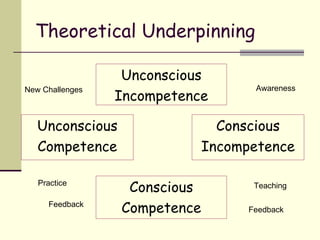
Theoretical Underpinning Experts  deliberately practice  the art and  science of medicine by having opportunities to : Reflect on their practice Create new patterns of information by connecting old and new material Correct mistakes in thinking and action Practice to the point of automaticity
Unconscious Incompetence Theoretical Underpinning Conscious Incompetence Unconscious Competence Conscious Competence Awareness Teaching Practice New Challenges Feedback Feedback
Four Types of Simulations 1. Simple 3. Standardized Patient 2. Mechanical 4. Virtual Scenario
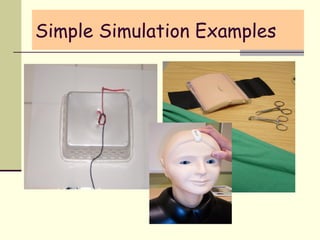
Simple Simulation Examples
Simple What is the advantage of  using simple simulation? allows practice of basic skills patient safety/comfort allows practice with minimal supervision available 24 hrs relatively inexpensive What disadvantage  is there? lack of direct feedback lacks patient interactivity only useful for simple skill building
Simple Key teaching points Provide students with step by step written or image instructions initially Encourage peer learning/practice Use with 5 step method of teaching skills/procedures   http://medicaleducation.wetpaint.com/page/5+Step+Approach+to+Teaching+Skills%2FProcedures Practice to point of automaticity for simple skill
Simple Mechanical Multi-task Simulated Person
Complex Mechanical Scenario Control Room  3D Internal Image + Simulated Person BMJ Simulation Module  http://learning.bmj.com/learning/search-result.html?moduleId =6080077&searchTerm=“Simulation”&page=0
Mechanical Simulation What is the advantage of  using mechanical  simulation? allows practice of more complex skills and teamwork patient safety/comfort allows for varied levels of risk student has basic skills when they enter OR/clinic What disadvantage is  there? high cost lacks patient interactivity requires supervision time consuming requires dedicated space and personnel
Process of Using Simulator Labs CLINICAL/HOSPITAL ENVIRONMENT SIMULATOR LAB Identify  learning  objective Simulator-based practice Patient   Feedback  Further practice as needed Competent Feedback
Problem: What is Medical Competence? Learned through Simple and Mechanical Simulation ? MEDICAL KNOWLEDGE CLINICAL REASONING PATIENT COMMUNICATION DEXTERITY/SKILL
Answer: Hybrid Standardized Patient ©Thanks to Dr. Roger Kneebone Attach a manufactured body part to an actor
Hybrid Standardized Patient What is the advantage of  using a hybrid standardized patient? program patient reaction patient safety/comfort learn to explain procedure to patient/parents practice draping and other physical patient preparation What disadvantage is  there? moderate cost time consuming requires dedicated space and personnel not appropriate for OR
Answer: Virtual Scenarios Second Life
Virtual Scenario (Information) Health Information Island
Virtual Scenario (Disaster) Play 2 Train
Virtual Scenario  (Clinical Reasoning) Imperial College London http://www.elearningimperial.com/index.php?option=com_content&task=view&id=37&Itemid=58 ©Pictures  thanks to Dr. Bertalan Meskó   http://scienceroll.com/2008/08/17/unique-medical-simulation-in-second-life/
Virtual Scenario Learn more about Second Life at  http://medicaleducation.wetpaint.com Click on The Networked Student  and scroll down.
T h a n k   y o u Read more about simulations here http:// www.medicine.usask.ca/faculty/cbf/medical -simulations

Medical Simulations

  • 1.
    Learning with MedicalSimulations Deirdre Bonnycastle Clinical Teaching College of Medicine University of Saskatchewan
  • 2.
    Objectives Upon completionof this module, participants will be able to: Describe four types of simulations Identify how simulations can improve learning
  • 3.
    Task of MedicalStudents Learning to think like a physician Learning to act like a physician
  • 4.
    Theoretical Underpinning Experts deliberately practice the art and science of medicine by having opportunities to : Reflect on their practice Create new patterns of information by connecting old and new material Correct mistakes in thinking and action Practice to the point of automaticity
  • 5.
    Unconscious Incompetence TheoreticalUnderpinning Conscious Incompetence Unconscious Competence Conscious Competence Awareness Teaching Practice New Challenges Feedback Feedback
  • 6.
    Four Types ofSimulations 1. Simple 3. Standardized Patient 2. Mechanical 4. Virtual Scenario
  • 7.
  • 8.
    Simple What isthe advantage of using simple simulation? allows practice of basic skills patient safety/comfort allows practice with minimal supervision available 24 hrs relatively inexpensive What disadvantage is there? lack of direct feedback lacks patient interactivity only useful for simple skill building
  • 9.
    Simple Key teachingpoints Provide students with step by step written or image instructions initially Encourage peer learning/practice Use with 5 step method of teaching skills/procedures http://medicaleducation.wetpaint.com/page/5+Step+Approach+to+Teaching+Skills%2FProcedures Practice to point of automaticity for simple skill
  • 10.
  • 11.
    Complex Mechanical ScenarioControl Room 3D Internal Image + Simulated Person BMJ Simulation Module http://learning.bmj.com/learning/search-result.html?moduleId =6080077&searchTerm=“Simulation”&page=0
  • 12.
    Mechanical Simulation Whatis the advantage of using mechanical simulation? allows practice of more complex skills and teamwork patient safety/comfort allows for varied levels of risk student has basic skills when they enter OR/clinic What disadvantage is there? high cost lacks patient interactivity requires supervision time consuming requires dedicated space and personnel
  • 13.
    Process of UsingSimulator Labs CLINICAL/HOSPITAL ENVIRONMENT SIMULATOR LAB Identify learning objective Simulator-based practice Patient Feedback Further practice as needed Competent Feedback
  • 14.
    Problem: What isMedical Competence? Learned through Simple and Mechanical Simulation ? MEDICAL KNOWLEDGE CLINICAL REASONING PATIENT COMMUNICATION DEXTERITY/SKILL
  • 15.
    Answer: Hybrid StandardizedPatient ©Thanks to Dr. Roger Kneebone Attach a manufactured body part to an actor
  • 16.
    Hybrid Standardized PatientWhat is the advantage of using a hybrid standardized patient? program patient reaction patient safety/comfort learn to explain procedure to patient/parents practice draping and other physical patient preparation What disadvantage is there? moderate cost time consuming requires dedicated space and personnel not appropriate for OR
  • 17.
  • 18.
    Virtual Scenario (Information)Health Information Island
  • 19.
  • 20.
    Virtual Scenario (Clinical Reasoning) Imperial College London http://www.elearningimperial.com/index.php?option=com_content&task=view&id=37&Itemid=58 ©Pictures thanks to Dr. Bertalan Meskó http://scienceroll.com/2008/08/17/unique-medical-simulation-in-second-life/
  • 21.
    Virtual Scenario Learnmore about Second Life at http://medicaleducation.wetpaint.com Click on The Networked Student and scroll down.
  • 22.
    T h an k y o u Read more about simulations here http:// www.medicine.usask.ca/faculty/cbf/medical -simulations