Prepared by
Prof. Chetan Lakhlani
NRVIBMS, Junagadh
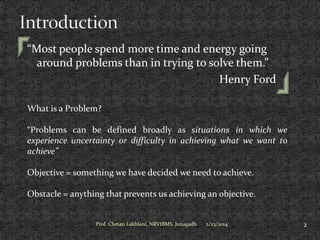
“Most people spend more time and energy going
around problems than in trying to solve them.”
Henry Ford
What is a Problem?
“Problems can be defined broadly as situations in which we
experience uncertainty or difficulty in achieving what we want to
achieve”
Objective = something we have decided we need to achieve.
Obstacle = anything that prevents us achieving an objective.

Prof. Chetan Lakhlani, NRVIBMS, Junagadh

2/23/2014

2
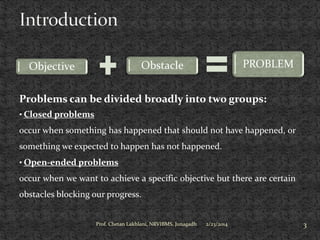
PROBLEM

Obstacle

Objective

Problems can be divided broadly into two groups:
• Closed problems

occur when something has happened that should not have happened, or
something we expected to happen has not happened.
• Open-ended problems

occur when we want to achieve a specific objective but there are certain
obstacles blocking our progress.

Prof. Chetan Lakhlani, NRVIBMS, Junagadh

2/23/2014

3
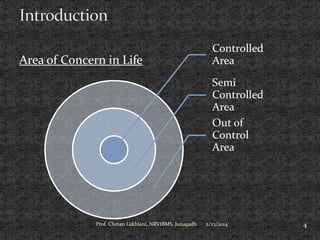
Area of Concern in Life

Controlled
Area
Semi
Controlled
Area
Out of
Control
Area

Prof. Chetan Lakhlani, NRVIBMS, Junagadh

2/23/2014

4
The optimistic way toward problem….
 “Probortunity”
 Its difference b/w the actual state and desired state.
 Its recognition of a present lacking and the belief in better
future.
People are likely to adopt either of the two approaches :
1. Stop It
 Prevent It
 Eliminate It
 Reduce It

2. Mop It…….(Clean It)
 Treat It
 Tolerate It
 Redirect It
Prof. Chetan Lakhlani, NRVIBMS, Junagadh

2/23/2014

5
Problem solving requires two distinct types of mental
skill:
 Analytical/ Logical Skill
 Creative Thinking
 Fluency
 Flexibility
 Elaboration

creativity include: Intuition, Incubation, Invention,
Innovation.
Prof. Chetan Lakhlani, NRVIBMS, Junagadh

2/23/2014

6
 Not being methodical.

 Lack of commitment to solving the problem.
 Misinterpreting the problem.
 Lack of knowledge of the techniques and processes







involved in problem solving.
Inability to use the techniques effectively.
Using a method inappropriate to the particular problem.
Insufficient or inaccurate information.
Inability to combine analytical and creative thinking.
Failure to ensure effective implementation.
Prof. Chetan Lakhlani, NRVIBMS, Junagadh

2/23/2014

7
A.






Perceptual blocks
Seeing only what you want to see
Stereotyping
Not recognizing problems
Not seeing the problem from other perspective.
Mistaking cause and effect

Overcoming perceptual block…..
 To Have a systems which may warn the possibility of problems.
 Defining and analyzing problems adequately.
 Collecting all the relevant information.
 Checking the possibility of inaccurate information or any assumptions
and relevance of data.
 Asking for other people's points of view.
 Using models to find the relationships between different aspects of the
problem.
Prof. Chetan Lakhlani, NRVIBMS, Junagadh

2/23/2014

8
B. Emotional blocks
It arises when our emotional needs conflict with the situation.
 Fear of making mistakes or looking foolish
 Impatience
 Avoiding anxiety
 Fear of taking risks
 Need for order
 Lack of challenge
Overcoming emotional block…..
 Try to develop your ideas into a practical form or develop a logical
argument.
 Follow strictly methodical approach.
 To avoid anxiety tackle problems in small, easily manageable steps; if
necessary, put the problem aside and come back to it later.
 If you don't want to take risks, identify the worst possible
consequences, and then try to find ways of preventing them.
Prof. Chetan Lakhlani, NRVIBMS, Junagadh

2/23/2014

9
C. Intellectual blocks
 Lack of knowledge or skill in the problem solving process

 Lack of creative thinking
 Inflexible thinking
 Not being methodical
 Lack of knowledge or skill in using the 'Language' of the problem
 Using inadequate information

Overcoming intellectual block…..
 Learn to be methodical
 Practice using different types of 'language' to tackle problems
 Practice using the various analytical and creative techniques.
Prof. Chetan Lakhlani, NRVIBMS, Junagadh

2/23/2014

10
D. Expressive blocks






Using the wrong language.
Unfamiliarity with a particular application of a language.
Inadequate explanations.
A passive management style.
A dominant management style.

Overcoming expressive block…..
 Identify which 'language' is most likely to help you solve a
particular problem.
 Use different presentation style, e.g. diagrams , flow chart,
picture etc.
 Ensure the relevant information is accurate and precise.
 Don’t be so aggressive or too passive and try to be
enthusiastic about your own ideas and others as well.
Prof. Chetan Lakhlani, NRVIBMS, Junagadh

2/23/2014

11
E . Environmental blocks
The social or physical environment, which prevent us from solving a problem
effectively
 Management style
 Distractions
 Physical discomfort
 Lack of support
 Stress
 Lack of communication
 Monotonous work
 Expectations of others
Overcoming expressive block…..
 A Strong idea and efficient presentation may prevent premature criticism.
 Conduct your problem solving in comfortable and free of distractions
environment, some time it may help, if you move away from your normal
working environment.
 Before seeking for the help, indicate their personal benefits.
 If pressure of work bothers you, set asides the problem and deal with it after
your routine work.
Prof. Chetan Lakhlani, NRVIBMS, Junagadh

2/23/2014

12
F. Cultural blocks
Not able recognize good or bad and wrong or right, just follow the custom.
 Unquestioning acceptance of the status quo
 Dislike of change
 People believe that fantasy and humor are not productive
 Feelings, intuition and subjective judgments are unreliable'
 Over-emphasis on competition or cooperation
 Taboos

Overcoming expressive block…..
 Identify constraints and question their validity.
 If you don’t want to change, do the things you like most and see the benefits
i.e. a new approach.
 Day dreaming, cracking jokes or comment may bring new perspectives .
 If you think intuition is unreliable, think about the last successful ‘GUESS’
which had helped you.
 In a highly competitive environment, being expressive about your ideas might
benefits to others.
 In cooperation environment, ask others ideas ; share your problem with them.
Prof. Chetan Lakhlani, NRVIBMS, Junagadh

2/23/2014

13
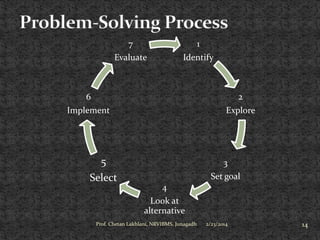
7

1

Evaluate

Identify

6

2

Implement

Explore

5

3

Select

Set goal
4
Look at
alternative

Prof. Chetan Lakhlani, NRVIBMS, Junagadh

2/23/2014

14
1. Identifying the Problem:
 In case of uncertainty ask friends or a professional










expert.
Comparison with others
Monitor for weak signals
Comparison of current performance with objectives or
past performance
Checklists
Brainstorming
Listing complaints
Role playing
Prof. Chetan Lakhlani, NRVIBMS, Junagadh

2/23/2014

15
2. Exploring the Problem:
to see the root cause, try to answer various question starts
with…….







Who?
What?
When?
Where?
Why?
How?

3. Set Goals:
Develop a goal statement:
 Helps to clarify the direction to solve the problem
 Gives something definite to focus on
Whole process is about closing or fixing the gap between the problem
and the goal.
Prof. Chetan Lakhlani, NRVIBMS, Junagadh

2/23/2014

16
4. Look at alternatives:
Techniques to identify alternative solutions…
 Analysis of past solutions
 Reading
 Researching
 Thinking
 Asking Questions
 Discussing
 Viewing the problem with fresh eyes
 Brainstorming
 Sleeping on it
Prof. Chetan Lakhlani, NRVIBMS, Junagadh

2/23/2014

17
5. Select the best solution:
 There may be a wide variety of possible solutions.
 Consider the number of factors which can affect a
solution, for instance, money, time, people,
procedures, policies, rules etc.
 Managers should priorities the solutions on the base of
the effectiveness of factors.
 Elimination the list wanted solutions and narrow
down the choices for the best or optimal outcomes.
6. Implementation:
Managers must have an action plan and communicate
it to those who directly and indirectly affected.
Prof. Chetan Lakhlani, NRVIBMS, Junagadh

2/23/2014

18
7. Evaluation:
Managers should review the effectiveness of the
solution against desired outcomes.
Did the solution work?

If not, why not?

What went right, and what went wrong?

What adjustments do they have to make to ensure that
the solution works better?


This stage requires careful analysis that improves upon
the best solution.

Prof. Chetan Lakhlani, NRVIBMS, Junagadh

2/23/2014

19
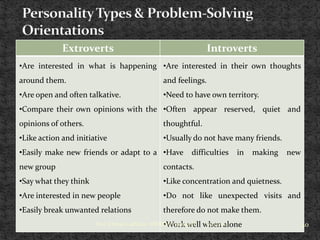
Extroverts

Introverts

•Are interested in what is happening •Are interested in their own thoughts
around them.

and feelings.

•Are open and often talkative.

•Need to have own territory.

•Compare their own opinions with the •Often appear reserved, quiet and

opinions of others.

thoughtful.

•Like action and initiative

•Usually do not have many friends.

•Easily make new friends or adapt to a •Have

difficulties

in

making

new

new group

contacts.

•Say what they think

•Like concentration and quietness.

•Are interested in new people

•Do not like unexpected visits and

•Easily break unwanted relations

therefore do not make them.

Prof. Chetan Lakhlani, NRVIBMS, Junagadh when alone
•Work well 2/23/2014

20
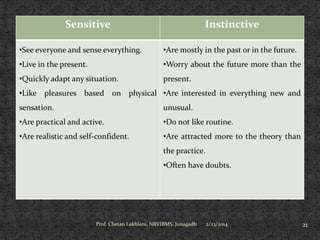
Sensitive

Instinctive

•See everyone and sense everything.

•Are mostly in the past or in the future.

•Live in the present.

•Worry about the future more than the

•Quickly adapt any situation.

present.

•Like pleasures based on physical •Are interested in everything new and
sensation.

unusual.

•Are practical and active.

•Do not like routine.

•Are realistic and self-confident.

•Are attracted more to the theory than
the practice.
•Often have doubts.

Prof. Chetan Lakhlani, NRVIBMS, Junagadh

2/23/2014

21
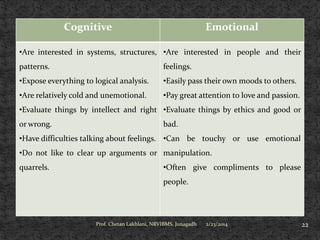
Cognitive

Emotional

•Are interested in systems, structures, •Are interested in people and their
patterns.

feelings.

•Expose everything to logical analysis.

•Easily pass their own moods to others.

•Are relatively cold and unemotional.

•Pay great attention to love and passion.

•Evaluate things by intellect and right •Evaluate things by ethics and good or
or wrong.

bad.

•Have difficulties talking about feelings. •Can be touchy or use emotional
•Do not like to clear up arguments or manipulation.
quarrels.

•Often give compliments to please
people.

Prof. Chetan Lakhlani, NRVIBMS, Junagadh

2/23/2014

22
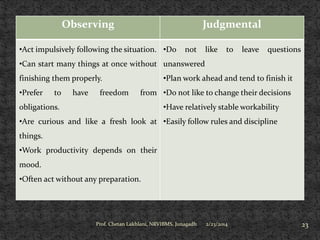
Observing

Judgmental

•Act impulsively following the situation. •Do

not

like

to

leave

questions

•Can start many things at once without unanswered
•Plan work ahead and tend to finish it

finishing them properly.
•Prefer

to

have

freedom

from •Do not like to change their decisions
•Have relatively stable workability

obligations.

•Are curious and like a fresh look at •Easily follow rules and discipline
things.
•Work productivity depends on their
mood.
•Often act without any preparation.

Prof. Chetan Lakhlani, NRVIBMS, Junagadh

2/23/2014

23
a). Means-End Analysis:
The problem solver compares the present situation with the goal, detects a
difference between them, and then searches for actions which may reduce
the difference.
b). Backwards Planning:
The strategy of working backwards include starting with the end results
and reversing the steps you need to get those results, in order to figure out
the answer to the problem.
c). Categorizing/Classifying:
It is the process of grouping objects or events together on the basis of a
logical rationale. There are two kinds of categorizing, grouping and
classifying. Grouping is putting together objects on the basis of a single
property. Classifying involves putting items together on the basis of more
than a single property at a time.
Prof. Chetan Lakhlani, NRVIBMS, Junagadh

2/23/2014

24
d). Challenging Assumptions:
It’s the direct conflict of ideas, opinions, or attitudes that have previously
been taken for granted. The purpose is to identify the fallacies,
consistencies and inconsistencies in the problem-solving process.
e). Evaluating/Judging:
It involves the comparison with a standard and making a qualitative or
quantitative judgment of value or worth
f ). Inductive/Deductive Reasoning:
Reasoning is the systematic and logical development of rules or concepts,
based on a general principle.
g). Thinking Aloud:
It is the process of verbalizing about a problem and its solution while a
partner listens in detail for errors in thinking or understanding.
Prof. Chetan Lakhlani, NRVIBMS, Junagadh

2/23/2014

25
h). Network Analysis:
It is a systems approach to project planning and
management where relationships among activities, events,
resources, and timelines are developed and charted.
i). Plus-Minus-Interesting (PMI):
It involves considering the positive, negative, and
interesting or thought-provoking aspects of an idea, using
a balance sheet grid where plus and minus are used for the
problem solving process.
j) Task analysis:
It is the consideration of skills and knowledge required to
learn or perform a specific task.
Prof. Chetan Lakhlani, NRVIBMS, Junagadh

2/23/2014

26
a). Brainstorming:
It is attempting to spontaneously generate as many ideas
on a subject as possible; ideas are not critiqued during
the brainstorming process; participants are encouraged
to form new ideas from ideas already stated.

b). Imaging/Visualization:
It is producing mental pictures of the total problem or
specific parts of the problem.
c). Incubation:
It is putting aside the problem and doing something else to
allow the mind to unconsciously consider the problem
Prof. Chetan Lakhlani, NRVIBMS, Junagadh

2/23/2014

27
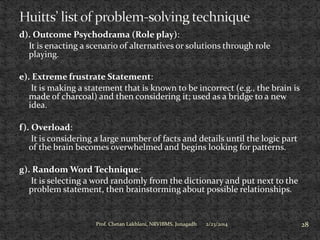
d). Outcome Psychodrama (Role play):
It is enacting a scenario of alternatives or solutions through role
playing.
e). Extreme frustrate Statement:
It is making a statement that is known to be incorrect (e.g., the brain is
made of charcoal) and then considering it; used as a bridge to a new
idea.
f). Overload:
It is considering a large number of facts and details until the logic part
of the brain becomes overwhelmed and begins looking for patterns.

g). Random Word Technique:
It is selecting a word randomly from the dictionary and put next to the
problem statement, then brainstorming about possible relationships.

Prof. Chetan Lakhlani, NRVIBMS, Junagadh

2/23/2014

28
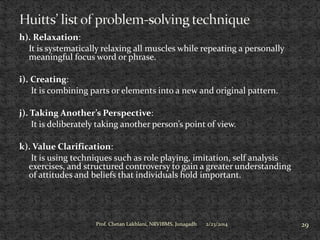
h). Relaxation:
It is systematically relaxing all muscles while repeating a personally
meaningful focus word or phrase.
i). Creating:
It is combining parts or elements into a new and original pattern.
j). Taking Another’s Perspective:
It is deliberately taking another person’s point of view.
k). Value Clarification:
It is using techniques such as role playing, imitation, self analysis
exercises, and structured controversy to gain a greater understanding
of attitudes and beliefs that individuals hold important.

Prof. Chetan Lakhlani, NRVIBMS, Junagadh

2/23/2014

29
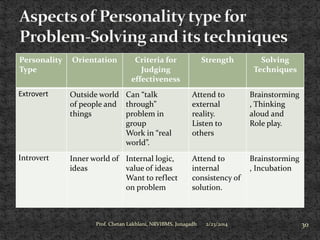
Personality
Type

Orientation

Criteria for
Judging
effectiveness

Strength

Extrovert

Outside world Can “talk
of people and through”
things
problem in
group
Work in “real
world”.

Attend to
external
reality.
Listen to
others

Brainstorming
, Thinking
aloud and
Role play.

Introvert

Inner world of Internal logic,
ideas
value of ideas
Want to reflect
on problem

Attend to
internal
consistency of
solution.

Brainstorming
, Incubation

Prof. Chetan Lakhlani, NRVIBMS, Junagadh

2/23/2014

Solving
Techniques

30
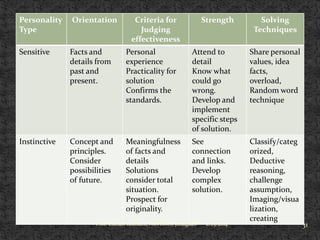
Personality
Type

Orientation

Criteria for
Judging
effectiveness

Strength

Sensitive

Facts and
details from
past and
present.

Personal
experience
Practicality for
solution
Confirms the
standards.

Attend to
detail
Know what
could go
wrong.
Develop and
implement
specific steps
of solution.

Share personal
values, idea
facts,
overload,
Random word
technique

Instinctive

Concept and
principles.
Consider
possibilities
of future.

Meaningfulness
of facts and
details
Solutions
consider total
situation.
Prospect for
originality.

See
connection
and links.
Develop
complex
solution.

Classify/categ
orized,
Deductive
reasoning,
challenge
assumption,
Imaging/visua
lization,
creating

Prof. Chetan Lakhlani, NRVIBMS, Junagadh

2/23/2014

Solving
Techniques

31
Personality
Type

Orientation

Criteria for
Judging
effectiveness

Strength

Solving
Techniques

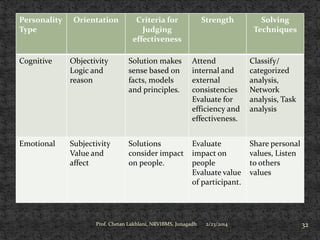
Cognitive

Objectivity
Logic and
reason

Solution makes
sense based on
facts, models
and principles.

Attend
internal and
external
consistencies
Evaluate for
efficiency and
effectiveness.

Classify/
categorized
analysis,
Network
analysis, Task
analysis

Emotional

Subjectivity
Value and
affect

Solutions
consider impact
on people.

Evaluate
impact on
people
Evaluate value
of participant.

Share personal
values, Listen
to others
values

Prof. Chetan Lakhlani, NRVIBMS, Junagadh

2/23/2014

32
Personality
Type

Orientation

Criteria for
Judging
effectiveness

Strength

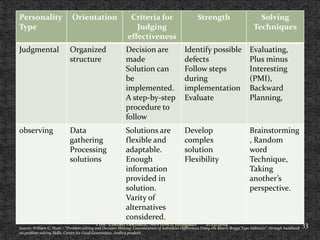
Judgmental

Organized
structure

Decision are
made
Solution can
be
implemented.
A step-by-step
procedure to
follow

Identify possible
defects
Follow steps
during
implementation
Evaluate

Evaluating,
Plus minus
Interesting
(PMI),
Backward
Planning,

observing

Data
gathering
Processing
solutions

Solutions are
flexible and
adaptable.
Enough
information
provided in
solution.
Varity of
alternatives
considered.

Develop
complex
solution
Flexibility

Brainstorming
, Random
word
Technique,
Taking
another’s
perspective.

Prof. Chetan Lakhlani, NRVIBMS, Junagadh

2/23/2014

Solving
Techniques

Source: William G. Huitt – “Problem solving and Decision Making: Consideration of Individual Differences Using the Myers-Briggs Type Indicator” through handbook
on problem solving Skills, Centre for Good Governance, Andhra pradesh

33
Thank You

Prof. Chetan Lakhlani, NRVIBMS, Junagadh

2/23/2014

34

Problem solving skill

  • 1.
    Prepared by Prof. ChetanLakhlani NRVIBMS, Junagadh
  • 2.
    “Most people spendmore time and energy going around problems than in trying to solve them.” Henry Ford What is a Problem? “Problems can be defined broadly as situations in which we experience uncertainty or difficulty in achieving what we want to achieve” Objective = something we have decided we need to achieve. Obstacle = anything that prevents us achieving an objective. Prof. Chetan Lakhlani, NRVIBMS, Junagadh 2/23/2014 2
  • 3.
    PROBLEM Obstacle Objective Problems can bedivided broadly into two groups: • Closed problems occur when something has happened that should not have happened, or something we expected to happen has not happened. • Open-ended problems occur when we want to achieve a specific objective but there are certain obstacles blocking our progress. Prof. Chetan Lakhlani, NRVIBMS, Junagadh 2/23/2014 3
  • 4.
    Area of Concernin Life Controlled Area Semi Controlled Area Out of Control Area Prof. Chetan Lakhlani, NRVIBMS, Junagadh 2/23/2014 4
  • 5.
    The optimistic waytoward problem….  “Probortunity”  Its difference b/w the actual state and desired state.  Its recognition of a present lacking and the belief in better future. People are likely to adopt either of the two approaches : 1. Stop It  Prevent It  Eliminate It  Reduce It 2. Mop It…….(Clean It)  Treat It  Tolerate It  Redirect It Prof. Chetan Lakhlani, NRVIBMS, Junagadh 2/23/2014 5
  • 6.
    Problem solving requirestwo distinct types of mental skill:  Analytical/ Logical Skill  Creative Thinking  Fluency  Flexibility  Elaboration creativity include: Intuition, Incubation, Invention, Innovation. Prof. Chetan Lakhlani, NRVIBMS, Junagadh 2/23/2014 6
  • 7.
     Not beingmethodical.  Lack of commitment to solving the problem.  Misinterpreting the problem.  Lack of knowledge of the techniques and processes      involved in problem solving. Inability to use the techniques effectively. Using a method inappropriate to the particular problem. Insufficient or inaccurate information. Inability to combine analytical and creative thinking. Failure to ensure effective implementation. Prof. Chetan Lakhlani, NRVIBMS, Junagadh 2/23/2014 7
  • 8.
    A.      Perceptual blocks Seeing onlywhat you want to see Stereotyping Not recognizing problems Not seeing the problem from other perspective. Mistaking cause and effect Overcoming perceptual block…..  To Have a systems which may warn the possibility of problems.  Defining and analyzing problems adequately.  Collecting all the relevant information.  Checking the possibility of inaccurate information or any assumptions and relevance of data.  Asking for other people's points of view.  Using models to find the relationships between different aspects of the problem. Prof. Chetan Lakhlani, NRVIBMS, Junagadh 2/23/2014 8
  • 9.
    B. Emotional blocks Itarises when our emotional needs conflict with the situation.  Fear of making mistakes or looking foolish  Impatience  Avoiding anxiety  Fear of taking risks  Need for order  Lack of challenge Overcoming emotional block…..  Try to develop your ideas into a practical form or develop a logical argument.  Follow strictly methodical approach.  To avoid anxiety tackle problems in small, easily manageable steps; if necessary, put the problem aside and come back to it later.  If you don't want to take risks, identify the worst possible consequences, and then try to find ways of preventing them. Prof. Chetan Lakhlani, NRVIBMS, Junagadh 2/23/2014 9
  • 10.
    C. Intellectual blocks Lack of knowledge or skill in the problem solving process  Lack of creative thinking  Inflexible thinking  Not being methodical  Lack of knowledge or skill in using the 'Language' of the problem  Using inadequate information Overcoming intellectual block…..  Learn to be methodical  Practice using different types of 'language' to tackle problems  Practice using the various analytical and creative techniques. Prof. Chetan Lakhlani, NRVIBMS, Junagadh 2/23/2014 10
  • 11.
    D. Expressive blocks      Usingthe wrong language. Unfamiliarity with a particular application of a language. Inadequate explanations. A passive management style. A dominant management style. Overcoming expressive block…..  Identify which 'language' is most likely to help you solve a particular problem.  Use different presentation style, e.g. diagrams , flow chart, picture etc.  Ensure the relevant information is accurate and precise.  Don’t be so aggressive or too passive and try to be enthusiastic about your own ideas and others as well. Prof. Chetan Lakhlani, NRVIBMS, Junagadh 2/23/2014 11
  • 12.
    E . Environmentalblocks The social or physical environment, which prevent us from solving a problem effectively  Management style  Distractions  Physical discomfort  Lack of support  Stress  Lack of communication  Monotonous work  Expectations of others Overcoming expressive block…..  A Strong idea and efficient presentation may prevent premature criticism.  Conduct your problem solving in comfortable and free of distractions environment, some time it may help, if you move away from your normal working environment.  Before seeking for the help, indicate their personal benefits.  If pressure of work bothers you, set asides the problem and deal with it after your routine work. Prof. Chetan Lakhlani, NRVIBMS, Junagadh 2/23/2014 12
  • 13.
    F. Cultural blocks Notable recognize good or bad and wrong or right, just follow the custom.  Unquestioning acceptance of the status quo  Dislike of change  People believe that fantasy and humor are not productive  Feelings, intuition and subjective judgments are unreliable'  Over-emphasis on competition or cooperation  Taboos Overcoming expressive block…..  Identify constraints and question their validity.  If you don’t want to change, do the things you like most and see the benefits i.e. a new approach.  Day dreaming, cracking jokes or comment may bring new perspectives .  If you think intuition is unreliable, think about the last successful ‘GUESS’ which had helped you.  In a highly competitive environment, being expressive about your ideas might benefits to others.  In cooperation environment, ask others ideas ; share your problem with them. Prof. Chetan Lakhlani, NRVIBMS, Junagadh 2/23/2014 13
  • 14.
  • 15.
    1. Identifying theProblem:  In case of uncertainty ask friends or a professional        expert. Comparison with others Monitor for weak signals Comparison of current performance with objectives or past performance Checklists Brainstorming Listing complaints Role playing Prof. Chetan Lakhlani, NRVIBMS, Junagadh 2/23/2014 15
  • 16.
    2. Exploring theProblem: to see the root cause, try to answer various question starts with…….       Who? What? When? Where? Why? How? 3. Set Goals: Develop a goal statement:  Helps to clarify the direction to solve the problem  Gives something definite to focus on Whole process is about closing or fixing the gap between the problem and the goal. Prof. Chetan Lakhlani, NRVIBMS, Junagadh 2/23/2014 16
  • 17.
    4. Look atalternatives: Techniques to identify alternative solutions…  Analysis of past solutions  Reading  Researching  Thinking  Asking Questions  Discussing  Viewing the problem with fresh eyes  Brainstorming  Sleeping on it Prof. Chetan Lakhlani, NRVIBMS, Junagadh 2/23/2014 17
  • 18.
    5. Select thebest solution:  There may be a wide variety of possible solutions.  Consider the number of factors which can affect a solution, for instance, money, time, people, procedures, policies, rules etc.  Managers should priorities the solutions on the base of the effectiveness of factors.  Elimination the list wanted solutions and narrow down the choices for the best or optimal outcomes. 6. Implementation: Managers must have an action plan and communicate it to those who directly and indirectly affected. Prof. Chetan Lakhlani, NRVIBMS, Junagadh 2/23/2014 18
  • 19.
    7. Evaluation: Managers shouldreview the effectiveness of the solution against desired outcomes. Did the solution work?  If not, why not?  What went right, and what went wrong?  What adjustments do they have to make to ensure that the solution works better?  This stage requires careful analysis that improves upon the best solution. Prof. Chetan Lakhlani, NRVIBMS, Junagadh 2/23/2014 19
  • 20.
    Extroverts Introverts •Are interested inwhat is happening •Are interested in their own thoughts around them. and feelings. •Are open and often talkative. •Need to have own territory. •Compare their own opinions with the •Often appear reserved, quiet and opinions of others. thoughtful. •Like action and initiative •Usually do not have many friends. •Easily make new friends or adapt to a •Have difficulties in making new new group contacts. •Say what they think •Like concentration and quietness. •Are interested in new people •Do not like unexpected visits and •Easily break unwanted relations therefore do not make them. Prof. Chetan Lakhlani, NRVIBMS, Junagadh when alone •Work well 2/23/2014 20
  • 21.
    Sensitive Instinctive •See everyone andsense everything. •Are mostly in the past or in the future. •Live in the present. •Worry about the future more than the •Quickly adapt any situation. present. •Like pleasures based on physical •Are interested in everything new and sensation. unusual. •Are practical and active. •Do not like routine. •Are realistic and self-confident. •Are attracted more to the theory than the practice. •Often have doubts. Prof. Chetan Lakhlani, NRVIBMS, Junagadh 2/23/2014 21
  • 22.
    Cognitive Emotional •Are interested insystems, structures, •Are interested in people and their patterns. feelings. •Expose everything to logical analysis. •Easily pass their own moods to others. •Are relatively cold and unemotional. •Pay great attention to love and passion. •Evaluate things by intellect and right •Evaluate things by ethics and good or or wrong. bad. •Have difficulties talking about feelings. •Can be touchy or use emotional •Do not like to clear up arguments or manipulation. quarrels. •Often give compliments to please people. Prof. Chetan Lakhlani, NRVIBMS, Junagadh 2/23/2014 22
  • 23.
    Observing Judgmental •Act impulsively followingthe situation. •Do not like to leave questions •Can start many things at once without unanswered •Plan work ahead and tend to finish it finishing them properly. •Prefer to have freedom from •Do not like to change their decisions •Have relatively stable workability obligations. •Are curious and like a fresh look at •Easily follow rules and discipline things. •Work productivity depends on their mood. •Often act without any preparation. Prof. Chetan Lakhlani, NRVIBMS, Junagadh 2/23/2014 23
  • 24.
    a). Means-End Analysis: Theproblem solver compares the present situation with the goal, detects a difference between them, and then searches for actions which may reduce the difference. b). Backwards Planning: The strategy of working backwards include starting with the end results and reversing the steps you need to get those results, in order to figure out the answer to the problem. c). Categorizing/Classifying: It is the process of grouping objects or events together on the basis of a logical rationale. There are two kinds of categorizing, grouping and classifying. Grouping is putting together objects on the basis of a single property. Classifying involves putting items together on the basis of more than a single property at a time. Prof. Chetan Lakhlani, NRVIBMS, Junagadh 2/23/2014 24
  • 25.
    d). Challenging Assumptions: It’sthe direct conflict of ideas, opinions, or attitudes that have previously been taken for granted. The purpose is to identify the fallacies, consistencies and inconsistencies in the problem-solving process. e). Evaluating/Judging: It involves the comparison with a standard and making a qualitative or quantitative judgment of value or worth f ). Inductive/Deductive Reasoning: Reasoning is the systematic and logical development of rules or concepts, based on a general principle. g). Thinking Aloud: It is the process of verbalizing about a problem and its solution while a partner listens in detail for errors in thinking or understanding. Prof. Chetan Lakhlani, NRVIBMS, Junagadh 2/23/2014 25
  • 26.
    h). Network Analysis: Itis a systems approach to project planning and management where relationships among activities, events, resources, and timelines are developed and charted. i). Plus-Minus-Interesting (PMI): It involves considering the positive, negative, and interesting or thought-provoking aspects of an idea, using a balance sheet grid where plus and minus are used for the problem solving process. j) Task analysis: It is the consideration of skills and knowledge required to learn or perform a specific task. Prof. Chetan Lakhlani, NRVIBMS, Junagadh 2/23/2014 26
  • 27.
    a). Brainstorming: It isattempting to spontaneously generate as many ideas on a subject as possible; ideas are not critiqued during the brainstorming process; participants are encouraged to form new ideas from ideas already stated. b). Imaging/Visualization: It is producing mental pictures of the total problem or specific parts of the problem. c). Incubation: It is putting aside the problem and doing something else to allow the mind to unconsciously consider the problem Prof. Chetan Lakhlani, NRVIBMS, Junagadh 2/23/2014 27
  • 28.
    d). Outcome Psychodrama(Role play): It is enacting a scenario of alternatives or solutions through role playing. e). Extreme frustrate Statement: It is making a statement that is known to be incorrect (e.g., the brain is made of charcoal) and then considering it; used as a bridge to a new idea. f). Overload: It is considering a large number of facts and details until the logic part of the brain becomes overwhelmed and begins looking for patterns. g). Random Word Technique: It is selecting a word randomly from the dictionary and put next to the problem statement, then brainstorming about possible relationships. Prof. Chetan Lakhlani, NRVIBMS, Junagadh 2/23/2014 28
  • 29.
    h). Relaxation: It issystematically relaxing all muscles while repeating a personally meaningful focus word or phrase. i). Creating: It is combining parts or elements into a new and original pattern. j). Taking Another’s Perspective: It is deliberately taking another person’s point of view. k). Value Clarification: It is using techniques such as role playing, imitation, self analysis exercises, and structured controversy to gain a greater understanding of attitudes and beliefs that individuals hold important. Prof. Chetan Lakhlani, NRVIBMS, Junagadh 2/23/2014 29
  • 30.
    Personality Type Orientation Criteria for Judging effectiveness Strength Extrovert Outside worldCan “talk of people and through” things problem in group Work in “real world”. Attend to external reality. Listen to others Brainstorming , Thinking aloud and Role play. Introvert Inner world of Internal logic, ideas value of ideas Want to reflect on problem Attend to internal consistency of solution. Brainstorming , Incubation Prof. Chetan Lakhlani, NRVIBMS, Junagadh 2/23/2014 Solving Techniques 30
  • 31.
    Personality Type Orientation Criteria for Judging effectiveness Strength Sensitive Facts and detailsfrom past and present. Personal experience Practicality for solution Confirms the standards. Attend to detail Know what could go wrong. Develop and implement specific steps of solution. Share personal values, idea facts, overload, Random word technique Instinctive Concept and principles. Consider possibilities of future. Meaningfulness of facts and details Solutions consider total situation. Prospect for originality. See connection and links. Develop complex solution. Classify/categ orized, Deductive reasoning, challenge assumption, Imaging/visua lization, creating Prof. Chetan Lakhlani, NRVIBMS, Junagadh 2/23/2014 Solving Techniques 31
  • 32.
    Personality Type Orientation Criteria for Judging effectiveness Strength Solving Techniques Cognitive Objectivity Logic and reason Solutionmakes sense based on facts, models and principles. Attend internal and external consistencies Evaluate for efficiency and effectiveness. Classify/ categorized analysis, Network analysis, Task analysis Emotional Subjectivity Value and affect Solutions consider impact on people. Evaluate impact on people Evaluate value of participant. Share personal values, Listen to others values Prof. Chetan Lakhlani, NRVIBMS, Junagadh 2/23/2014 32
  • 33.
    Personality Type Orientation Criteria for Judging effectiveness Strength Judgmental Organized structure Decision are made Solutioncan be implemented. A step-by-step procedure to follow Identify possible defects Follow steps during implementation Evaluate Evaluating, Plus minus Interesting (PMI), Backward Planning, observing Data gathering Processing solutions Solutions are flexible and adaptable. Enough information provided in solution. Varity of alternatives considered. Develop complex solution Flexibility Brainstorming , Random word Technique, Taking another’s perspective. Prof. Chetan Lakhlani, NRVIBMS, Junagadh 2/23/2014 Solving Techniques Source: William G. Huitt – “Problem solving and Decision Making: Consideration of Individual Differences Using the Myers-Briggs Type Indicator” through handbook on problem solving Skills, Centre for Good Governance, Andhra pradesh 33
  • 34.
    Thank You Prof. ChetanLakhlani, NRVIBMS, Junagadh 2/23/2014 34