1ST GROUP
1ST GROUP MEMBERS
 Franis Wijayanti 110810251002
 Andy Dinastyo 110810251010
 Eka Ardha Nareswari 110810251013
 Dini Optimasi 110810251014
 Nirwan Sukmajati 110810251016
 Beny Fatkhur R.A.S 110810251022
 Orysta Setyoko 110810251025
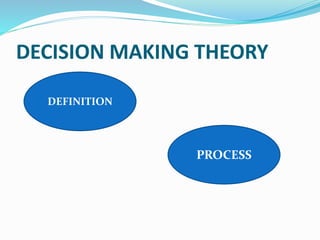
DECISION MAKING THEORY
DEFINITION
PROCESS
DEFINITION
The thought process of selecting a logical choice from
the available options. When trying to make a good
decision, a person must weight the positives and
negatives of each option, and consider all the
alternatives. For effective decision making, a person
must be able to forecast the outcome of each option as
well, and based on all these items, determine which
option is the best for particular situation.
PROCESS
 Each step in the decision making process may include
social, cognitive and cultural obstacles to successfully
negotiating dilemmas. It has been suggested that
becoming more aware of these obstacles allows one to
better anticipate and overcome them. The Arkansas
Program presents eight stages of moral decision making
based on the work of James Rest
 Establishing community: creating and nurturing the
relationships, norms, and procedures that will influence
how problems are understood and communicated. This
stage takes place prior to and during a moral dilemma
 Perception: recognizing that a problem exists
 Interpretation: identifying competing
explanations for the problem, and evaluating the
drivers behind those interpretations
 Judgment: sifting through various possible actions
or responses and determining which is more
justifiable
 Motivation: examining the competing
commitments which may distract from a more
moral course of action and then prioritizing and
committing to moral values over other personal,
institutional or social values
 Action: following through with action that supports
the more justified decision. Integrity is supported by
the ability to overcome distractions and obstacles,
developing implementing skills, and ego strength
 Reflection in action
 Reflection on action
When in an organization and faced with a difficult
decision, there are several steps one can take to ensure the best
possible solutions will be decided. These steps are put into seven
effective ways to go about this decision making process (McMahon
2007).
 The first step - Outline your goal and outcome. This will enable
decision makers to see exactly what they are trying to accomplish
and keep them on a specific path.
 The second step - Gather data. This will help decision makers
have actual evidence to help them come up with a solution.
 The third step - Brainstorm to develop alternatives. Coming up
with more than one solution enables you to see which one can
actually work.
 The fourth step - List pros and cons of each alternative.
With the list of pros and cons, you can eliminate the
solutions that have more cons than pros, making your
decision easier.
 The fifth step - Make the decision. Once you analyze each
solution, you should pick the one that has many pros (or
the pros that are most significant), and is a solution that
everyone can agree with.
 The sixth step - Immediately take action. Once the
decision is picked, you should implement it right away.
 The seventh step - Learn from, and reflect on the decision
making. This step allows you to see what you did right and
wrong when coming up, and putting the decision to use.
Examples of Decisions Making
when we go to campus we thingk we going by
motorcycle or by walking.
When we wanna eat we got alternative to eat rice but
more expensive or we can buy noodle is cheaper
When we tired we can choose to sleep or we can do
her/his homework
Making Decisions: The Rational
Model
 Certainty
 The implication that the outcome of every possible
alternative is known.
 Uncertainty
 A condition under which there is not full knowledge of
the problem and reasonable probabilities for alternative
outcomes cannot be determined.
 Risk
 The probability that a particular outcome will result
from a given decision.
 Rational
 Describes choices that are consistent and value-
maximizing within specified constraints.
 Bounded Rationality (Herbert Simon)
 Behavior that is rational within the parameters of a
simplified model that captures the essential features of a
problem.
 Satisfice
 Making a “good enough” decision: choosing the first-
identified alternative that satisfactorily and sufficiently
solves the problem.
Common Decision-Making Errors
 Heuristics: Using Judgmental Shortcuts
 Availability heuristic
 The tendency to base judgments on information that is readily
available.
 Representative heuristic
 The tendency to base judgments of probability on things
(objects or events) that are familiar
 Escalation of commitment
 An increased commitment to a previous decision despite
negative information about the decision’s present outcomes.
References
 www.wikipedia.com/decision making
 Koontz,Harold., and O’Donnel,Cyril., and Weihrich,
Heinz. 1986. Management. Penerbit Airlangga:
Surabaya

Decision making theory and process

  • 1.
  • 2.
    1ST GROUP MEMBERS Franis Wijayanti 110810251002  Andy Dinastyo 110810251010  Eka Ardha Nareswari 110810251013  Dini Optimasi 110810251014  Nirwan Sukmajati 110810251016  Beny Fatkhur R.A.S 110810251022  Orysta Setyoko 110810251025
  • 3.
  • 4.
    DEFINITION The thought processof selecting a logical choice from the available options. When trying to make a good decision, a person must weight the positives and negatives of each option, and consider all the alternatives. For effective decision making, a person must be able to forecast the outcome of each option as well, and based on all these items, determine which option is the best for particular situation.
  • 5.
    PROCESS  Each stepin the decision making process may include social, cognitive and cultural obstacles to successfully negotiating dilemmas. It has been suggested that becoming more aware of these obstacles allows one to better anticipate and overcome them. The Arkansas Program presents eight stages of moral decision making based on the work of James Rest  Establishing community: creating and nurturing the relationships, norms, and procedures that will influence how problems are understood and communicated. This stage takes place prior to and during a moral dilemma
  • 6.
     Perception: recognizingthat a problem exists  Interpretation: identifying competing explanations for the problem, and evaluating the drivers behind those interpretations  Judgment: sifting through various possible actions or responses and determining which is more justifiable  Motivation: examining the competing commitments which may distract from a more moral course of action and then prioritizing and committing to moral values over other personal, institutional or social values
  • 7.
     Action: followingthrough with action that supports the more justified decision. Integrity is supported by the ability to overcome distractions and obstacles, developing implementing skills, and ego strength  Reflection in action  Reflection on action
  • 8.
    When in anorganization and faced with a difficult decision, there are several steps one can take to ensure the best possible solutions will be decided. These steps are put into seven effective ways to go about this decision making process (McMahon 2007).  The first step - Outline your goal and outcome. This will enable decision makers to see exactly what they are trying to accomplish and keep them on a specific path.  The second step - Gather data. This will help decision makers have actual evidence to help them come up with a solution.  The third step - Brainstorm to develop alternatives. Coming up with more than one solution enables you to see which one can actually work.
  • 9.
     The fourthstep - List pros and cons of each alternative. With the list of pros and cons, you can eliminate the solutions that have more cons than pros, making your decision easier.  The fifth step - Make the decision. Once you analyze each solution, you should pick the one that has many pros (or the pros that are most significant), and is a solution that everyone can agree with.  The sixth step - Immediately take action. Once the decision is picked, you should implement it right away.  The seventh step - Learn from, and reflect on the decision making. This step allows you to see what you did right and wrong when coming up, and putting the decision to use.
  • 10.
    Examples of DecisionsMaking when we go to campus we thingk we going by motorcycle or by walking. When we wanna eat we got alternative to eat rice but more expensive or we can buy noodle is cheaper When we tired we can choose to sleep or we can do her/his homework
  • 11.
    Making Decisions: TheRational Model  Certainty  The implication that the outcome of every possible alternative is known.  Uncertainty  A condition under which there is not full knowledge of the problem and reasonable probabilities for alternative outcomes cannot be determined.  Risk  The probability that a particular outcome will result from a given decision.
  • 12.
     Rational  Describeschoices that are consistent and value- maximizing within specified constraints.  Bounded Rationality (Herbert Simon)  Behavior that is rational within the parameters of a simplified model that captures the essential features of a problem.  Satisfice  Making a “good enough” decision: choosing the first- identified alternative that satisfactorily and sufficiently solves the problem.
  • 13.
    Common Decision-Making Errors Heuristics: Using Judgmental Shortcuts  Availability heuristic  The tendency to base judgments on information that is readily available.  Representative heuristic  The tendency to base judgments of probability on things (objects or events) that are familiar  Escalation of commitment  An increased commitment to a previous decision despite negative information about the decision’s present outcomes.
  • 14.
    References  www.wikipedia.com/decision making Koontz,Harold., and O’Donnel,Cyril., and Weihrich, Heinz. 1986. Management. Penerbit Airlangga: Surabaya