(NPV	- IRR	– IP)
Sequence
• Introduction
• Basic	terms	review
• Capital	budgeting	introduction
• Capital	budgeting	technique	
• Sensitivity	analysis
• Scenario	analysis
•Lets	Begin
A	review	of	Basics:
Present	Value,	Net	Present	value	and		future	value
• Present	value (PV)	is	the	current	worth	of	a	future	sum	of	money	or	
stream	of	cash	flows	given	a	specified	rate	of	return.	In	other	words,	
present	value,	also	known	as present discounted value,	is	
the value of	an	expected	income	stream	determined	as	of	the	date	of	
valuation
• Difference	between	a	project’s	value	and	its	cost	is	its	NPV
• Future	value is	the value of	an	asset	at	a	specific	date.	It	measures	
the	nominal future sum	of	money	that	a	given	sum	of	money	is	
"worth"	at	a	specified	time	in	the future assuming	a	certain	interest	
rate,	or	more	generally,	rate	of	return;	it	is	the	
present value multiplied	by	the	accumulation	function.
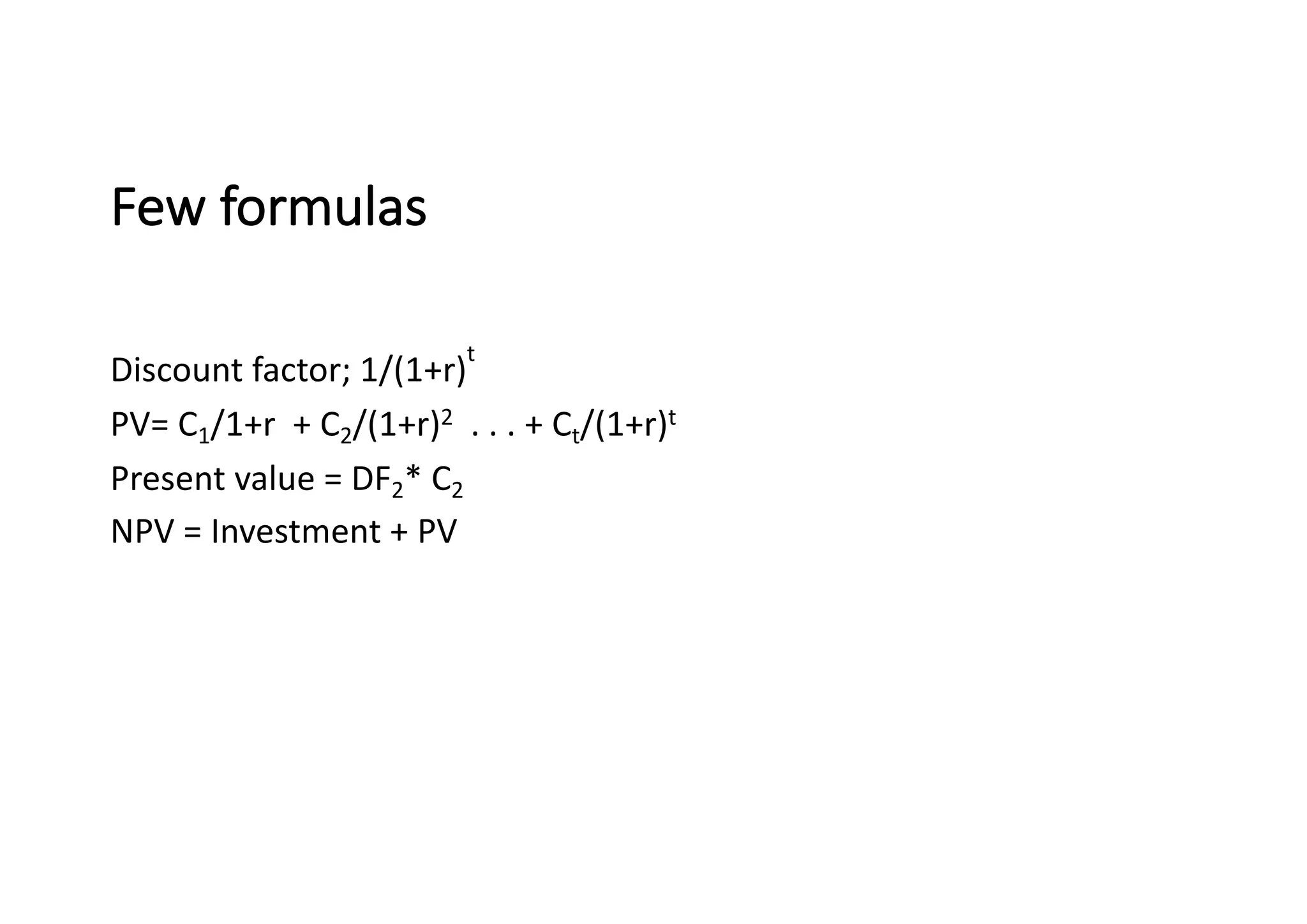
Few	formulas
Discount	factor;	1/(1+r)
t
PV=	C1/1+r		+	C2/(1+r)2 .	.	.	+	Ct/(1+r)t	
Present	value	=	DF2*	C2
NPV	=	Investment	+	PV
A	review	of	Basic:	Example
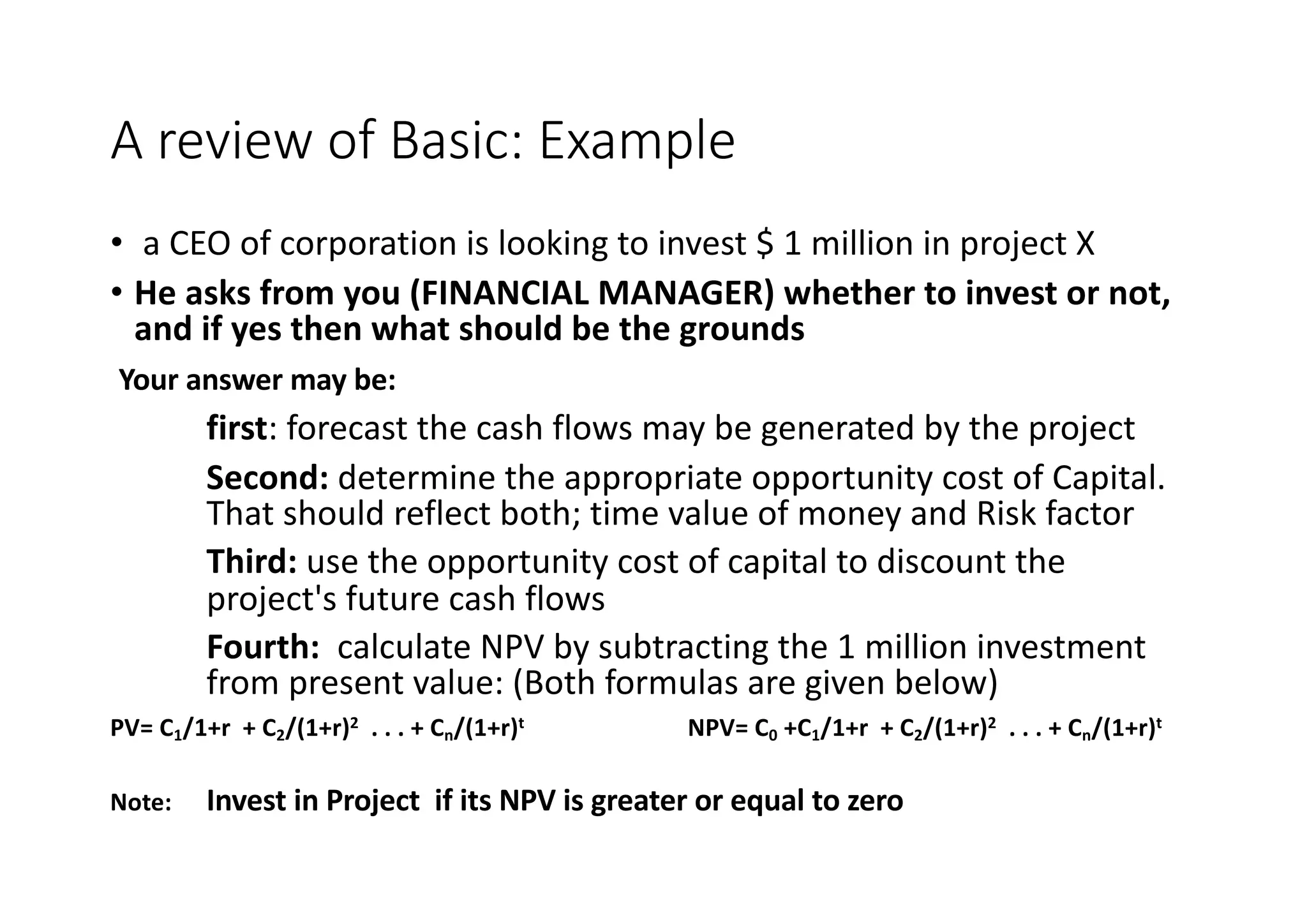
• a	CEO	of	corporation	is	looking	to	invest	$	1	million	in	project	X
• He	asks	from	you	(FINANCIAL	MANAGER)	whether	to	invest	or	not,	
and	if	yes	then	what	should	be	the	grounds
Your	answer	may	be:
first:	forecast	the	cash	flows	may	be	generated	by	the	project
Second:	determine	the	appropriate	opportunity	cost	of	Capital.	
That	should	reflect	both;	time	value	of	money	and	Risk	factor
Third: use	the	opportunity	cost	of	capital	to	discount	the	
project's	future	cash	flows
Fourth:	 calculate	NPV	by	subtracting	the	1	million	investment	
from	present	value:	(Both	formulas	are	given	below)
PV=	C1/1+r		+	C2/(1+r)2 .	.	.	+	Cn/(1+r)t NPV=	C0 +C1/1+r		+	C2/(1+r)2 .	.	.	+	Cn/(1+r)t
Note: Invest	in	Project		if	its	NPV	is	greater	or	equal	to	zero
Net	Present	Value
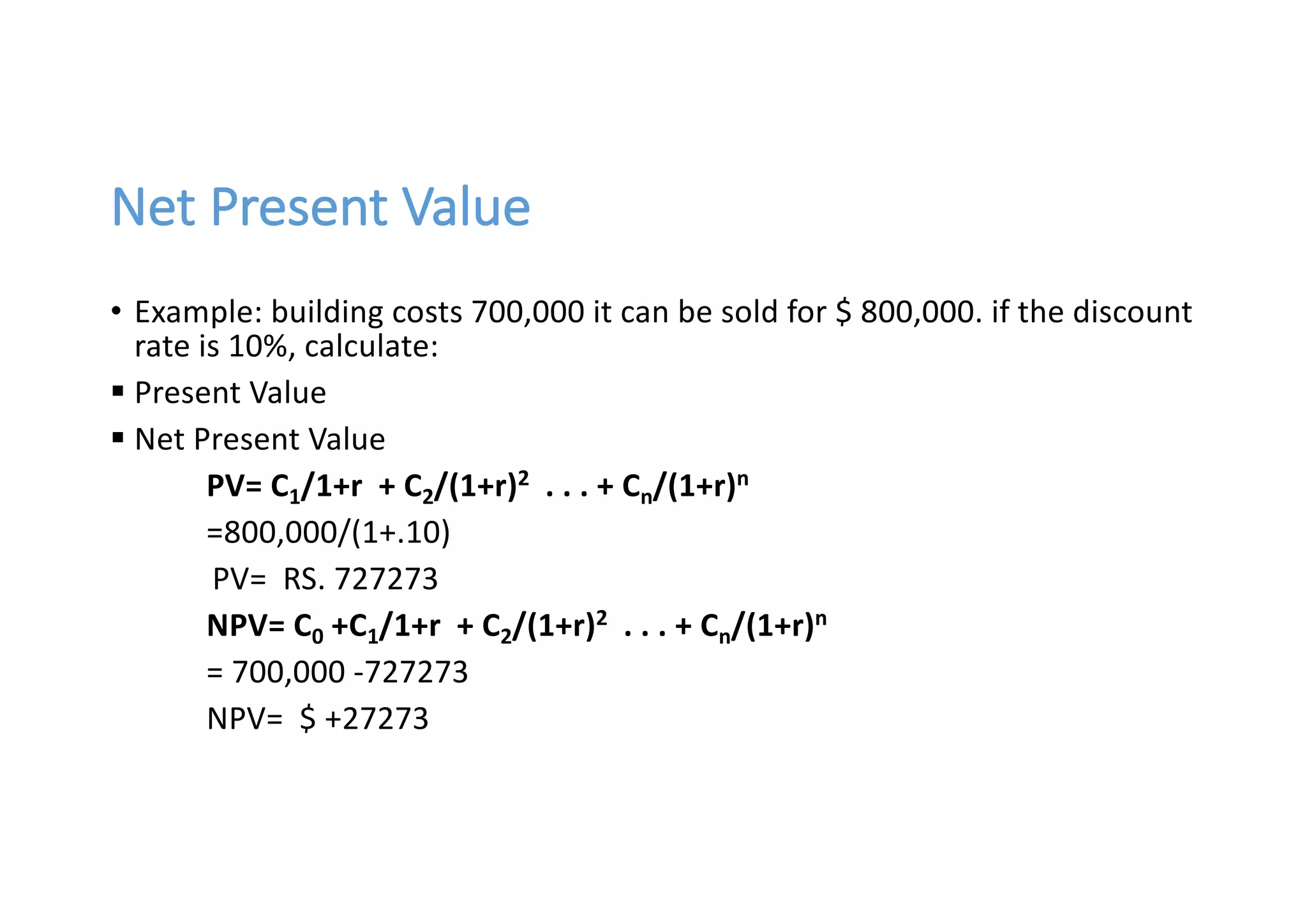
• Example:	building	costs	700,000	it	can	be	sold	for	$ 800,000.	if	the	discount	
rate	is	10%,	calculate:
§ Present	Value
§ Net	Present	Value
PV=	C1/1+r		+	C2/(1+r)2 .	.	.	+	Cn/(1+r)n
=800,000/(1+.10)
PV=		RS.	727273
NPV=	C0 +C1/1+r		+	C2/(1+r)2 .	.	.	+	Cn/(1+r)n
=	700,000	-727273
NPV=		$ +27273
NPV	Strengths	
and	Weaknesses
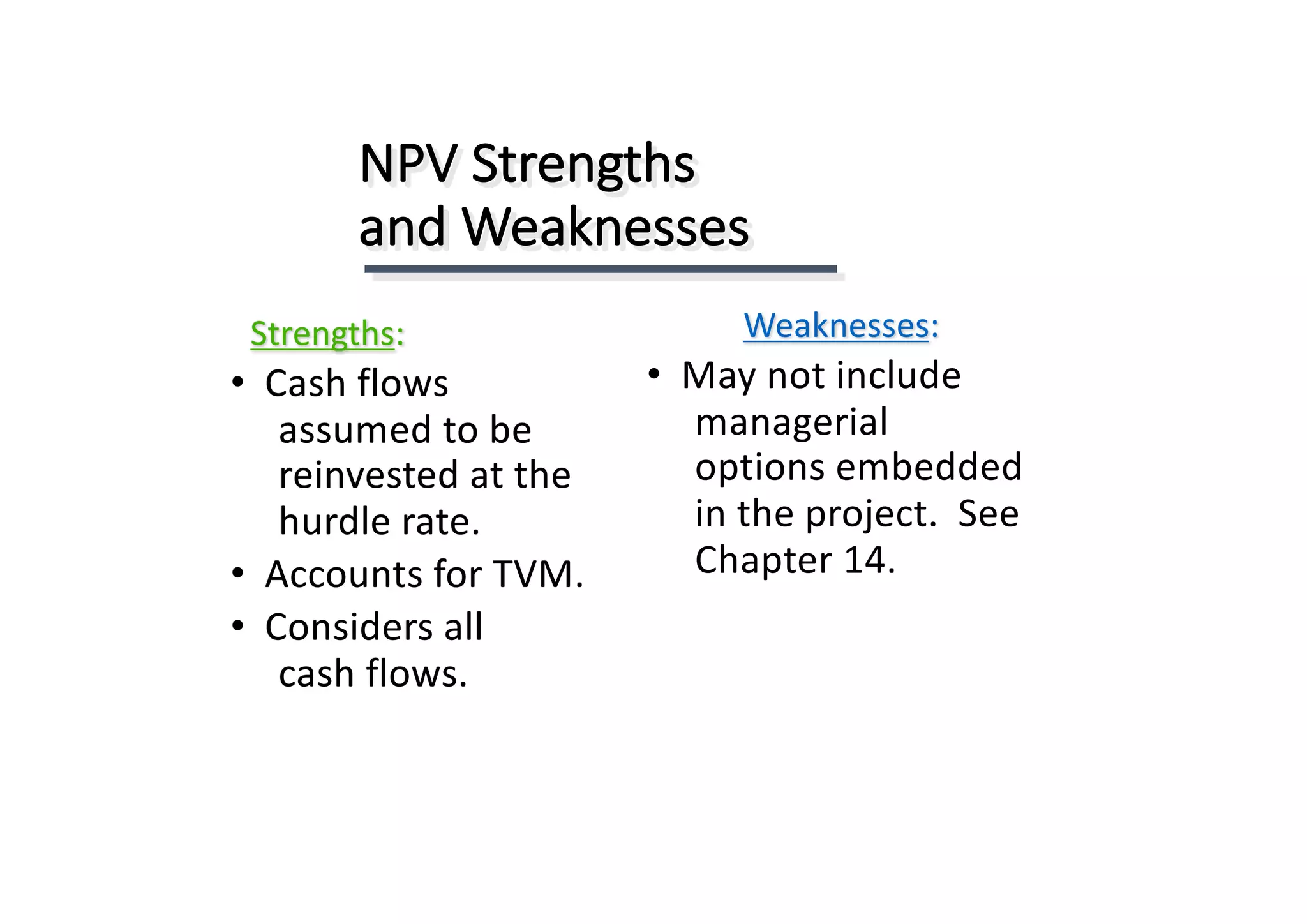
Strengths:
• Cash	flows	
assumed	to	be	
reinvested	at	the	
hurdle	rate.
• Accounts	for	TVM.
• Considers	all	
cash	flows.
Weaknesses:
• May	not	include	
managerial	
options	embedded	
in	the	project.		See	
Chapter	14.
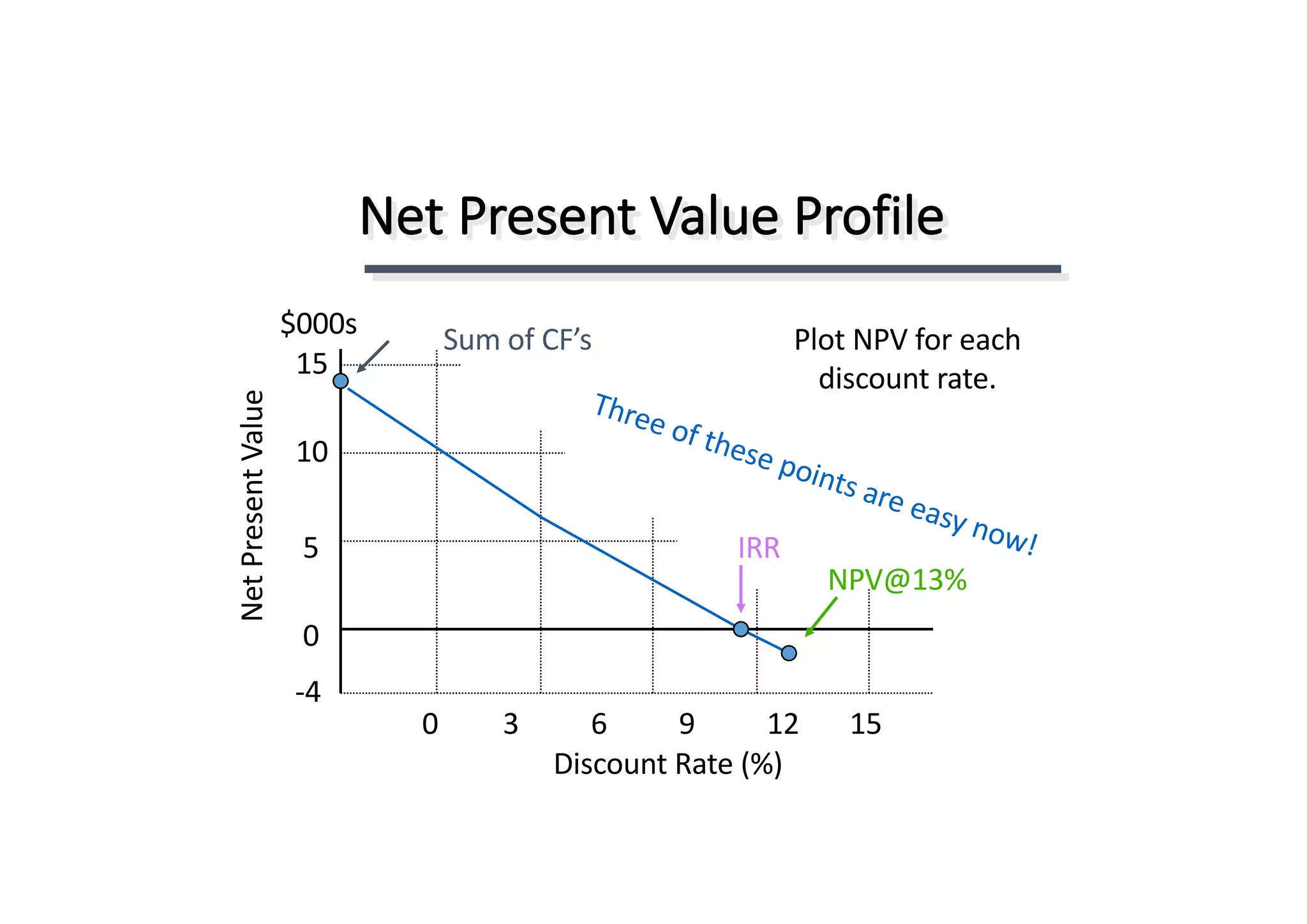
Net	Present	Value	Profile
Discount	Rate	(%)
0									3										6										9										12							15
IRR
NPV@13%
Sum	of	CF’s Plot	NPV	for	each
discount	rate.
Net	Present	Value
$000s
15
10
5
0
-4
A	review	of	Basic:	Example		…	continue
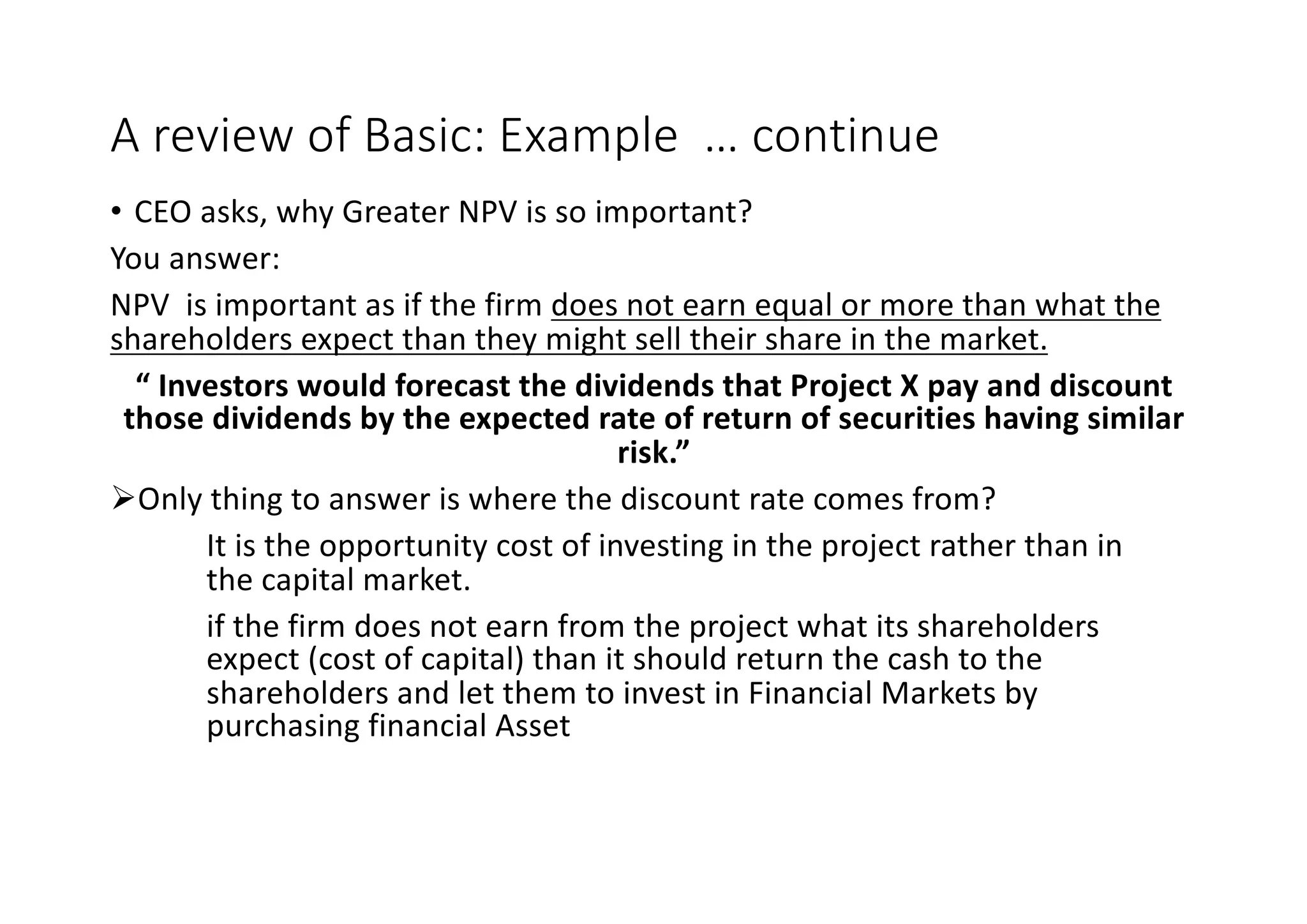
• CEO	asks,	why	Greater	NPV	is	so	important?
You	answer:
NPV		is	important	as	if	the	firm	does	not	earn	equal	or	more	than	what	the	
shareholders	expect	than	they	might	sell	their	share	in	the	market.
“	Investors	would	forecast	the	dividends	that	Project	X	pay	and	discount	
those	dividends	by	the	expected	rate	of	return	of	securities	having	similar	
risk.”	
ØOnly	thing	to	answer	is	where	the	discount	rate	comes	from?
It	is	the	opportunity	cost	of	investing	in	the	project	rather	than	in	
the	capital	market.
if	the	firm	does	not	earn	from	the	project	what	its	shareholders	
expect	(cost	of	capital)	than	it	should	return	the	cash	to	the	
shareholders	and	let	them	to	invest	in	Financial	Markets	by	
purchasing	financial	Asset
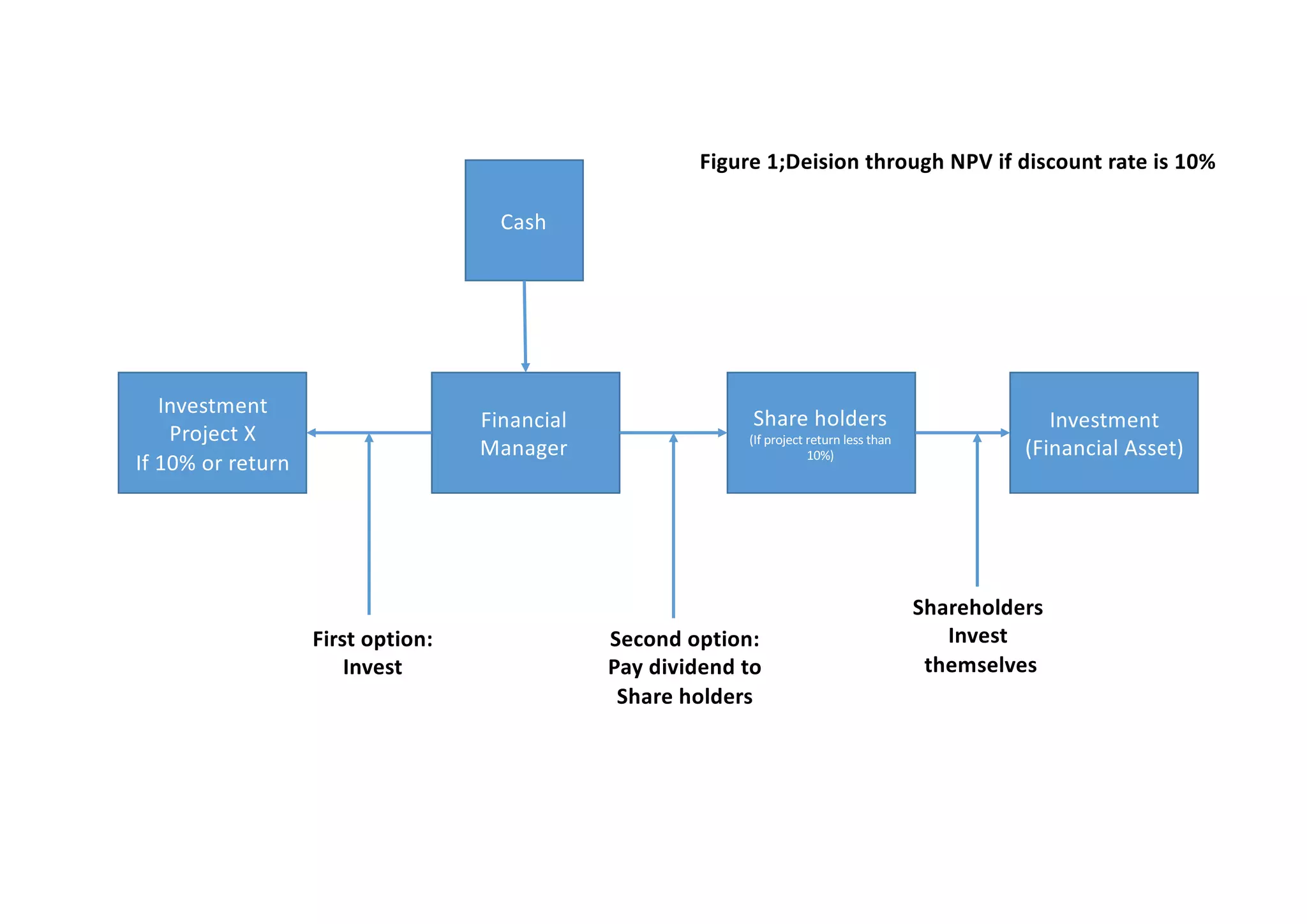
Investment	
Project	X
If	10%	or	return
Cash
Financial	
Manager
Share	holders
(If	project	return	less	than	
10%)
Investment	
(Financial	Asset)
First	option:
Invest
Second	option:
Pay	dividend	to
Share	holders
Shareholders
Invest
themselves
Figure	1;Deision	through	NPV	if	discount	rate	is	10%
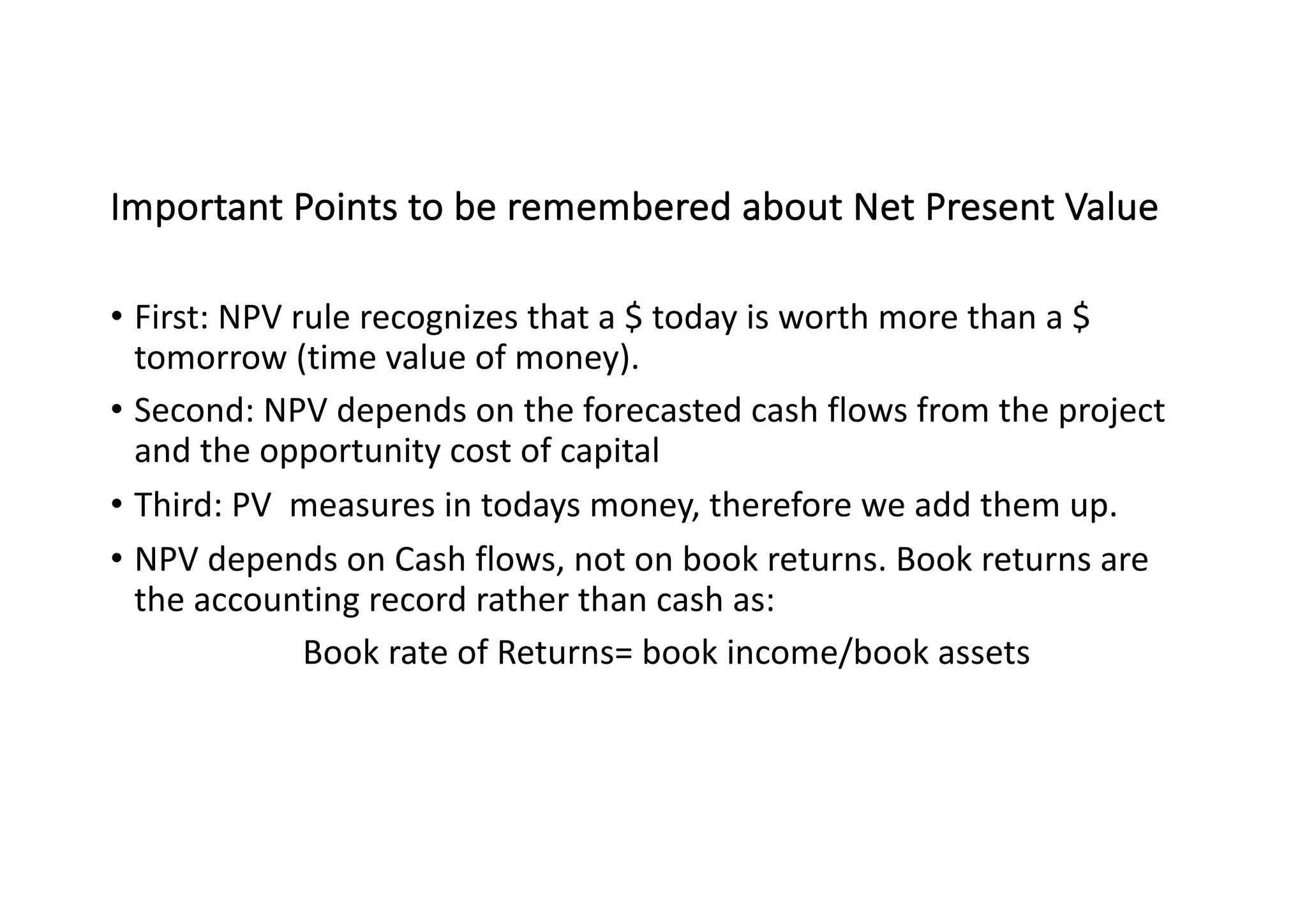
Important	Points	to	be	remembered	about	Net	Present	Value
• First:	NPV	rule	recognizes	that	a	$	today	is	worth	more	than	a	$	
tomorrow	(time	value	of	money).
• Second:	NPV	depends	on	the	forecasted	cash	flows	from	the	project	
and	the	opportunity	cost	of	capital
• Third:	PV		measures	in	todays	money,	therefore	we	add	them	up.
• NPV	depends	on	Cash	flows,	not	on	book	returns.	Book	returns	are	
the	accounting	record	rather	than	cash	as:
Book	rate	of	Returns=	book	income/book	assets
Capital	Budgeting	
The	Capital	Budgeting	Process	of
generating	Investment	Project	Proposals	and
estimating	Project	“After-Tax	Incremental	Operating	Cash	
Flows”
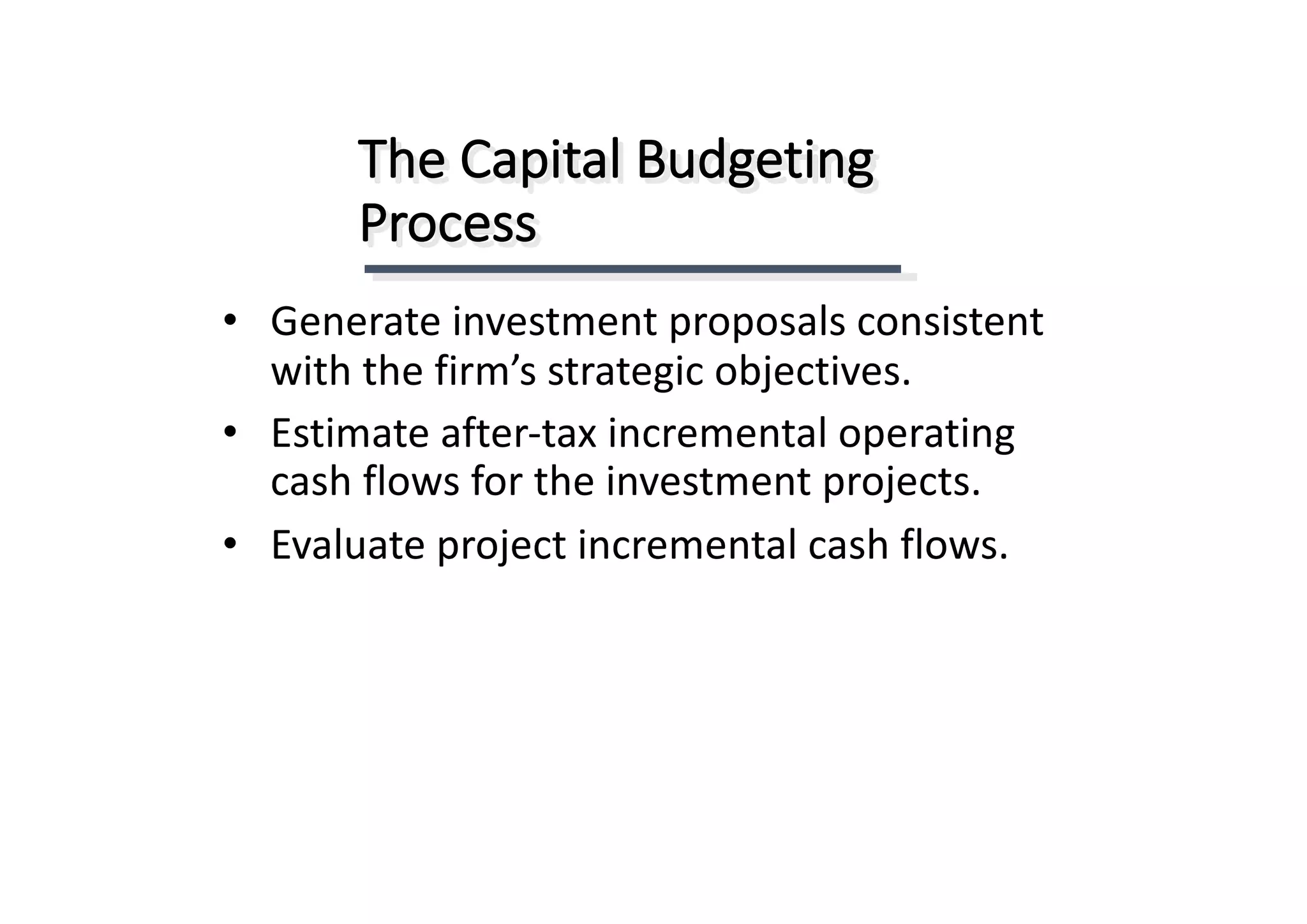
The	Capital	Budgeting	
Process
• Generate	investment	proposals	consistent	
with	the	firm’s	strategic	objectives.
• Estimate	after-tax	incremental	operating	
cash	flows	for	the	investment	projects.
• Evaluate	project	incremental	cash	flows.
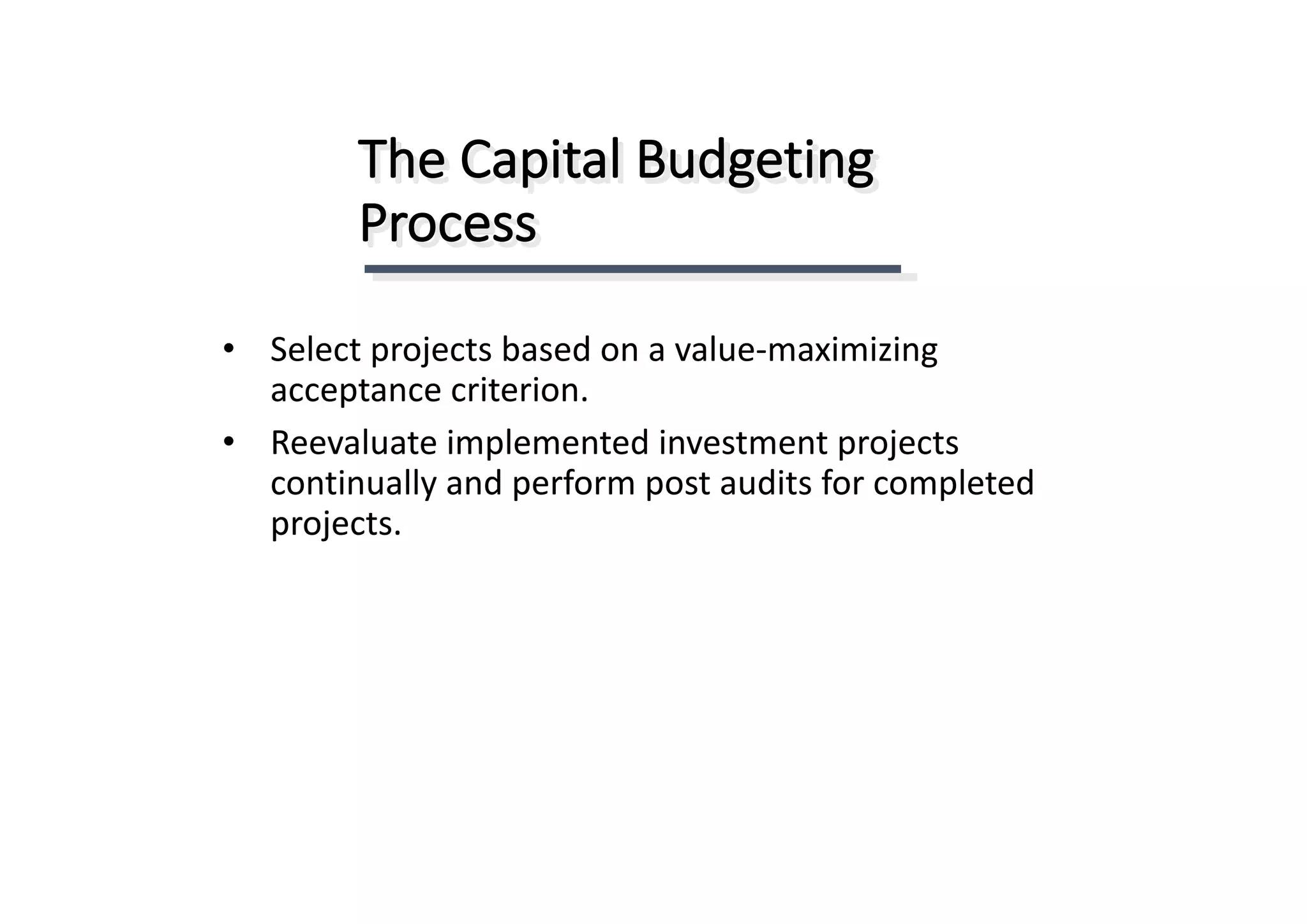
The	Capital	Budgeting	
Process
• Select	projects	based	on	a	value-maximizing	
acceptance	criterion.
• Reevaluate	implemented	investment	projects	
continually	and	perform	post	audits	for	completed	
projects.
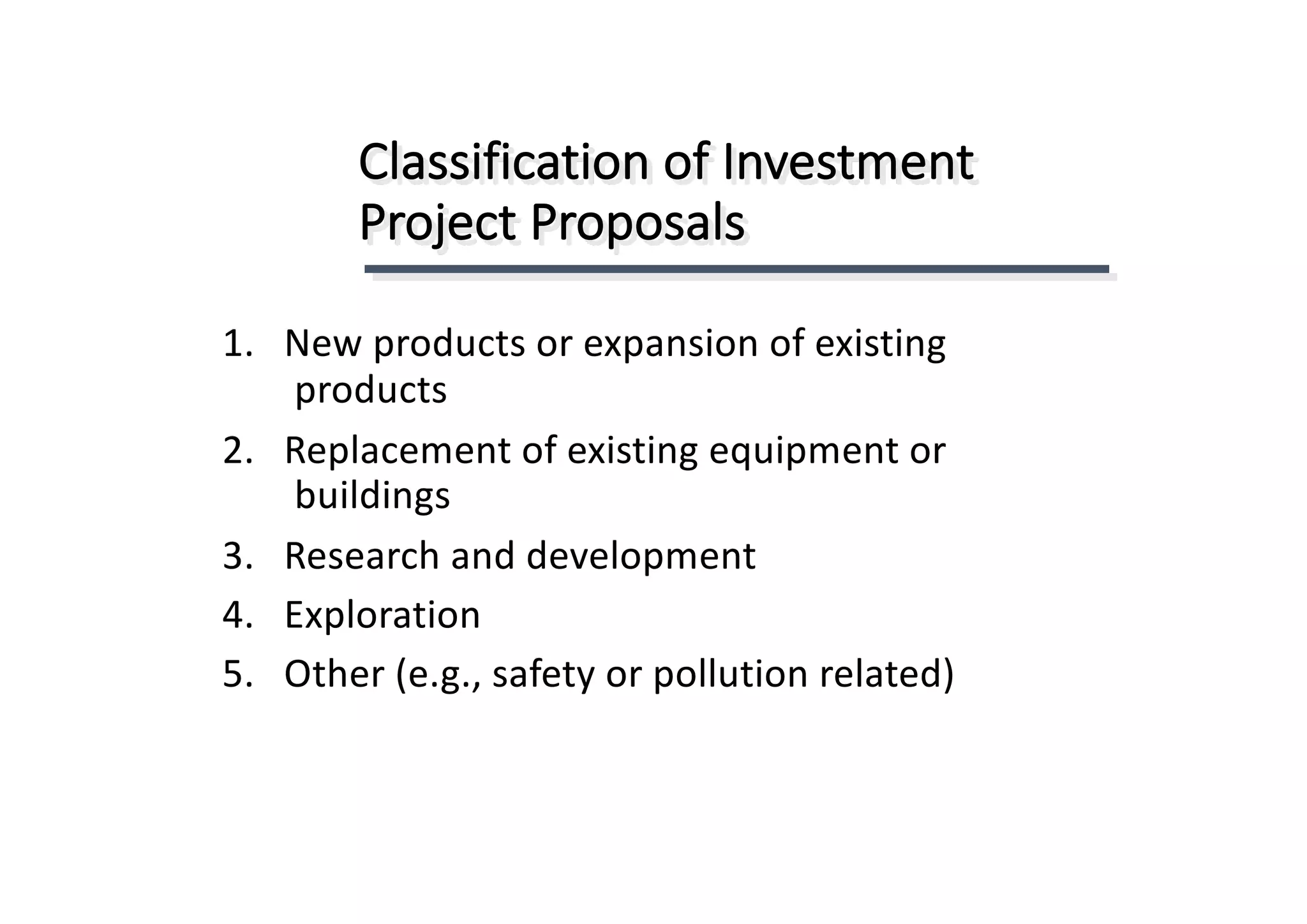
Classification	of	Investment	
Project	Proposals
1.			New	products	or	expansion	of	existing	
products
2.			Replacement	of	existing	equipment	or	
buildings
3.			Research	and	development
4.			Exploration
5.			Other	(e.g.,	safety	or	pollution	related)
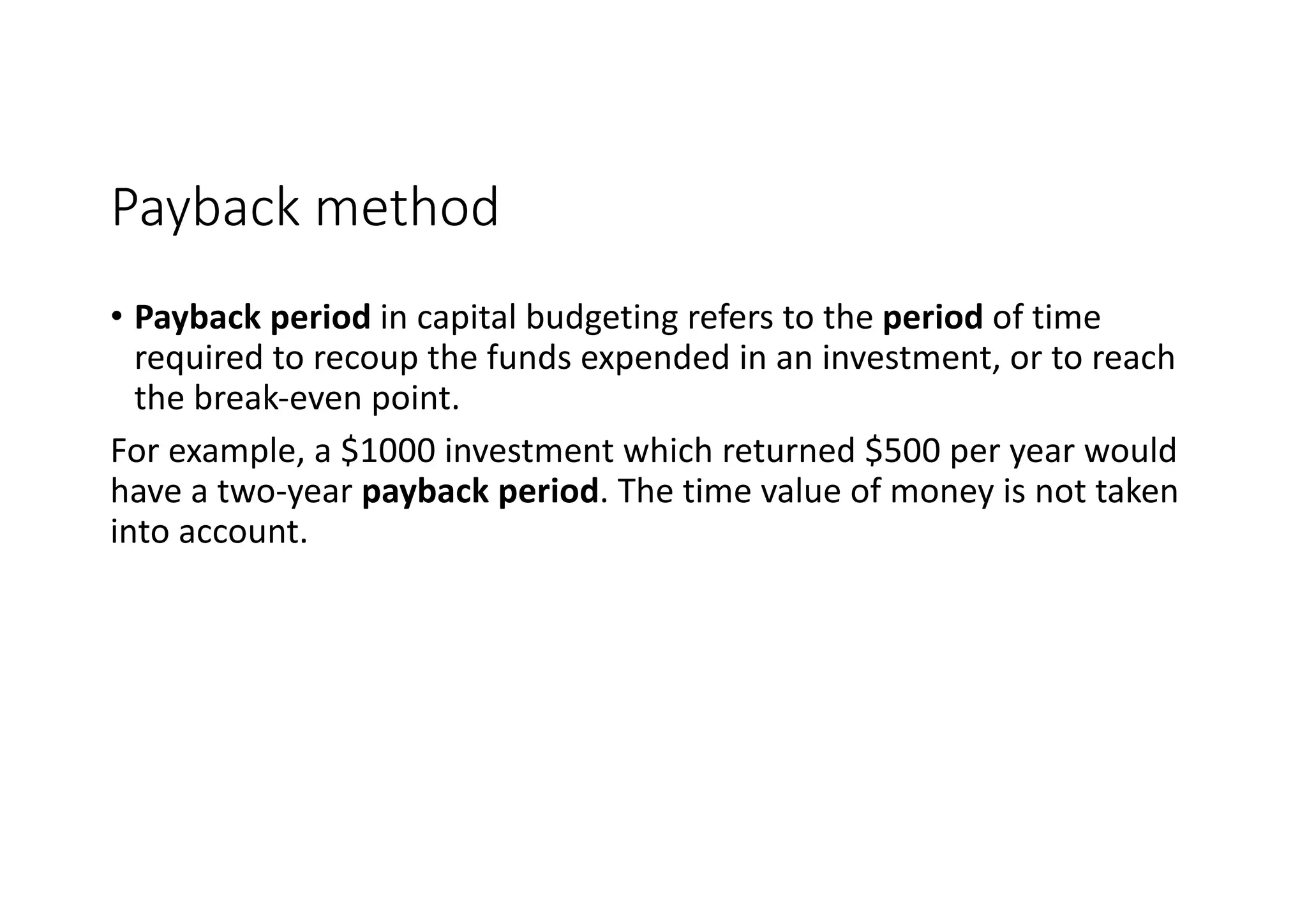
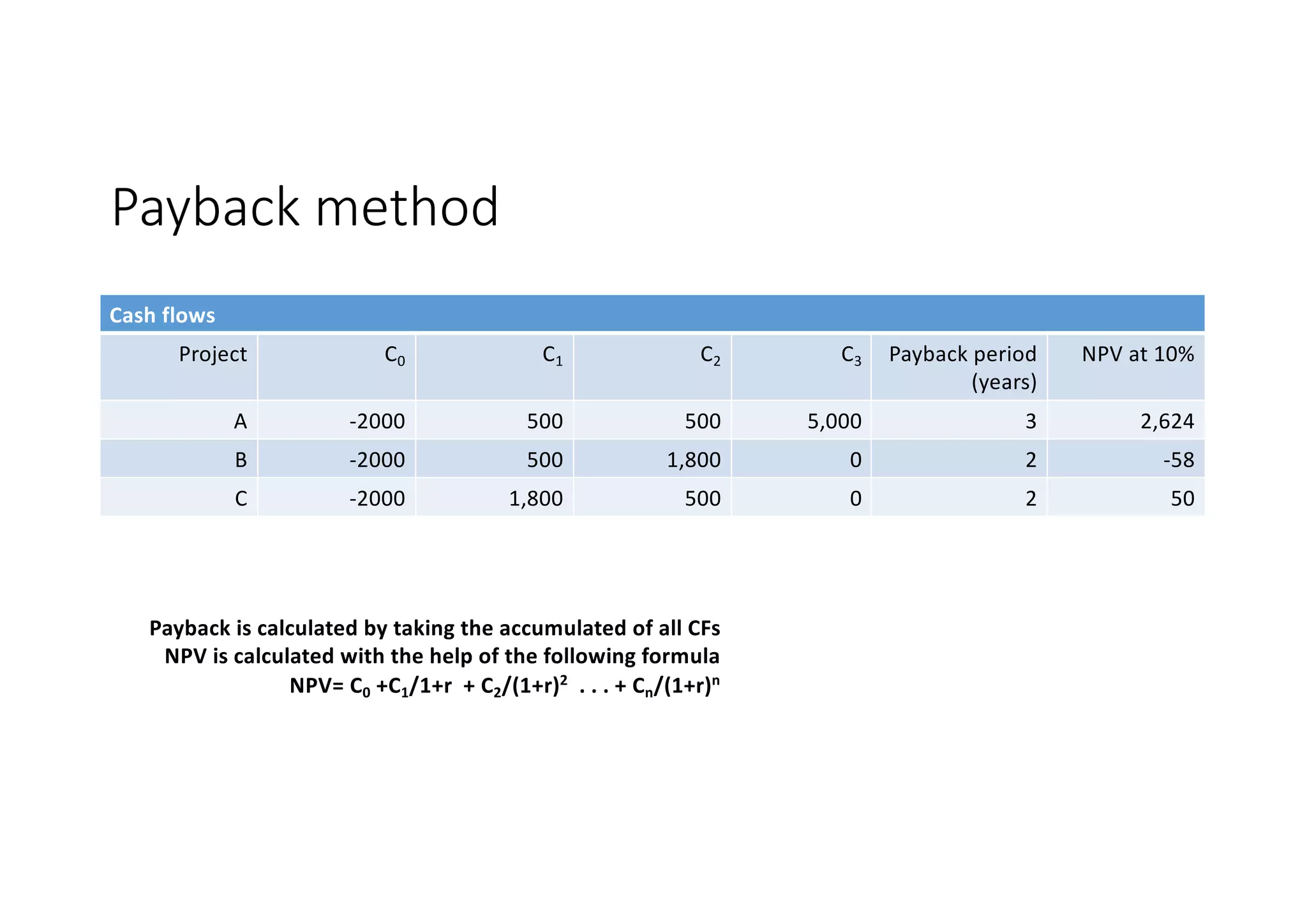
Payback	method
• Payback	period in	capital	budgeting	refers	to	the period of	time	
required	to	recoup	the	funds	expended	in	an	investment,	or	to	reach	
the	break-even	point.	
For	example,	a	$1000	investment	which	returned	$500	per	year	would	
have	a	two-year payback	period.	The	time	value	of	money	is	not	taken	
into	account.
Payback	method
Cash flows
NPV	at	10%Payback	period
(years)
3C2C1C0CProject
2,62435,000500500-2000A
-58201,800500-2000B
50205001,800-2000C
Payback	is	calculated	by	taking	the	accumulated	of	all	CFs
NPV	is	calculated	with	the	help	of	the	following	formula
nr)+1/(nC.	.	.	+	2r)+1/(2Cr		+	+1/1C+0C=	NPV
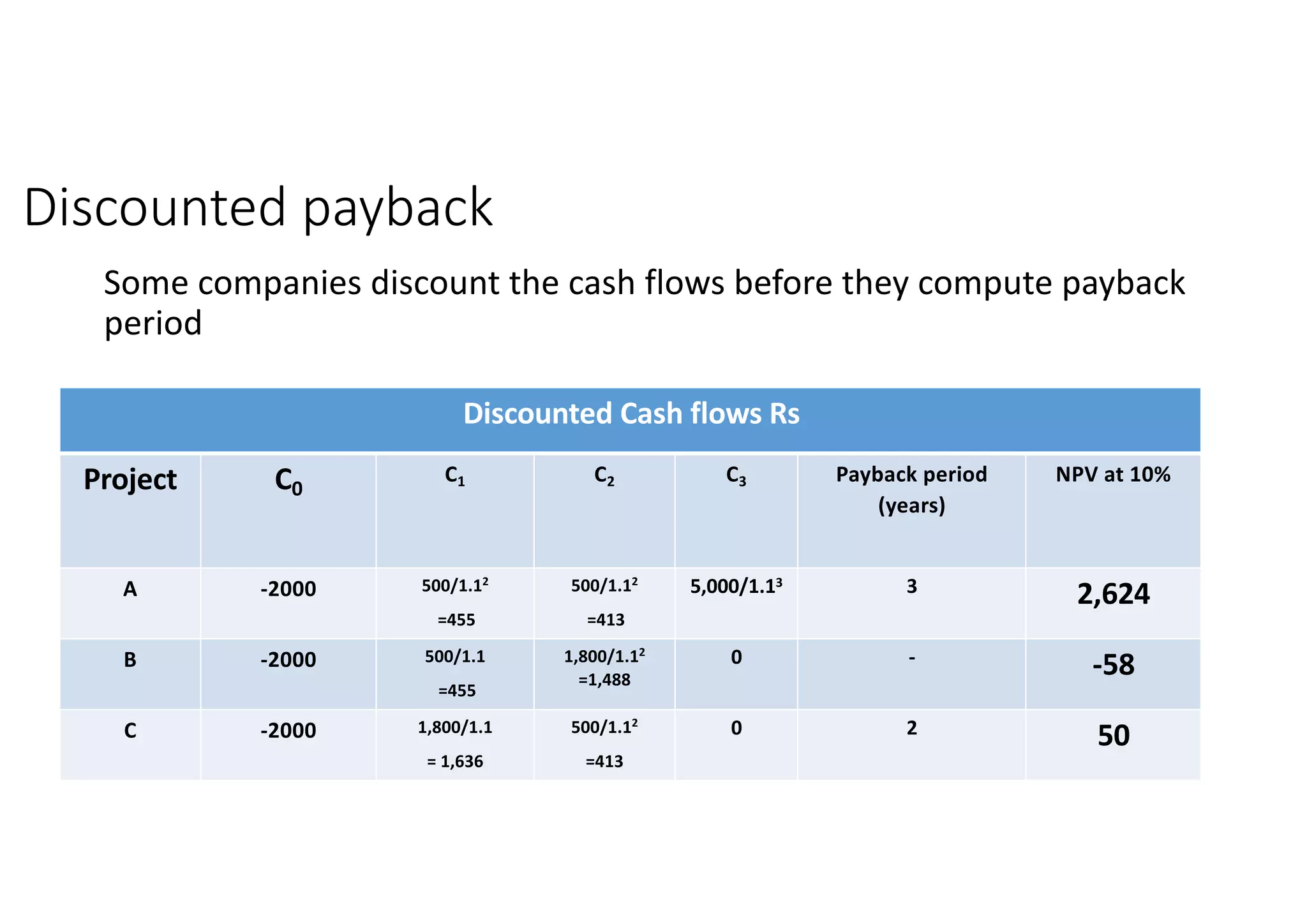
Discounted	payback
Some	companies	discount	the	cash	flows	before	they	compute	payback	
period
Discounted	Cash	flows	Rs
NPV	at	10%Payback	period	
(years)
C3C2C1C0Project
2,62435,000/1.13500/1.12	
=413
500/1.12
=455
-2000A
-58-01,800/1.12	
=1,488
500/1.1
=455
-2000B
5020500/1.12
=413
1,800/1.1
=	1,636
-2000C
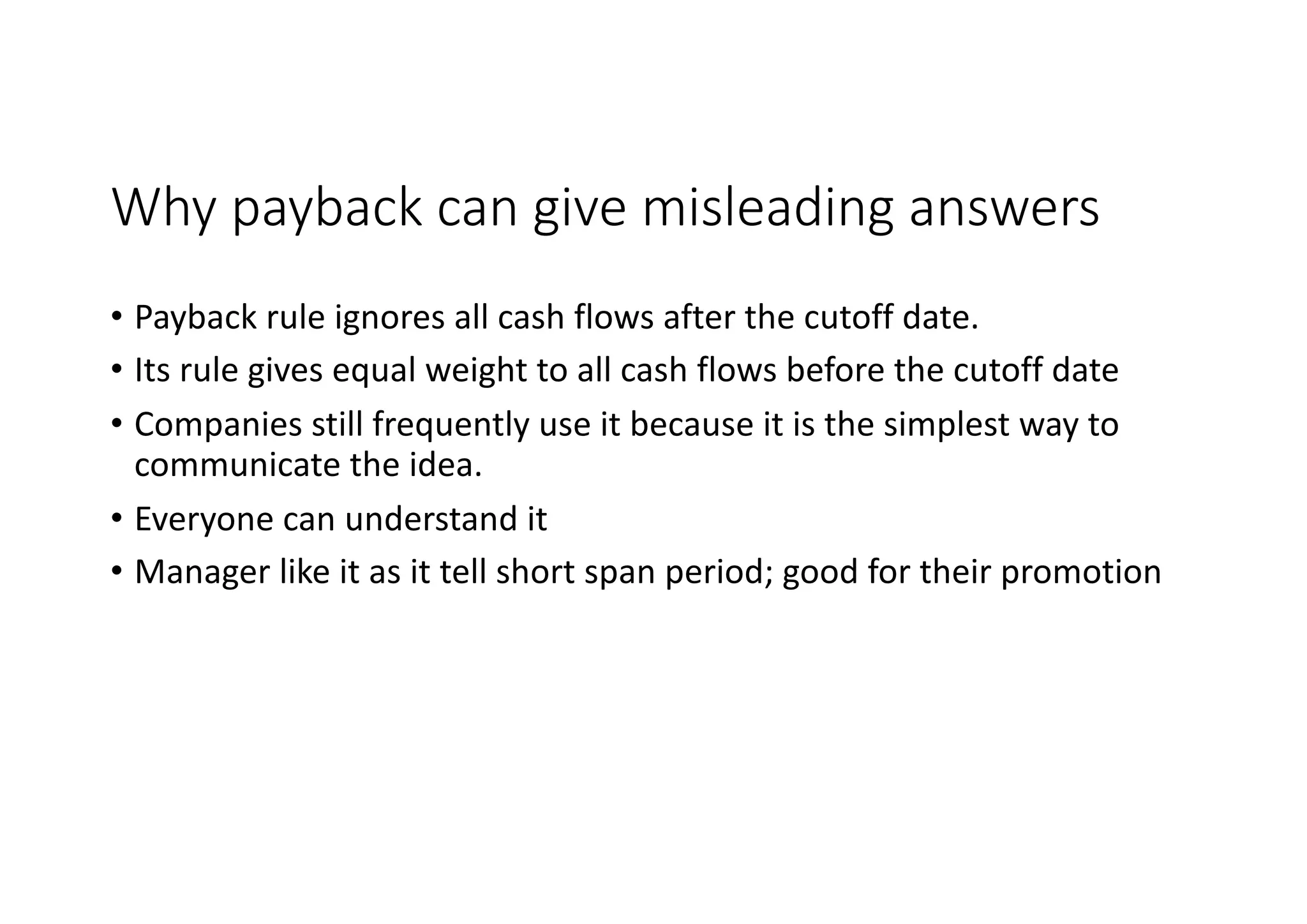
Why	payback	can	give	misleading	answers
• Payback	rule	ignores	all	cash	flows	after	the	cutoff	date.
• Its	rule	gives	equal	weight	to	all	cash	flows	before	the	cutoff	date
• Companies	still	frequently	use	it	because	it	is	the	simplest	way	to		
communicate	the	idea.	
• Everyone	can	understand	it
• Manager	like	it	as	it	tell	short	span	period;	good	for	their	promotion
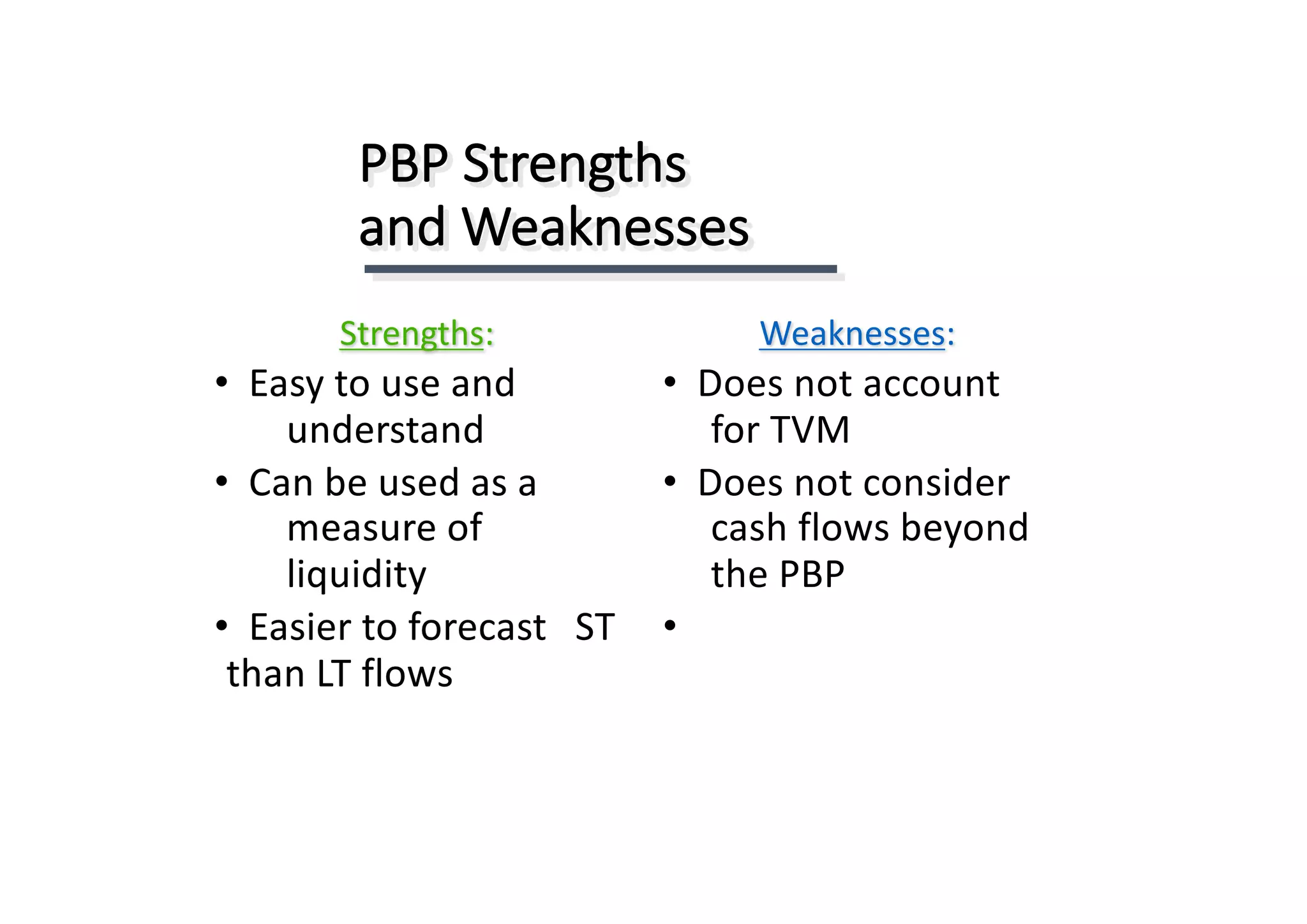
PBP	Strengths	
and	Weaknesses
Strengths:
• Easy	to	use	and							
understand
• Can	be	used	as	a	
measure	of	
liquidity
• Easier	to	forecast	 ST	
than	LT	flows
Weaknesses:
• Does	not	account	
for	TVM
• Does	not	consider	
cash	flows	beyond	
the	PBP
•
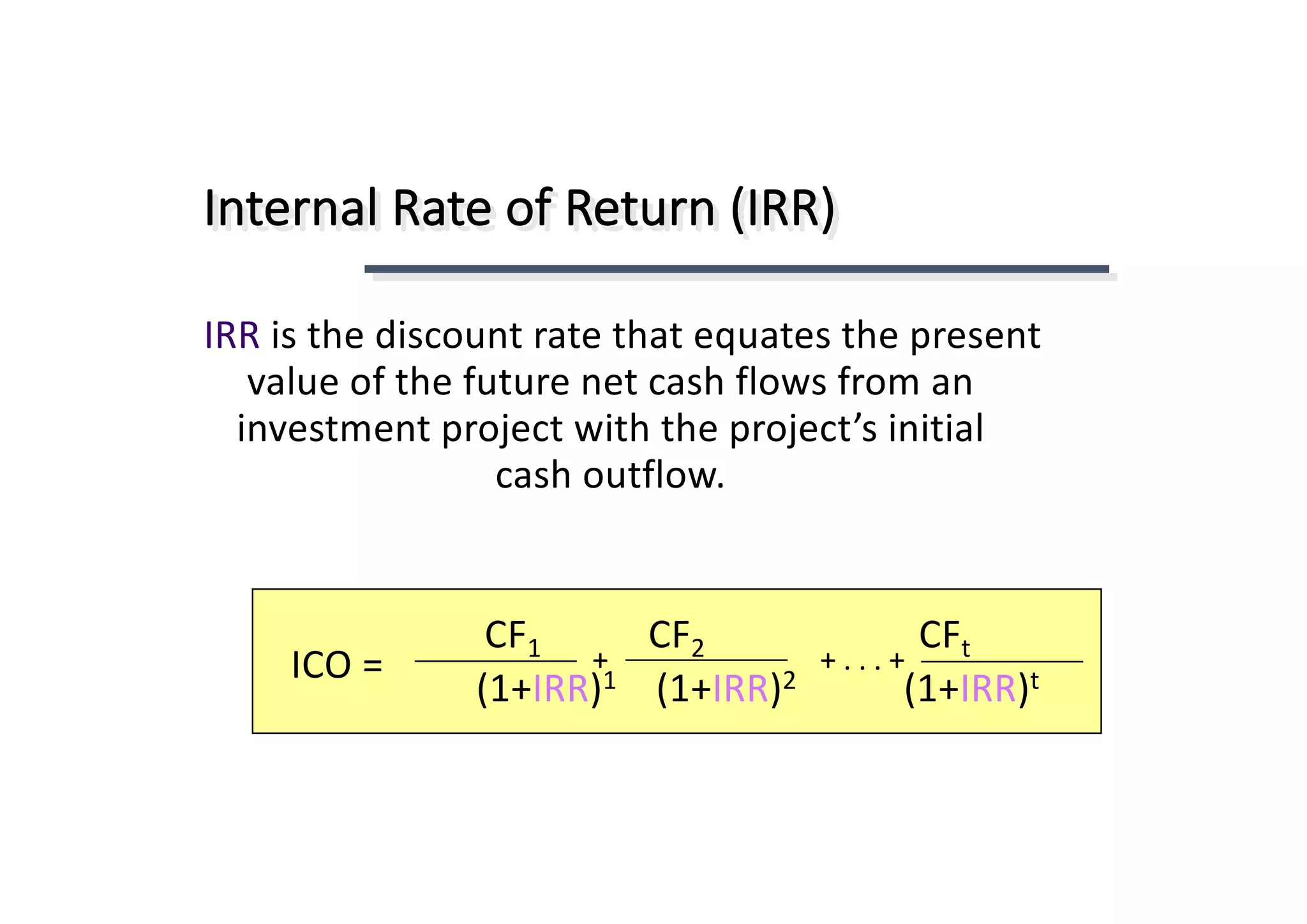
Internal	Rate	of	Return	(IRR)
IRR is	the	discount	rate	that	equates	the	present	
value	of	the	future	net	cash	flows	from	an	
investment	project	with	the	project’s	initial	
cash	outflow.
tCF2CF1CF
t)IRR+1(2)IRR+1(1)IRR+1(
+	.	.	.	++ICO	=
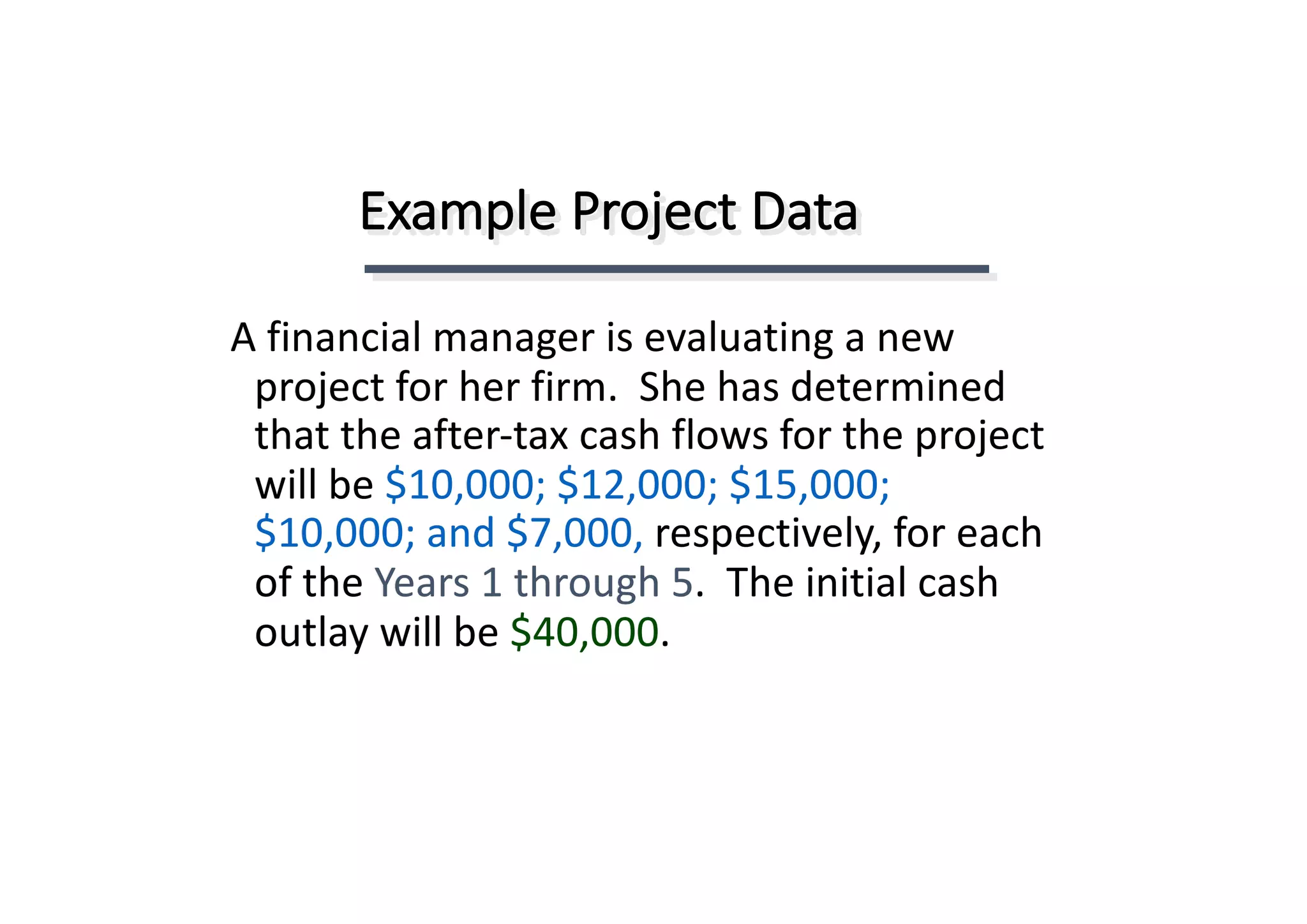
Example	Project	Data
A	financial	manager	is	evaluating	a	new	
project	for	her	firm.		She	has	determined	
that	the	after-tax	cash	flows	for	the	project	
will	be	$10,000;	$12,000;	$15,000;	
$10,000;	and	$7,000,	respectively,	for	each	
of	the	Years	1	through	5.		The	initial	cash	
outlay	will	be	$40,000.
Independent	Project
• Independent -- A	project	whose	acceptance	(or	
rejection)	does	not	prevent	the	acceptance	of	other	
projects	under	consideration.
◆ For this project, assume that it is
independent of any other potential
projects.
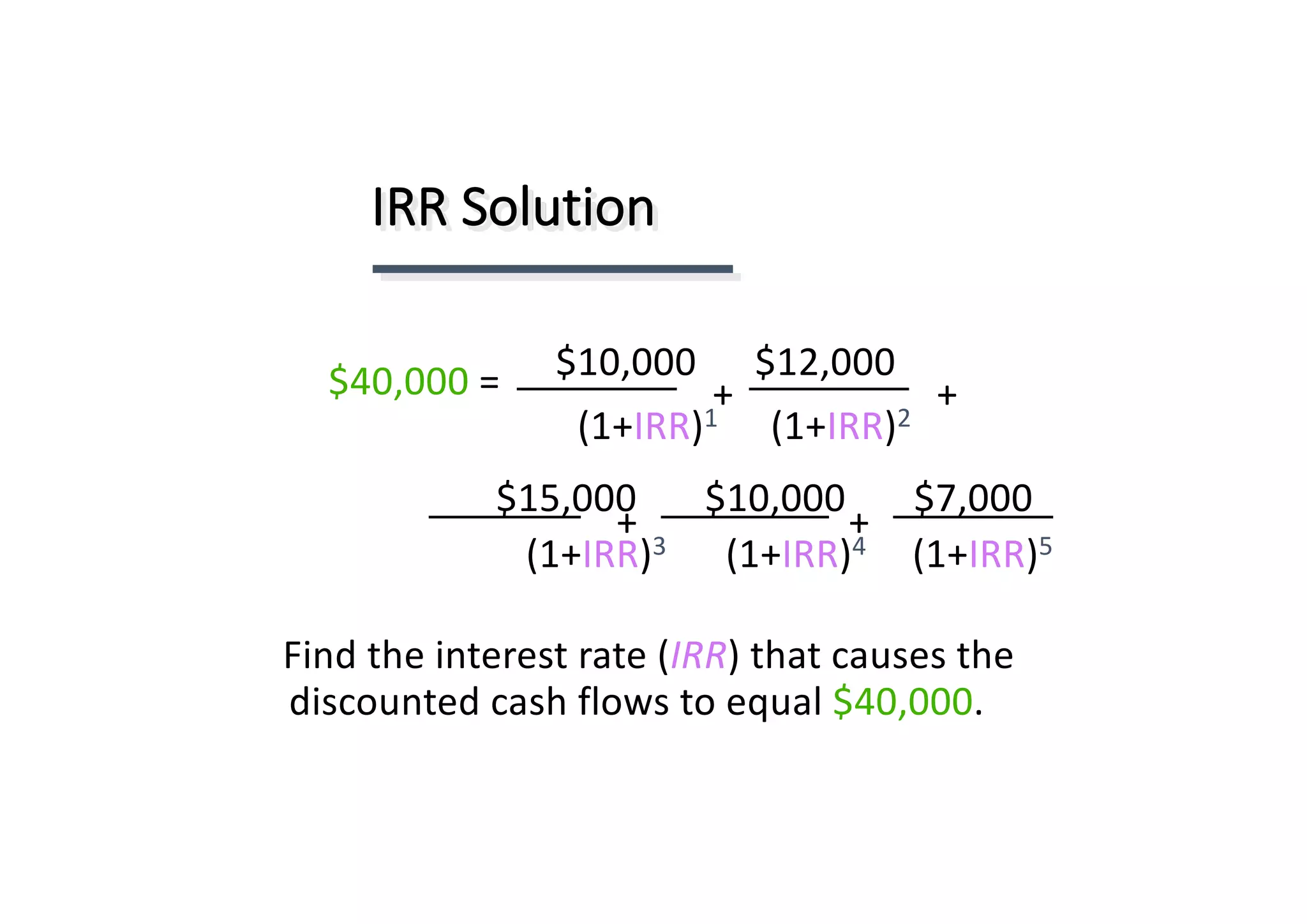
$15,000							$10,000							$7,000
IRR	Solution
$10,000						$12,000
2)IRR+1(1)IRR+1(
Find	the	interest	rate	(IRR)	that	causes	the	
discounted	cash	flows	to	equal	$40,000.
+ +
++$40,000 =
5)IRR+1(4)IRR+1(3)IRR+1(
IRR	Solution	(Try	10%)
$40,000 =	 $10,000(PVIF10%,1)	+	$12,000(PVIF10%,2)	+
$15,000(PVIF10%,3)	+	$10,000(PVIF10%,4)	+	 $		
7,000(PVIF10%,5)	
$40,000 =	 $10,000(.909)	+	$12,000(.826)	+	
$15,000(.751)	+	$10,000(.683)	+	
$		7,000(.621)
$40,000 =	 $9,090	+	$9,912	+	$11,265	+	
$6,830	+	$4,347
= $41,444 [Rate	is	too	low!!]
IRR	Solution	(Try	15%)
$40,000 =	 $10,000(PVIF15%,1)	+	$12,000(PVIF15%,2)	+	
$15,000(PVIF15%,3)	+	$10,000(PVIF15%,4)	+	 $		
7,000(PVIF15%,5)	
$40,000 =	 $10,000(.870)	+	$12,000(.756)	+	
$15,000(.658)	+	$10,000(.572)	+	
$		7,000(.497)
$40,000 =	 $8,700	+	$9,072	+	$9,870	+	
$5,720	+	$3,479
= $36,841 [Rate	is	too	high!!]
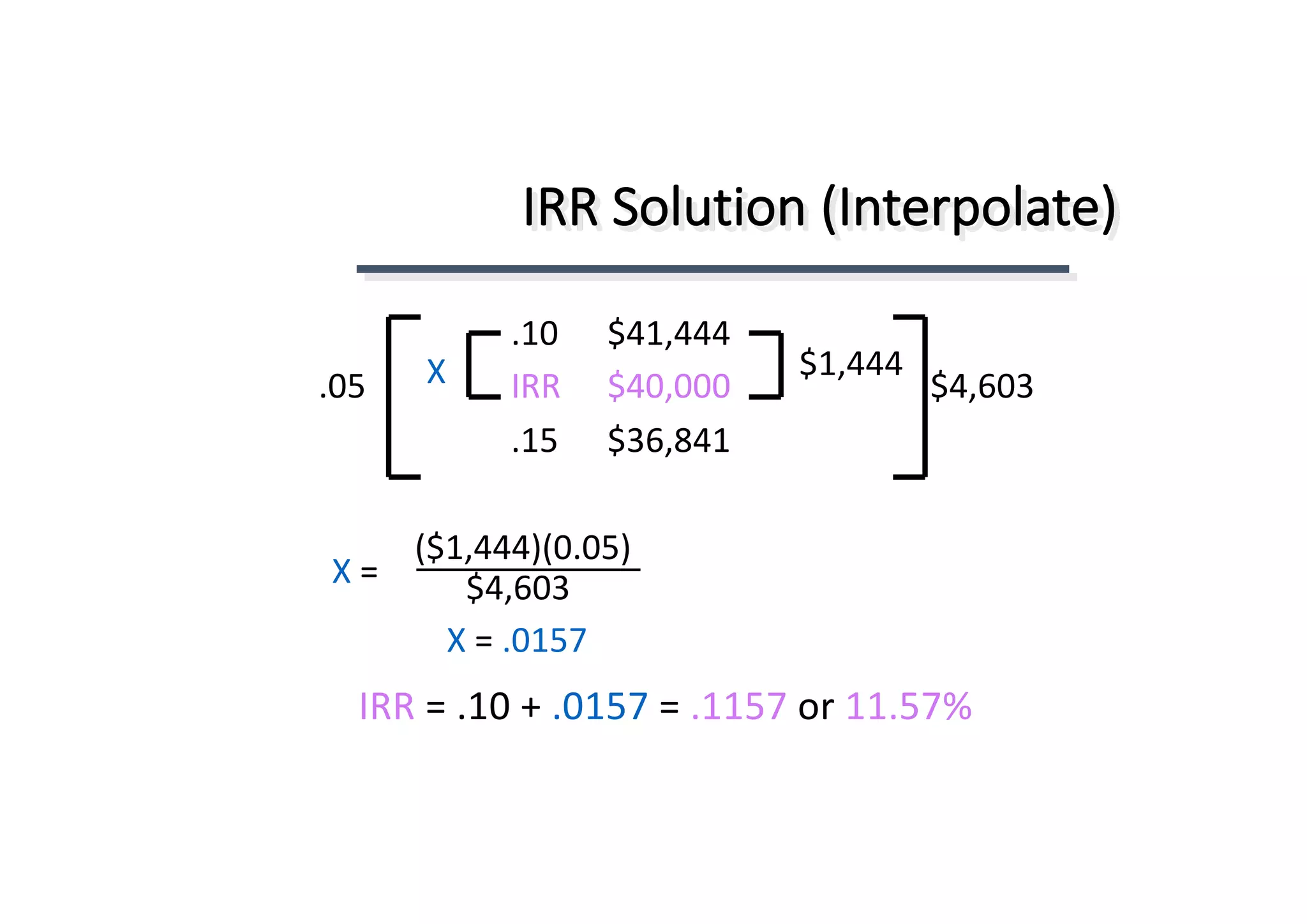
.10 $41,444
.05 IRR $40,000 $4,603
.15 $36,841
($1,444)(0.05)
$4,603
IRR	Solution	(Interpolate)
$1,444X
X =
X =	.0157
IRR =	.10	+	.0157 = .1157	or	11.57%
IRR	Acceptance	Criterion
No!		The	firm	will	receive	11.57% for	each	
dollar	invested	in	this	project	at	a	cost	of	
13%.		[	IRR <	Hurdle	Rate	]
The	management	of	a	company has	
determined	that	the	hurdle	rate	is	13%	for	
projects	of	this	type.
Should	this	project	be	accepted?
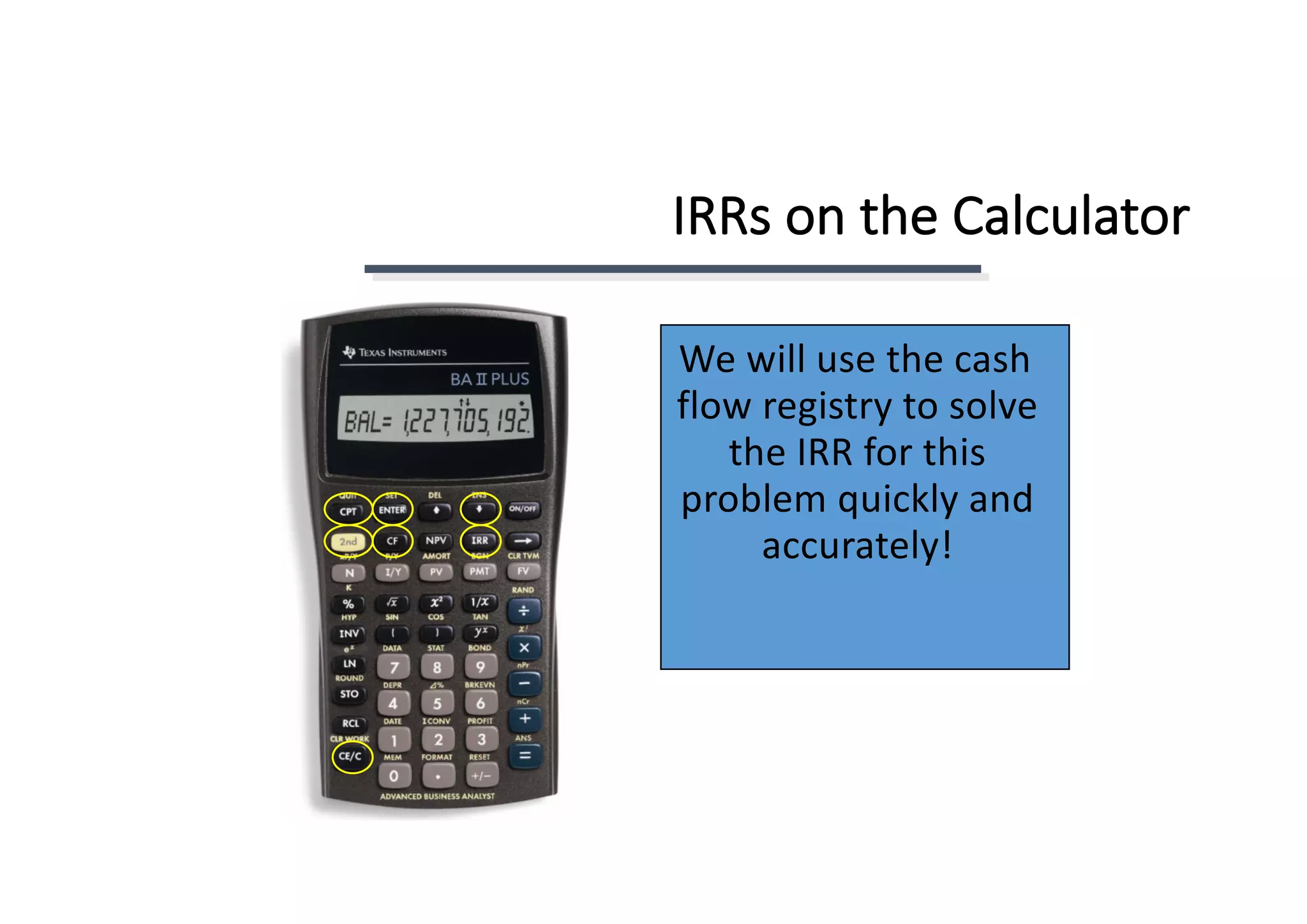
IRRs	on	the	Calculator
We	will	use	the	cash	
flow	registry	to	solve	
the	IRR	for	this	
problem	quickly	and	
accurately!
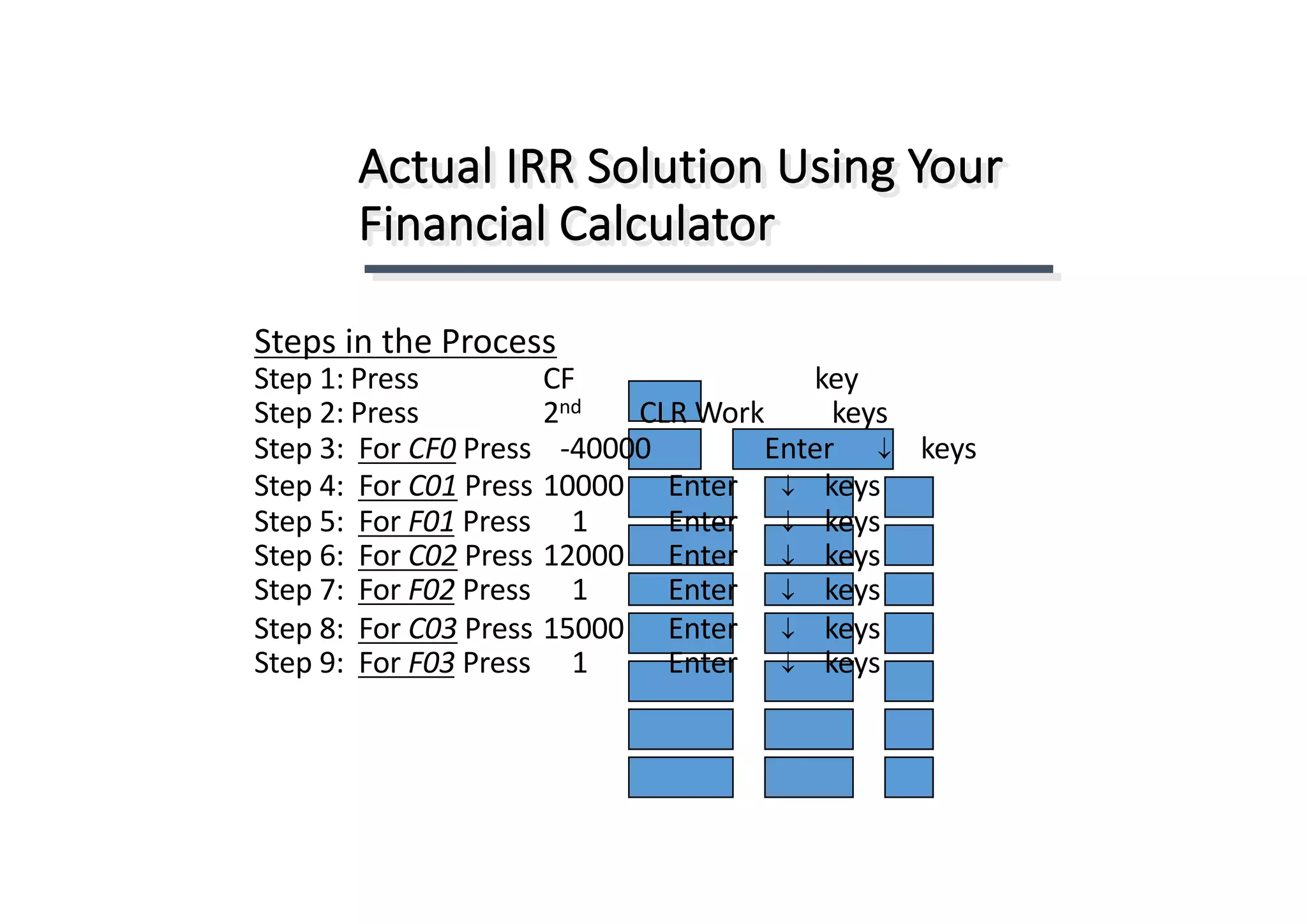
Actual	IRR	Solution	Using	Your	
Financial	Calculator
Steps	in	the	Process
Step	1: Press CF key
Step	2: Press 2nd CLR	Work keys
Step	3:		For	CF0 Press				-40000 Enter						¯ keys
Step	4:		For	C01 Press 10000 Enter						¯ keys
Step	5:		For	F01 Press 1 Enter						¯ keys
Step	6:		For	C02 Press 12000 Enter						¯ keys
Step	7:		For	F02 Press 1 Enter						¯ keys
Step	8:		For	C03 Press 15000 Enter						¯ keys
Step	9:		For	F03 Press 1 Enter						¯ keys
Actual	IRR	Solution	Using	Your	
Financial	Calculator
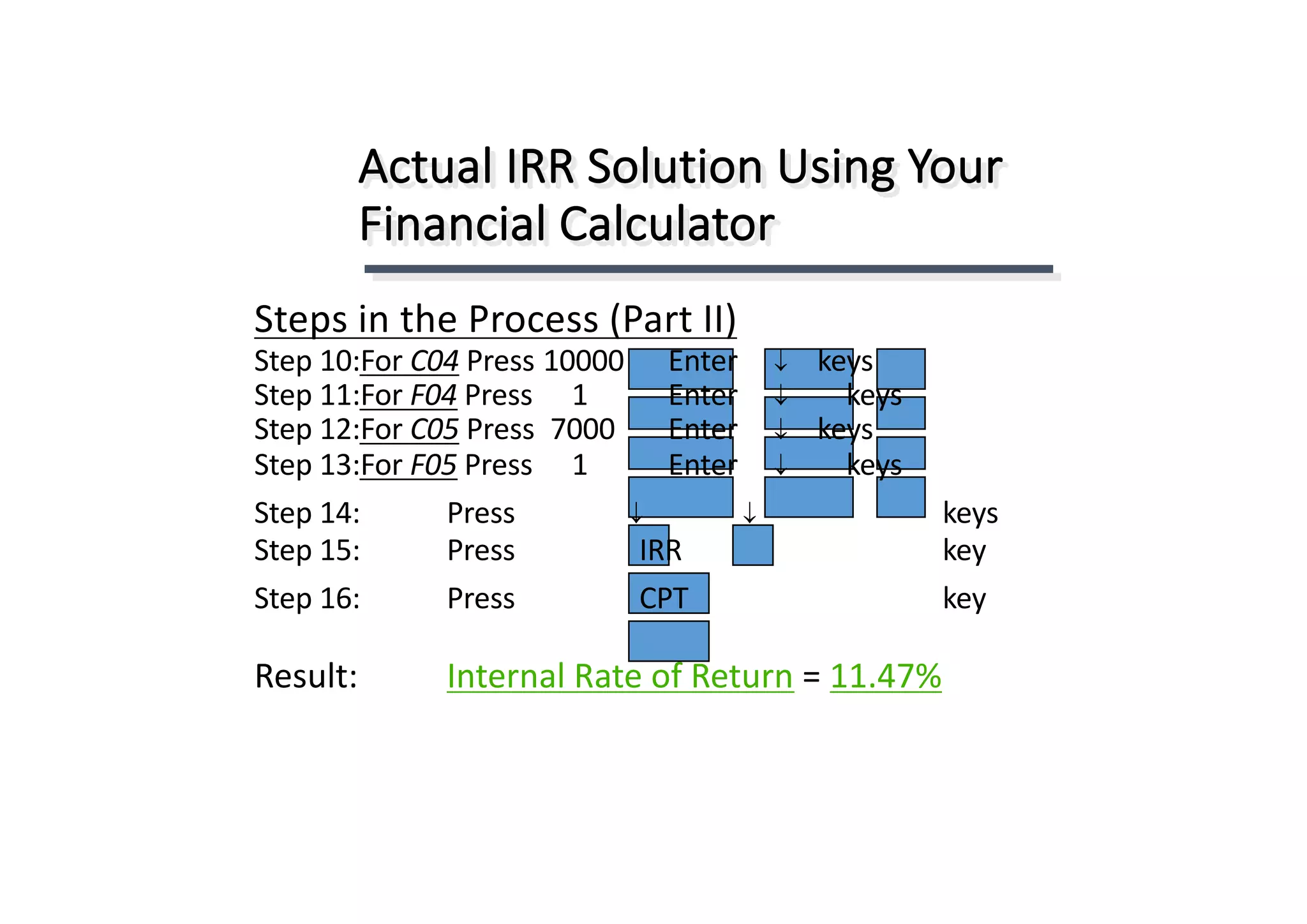
Steps	in	the	Process	(Part	II)
Step	10:For	C04 Press 10000 Enter					¯ keys
Step	11:For	F04 Press 1 Enter					¯ keys
Step	12:For	C05 Press 7000 Enter					¯ keys
Step	13:For	F05 Press 1 Enter					¯ keys
Step	14:		 Press ¯ ¯ keys
Step	15:		 Press IRR key
Step	16:		 Press CPT key
Result: Internal	Rate	of	Return =	11.47%
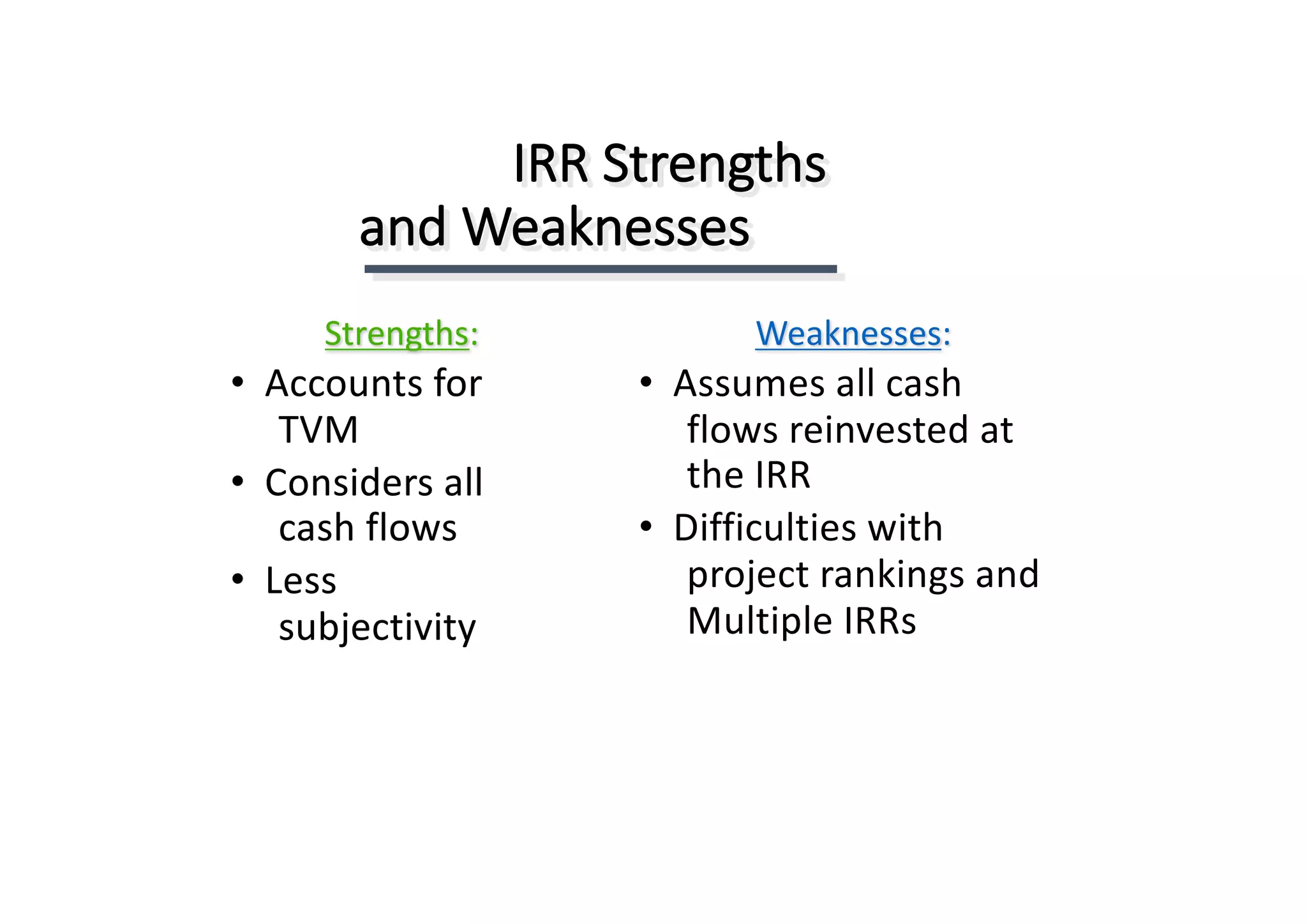
IRR	Strengths	
and	Weaknesses
Strengths:								
• Accounts	for	
TVM
• Considers	all	
cash	flows
• Less	
subjectivity
Weaknesses:	
• Assumes	all	cash	
flows	reinvested	at	
the	IRR
• Difficulties	with	
project	rankings	and	
Multiple	IRRs
NPV	on	the	Calculator
We	will	use	the	cash	flow	
registry	to	solve	the	NPV	
for	this	problem	quickly	
and	accurately!
Hint:	If	you	have	not cleared	
the	cash	flows	from	your	
calculator,	then	you	may	skip	
to	Step	15.
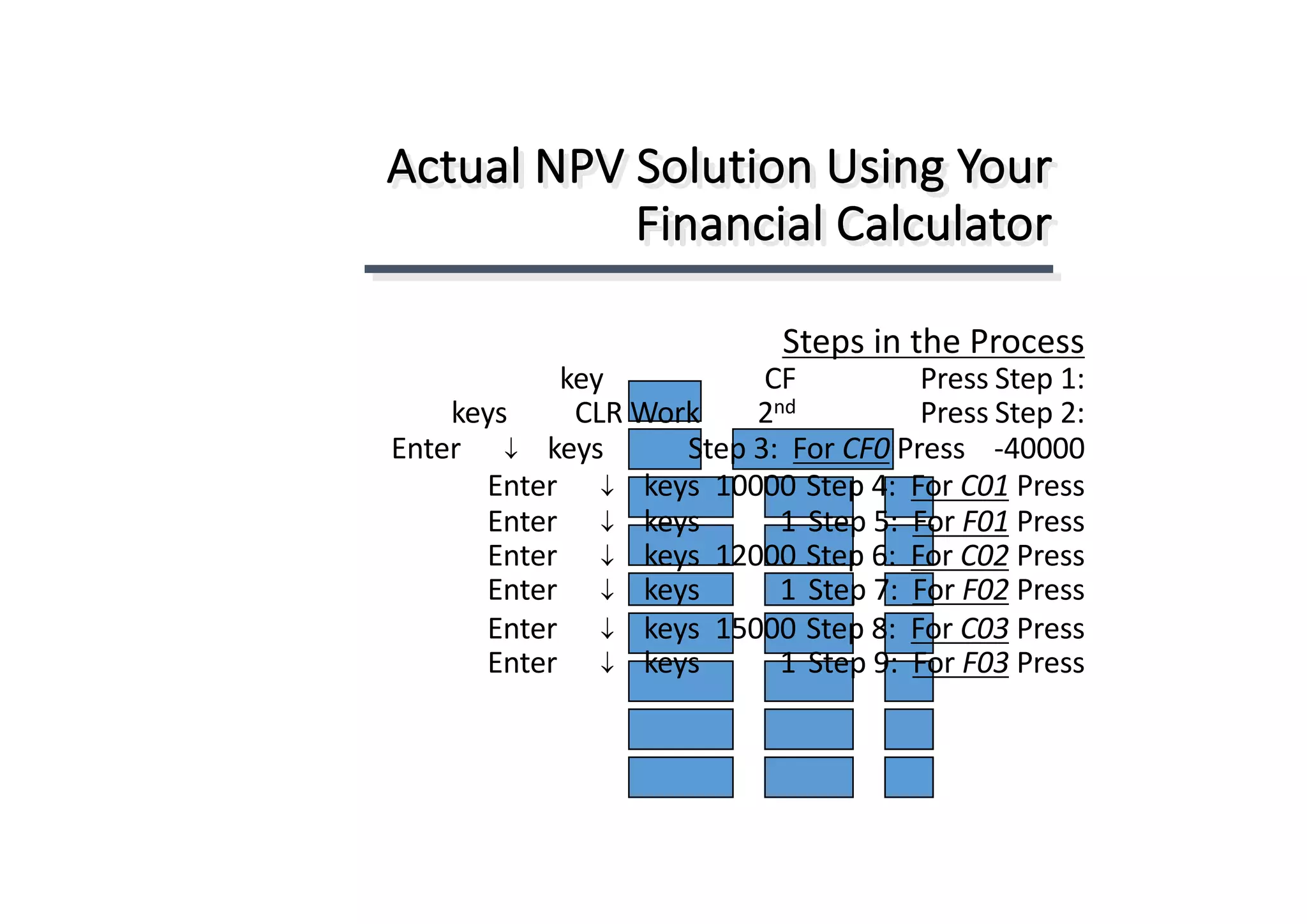
Actual	NPV	Solution	Using	Your	
Financial	Calculator
Steps	in	the	Process
Step	1:PressCFkey
:2Step	Pressnd2CLR	Workkeys
40000-Press				0CFFor	:		3Step	keys¯Enter						
Press01CFor	:		4Step	10000keys¯Enter						
Press01FFor	:		5Step	1keys¯Enter						
Press02CFor	:		6Step	12000keys¯Enter						
Press02FFor	:		7Step	1keys¯Enter						
Press03CFor	:		8Step	15000keys¯Enter						
Press03FFor	:		9Step	1keys¯Enter
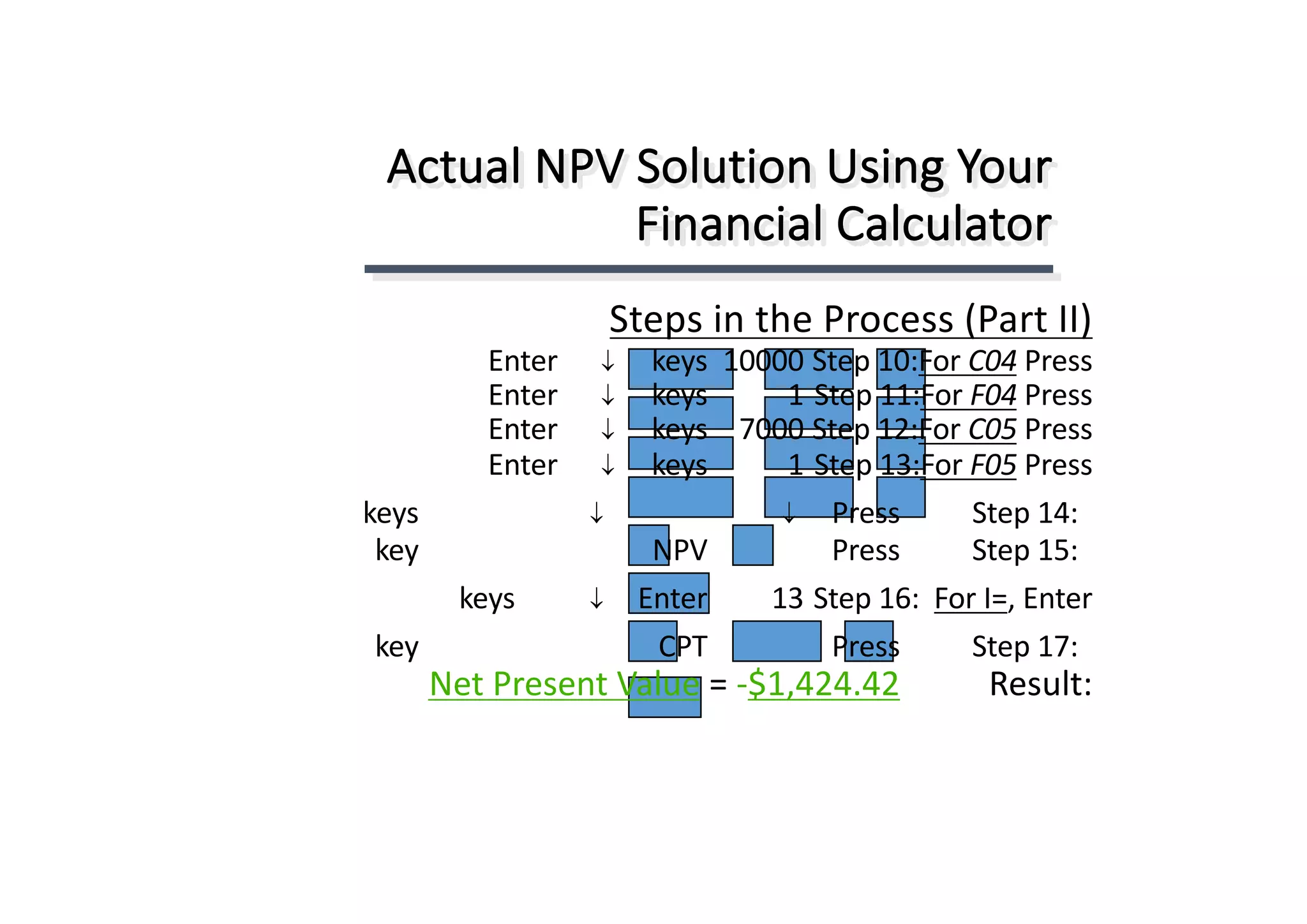
Part	II)Steps	in	the	Process	(
Press04CFor	:10Step	10000keys¯Enter						
Press04FFor	:11Step	1keys¯Enter						
Press05CFor	:12Step	7000keys¯Enter						
Press05FFor	:13Step	1keys¯Enter						
Step	14:		Press¯¯keys
Step	15:		PressNPVkey
Enter,	For	I=:		16Step	13Enter¯keys
Step	17:		PressCPTkey
Result:1,424.42$-=	Net	Present	Value
Actual	NPV	Solution	Using	Your	
Financial	Calculator
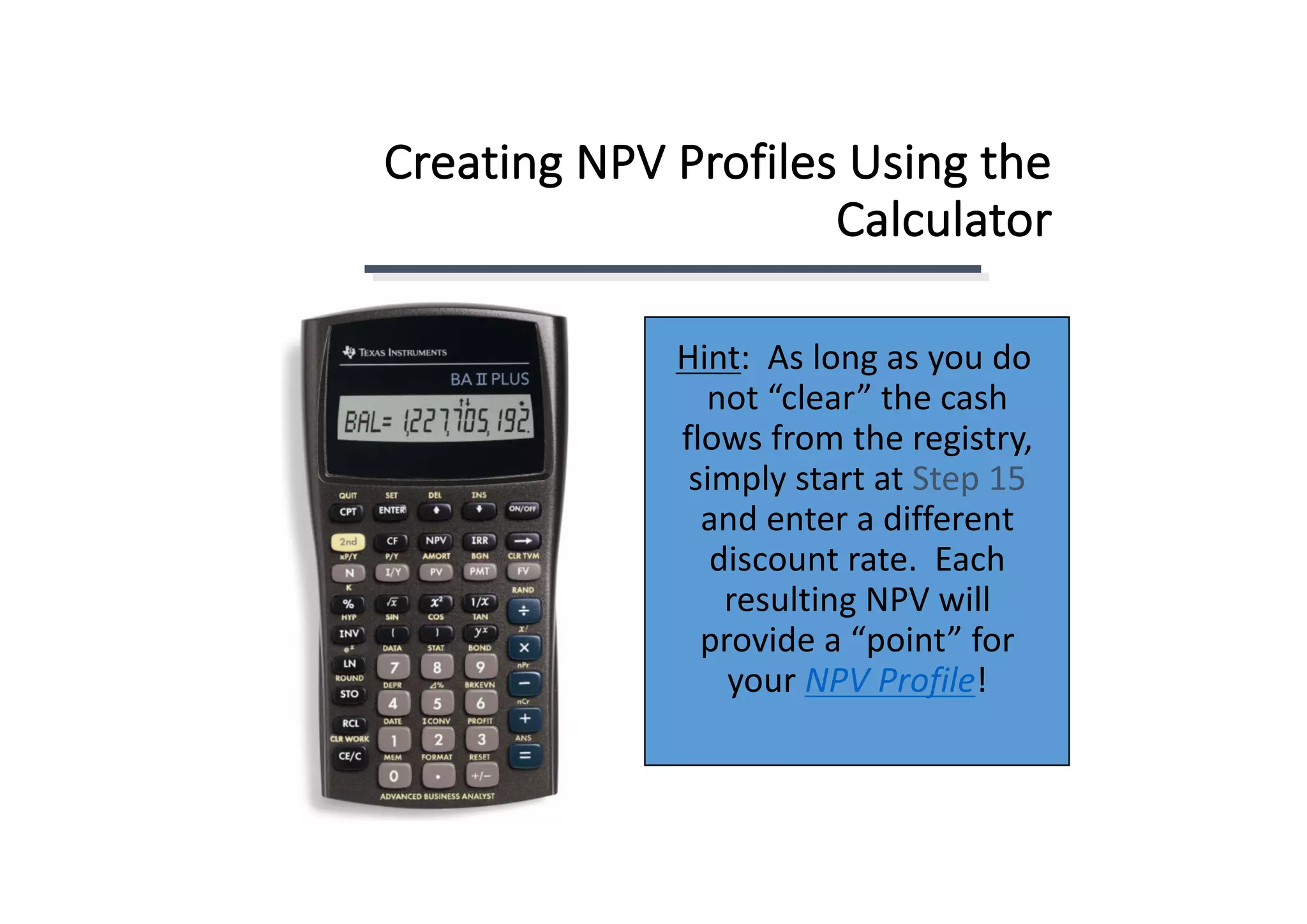
Creating	NPV	Profiles	Using	the	
Calculator
Hint:		As	long	as	you	do	
not	“clear”	the	cash	
flows	from	the	registry,	
simply	start	at	Step	15
and	enter	a	different	
discount	rate.		Each	
resulting	NPV	will	
provide	a	“point”	for	
your	NPV	Profile!
Profitability	Index	(PI)
PI	is	the	ratio	of	the	present	value	of	a	
project’s	future	net	cash	flows	to	the	
project’s	initial	cash	outflow.
CF1 CF2 CFn
(1+k)1 (1+k)2 (1+k)n
+	.	.	.	++ ICOPI	=
PI	=	1	+	[	NPV /	ICO ]
<<	OR	>>
PI	Acceptance	Criterion
This.		1.00less	than	is	PIThe	No!		means	
that	the	project	is	not	profitable.		[Reject	as	PI <	
1.00 ]
PI=	$38,572	/	$40,000
=	.9643	(Method	#1,	13-33)
Should	this	project	be	accepted?
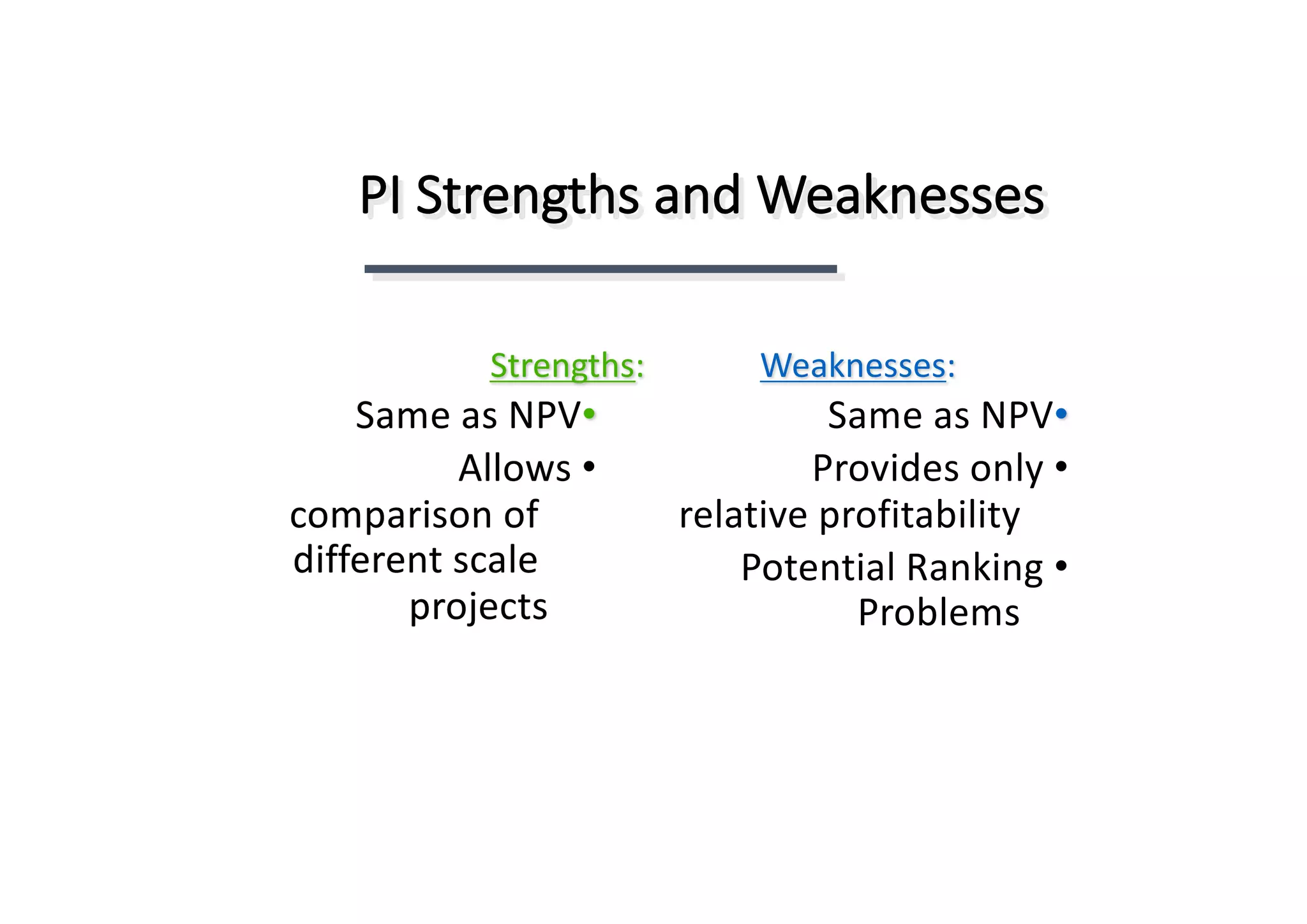
PI	Strengths	and	Weaknesses
:Strengths
•Same	as	NPV
•Allows	
comparison	of	
different	scale	
projects
:Weaknesses
•Same	as	NPV
•Provides	only	
relative	profitability
•Potential	Ranking	
Problems
Other	Project	Relationships
• Mutually	Exclusive -- A	project	whose	
acceptance	precludes	the	acceptance	
of	one	or	more	alternative	projects.	
◆ Dependent -- A project whose
acceptance depends on the
acceptance of one or more other
projects.
Potential	Problems	
Under	Mutual	Exclusivity
A.		Scale	of	Investment
B.		Cash-flow	Pattern
C.		Project	Life
Ranking	of	project	proposals	may	create	contradictory	
results.
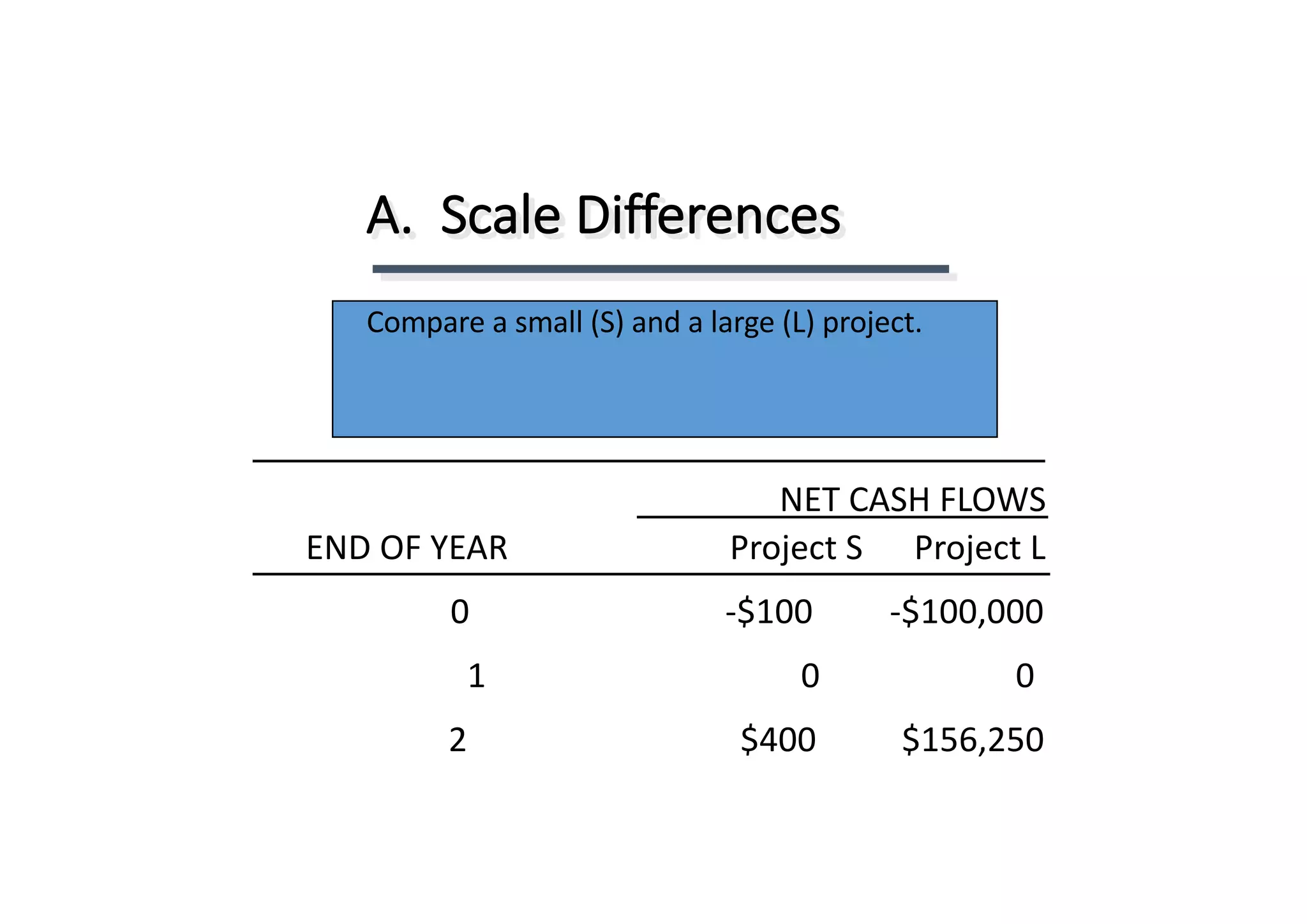
A.		Scale	Differences
Compare	a	small	(S)	and	a	large	(L)	project.
NET	CASH	FLOWS
Project	S						Project	LEND	OF	YEAR
0																														-$100									-$100,000
1																																					0																							0
2																																$400										$156,250
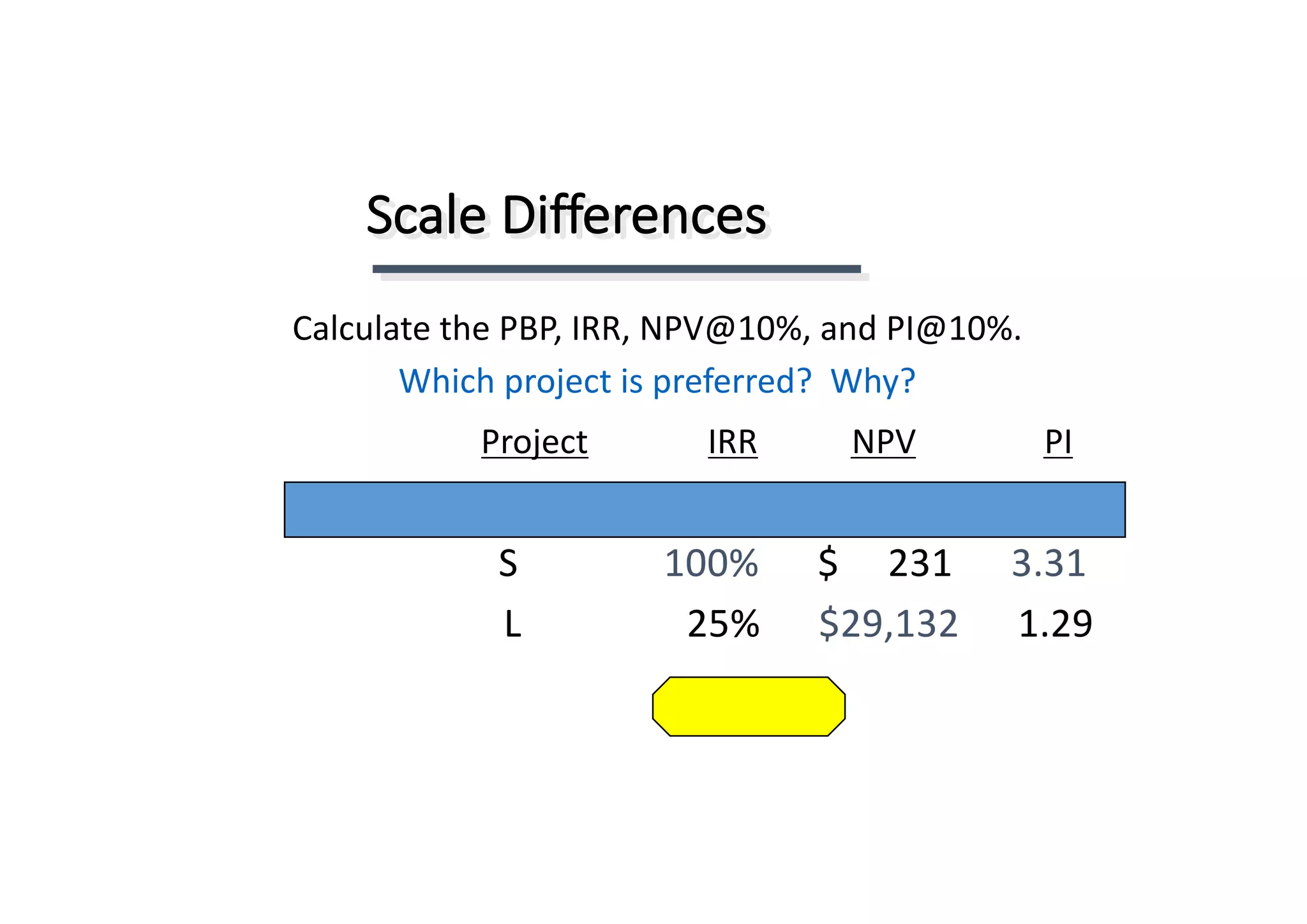
Scale	Differences
Calculate	the	PBP,	IRR,	NPV@10%,	and	PI@10%.
Which	project	is	preferred?		Why?
PINPVIRRProject
S								 100%	 $					231 3.31
L																	25% $29,132						1.29
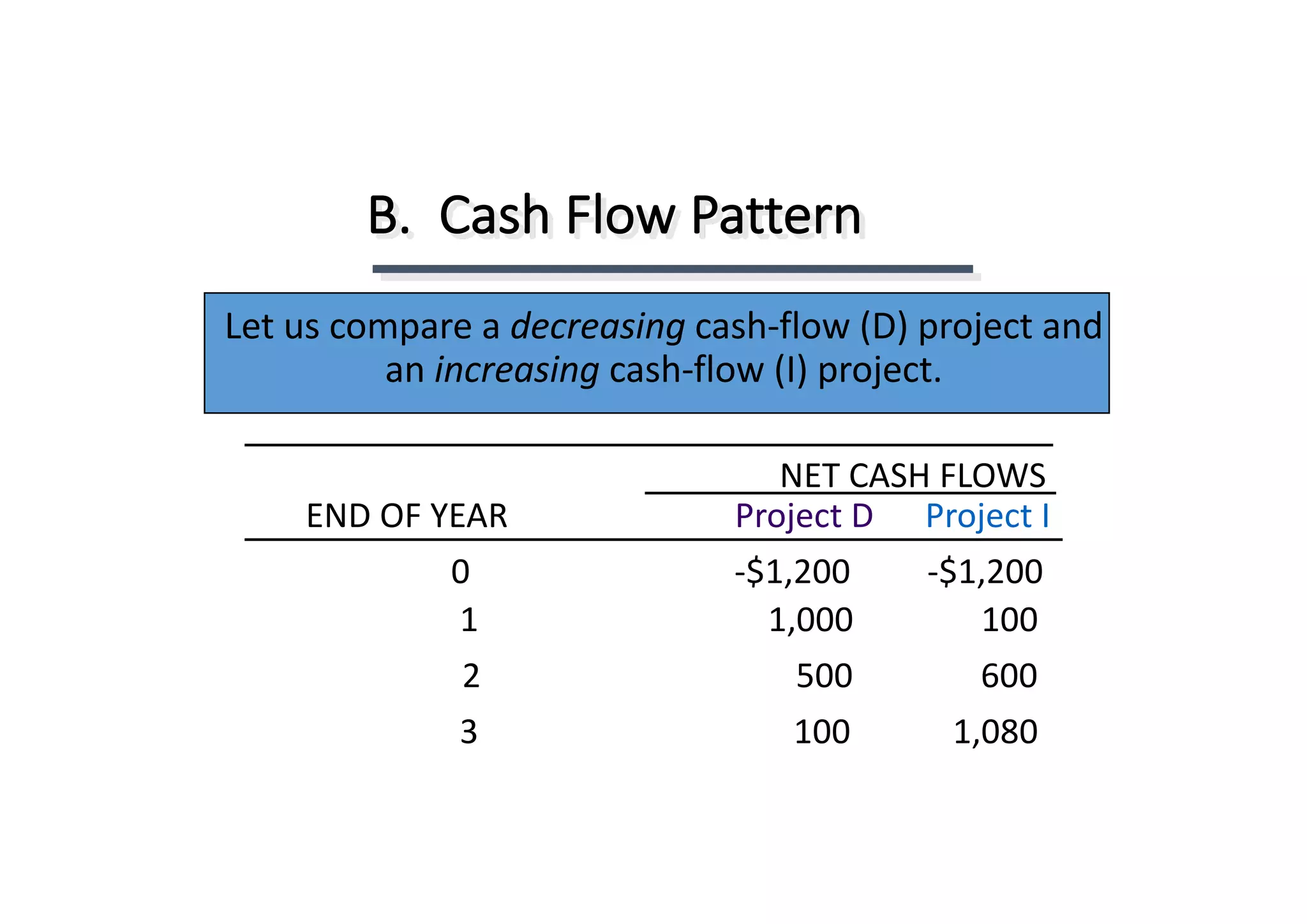
B.		Cash	Flow	Pattern
Let	us	compare	a	decreasing cash-flow	(D)	project	and	
an	increasing cash-flow	(I)	project.
NET	CASH	FLOWS
Project	D Project	IEND	OF	YEAR
0																															-$1,200									-$1,200
1																																		1,000															100
2																																					500															600
3																																					100												1,080
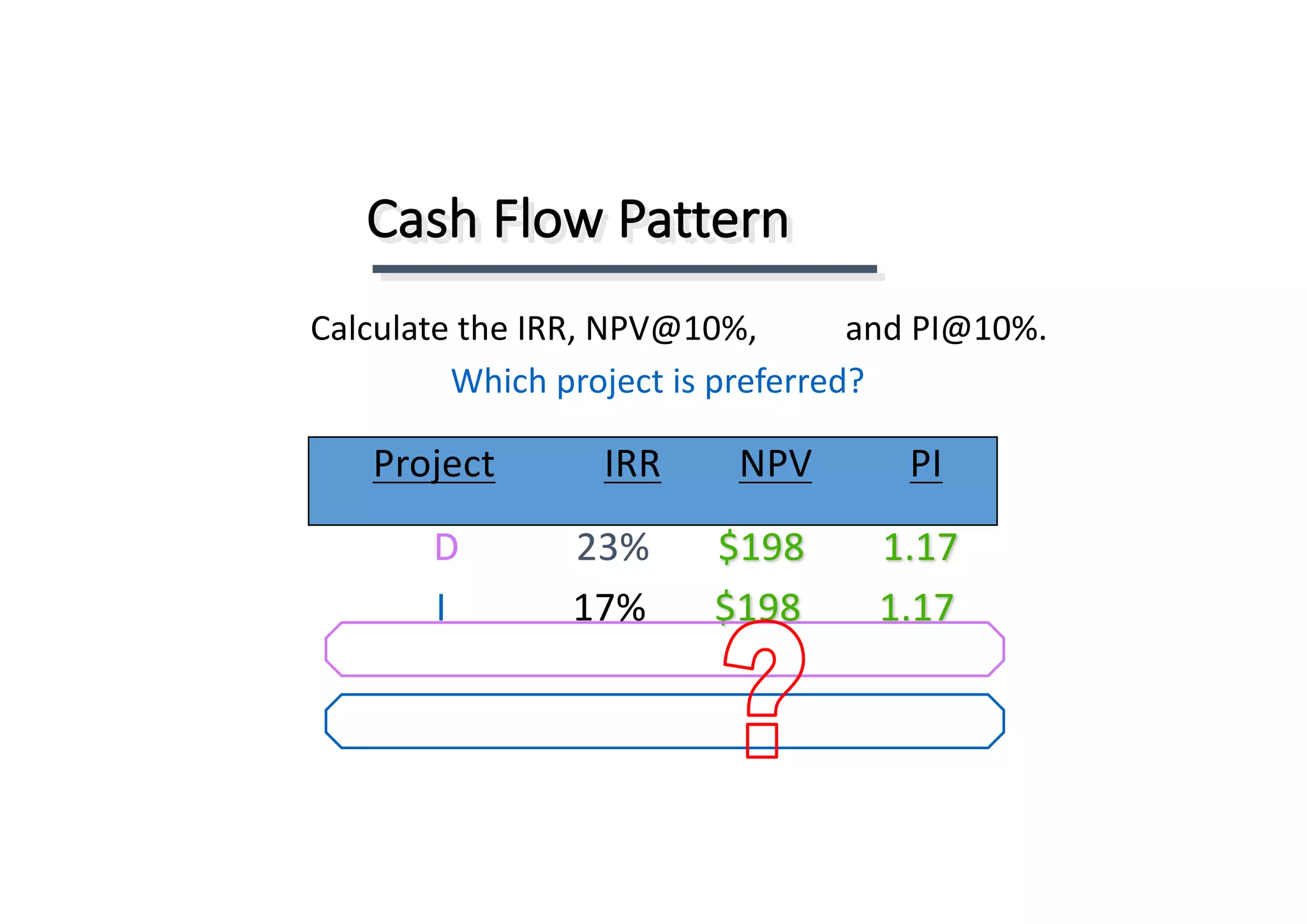
D 23% $198								1.17
I 17% $198								1.17
Cash	Flow	Pattern
Calculate	the	IRR,	NPV@10%,	 and	PI@10%.
Which	project	is	preferred?	
Project IRR NPV PI
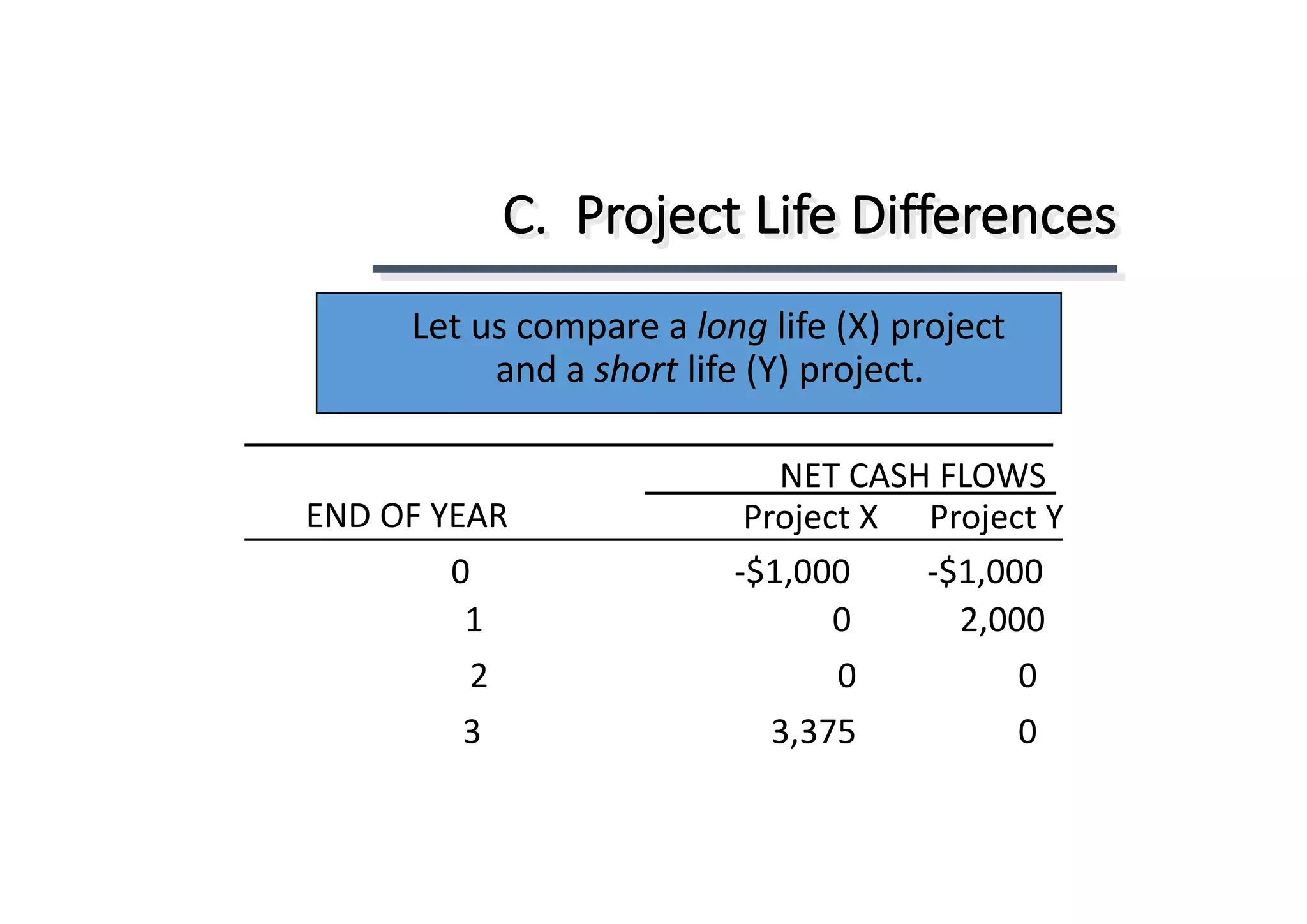
C.		Project	Life	Differences
Let	us	compare	a	long life	(X)	project	
and	a	short life	(Y)	project.
NET	CASH	FLOWS
Project	X						Project	YEND	OF	YEAR
0																															-$1,000									-$1,000
1																																									0												 2,000
2																																									0																			0
3																																		3,375																			0
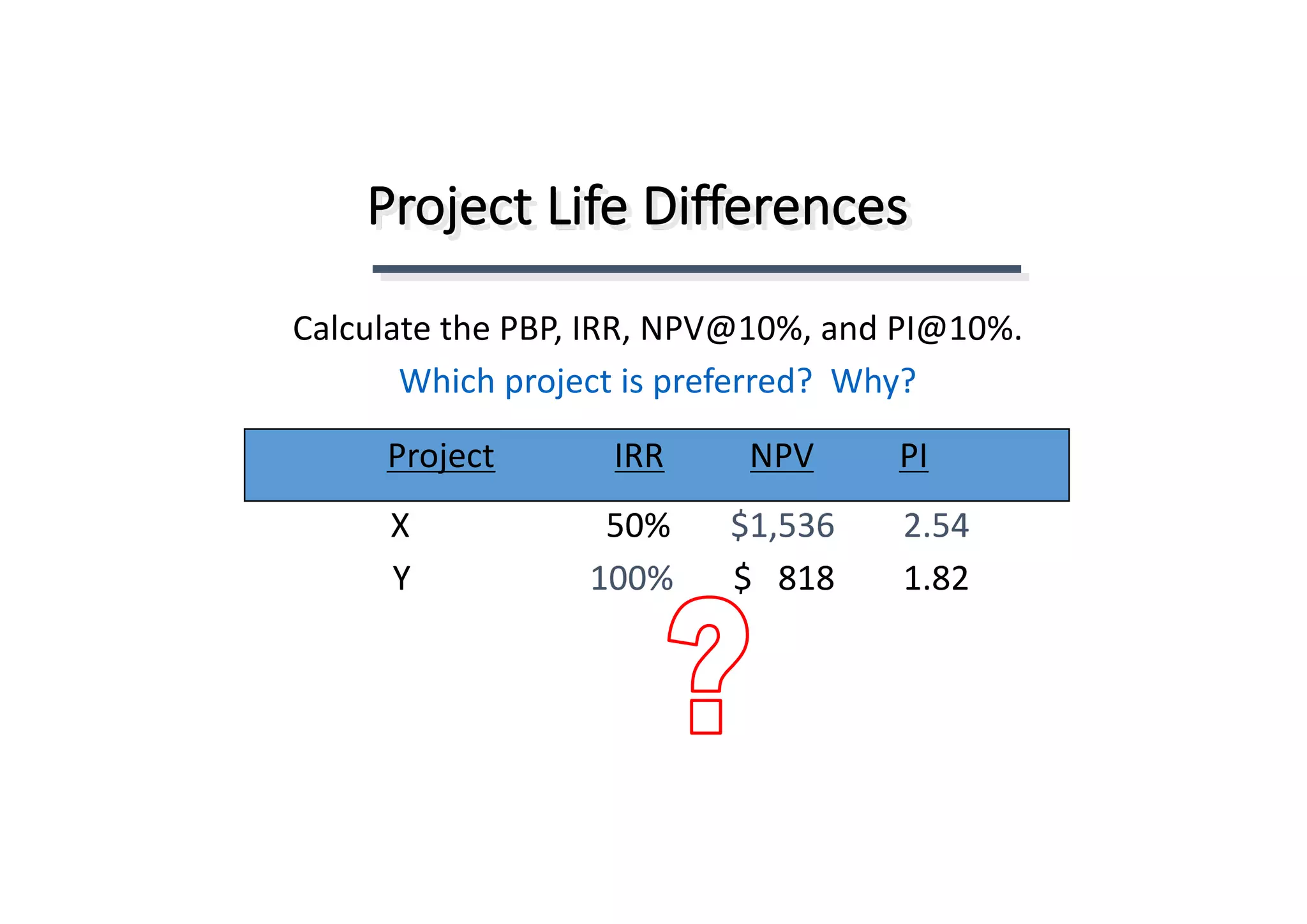
X																							50%							$1,536								2.54
Y 100%							$			818								1.82
Project	Life	Differences
Calculate	the	PBP,	IRR,	NPV@10%,	and	PI@10%.
Which	project	is	preferred?		Why?
Project IRR NPV PI
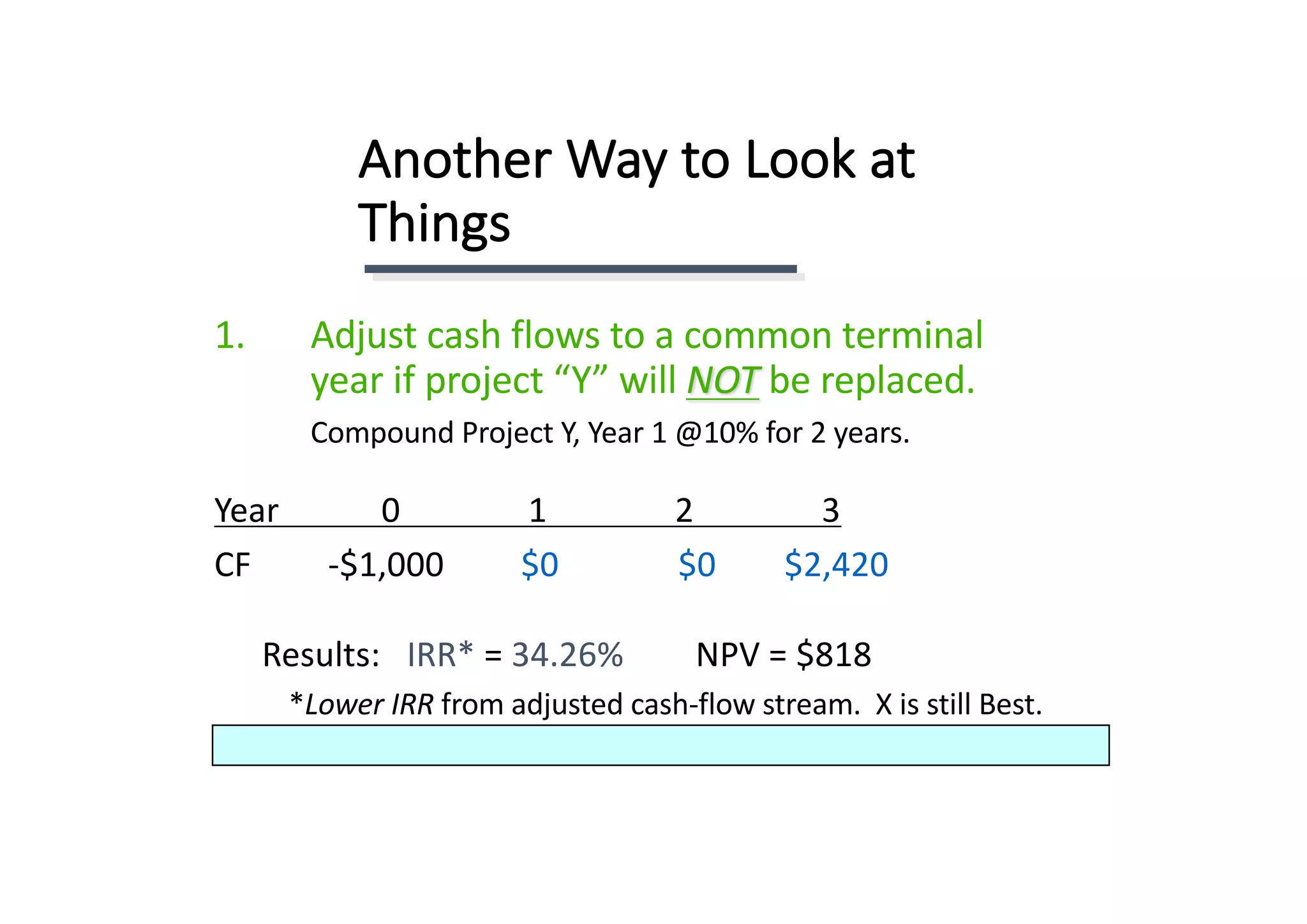
Another	Way	to	Look	at	
Things
1. Adjust	cash	flows	to	a	common	terminal	
year	if	project	“Y”	will	NOT be	replaced.
Compound	Project	Y,	Year	1	@10%	for	2	years.
Year												0															1															2															3
CF									-$1,000 $0														$0								$2,420
Results: IRR*	=	34.26% NPV	=	$818
*Lower	IRR	from	adjusted	cash-flow	stream.		X	is	still	Best.
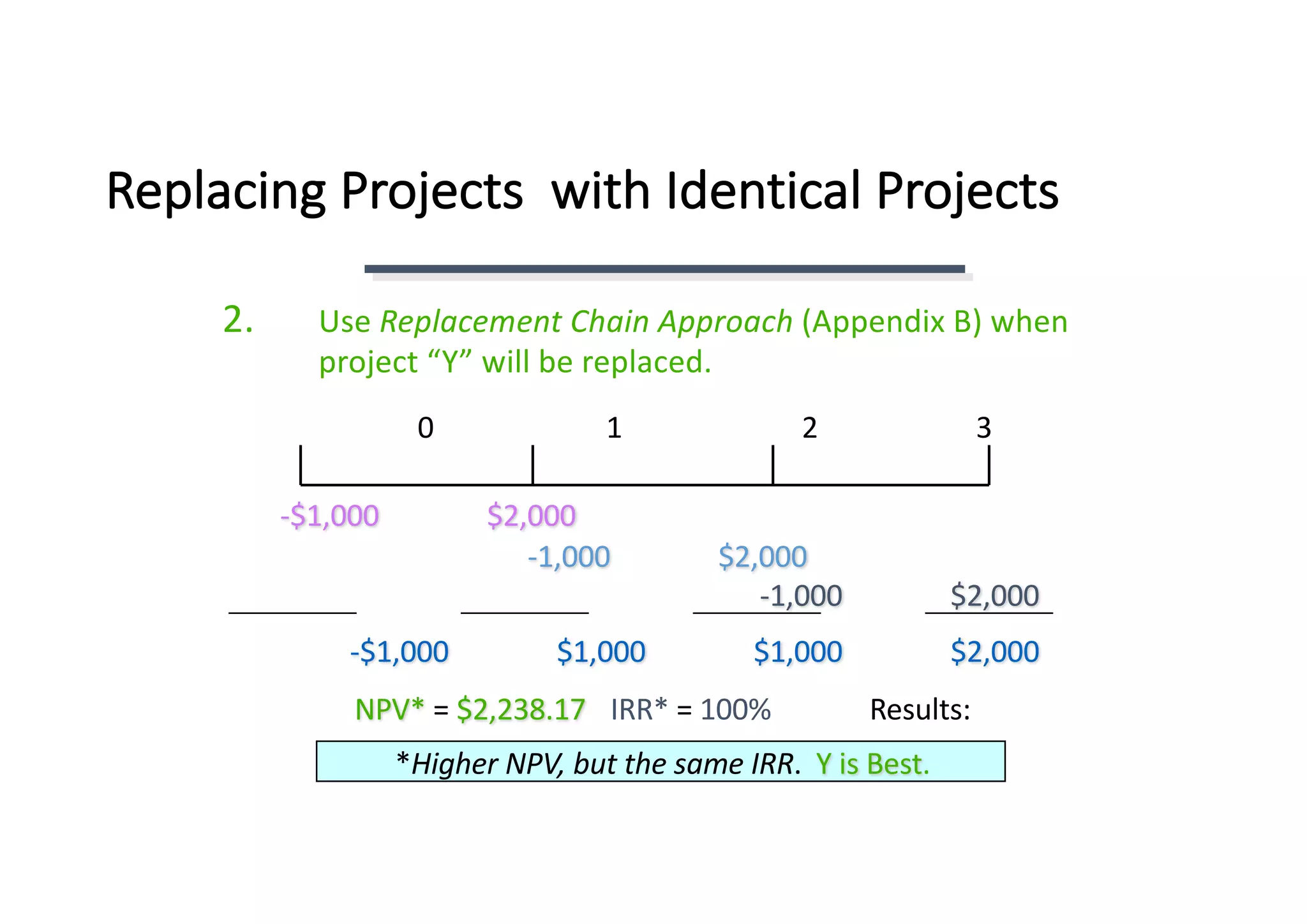
Replacing	Projects	 with	Identical	Projects
2. Use	Replacement	Chain	Approach	(Appendix	B)	when	
project	“Y”	will	be	replaced.
0																								1																									2																						3
-$1,000															$2,000
-1,000															$2,000
-1,000															$2,000
-$1,000															$1,000															$1,000															$2,000
Results:IRR*	=	100%	NPV* = $2,238.17
*Higher	NPV,	but	the	same	IRR. Y	is	Best.
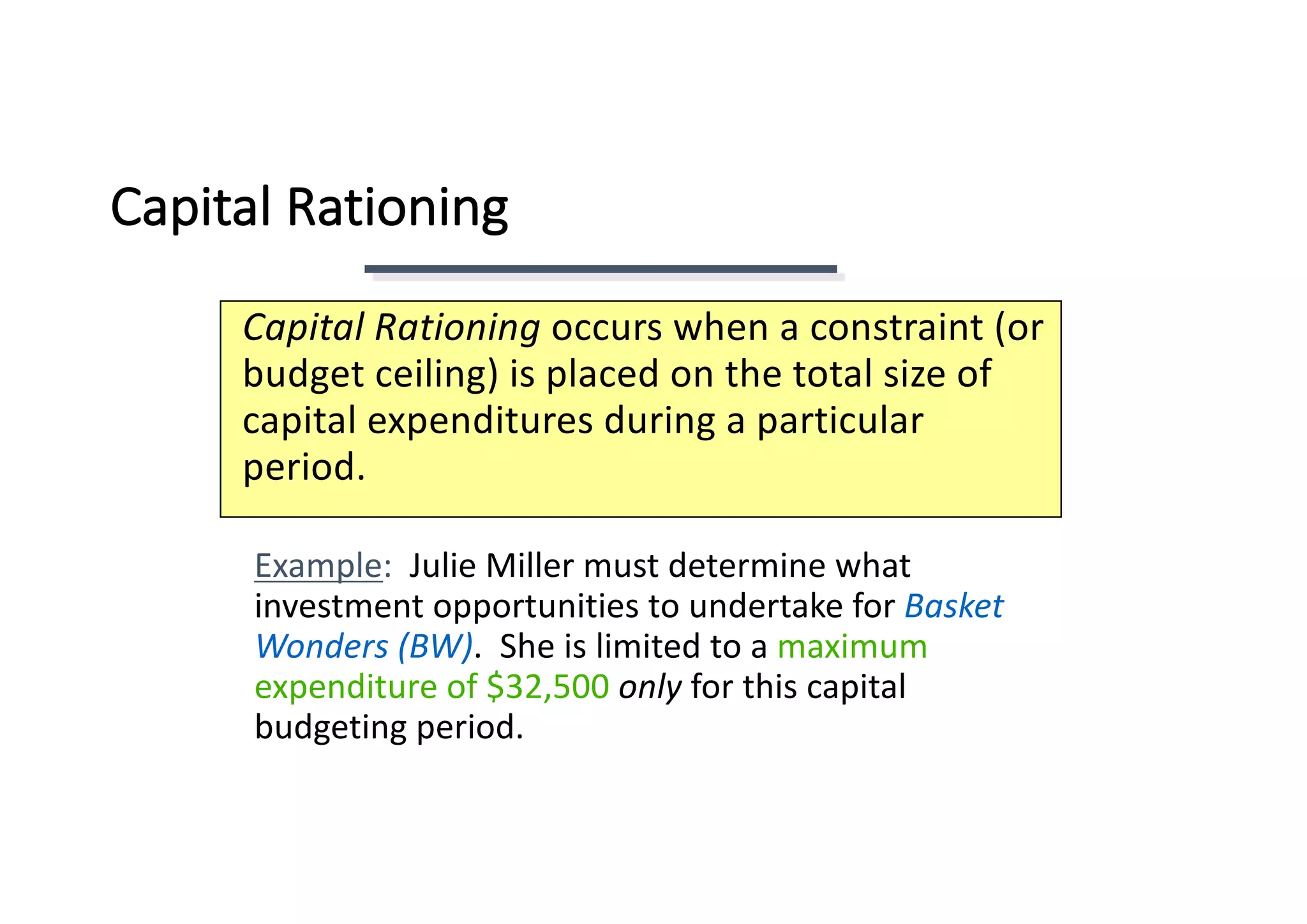
Capital	Rationing
Capital	Rationing	occurs	when	a	constraint	(or	
budget	ceiling)	is	placed	on	the	total	size	of	
capital	expenditures	during	a	particular	
period.
Example:		Julie	Miller	must	determine	what	
investment	opportunities	to	undertake	for	Basket	
Wonders	(BW).		She	is	limited	to	a	maximum	
expenditure	of	$32,500	only for	this	capital	
budgeting	period.
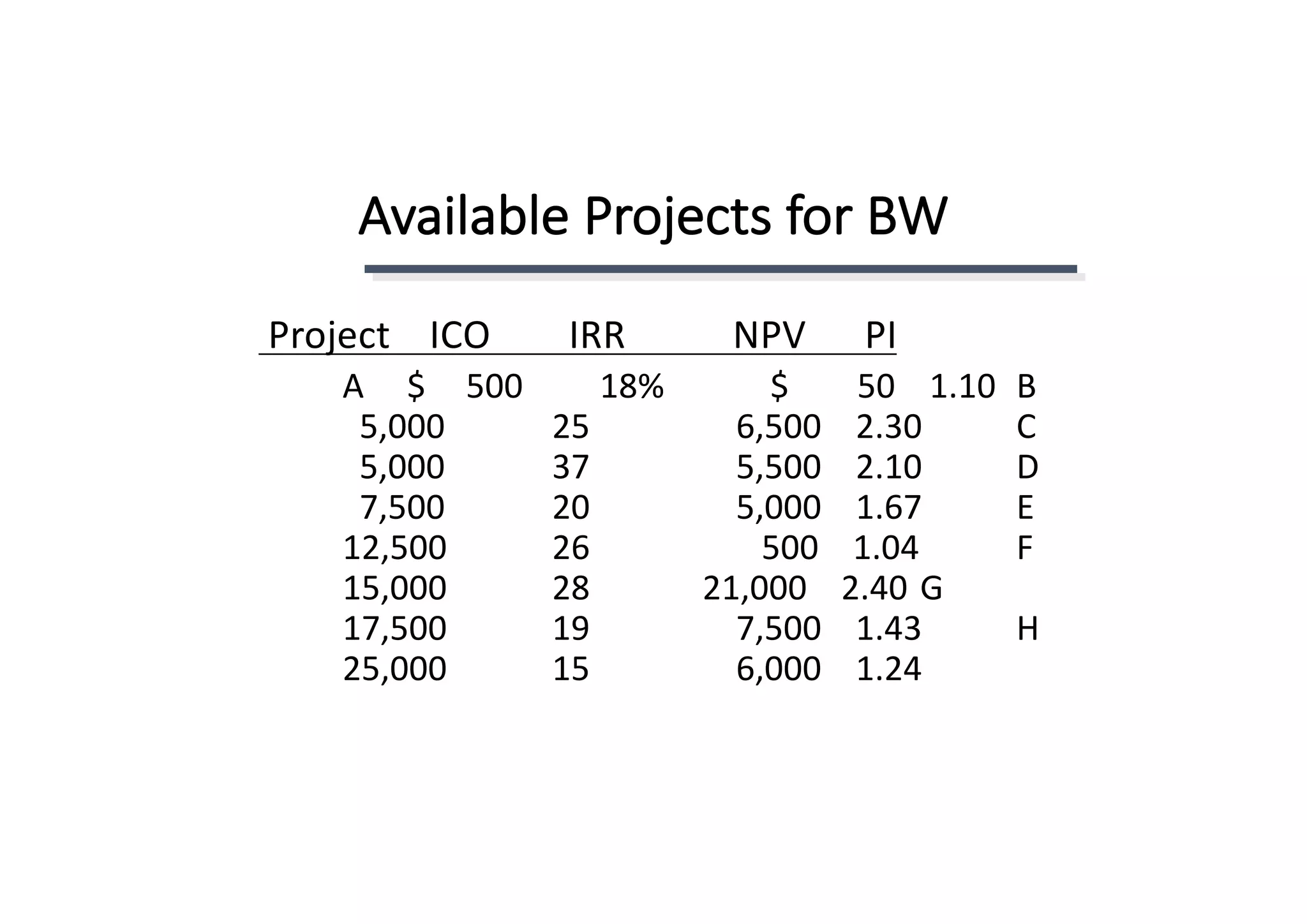
Available	Projects	for	BW
Project				ICO								IRR											NPV						PI
A					$				 500									18% $								50				1.10	 B
5,000 25 6,500				2.30	 C	
5,000 37 5,500				2.10	 D
7,500 20 5,000				1.67	 E
12,500 26 500				1.04	 F
15,000	 28 21,000				2.40	G
17,500 19 7,500				1.43	 H
25,000 15 6,000				1.24
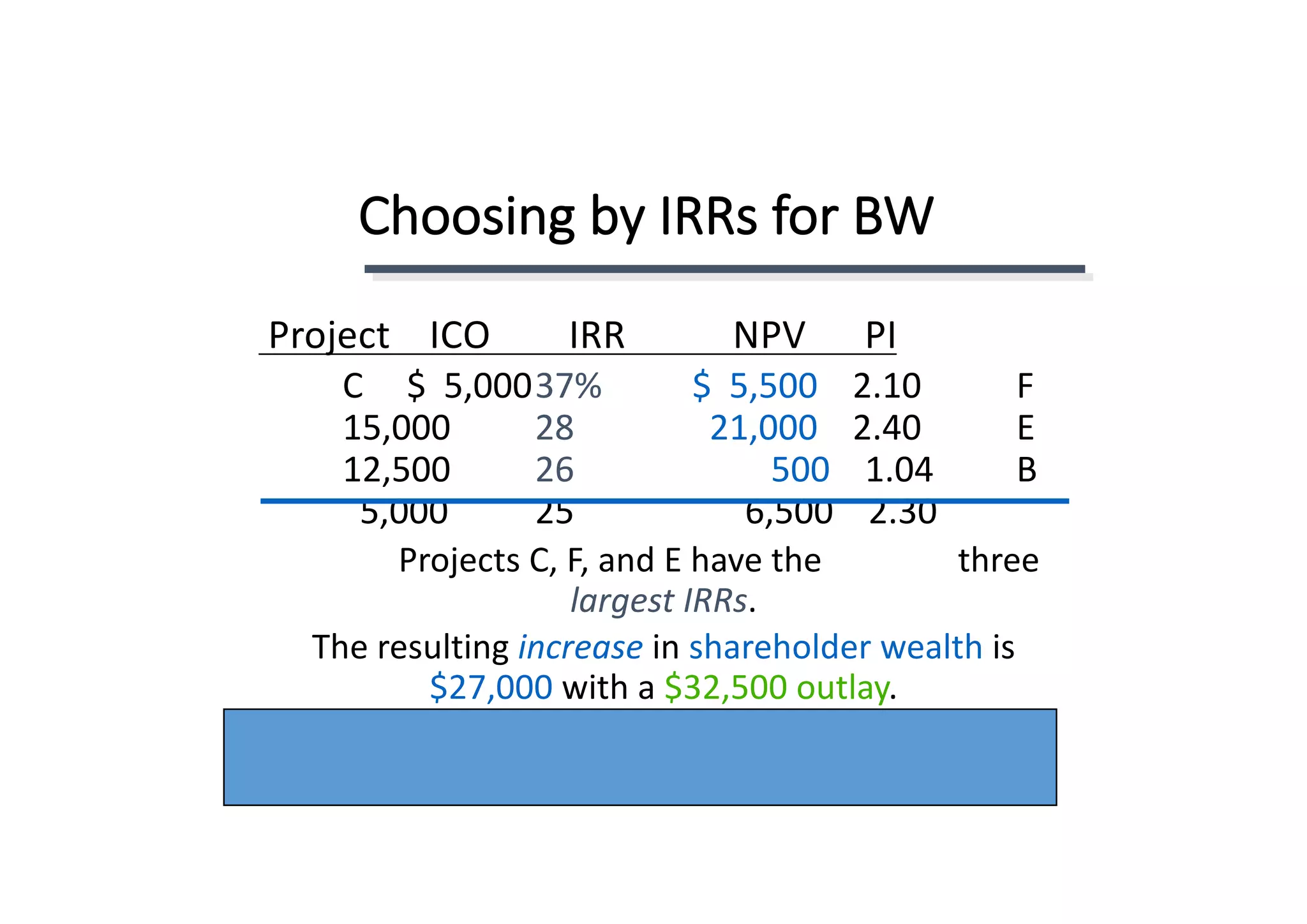
Choosing	by	IRRs	for	BW
Project				ICO								IRR											NPV						PI
C					$		5,00037% $		5,500 2.10	 F
15,000	 28 21,000 2.40	 E
12,500 26 500 1.04	 B
5,000 25 6,500				2.30
Projects	C,	F,	and	E	have	the three	
largest	IRRs.
The	resulting	increase in shareholder	wealth is	
$27,000 with	a	$32,500	outlay.
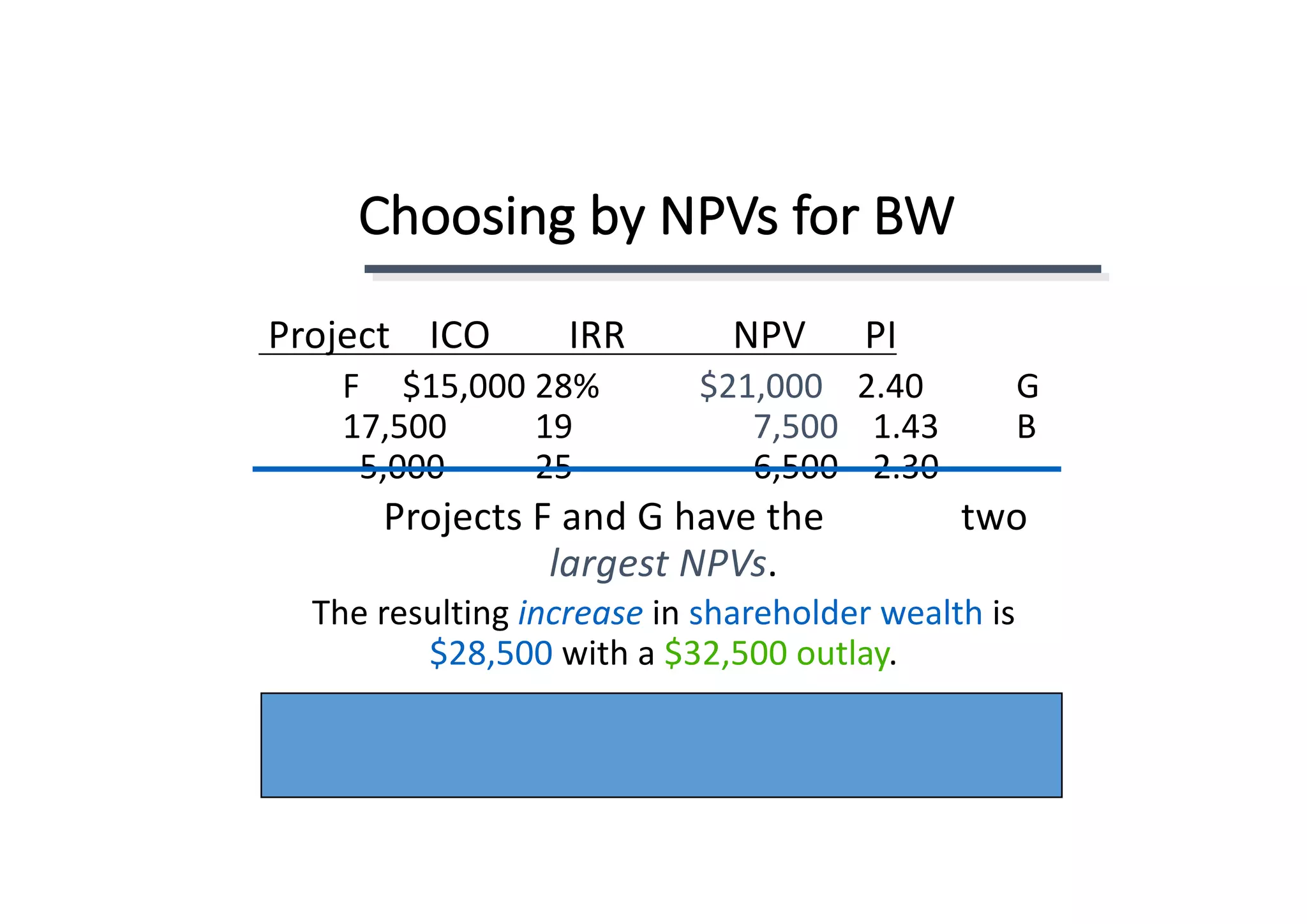
Choosing	by	NPVs	for	BW
Project				ICO								IRR											NPV						PI
F					$15,000	28% $21,000 2.40	 G
17,500 19 7,500 1.43	 B
5,000 25 6,500				2.30
Projects	F	and	G	have	the	 two	
largest	NPVs.
The	resulting	increase in shareholder	wealth is	
$28,500 with	a	$32,500	outlay.
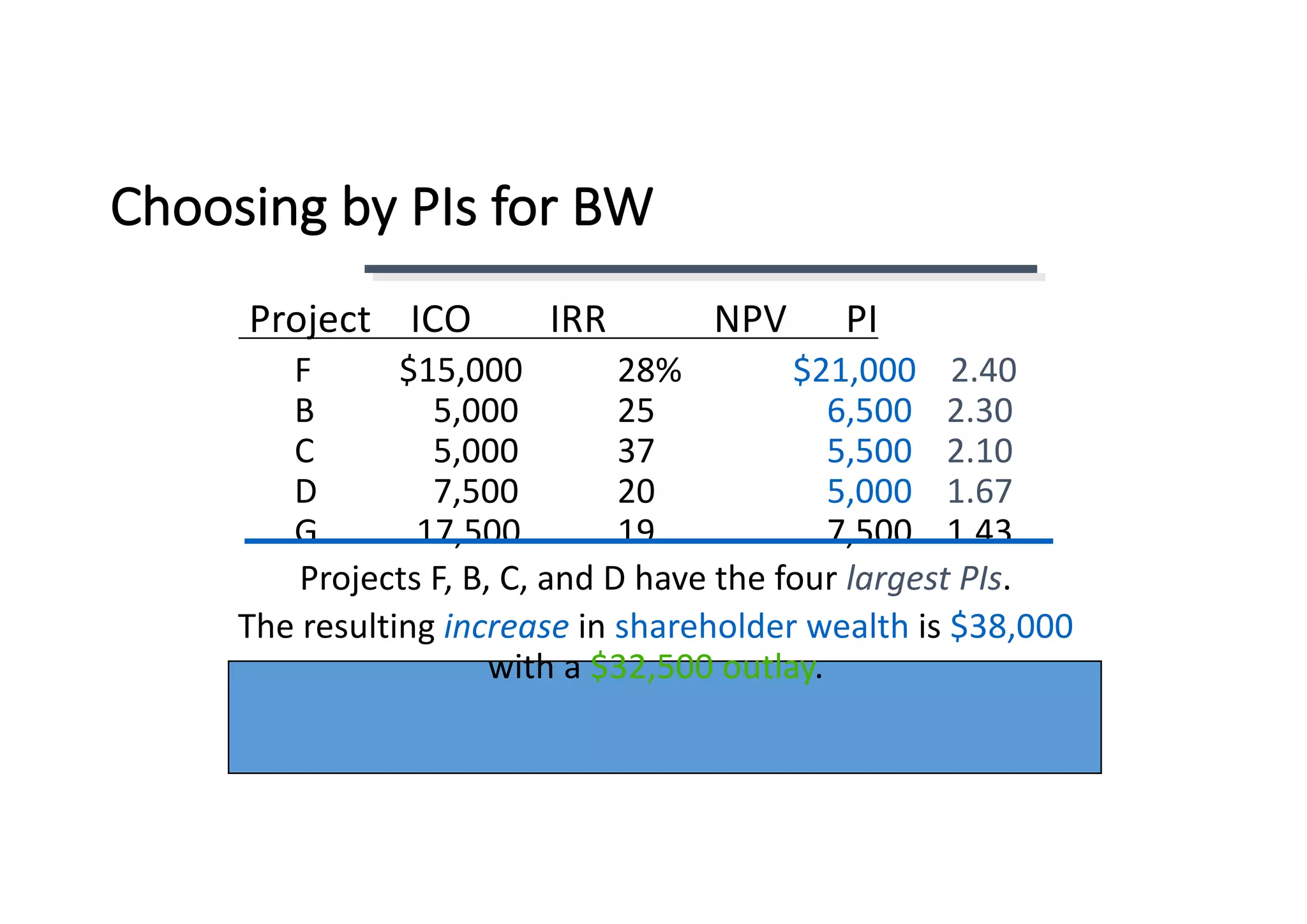
Choosing	by	PIs	for	BW
Project				ICO								IRR											NPV						PI
F $15,000	 28% $21,000 2.40
B 5,000 25 6,500 2.30
C	 5,000 37				 5,500 2.10
D 7,500 20 5,000 1.67
G 17,500 19 7,500				1.43
Projects	F,	B,	C,	and	D	have	the	four	largest	PIs.
The	resulting	increase in shareholder	wealth is	$38,000
with	a	$32,500	outlay.
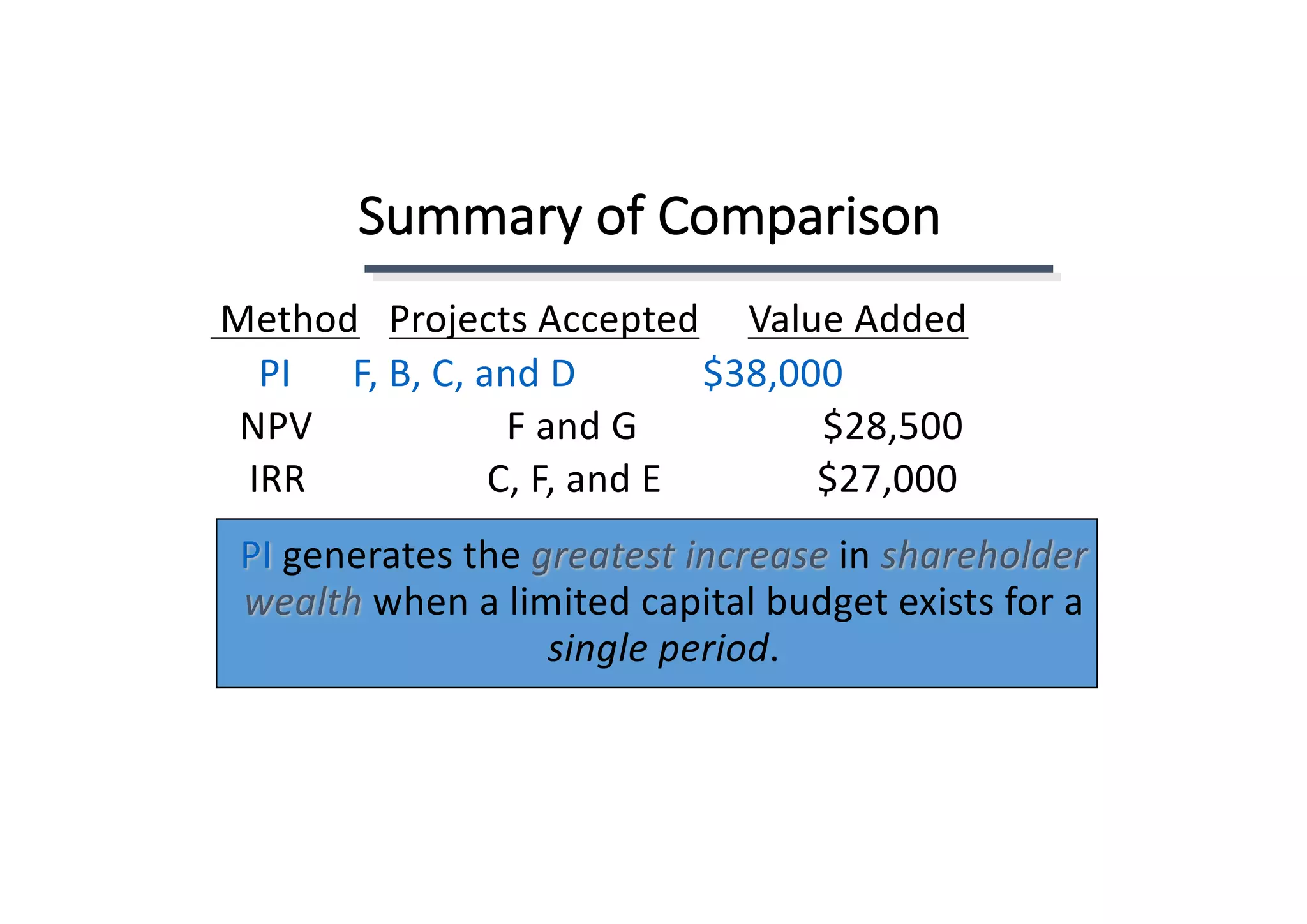
Summary	of	Comparison
Method Projects	Accepted Value	Added
PI F,	B,	C,	and	D													$38,000
NPV F	and	G																			$28,500
IRR C,	F,	and	E																$27,000
PI generates	the	greatest increase in	shareholder	
wealth	when	a	limited	capital	budget	exists	for	a	
single	period.
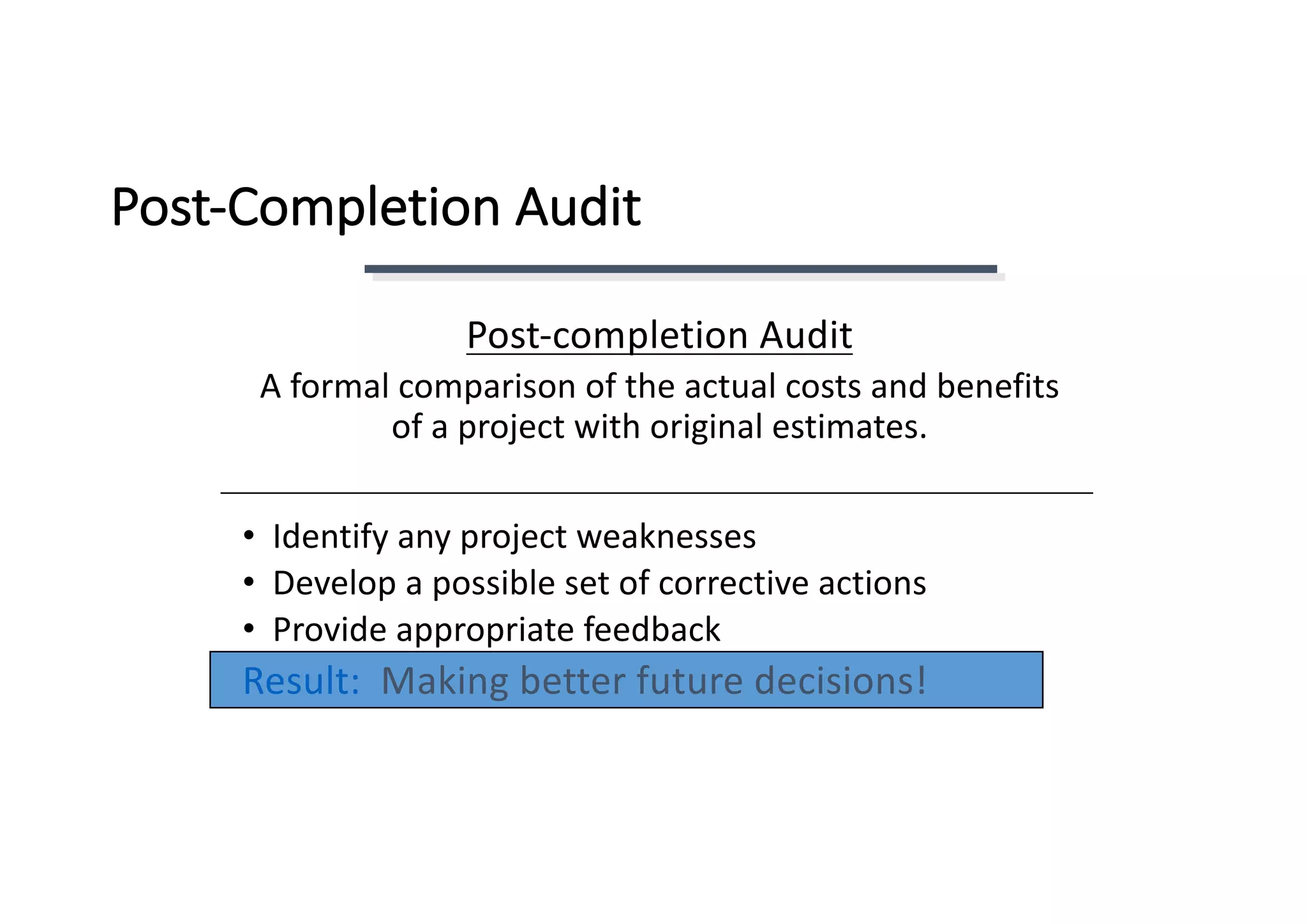
Post-Completion	Audit
Post-completion	Audit
A	formal	comparison	of	the	actual	costs	and	benefits	
of	a	project	with	original	estimates.
• Identify	any	project	weaknesses
• Develop	a	possible	set	of	corrective	actions
• Provide	appropriate	feedback
Result:		Making	better	future	decisions!
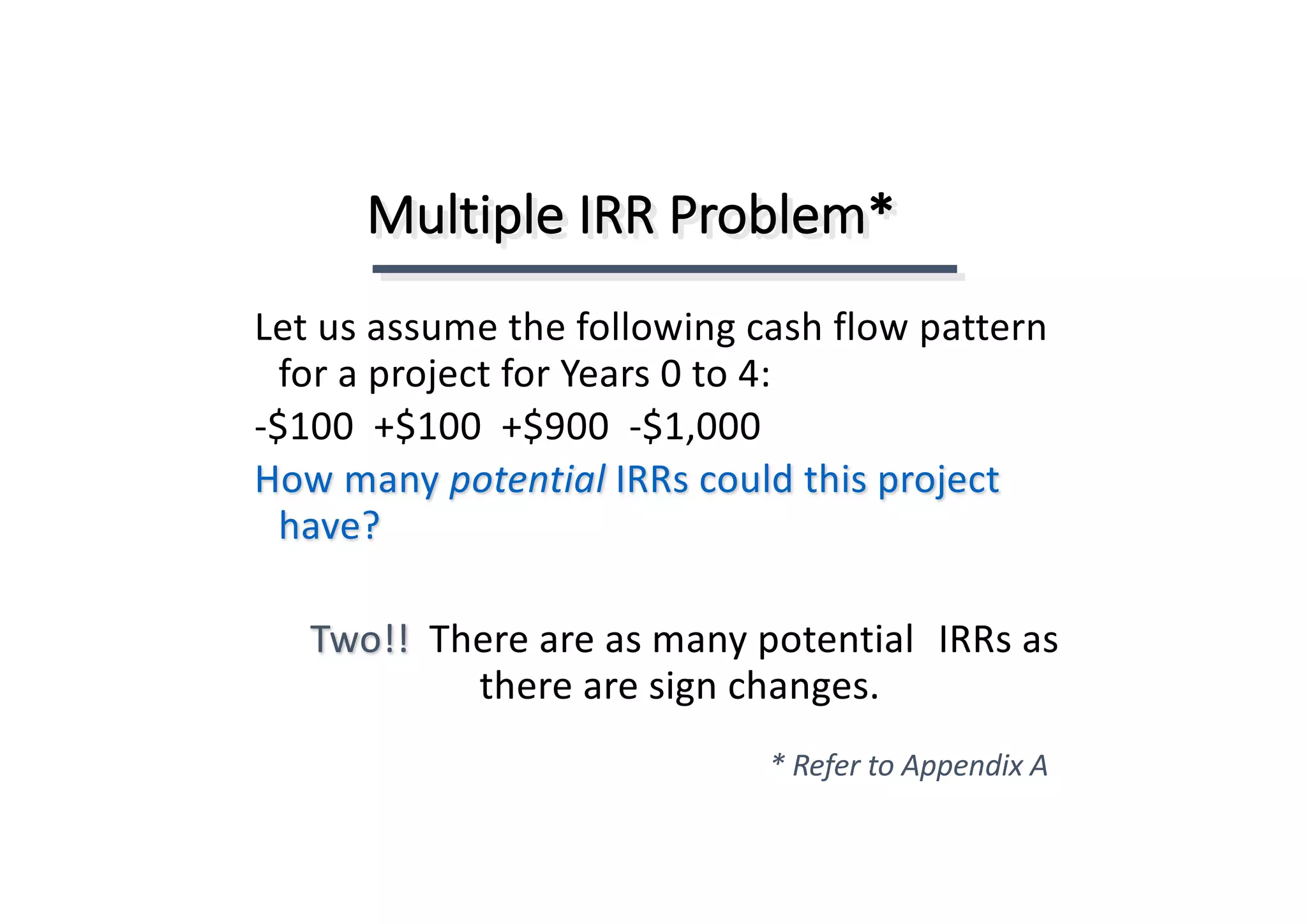
Multiple	IRR	Problem*
Two!!		There	are	as	many	potential	 IRRs	as	
there	are	sign	changes.
Let	us	assume	the	following	cash	flow	pattern	
for	a	project	for	Years	0	to	4:
-$100		+$100		+$900		-$1,000
How	many	potential IRRs	could	this	project	
have?
*	Refer	to	Appendix	A
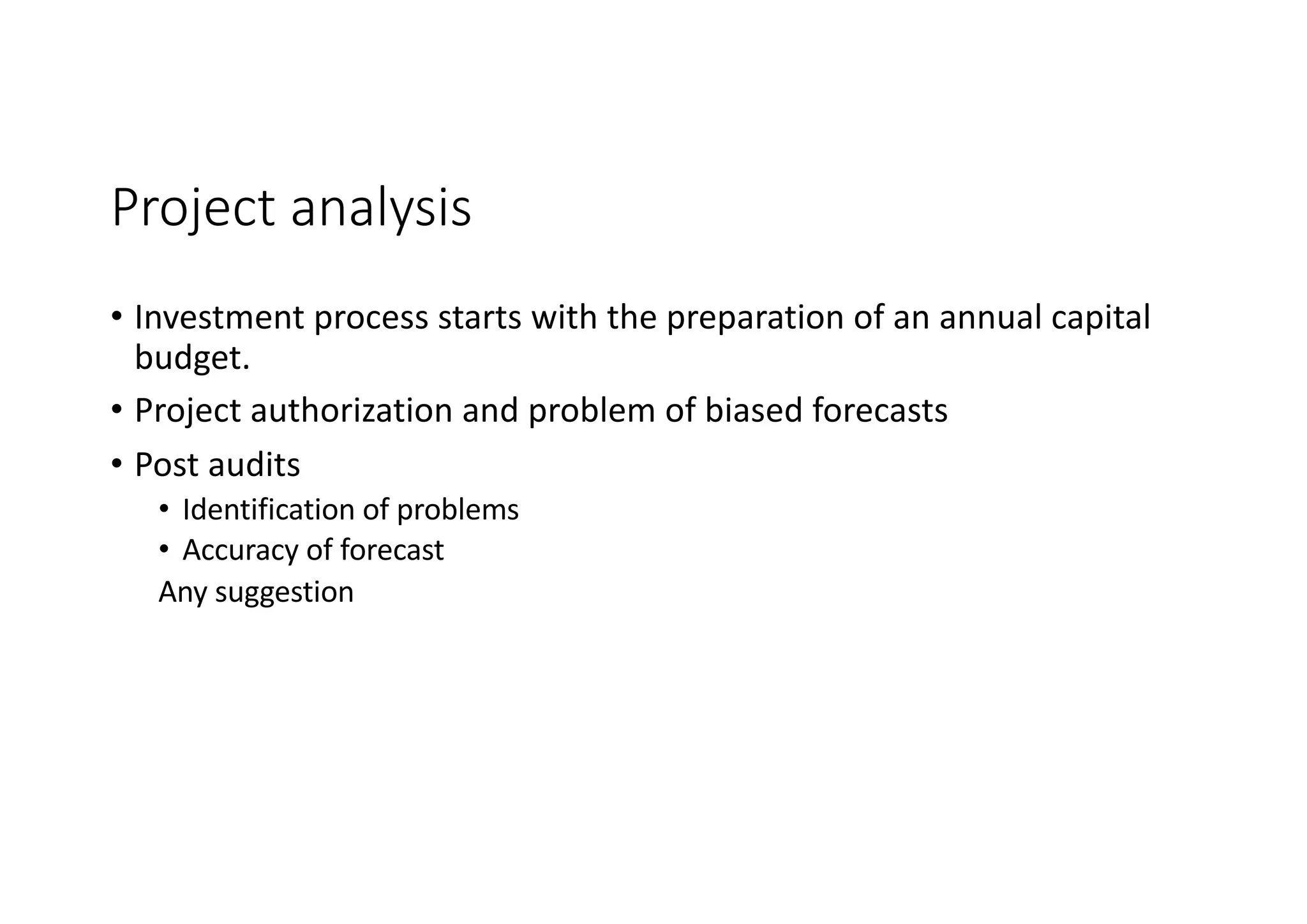
Project	analysis
• Investment	process	starts	with	the	preparation	of	an	annual	capital	
budget.
• Project	authorization	and	problem	of	biased	forecasts
• Post	audits
• Identification	of	problems
• Accuracy	of	forecast
Any	suggestion
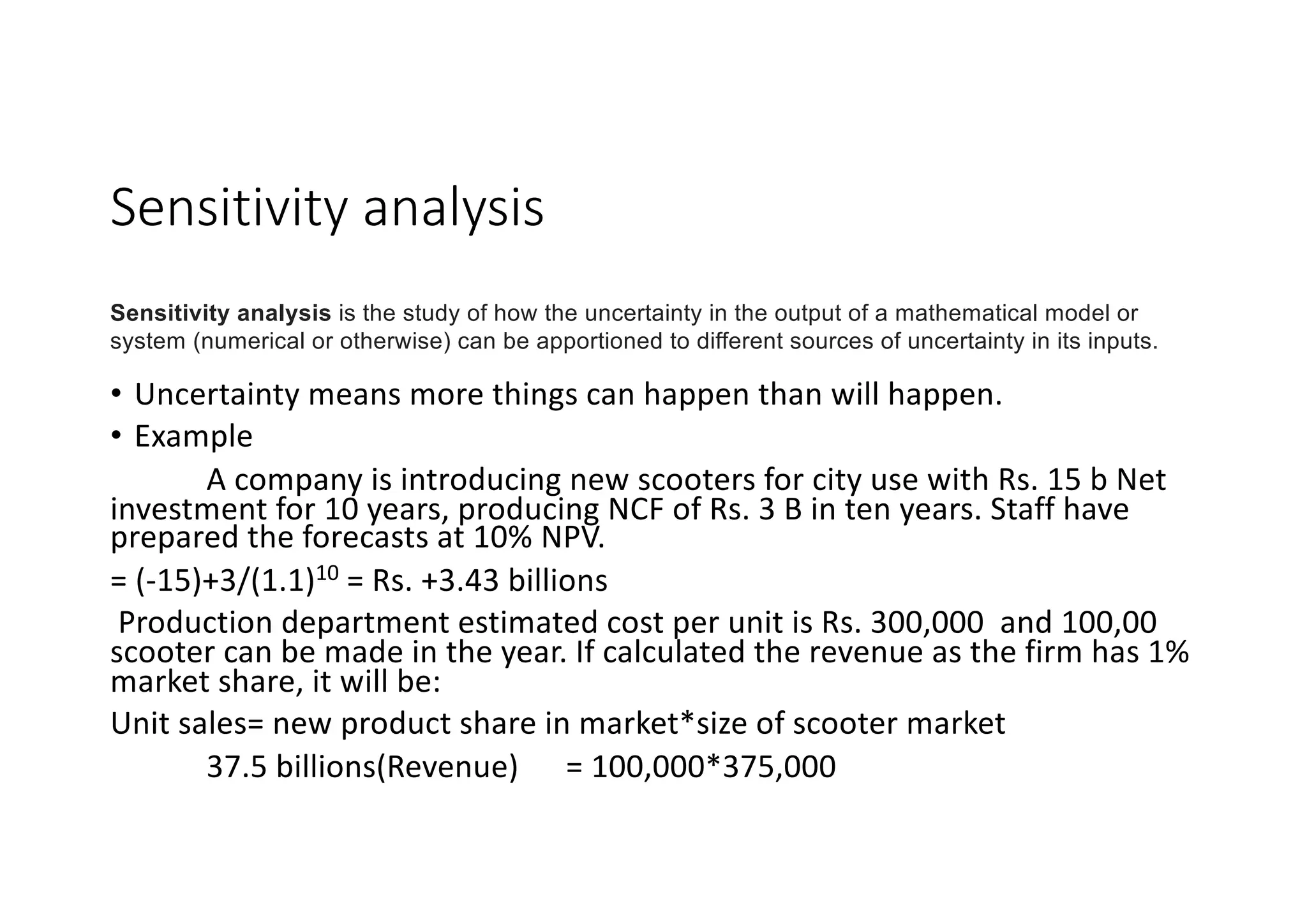
Sensitivity	analysis
• Uncertainty	means	more	things	can	happen	than	will	happen.
• Example
A	company	is	introducing	new	scooters	for	city	use	with	Rs.	15	b	Net	
investment	for	10	years,	producing	NCF	of	Rs.	3	B	in	ten	years.	Staff	have	
prepared	the	forecasts	at	10%	NPV.
= (-15)+3/(1.1)10 =	Rs.	+3.43	billions
Production	department	estimated	cost	per	unit	is	Rs.	300,000		and	100,00	
scooter	can	be	made	in	the	year.	If	calculated	the	revenue	as	the	firm	has	1%	
market	share,	it	will	be:
Unit	sales=	new	product	share	in	market*size	of	scooter	market
37.5	billions(Revenue)						=	100,000*375,000
Sensitivity analysis is the study of how the uncertainty in the output of a mathematical model or
system (numerical or otherwise) can be apportioned to different sources of uncertainty in its inputs.
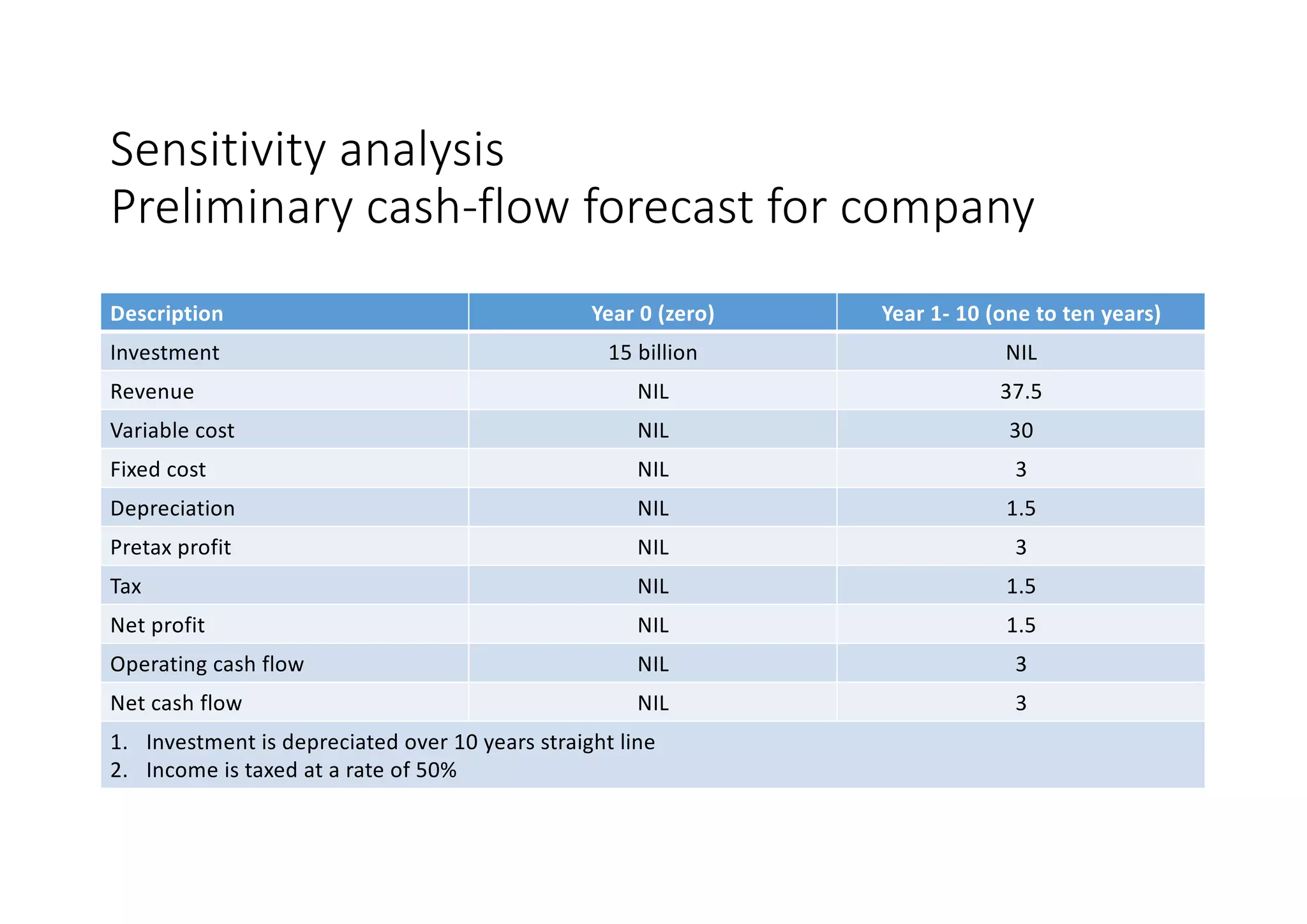
Sensitivity	analysis
Preliminary	cash-flow	forecast	for	company
Year	1- 10	(one	to	ten	years)Year	0	(zero)Description
NIL15	billionInvestment
37.5NILRevenue
30NILVariable	cost	
3NILFixed	cost
1.5NILDepreciation
3NILPretax	profit
1.5NILTax	
1.5NILNet	profit
3NILOperating	cash	flow
3NILNet	cash	flow
1. Investment	is	depreciated	over	10	years	straight	line
2. Income is	taxed	at	a	rate	of	50%
Sensitivity	analysis…
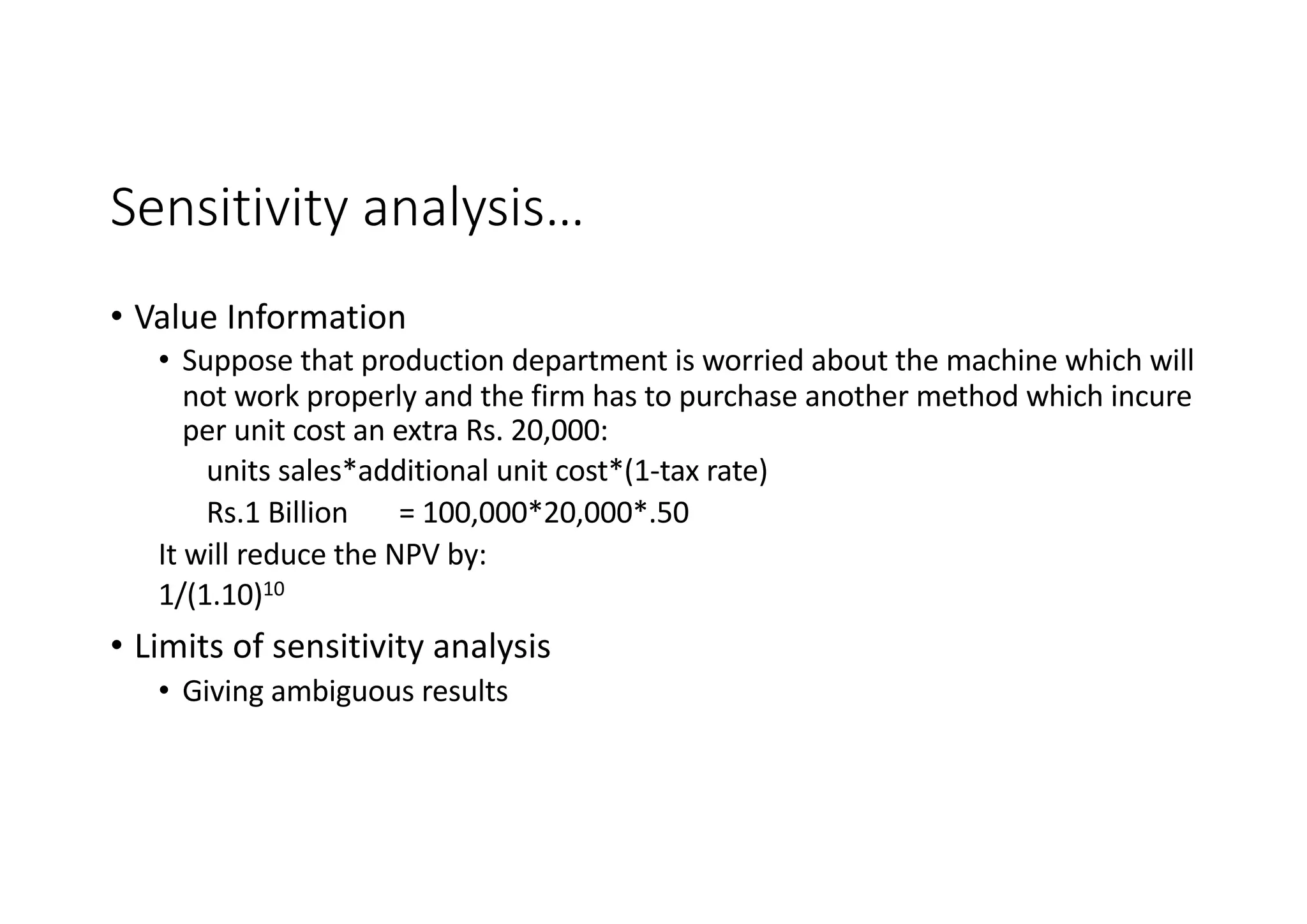
• Value	Information
• Suppose	that	production	department	is	worried	about	the	machine	which	will	
not	work	properly	and	the	firm	has	to	purchase	another	method	which	incure
per	unit	cost	an	extra	Rs.	20,000:
units	sales*additional	unit	cost*(1-tax	rate)
Rs.1	Billion =	100,000*20,000*.50
It	will	reduce	the	NPV	by:
1/(1.10)10
• Limits	of	sensitivity	analysis
• Giving	ambiguous	results
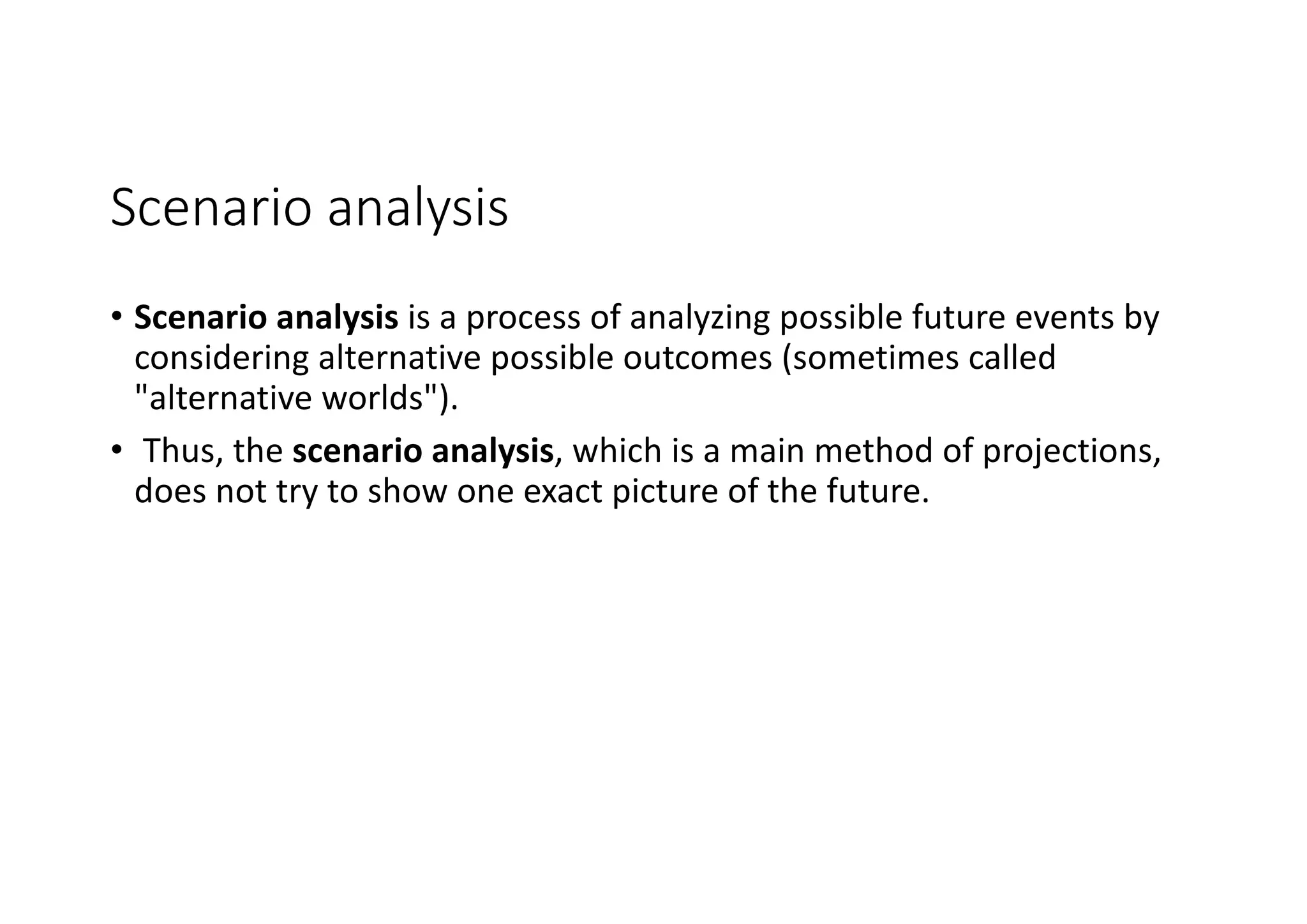
Scenario	analysis
• Scenario	analysis is	a	process	of	analyzing	possible	future	events	by	
considering	alternative	possible	outcomes	(sometimes	called	
"alternative	worlds").
• Thus,	the scenario	analysis,	which	is	a	main	method	of	projections,	
does	not	try	to	show	one	exact	picture	of	the	future.
Net Present Value, IRR and Profitability Index

Net Present Value, IRR and Profitability Index