LINEAR PROGRAMING
OPERATIONS RESEARCH
BY- Anam Katmale……
MMS-I
Meaning & Definition
Linear programming is the two word phrase. It means
1. The word linear refer to any linear relationship among variables in a
model. It means that any change in one variable will result into a
proportional change in other variables.
2. Programming refers to any problem that can be modelled and solved
mathematically.
According to William M Fox, “Linear programming is a planning technique
that permits some objective functions to be minimized or maximized within
the framework of given situational restrictions”.
Components of Linear Programming Problem
 Objective Function:
 It is linear function and can work either by maximization or
minimization process. It includes all possible components of a
problem to optimize the solution.
Decision Variables:
 The variables that help to decide the outcome are called ‘Decision
Variables’ OR ‘Activity Variables’.
Constraints:
• Constraints are a part of every practical situation
• The mathematically program stated in a algebraic form will also
specify constraints.
Assumptions of Linear Programming Problem
Certainty:
 All the variables and parameters in an LP model should be assumed
to be constant or known.
 For the best optimal solution, parameters such a availability and
consumption of resource or the profit/cost contribution variable
should be assumed to be certainty.
 Divisibility:
 It is assumed that decision variables and resources have solution
values which are either whole number or mixed numbers .
 For eg machines,employees etc.
Assumptions of Linear Programming Problem conti…
Additive:
 This means that the function value is the sum of the contributions of
each term, i.e., when two or more activities are used , the total
product is equal to the sum of the individual products where there
is no interaction effect between the activities.
Linearity:
 Liner programming requires linearity in the equations, i.e., the
relationship in both objective function and constraints must be
linear.
Advantages of Linear Programming Problem
Improve
Quality
Decision
Cost- Benefit
Analysis
Flexibility
Number of
Possible
Solutions
Use of
Productivity
Factors
Scientific
Approach
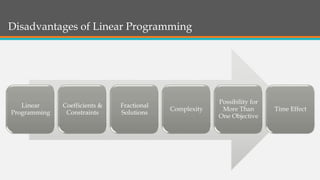
Disadvantages of Linear Programming
Linear
Programming
Coefficients &
Constraints
Fractional
Solutions
Complexity
Possibility for
More Than
One Objective
Time Effect
Linear programing

Linear programing

  • 1.
  • 2.
    Meaning & Definition Linearprogramming is the two word phrase. It means 1. The word linear refer to any linear relationship among variables in a model. It means that any change in one variable will result into a proportional change in other variables. 2. Programming refers to any problem that can be modelled and solved mathematically. According to William M Fox, “Linear programming is a planning technique that permits some objective functions to be minimized or maximized within the framework of given situational restrictions”.
  • 3.
    Components of LinearProgramming Problem  Objective Function:  It is linear function and can work either by maximization or minimization process. It includes all possible components of a problem to optimize the solution. Decision Variables:  The variables that help to decide the outcome are called ‘Decision Variables’ OR ‘Activity Variables’. Constraints: • Constraints are a part of every practical situation • The mathematically program stated in a algebraic form will also specify constraints.
  • 4.
    Assumptions of LinearProgramming Problem Certainty:  All the variables and parameters in an LP model should be assumed to be constant or known.  For the best optimal solution, parameters such a availability and consumption of resource or the profit/cost contribution variable should be assumed to be certainty.  Divisibility:  It is assumed that decision variables and resources have solution values which are either whole number or mixed numbers .  For eg machines,employees etc.
  • 5.
    Assumptions of LinearProgramming Problem conti… Additive:  This means that the function value is the sum of the contributions of each term, i.e., when two or more activities are used , the total product is equal to the sum of the individual products where there is no interaction effect between the activities. Linearity:  Liner programming requires linearity in the equations, i.e., the relationship in both objective function and constraints must be linear.
  • 6.
    Advantages of LinearProgramming Problem Improve Quality Decision Cost- Benefit Analysis Flexibility Number of Possible Solutions Use of Productivity Factors Scientific Approach
  • 7.
    Disadvantages of LinearProgramming Linear Programming Coefficients & Constraints Fractional Solutions Complexity Possibility for More Than One Objective Time Effect