Decision Making   Decision making is the selection of a course of action from among alternatives.
Decision Making Process  A set of steps that include identifying a problem, selecting an alternative and evaluating the decisions effectiveness.
Pervasiveness of Decision Making  Decision making is the corner stone of entire managing ambit. Planning: What one the organizations long-tern objectives. What strategies will best these objectives. Organizing: How many  people are required to do a particular job.  How should jobs be designed. Leading : How do I handle employees who appear to be low in motions. How will a specific change affect worker productivity. Controlling: What activities in an organization need to be controlled. How these activities be controlled.
Problem  A problem is a discrepancy between an existing and a desired state of affairs.
Types of Problems  Well – structured Straight forward problems, easy to define and to make decisions. Ill –structured  New or unusual problems, information incomplete or ambiguous, not easy to define and make decisions. Crisis A crisis problem is a serious difficulty requiring immediate action. Non-crisis It is a problem that requires resolution but does not have the importance and urgency of a crisis. Opportunity An opportunity is a situation that offers strong potential for significant organizational gain if appropriate actions are taken in time.
Decision criteria  Criteria that define what is relevant in a decision.
Implementation  Conveying a decision to those affected and getting their commitment to it.
Scope of Decision It is the part of organization that a decision will affect. (The broader the scope of a decision the higher is the level of manager responsible for making that decision.)
Types of  decisions Programmed Decision Program decisions are decisions that are routine and repetitive and that typically require specific handling methods. Habits SOPs, Rules of thumb Clerical routine work
Non- Programmed Decisions These are typically one-shot decisions that are usually less structured Judgment Intuition Creativity
Decision making environment  Certainty Risk Uncertainty Ambiguity
Certainty All the information the decision maker needs is fully available
Risk A decision has clear out objectives, and good information is available, but future outcomes associated with each alternative are subject to chance
Uncertainty  Managers know what objective they wish to achieve, but information about alternatives and future events is incomplete.
Ambiguity The objective to be achieved or the problem to be solved are unclear, alternatives are difficult to define, and information about outcomes is unavailable.
Models Of Decision Marking  Classical  model Normative  model
Classical Model  This model is made on the assumption that managers should make logical decisions that will be in organization`s best economic interests.
Normative Model  This model defines how a decision –maker should make decisions and provides guidelines for reaching an ideal outcome for the organization.
The Decision Making Process Step 1.  Identifying a Problem Step 2.  Identifying decision criteria Step 3.  Developing alternatives Step 4.  Analyzing alternatives Step 5.  Selecting an alternative Step 6.  Evaluating decision effectiveness
Decision  making Types Of Managers Problem Avoider Ignores information that points to a problem. Inactive Does not want to confront problem Problem Solver Tries  to solve the problems when they come up. Reactive to problems after they occur. Firefighters. Problem Seekers Actively seek out problems to solve. Pursue new opportunities, pro-active. Anticipate problems before they occur.
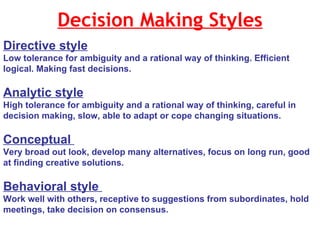
Decision Making Styles Directive style Low tolerance for ambiguity and a rational way of thinking. Efficient logical. Making fast decisions. Analytic style High tolerance for ambiguity and a rational way of thinking, careful in decision making, slow, able to adapt or cope changing situations. Conceptual  Very broad out look, develop many alternatives, focus on long run, good at finding creative solutions.  Behavioral style  Work well with others, receptive to suggestions from subordinates, hold meetings, take decision on consensus.
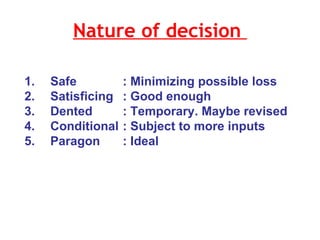
Nature of decision  1.  Safe  : Minimizing possible loss 2. Satisficing : Good enough 3. Dented : Temporary. Maybe revised 4. Conditional : Subject to more inputs  5. Paragon : Ideal
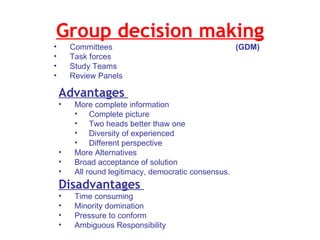
Group decision making  Committees    (GDM) Task forces  Study Teams  Review Panels  Advantages  More complete information  Complete picture  Two heads better thaw one  Diversity of experienced  Different perspective  More Alternatives  Broad acceptance of solution  All round legitimacy, democratic consensus.  Disadvantages  Time consuming  Minority domination  Pressure to conform  Ambiguous Responsibility
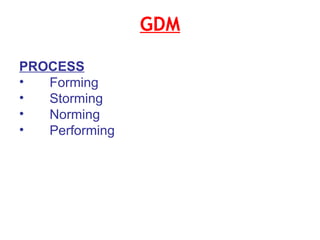
GDM PROCESS Forming Storming Norming Performing
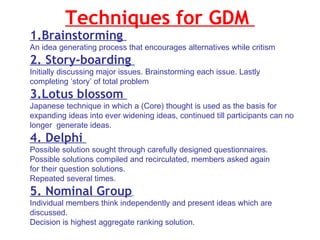
Techniques for GDM  1.Brainstorming  An idea generating process that encourages alternatives while critism  2. Story-boarding  Initially discussing major issues. Brainstorming each issue. Lastly completing ‘story’ of total problem  3.Lotus blossom  Japanese technique in which a (Core) thought is used as the basis for expanding ideas into ever widening ideas, continued till participants can no longer  generate ideas.  4. Delphi  Possible solution sought through carefully designed questionnaires. Possible solutions compiled and recirculated, members asked again  for their question solutions. Repeated several times. 5. Nominal Group   Individual members think independently and present ideas which are discussed. Decision is highest aggregate ranking solution.

Pom 4

  • 1.
    Decision Making Decision making is the selection of a course of action from among alternatives.
  • 2.
    Decision Making Process A set of steps that include identifying a problem, selecting an alternative and evaluating the decisions effectiveness.
  • 3.
    Pervasiveness of DecisionMaking Decision making is the corner stone of entire managing ambit. Planning: What one the organizations long-tern objectives. What strategies will best these objectives. Organizing: How many people are required to do a particular job. How should jobs be designed. Leading : How do I handle employees who appear to be low in motions. How will a specific change affect worker productivity. Controlling: What activities in an organization need to be controlled. How these activities be controlled.
  • 4.
    Problem Aproblem is a discrepancy between an existing and a desired state of affairs.
  • 5.
    Types of Problems Well – structured Straight forward problems, easy to define and to make decisions. Ill –structured New or unusual problems, information incomplete or ambiguous, not easy to define and make decisions. Crisis A crisis problem is a serious difficulty requiring immediate action. Non-crisis It is a problem that requires resolution but does not have the importance and urgency of a crisis. Opportunity An opportunity is a situation that offers strong potential for significant organizational gain if appropriate actions are taken in time.
  • 6.
    Decision criteria Criteria that define what is relevant in a decision.
  • 7.
    Implementation Conveyinga decision to those affected and getting their commitment to it.
  • 8.
    Scope of DecisionIt is the part of organization that a decision will affect. (The broader the scope of a decision the higher is the level of manager responsible for making that decision.)
  • 9.
    Types of decisions Programmed Decision Program decisions are decisions that are routine and repetitive and that typically require specific handling methods. Habits SOPs, Rules of thumb Clerical routine work
  • 10.
    Non- Programmed DecisionsThese are typically one-shot decisions that are usually less structured Judgment Intuition Creativity
  • 11.
    Decision making environment Certainty Risk Uncertainty Ambiguity
  • 12.
    Certainty All theinformation the decision maker needs is fully available
  • 13.
    Risk A decisionhas clear out objectives, and good information is available, but future outcomes associated with each alternative are subject to chance
  • 14.
    Uncertainty Managersknow what objective they wish to achieve, but information about alternatives and future events is incomplete.
  • 15.
    Ambiguity The objectiveto be achieved or the problem to be solved are unclear, alternatives are difficult to define, and information about outcomes is unavailable.
  • 16.
    Models Of DecisionMarking Classical model Normative model
  • 17.
    Classical Model This model is made on the assumption that managers should make logical decisions that will be in organization`s best economic interests.
  • 18.
    Normative Model This model defines how a decision –maker should make decisions and provides guidelines for reaching an ideal outcome for the organization.
  • 19.
    The Decision MakingProcess Step 1. Identifying a Problem Step 2. Identifying decision criteria Step 3. Developing alternatives Step 4. Analyzing alternatives Step 5. Selecting an alternative Step 6. Evaluating decision effectiveness
  • 20.
    Decision makingTypes Of Managers Problem Avoider Ignores information that points to a problem. Inactive Does not want to confront problem Problem Solver Tries to solve the problems when they come up. Reactive to problems after they occur. Firefighters. Problem Seekers Actively seek out problems to solve. Pursue new opportunities, pro-active. Anticipate problems before they occur.
  • 21.
    Decision Making StylesDirective style Low tolerance for ambiguity and a rational way of thinking. Efficient logical. Making fast decisions. Analytic style High tolerance for ambiguity and a rational way of thinking, careful in decision making, slow, able to adapt or cope changing situations. Conceptual Very broad out look, develop many alternatives, focus on long run, good at finding creative solutions. Behavioral style Work well with others, receptive to suggestions from subordinates, hold meetings, take decision on consensus.
  • 22.
    Nature of decision 1. Safe : Minimizing possible loss 2. Satisficing : Good enough 3. Dented : Temporary. Maybe revised 4. Conditional : Subject to more inputs 5. Paragon : Ideal
  • 23.
    Group decision making Committees (GDM) Task forces Study Teams Review Panels Advantages More complete information Complete picture Two heads better thaw one Diversity of experienced Different perspective More Alternatives Broad acceptance of solution All round legitimacy, democratic consensus. Disadvantages Time consuming Minority domination Pressure to conform Ambiguous Responsibility
  • 24.
    GDM PROCESS FormingStorming Norming Performing
  • 25.
    Techniques for GDM 1.Brainstorming An idea generating process that encourages alternatives while critism 2. Story-boarding Initially discussing major issues. Brainstorming each issue. Lastly completing ‘story’ of total problem 3.Lotus blossom Japanese technique in which a (Core) thought is used as the basis for expanding ideas into ever widening ideas, continued till participants can no longer generate ideas. 4. Delphi Possible solution sought through carefully designed questionnaires. Possible solutions compiled and recirculated, members asked again for their question solutions. Repeated several times. 5. Nominal Group Individual members think independently and present ideas which are discussed. Decision is highest aggregate ranking solution.