COMPUTER SYSTEM SERVICING NCII
ETHERNET CABLING SYSTEM
LEARNING COMPETENCIES
After this module the learners will be able to . . .
○ Enumerate and discuss the tools and equipment use in computer
networking.
○ Discuss the color scheme of T568A and T568B standardization of
network cablingsystem.
RJ45
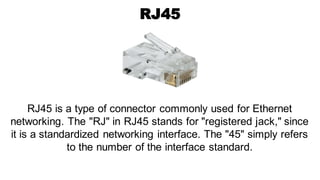
RJ45 is a type of connector commonly used for Ethernet
networking. The "RJ" in RJ45 stands for "registered jack," since
it is a standardized networking interface. The "45" simply refers
to the number of the interface standard.
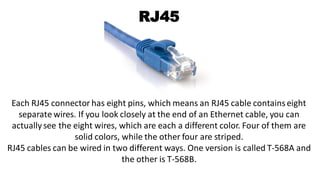
RJ45
Each RJ45 connector has eight pins, which means an RJ45 cable containseight
separate wires. If you look closely at the end of an Ethernet cable, you can
actuallysee the eight wires, which are each a different color. Four of them are
solid colors, while the other four are striped.
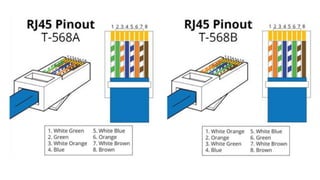
RJ45 cables can be wired in two different ways. One version is called T-568A and
the other is T-568B.
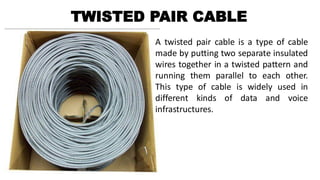
TWISTED PAIR CABLE
A twisted pair cable is a type of cable
made by putting two separate insulated
wires together in a twisted pattern and
running them parallel to each other.
This type of cable is widely used in
different kinds of data and voice
infrastructures.
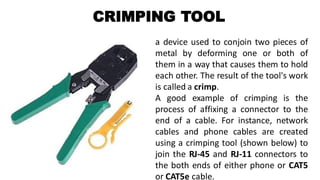
CRIMPING TOOL
a device used to conjoin two pieces of
metal by deforming one or both of
them in a way that causes them to hold
each other. The result of the tool's work
is called a crimp.
A good example of crimping is the
process of affixing a connector to the
end of a cable. For instance, network
cables and phone cables are created
using a crimping tool (shown below) to
join the RJ-45 and RJ-11 connectors to
the both ends of either phone or CAT5
or CAT5e cable.
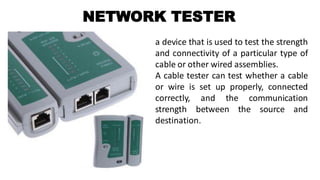
NETWORK TESTER
a device that is used to test the strength
and connectivity of a particular type of
cable or other wired assemblies.
A cable tester can test whether a cable
or wire is set up properly, connected
correctly, and the communication
strength between the source and
destination.
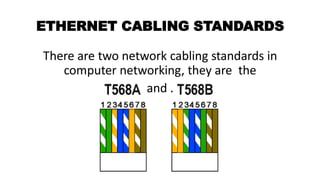
ETHERNET CABLING STANDARDS
There are two network cabling standards in
computer networking, they are the
and .
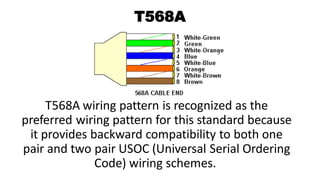
T568A
T568A wiring pattern is recognized as the
preferred wiring pattern for this standard because
it provides backward compatibility to both one
pair and two pair USOC (Universal Serial Ordering
Code) wiring schemes.
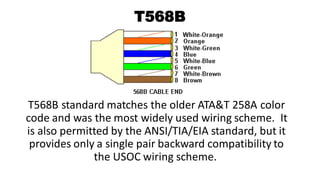
T568B
T568B standard matches the older ATA&T 258A color
code and was the most widely used wiring scheme. It
is also permitted by the ANSI/TIA/EIA standard, but it
provides only a single pair backward compatibility to
the USOC wiring scheme.
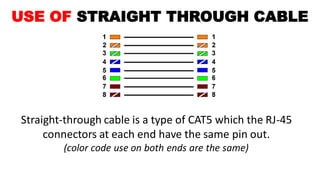
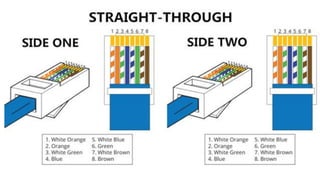
USE OF STRAIGHT THROUGH CABLE
Straight-through cable is a type of CAT5 which the RJ-45
connectors at each end have the same pin out.
(color code use on both ends are the same)
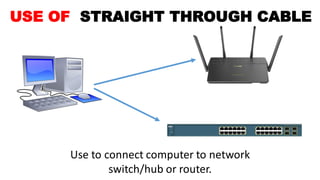
USE OF STRAIGHT THROUGH CABLE
Use to connect computer to network
switch/hub or router.
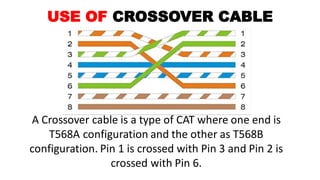
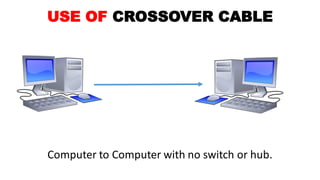
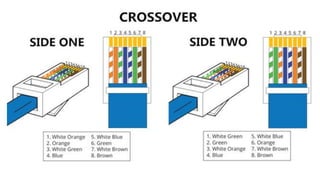
USE OF CROSSOVER CABLE
A Crossover cable is a type of CAT where one end is
T568A configuration and the other as T568B
configuration. Pin 1 is crossed with Pin 3 and Pin 2 is
crossed with Pin 6.
USE OF CROSSOVER CABLE
Computer to Computer with no switch or hub.
USE OF CROSSOVER CABLE
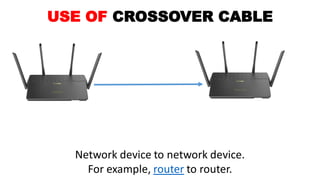
Network device to network device.
For example, router to router.
QUESTION:
I was wondering what standard should I use 568a or 568b?
And if I have already made all my ends up with 568A and LC&D
documentations require 568b can I use a cross over cable?
ANSWER:
We recommend that you use 568B and a crossover cable is not needed.
Our system requires a “Straight-Through” cable, so either standard can
be used. You can even have a mixed cables, some cables as 568A and
some as 568B as long as all of them are “Straight-Through” cables.
However, it’s advised not to mix different color schemes because this
may cause confusion.
CONCLUSION
Straight through and crossover cables are wired differently from each
other. One easy way to tell what you have is to look at the order of the
colored wires inside the RJ45 connector. If the order of the wires is the
same on both ends, then you have a straight through cable. If not, then
it’s most likely a crossover cable or was wired wrong. At present, the
straight through cable is much more popular than crossover cable and
is widely used by people.
https://www.techopedia.com
https://www.webopedia.com
https://www.computerhope.com
Resources

CSS L14 - ETHERNET CABLING

  • 1.
    COMPUTER SYSTEM SERVICINGNCII ETHERNET CABLING SYSTEM
  • 2.
    LEARNING COMPETENCIES After thismodule the learners will be able to . . . ○ Enumerate and discuss the tools and equipment use in computer networking. ○ Discuss the color scheme of T568A and T568B standardization of network cablingsystem.
  • 4.
    RJ45 RJ45 is atype of connector commonly used for Ethernet networking. The "RJ" in RJ45 stands for "registered jack," since it is a standardized networking interface. The "45" simply refers to the number of the interface standard.
  • 5.
    RJ45 Each RJ45 connectorhas eight pins, which means an RJ45 cable containseight separate wires. If you look closely at the end of an Ethernet cable, you can actuallysee the eight wires, which are each a different color. Four of them are solid colors, while the other four are striped. RJ45 cables can be wired in two different ways. One version is called T-568A and the other is T-568B.
  • 6.
    TWISTED PAIR CABLE Atwisted pair cable is a type of cable made by putting two separate insulated wires together in a twisted pattern and running them parallel to each other. This type of cable is widely used in different kinds of data and voice infrastructures.
  • 7.
    CRIMPING TOOL a deviceused to conjoin two pieces of metal by deforming one or both of them in a way that causes them to hold each other. The result of the tool's work is called a crimp. A good example of crimping is the process of affixing a connector to the end of a cable. For instance, network cables and phone cables are created using a crimping tool (shown below) to join the RJ-45 and RJ-11 connectors to the both ends of either phone or CAT5 or CAT5e cable.
  • 8.
    NETWORK TESTER a devicethat is used to test the strength and connectivity of a particular type of cable or other wired assemblies. A cable tester can test whether a cable or wire is set up properly, connected correctly, and the communication strength between the source and destination.
  • 10.
    ETHERNET CABLING STANDARDS Thereare two network cabling standards in computer networking, they are the and .
  • 11.
    T568A T568A wiring patternis recognized as the preferred wiring pattern for this standard because it provides backward compatibility to both one pair and two pair USOC (Universal Serial Ordering Code) wiring schemes.
  • 12.
    T568B T568B standard matchesthe older ATA&T 258A color code and was the most widely used wiring scheme. It is also permitted by the ANSI/TIA/EIA standard, but it provides only a single pair backward compatibility to the USOC wiring scheme.
  • 14.
    USE OF STRAIGHTTHROUGH CABLE Straight-through cable is a type of CAT5 which the RJ-45 connectors at each end have the same pin out. (color code use on both ends are the same)
  • 15.
    USE OF STRAIGHTTHROUGH CABLE Use to connect computer to network switch/hub or router.
  • 16.
    USE OF CROSSOVERCABLE A Crossover cable is a type of CAT where one end is T568A configuration and the other as T568B configuration. Pin 1 is crossed with Pin 3 and Pin 2 is crossed with Pin 6.
  • 17.
    USE OF CROSSOVERCABLE Computer to Computer with no switch or hub.
  • 18.
    USE OF CROSSOVERCABLE Network device to network device. For example, router to router.
  • 19.
    QUESTION: I was wonderingwhat standard should I use 568a or 568b? And if I have already made all my ends up with 568A and LC&D documentations require 568b can I use a cross over cable?
  • 20.
    ANSWER: We recommend thatyou use 568B and a crossover cable is not needed. Our system requires a “Straight-Through” cable, so either standard can be used. You can even have a mixed cables, some cables as 568A and some as 568B as long as all of them are “Straight-Through” cables. However, it’s advised not to mix different color schemes because this may cause confusion.
  • 21.
    CONCLUSION Straight through andcrossover cables are wired differently from each other. One easy way to tell what you have is to look at the order of the colored wires inside the RJ45 connector. If the order of the wires is the same on both ends, then you have a straight through cable. If not, then it’s most likely a crossover cable or was wired wrong. At present, the straight through cable is much more popular than crossover cable and is widely used by people.
  • 28.