By
Dr Khaled Saleh
1. To study the importance of creatine in
muscle as a storage form of energy
2. To understand the biosynthesis of creatine
3. To study the process of creatine
degradation and formation of creatinine as
an end product
4. To understand the clinical importance of
creatinine as a sensitive indicator of kidney
function
5. To study different types of creatine kinase
(CK) and their clinical importance
Objectives
What’s Creatine and Creatinine
• Creatine and creatinine are not the same
substance!
• Creatine is found in the muscles…….
• Creatinine is a break-down product (a
waste product) of creatine phosphate and
creatine in muscles, and is usually
produced at a fairly constant rate by the
body depending on muscle mass).
1. The creatine is an amino
acid that does not found in
proteins.
2. Creatine is a nitrogenous
organic acid
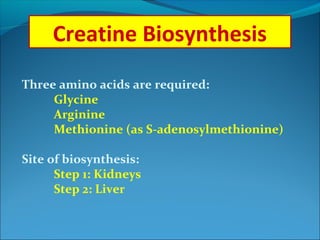
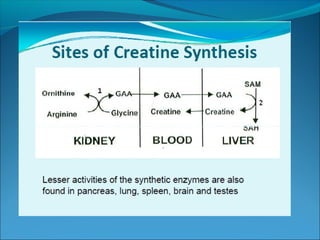
Three amino acids are required:
Glycine
Arginine
Methionine (as S-adenosylmethionine)
Site of biosynthesis:
Step 1: Kidneys
Step 2: Liver
Creatine Biosynthesis
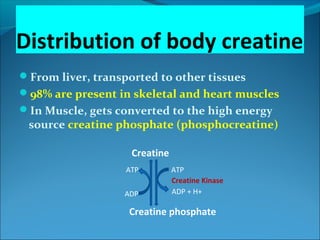
Distribution of body creatine
From liver, transported to other tissues
98% are present in skeletal and heart muscles
In Muscle, gets converted to the high energy
source creatine phosphate (phosphocreatine)
Creatine
Creatine phosphate
ATP
ADP + H+
ATP
ADP
Creatine Kinase
What’s the Relationship between Creatine
and Creatinephosphate?
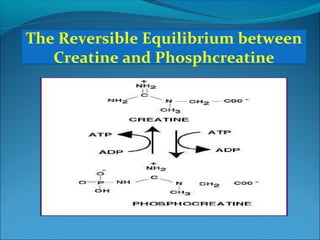
Creatine and creatine phosphate exist in a
reversible equilibrium in skeletal muscle.
In skeletal muscle, approximately one-fourth of
creatine exists as free creatine and threefourth
exists as creatine phosphate.
The Reversible Equilibrium between
Creatine and Phosphcreatine
Creatine Phosphate
Is a high-energy phosphate compound
Acts as a storage form of energy in the muscle
Provides a small but, ready source of energy
during first few minutes of intense muscular
contraction
The amount of creatine phosphate in the body is
proportional to the muscle mass
1. Creatine and creatine phosphate spontaneously
form creatinine as an end product
2. Creatinine is excreted in the urine
3. Serum creatinine is a sensitive indicator of
kidney disease (Kidney function test)
4. Serum creatinine increases with the impairment
of kidney function
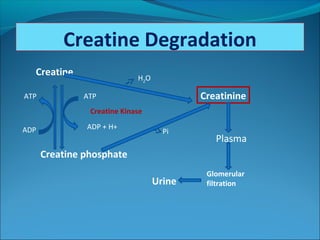
Creatine Degradation
Creatine
Creatine phosphate
ATP
ADP + H+
ATP
ADP
Creatine Kinase
Creatinine
H2O
Pi
Plasma
Glomerular
filtrationUrine
What is the Fate of Creatinine that was Produced
from Break Down of Creatine Phosphate during
Anaerobic Exercise..?
CREATININE EXCRETION
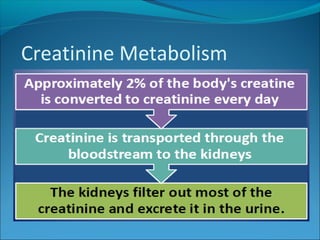
• The creatinine is a waste product of creatine
phosphate and it will be excreted by the kidney in the
urine at a rate of 1 to 2 g/day.
Creatinine Metabolism
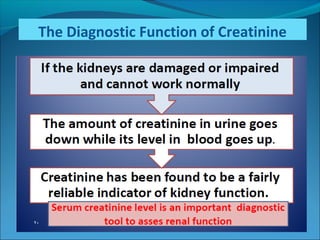
The Diagnostic Function of Creatinine
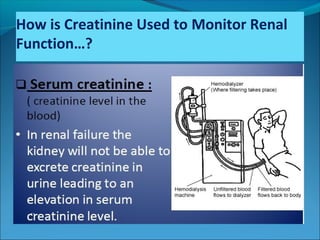
How is Creatinine Used to Monitor Renal
Function…?
Levels of Creatinine in the Blood
Depends Mainly on Renal
Function….but…
Is there other factors may affect
creatinine level in the blood…?
Serum Creatinine may be Affected
Partly by….
The amount of muscle tissue you have. Men tend to
have higher levels of blood creatinine because they
have more skeletal muscle tissues than women.
Protein in diet . Vegetarians have been shown to have
lower creatinine levels in blood.
Creatine Kinase (CK)
CK is responsible for the generation of energy in
contractile muscular tissues
CK levels are changed in disorders of cardiac and
skeletal muscle
Creatine
Creatine phosphate
ATP
ADP + H+
ATP
ADP
Creatine Kinase
1. CK is required for conversion of creatine into
creatine phosphate
2. CK has 3 isoenzymes:
CK-MM mainly in skeletal muscle
CK-MB mainly in heart muscle
CK-BB mainly in brain
3. Serum total CK is increased in:
Crush injuries (Damage of skeletal muscles)
Myocardial infarction (Damage of heart
muscle)
Creatine Kinase (CK)
What is the relation of CK activity in
the blood to tissue damage?
. Diagnostic Value: CK is present in all tissues but
only SELECTIVE RELEASE (brain, muscle but not
liver) therefore different from liver damage
caused by:MI, muscle trauma, muscle dystrophy,
severe exertion, IM injections, hypothyroidism,
chronic alcoholism (with myopathy
What is the purpose of assaying for CK over
a period of time?
Isozymes creatine kinase are tissue specific CK is a
dimer of MM, MB, BB isozymes, and only MB is present in
the myocardium (15% TOTAL CK)
MB-CK: myocardial specific injury
- 100% increase in MB-CK within 4 hr
- Peaks at 8-24 hr then decreases, with aminotranserase
change much slower  peak ~ 60 hrs , LDH is the best
indicator to follow the MI from third day(To maximize
treatment, prompt recognition essential)
- Usually [CK] cardium & % MB/total CK are constant,
[MB-CK↑] is proportional to degree injury to myo cardium
Creatinine in urine and plasma
Normal serum creatinine level is 0.7 to 1.4 mg/dl and
serum creatine level is 0.2 to 0.4mg/dl
The amount of creatinine excreted is proportional to the
total creatine phosphate content of the body
therefore can be used to estimate muscle mass
Serum creatinine is a sensitive indicator of kidney disease
(Kidney function test)
Because normally creatinine is rapidly removed from
the blood and excreted
The amount of creatinine in urine is used as an indicator
for the proper collection of 24 hours urine sample (normal
urinary output is 15-25 mg/kg/d)
Creatine metabolism

Creatine metabolism

  • 1.
  • 2.
    1. To studythe importance of creatine in muscle as a storage form of energy 2. To understand the biosynthesis of creatine 3. To study the process of creatine degradation and formation of creatinine as an end product 4. To understand the clinical importance of creatinine as a sensitive indicator of kidney function 5. To study different types of creatine kinase (CK) and their clinical importance Objectives
  • 3.
    What’s Creatine andCreatinine • Creatine and creatinine are not the same substance! • Creatine is found in the muscles……. • Creatinine is a break-down product (a waste product) of creatine phosphate and creatine in muscles, and is usually produced at a fairly constant rate by the body depending on muscle mass).
  • 4.
    1. The creatineis an amino acid that does not found in proteins. 2. Creatine is a nitrogenous organic acid
  • 5.
    Three amino acidsare required: Glycine Arginine Methionine (as S-adenosylmethionine) Site of biosynthesis: Step 1: Kidneys Step 2: Liver Creatine Biosynthesis
  • 8.
    Distribution of bodycreatine From liver, transported to other tissues 98% are present in skeletal and heart muscles In Muscle, gets converted to the high energy source creatine phosphate (phosphocreatine) Creatine Creatine phosphate ATP ADP + H+ ATP ADP Creatine Kinase
  • 9.
    What’s the Relationshipbetween Creatine and Creatinephosphate? Creatine and creatine phosphate exist in a reversible equilibrium in skeletal muscle. In skeletal muscle, approximately one-fourth of creatine exists as free creatine and threefourth exists as creatine phosphate.
  • 10.
    The Reversible Equilibriumbetween Creatine and Phosphcreatine
  • 11.
    Creatine Phosphate Is ahigh-energy phosphate compound Acts as a storage form of energy in the muscle Provides a small but, ready source of energy during first few minutes of intense muscular contraction The amount of creatine phosphate in the body is proportional to the muscle mass
  • 13.
    1. Creatine andcreatine phosphate spontaneously form creatinine as an end product 2. Creatinine is excreted in the urine 3. Serum creatinine is a sensitive indicator of kidney disease (Kidney function test) 4. Serum creatinine increases with the impairment of kidney function Creatine Degradation
  • 14.
    Creatine Degradation Creatine Creatine phosphate ATP ADP+ H+ ATP ADP Creatine Kinase Creatinine H2O Pi Plasma Glomerular filtrationUrine
  • 15.
    What is theFate of Creatinine that was Produced from Break Down of Creatine Phosphate during Anaerobic Exercise..? CREATININE EXCRETION • The creatinine is a waste product of creatine phosphate and it will be excreted by the kidney in the urine at a rate of 1 to 2 g/day.
  • 16.
  • 17.
  • 18.
    How is CreatinineUsed to Monitor Renal Function…?
  • 19.
    Levels of Creatininein the Blood Depends Mainly on Renal Function….but… Is there other factors may affect creatinine level in the blood…?
  • 20.
    Serum Creatinine maybe Affected Partly by…. The amount of muscle tissue you have. Men tend to have higher levels of blood creatinine because they have more skeletal muscle tissues than women. Protein in diet . Vegetarians have been shown to have lower creatinine levels in blood.
  • 21.
    Creatine Kinase (CK) CKis responsible for the generation of energy in contractile muscular tissues CK levels are changed in disorders of cardiac and skeletal muscle Creatine Creatine phosphate ATP ADP + H+ ATP ADP Creatine Kinase
  • 22.
    1. CK isrequired for conversion of creatine into creatine phosphate 2. CK has 3 isoenzymes: CK-MM mainly in skeletal muscle CK-MB mainly in heart muscle CK-BB mainly in brain 3. Serum total CK is increased in: Crush injuries (Damage of skeletal muscles) Myocardial infarction (Damage of heart muscle) Creatine Kinase (CK)
  • 23.
    What is therelation of CK activity in the blood to tissue damage? . Diagnostic Value: CK is present in all tissues but only SELECTIVE RELEASE (brain, muscle but not liver) therefore different from liver damage caused by:MI, muscle trauma, muscle dystrophy, severe exertion, IM injections, hypothyroidism, chronic alcoholism (with myopathy
  • 24.
    What is thepurpose of assaying for CK over a period of time? Isozymes creatine kinase are tissue specific CK is a dimer of MM, MB, BB isozymes, and only MB is present in the myocardium (15% TOTAL CK) MB-CK: myocardial specific injury - 100% increase in MB-CK within 4 hr - Peaks at 8-24 hr then decreases, with aminotranserase change much slower  peak ~ 60 hrs , LDH is the best indicator to follow the MI from third day(To maximize treatment, prompt recognition essential) - Usually [CK] cardium & % MB/total CK are constant, [MB-CK↑] is proportional to degree injury to myo cardium
  • 25.
    Creatinine in urineand plasma Normal serum creatinine level is 0.7 to 1.4 mg/dl and serum creatine level is 0.2 to 0.4mg/dl The amount of creatinine excreted is proportional to the total creatine phosphate content of the body therefore can be used to estimate muscle mass Serum creatinine is a sensitive indicator of kidney disease (Kidney function test) Because normally creatinine is rapidly removed from the blood and excreted The amount of creatinine in urine is used as an indicator for the proper collection of 24 hours urine sample (normal urinary output is 15-25 mg/kg/d)