DIAGNOSIS
IMPORTANCE OF
CREATINE KINASE
• Introduction
• Isomers of creatine kinase
• Location of Enzyme
• Normal value
• When CK level is high in blood
• When CK level is low in blood
• Diagnostic importance of Creatine
phosphokinase
Introduction
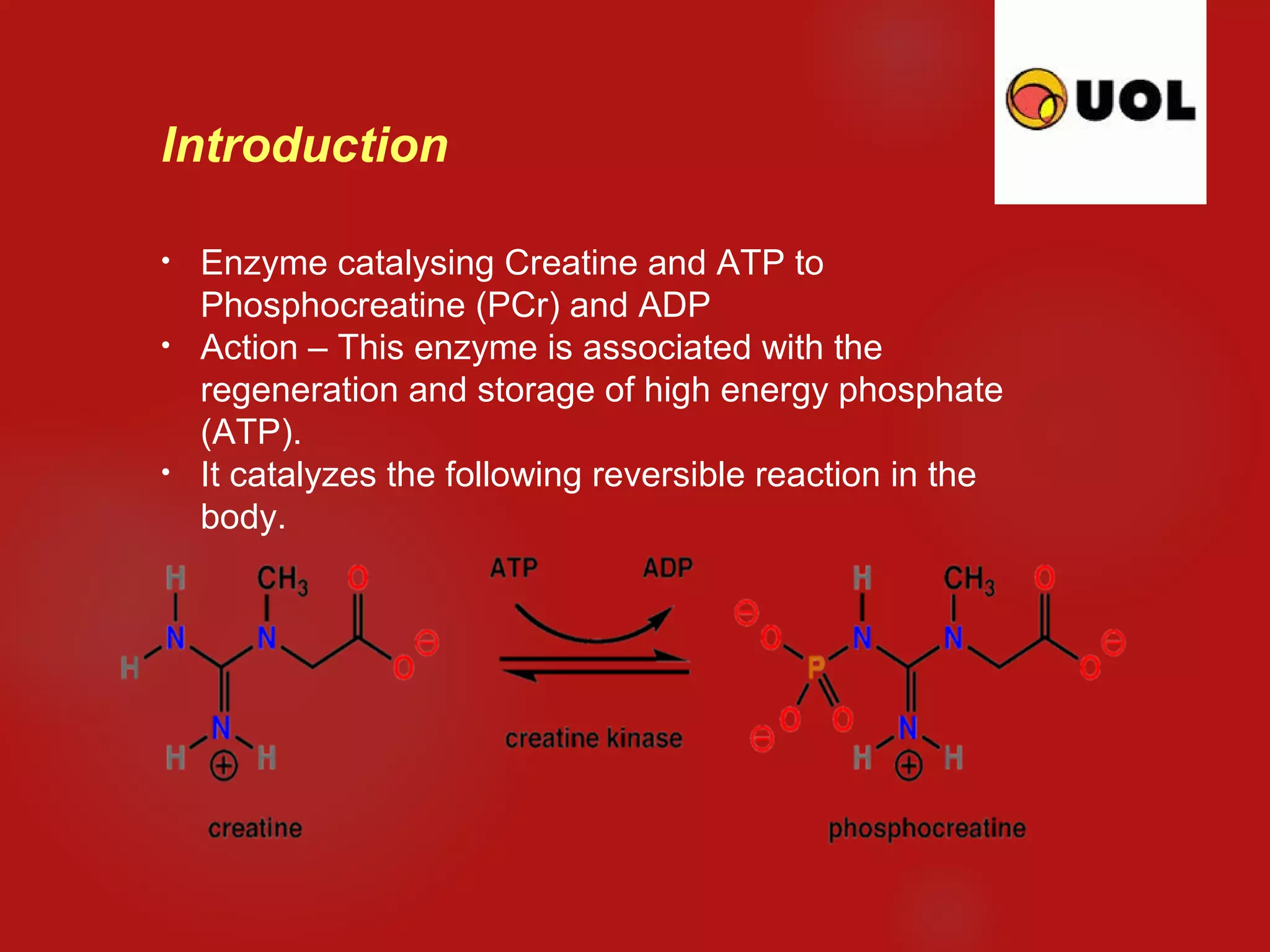
• Enzyme catalysing Creatine and ATP to
Phosphocreatine (PCr) and ADP
• Action – This enzyme is associated with the
regeneration and storage of high energy phosphate
(ATP).
• It catalyzes the following reversible reaction in the
body.
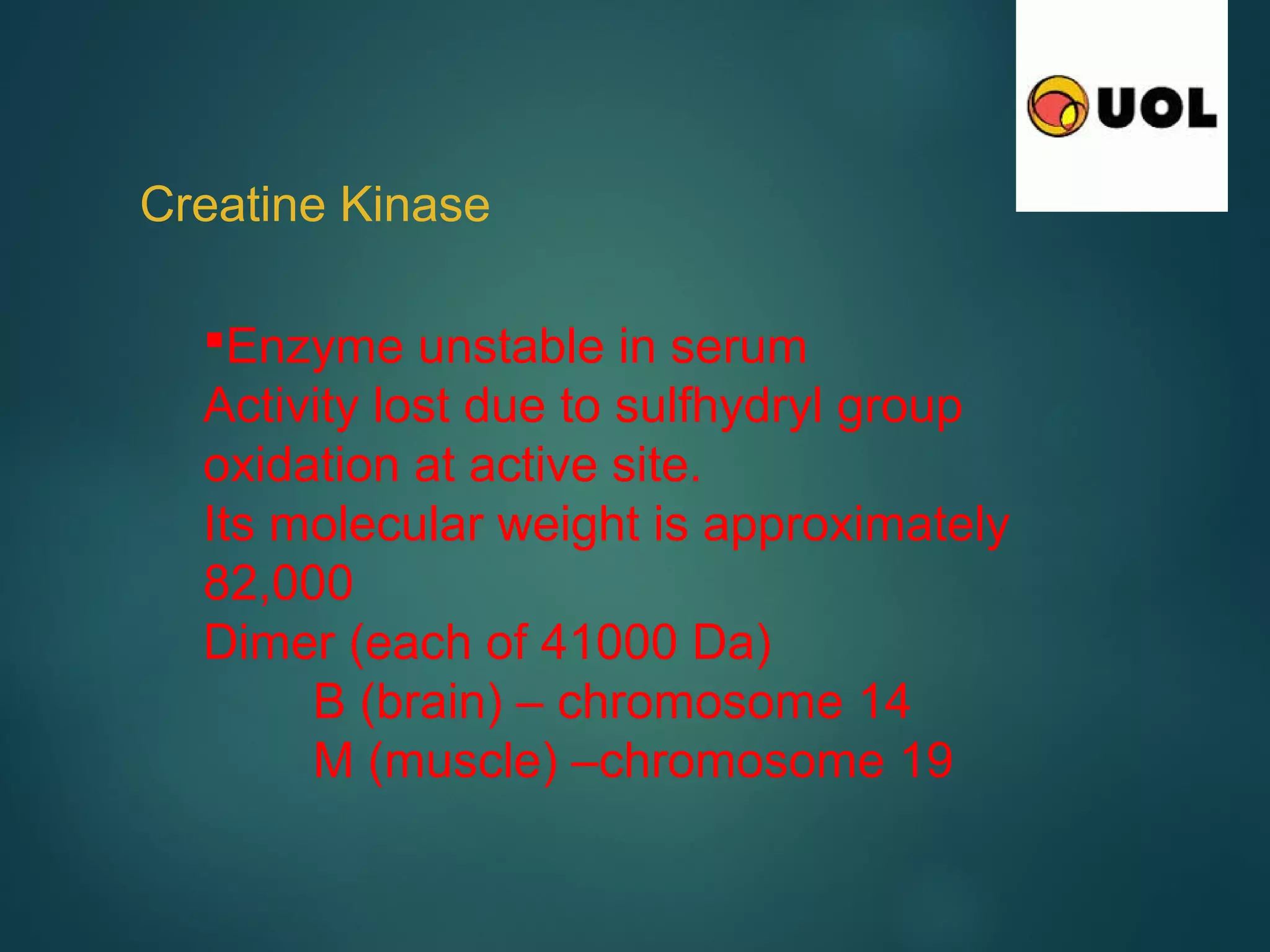
Enzyme unstable in serum
Activity lost due to sulfhydryl group
oxidation at active site.
Its molecular weight is approximately
82,000
Dimer (each of 41000 Da)
B (brain) – chromosome 14
M (muscle) –chromosome 19
Creatine Kinase
skeletal muscle
heart muscle
brain tissue.
Highest activities are found in
Smaller quantities are found in
kidney
the bladder
prostate
gastrointestinal tract
liver
pancreas
spleen
uterus
placenta
thyroid
lung
Indicators of Cardiac Injury
Creatine kinase (CK)
• creatine phosphokinase (CPK)
• catalyze transfer of a PO4 group between creatine
PO4 & ADP to form creatine + ATP
• requires magnesium as cofactor
• dimeric with pair of two different monomers  M & B
• 3 isozymes: CK1 (BB), CK2 (MB), CK3 (MM)
• M and B subunits antigenically distinct proteins
encoded by different genes
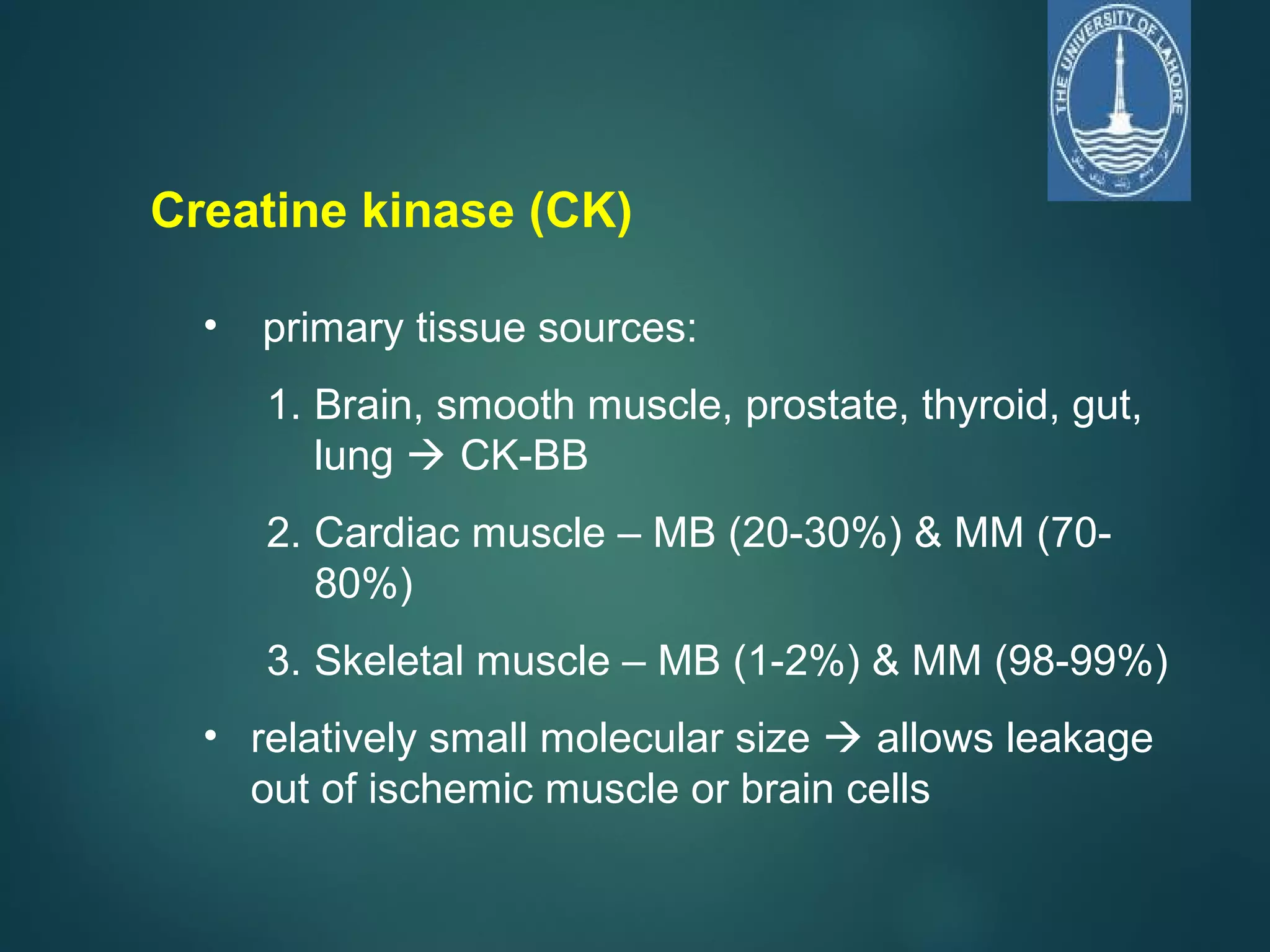
• primary tissue sources:
1. Brain, smooth muscle, prostate, thyroid, gut,
lung  CK-BB
2. Cardiac muscle – MB (20-30%) & MM (70-
80%)
3. Skeletal muscle – MB (1-2%) & MM (98-99%)
• relatively small molecular size  allows leakage
out of ischemic muscle or brain cells
Creatine kinase (CK)
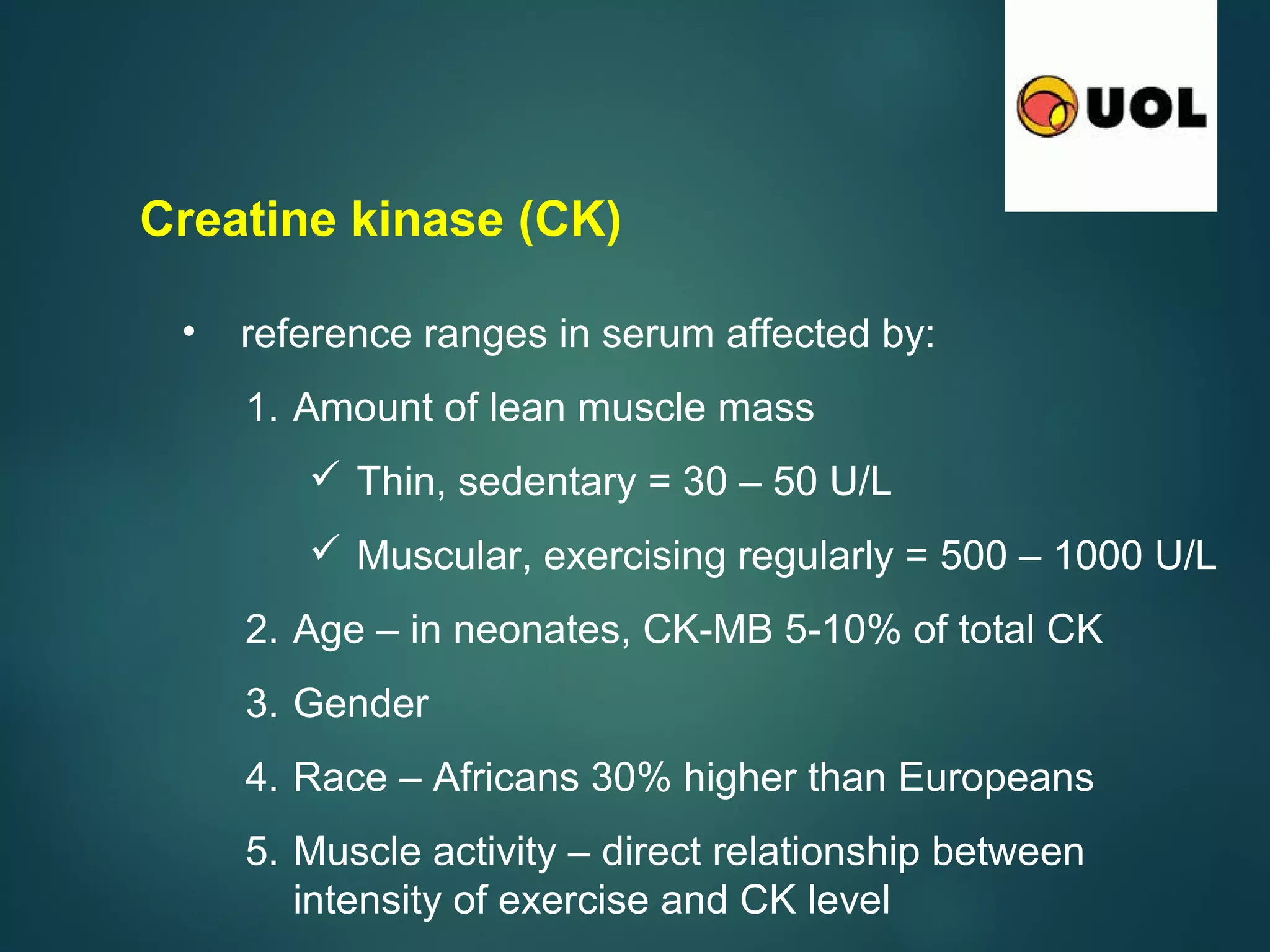
• reference ranges in serum affected by:
1. Amount of lean muscle mass
 Thin, sedentary = 30 – 50 U/L
 Muscular, exercising regularly = 500 – 1000 U/L
2. Age – in neonates, CK-MB 5-10% of total CK
3. Gender
4. Race – Africans 30% higher than Europeans
5. Muscle activity – direct relationship between
intensity of exercise and CK level
Creatine kinase (CK)
• persons exercising periodically & at usual
intensity levels with lower CK than those who do
not exercise at all
• decrease with severe inactivity
• short-term strenuous exercise  10-100 fold
increase
• marathon runners  up to 2000 U/L as resting
value
Creatine kinase (CK)
CK-MM, which is found in your skeletal muscle and heart.
CK-MB, which is found in the heart and rises when heart
muscle is damaged.
CK-BB, which is found mostly in your brain
The three types of CK are called isoenzymes.
• released from damaged muscles: CK, AST, LD,
myoglobin
 Myoglobin >> CK >> AST and LD
• released during ischemia, injury or inflammation
• also increased in:
1. Chronic myopathies
2. Chronic renal failure
3. Acute respiratory exertion – respiratory muscles
with more CK than other muscles
Diagnostic Applications
CM-MM
• Brain trauma or brain surgery
1. Injury to smooth muscles (e.g. intestinal
ischemia)
2. Transient increase after cardiac arrest 
reflect cerebral ischemia
CK-BB
Diagnostic Applications
• primary clinical use: detection of acute MI
 Following MI:
 Total CK – 98% sensitive but 68-85% specific; peak value
18-30 hrs; duration 2-5 days; level 5-10x normal
 CK-MB – rise proportional to extent of infarction; appears in
serum within 6 hrs after AMI; peak value 12-24 hrs; duration
1.5-3 days  persistence indicates extension or infarction or
re-infarctionPost AMI CK-MB
 CK-MB increases 4 – 8 hours post AMI
 Peaks at 12 - 24 hours post AMI
 Returns to normal 48 - 72 hours
CK-MB
Diagnostic Applications
Normal: 24 – 170 U/L (women) 24 – 195 U/L (men)
• Marked elevation (> 5x normal)
1. After trauma from electrocution, crush injury,
convulsion, tetany, surgical incision or IM injection
2. Athletic individuals – inc. muscle mass & inc.
release during strenuous activity
3. Muscular dystrophies
4. Chronic inflammation of muscle (dermatomyositis
or polymyositis)
Total Serum CK
Diagnostic Applications
55 to 170 units/L for men
30 to 135 units/L for
women
68 to 580 units/L for
newborns
Generally the normal range is:
CK-MM generally rises in response to muscle damage
in your heart, brain, or skeleton after a crush injury,
seizures, muscular dystrophy, muscle inflammation, or
another skeletal muscle disorder.
CK-MB generally rises in response to a heart attack,
inflammation of the heart muscle, muscular dystrophy,
and other problems related to the heart.
CK-BB tends to rise in response to a brain injury,
meningitis, abnormal cell growth, severe shock, stroke,
hypothermia, or restricted blood flow to the bowel.
This test may be used to
 Diagnose heart attack
 Evaluate cause of chest pain
 Determine if or how badly a muscle is
damaged
 Detect rhabdomyolysis dermatomyositis,
Muscular dystrophy polymyositis, and other
muscle diseases
 Tell the difference between malignant
hyperthermia and postoperative infection.
 Acute Renal Failure
LOW LEVEL OF CK IN BLOOD
Having lower-than-normal CK levels in
your blood is rare.
Low than normal Level is not abnormality.
Muscle diseases - or renal failure could
fall under this genetic abnormality
Brain injury or stroke
Convulsions
Delirium tremens
Dermatomyositis or polymyositis
Electric shock
Heart attack
Inflammation of the heart muscle (myocarditis)
Lung tissue death (pulmonary infarction)
Muscular dystrophies
Myopathy
Polymyositis
vitamin E-selenium deficiency
snake bite poisoning
Additional conditions may give positive test results:
Hypothyroidism
Hyperthyroidism
Pericarditis following a heart attack
Rhabdomyolysis
High CPK levels may be seen in patients who have:
Cardiac catheterization
Intramuscular injections
Trauma to muscles
Recent surgery
Heavy exercise.
Drinking too much alcohol
Factors that may affect test results include
Amphotericin B
Certain anesthetics
Statins
Fibrates
Dexamethasone
Alcohol
Cocaine
Drugs that can increase CPK measurements include
If you have had a heart attack, your doctor may look for high levels of myoglobins or
troponins, other proteins that are also found in your heart.
Troponin blood test
Electrocardiogram, or ECG, to measure the electrical activity of your heart
What other tests might I have along with this test?
These other tests include:
DO YOU HAVE ANY
QUESTION?

important of creatine kinase enzyme

  • 1.
  • 2.
    • Introduction • Isomersof creatine kinase • Location of Enzyme • Normal value • When CK level is high in blood • When CK level is low in blood • Diagnostic importance of Creatine phosphokinase
  • 3.
    Introduction • Enzyme catalysingCreatine and ATP to Phosphocreatine (PCr) and ADP • Action – This enzyme is associated with the regeneration and storage of high energy phosphate (ATP). • It catalyzes the following reversible reaction in the body.
  • 4.
    Enzyme unstable inserum Activity lost due to sulfhydryl group oxidation at active site. Its molecular weight is approximately 82,000 Dimer (each of 41000 Da) B (brain) – chromosome 14 M (muscle) –chromosome 19 Creatine Kinase
  • 5.
    skeletal muscle heart muscle braintissue. Highest activities are found in Smaller quantities are found in kidney the bladder prostate gastrointestinal tract liver pancreas spleen uterus placenta thyroid lung
  • 6.
    Indicators of CardiacInjury Creatine kinase (CK) • creatine phosphokinase (CPK) • catalyze transfer of a PO4 group between creatine PO4 & ADP to form creatine + ATP • requires magnesium as cofactor • dimeric with pair of two different monomers  M & B • 3 isozymes: CK1 (BB), CK2 (MB), CK3 (MM) • M and B subunits antigenically distinct proteins encoded by different genes
  • 7.
    • primary tissuesources: 1. Brain, smooth muscle, prostate, thyroid, gut, lung  CK-BB 2. Cardiac muscle – MB (20-30%) & MM (70- 80%) 3. Skeletal muscle – MB (1-2%) & MM (98-99%) • relatively small molecular size  allows leakage out of ischemic muscle or brain cells Creatine kinase (CK)
  • 8.
    • reference rangesin serum affected by: 1. Amount of lean muscle mass  Thin, sedentary = 30 – 50 U/L  Muscular, exercising regularly = 500 – 1000 U/L 2. Age – in neonates, CK-MB 5-10% of total CK 3. Gender 4. Race – Africans 30% higher than Europeans 5. Muscle activity – direct relationship between intensity of exercise and CK level Creatine kinase (CK)
  • 9.
    • persons exercisingperiodically & at usual intensity levels with lower CK than those who do not exercise at all • decrease with severe inactivity • short-term strenuous exercise  10-100 fold increase • marathon runners  up to 2000 U/L as resting value Creatine kinase (CK)
  • 10.
    CK-MM, which isfound in your skeletal muscle and heart. CK-MB, which is found in the heart and rises when heart muscle is damaged. CK-BB, which is found mostly in your brain The three types of CK are called isoenzymes.
  • 12.
    • released fromdamaged muscles: CK, AST, LD, myoglobin  Myoglobin >> CK >> AST and LD • released during ischemia, injury or inflammation • also increased in: 1. Chronic myopathies 2. Chronic renal failure 3. Acute respiratory exertion – respiratory muscles with more CK than other muscles Diagnostic Applications CM-MM
  • 13.
    • Brain traumaor brain surgery 1. Injury to smooth muscles (e.g. intestinal ischemia) 2. Transient increase after cardiac arrest  reflect cerebral ischemia CK-BB Diagnostic Applications
  • 14.
    • primary clinicaluse: detection of acute MI  Following MI:  Total CK – 98% sensitive but 68-85% specific; peak value 18-30 hrs; duration 2-5 days; level 5-10x normal  CK-MB – rise proportional to extent of infarction; appears in serum within 6 hrs after AMI; peak value 12-24 hrs; duration 1.5-3 days  persistence indicates extension or infarction or re-infarctionPost AMI CK-MB  CK-MB increases 4 – 8 hours post AMI  Peaks at 12 - 24 hours post AMI  Returns to normal 48 - 72 hours CK-MB Diagnostic Applications
  • 15.
    Normal: 24 –170 U/L (women) 24 – 195 U/L (men) • Marked elevation (> 5x normal) 1. After trauma from electrocution, crush injury, convulsion, tetany, surgical incision or IM injection 2. Athletic individuals – inc. muscle mass & inc. release during strenuous activity 3. Muscular dystrophies 4. Chronic inflammation of muscle (dermatomyositis or polymyositis) Total Serum CK Diagnostic Applications
  • 16.
    55 to 170units/L for men 30 to 135 units/L for women 68 to 580 units/L for newborns Generally the normal range is:
  • 17.
    CK-MM generally risesin response to muscle damage in your heart, brain, or skeleton after a crush injury, seizures, muscular dystrophy, muscle inflammation, or another skeletal muscle disorder. CK-MB generally rises in response to a heart attack, inflammation of the heart muscle, muscular dystrophy, and other problems related to the heart. CK-BB tends to rise in response to a brain injury, meningitis, abnormal cell growth, severe shock, stroke, hypothermia, or restricted blood flow to the bowel.
  • 18.
    This test maybe used to  Diagnose heart attack  Evaluate cause of chest pain  Determine if or how badly a muscle is damaged  Detect rhabdomyolysis dermatomyositis, Muscular dystrophy polymyositis, and other muscle diseases  Tell the difference between malignant hyperthermia and postoperative infection.  Acute Renal Failure
  • 19.
    LOW LEVEL OFCK IN BLOOD Having lower-than-normal CK levels in your blood is rare. Low than normal Level is not abnormality. Muscle diseases - or renal failure could fall under this genetic abnormality
  • 20.
    Brain injury orstroke Convulsions Delirium tremens Dermatomyositis or polymyositis Electric shock Heart attack Inflammation of the heart muscle (myocarditis) Lung tissue death (pulmonary infarction) Muscular dystrophies Myopathy Polymyositis vitamin E-selenium deficiency snake bite poisoning Additional conditions may give positive test results: Hypothyroidism Hyperthyroidism Pericarditis following a heart attack Rhabdomyolysis High CPK levels may be seen in patients who have:
  • 21.
    Cardiac catheterization Intramuscular injections Traumato muscles Recent surgery Heavy exercise. Drinking too much alcohol Factors that may affect test results include Amphotericin B Certain anesthetics Statins Fibrates Dexamethasone Alcohol Cocaine Drugs that can increase CPK measurements include
  • 22.
    If you havehad a heart attack, your doctor may look for high levels of myoglobins or troponins, other proteins that are also found in your heart. Troponin blood test Electrocardiogram, or ECG, to measure the electrical activity of your heart What other tests might I have along with this test? These other tests include:
  • 24.
    DO YOU HAVEANY QUESTION?