ENZYMES ELEVATION CAUSE MUSCLE
INJURY
PRESENTED BY
HIRA ALI SHAH
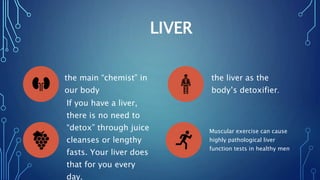
LIVER
the main “chemist” in
our body
the liver as the
body’s detoxifier.
If you have a liver,
there is no need to
“detox” through juice
cleanses or lengthy
fasts. Your liver does
that for you every
day.
Muscular exercise can cause
highly pathological liver
function tests in healthy men
3 of the markers are found in large quantities in the liver and can be
elevated in the blood when there is liver damage;
•ALT=Alanine Aminotransferase
•AST=Aspartate Aminotransferase
•GGT=Gamma-glutamyl Transpeptidase
•Creatine Kinase
liver enzymes may be elevated after resistance-exercise or weightlifting.
ALANINE AMINOTRANSFERASE
• Enzymes found in liver but also in other tissues, such as
skeletal muscles.
• They are a part of the normal metabolic processes in the
liver amino acids from one molecule to another.
• Smaller amounts of ALT kidneys and other organs
too.
• ALT use to break down food into energy.
• Normally, ALT levels in the blood are low.
• If your liver is damaged, it will release more ALT into
your blood and levels will rise.
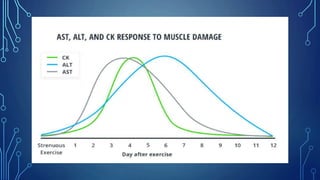
• ALT increases after exercise and remain increase for
7 days
• The range for normal ALT between 7-56 units per
liter.
• Mild elevations are generally considered to be 2-3
times higher than the normal range.
ASPARTATE AMINOTRANSFERASE
• Enzyme cells throughout the body like in heart
and liver, kidneys, muscles and red blood cells.
• It’s a protein that helps trigger chemical reactions.
• In healthy individuals, levels of AST in the blood are
low.
• When liver or muscle cells are injured, they release
AST into the blood. This makes AST a useful test for
detecting or monitoring liver damage.
• According to liver specialists, abnormal ALT results are more likely
related to liver injury than abnormal AST results. In fact, if AST levels
are abnormal and ALT levels are normal, the problem is much more
likely due to a heart condition or muscle problem rather than the liver.
• possible reasons for an increased AST level that aren’t related to the
liver include:
•a recent heart attack
•strenuous activity
•an injection of medicine into your muscle
•burns
•seizures
•surgery
•muscle diseases
• AST is reported between 10 to 40 units per liter
HIGH LEVEL OF ALT AND AST
• ALT and AST skeletal muscles.
• When muscle is damaged, such as in response to exercise released
from the muscle and their concentration in the blood increases.
• ALT and AST 7 or more days after strenuous exercise.
• The the intensity and the longer the duration of workout will result
peak levels and levels remain for longer.
• Untrained athletes will see larger and longer increases relative to more
trained athletes. As an athlete trains, their work capacity increases,
allowing them to sustain greater training loads/volumes with a
comparable increase in ALT, AST and CK. While resistance training
generally causes greater muscle damage than endurance events.
CREATINE KINASE
• It’s a type of protein.
• Enzyme heart, brain, skeletal muscle, and other tissues.
• Increased amounts of CK are released into the blood when
there is muscle damage.
• The small amount of CK that is normally in the blood comes
primarily from skeletal muscles.
• Any condition that causes muscle damage and/or interferes
with muscle energy production or use can cause an increase in
CK.
• Chronically elevated Creatine Kinase can lead to muscle fatigue,
injury and decreased athletic performance
TYPES OF CK
CK made up of three enzymes form:
•CK-MB if your heart muscle is damaged after muscular
dystrophy, muscle inflammation, seizures or any other skeletal
muscle disorder.
•CK-MM with other muscle damage after heart attack,
inflammation of heart muscle, muscular dystrophy, cardiac
surgery
•CK-BB mostly in the brain tends to rise in response to
brain injury, meningitis, abnormal cell growth, stroke.
ROLE OF CREATINE KINASE
• Creatine kinase (CK) has several functions in cellular energy
metabolism
• It catalyzes the reversible transfer of high-energy phosphate
from ATP to creatine, facilitating storage of energy
• In muscle cells, this extra energy buffer plays a role in
maintaining ATP homeostasis
• Total creatine kinase (CK) levels depend on age, gender, race,
muscle mass, physical activity and climatic condition.
• The highest post-exercise serum enzyme activities are
found after prolonged exercise such as ultradistance
marathon running or weight-bearing exercises and
downhill running, which include eccentric muscular
contractions.
• Total serum CK activity is markedly elevated for 24 h after
the exercise and when patients rest, it gradually returns
to basal levels.
• Persistently increased serum CK levels are occasionally
encountered in healthy individuals and are also markedly
increased in the pre-clinical stages of muscle diseases.
DISEASES
MUSCULAR DYSTROPHY
• strenuous exercise and inflammation of muscles(myositis) CK
as can muscle diseases (myopathies) such as muscular dystrophy
cause progressive weakness and loss of muscle mass.
RHABDOMYOLYSIS
• An extreme breakdown of skeletal muscle tissue, is associated
with significantly elevated levels of CK.
• Muscle breakdown causes the release of myoglobin into the
bloodstream. Myoglobin is the protein that stores oxygen in your
muscles. If you have too much myoglobin in your blood, it can
cause kidney damage.
MONITORING YOUR LEVELS FOR
OVERTRAINING:
• Your heart rate can indicate that you're overtraining
• Monitoring the levels of your AST, ALT, and CK
throughout training can help you determine if your
muscles are recovering as they should be.
• Prolonged elevations in any of these markers can
mean that your training load is high, recovery is
taking longer, and the risk of overtraining may be
greater.
RECOVERY
• To become stronger, faster, and fitter, you have to push your body
harder. But then you have to rest, too.
• Passive recovery is synonymous with complete rest.
• Active recovery means low-intensity. If you’re feeling fatigued from
strength training, engage in a lower intensity cardiovascular bike ride
or walk, which enables your body to circulate waste products caused
by the rigorous activity. Or try a gentle yoga practice to stretch out
tired muscles.
• Nutritional recovery The foods you eat provide your body need to
repair muscles and promote recovery. A whole-foods-based diet rich
in antioxidants, whole carbohydrates, and lean protein can help
trigger the right changes in your body between workouts and sleep.
enzymes elevation cause muscle injury

enzymes elevation cause muscle injury

  • 1.
    ENZYMES ELEVATION CAUSEMUSCLE INJURY PRESENTED BY HIRA ALI SHAH
  • 2.
    LIVER the main “chemist”in our body the liver as the body’s detoxifier. If you have a liver, there is no need to “detox” through juice cleanses or lengthy fasts. Your liver does that for you every day. Muscular exercise can cause highly pathological liver function tests in healthy men
  • 3.
    3 of themarkers are found in large quantities in the liver and can be elevated in the blood when there is liver damage; •ALT=Alanine Aminotransferase •AST=Aspartate Aminotransferase •GGT=Gamma-glutamyl Transpeptidase •Creatine Kinase liver enzymes may be elevated after resistance-exercise or weightlifting.
  • 5.
    ALANINE AMINOTRANSFERASE • Enzymesfound in liver but also in other tissues, such as skeletal muscles. • They are a part of the normal metabolic processes in the liver amino acids from one molecule to another. • Smaller amounts of ALT kidneys and other organs too. • ALT use to break down food into energy. • Normally, ALT levels in the blood are low.
  • 6.
    • If yourliver is damaged, it will release more ALT into your blood and levels will rise. • ALT increases after exercise and remain increase for 7 days • The range for normal ALT between 7-56 units per liter. • Mild elevations are generally considered to be 2-3 times higher than the normal range.
  • 7.
    ASPARTATE AMINOTRANSFERASE • Enzymecells throughout the body like in heart and liver, kidneys, muscles and red blood cells. • It’s a protein that helps trigger chemical reactions. • In healthy individuals, levels of AST in the blood are low. • When liver or muscle cells are injured, they release AST into the blood. This makes AST a useful test for detecting or monitoring liver damage.
  • 8.
    • According toliver specialists, abnormal ALT results are more likely related to liver injury than abnormal AST results. In fact, if AST levels are abnormal and ALT levels are normal, the problem is much more likely due to a heart condition or muscle problem rather than the liver. • possible reasons for an increased AST level that aren’t related to the liver include: •a recent heart attack •strenuous activity •an injection of medicine into your muscle •burns •seizures •surgery •muscle diseases • AST is reported between 10 to 40 units per liter
  • 9.
    HIGH LEVEL OFALT AND AST • ALT and AST skeletal muscles. • When muscle is damaged, such as in response to exercise released from the muscle and their concentration in the blood increases. • ALT and AST 7 or more days after strenuous exercise. • The the intensity and the longer the duration of workout will result peak levels and levels remain for longer. • Untrained athletes will see larger and longer increases relative to more trained athletes. As an athlete trains, their work capacity increases, allowing them to sustain greater training loads/volumes with a comparable increase in ALT, AST and CK. While resistance training generally causes greater muscle damage than endurance events.
  • 10.
    CREATINE KINASE • It’sa type of protein. • Enzyme heart, brain, skeletal muscle, and other tissues. • Increased amounts of CK are released into the blood when there is muscle damage. • The small amount of CK that is normally in the blood comes primarily from skeletal muscles. • Any condition that causes muscle damage and/or interferes with muscle energy production or use can cause an increase in CK. • Chronically elevated Creatine Kinase can lead to muscle fatigue, injury and decreased athletic performance
  • 11.
    TYPES OF CK CKmade up of three enzymes form: •CK-MB if your heart muscle is damaged after muscular dystrophy, muscle inflammation, seizures or any other skeletal muscle disorder. •CK-MM with other muscle damage after heart attack, inflammation of heart muscle, muscular dystrophy, cardiac surgery •CK-BB mostly in the brain tends to rise in response to brain injury, meningitis, abnormal cell growth, stroke.
  • 12.
    ROLE OF CREATINEKINASE • Creatine kinase (CK) has several functions in cellular energy metabolism • It catalyzes the reversible transfer of high-energy phosphate from ATP to creatine, facilitating storage of energy • In muscle cells, this extra energy buffer plays a role in maintaining ATP homeostasis • Total creatine kinase (CK) levels depend on age, gender, race, muscle mass, physical activity and climatic condition.
  • 13.
    • The highestpost-exercise serum enzyme activities are found after prolonged exercise such as ultradistance marathon running or weight-bearing exercises and downhill running, which include eccentric muscular contractions. • Total serum CK activity is markedly elevated for 24 h after the exercise and when patients rest, it gradually returns to basal levels. • Persistently increased serum CK levels are occasionally encountered in healthy individuals and are also markedly increased in the pre-clinical stages of muscle diseases.
  • 14.
    DISEASES MUSCULAR DYSTROPHY • strenuousexercise and inflammation of muscles(myositis) CK as can muscle diseases (myopathies) such as muscular dystrophy cause progressive weakness and loss of muscle mass. RHABDOMYOLYSIS • An extreme breakdown of skeletal muscle tissue, is associated with significantly elevated levels of CK. • Muscle breakdown causes the release of myoglobin into the bloodstream. Myoglobin is the protein that stores oxygen in your muscles. If you have too much myoglobin in your blood, it can cause kidney damage.
  • 16.
    MONITORING YOUR LEVELSFOR OVERTRAINING: • Your heart rate can indicate that you're overtraining • Monitoring the levels of your AST, ALT, and CK throughout training can help you determine if your muscles are recovering as they should be. • Prolonged elevations in any of these markers can mean that your training load is high, recovery is taking longer, and the risk of overtraining may be greater.
  • 17.
    RECOVERY • To becomestronger, faster, and fitter, you have to push your body harder. But then you have to rest, too. • Passive recovery is synonymous with complete rest. • Active recovery means low-intensity. If you’re feeling fatigued from strength training, engage in a lower intensity cardiovascular bike ride or walk, which enables your body to circulate waste products caused by the rigorous activity. Or try a gentle yoga practice to stretch out tired muscles. • Nutritional recovery The foods you eat provide your body need to repair muscles and promote recovery. A whole-foods-based diet rich in antioxidants, whole carbohydrates, and lean protein can help trigger the right changes in your body between workouts and sleep.