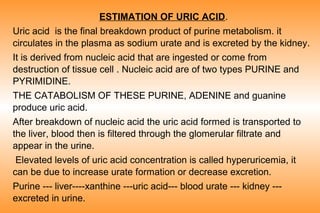

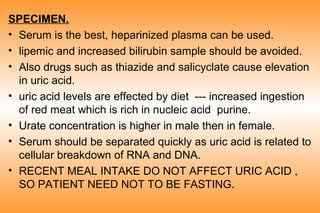
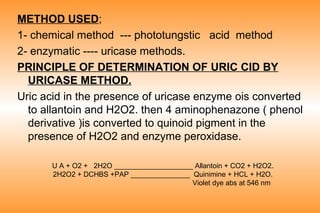
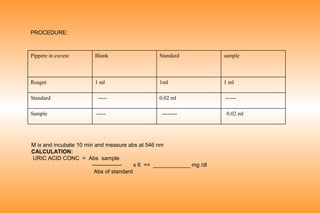
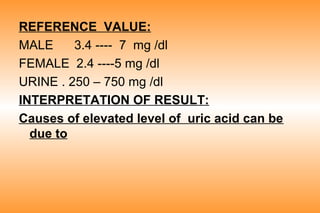
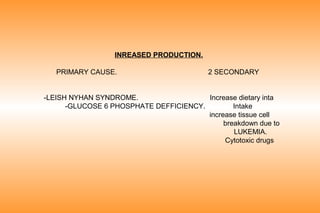
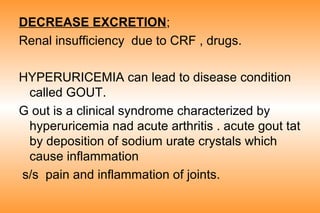

Uric acid is produced from the breakdown of purines from ingested and cellular nucleic acids. It circulates in the blood as sodium urate and is excreted by the kidneys. Elevated levels of uric acid, called hyperuricemia, can be caused by increased production or decreased excretion. The objective is to determine uric acid levels to diagnose hyperuricemia. Serum separated quickly after collection is the best specimen, avoiding lipemic or high bilirubin samples. The uricase method enzymatically converts uric acid to allantoin and hydrogen peroxide to produce a violet dye for measurement. Elevated levels can indicate increased production from genetic disorders or tissue breakdown,


![Мочевая кислота, артериальная гипертензия и заболевания почек.2014 [ENG]](https://cdn.slidesharecdn.com/ss_thumbnails/random-151010012350-lva1-app6891-thumbnail.jpg?width=640&height=640&fit=bounds)


![Hypothalamus short ppt by Dr. Neha [PT].pptx](https://cdn.slidesharecdn.com/ss_thumbnails/hypothalamusbydr-260124145759-b9f94a93-thumbnail.jpg?width=640&height=640&fit=bounds)


