Chapter 11 Peripheral Nervous System
Peripheral Nervous System Cranial nerves  arising from the brain Connect to the skin and skeletal muscles Connect to viscera(organs) Spinal nerves  arising from the spinal cord Connect to the skin and skeletal muscles Connecting to viscera(organs)
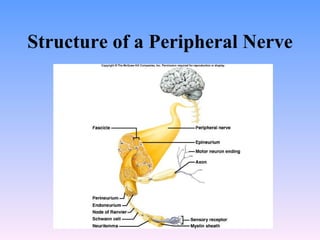
Structure of a Peripheral Nerve
Nerve Fiber Classification Sensory Nerves  – conduct impulses into CNS Motor Nerves  – conduct impulses to muscles or glands Mixed Nerves  – contain both sensory nerve fibers and motor nerve fibers; most nerves
Cranial Nerves
Cranial Nerves I and II Olfactory (I) sensory  smell Optic (II) sensory  vision
Cranial Nerves III and IV Trochlear (IV) primarily motor motor impulses to muscles that move the eyes Oculomotor (III) primarily motor motor impulses to muscles that raise eyelids move the eyes focus lens adjust light entering eye
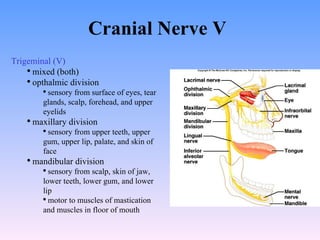
Cranial Nerve V Trigeminal (V) mixed (both) opthalmic division sensory from surface of eyes, tear glands, scalp, forehead, and upper eyelids maxillary division sensory from upper teeth, upper gum, upper lip, palate, and skin of face mandibular division sensory from scalp, skin of jaw, lower teeth, lower gum, and lower lip motor to muscles of mastication and muscles in floor of mouth
Muscles of Mastication
Cranial Nerves VI and VII Abducens (VI) primarily motor motor impulses to muscles that move the eyes Facial (VII) mixed (both) sensory from taste receptors motor to muscles of facial expression, tear glands, and salivary glands
Muscles of Facial Expression
Cranial Nerves VIII and IX Vestibulocochlear (VIII) aka Auditory  sensory sensory from equilibrium receptors of ear (balance) sensory from hearing receptors Glossopharyngeal (IX) mixed (both) sensory from pharynx, tonsils, tongue, and carotid arteries motor to salivary glands and muscles of pharynx
Cranial Nerve X Vagus (X) mixed (both) motor to muscles of speech and swallowing motor to viscera of thorax and abdomen sensory from pharynx, larynx, esophagus, and viscera of thorax and abdomen
Cranial Nerves XI and XII Accessory (XI) Aka Spinal Accessory  primarily motor motor to muscles of soft palate, pharynx, larynx, neck (sternocleidomastoid), and back (trapezius) Hypoglossal (XII) primarily motor motor to muscles of the tongue
Spinal Nerves mixed nerves 31 pairs 8 cervical (C1 to C8) 12 thoracic (T1 to T12) 5 lumbar (L1 to L5) 5 sacral (S1 to S5) 1 coccygeal (Co)
Dermatome an area of skin that the sensory nerve fibers of a particular spinal nerve innervate
Cervical Plexus Nerve plexus  – complex networks formed by anterior branches of spinal nerves; fibers of various spinal nerves are  sorted and recombined Cervical Plexus C1-C4 lies deep in the neck supply muscles and skin of the neck contribute to phrenic nerve
Brachial Plexus C5-T1 lies deep within shoulders musculocutaneous nerves biceps brachii; brachialis ulnar nerves “ funny bone” flexor carpi ulnaris median nerves flexor carpi radialis  radial nerves posterior muscles triceps brachii extensors axillary nerves deltoid
Muscles That Move the Forearm
Muscles That Move the Hand
Lumbosacral Plexus T12 – S5 obturator nerves  supply adductors of thighs femoral nerves supply muscles and skin of quads and sartorius tibial nerves supply posterior leg muscles; hams, calves sciatic nerves longest and largest nerve of the body
Muscles That Move the Thigh
Muscles That Move the Leg
Muscles That Move the Foot
Autonomic Nervous System functions without conscious effort controls visceral activities regulates smooth muscle, cardiac muscle, and glands Two Divisions sympathetic  – prepares body for fight or flight situations parasympathetic  – prepares body for resting and digesting activities
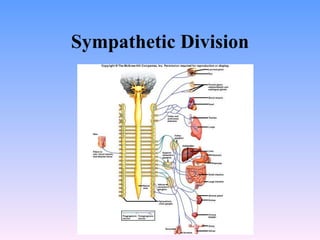
Sympathetic Division
Parasympathetic Division
Control of Autonomic  Activity Controlled largely by CNS Medulla oblongata regulates cardiac, vasomotor and respiratory activities Hypothalamus regulates visceral functions Cerebral cortex control emotional responses

11 Peripheral Nervous System

  • 1.
    Chapter 11 PeripheralNervous System
  • 2.
    Peripheral Nervous SystemCranial nerves arising from the brain Connect to the skin and skeletal muscles Connect to viscera(organs) Spinal nerves arising from the spinal cord Connect to the skin and skeletal muscles Connecting to viscera(organs)
  • 3.
    Structure of aPeripheral Nerve
  • 4.
    Nerve Fiber ClassificationSensory Nerves – conduct impulses into CNS Motor Nerves – conduct impulses to muscles or glands Mixed Nerves – contain both sensory nerve fibers and motor nerve fibers; most nerves
  • 5.
  • 6.
    Cranial Nerves Iand II Olfactory (I) sensory smell Optic (II) sensory vision
  • 7.
    Cranial Nerves IIIand IV Trochlear (IV) primarily motor motor impulses to muscles that move the eyes Oculomotor (III) primarily motor motor impulses to muscles that raise eyelids move the eyes focus lens adjust light entering eye
  • 8.
    Cranial Nerve VTrigeminal (V) mixed (both) opthalmic division sensory from surface of eyes, tear glands, scalp, forehead, and upper eyelids maxillary division sensory from upper teeth, upper gum, upper lip, palate, and skin of face mandibular division sensory from scalp, skin of jaw, lower teeth, lower gum, and lower lip motor to muscles of mastication and muscles in floor of mouth
  • 9.
  • 10.
    Cranial Nerves VIand VII Abducens (VI) primarily motor motor impulses to muscles that move the eyes Facial (VII) mixed (both) sensory from taste receptors motor to muscles of facial expression, tear glands, and salivary glands
  • 11.
  • 12.
    Cranial Nerves VIIIand IX Vestibulocochlear (VIII) aka Auditory sensory sensory from equilibrium receptors of ear (balance) sensory from hearing receptors Glossopharyngeal (IX) mixed (both) sensory from pharynx, tonsils, tongue, and carotid arteries motor to salivary glands and muscles of pharynx
  • 13.
    Cranial Nerve XVagus (X) mixed (both) motor to muscles of speech and swallowing motor to viscera of thorax and abdomen sensory from pharynx, larynx, esophagus, and viscera of thorax and abdomen
  • 14.
    Cranial Nerves XIand XII Accessory (XI) Aka Spinal Accessory primarily motor motor to muscles of soft palate, pharynx, larynx, neck (sternocleidomastoid), and back (trapezius) Hypoglossal (XII) primarily motor motor to muscles of the tongue
  • 15.
    Spinal Nerves mixednerves 31 pairs 8 cervical (C1 to C8) 12 thoracic (T1 to T12) 5 lumbar (L1 to L5) 5 sacral (S1 to S5) 1 coccygeal (Co)
  • 16.
    Dermatome an areaof skin that the sensory nerve fibers of a particular spinal nerve innervate
  • 17.
    Cervical Plexus Nerveplexus – complex networks formed by anterior branches of spinal nerves; fibers of various spinal nerves are sorted and recombined Cervical Plexus C1-C4 lies deep in the neck supply muscles and skin of the neck contribute to phrenic nerve
  • 18.
    Brachial Plexus C5-T1lies deep within shoulders musculocutaneous nerves biceps brachii; brachialis ulnar nerves “ funny bone” flexor carpi ulnaris median nerves flexor carpi radialis radial nerves posterior muscles triceps brachii extensors axillary nerves deltoid
  • 19.
    Muscles That Movethe Forearm
  • 20.
  • 21.
    Lumbosacral Plexus T12– S5 obturator nerves supply adductors of thighs femoral nerves supply muscles and skin of quads and sartorius tibial nerves supply posterior leg muscles; hams, calves sciatic nerves longest and largest nerve of the body
  • 22.
  • 23.
  • 24.
  • 25.
    Autonomic Nervous Systemfunctions without conscious effort controls visceral activities regulates smooth muscle, cardiac muscle, and glands Two Divisions sympathetic – prepares body for fight or flight situations parasympathetic – prepares body for resting and digesting activities
  • 26.
  • 27.
  • 28.
    Control of Autonomic Activity Controlled largely by CNS Medulla oblongata regulates cardiac, vasomotor and respiratory activities Hypothalamus regulates visceral functions Cerebral cortex control emotional responses