Organization of Nervous System and
Neuron
Prepared by: Simranjeet Kaur
Assistant Professor Pharmacology
PCTE Group of Institutions, Ludhiana
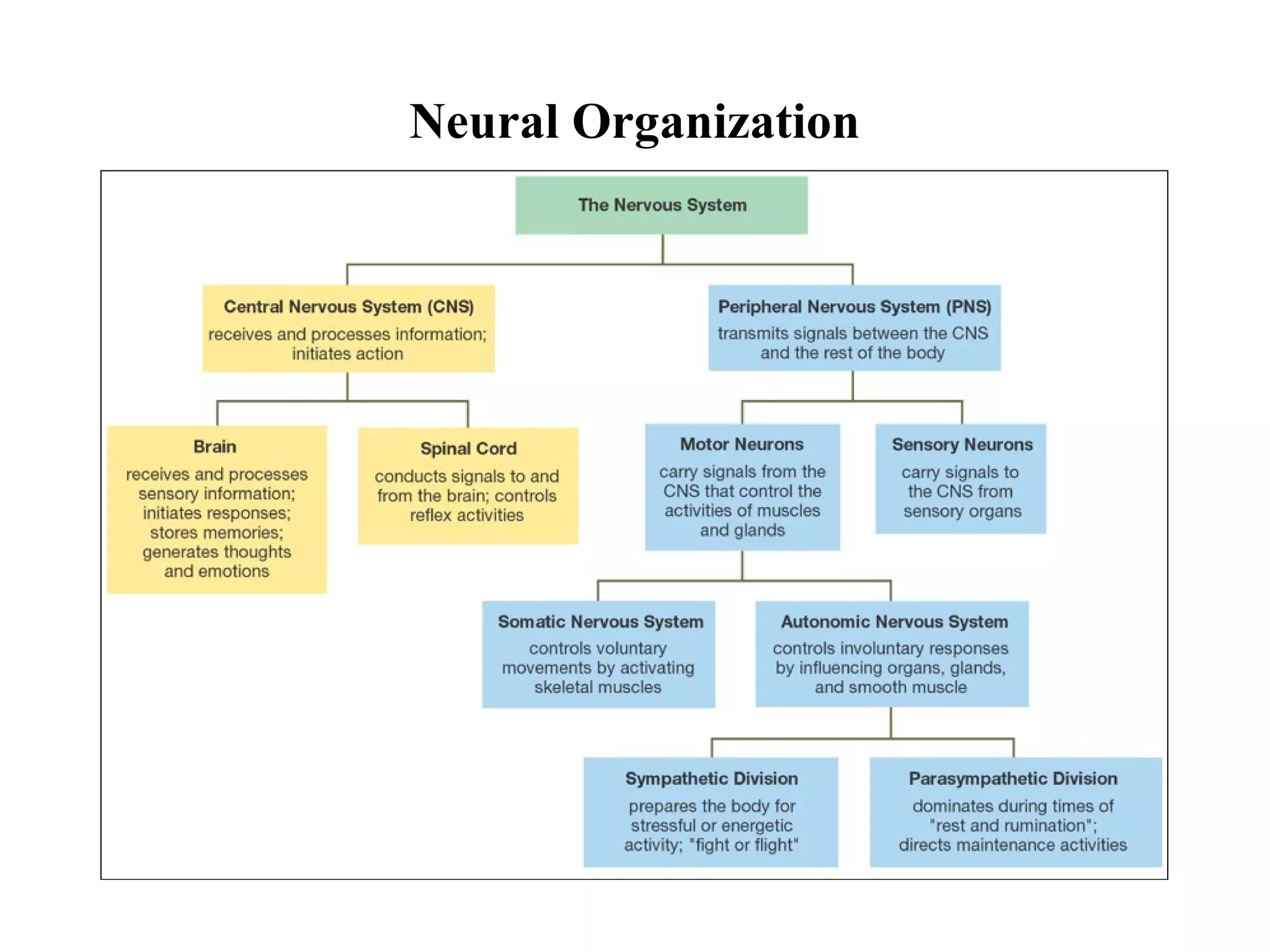
Neural Organization
Central Nervous System
• Consists of brain and spine
• Functions:
– Receives sensory signals and determines appropriate response
– Stores memory
– Carries out thought
Peripheral Nervous System
• Nerves, neurons, and sensory organs outside the central nervous
system
• Functions:
– Sends signals to the CNS
– Receives and transmits motor signals from the CNS
– Stimulates effectors
Somatic Nervous System
• Motor neurons that control voluntary movements by activating
skeletal muscles.
• Also involved in what we perceive as involuntary movements,
such as reflexes (though voluntary control of the muscles involved,
such as tensing them, can reduce the response).
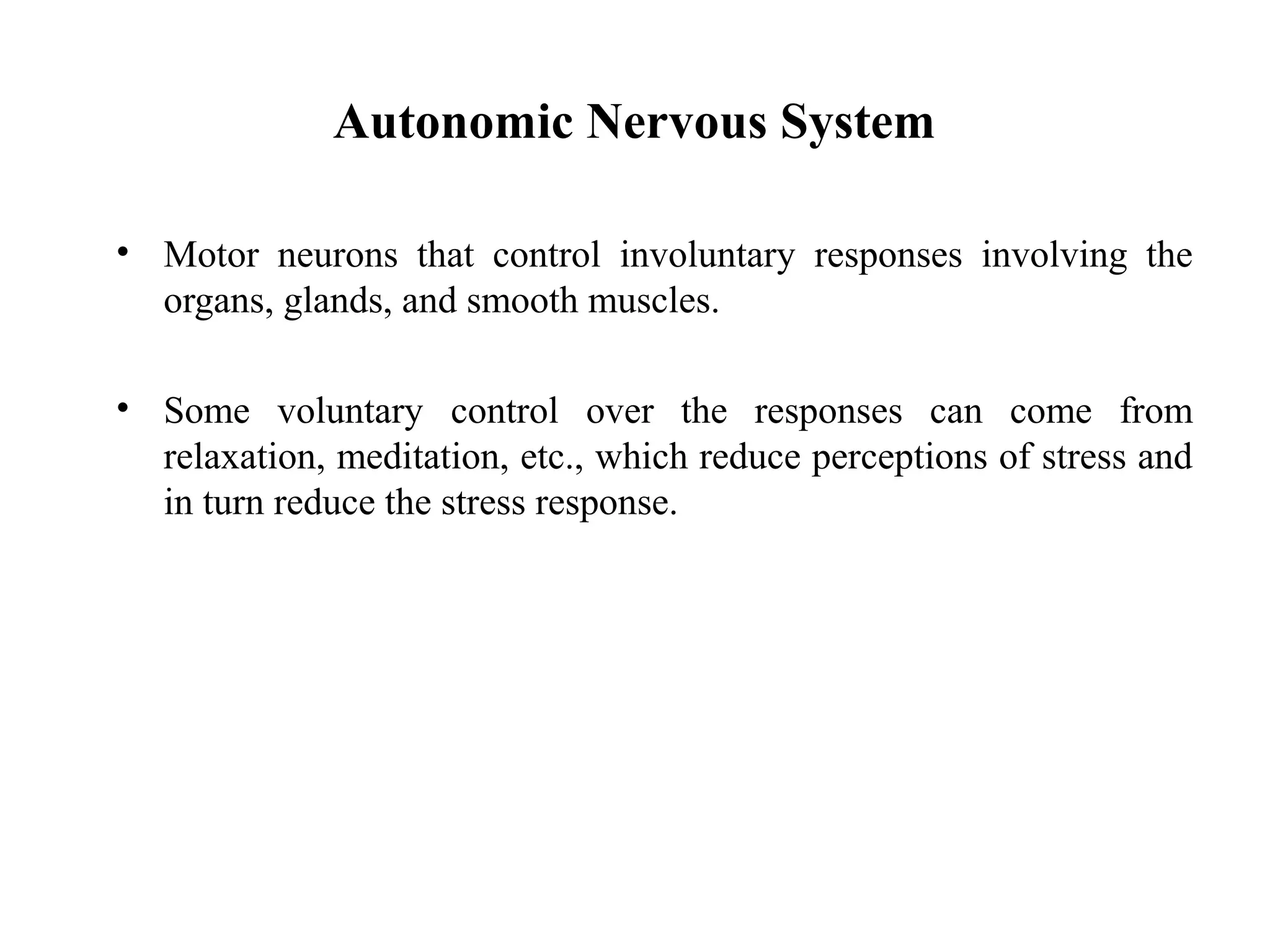
Autonomic Nervous System
• Motor neurons that control involuntary responses involving the
organs, glands, and smooth muscles.
• Some voluntary control over the responses can come from
relaxation, meditation, etc., which reduce perceptions of stress and
in turn reduce the stress response.
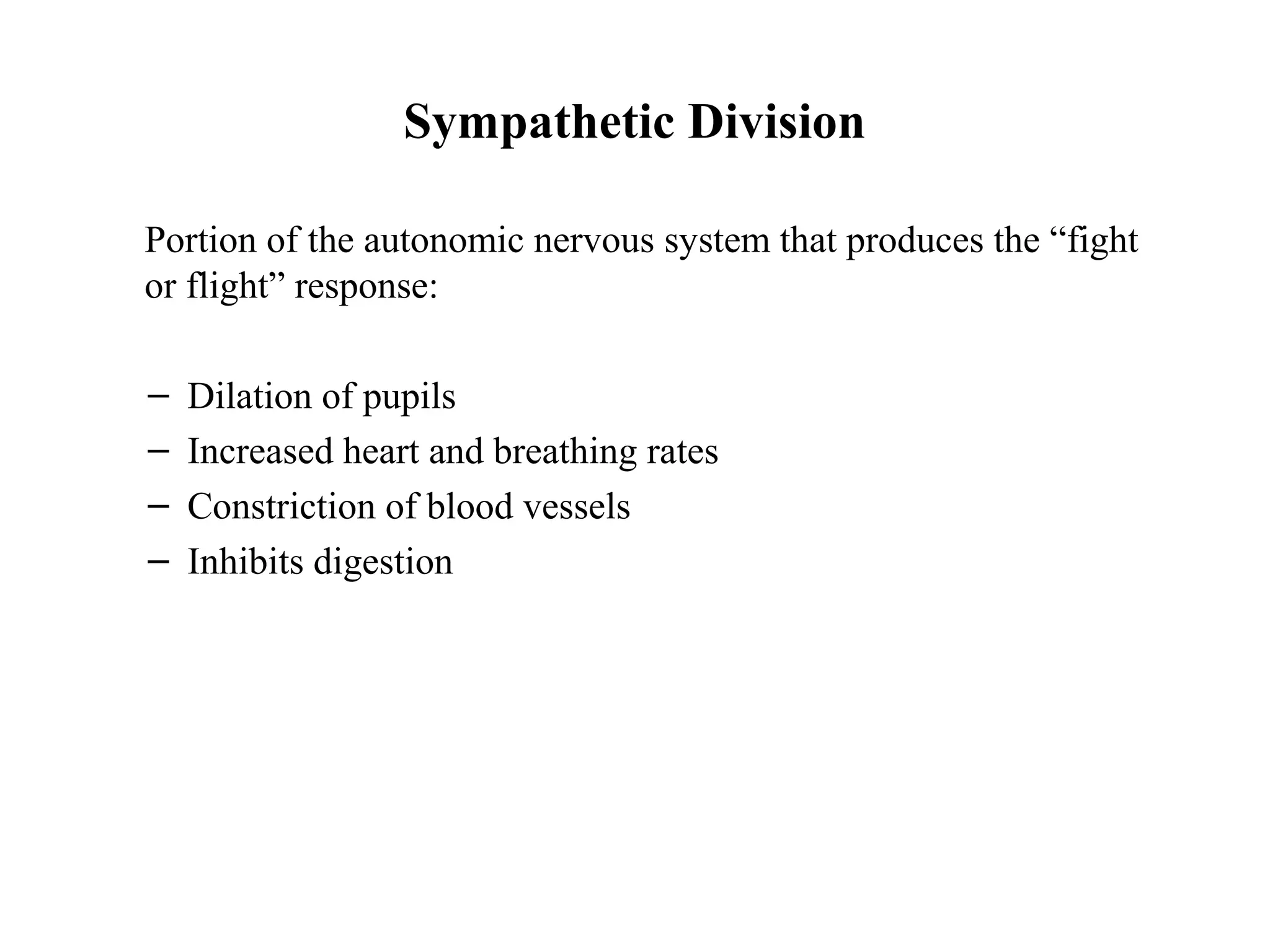
Sympathetic Division
Portion of the autonomic nervous system that produces the “fight
or flight” response:
– Dilation of pupils
– Increased heart and breathing rates
– Constriction of blood vessels
– Inhibits digestion
Parasympathetic Division
Portion of the autonomic nervous system that produces the “rest
and ruminate” response:
– Constricts pupils
– Dilates blood vessels
– Reduces heart and breathing rates.
– Stimulates digestion.
The Neuron
• It is the basic structural unit of
the NS.
• It generates electrical impulses
→ transmitted from one part of
the body to another.
• In most neurons: electrical
impulses → release of chemical
messenger to communicate with
each other.
• Neurons are integrators: their
output = the sum of the inputs
they receive from thousands of
other neurons that end on them.
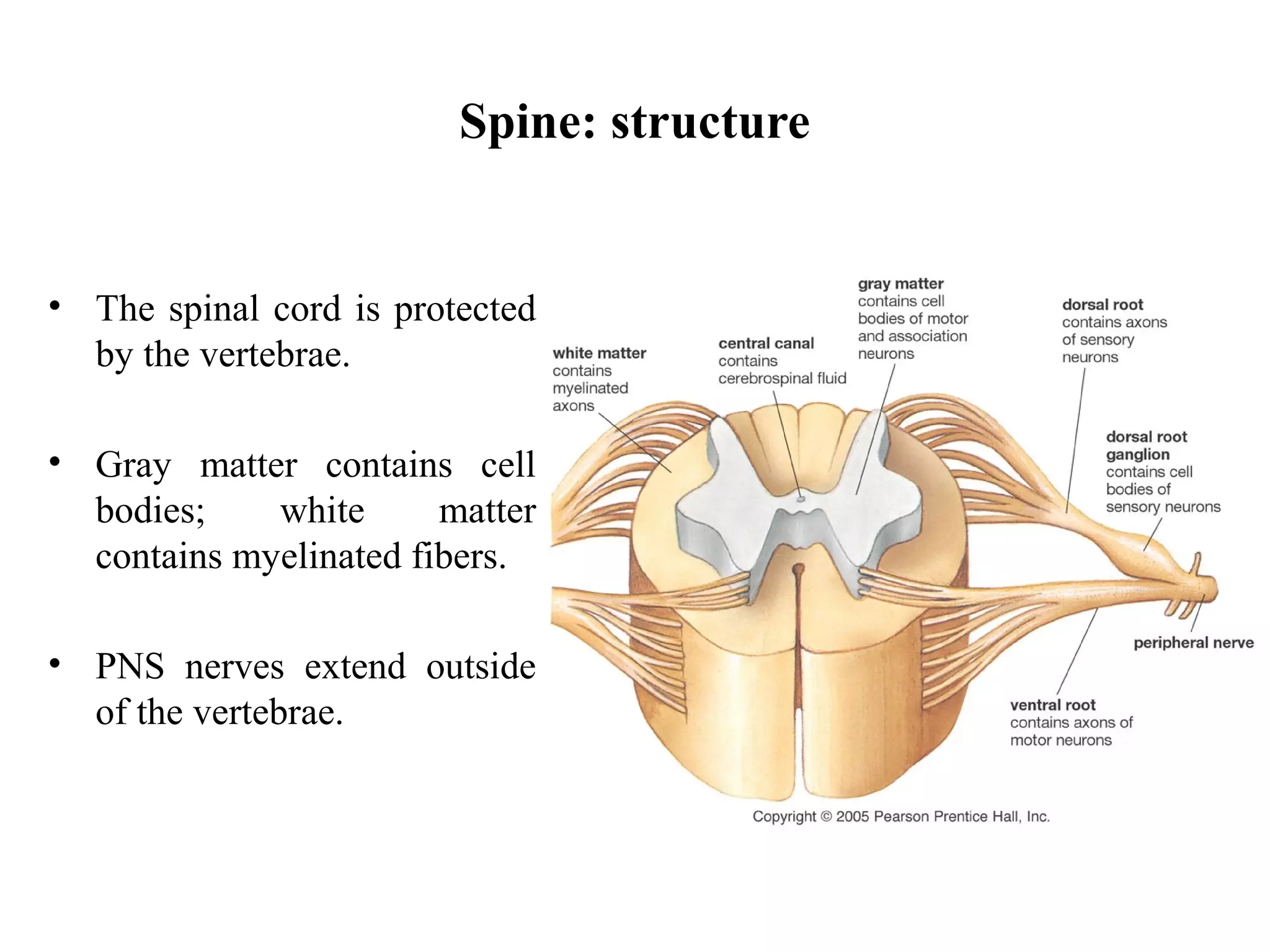
Spine: structure
• The spinal cord is protected
by the vertebrae.
• Gray matter contains cell
bodies; white matter
contains myelinated fibers.
• PNS nerves extend outside
of the vertebrae.
Brain: Structure
• Hindbrain carries out the most
basic functions.
• Midbrain coordinates signals.
• Forebrain processes signals,
stores memories, creates
thought.
Hindbrain
• Medulla: controls
autonomic fuctions.
• Pons: controls sleep
stages.
• Cerebellum: coordinates
movement, stores some
motor memory.
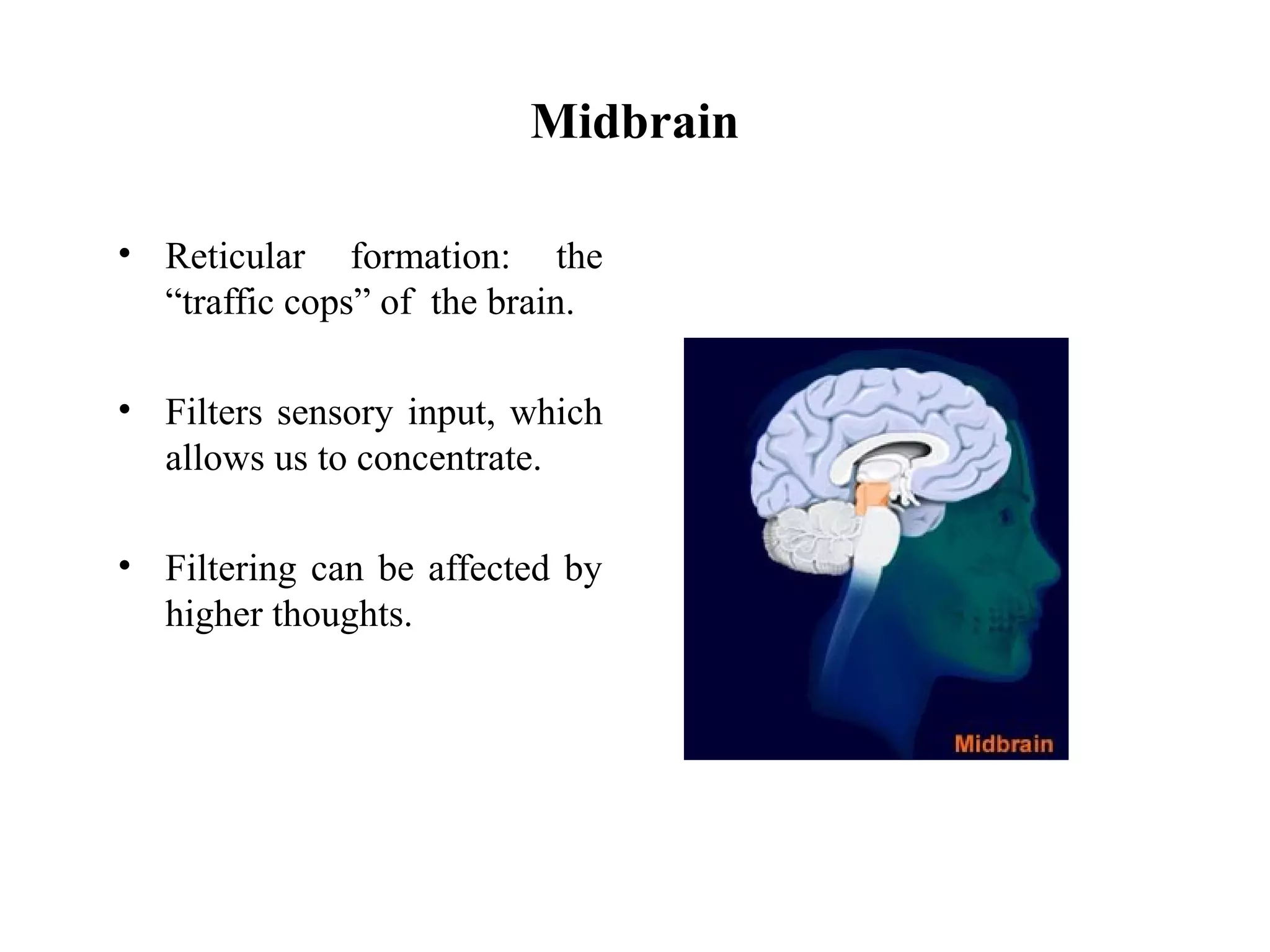
Midbrain
• Reticular formation: the
“traffic cops” of the brain.
• Filters sensory input, which
allows us to concentrate.
• Filtering can be affected by
higher thoughts.
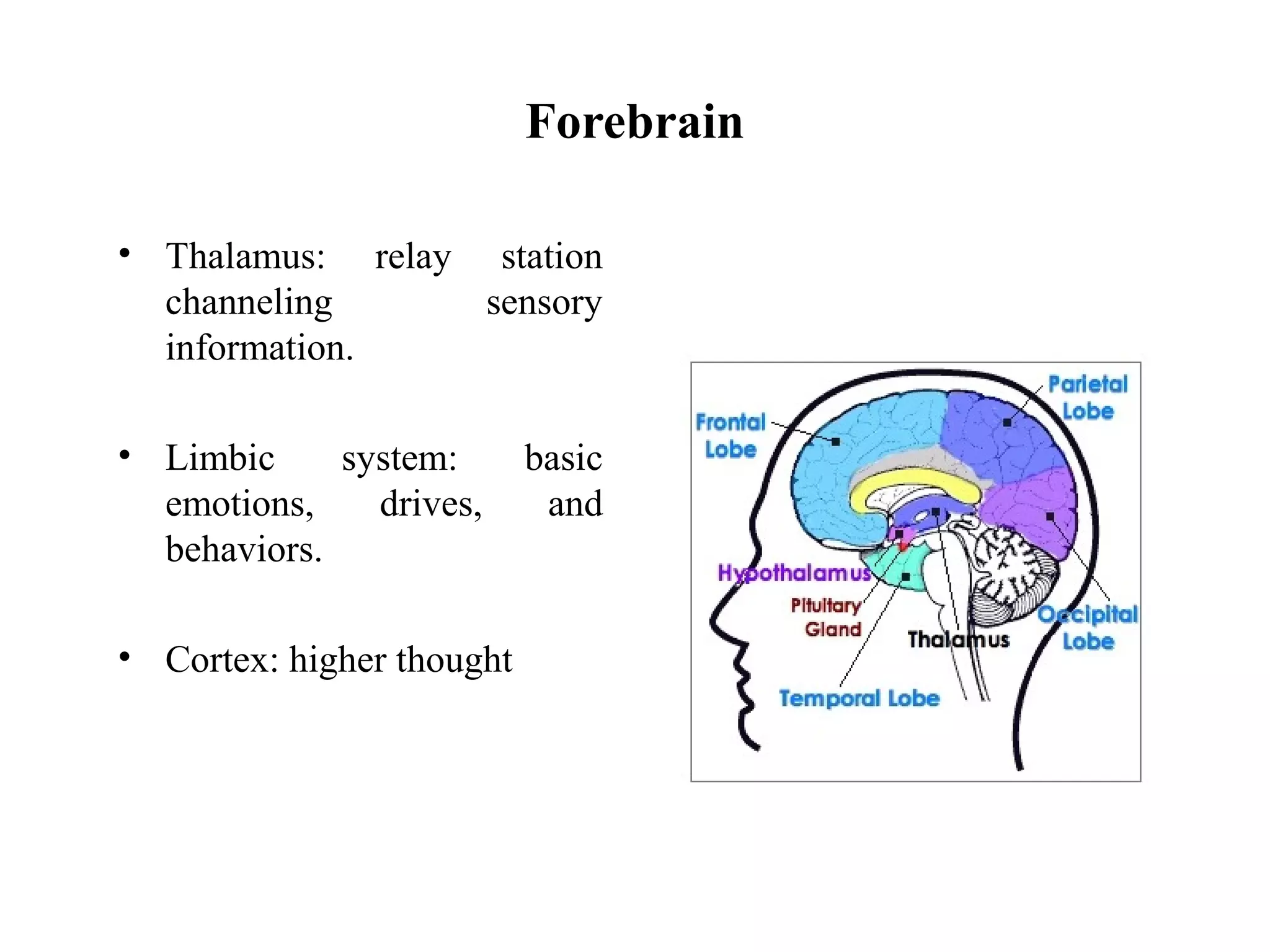
Forebrain
• Thalamus: relay station
channeling sensory
information.
• Limbic system: basic
emotions, drives, and
behaviors.
• Cortex: higher thought
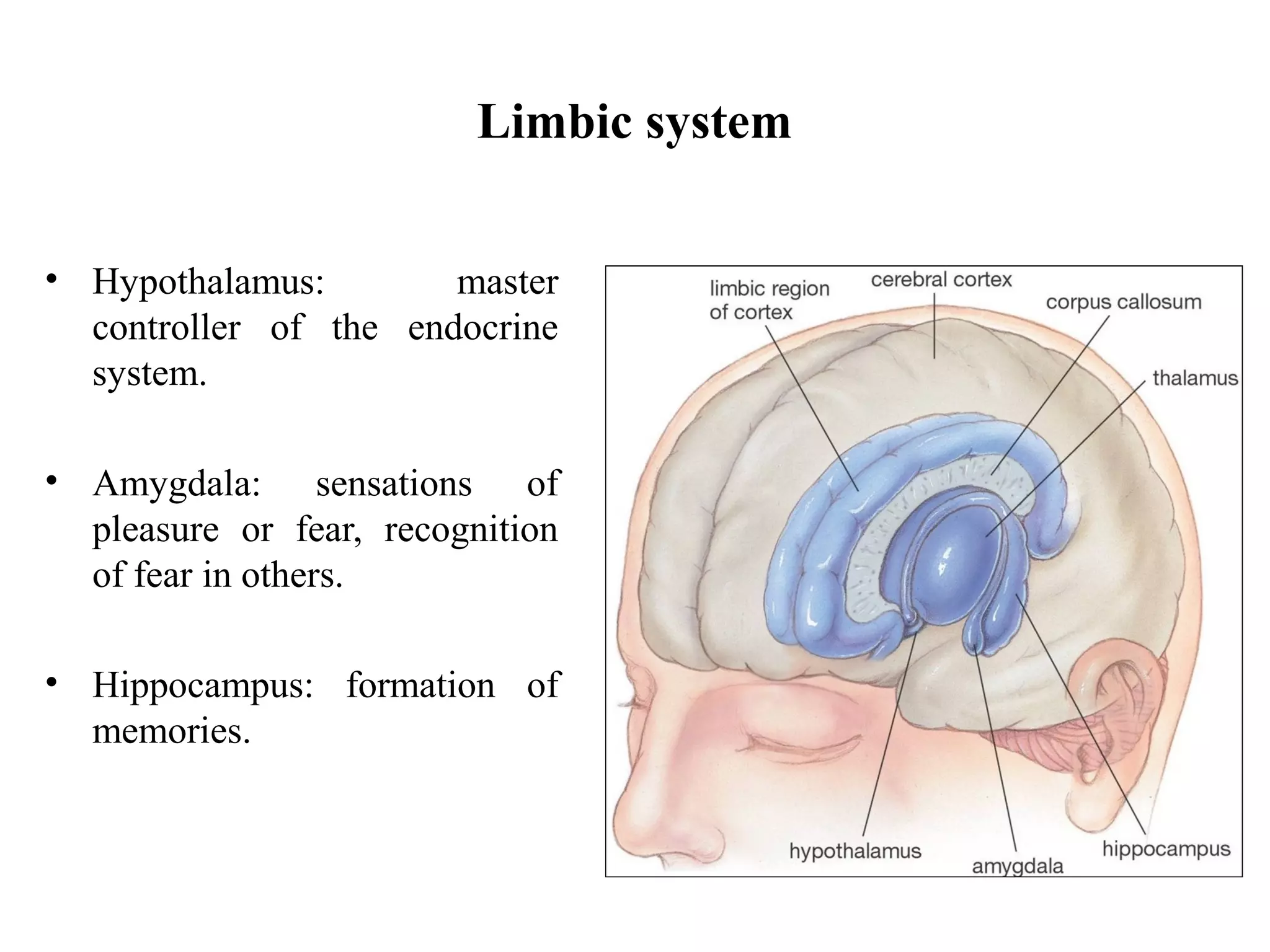
Limbic system
• Hypothalamus: master
controller of the endocrine
system.
• Amygdala: sensations of
pleasure or fear, recognition
of fear in others.
• Hippocampus: formation of
memories.
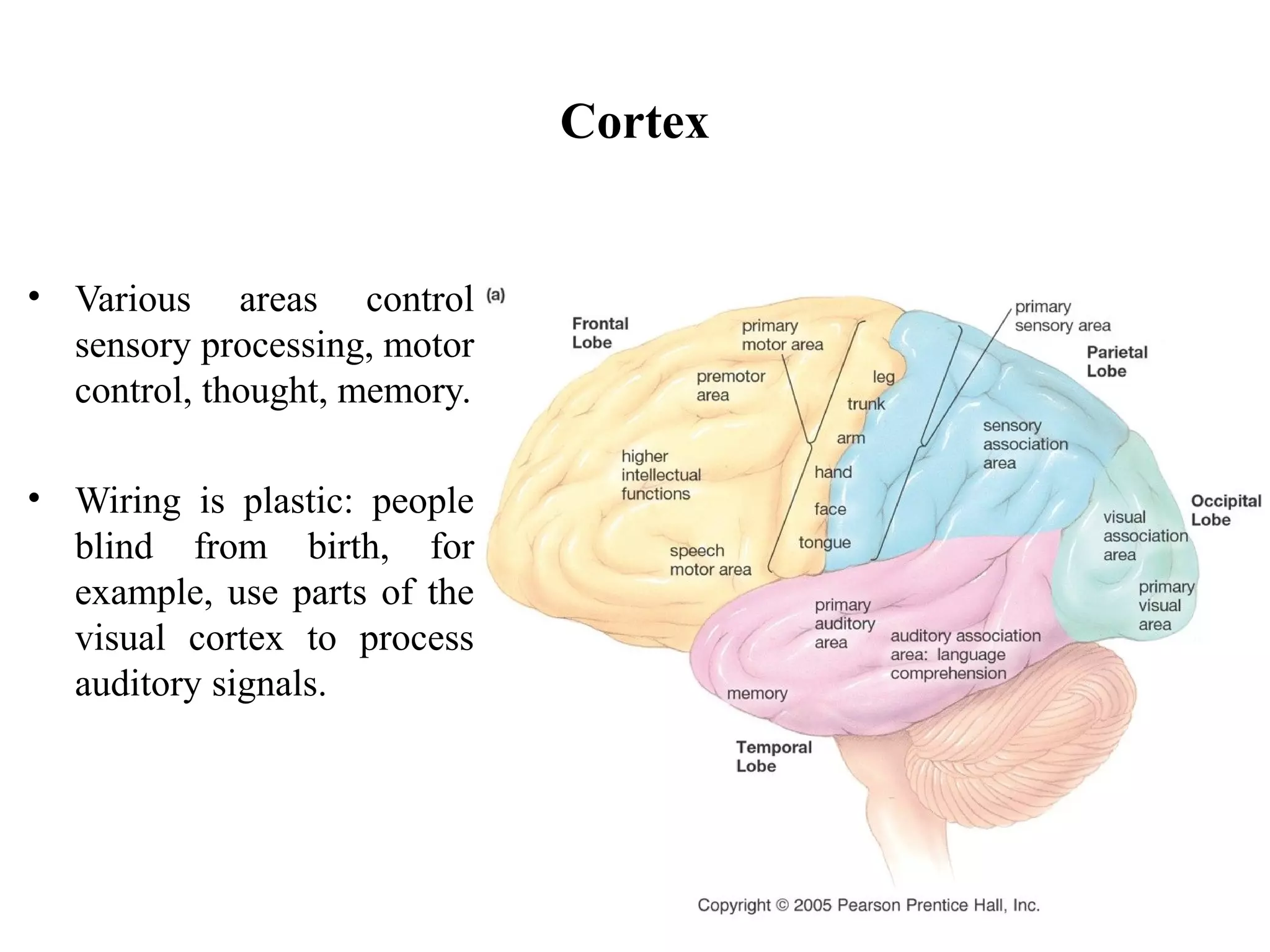
Cortex
• Various areas control
sensory processing, motor
control, thought, memory.
• Wiring is plastic: people
blind from birth, for
example, use parts of the
visual cortex to process
auditory signals.
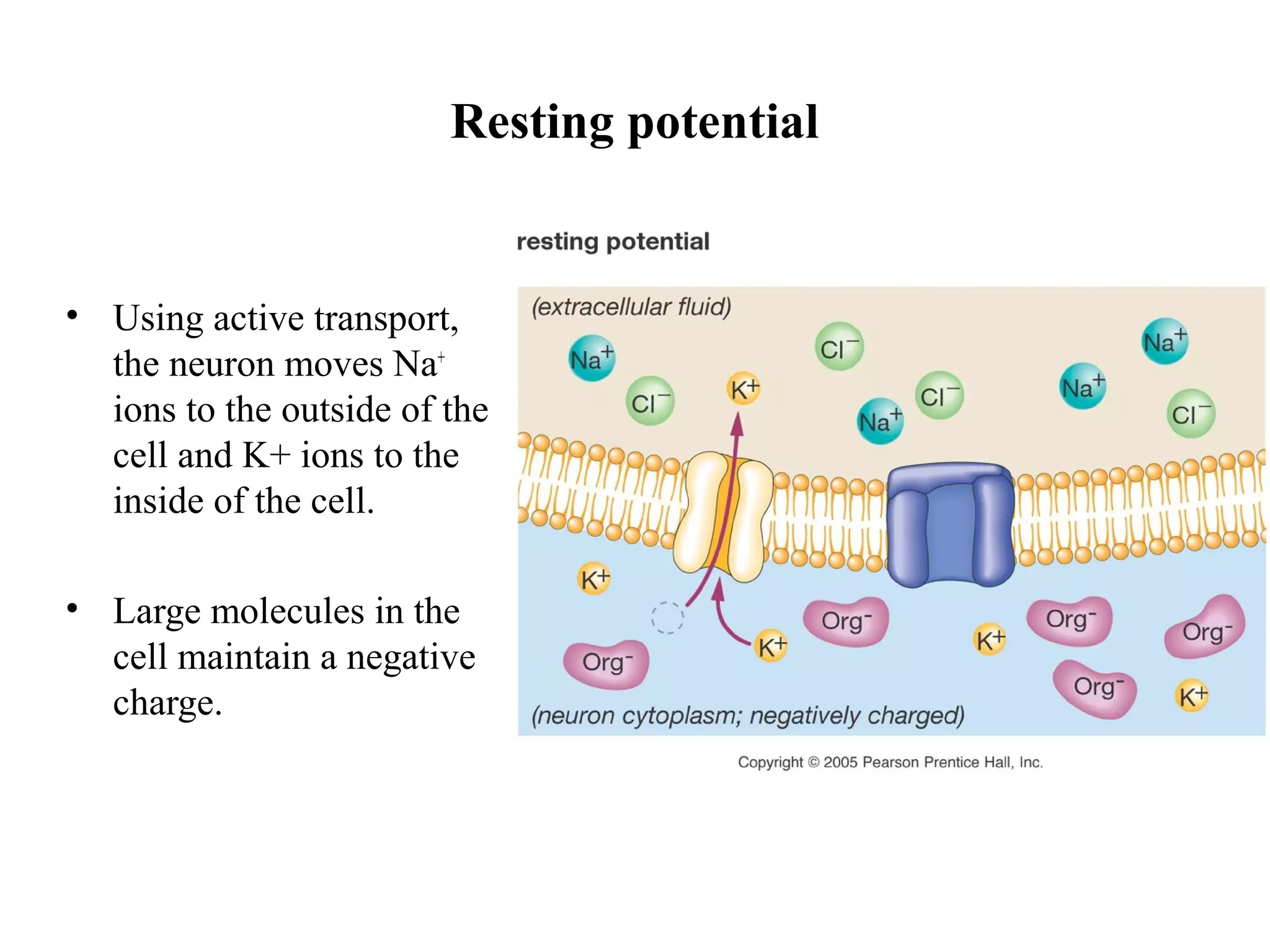
Resting potential
• Using active transport,
the neuron moves Na+
ions to the outside of the
cell and K+ ions to the
inside of the cell.
• Large molecules in the
cell maintain a negative
charge.
Action potential
• On receiving a stimulus,
sodium gates and
potassium channels open
briefly, allowing these ions
to diffuse.
• The gates close, and active
transport restores the
resting potential.
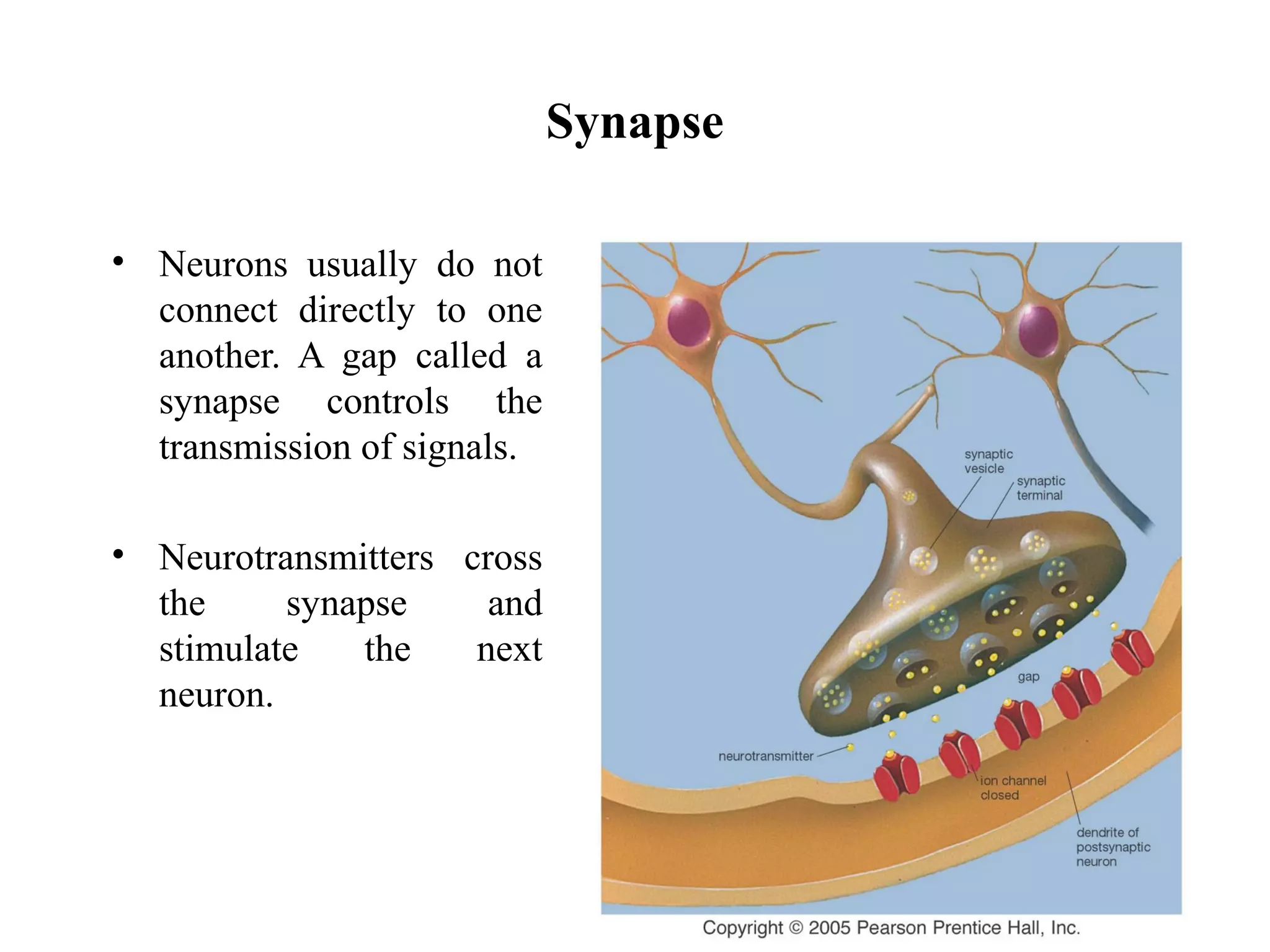
Synapse
• Neurons usually do not
connect directly to one
another. A gap called a
synapse controls the
transmission of signals.
• Neurotransmitters cross
the synapse and
stimulate the next
neuron.
Some Neurotransmitters
Neurotransmitter Location Some Functions
Acetylcholine
Neuron-to-muscle
synapse
Activates muscles
Dopamine Mid-brain Control of movement
Epinephrine Sympathetic system Stress response
Serotonin
Midbrain, pons,
medulla
Mood, sleep
Endorphins Brain, spine Mood, pain reduction
Nitric Oxide Brain Memory storage
Reflexes
• The simplest neural pathway is the reflex arc.
• This involves one or more sensory neurons, association neurons in the
spine, and motor neurons, which carry out the reflex entirely before
the brain is aware of the response.
Reflex Arc
Organization of  nervous system

Organization of nervous system

  • 1.
    Organization of NervousSystem and Neuron Prepared by: Simranjeet Kaur Assistant Professor Pharmacology PCTE Group of Institutions, Ludhiana
  • 2.
  • 3.
    Central Nervous System •Consists of brain and spine • Functions: – Receives sensory signals and determines appropriate response – Stores memory – Carries out thought
  • 4.
    Peripheral Nervous System •Nerves, neurons, and sensory organs outside the central nervous system • Functions: – Sends signals to the CNS – Receives and transmits motor signals from the CNS – Stimulates effectors
  • 5.
    Somatic Nervous System •Motor neurons that control voluntary movements by activating skeletal muscles. • Also involved in what we perceive as involuntary movements, such as reflexes (though voluntary control of the muscles involved, such as tensing them, can reduce the response).
  • 6.
    Autonomic Nervous System •Motor neurons that control involuntary responses involving the organs, glands, and smooth muscles. • Some voluntary control over the responses can come from relaxation, meditation, etc., which reduce perceptions of stress and in turn reduce the stress response.
  • 7.
    Sympathetic Division Portion ofthe autonomic nervous system that produces the “fight or flight” response: – Dilation of pupils – Increased heart and breathing rates – Constriction of blood vessels – Inhibits digestion
  • 8.
    Parasympathetic Division Portion ofthe autonomic nervous system that produces the “rest and ruminate” response: – Constricts pupils – Dilates blood vessels – Reduces heart and breathing rates. – Stimulates digestion.
  • 9.
    The Neuron • Itis the basic structural unit of the NS. • It generates electrical impulses → transmitted from one part of the body to another. • In most neurons: electrical impulses → release of chemical messenger to communicate with each other. • Neurons are integrators: their output = the sum of the inputs they receive from thousands of other neurons that end on them.
  • 10.
    Spine: structure • Thespinal cord is protected by the vertebrae. • Gray matter contains cell bodies; white matter contains myelinated fibers. • PNS nerves extend outside of the vertebrae.
  • 11.
    Brain: Structure • Hindbraincarries out the most basic functions. • Midbrain coordinates signals. • Forebrain processes signals, stores memories, creates thought.
  • 12.
    Hindbrain • Medulla: controls autonomicfuctions. • Pons: controls sleep stages. • Cerebellum: coordinates movement, stores some motor memory.
  • 13.
    Midbrain • Reticular formation:the “traffic cops” of the brain. • Filters sensory input, which allows us to concentrate. • Filtering can be affected by higher thoughts.
  • 14.
    Forebrain • Thalamus: relaystation channeling sensory information. • Limbic system: basic emotions, drives, and behaviors. • Cortex: higher thought
  • 15.
    Limbic system • Hypothalamus:master controller of the endocrine system. • Amygdala: sensations of pleasure or fear, recognition of fear in others. • Hippocampus: formation of memories.
  • 16.
    Cortex • Various areascontrol sensory processing, motor control, thought, memory. • Wiring is plastic: people blind from birth, for example, use parts of the visual cortex to process auditory signals.
  • 17.
    Resting potential • Usingactive transport, the neuron moves Na+ ions to the outside of the cell and K+ ions to the inside of the cell. • Large molecules in the cell maintain a negative charge.
  • 18.
    Action potential • Onreceiving a stimulus, sodium gates and potassium channels open briefly, allowing these ions to diffuse. • The gates close, and active transport restores the resting potential.
  • 19.
    Synapse • Neurons usuallydo not connect directly to one another. A gap called a synapse controls the transmission of signals. • Neurotransmitters cross the synapse and stimulate the next neuron.
  • 20.
    Some Neurotransmitters Neurotransmitter LocationSome Functions Acetylcholine Neuron-to-muscle synapse Activates muscles Dopamine Mid-brain Control of movement Epinephrine Sympathetic system Stress response Serotonin Midbrain, pons, medulla Mood, sleep Endorphins Brain, spine Mood, pain reduction Nitric Oxide Brain Memory storage
  • 21.
    Reflexes • The simplestneural pathway is the reflex arc. • This involves one or more sensory neurons, association neurons in the spine, and motor neurons, which carry out the reflex entirely before the brain is aware of the response. Reflex Arc