Name :- Amina munawar
Roll no. :- 15003
Assignment :- cranial nerves
Cranial Nerves
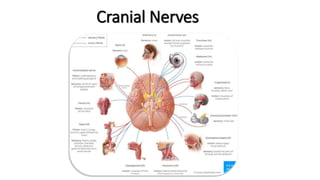
Cranial Nerves
• Cranial nerves are the 12 nerves of the peripheral nervous system that emerge
from the foramina and fissures of the cranium .
• All cranial nerves originate from nuclei in the brain .
• Two originate from the forebrain (olfactory and Optic ) , one has a nucleus in the
spinal cord (accessory) , while the remainder originate from the brainstem .
• List of cranial nerves are :-
1. Olfactory 2. Optic
3. Oculomotor 4. Trochlear
5. Trigeminal 6. Abducens
7. Facial 8. Vestibulocochlear
9. Glossopharyngeal 10. Vagus
11. Accessory 12.Hypoglossal
Olfactory Nerve (CN I)
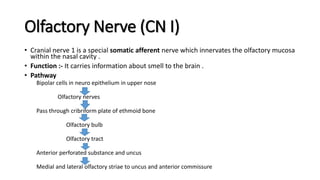
• Cranial nerve 1 is a special somatic afferent nerve which innervates the olfactory mucosa
within the nasal cavity .
• Function :- It carries information about smell to the brain .
• Pathway
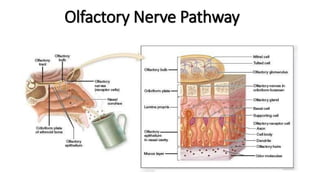
Bipolar cells in neuro epithelium in upper nose
Olfactory nerves
Pass through cribriform plate of ethmoid bone
Olfactory bulb
Olfactory tract
Anterior perforated substance and uncus
Medial and lateral olfactory striae to uncus and anterior commissure
Olfactory Nerve Pathway
Optic Nerve (CN II)
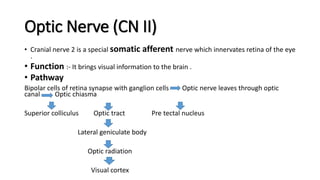
• Cranial nerve 2 is a special somatic afferent nerve which innervates retina of the eye
.
• Function :- It brings visual information to the brain .
• Pathway
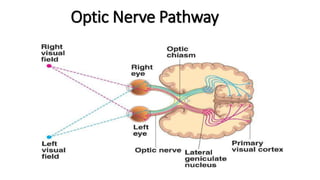
Bipolar cells of retina synapse with ganglion cells Optic nerve leaves through optic
canal Optic chiasma
Superior colliculus Optic tract Pre tectal nucleus
Lateral geniculate body
Optic radiation
Visual cortex
Optic Nerve Pathway
Oculomotor Nerve (CN III)
• Cranial nerve 3 is both a somatic and visceral efferent motor nerve . It
has two nuclei and carries two types of efferent fibers .
• Function :- It innervates eye muscles and enables eye movement ,
constriction of the pupil and lens .
• Pathway
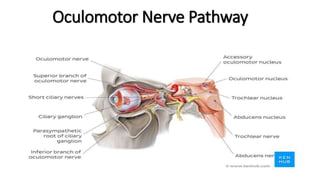
Emerges through midbrain (ventrally) between posterior cerebral and
superior cerebellar branches of basilar artery Lateral wall of cavernous
sinus Divides into superior and inferior division Superior orbital
fissure Orbit Muscles of orbit except lateral rectus and superior
oblique (branch to inferior oblique carries parasympathetic fibers )
Oculomotor Nerve Pathway
Trochlear Nerve (CN IV)
• Cranial nerve 4 is a general somatic motor nerve .
• Function :- It supplies one extraocular muscle thus playing a role in eye movement .
• Pathway
Emerges dorsally from midbrain just inferior to the inferior colliculi
Curves around cerebral peduncles between posterior cerebral and superior cerebellar branches of basilar
artery
Enters lateral wall of cavernous sinus below 3rd nerve
Superior orbital fissure
Orbital cavity
Superior oblique muscles
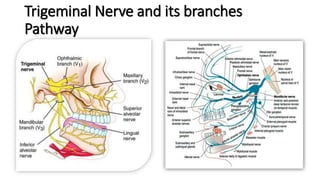
Trigeminal Nerve (CN V)
• Cranial nerve 5 is a mixed nerve ,containing both special visceral and
general somatic fibers .
• Function :- It supplies sensation to the facial skin .
• Pathway
Emerges from pons ventrally by a large sensory and smaller motor root
Traverses post. Cranial fossa Reaches apex of petrous part of
temporal bone in middle cranial fossa Trigeminal ganglion
Divides into 3 division
Trigeminal Nerve and its branches
Pathway
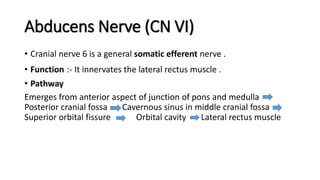
Abducens Nerve (CN VI)
• Cranial nerve 6 is a general somatic efferent nerve .
• Function :- It innervates the lateral rectus muscle .
• Pathway
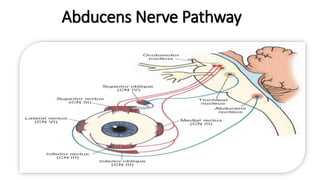
Emerges from anterior aspect of junction of pons and medulla
Posterior cranial fossa Cavernous sinus in middle cranial fossa
Superior orbital fissure Orbital cavity Lateral rectus muscle
Abducens Nerve Pathway
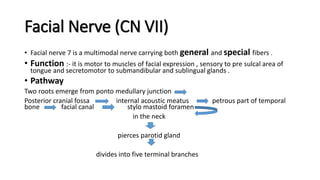
Facial Nerve (CN VII)
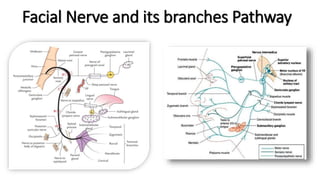
• Facial nerve 7 is a multimodal nerve carrying both general and special fibers .
• Function :- it is motor to muscles of facial expression , sensory to pre sulcal area of
tongue and secretomotor to submandibular and sublingual glands .
• Pathway
Two roots emerge from ponto medullary junction
Posterior cranial fossa internal acoustic meatus petrous part of temporal
bone facial canal stylo mastoid foramen
in the neck
pierces parotid gland
divides into five terminal branches
Facial Nerve and its branches Pathway
Vestibulocochlear Nerve (CN VIII)
• Cranial nerve 8 is a special somatic afferent nerve . It is composed of two parts :
the vestibular nerve and the cochlear nerve .
• Function :- cochlear component enables hearing and vestibular component mediates
balance and motion .
• Pathway
Vestibular component arise from vestibular nuclei complex in pons and medulla
cochlear component arise from ventral and dorsal cochlear nuclei in the inferior
cerebellar peduncle
Both sets combine in pons to form vestibulocochlear nerve
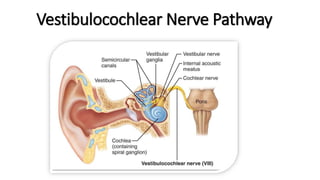
Nerve emerge from brain at cerebellopontine angle and exit cranium via internal acoustic
meatus at the distal end of internal acoustic meatus nerve splits forming
vestibular and cochlear nerve
Vestibulocochlear Nerve Pathway
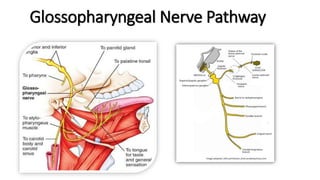
Glossopharyngeal Nerve (CN IX)
• Cranial nerve 9 is a multimodal mixed nerve .
• Function :- It supplies stylopharyngeus muscle , secretomotor fibers to
parotid gland and sensory fibers to tonsil , pharynx and posterior 1/3 of
tongue .
• Pathway
Glossopharyngeal nerve originates in the medulla oblongata of the brain
It emerges from the anterior aspect of medulla , moving laterally in the
posterior cranial fossa
The nerve leaves the cranium via jugular foramen
Glossopharyngeal Nerve Pathway
Vagus Nerve (CN X)
• Vagus nerve is a multimodal mixed nerve . It is the longest cranial nerve and only one which leaves head
and neck region .
• Function :- Vagus nerve controls number of functions including gland secretions , peristalsis , phonation ,
taste , visceral and general sensation of head , thorax and abdomen .
• Pathway
Emerges from upper medulla through posterolateral fissure (8-10 rootlets)
Posterior cranial fossa
Jugular foramen
Carotid sheath
Lies ant. to 1st part of subclavian artery thorax
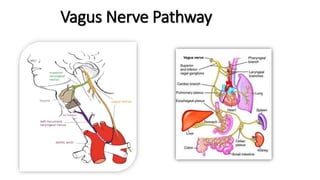
Vagus Nerve Pathway
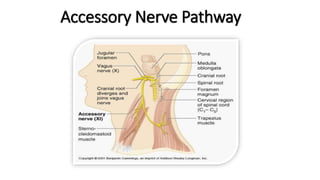
Accessory nerve (CN XI)
• Cranial nerve 11 is an efferent nerve . It has two roots spinal and cranial .
• Function :- It innervates sternocleidomastoid and trapezius muscle .
• Pathway
Spinal portion arises from neurons of upper spinal cord specially C1-6 spinal
nerve roots
These fibers coalesce to form spinal part of accessory nerve , which runs
superiorly to enter cranial cavity via foramen magnum
Cranial portion arises from medulla oblongata and leaves the cranium via
jugular foramen
Accessory Nerve Pathway
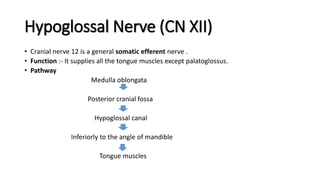
Hypoglossal Nerve (CN XII)
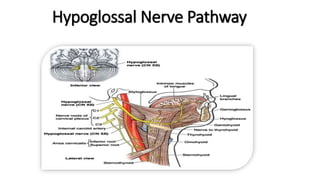
• Cranial nerve 12 is a general somatic efferent nerve .
• Function :- It supplies all the tongue muscles except palatoglossus.
• Pathway
Medulla oblongata
Posterior cranial fossa
Hypoglossal canal
Inferiorly to the angle of mandible
Tongue muscles
Hypoglossal Nerve Pathway
Cranial nerves ppt

Cranial nerves ppt

  • 1.
    Name :- Aminamunawar Roll no. :- 15003 Assignment :- cranial nerves
  • 2.
  • 3.
    Cranial Nerves • Cranialnerves are the 12 nerves of the peripheral nervous system that emerge from the foramina and fissures of the cranium . • All cranial nerves originate from nuclei in the brain . • Two originate from the forebrain (olfactory and Optic ) , one has a nucleus in the spinal cord (accessory) , while the remainder originate from the brainstem . • List of cranial nerves are :- 1. Olfactory 2. Optic 3. Oculomotor 4. Trochlear 5. Trigeminal 6. Abducens 7. Facial 8. Vestibulocochlear 9. Glossopharyngeal 10. Vagus 11. Accessory 12.Hypoglossal
  • 4.
    Olfactory Nerve (CNI) • Cranial nerve 1 is a special somatic afferent nerve which innervates the olfactory mucosa within the nasal cavity . • Function :- It carries information about smell to the brain . • Pathway Bipolar cells in neuro epithelium in upper nose Olfactory nerves Pass through cribriform plate of ethmoid bone Olfactory bulb Olfactory tract Anterior perforated substance and uncus Medial and lateral olfactory striae to uncus and anterior commissure
  • 5.
  • 6.
    Optic Nerve (CNII) • Cranial nerve 2 is a special somatic afferent nerve which innervates retina of the eye . • Function :- It brings visual information to the brain . • Pathway Bipolar cells of retina synapse with ganglion cells Optic nerve leaves through optic canal Optic chiasma Superior colliculus Optic tract Pre tectal nucleus Lateral geniculate body Optic radiation Visual cortex
  • 7.
  • 8.
    Oculomotor Nerve (CNIII) • Cranial nerve 3 is both a somatic and visceral efferent motor nerve . It has two nuclei and carries two types of efferent fibers . • Function :- It innervates eye muscles and enables eye movement , constriction of the pupil and lens . • Pathway Emerges through midbrain (ventrally) between posterior cerebral and superior cerebellar branches of basilar artery Lateral wall of cavernous sinus Divides into superior and inferior division Superior orbital fissure Orbit Muscles of orbit except lateral rectus and superior oblique (branch to inferior oblique carries parasympathetic fibers )
  • 9.
  • 10.
    Trochlear Nerve (CNIV) • Cranial nerve 4 is a general somatic motor nerve . • Function :- It supplies one extraocular muscle thus playing a role in eye movement . • Pathway Emerges dorsally from midbrain just inferior to the inferior colliculi Curves around cerebral peduncles between posterior cerebral and superior cerebellar branches of basilar artery Enters lateral wall of cavernous sinus below 3rd nerve Superior orbital fissure Orbital cavity Superior oblique muscles
  • 11.
    Trigeminal Nerve (CNV) • Cranial nerve 5 is a mixed nerve ,containing both special visceral and general somatic fibers . • Function :- It supplies sensation to the facial skin . • Pathway Emerges from pons ventrally by a large sensory and smaller motor root Traverses post. Cranial fossa Reaches apex of petrous part of temporal bone in middle cranial fossa Trigeminal ganglion Divides into 3 division
  • 12.
    Trigeminal Nerve andits branches Pathway
  • 13.
    Abducens Nerve (CNVI) • Cranial nerve 6 is a general somatic efferent nerve . • Function :- It innervates the lateral rectus muscle . • Pathway Emerges from anterior aspect of junction of pons and medulla Posterior cranial fossa Cavernous sinus in middle cranial fossa Superior orbital fissure Orbital cavity Lateral rectus muscle
  • 14.
  • 15.
    Facial Nerve (CNVII) • Facial nerve 7 is a multimodal nerve carrying both general and special fibers . • Function :- it is motor to muscles of facial expression , sensory to pre sulcal area of tongue and secretomotor to submandibular and sublingual glands . • Pathway Two roots emerge from ponto medullary junction Posterior cranial fossa internal acoustic meatus petrous part of temporal bone facial canal stylo mastoid foramen in the neck pierces parotid gland divides into five terminal branches
  • 16.
    Facial Nerve andits branches Pathway
  • 17.
    Vestibulocochlear Nerve (CNVIII) • Cranial nerve 8 is a special somatic afferent nerve . It is composed of two parts : the vestibular nerve and the cochlear nerve . • Function :- cochlear component enables hearing and vestibular component mediates balance and motion . • Pathway Vestibular component arise from vestibular nuclei complex in pons and medulla cochlear component arise from ventral and dorsal cochlear nuclei in the inferior cerebellar peduncle Both sets combine in pons to form vestibulocochlear nerve Nerve emerge from brain at cerebellopontine angle and exit cranium via internal acoustic meatus at the distal end of internal acoustic meatus nerve splits forming vestibular and cochlear nerve
  • 18.
  • 19.
    Glossopharyngeal Nerve (CNIX) • Cranial nerve 9 is a multimodal mixed nerve . • Function :- It supplies stylopharyngeus muscle , secretomotor fibers to parotid gland and sensory fibers to tonsil , pharynx and posterior 1/3 of tongue . • Pathway Glossopharyngeal nerve originates in the medulla oblongata of the brain It emerges from the anterior aspect of medulla , moving laterally in the posterior cranial fossa The nerve leaves the cranium via jugular foramen
  • 20.
  • 21.
    Vagus Nerve (CNX) • Vagus nerve is a multimodal mixed nerve . It is the longest cranial nerve and only one which leaves head and neck region . • Function :- Vagus nerve controls number of functions including gland secretions , peristalsis , phonation , taste , visceral and general sensation of head , thorax and abdomen . • Pathway Emerges from upper medulla through posterolateral fissure (8-10 rootlets) Posterior cranial fossa Jugular foramen Carotid sheath Lies ant. to 1st part of subclavian artery thorax
  • 22.
  • 23.
    Accessory nerve (CNXI) • Cranial nerve 11 is an efferent nerve . It has two roots spinal and cranial . • Function :- It innervates sternocleidomastoid and trapezius muscle . • Pathway Spinal portion arises from neurons of upper spinal cord specially C1-6 spinal nerve roots These fibers coalesce to form spinal part of accessory nerve , which runs superiorly to enter cranial cavity via foramen magnum Cranial portion arises from medulla oblongata and leaves the cranium via jugular foramen
  • 24.
  • 25.
    Hypoglossal Nerve (CNXII) • Cranial nerve 12 is a general somatic efferent nerve . • Function :- It supplies all the tongue muscles except palatoglossus. • Pathway Medulla oblongata Posterior cranial fossa Hypoglossal canal Inferiorly to the angle of mandible Tongue muscles
  • 26.