Human Anatomy and Physiology-II
Nervous system
(Brain-Cerebrum)
Mr N.JEGAN
Associate Professor
K.M.COLLEGE OF PHARMACY.
MADURAI.
Brain-Introduction
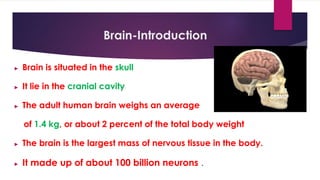
► Brain is situated in the skull
► It lie in the cranial cavity
► The adult human brain weighs an average
of 1.4 kg, or about 2 percent of the total body weight
► The brain is the largest mass of nervous tissue in the body.
► It made up of about 100 billion neurons .
Brain-Layers
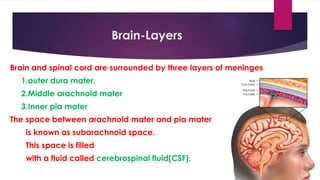
Brain and spinal cord are surrounded by three layers of meninges
1.outer dura mater,
2.Middle arachnoid mater
3.Inner pia mater
The space between arachnoid mater and pia mater
is known as subarachnoid space.
This space is filled
with a fluid called cerebrospinal fluid(CSF).
Parts of Brain
Cerebrum
Cerebrum (forebrain)
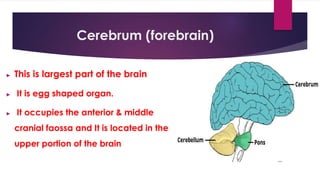
► This is largest part of the brain
► It is egg shaped organ.
► It occupies the anterior & middle
cranial faossa and It is located in the
upper portion of the brain
Layers of the Cerebrum
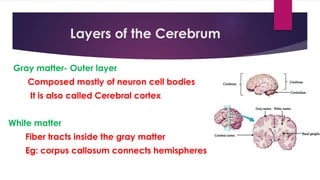
Gray matter- Outer layer
Composed mostly of neuron cell bodies
It is also called Cerebral cortex
White matter
Fiber tracts inside the gray matter
Eg: corpus callosum connects hemispheres
cerebral hemispheres
► It is divided by a deep cleft, the longitudinal cerebral fissure, into right and
left cerebral hemispheres, each containing one of the lateral ventricles.
► Deep within the brain the hemispheres are connected by a mass of white
matter (nerve fibres) called the corpus callosum.
Lobes of the Cerebrum
Each hemisphere of the cerebrum is divided into lobes which take the
names of the bones of the cranium under
which they lie:
1.Frontal lobe
2. Parietal lobe
3. Temporal lobe
4. Occipital lobe
Sulcus
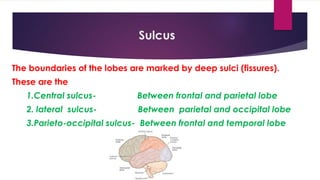
The boundaries of the lobes are marked by deep sulci (fissures).
These are the
1.Central sulcus- Between frontal and parietal lobe
2. lateral sulcus- Between parietal and occipital lobe
3.Parieto-occipital sulcus- Between frontal and temporal lobe
Cerebral lobe -Functions
► Frontal lobe:-
Center of reasoning, Planning, Emotion, Speech,Problem solving.
► Parietal lobe:-
Receive sensory input from Skin (touch, pain, perception etc.
► Occipital lobe:-
Receive input from eye.
► Temporal lobe:-
Hearing, Memory, Speech
Functional Areas of the Cerebrum
The main areas of the cerebrum associated with
1. Motor areas of the cerebrum
Skeletal muscle activity
2. Sensory area
Sensory perception
3. Association area
It control the complex activity in our body.
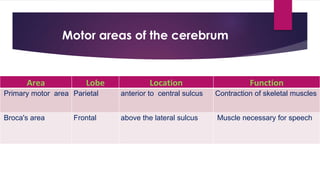
Motor areas of the cerebrum
Area Lobe Location Function
Primary motor area Parietal anterior to central sulcus Contraction of skeletal muscles
Broca's area Frontal above the lateral sulcus Muscle necessary for speech
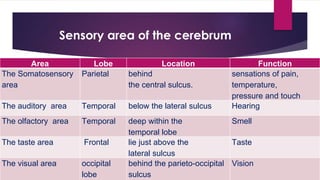
Sensory area of the cerebrum
Area Lobe Location Function
The Somatosensory
area
Parietal behind
the central sulcus.
sensations of pain,
temperature,
pressure and touch
The auditory area Temporal below the lateral sulcus Hearing
The olfactory area Temporal deep within the
temporal lobe
Smell
The taste area Frontal lie just above the
lateral sulcus
Taste
The visual area occipital
lobe
behind the parieto-occipital
sulcus
Vision
Association areas of the cerebrum
Area Lobe Location Function
Premotor area Frontal Anterior to the motor area Learned pattern of
movements. For eg. Tying a
shoe lace or writing
The frontal area Frontal Anteriorly from the
premotor area
Behaviour, character and
emotional
Wernick's area Temporal Near parieto-occipital
sulcus
Intelligence, Language and
spoken word perceived
Functions of the cerebrum
1.Mental activities involved in memory, intelligence, sense of
responsibility, thinking, reasoning, moral sense and learning.
2. Sensory perception, including the perception of pain,
temperature, touch, sight, hearing, taste and smell
3. Initiation and control of skeletal (voluntary) muscle contraction.
Thank you

Cerebrum

  • 1.
    Human Anatomy andPhysiology-II Nervous system (Brain-Cerebrum) Mr N.JEGAN Associate Professor K.M.COLLEGE OF PHARMACY. MADURAI.
  • 2.
    Brain-Introduction ► Brain issituated in the skull ► It lie in the cranial cavity ► The adult human brain weighs an average of 1.4 kg, or about 2 percent of the total body weight ► The brain is the largest mass of nervous tissue in the body. ► It made up of about 100 billion neurons .
  • 3.
    Brain-Layers Brain and spinalcord are surrounded by three layers of meninges 1.outer dura mater, 2.Middle arachnoid mater 3.Inner pia mater The space between arachnoid mater and pia mater is known as subarachnoid space. This space is filled with a fluid called cerebrospinal fluid(CSF).
  • 4.
  • 6.
  • 7.
    Cerebrum (forebrain) ► Thisis largest part of the brain ► It is egg shaped organ. ► It occupies the anterior & middle cranial faossa and It is located in the upper portion of the brain
  • 8.
    Layers of theCerebrum Gray matter- Outer layer Composed mostly of neuron cell bodies It is also called Cerebral cortex White matter Fiber tracts inside the gray matter Eg: corpus callosum connects hemispheres
  • 9.
    cerebral hemispheres ► Itis divided by a deep cleft, the longitudinal cerebral fissure, into right and left cerebral hemispheres, each containing one of the lateral ventricles. ► Deep within the brain the hemispheres are connected by a mass of white matter (nerve fibres) called the corpus callosum.
  • 10.
    Lobes of theCerebrum Each hemisphere of the cerebrum is divided into lobes which take the names of the bones of the cranium under which they lie: 1.Frontal lobe 2. Parietal lobe 3. Temporal lobe 4. Occipital lobe
  • 11.
    Sulcus The boundaries ofthe lobes are marked by deep sulci (fissures). These are the 1.Central sulcus- Between frontal and parietal lobe 2. lateral sulcus- Between parietal and occipital lobe 3.Parieto-occipital sulcus- Between frontal and temporal lobe
  • 12.
    Cerebral lobe -Functions ►Frontal lobe:- Center of reasoning, Planning, Emotion, Speech,Problem solving. ► Parietal lobe:- Receive sensory input from Skin (touch, pain, perception etc. ► Occipital lobe:- Receive input from eye. ► Temporal lobe:- Hearing, Memory, Speech
  • 13.
    Functional Areas ofthe Cerebrum The main areas of the cerebrum associated with 1. Motor areas of the cerebrum Skeletal muscle activity 2. Sensory area Sensory perception 3. Association area It control the complex activity in our body.
  • 14.
    Motor areas ofthe cerebrum Area Lobe Location Function Primary motor area Parietal anterior to central sulcus Contraction of skeletal muscles Broca's area Frontal above the lateral sulcus Muscle necessary for speech
  • 15.
    Sensory area ofthe cerebrum Area Lobe Location Function The Somatosensory area Parietal behind the central sulcus. sensations of pain, temperature, pressure and touch The auditory area Temporal below the lateral sulcus Hearing The olfactory area Temporal deep within the temporal lobe Smell The taste area Frontal lie just above the lateral sulcus Taste The visual area occipital lobe behind the parieto-occipital sulcus Vision
  • 16.
    Association areas ofthe cerebrum Area Lobe Location Function Premotor area Frontal Anterior to the motor area Learned pattern of movements. For eg. Tying a shoe lace or writing The frontal area Frontal Anteriorly from the premotor area Behaviour, character and emotional Wernick's area Temporal Near parieto-occipital sulcus Intelligence, Language and spoken word perceived
  • 18.
    Functions of thecerebrum 1.Mental activities involved in memory, intelligence, sense of responsibility, thinking, reasoning, moral sense and learning. 2. Sensory perception, including the perception of pain, temperature, touch, sight, hearing, taste and smell 3. Initiation and control of skeletal (voluntary) muscle contraction.
  • 19.