Peripheral Nervous System
    Brian J. Piper, Ph.D., M.S.
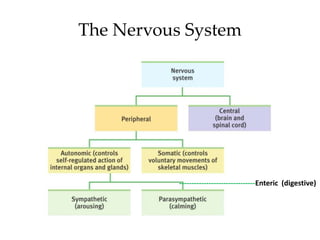
The Nervous System


           -------------------------------Enteric (digestive)
Goals
• Anatomy & Physiology of:
  – Somatic Nervous System
  – Autonomic Nervous System
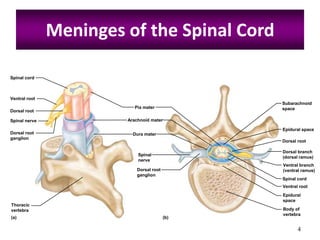
Meninges of the Spinal Cord

Spinal cord


Ventral root
                                                Subarachnoid
                           Pia mater            space
Dorsal root

Spinal nerve            Arachnoid mater

                                                Epidural space
Dorsal root               Dura mater
ganglion
                                                Dorsal root

                                                Dorsal branch
                            Spinal
                                                (dorsal ramus)
                            nerve
                                                Ventral branch
                            Dorsal root         (ventral ramus)
                            ganglion
                                                Spinal cord
                                                Ventral root
                                                Epidural
                                                space
Thoracic
vertebra                                        Body of
                                                vertebra
(a)                                       (b)

                                                       4
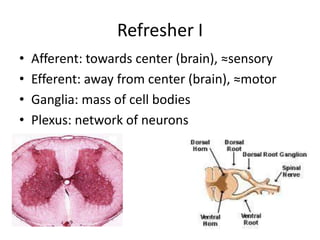
Refresher I
•   Afferent: towards center (brain), ≈sensory
•   Efferent: away from center (brain), ≈motor
•   Ganglia: mass of cell bodies
•   Plexus: network of neurons
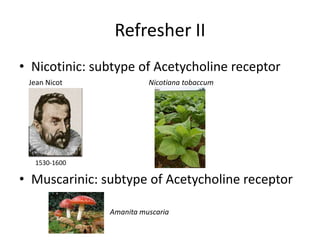
Refresher II
• Nicotinic: subtype of Acetycholine receptor
 Jean Nicot              Nicotiana tobaccum


  1530-1600

• Muscarinic: subtype of Acetycholine receptor

               Amanita muscaria
Peripheral Nervous System

• Cranial nerves arising from the brain
    • Somatic fibers connecting to the skin and skeletal muscles
    • Autonomic fibers connecting to viscera

• Spinal nerves arising from the spinal cord
    • Somatic fibers connecting to the skin and skeletal muscles
    • Autonomic fibers connecting to viscera


                                                                   7
12 Cranial Nerves
   • On Old Olympic Towering Tops A Finn And
     German Viewed Some Hops
   • Once One Openly Told Tourists About Fighting
     Vampires Gobling Various Antelope Herds
   • Oh Once One Takes The Anatomy Final Very
     Good Vacations Are Heavenly


http://en.wikipedia.org/wiki/List_of_mnemonics_for_the_cranial_nerves
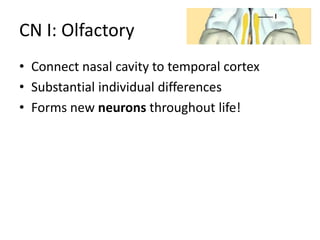
CN I: Olfactory
• Connect nasal cavity to temporal cortex
• Substantial individual differences
• Forms new neurons throughout life!
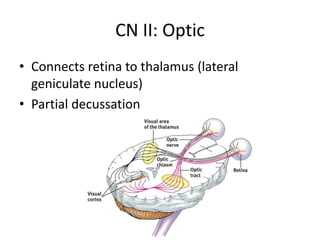
CN II: Optic
• Connects retina to thalamus (lateral
  geniculate nucleus)
• Partial decussation
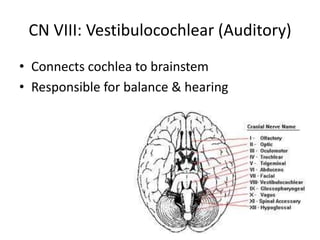
CN VIII: Vestibulocochlear (Auditory)
• Connects cochlea to brainstem
• Responsible for balance & hearing
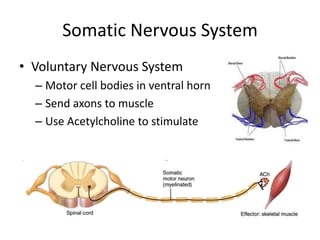
Somatic Nervous System
• Voluntary Nervous System
  – Motor cell bodies in ventral horn
  – Send axons to muscle
  – Use Acetylcholine to stimulate
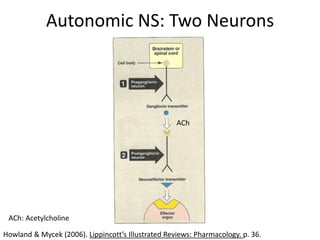
Autonomic NS: Two Neurons


                                                    ACh


 ACh: Acetylcholine

Howland & Mycek (2006). Lippincott’s Illustrated Reviews: Pharmacology. p. 36.
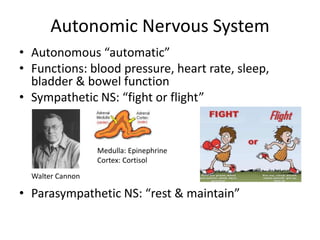
Autonomic Nervous System
• Autonomous “automatic”
• Functions: blood pressure, heart rate, sleep,
  bladder & bowel function
• Sympathetic NS: “fight or flight”


                  Medulla: Epinephrine
                  Cortex: Cortisol
  Walter Cannon

• Parasympathetic NS: “rest & maintain”
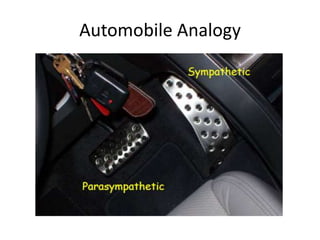
Automobile Analogy
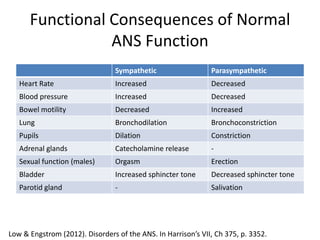
Functional Consequences of Normal
                 ANS Function
                                 Sympathetic                  Parasympathetic
   Heart Rate                    Increased                    Decreased
   Blood pressure                Increased                    Decreased
   Bowel motility                Decreased                    Increased
   Lung                          Bronchodilation              Bronchoconstriction
   Pupils                        Dilation                     Constriction
   Adrenal glands                Catecholamine release        -
   Sexual function (males)       Orgasm                       Erection
   Bladder                       Increased sphincter tone     Decreased sphincter tone
   Parotid gland                 -                            Salivation


Low & Engstrom (2012). Disorders of the ANS. In Harrison’s VII, Ch 375, p. 3352.
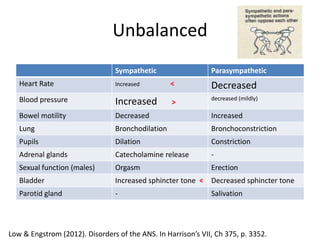
Unbalanced
                                 Sympathetic                  Parasympathetic
   Heart Rate                    Increased         <          Decreased
   Blood pressure                                             decreased (mildly)
                                 Increased         >
   Bowel motility                Decreased                    Increased
   Lung                          Bronchodilation              Bronchoconstriction
   Pupils                        Dilation                     Constriction
   Adrenal glands                Catecholamine release        -
   Sexual function (males)       Orgasm                       Erection
   Bladder                       Increased sphincter tone < Decreased sphincter tone
   Parotid gland                 -                            Salivation


Low & Engstrom (2012). Disorders of the ANS. In Harrison’s VII, Ch 375, p. 3352.
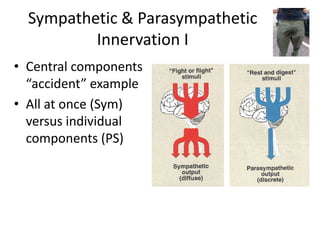
Sympathetic & Parasympathetic
          Innervation I
• Central components
  “accident” example
• All at once (Sym)
  versus individual
  components (PS)
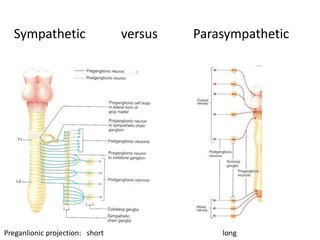
Sympathetic                    versus   Parasympathetic


Preganlionic projection: short                long
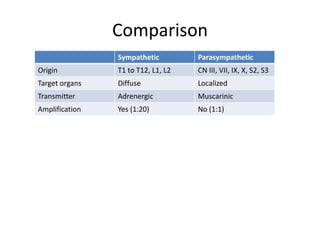
Comparison
                Sympathetic         Parasympathetic
Origin          T1 to T12, L1, L2   CN III, VII, IX, X, S2, S3
Target organs   Diffuse             Localized
Transmitter     Adrenergic          Muscarinic
Amplification   Yes (1:20)          No (1:1)
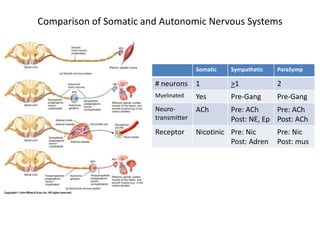
Comparison of Somatic and Autonomic Nervous Systems


                                      Somatic   Sympathetic   ParaSymp

                        # neurons     1         >1            2
                        Myelinated    Yes       Pre-Gang      Pre-Gang
                        Neuro-        ACh       Pre: ACh     Pre: ACh
                        transmitter             Post: NE, Ep Post: ACh
                        Receptor      Nicotinic Pre: Nic      Pre: Nic
                                                Post: Adren   Post: mus
Light Reading


O:15 to 3:58: http://www.youtube.com/watch?v=sPS7GnromGo
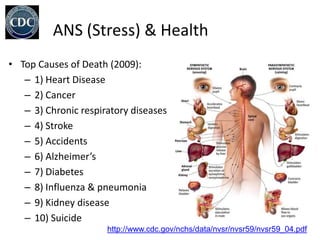
ANS (Stress) & Health
• Top Causes of Death (2009):
   – 1) Heart Disease
   – 2) Cancer
   – 3) Chronic respiratory diseases
   – 4) Stroke
   – 5) Accidents
   – 6) Alzheimer’s
   – 7) Diabetes
   – 8) Influenza & pneumonia
   – 9) Kidney disease
   – 10) Suicide
                      http://www.cdc.gov/nchs/data/nvsr/nvsr59/nvsr59_04.pdf

Introduction to the PNS

  • 1.
    Peripheral Nervous System Brian J. Piper, Ph.D., M.S.
  • 2.
    The Nervous System -------------------------------Enteric (digestive)
  • 3.
    Goals • Anatomy &Physiology of: – Somatic Nervous System – Autonomic Nervous System
  • 4.
    Meninges of theSpinal Cord Spinal cord Ventral root Subarachnoid Pia mater space Dorsal root Spinal nerve Arachnoid mater Epidural space Dorsal root Dura mater ganglion Dorsal root Dorsal branch Spinal (dorsal ramus) nerve Ventral branch Dorsal root (ventral ramus) ganglion Spinal cord Ventral root Epidural space Thoracic vertebra Body of vertebra (a) (b) 4
  • 5.
    Refresher I • Afferent: towards center (brain), ≈sensory • Efferent: away from center (brain), ≈motor • Ganglia: mass of cell bodies • Plexus: network of neurons
  • 6.
    Refresher II • Nicotinic:subtype of Acetycholine receptor Jean Nicot Nicotiana tobaccum 1530-1600 • Muscarinic: subtype of Acetycholine receptor Amanita muscaria
  • 7.
    Peripheral Nervous System •Cranial nerves arising from the brain • Somatic fibers connecting to the skin and skeletal muscles • Autonomic fibers connecting to viscera • Spinal nerves arising from the spinal cord • Somatic fibers connecting to the skin and skeletal muscles • Autonomic fibers connecting to viscera 7
  • 8.
    12 Cranial Nerves • On Old Olympic Towering Tops A Finn And German Viewed Some Hops • Once One Openly Told Tourists About Fighting Vampires Gobling Various Antelope Herds • Oh Once One Takes The Anatomy Final Very Good Vacations Are Heavenly http://en.wikipedia.org/wiki/List_of_mnemonics_for_the_cranial_nerves
  • 9.
    CN I: Olfactory •Connect nasal cavity to temporal cortex • Substantial individual differences • Forms new neurons throughout life!
  • 10.
    CN II: Optic •Connects retina to thalamus (lateral geniculate nucleus) • Partial decussation
  • 11.
    CN VIII: Vestibulocochlear(Auditory) • Connects cochlea to brainstem • Responsible for balance & hearing
  • 12.
    Somatic Nervous System •Voluntary Nervous System – Motor cell bodies in ventral horn – Send axons to muscle – Use Acetylcholine to stimulate
  • 13.
    Autonomic NS: TwoNeurons ACh ACh: Acetylcholine Howland & Mycek (2006). Lippincott’s Illustrated Reviews: Pharmacology. p. 36.
  • 14.
    Autonomic Nervous System •Autonomous “automatic” • Functions: blood pressure, heart rate, sleep, bladder & bowel function • Sympathetic NS: “fight or flight” Medulla: Epinephrine Cortex: Cortisol Walter Cannon • Parasympathetic NS: “rest & maintain”
  • 15.
  • 16.
    Functional Consequences ofNormal ANS Function Sympathetic Parasympathetic Heart Rate Increased Decreased Blood pressure Increased Decreased Bowel motility Decreased Increased Lung Bronchodilation Bronchoconstriction Pupils Dilation Constriction Adrenal glands Catecholamine release - Sexual function (males) Orgasm Erection Bladder Increased sphincter tone Decreased sphincter tone Parotid gland - Salivation Low & Engstrom (2012). Disorders of the ANS. In Harrison’s VII, Ch 375, p. 3352.
  • 17.
    Unbalanced Sympathetic Parasympathetic Heart Rate Increased < Decreased Blood pressure decreased (mildly) Increased > Bowel motility Decreased Increased Lung Bronchodilation Bronchoconstriction Pupils Dilation Constriction Adrenal glands Catecholamine release - Sexual function (males) Orgasm Erection Bladder Increased sphincter tone < Decreased sphincter tone Parotid gland - Salivation Low & Engstrom (2012). Disorders of the ANS. In Harrison’s VII, Ch 375, p. 3352.
  • 18.
    Sympathetic & Parasympathetic Innervation I • Central components “accident” example • All at once (Sym) versus individual components (PS)
  • 19.
    Sympathetic versus Parasympathetic Preganlionic projection: short long
  • 20.
    Comparison Sympathetic Parasympathetic Origin T1 to T12, L1, L2 CN III, VII, IX, X, S2, S3 Target organs Diffuse Localized Transmitter Adrenergic Muscarinic Amplification Yes (1:20) No (1:1)
  • 21.
    Comparison of Somaticand Autonomic Nervous Systems Somatic Sympathetic ParaSymp # neurons 1 >1 2 Myelinated Yes Pre-Gang Pre-Gang Neuro- ACh Pre: ACh Pre: ACh transmitter Post: NE, Ep Post: ACh Receptor Nicotinic Pre: Nic Pre: Nic Post: Adren Post: mus
  • 22.
    Light Reading O:15 to3:58: http://www.youtube.com/watch?v=sPS7GnromGo
  • 23.
    ANS (Stress) &Health • Top Causes of Death (2009): – 1) Heart Disease – 2) Cancer – 3) Chronic respiratory diseases – 4) Stroke – 5) Accidents – 6) Alzheimer’s – 7) Diabetes – 8) Influenza & pneumonia – 9) Kidney disease – 10) Suicide http://www.cdc.gov/nchs/data/nvsr/nvsr59/nvsr59_04.pdf