STRUCTURE & FUNCTION OF CELL COMPONENTS
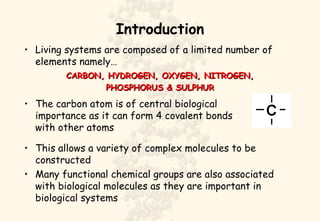
Introduction Living systems are composed of a limited number of elements namely… CARBON, HYDROGEN, OXYGEN, NITROGEN, PHOSPHORUS & SULPHUR The carbon atom is of central biological importance as it can form 4 covalent bonds with other atoms This allows a variety of complex molecules to be constructed Many functional chemical groups are also associated with biological molecules as they are important in biological systems
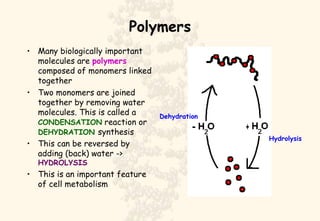
Polymers Many biologically important molecules are  polymers  composed of monomers linked together Two monomers are joined together by removing water molecules. This is called a  CONDENSATION  reaction or  DEHYDRATION  synthesis This can be reversed by adding (back) water ->  HYDROLYSIS This is an important feature of cell metabolism Dehydration Hydrolysis
Making and breaking chemical bonds involves  ENERGY Synthesising more complex structures  REQUIRES  energy. These are called  ANABOLIC  or  BIOSYNTHETIC  reactions If there is little overall change in energy, the reactions are  reversible Cell metabolism is tightly controlled to avoid energy chaos
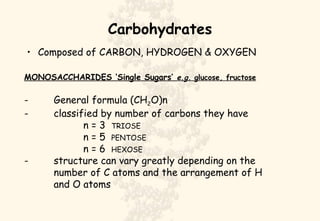
Carbohydrates Composed of CARBON, HYDROGEN & OXYGEN MONOSACCHARIDES ‘Single Sugars’  e.g.  glucose, fructose -  General formula (CH 2 O)n -  classified by number of carbons they have n = 3  TRIOSE n = 5  PENTOSE n = 6  HEXOSE -  structure can vary greatly depending on the  number of C atoms and the arrangement of H  and O atoms
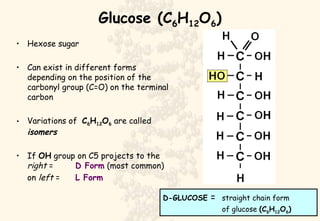
Glucose (C 6 H 12 O 6 ) Hexose sugar Can exist in different forms depending on the position of the carbonyl group (C=O) on the terminal carbon Variations of  C 6 H 12 O 6  are called  isomers If  OH  group on C5 projects to the  right  =  D Form  (most common) on  left  =  L Form D-GLUCOSE  =  straight chain form  of glucose  (C 6 H 12 O 6 )
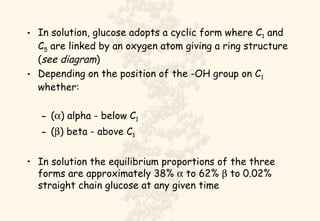
In solution, glucose adopts a cyclic form where C 1  and C 5  are linked by an oxygen atom giving a ring structure ( see diagram ) Depending on the position of the -OH group on C 1  whether: (  ) alpha - below C 1 (  ) beta - above C 1 In solution the equilibrium proportions of the three forms are approximately 38%    to 62%    to 0.02% straight chain glucose at any given time
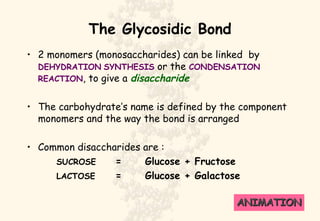
The Glycosidic Bond 2 monomers (monosaccharides) can be linked  by  DEHYDRATION   SYNTHESIS  or the  CONDENSATION REACTION , to give a  disaccharide The carbohydrate’s name is defined by the component monomers and the way the bond is arranged Common disaccharides are : SUCROSE =  Glucose + Fructose LACTOSE = Glucose + Galactose ANIMATION
Polysaccharides Long chains of simple sugars  e.g.   starch ,  glycogen  and  cellulose If the repeating monomers are the  same , they form a  homopolymer . If they are  different  they form a  heteropolymer Polysaccharides are insoluble in water and so make ideal storage compounds The following three polysaccharides are all homopolymers of  glucose  but they have different functions and properties depending on their structure
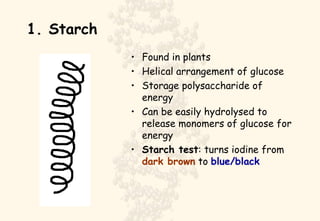
1. Starch Found in plants Helical arrangement of glucose Storage polysaccharide of energy Can be easily hydrolysed to release monomers of glucose for energy Starch test : turns iodine from  dark brown  to  blue/black
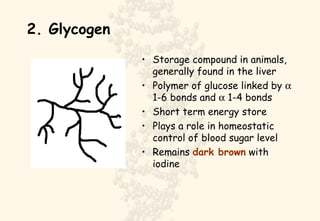
2. Glycogen Storage compound in animals, generally found in the liver Polymer of glucose linked by    1-6 bonds and    1-4 bonds Short term energy store Plays a role in homeostatic control of blood sugar level Remains  dark brown  with iodine
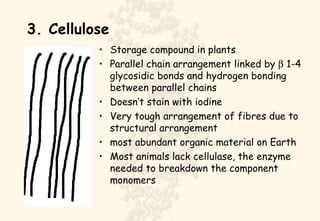
3. Cellulose Storage compound in plants Parallel chain arrangement linked by    1-4 glycosidic bonds and hydrogen bonding between parallel chains Doesn’t stain with iodine Very tough arrangement of fibres due to structural arrangement most abundant organic material on Earth Most animals lack cellulase, the enzyme needed to breakdown the component monomers
4. Chitin A homopolysaccharide similar to cellulose in structure. Component of many insect exoskeletons - very strong and rigid; also resistant to chemicals. 5. Glycosaminoglycans A heteropolymer found in skin and connective tissue of vertebrates
Summary of Carbohydrate Functions Immediate respiratory substrate   e.g.  glucose Energy stores   e.g.  glycogen in mammals, starch in plants Structural components   e.g.  cellulose in plant cell walls, chitin in insect exoskeleton, pentose sugars (ribose & deoxyribose in RNA & DNA) Metabolites   i.e.  intermediates in biochemical pathways Cell to cell attachment molecules   e.g.  glycoproteins or glycolipids on the plasma membrane Transport   e.g.  sucrose in plant phloem tissue

Carbohydrates

  • 1.
    STRUCTURE & FUNCTIONOF CELL COMPONENTS
  • 2.
    Introduction Living systemsare composed of a limited number of elements namely… CARBON, HYDROGEN, OXYGEN, NITROGEN, PHOSPHORUS & SULPHUR The carbon atom is of central biological importance as it can form 4 covalent bonds with other atoms This allows a variety of complex molecules to be constructed Many functional chemical groups are also associated with biological molecules as they are important in biological systems
  • 3.
    Polymers Many biologicallyimportant molecules are polymers composed of monomers linked together Two monomers are joined together by removing water molecules. This is called a CONDENSATION reaction or DEHYDRATION synthesis This can be reversed by adding (back) water -> HYDROLYSIS This is an important feature of cell metabolism Dehydration Hydrolysis
  • 4.
    Making and breakingchemical bonds involves ENERGY Synthesising more complex structures REQUIRES energy. These are called ANABOLIC or BIOSYNTHETIC reactions If there is little overall change in energy, the reactions are reversible Cell metabolism is tightly controlled to avoid energy chaos
  • 5.
    Carbohydrates Composed ofCARBON, HYDROGEN & OXYGEN MONOSACCHARIDES ‘Single Sugars’ e.g. glucose, fructose - General formula (CH 2 O)n - classified by number of carbons they have n = 3 TRIOSE n = 5 PENTOSE n = 6 HEXOSE - structure can vary greatly depending on the number of C atoms and the arrangement of H and O atoms
  • 6.
    Glucose (C 6H 12 O 6 ) Hexose sugar Can exist in different forms depending on the position of the carbonyl group (C=O) on the terminal carbon Variations of C 6 H 12 O 6 are called isomers If OH group on C5 projects to the right = D Form (most common) on left = L Form D-GLUCOSE = straight chain form of glucose (C 6 H 12 O 6 )
  • 7.
    In solution, glucoseadopts a cyclic form where C 1 and C 5 are linked by an oxygen atom giving a ring structure ( see diagram ) Depending on the position of the -OH group on C 1 whether: (  ) alpha - below C 1 (  ) beta - above C 1 In solution the equilibrium proportions of the three forms are approximately 38%  to 62%  to 0.02% straight chain glucose at any given time
  • 8.
    The Glycosidic Bond2 monomers (monosaccharides) can be linked by DEHYDRATION SYNTHESIS or the CONDENSATION REACTION , to give a disaccharide The carbohydrate’s name is defined by the component monomers and the way the bond is arranged Common disaccharides are : SUCROSE = Glucose + Fructose LACTOSE = Glucose + Galactose ANIMATION
  • 9.
    Polysaccharides Long chainsof simple sugars e.g. starch , glycogen and cellulose If the repeating monomers are the same , they form a homopolymer . If they are different they form a heteropolymer Polysaccharides are insoluble in water and so make ideal storage compounds The following three polysaccharides are all homopolymers of glucose but they have different functions and properties depending on their structure
  • 10.
    1. Starch Foundin plants Helical arrangement of glucose Storage polysaccharide of energy Can be easily hydrolysed to release monomers of glucose for energy Starch test : turns iodine from dark brown to blue/black
  • 11.
    2. Glycogen Storagecompound in animals, generally found in the liver Polymer of glucose linked by  1-6 bonds and  1-4 bonds Short term energy store Plays a role in homeostatic control of blood sugar level Remains dark brown with iodine
  • 12.
    3. Cellulose Storagecompound in plants Parallel chain arrangement linked by  1-4 glycosidic bonds and hydrogen bonding between parallel chains Doesn’t stain with iodine Very tough arrangement of fibres due to structural arrangement most abundant organic material on Earth Most animals lack cellulase, the enzyme needed to breakdown the component monomers
  • 13.
    4. Chitin Ahomopolysaccharide similar to cellulose in structure. Component of many insect exoskeletons - very strong and rigid; also resistant to chemicals. 5. Glycosaminoglycans A heteropolymer found in skin and connective tissue of vertebrates
  • 14.
    Summary of CarbohydrateFunctions Immediate respiratory substrate e.g. glucose Energy stores e.g. glycogen in mammals, starch in plants Structural components e.g. cellulose in plant cell walls, chitin in insect exoskeleton, pentose sugars (ribose & deoxyribose in RNA & DNA) Metabolites i.e. intermediates in biochemical pathways Cell to cell attachment molecules e.g. glycoproteins or glycolipids on the plasma membrane Transport e.g. sucrose in plant phloem tissue