Unit-2
Biological molecules
By – Suman Tiwari (M.Sc.,M.Ed.)
Biological molecules
•A biomolecule or biological molecule
•It is a loosely used term for molecules and ions present
in organisms that are essential to one or more
typically biological processes, such as cell
division, morphogenesis, or development .
•Biomolecules are usuallyendogenous, produced within the
organism but organisms usually
need exogenous biomolecules, for example certain nutrients,
to survive.
•Biomolecule: any molecule that is involved in the
maintenance and metabolic processes of living
organisms. Biomolecules include carbohydrate,
lipid, protein, nucleic acid, and water molecules.
Biomolecules consists mainly of carbon and hydrogen
with nitrogen, oxygen, sulphur, and phosphorus.
Biomolecules are very large molecules of many atoms
that are covalently bound together. Biomolecules are
usually endogenous but may also be exogenous.
•All the carbon compounds we get from living tissues can
be called biomolecules.
Biological molecules
•Biology and its subfields of biochemistry and molecular
biology study biomolecules and their reactions. Most
biomolecules are organic compounds, and just
four elements—oxygen, carbon, hydrogen,
and nitrogen—make up 96% of the human body's mass.
But many other elements, such as the various biometals,
are present in small amounts.
Evolution of life – Electric discharge Experiment
https://safeYouTube.net/w/HDBA
Biological molecules
Cells Molecules
Organic Inorganic
-Proteins
-Carbohydrates
-Fats
-Nucleic acid
-Amino acid
-Polysaccharides
-Minerals
( 17 essential in plants
24 essential in animals )
-Ions
-Water
Biological molecules
Living
Cells
Trichloroacetic
acid
Acid insoluble pool
(Molecule have molecular
wt. more than 10000
Daltons)
Acid soluble pool
(Molecule have molecular
wt. 18 to 1000 Daltons)
Biological molecules
Molecular
Weight
Macromolecules
(Above 10000)
Micromolecules
(Between 18 to 1000)
-Monosaccharide
-Disaccharide
-Oligosaccharide
-Amino acids
-Lipids
-Nucleotides
-Polysaccharide
-Proteins
-Nucleic acids
(DNA , RNA )
•Monomer: simple molecule which is used as a basic
building block for the synthesis of a polymer; many
monomers are joined together to make the polymer,
usually by condensation reactions e.g. monosaccharides,
amino acids, nucleic acids.
• Polymer: is a giant molecule made from monomers e.g.
polysaccharides, proteins, nucleic acids.
Types
Natural polymers : Cellulose , Rubber.
Synthetic / Artificial polymer: Polyester, Polythene, PVC
(Polyvinyl chloride and Nylon)
•
Macromolecule: These are large and complex molecules
that are formed due to polymerisation of smaller
monomers e.g. polysaccharides, nucleic acids.
•Carbohydrates (Saccharides)
•Made up of C, H, O in the ratio of 1:2:1
•As they contain: C H2O (Hydrates of C)
•General Formula : Cn H2n O n
•They are of different types based on number of carbon
atoms:
•1. Monosaccharides (1 Carbon)
•2. Disaccharides (2 Carbon)
•3. Oligosaccharides (3-7 Carbon)
•4. Polysaccharides (1000 Carbon monounits)
Carbohydrates
•Number of Carbon : 3-7
3- Carbon: Triose sugar. E.g. -glyceraldehyde
4- Carbon: Tetrose sugar. E.g.- Erythrose
5- Carbon: Pentose sugar. E.g.- Ribose, Arabinose
6- Carbon: Hexose sugar. E.g.- Glucose, Fructose, Galactose.
7- Carbon: Heptose sugar. E.g.-Sedoheptulose.
Monosaccharides
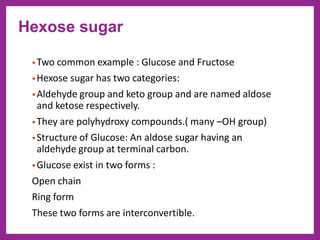
•Two common example : Glucose and Fructose
•Hexose sugar has two categories:
•Aldehyde group and keto group and are named aldose
and ketose respectively.
•They are polyhydroxy compounds.( many –OH group)
•Structure of Glucose: An aldose sugar having an
aldehyde group at terminal carbon.
•Glucose exist in two forms :
Open chain
Ring form
These two forms are interconvertible.
Hexose sugar
Pyranose ring:
5Carbon &
1 Oxygen.
Hexagonal
structure
Structure of Glucose
(Aldose Sugar )
Open chain
Close chain
The bond formed between an aldehyde and hydroxyl group is
called glycosidic bond. This bond is always formed by the
elimination of a water molecule. If this bond is formed
between the same molecule, its called as hemiacetal bond.
Structure of Glucose
Structure of Fructose
(Ketose Sugar )
Pentagonal -
4Carbon &
1 Oxygen
Such ring is
called Furanose
ring
Both Glucose and Fructose are reducing sugars as they convert
cuprus to cupric as they have aldehyde or keto group
Fructose is commonly known as fruit sugar.
Glucose and Fructose are isomers of each other
Open chain Close chain
Structure of Fructose
•C-5 -E.g. Ribose, deoxyribose, Arabinose
Pentose sugar
Ribose sugar has two functional group so it is more
reactive than deoxyribose.
•Disaccharides are formed by joining two monosaccharides
units by a glycosidic bond.
•1. Maltose ,common Malt sugar( Glucose + Glucose)-
Reducing sugar as one aldehyde group is present.
Disaccharides
1-4, glycosidic bond
•2. Sucrose, common cane sugar (Glucose + Fructose). It
is a non-reducing sugar as no functional group.
Disaccharides
•3. Lactose, common milk sugar(Glucose + Galactose). It is
a reducing sugar.
Disaccharides
1-4, Glycosidic bond
The principal reagent in Benedict's Test for Reducing Sugars
is Benedict's Solution which contains:
•copper(II) sulphate
•sodium carbonate
•sodium citrate
•Reducing sugars are simple sugars and include all
monosaccharides and most disaccarides. Some examples of
monosaccharides are glucose, fructose and
galactose.Examples of reducing disaccharides are lactose
and maltose.
Note that the disaccharide sucrose is not a reducing sugar.
In fact, sucrose is the most common non-reducing sugar.
Video Link :https://safeYouTube.net/w/OCmC
Benedict’s Test
Sugars are classified as reducing or non-reducing based
on their ability to act as a reducing agent during the
Benedict's Test. A reducing agent donates electrons
during a redox reaction and is itself oxidized.
The aldehyde functional group is the reducing agent in
reducing sugars. Reducing sugars have either an
aldehyde functional group or have a ketone group - in an
open chain form - which can be converted into an
aldehyde.
• http://brilliantbiologystudent.weebly.com/benedicts-test-for-
reducing-sugars.html
Video for Non-reducing sugar :
https://safeYouTube.net/w/sFmC
http://brilliantbiologystudent.weebly.com/benedicts-test-for-
non-reducing-sugars.html
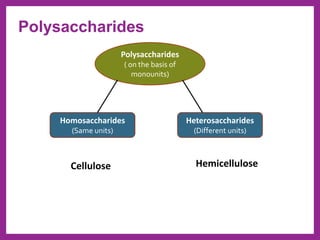
Polysaccharides
Polysaccharides
( on the basis of
monounits)
Homosaccharides
(Same units)
Heterosaccharides
(Different units)
Cellulose Hemicellulose
Polysaccharides
Polysaccharides
( on the basis of
function)
Storage
polysaccharide
Structural
polysaccharides
Starch Cellulose
•Its a storage polysaccharide.
•Its a homopolysaccharide(monounit-Glucose).
•It is made up of two components – Amylose and
Amylopectin.
•Amylose contains 200-2000 glucose chain. It has 1,4-
Glycosidic bond. It has a linear but highly coiled structure
•Amylopectin contains 2000- 20,000 glucose units.It has
1,4- Glycosidic bond as well as 1,6- Glycosidic bond as a
result they have a branched structure.
•Ratio of amylose to amylopectin in a starch molecule is
1:3.
•The blue-black colour of starch with iodine is due to
amylose.
Starch
Starch
•Storage of starch is usually done in grain forms in a cell.
•These grains are classified as simple starch grain and
compound starch grain.
•Simple grain has one point around which the starch
layers deposit.
•Point is made of Hilum.
•If one hilum present then simple starch grain if more
than two compound starch grain.
Starch
• It is a storage polysaccharide. As it found in animals only so also
known as animal starch.
• It is a homopolysaccharide. (Monounit –Glucose)
• It is stored in liver and muscle cells.
• It has 1,4- alpha glycosidic bond( gives linear structure) and many
1,6-glycosidic.
• It produces red colour with Iodine solution.
Glycogen
•It is a structural polysaccharide.(makes cell wall)
•It is a homoplysaccharide. (Monounit –Glucose)
•Bond in case of cellulose is Beta 1,4- Glycosidic bond.
•It has a linear structure.
Uses
•Cotton fibres are 90% cellulose
•Jute, hemp have 40% of cellulose
•Cellulose+ Base= Rayon ( A synthetic fibre)
•Cellulose acetate is used for making shatterproof glass
•Cellulose nitrate is used to make explosives
•Carboxy methyl cellulose is used for making ice-creams.
Cellulose
Cellulose
•It is a homopolysaccharide.
•It is a structural polysaccharide.
•Monounit is N-Acetylglucoseamine.
•It is found in the cell walls of Fungi and exoskeleton of
Arthropods.
Chitin
Inulin
It is a homopolysaccharide.
• Monounit is Fructose.
• It is found in the roots of Dahlia plant
Agar
It is a homopolysaccharide.
• It is a structural polysaccharide.
• Monounit is Galactose.
• It is extracted from red algae.
• It is used to make nutritive medium.
Hemicellulose
It is a heteropolysaccharide.
• Monounit is galactose,Mannose, Xylose and Arabinose.
Some other
polysaccharides
•The polar nature of water molecules
•An important feature of the water molecule is its polar
nature. Polar molecules once placed into water dissolve
and dissociate into water ions. Ionic molecules when
they are placed into water dissociate into ions. Since
oxygen has a higher electronegativity than hydrogen, the
side of the molecule with the oxygen atom has a partial
negative charge. A molecule with such a charge
difference is called a dipole.
Water
Hydrogen bond
•Hydrogen bonding in water
•A bond between molecules where the slightly positive
hydrogen atoms in one water molecule are attracted to
the slightly negative oxygen atom in another water
molecule. The type of attraction is a weak interaction
that occurs between a slightly negatively charged atoms
and a slightly positively charged atom. It is weaker than a
covalent bond but is the strongest intermolecular forces.
Each of the individual hydrogen bonds is weak, where
water forms many of these hydrogen bonds.
•A hydrogen bond is a weak interaction that occurs
between slightly negatively charged atoms and a
slightly positively charged atom.
Water
Many of the properties stated below are due to its dipolar
nature and subsequent hydrogen bonds it forms and
allows.
•1. Solvent
•Water is a good solvent since it is a charged molecule
allowing them to easily be transported alongside this its
water molecule’s dipole nature allows other polar
molecules to be readily dissolved into water. Such
examples of charged polar molecules such as salts,
amino acids and sugars are able to readily dissolved in
water. They are termed as hydrophilic; “water-loving”
molecules. Non-polar molecules such as lipids are
termed as hydrophobic, “water-hating”.
Physical Properties of
water
•2. High heat capacity
•The tendency of water molecules to stick together is
known as cohesion. Hence it would take a lot of heat
energy to separate molecules that are stuck together
rather than if they were not bonded together. Relating
this to water, water does not change temperature very
easily as it has a specific heat capacity of 4.2 J g-1 °C-1
which in simple terms means it takes 4.2 joules of energy
to heat 1 g of water by 1 °C. This is remarkably high and
is what keeps aquatic and cellular environments stable.
Water
•3. High Latent heat of Vaporisation
•Hydrogen bonding between the water molecules allows
it to have a high latent heat of vaporisation. Therefore, a
large amount of energy is needed to change water from
a liquid state into a gaseous state, where evaporation
has a cooling effect on organisms such as sweating in
animals and transpiration in plants.
Water
•3.Density
•Water has a unique property that in a solid state (ice) it
is less dense that the liquid state and is able to float on
water. This property is different for the normal situation
as most substances are in a gas form when they are less
dense and more dense are in a solid state. This shows
how water is different. The property of water makes it
crucial for aquatic organisms to be able to survive in
freezing sub-zero temperatures such as in ponds, lakes
etc.
Water
•4.Cohesion and surface tension in water
• Water has properties of being cohesive, where they have a
tendency to stick to other molecules together. This is due to the
hydrogen bonding within water molecules that causes it to have a
large cohesive forces which allows for the water to be pulled
through a tube for example in plants; xylem vessels which are long
tubes that help in the transportation of water to provide the plan
with mechanical support. Another force called surface tension is
also an unique property of water. Surface tension is the attractive
force that can be exerted upon the surface of other molecules of a
liquid which gives the tendency of the fluid surface to shrink into
minimum surface area rather than the body of water escaping.
Surface tenion of water allows for skaters to walk on water or allow
insects that are usually denser than water, float on a water surface.
Water
• 5. pH
• Water itself is partially ionized and has a source of H+ ions that
cause for several biochemical reactions to be sensitive to pH
changes. Pure water is not buffered at a neutral pH unlike the
cytoplasm and tissue fluids within living organisms that are buffered
at neutral pH 7.5.
• 6. Ionization
• Ionization is the process for forming or splitting of molecules to
their cations and anions. An example is when sodium chloride
(NaCl) dissolve into water they ionize and separate into positive and
negative ions (Na+, Cl–).
Water
Lipids
Lipids
Simple Conjugated
Lipid
derivatives
Esters of fatty
acids and
alcohol
True fats or
Neutral Lipids
Waxes
Esters of fatty acid
and glycerol
Esters of fatty acid
and alcohol other
than glycerol.
Conjugated
Lipid
derivatives
Simple lipid+
Non lipid part
-Phospholipid
-Glycolipid
- Lipoprotein
Sterols Terpenes
•Esters of Fatty acid and Glycerol.
•Fatty acids are classified into two types( -R-COOH )
1. Essential fatty acids
2. Non-essential fatty acids
Essential Fatty acid :
1. Linolic Acid (gives Omega 6)
2. Alpha Linolenic Acid (gives Omega 3)
3. Archedonic Acid (it is synthesised from Linolic acid)
Other then these 3 all other Fatty acids are non-essential
fatty acids.
Simple Lipid: True or
Neutral Fats
• Saturated FA- Hydrocarbon chains have single bonds
• Unsaturated FA- Hydrocarbon chains have double and triple bonds
Types of Fatty Acids
Glycerol head
(Hydrophilic)
Fatty Acid Tail
(Hydrophobic) Amphipathic
Molecules
Based on number of fatty acids chain attached to a
Glycerol head they are of three types:
•Monoglycerides- One tail.
•Diglycerides- Two tails.
•Triglycerides- Three tails.
Hence True fats are of two types:
1. Saturated Fats- Glycerol + saturated fatty acid
(They are solid at room temperature)ex. All animal fats
2. Unsaturated Fats- Glycerol + unsaturated fatty acid
(They are liquid at room temperature)ex. All plant fats
Neutral/True Fats
•Functions of Neutral Fats:
1. Subcutaneous fats are deposited under the skin layer
and act as insulators.
2. Deposited around the organs- to protect it from
mechanical shock
3. Reserve form of energy- stored in body as a reserve
form of energy.
Neutral Fats
Esters of fatty acids and alcohol other than glycerol.
1. Plant waxes- with substance cutin it forms the cuticle
layer in plants. Mostly found in Hydrophytes.
2. Bee wax- Wax produced by honey bees to make their
hives, these are secreted by the wax glands in the last
abdominal segment of worker bees. It is soft and
yellow in colour.
3. Ear wax(Cerumen)- Secreted by cerumen part of
internal ear. It helps to protect our ear drum.
4. Sebum (oil)- Secreted by sebaceous gland .
5. Lanolin-Wool wax
Waxes
• 1. Phospholipid- ex. lecithine . Phospholipid are found in
plasma membrane. They have a phosphate group
attached to the head of a simple lipid.
•2. Glycolipid- It has a carbohydrate group attached to a
simple lipid. It is found on plasma membrane. It a
protective protein.
• 3. Sphinglipids- Lipid + Nitrogen base. It is found in
plasma membrane and nervous tissues.
•4.Lipoprotein- simple lipids + protein. The role
of lipoprotein particles is to transport fat molecules,
such as triacylglycerols (also known as triglycerides),
phospholipids, and cholesterol within the extracellular
water of the body to all the cells and tissues of the body.
Conjugated Lipids
Sterols( steroid alcohol)
1.Phytosterol-If found in plants they are called
phytosterols. Ex. (i)Stigmasterol- obtained from
soyabean, also used to obtain progesterol.
(ii) Sitosterol-obtained from wheat.
2. Engosterol- Obtained from Fungi. Found in plasma
membrane.
3. Zoosterol- Obtained from animals. Ex. Cholesterol. It
acts as an insulators. In plasma membrane it provides
strength to it.
4. Steroid hormones- Progesterone, Testosterone,
oestrogen.
5. Vitamin D.
Derived Lipids
•Terpene- Derivatives of a 5 carbon compound called
Isoprene
•1. Natural rubber- It is a polyterpene
•2. Vitamin A
•3. Carotenoids
They impart specific odour to like Camphor, Eucalyptus
oil, menthol
Derived Lipids
•The Ethanol Emulsion Test is a food test which
determines the presence of a broad group of naturally
occurring compounds known as lipids. Lipids consist
of fats and oils.
Video Link : https://safeYouTube.net/w/eIsD
Sudan III Test
Sudan III is a red fat-soluble dye that is utilized in the
identification of the presence of lipids, triglycerides and
lipoproteins. The Reaction: Sudan III reacts with
the lipids or triglycerides to stain red in colour.
Video Link: https://safeYouTube.net/w/SOsD
Test for the presence of
Lipids
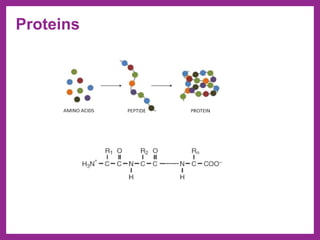
•Proteins are an extremely important class of
macromolecules in living organisms. More than 50% of
the dry mass of most cells is protein.
•All proteins are made from the same basic monomers.
These are amino acids.
Proteins
•There are 20 AA required for protein synthesis.
•There are 100 AA required for other functions of life.
•They are also known as methane derivatives.
•It has an amino group (basic nature) and a carboxyl
group( acidic nature)
Amino acids
•If A = C : Neutral AA. Ex- Glycine, Serine
•If A > C: Basic. Ex- Lysine, Arginine
•If A < C: Acidic. Ex- Glutamic acid, Aspartic acid
Classification of AA
1. Essential AA- Tryptophan, Methionine, Phenylalanine
2. Non- essential AA- Glutamic acid, Aspartic acid, Alanine
3. Semi-essential AA( growth and lactation period)-Histidine,
Arginine
•Video link : https://safeYouTube.net/w/XqFD
Amino acids
• The amino acids of a polypeptide are attached to their neighbours
by covalent bonds known as a peptide bonds. Each bond forms in a
dehydration synthesis (condensation) reaction. During protein
synthesis, the carboxyl group of the amino acid at the end of the
growing polypeptide chain chain reacts with the amino group of an
incoming amino acid, releasing a molecule of water. The resulting
bond between amino acids is a peptide bond.
Peptide bond
•Berzelius suggested the name for molecules studied by Mulder.
•They are also Known as polypeptides.
•On the basis of number of chains it had been divided into :
1. Monomeric protein- made up of only one polypeptide chain .
Ex.: Lysozyme (found in saliva, tears), Myoglobin.
2. Multimeric protein- made up of many polypeptide chains.
Ex.: Haemoglobin( It has two alpha chain and two beta chains ,
hence four polypeptide chains).
Insulin(one alpha and one beta chain).
Protein
(Macromolecule)
Classification on the basis of AA types present:
1. First class/Complete protein- It has all essential and non
essential AA.
Ex. Animal Proteins
2. Second class/ Incomplete protein- It lack some AA.
Ex. Plant Proteins
Proteins
• Classification on the basis of structure:
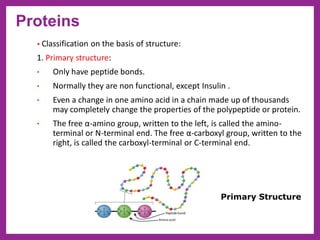
1. Primary structure:
• Only have peptide bonds.
• Normally they are non functional, except Insulin .
• Even a change in one amino acid in a chain made up of thousands
may completely change the properties of the polypeptide or protein.
• The free α-amino group, written to the left, is called the amino-
terminal or N-terminal end. The free α-carboxyl group, written to the
right, is called the carboxyl-terminal or C-terminal end.
Primary Structure
Proteins
Proteins
2. Secondary structure:
• They are structural proteins.
• Along with peptide bonds they also have hydrogen
bonds.
• They make an alpha helix( If hydrogen bond within the
same chain AA) and beta pleated( If hydrogen bond is
between two different polypeptide chain)structure.
• Ex.: Alpha- Keratin, Beta- Silk fibre.
Proteins
The most common helical coil is a right-handed α-helix.
• α-keratin from hair and nails is an α-helical protein.
Myoglobin has several α-helical regions.
• Proline, glycine, and asparagine are seldom found in
α-helices; they are “helix breakers.”
In β-sheets (pleated sheets), the hydrogen bonds occur
between residues on neighbouring peptide chains.
• The hydrogen bonds may be on different chains or
distant regions of the same chain.
The strands may run parallel or antiparallel.
Fibroin in silk is a β-sheet protein.
Proteins
3. Tertiary Structure:
• It has three polypeptide chains.
• They are specifically functional proteins as they have
active sites.
• Peptide bond, hydrogen bond, ionic bond, disulphide
bond.
• Ex.: Enzymes
Proteins
4. Quaternary structure:
• It has four polypeptide chains.(2 alpha 2 beta chains)
• They are also specifically functional.
• Chains are held together by electrostatic bonds.
• Peptide bond, hydrogen bond, ionic bond, disulphide
bond.
• Ex.: Globin of haemoglobin
Proteins
Globular and fibrous
Proteins
•There are two main classes of protein tertiary structure:
•Fibrous proteins are generally composed of long and
narrow strands and have a structural role
(they are something)
•Globular proteins generally have a more compact and
rounded shape and have functional roles
(they do something)
Globular and fibrous
Proteins
Comparision
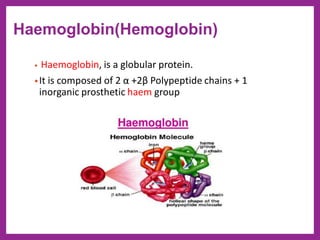
• Haemoglobin, is a globular protein.
•It is composed of 2 α +2β Polypeptide chains + 1
inorganic prosthetic haem group
Haemoglobin(Hemoglobin)
Haemoglobin
Collagen
Collagen
• Denaturation is a structural change in a protein that results in the
loss (usually permanent) of its biological properties
• Because the way a protein folds determines its function, any change
or abrogation of the tertiary structure will alter its activity
•
Denaturation of proteins can usually be caused by two key
conditions – temperature and pH.
Denaturation
•Temperature
•High levels of thermal energy may disrupt the hydrogen
bonds that hold the protein together
•As these bonds are broken, the protein will begin to
unfold and lose its capacity to function as intended
•Temperatures at which proteins denature may vary, but
most human proteins function optimally at body
temperature (~37ºC)
Denaturation
• pH
• Amino acids are zwitterions, neutral molecules possessing both
negatively (COO–) and positively (NH3
+) charged regions
• Changing the pH will alter the charge of the protein, which in
turn will alter protein solubility and overall shape
• All proteins have an optimal pH which is dependent on the
environment in which it functions (e.g. stomach proteins require
an acidic environment to operate, whereas blood proteins
function best at a neutral pH)
Denaturation
• Proteins are a very diverse class of compounds and may serve a
number of different roles within a cell, including:
Structure
• Collagen: A component of the connective tissue of animals (most
abundant protein in mammals)
• Spider silk: A fiber spun by spiders and used to make webs (by
weight, is stronger than kevlar and steel)
Hormones
• Insulin: Protein produced by the pancreas and triggers a reduction
in blood glucose levels
• Glucagon: Protein produced by the pancreas that triggers an
increase in blood glucose levels
Immunity
• Immunoglobulins: Antibodies produced by plasma cells that are
capable of targeting specific antigens
Protein Functions
Transport
• Haemoglobin: A protein found in red blood cells that is responsible
for the transport of oxygen
• Cytochrome: A group of proteins located in the mitochondria and
involved in the electron transport chain
Sensation
• Rhodopsin: A pigment in the photoreceptor cells of the retina that is
responsible for the detection of light
Movement
• Actin: Thin filaments involved in the contraction of muscle fibres
• Myosin: Thick filaments involved in the contraction of muscle fibres
Enzymes
• Rubisco: An enzyme involved in the light independent stage of
photosynthesis
Protein Functions
Place one-two spatulas of the food sample into a test tube or 1 cm3 if
the sample is liquid. Add about 1 cm3 depth of water to the tube
and stir to mix.
• Add an equal volume of potassium hydroxide solution to the tube
and stir.
• Add two drops of copper sulfate solution and stir for two minutes.
• Record the colour of the solution.
• Proteins are detected using Biuret reagent.This turns to
purple colour when mixed with protein.
Biuret test for proteins
Video Link-
https://safeYouTube.net/w/hxbE
Thank You

Biological molecules

  • 1.
    Unit-2 Biological molecules By –Suman Tiwari (M.Sc.,M.Ed.)
  • 2.
    Biological molecules •A biomoleculeor biological molecule •It is a loosely used term for molecules and ions present in organisms that are essential to one or more typically biological processes, such as cell division, morphogenesis, or development . •Biomolecules are usuallyendogenous, produced within the organism but organisms usually need exogenous biomolecules, for example certain nutrients, to survive.
  • 3.
    •Biomolecule: any moleculethat is involved in the maintenance and metabolic processes of living organisms. Biomolecules include carbohydrate, lipid, protein, nucleic acid, and water molecules. Biomolecules consists mainly of carbon and hydrogen with nitrogen, oxygen, sulphur, and phosphorus. Biomolecules are very large molecules of many atoms that are covalently bound together. Biomolecules are usually endogenous but may also be exogenous. •All the carbon compounds we get from living tissues can be called biomolecules. Biological molecules
  • 4.
    •Biology and itssubfields of biochemistry and molecular biology study biomolecules and their reactions. Most biomolecules are organic compounds, and just four elements—oxygen, carbon, hydrogen, and nitrogen—make up 96% of the human body's mass. But many other elements, such as the various biometals, are present in small amounts. Evolution of life – Electric discharge Experiment https://safeYouTube.net/w/HDBA Biological molecules
  • 5.
  • 6.
    Cells Molecules Organic Inorganic -Proteins -Carbohydrates -Fats -Nucleicacid -Amino acid -Polysaccharides -Minerals ( 17 essential in plants 24 essential in animals ) -Ions -Water Biological molecules
  • 7.
    Biological molecules Living Cells Trichloroacetic acid Acid insolublepool (Molecule have molecular wt. more than 10000 Daltons) Acid soluble pool (Molecule have molecular wt. 18 to 1000 Daltons)
  • 8.
    Biological molecules Molecular Weight Macromolecules (Above 10000) Micromolecules (Between18 to 1000) -Monosaccharide -Disaccharide -Oligosaccharide -Amino acids -Lipids -Nucleotides -Polysaccharide -Proteins -Nucleic acids (DNA , RNA )
  • 9.
    •Monomer: simple moleculewhich is used as a basic building block for the synthesis of a polymer; many monomers are joined together to make the polymer, usually by condensation reactions e.g. monosaccharides, amino acids, nucleic acids. • Polymer: is a giant molecule made from monomers e.g. polysaccharides, proteins, nucleic acids. Types Natural polymers : Cellulose , Rubber. Synthetic / Artificial polymer: Polyester, Polythene, PVC (Polyvinyl chloride and Nylon) •
  • 10.
    Macromolecule: These arelarge and complex molecules that are formed due to polymerisation of smaller monomers e.g. polysaccharides, nucleic acids.
  • 11.
    •Carbohydrates (Saccharides) •Made upof C, H, O in the ratio of 1:2:1 •As they contain: C H2O (Hydrates of C) •General Formula : Cn H2n O n •They are of different types based on number of carbon atoms: •1. Monosaccharides (1 Carbon) •2. Disaccharides (2 Carbon) •3. Oligosaccharides (3-7 Carbon) •4. Polysaccharides (1000 Carbon monounits) Carbohydrates
  • 12.
    •Number of Carbon: 3-7 3- Carbon: Triose sugar. E.g. -glyceraldehyde 4- Carbon: Tetrose sugar. E.g.- Erythrose 5- Carbon: Pentose sugar. E.g.- Ribose, Arabinose 6- Carbon: Hexose sugar. E.g.- Glucose, Fructose, Galactose. 7- Carbon: Heptose sugar. E.g.-Sedoheptulose. Monosaccharides
  • 13.
    •Two common example: Glucose and Fructose •Hexose sugar has two categories: •Aldehyde group and keto group and are named aldose and ketose respectively. •They are polyhydroxy compounds.( many –OH group) •Structure of Glucose: An aldose sugar having an aldehyde group at terminal carbon. •Glucose exist in two forms : Open chain Ring form These two forms are interconvertible. Hexose sugar
  • 14.
    Pyranose ring: 5Carbon & 1Oxygen. Hexagonal structure Structure of Glucose (Aldose Sugar ) Open chain Close chain The bond formed between an aldehyde and hydroxyl group is called glycosidic bond. This bond is always formed by the elimination of a water molecule. If this bond is formed between the same molecule, its called as hemiacetal bond.
  • 15.
  • 16.
    Structure of Fructose (KetoseSugar ) Pentagonal - 4Carbon & 1 Oxygen Such ring is called Furanose ring Both Glucose and Fructose are reducing sugars as they convert cuprus to cupric as they have aldehyde or keto group Fructose is commonly known as fruit sugar. Glucose and Fructose are isomers of each other Open chain Close chain
  • 17.
  • 18.
    •C-5 -E.g. Ribose,deoxyribose, Arabinose Pentose sugar Ribose sugar has two functional group so it is more reactive than deoxyribose.
  • 19.
    •Disaccharides are formedby joining two monosaccharides units by a glycosidic bond. •1. Maltose ,common Malt sugar( Glucose + Glucose)- Reducing sugar as one aldehyde group is present. Disaccharides 1-4, glycosidic bond
  • 20.
    •2. Sucrose, commoncane sugar (Glucose + Fructose). It is a non-reducing sugar as no functional group. Disaccharides
  • 21.
    •3. Lactose, commonmilk sugar(Glucose + Galactose). It is a reducing sugar. Disaccharides 1-4, Glycosidic bond
  • 22.
    The principal reagentin Benedict's Test for Reducing Sugars is Benedict's Solution which contains: •copper(II) sulphate •sodium carbonate •sodium citrate •Reducing sugars are simple sugars and include all monosaccharides and most disaccarides. Some examples of monosaccharides are glucose, fructose and galactose.Examples of reducing disaccharides are lactose and maltose. Note that the disaccharide sucrose is not a reducing sugar. In fact, sucrose is the most common non-reducing sugar. Video Link :https://safeYouTube.net/w/OCmC Benedict’s Test
  • 23.
    Sugars are classifiedas reducing or non-reducing based on their ability to act as a reducing agent during the Benedict's Test. A reducing agent donates electrons during a redox reaction and is itself oxidized. The aldehyde functional group is the reducing agent in reducing sugars. Reducing sugars have either an aldehyde functional group or have a ketone group - in an open chain form - which can be converted into an aldehyde. • http://brilliantbiologystudent.weebly.com/benedicts-test-for- reducing-sugars.html Video for Non-reducing sugar : https://safeYouTube.net/w/sFmC http://brilliantbiologystudent.weebly.com/benedicts-test-for- non-reducing-sugars.html
  • 24.
    Polysaccharides Polysaccharides ( on thebasis of monounits) Homosaccharides (Same units) Heterosaccharides (Different units) Cellulose Hemicellulose
  • 25.
    Polysaccharides Polysaccharides ( on thebasis of function) Storage polysaccharide Structural polysaccharides Starch Cellulose
  • 26.
    •Its a storagepolysaccharide. •Its a homopolysaccharide(monounit-Glucose). •It is made up of two components – Amylose and Amylopectin. •Amylose contains 200-2000 glucose chain. It has 1,4- Glycosidic bond. It has a linear but highly coiled structure •Amylopectin contains 2000- 20,000 glucose units.It has 1,4- Glycosidic bond as well as 1,6- Glycosidic bond as a result they have a branched structure. •Ratio of amylose to amylopectin in a starch molecule is 1:3. •The blue-black colour of starch with iodine is due to amylose. Starch
  • 27.
  • 28.
    •Storage of starchis usually done in grain forms in a cell. •These grains are classified as simple starch grain and compound starch grain. •Simple grain has one point around which the starch layers deposit. •Point is made of Hilum. •If one hilum present then simple starch grain if more than two compound starch grain. Starch
  • 29.
    • It isa storage polysaccharide. As it found in animals only so also known as animal starch. • It is a homopolysaccharide. (Monounit –Glucose) • It is stored in liver and muscle cells. • It has 1,4- alpha glycosidic bond( gives linear structure) and many 1,6-glycosidic. • It produces red colour with Iodine solution. Glycogen
  • 30.
    •It is astructural polysaccharide.(makes cell wall) •It is a homoplysaccharide. (Monounit –Glucose) •Bond in case of cellulose is Beta 1,4- Glycosidic bond. •It has a linear structure. Uses •Cotton fibres are 90% cellulose •Jute, hemp have 40% of cellulose •Cellulose+ Base= Rayon ( A synthetic fibre) •Cellulose acetate is used for making shatterproof glass •Cellulose nitrate is used to make explosives •Carboxy methyl cellulose is used for making ice-creams. Cellulose
  • 31.
  • 32.
    •It is ahomopolysaccharide. •It is a structural polysaccharide. •Monounit is N-Acetylglucoseamine. •It is found in the cell walls of Fungi and exoskeleton of Arthropods. Chitin
  • 33.
    Inulin It is ahomopolysaccharide. • Monounit is Fructose. • It is found in the roots of Dahlia plant Agar It is a homopolysaccharide. • It is a structural polysaccharide. • Monounit is Galactose. • It is extracted from red algae. • It is used to make nutritive medium. Hemicellulose It is a heteropolysaccharide. • Monounit is galactose,Mannose, Xylose and Arabinose. Some other polysaccharides
  • 34.
    •The polar natureof water molecules •An important feature of the water molecule is its polar nature. Polar molecules once placed into water dissolve and dissociate into water ions. Ionic molecules when they are placed into water dissociate into ions. Since oxygen has a higher electronegativity than hydrogen, the side of the molecule with the oxygen atom has a partial negative charge. A molecule with such a charge difference is called a dipole. Water
  • 35.
  • 36.
    •Hydrogen bonding inwater •A bond between molecules where the slightly positive hydrogen atoms in one water molecule are attracted to the slightly negative oxygen atom in another water molecule. The type of attraction is a weak interaction that occurs between a slightly negatively charged atoms and a slightly positively charged atom. It is weaker than a covalent bond but is the strongest intermolecular forces. Each of the individual hydrogen bonds is weak, where water forms many of these hydrogen bonds. •A hydrogen bond is a weak interaction that occurs between slightly negatively charged atoms and a slightly positively charged atom. Water
  • 37.
    Many of theproperties stated below are due to its dipolar nature and subsequent hydrogen bonds it forms and allows. •1. Solvent •Water is a good solvent since it is a charged molecule allowing them to easily be transported alongside this its water molecule’s dipole nature allows other polar molecules to be readily dissolved into water. Such examples of charged polar molecules such as salts, amino acids and sugars are able to readily dissolved in water. They are termed as hydrophilic; “water-loving” molecules. Non-polar molecules such as lipids are termed as hydrophobic, “water-hating”. Physical Properties of water
  • 38.
    •2. High heatcapacity •The tendency of water molecules to stick together is known as cohesion. Hence it would take a lot of heat energy to separate molecules that are stuck together rather than if they were not bonded together. Relating this to water, water does not change temperature very easily as it has a specific heat capacity of 4.2 J g-1 °C-1 which in simple terms means it takes 4.2 joules of energy to heat 1 g of water by 1 °C. This is remarkably high and is what keeps aquatic and cellular environments stable. Water
  • 39.
    •3. High Latentheat of Vaporisation •Hydrogen bonding between the water molecules allows it to have a high latent heat of vaporisation. Therefore, a large amount of energy is needed to change water from a liquid state into a gaseous state, where evaporation has a cooling effect on organisms such as sweating in animals and transpiration in plants. Water
  • 40.
    •3.Density •Water has aunique property that in a solid state (ice) it is less dense that the liquid state and is able to float on water. This property is different for the normal situation as most substances are in a gas form when they are less dense and more dense are in a solid state. This shows how water is different. The property of water makes it crucial for aquatic organisms to be able to survive in freezing sub-zero temperatures such as in ponds, lakes etc. Water
  • 41.
    •4.Cohesion and surfacetension in water • Water has properties of being cohesive, where they have a tendency to stick to other molecules together. This is due to the hydrogen bonding within water molecules that causes it to have a large cohesive forces which allows for the water to be pulled through a tube for example in plants; xylem vessels which are long tubes that help in the transportation of water to provide the plan with mechanical support. Another force called surface tension is also an unique property of water. Surface tension is the attractive force that can be exerted upon the surface of other molecules of a liquid which gives the tendency of the fluid surface to shrink into minimum surface area rather than the body of water escaping. Surface tenion of water allows for skaters to walk on water or allow insects that are usually denser than water, float on a water surface. Water
  • 42.
    • 5. pH •Water itself is partially ionized and has a source of H+ ions that cause for several biochemical reactions to be sensitive to pH changes. Pure water is not buffered at a neutral pH unlike the cytoplasm and tissue fluids within living organisms that are buffered at neutral pH 7.5. • 6. Ionization • Ionization is the process for forming or splitting of molecules to their cations and anions. An example is when sodium chloride (NaCl) dissolve into water they ionize and separate into positive and negative ions (Na+, Cl–). Water
  • 43.
    Lipids Lipids Simple Conjugated Lipid derivatives Esters offatty acids and alcohol True fats or Neutral Lipids Waxes Esters of fatty acid and glycerol Esters of fatty acid and alcohol other than glycerol.
  • 44.
    Conjugated Lipid derivatives Simple lipid+ Non lipidpart -Phospholipid -Glycolipid - Lipoprotein Sterols Terpenes
  • 45.
    •Esters of Fattyacid and Glycerol. •Fatty acids are classified into two types( -R-COOH ) 1. Essential fatty acids 2. Non-essential fatty acids Essential Fatty acid : 1. Linolic Acid (gives Omega 6) 2. Alpha Linolenic Acid (gives Omega 3) 3. Archedonic Acid (it is synthesised from Linolic acid) Other then these 3 all other Fatty acids are non-essential fatty acids. Simple Lipid: True or Neutral Fats
  • 46.
    • Saturated FA-Hydrocarbon chains have single bonds • Unsaturated FA- Hydrocarbon chains have double and triple bonds Types of Fatty Acids Glycerol head (Hydrophilic) Fatty Acid Tail (Hydrophobic) Amphipathic Molecules
  • 47.
    Based on numberof fatty acids chain attached to a Glycerol head they are of three types: •Monoglycerides- One tail. •Diglycerides- Two tails. •Triglycerides- Three tails. Hence True fats are of two types: 1. Saturated Fats- Glycerol + saturated fatty acid (They are solid at room temperature)ex. All animal fats 2. Unsaturated Fats- Glycerol + unsaturated fatty acid (They are liquid at room temperature)ex. All plant fats Neutral/True Fats
  • 48.
    •Functions of NeutralFats: 1. Subcutaneous fats are deposited under the skin layer and act as insulators. 2. Deposited around the organs- to protect it from mechanical shock 3. Reserve form of energy- stored in body as a reserve form of energy. Neutral Fats
  • 49.
    Esters of fattyacids and alcohol other than glycerol. 1. Plant waxes- with substance cutin it forms the cuticle layer in plants. Mostly found in Hydrophytes. 2. Bee wax- Wax produced by honey bees to make their hives, these are secreted by the wax glands in the last abdominal segment of worker bees. It is soft and yellow in colour. 3. Ear wax(Cerumen)- Secreted by cerumen part of internal ear. It helps to protect our ear drum. 4. Sebum (oil)- Secreted by sebaceous gland . 5. Lanolin-Wool wax Waxes
  • 50.
    • 1. Phospholipid-ex. lecithine . Phospholipid are found in plasma membrane. They have a phosphate group attached to the head of a simple lipid. •2. Glycolipid- It has a carbohydrate group attached to a simple lipid. It is found on plasma membrane. It a protective protein. • 3. Sphinglipids- Lipid + Nitrogen base. It is found in plasma membrane and nervous tissues. •4.Lipoprotein- simple lipids + protein. The role of lipoprotein particles is to transport fat molecules, such as triacylglycerols (also known as triglycerides), phospholipids, and cholesterol within the extracellular water of the body to all the cells and tissues of the body. Conjugated Lipids
  • 51.
    Sterols( steroid alcohol) 1.Phytosterol-Iffound in plants they are called phytosterols. Ex. (i)Stigmasterol- obtained from soyabean, also used to obtain progesterol. (ii) Sitosterol-obtained from wheat. 2. Engosterol- Obtained from Fungi. Found in plasma membrane. 3. Zoosterol- Obtained from animals. Ex. Cholesterol. It acts as an insulators. In plasma membrane it provides strength to it. 4. Steroid hormones- Progesterone, Testosterone, oestrogen. 5. Vitamin D. Derived Lipids
  • 52.
    •Terpene- Derivatives ofa 5 carbon compound called Isoprene •1. Natural rubber- It is a polyterpene •2. Vitamin A •3. Carotenoids They impart specific odour to like Camphor, Eucalyptus oil, menthol Derived Lipids
  • 53.
    •The Ethanol EmulsionTest is a food test which determines the presence of a broad group of naturally occurring compounds known as lipids. Lipids consist of fats and oils. Video Link : https://safeYouTube.net/w/eIsD Sudan III Test Sudan III is a red fat-soluble dye that is utilized in the identification of the presence of lipids, triglycerides and lipoproteins. The Reaction: Sudan III reacts with the lipids or triglycerides to stain red in colour. Video Link: https://safeYouTube.net/w/SOsD Test for the presence of Lipids
  • 54.
    •Proteins are anextremely important class of macromolecules in living organisms. More than 50% of the dry mass of most cells is protein. •All proteins are made from the same basic monomers. These are amino acids. Proteins
  • 55.
    •There are 20AA required for protein synthesis. •There are 100 AA required for other functions of life. •They are also known as methane derivatives. •It has an amino group (basic nature) and a carboxyl group( acidic nature) Amino acids
  • 56.
    •If A =C : Neutral AA. Ex- Glycine, Serine •If A > C: Basic. Ex- Lysine, Arginine •If A < C: Acidic. Ex- Glutamic acid, Aspartic acid Classification of AA 1. Essential AA- Tryptophan, Methionine, Phenylalanine 2. Non- essential AA- Glutamic acid, Aspartic acid, Alanine 3. Semi-essential AA( growth and lactation period)-Histidine, Arginine •Video link : https://safeYouTube.net/w/XqFD Amino acids
  • 57.
    • The aminoacids of a polypeptide are attached to their neighbours by covalent bonds known as a peptide bonds. Each bond forms in a dehydration synthesis (condensation) reaction. During protein synthesis, the carboxyl group of the amino acid at the end of the growing polypeptide chain chain reacts with the amino group of an incoming amino acid, releasing a molecule of water. The resulting bond between amino acids is a peptide bond. Peptide bond
  • 58.
    •Berzelius suggested thename for molecules studied by Mulder. •They are also Known as polypeptides. •On the basis of number of chains it had been divided into : 1. Monomeric protein- made up of only one polypeptide chain . Ex.: Lysozyme (found in saliva, tears), Myoglobin. 2. Multimeric protein- made up of many polypeptide chains. Ex.: Haemoglobin( It has two alpha chain and two beta chains , hence four polypeptide chains). Insulin(one alpha and one beta chain). Protein (Macromolecule)
  • 59.
    Classification on thebasis of AA types present: 1. First class/Complete protein- It has all essential and non essential AA. Ex. Animal Proteins 2. Second class/ Incomplete protein- It lack some AA. Ex. Plant Proteins Proteins
  • 60.
    • Classification onthe basis of structure: 1. Primary structure: • Only have peptide bonds. • Normally they are non functional, except Insulin . • Even a change in one amino acid in a chain made up of thousands may completely change the properties of the polypeptide or protein. • The free α-amino group, written to the left, is called the amino- terminal or N-terminal end. The free α-carboxyl group, written to the right, is called the carboxyl-terminal or C-terminal end. Primary Structure Proteins
  • 61.
  • 62.
    2. Secondary structure: •They are structural proteins. • Along with peptide bonds they also have hydrogen bonds. • They make an alpha helix( If hydrogen bond within the same chain AA) and beta pleated( If hydrogen bond is between two different polypeptide chain)structure. • Ex.: Alpha- Keratin, Beta- Silk fibre. Proteins
  • 63.
    The most commonhelical coil is a right-handed α-helix. • α-keratin from hair and nails is an α-helical protein. Myoglobin has several α-helical regions. • Proline, glycine, and asparagine are seldom found in α-helices; they are “helix breakers.” In β-sheets (pleated sheets), the hydrogen bonds occur between residues on neighbouring peptide chains. • The hydrogen bonds may be on different chains or distant regions of the same chain. The strands may run parallel or antiparallel. Fibroin in silk is a β-sheet protein. Proteins
  • 64.
    3. Tertiary Structure: •It has three polypeptide chains. • They are specifically functional proteins as they have active sites. • Peptide bond, hydrogen bond, ionic bond, disulphide bond. • Ex.: Enzymes Proteins
  • 65.
    4. Quaternary structure: •It has four polypeptide chains.(2 alpha 2 beta chains) • They are also specifically functional. • Chains are held together by electrostatic bonds. • Peptide bond, hydrogen bond, ionic bond, disulphide bond. • Ex.: Globin of haemoglobin Proteins
  • 66.
  • 67.
    •There are twomain classes of protein tertiary structure: •Fibrous proteins are generally composed of long and narrow strands and have a structural role (they are something) •Globular proteins generally have a more compact and rounded shape and have functional roles (they do something) Globular and fibrous Proteins
  • 68.
  • 69.
    • Haemoglobin, isa globular protein. •It is composed of 2 α +2β Polypeptide chains + 1 inorganic prosthetic haem group Haemoglobin(Hemoglobin)
  • 70.
  • 71.
  • 72.
  • 73.
    • Denaturation isa structural change in a protein that results in the loss (usually permanent) of its biological properties • Because the way a protein folds determines its function, any change or abrogation of the tertiary structure will alter its activity • Denaturation of proteins can usually be caused by two key conditions – temperature and pH. Denaturation
  • 74.
    •Temperature •High levels ofthermal energy may disrupt the hydrogen bonds that hold the protein together •As these bonds are broken, the protein will begin to unfold and lose its capacity to function as intended •Temperatures at which proteins denature may vary, but most human proteins function optimally at body temperature (~37ºC) Denaturation
  • 75.
    • pH • Aminoacids are zwitterions, neutral molecules possessing both negatively (COO–) and positively (NH3 +) charged regions • Changing the pH will alter the charge of the protein, which in turn will alter protein solubility and overall shape • All proteins have an optimal pH which is dependent on the environment in which it functions (e.g. stomach proteins require an acidic environment to operate, whereas blood proteins function best at a neutral pH) Denaturation
  • 76.
    • Proteins area very diverse class of compounds and may serve a number of different roles within a cell, including: Structure • Collagen: A component of the connective tissue of animals (most abundant protein in mammals) • Spider silk: A fiber spun by spiders and used to make webs (by weight, is stronger than kevlar and steel) Hormones • Insulin: Protein produced by the pancreas and triggers a reduction in blood glucose levels • Glucagon: Protein produced by the pancreas that triggers an increase in blood glucose levels Immunity • Immunoglobulins: Antibodies produced by plasma cells that are capable of targeting specific antigens Protein Functions
  • 77.
    Transport • Haemoglobin: Aprotein found in red blood cells that is responsible for the transport of oxygen • Cytochrome: A group of proteins located in the mitochondria and involved in the electron transport chain Sensation • Rhodopsin: A pigment in the photoreceptor cells of the retina that is responsible for the detection of light Movement • Actin: Thin filaments involved in the contraction of muscle fibres • Myosin: Thick filaments involved in the contraction of muscle fibres Enzymes • Rubisco: An enzyme involved in the light independent stage of photosynthesis Protein Functions
  • 78.
    Place one-two spatulasof the food sample into a test tube or 1 cm3 if the sample is liquid. Add about 1 cm3 depth of water to the tube and stir to mix. • Add an equal volume of potassium hydroxide solution to the tube and stir. • Add two drops of copper sulfate solution and stir for two minutes. • Record the colour of the solution. • Proteins are detected using Biuret reagent.This turns to purple colour when mixed with protein. Biuret test for proteins Video Link- https://safeYouTube.net/w/hxbE
  • 79.