There are four classes of 
biological macromolecules: 
Proteins, lipids, carbohydrates 
and nucleic acids
Before you can understand the topics in this 
unit there are some key vocabulary terms you 
need to know. 
Macromolecule 
Polymer 
Monomer
What do these words mean?
So What Is A 
Macromolecule? 
A very large molecule, such as a 
polymer or protein, consisting of 
many smaller structural units linked 
together. Also called supermolecule.
Biological 
Macromolecule 
All biological macro-molecule are 
made up of a small number of 
elements: Carbon, Hydrogen, Oxygen, 
Nitrogen, Phosphorus and Sulfur
Next Word…..
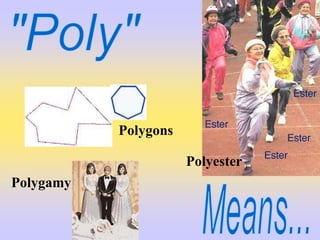
Polygons 
Polygamy 
Polyester
What does 
“Mono” mean?
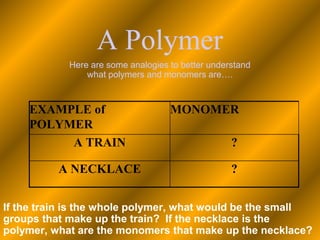
A Polymer 
Here are some analogies to better understand 
what polymers and monomers are…. 
EXAMPLE of 
POLYMER 
MONOMER 
A TRAIN ? 
A NECKLACE ? 
If the train is the whole polymer, what would be the small 
groups that make up the train? If the necklace is the 
polymer, what are the monomers that make up the necklace?
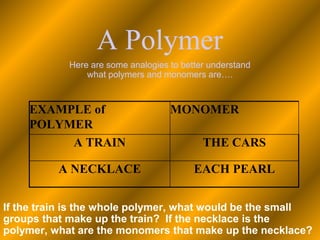
A Polymer 
Here are some analogies to better understand 
what polymers and monomers are…. 
EXAMPLE of 
POLYMER 
MONOMER 
A TRAIN THE CARS 
A NECKLACE EACH PEARL 
If the train is the whole polymer, what would be the small 
groups that make up the train? If the necklace is the 
polymer, what are the monomers that make up the necklace?
Three out of the 4 types of 
biochemical macromolecules 
can be found on food 
nutrition labels…
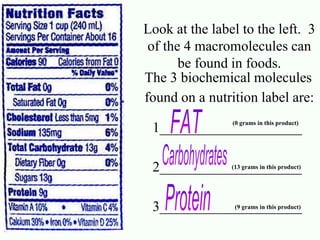
Look at the label to the left. 3 
of the 4 macromolecules can 
be found in foods. 
The 3 biochemical molecules 
found on a nutrition label are: 
(0 grams in this product) 
1____________________ 
2____________________ 
(13 grams in this product) 
3____________________ 
(9 grams in this product)
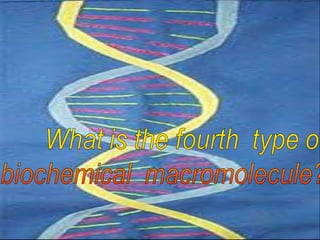
The 4th type of biochemical 
macromolecules are the 
NUCLEIC ACIDS 
The types of Nucleic Acids 
–DNA (DeoxyriboNucleic Acid) 
–RNA (RiboNucleic Acid)
When studying these biochemical 
molecules, we are interested in 
finding out….. 
• what they do for living things. 
• what they generally look like. 
• what their monomers are. 
• and how they may help the body gain 
energy to sustain life.
Keep the following in mind when 
studying this material: 
Nucleic Acids What they look like 
Carbohydrates What they do/Where are 
they 
Lipids What are they made up of-at 
the level of atoms 
Proteins
LET’S BEGIN WITH 
CARBOHYDRATES 
✓They are the main source for the body to gain energy. 
They are our fuel! 
✓They make up the cell wall in plants which allow them 
to grow tall, without this carbohydrate, a plant would be 
a mushy mess! This type of carbohydrate is called 
Cellulose. 
THINK: CARBS= ENERGY and CELL WALLS
CARBOHYDRATES 
•In plant foods- in the cell walls of 
plants --- in fruits, vegetables, peas, 
beans, SUGAR comes from a plant 
and so does FLOUR! (pasta, 
potatoes, bread, candy, cookies) 
--------------------------------------------------- 
•In animal products- in MILK
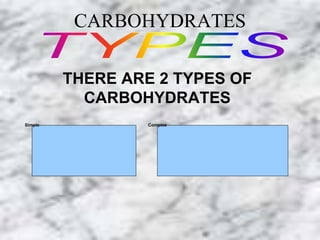
CARBOHYDRATES 
THERE ARE 2 TYPES OF 
CARBOHYDRATES 
Simple Complex
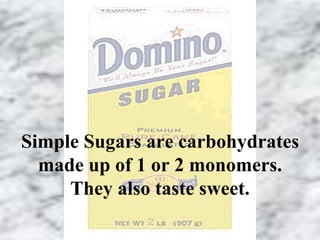
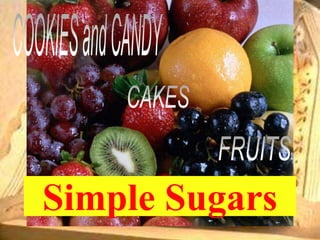
Simple Sugars are carbohydrates 
made up of 1 or 2 monomers. 
They also taste sweet.
Simple Sugars
Complex 
Carbohydrates… 
What are they? 
Complex Cabohydrates are polymers 
made up of many monomers. 
Most also taste starchy.
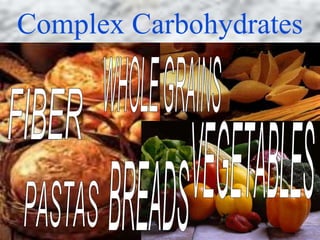
Complex Carbohydrates
CARBOHYDRATES 
Carbohydrates are chains 
(polymers) made of monomers. The 
most common monomer of 
carbohydrates is…
CARBOHYDRATES 
Each carbohydrate is made up of… 
THINK: “CHO”
NOW ONTO PROTEINS 
✓They are the major structural molecules in living things 
for growth and repair : muscles, ligaments, tendons, bones, 
hair, skin, nails…IN FACT ALL CELL MEMBRANES have 
protein in them 
✓They make up antibodies in the immune system 
✓They make up enzymes for helping chemical reactions 
✓They makeup non-steriod hormones which 
THINK: Proteins= membranes, enzymes, antibodies, non-steriod 
hormones, structural molecules, “MEANS”
MORE ON PROTEINS… 
The following slides give 
you a little more in depth 
info on things that are 
made of proteins…
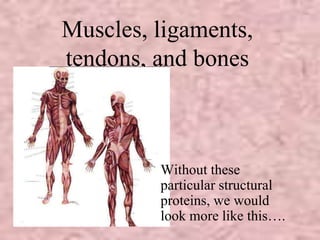
Muscles, ligaments, 
tendons, and bones 
Without these 
particular structural 
proteins, we would 
look more like this….
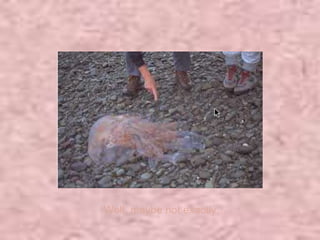
Well, maybe not exactly…
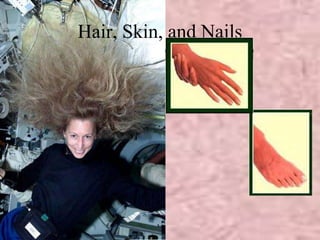
Hair, Skin, and Nails
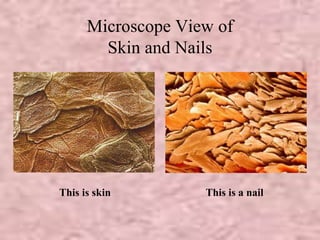
Microscope View of 
Skin and Nails 
This is skin This is a nail
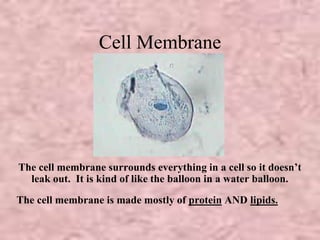
Cell Membrane 
The cell membrane surrounds everything in a cell so it doesn’t 
leak out. It is kind of like the balloon in a water balloon. 
The cell membrane is made mostly of protein AND lipids.
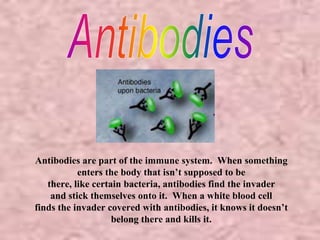
Antibodies are part of the immune system. When something 
enters the body that isn’t supposed to be 
there, like certain bacteria, antibodies find the invader 
and stick themselves onto it. When a white blood cell 
finds the invader covered with antibodies, it knows it doesn’t 
belong there and kills it.
Enzymes are proteins that speed up 
chemical reactions. If you didn’t have 
enzymes in your stomach to speed up 
digestion, the food would rot in your 
stomach because it would take so long!
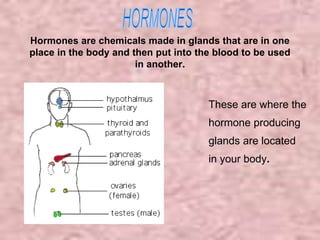
Hormones are chemicals made in glands that are in one 
place in the body and then put into the blood to be used 
in another. 
These are where the 
hormone producing 
glands are located 
in your body.
PROTEINS 
•In plant foods- in the cell 
membranes 
•In animal products- in the cell 
membranes- in the muscles or 
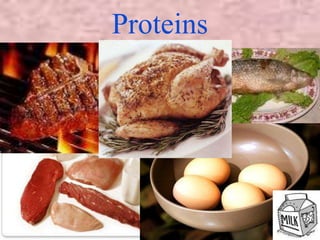
living things- cows, chicken, fish…
Proteins
Proteins 
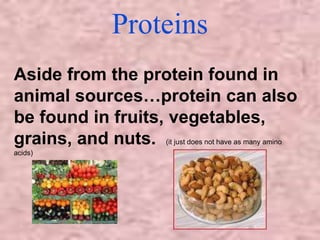
Aside from the protein found in 
animal sources…protein can also 
be found in fruits, vegetables, 
grains, and nuts. (it just does not have as many amino 
acids)
PROTEINS 
Proteins are made of long chains 
(polymers) made of monomers. All 
proteins are made of the 
monomer…
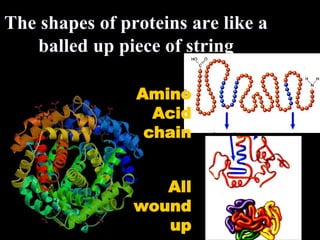
The shapes of proteins are like a 
balled up piece of string 
Amino 
Acid 
chain 
All 
wound 
up
PROTEINS 
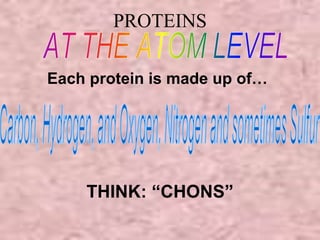
Each protein is made up of… 
THINK: “CHONS”
LIPIDS ARE NEXT 
✓They are a great source of STORED ENERGY so we 
have it in the future. 
✓They INSULATE the body to maintain normal body 
temperature and they CUSHION the internal organs for 
protection. 
✓They produce hormones for the body called 
STERIODS 
✓They waterproof surfaces of animals,plants, and 
fruits- these are waxes! 
THINK: Waterproof, insulate, steriods, energy, 
cushion… “WISE C”
LIPIPS…Some interesting info 
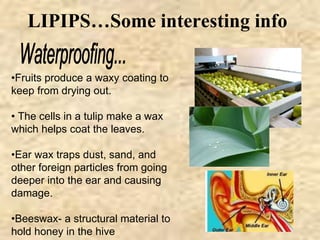
•Fruits produce a waxy coating to 
keep from drying out. 
• The cells in a tulip make a wax 
which helps coat the leaves. 
•Ear wax traps dust, sand, and 
other foreign particles from going 
deeper into the ear and causing 
damage. 
•Beeswax- a structural material to 
hold honey in the hive
LIPIDS 
•In plants- in the seeds 
--------------------------------------------------- 
•In animals- in adipose tissue, 
connective tissue, in animals 
--------------------------------------------------- 
•Lipids make up the cell membrane of 
all cells.
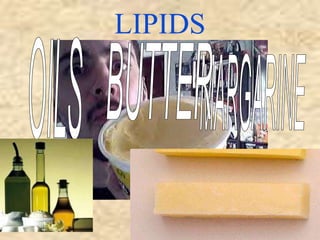
LIPIDS
LIPIDS 
Lipids are chains (polymers) made 
of monomers. The most common 
monomer of lipids is…
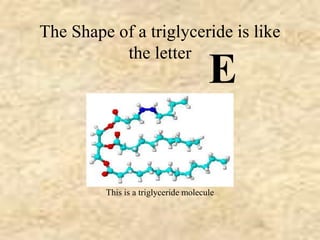
The Shape of a triglyceride is like 
the letter E 
This is a triglyceride molecule
LIPIDS 
Each Lipid is made up of… 
THINK: “CHO”
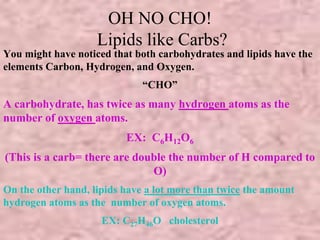
OH NO CHO! 
Lipids like Carbs? 
You might have noticed that both carbohydrates and lipids have the 
elements Carbon, Hydrogen, and Oxygen. 
“CHO” 
A carbohydrate, has twice as many hydrogen atoms as the 
number of oxygen atoms. 
EX: C6H12O6 
(This is a carb= there are double the number of H compared to 
O) 
On the other hand, lipids have a lot more than twice the amount 
hydrogen atoms as the number of oxygen atoms. 
EX: C27H46O cholesterol

Macromolecule characteristics

  • 1.
    There are fourclasses of biological macromolecules: Proteins, lipids, carbohydrates and nucleic acids
  • 2.
    Before you canunderstand the topics in this unit there are some key vocabulary terms you need to know. Macromolecule Polymer Monomer
  • 4.
    What do thesewords mean?
  • 5.
    So What IsA Macromolecule? A very large molecule, such as a polymer or protein, consisting of many smaller structural units linked together. Also called supermolecule.
  • 6.
    Biological Macromolecule Allbiological macro-molecule are made up of a small number of elements: Carbon, Hydrogen, Oxygen, Nitrogen, Phosphorus and Sulfur
  • 7.
  • 8.
  • 10.
  • 11.
    A Polymer Hereare some analogies to better understand what polymers and monomers are…. EXAMPLE of POLYMER MONOMER A TRAIN ? A NECKLACE ? If the train is the whole polymer, what would be the small groups that make up the train? If the necklace is the polymer, what are the monomers that make up the necklace?
  • 12.
    A Polymer Hereare some analogies to better understand what polymers and monomers are…. EXAMPLE of POLYMER MONOMER A TRAIN THE CARS A NECKLACE EACH PEARL If the train is the whole polymer, what would be the small groups that make up the train? If the necklace is the polymer, what are the monomers that make up the necklace?
  • 14.
    Three out ofthe 4 types of biochemical macromolecules can be found on food nutrition labels…
  • 15.
    Look at thelabel to the left. 3 of the 4 macromolecules can be found in foods. The 3 biochemical molecules found on a nutrition label are: (0 grams in this product) 1____________________ 2____________________ (13 grams in this product) 3____________________ (9 grams in this product)
  • 17.
    The 4th typeof biochemical macromolecules are the NUCLEIC ACIDS The types of Nucleic Acids –DNA (DeoxyriboNucleic Acid) –RNA (RiboNucleic Acid)
  • 18.
    When studying thesebiochemical molecules, we are interested in finding out….. • what they do for living things. • what they generally look like. • what their monomers are. • and how they may help the body gain energy to sustain life.
  • 19.
    Keep the followingin mind when studying this material: Nucleic Acids What they look like Carbohydrates What they do/Where are they Lipids What are they made up of-at the level of atoms Proteins
  • 20.
    LET’S BEGIN WITH CARBOHYDRATES ✓They are the main source for the body to gain energy. They are our fuel! ✓They make up the cell wall in plants which allow them to grow tall, without this carbohydrate, a plant would be a mushy mess! This type of carbohydrate is called Cellulose. THINK: CARBS= ENERGY and CELL WALLS
  • 21.
    CARBOHYDRATES •In plantfoods- in the cell walls of plants --- in fruits, vegetables, peas, beans, SUGAR comes from a plant and so does FLOUR! (pasta, potatoes, bread, candy, cookies) --------------------------------------------------- •In animal products- in MILK
  • 22.
    CARBOHYDRATES THERE ARE2 TYPES OF CARBOHYDRATES Simple Complex
  • 23.
    Simple Sugars arecarbohydrates made up of 1 or 2 monomers. They also taste sweet.
  • 24.
  • 25.
    Complex Carbohydrates… Whatare they? Complex Cabohydrates are polymers made up of many monomers. Most also taste starchy.
  • 26.
  • 27.
    CARBOHYDRATES Carbohydrates arechains (polymers) made of monomers. The most common monomer of carbohydrates is…
  • 28.
    CARBOHYDRATES Each carbohydrateis made up of… THINK: “CHO”
  • 29.
    NOW ONTO PROTEINS ✓They are the major structural molecules in living things for growth and repair : muscles, ligaments, tendons, bones, hair, skin, nails…IN FACT ALL CELL MEMBRANES have protein in them ✓They make up antibodies in the immune system ✓They make up enzymes for helping chemical reactions ✓They makeup non-steriod hormones which THINK: Proteins= membranes, enzymes, antibodies, non-steriod hormones, structural molecules, “MEANS”
  • 30.
    MORE ON PROTEINS… The following slides give you a little more in depth info on things that are made of proteins…
  • 31.
    Muscles, ligaments, tendons,and bones Without these particular structural proteins, we would look more like this….
  • 32.
    Well, maybe notexactly…
  • 33.
  • 34.
    Microscope View of Skin and Nails This is skin This is a nail
  • 35.
    Cell Membrane Thecell membrane surrounds everything in a cell so it doesn’t leak out. It is kind of like the balloon in a water balloon. The cell membrane is made mostly of protein AND lipids.
  • 36.
    Antibodies are partof the immune system. When something enters the body that isn’t supposed to be there, like certain bacteria, antibodies find the invader and stick themselves onto it. When a white blood cell finds the invader covered with antibodies, it knows it doesn’t belong there and kills it.
  • 37.
    Enzymes are proteinsthat speed up chemical reactions. If you didn’t have enzymes in your stomach to speed up digestion, the food would rot in your stomach because it would take so long!
  • 38.
    Hormones are chemicalsmade in glands that are in one place in the body and then put into the blood to be used in another. These are where the hormone producing glands are located in your body.
  • 39.
    PROTEINS •In plantfoods- in the cell membranes •In animal products- in the cell membranes- in the muscles or living things- cows, chicken, fish…
  • 40.
  • 41.
    Proteins Aside fromthe protein found in animal sources…protein can also be found in fruits, vegetables, grains, and nuts. (it just does not have as many amino acids)
  • 42.
    PROTEINS Proteins aremade of long chains (polymers) made of monomers. All proteins are made of the monomer…
  • 43.
    The shapes ofproteins are like a balled up piece of string Amino Acid chain All wound up
  • 44.
    PROTEINS Each proteinis made up of… THINK: “CHONS”
  • 45.
    LIPIDS ARE NEXT ✓They are a great source of STORED ENERGY so we have it in the future. ✓They INSULATE the body to maintain normal body temperature and they CUSHION the internal organs for protection. ✓They produce hormones for the body called STERIODS ✓They waterproof surfaces of animals,plants, and fruits- these are waxes! THINK: Waterproof, insulate, steriods, energy, cushion… “WISE C”
  • 46.
    LIPIPS…Some interesting info •Fruits produce a waxy coating to keep from drying out. • The cells in a tulip make a wax which helps coat the leaves. •Ear wax traps dust, sand, and other foreign particles from going deeper into the ear and causing damage. •Beeswax- a structural material to hold honey in the hive
  • 47.
    LIPIDS •In plants-in the seeds --------------------------------------------------- •In animals- in adipose tissue, connective tissue, in animals --------------------------------------------------- •Lipids make up the cell membrane of all cells.
  • 48.
  • 49.
    LIPIDS Lipids arechains (polymers) made of monomers. The most common monomer of lipids is…
  • 50.
    The Shape ofa triglyceride is like the letter E This is a triglyceride molecule
  • 51.
    LIPIDS Each Lipidis made up of… THINK: “CHO”
  • 52.
    OH NO CHO! Lipids like Carbs? You might have noticed that both carbohydrates and lipids have the elements Carbon, Hydrogen, and Oxygen. “CHO” A carbohydrate, has twice as many hydrogen atoms as the number of oxygen atoms. EX: C6H12O6 (This is a carb= there are double the number of H compared to O) On the other hand, lipids have a lot more than twice the amount hydrogen atoms as the number of oxygen atoms. EX: C27H46O cholesterol