Carbohydrates
Monosaccharides
• All monosaccharides have the empirical
  formula CH2O.
• They contain a carbonyl group in addition to
  this and at least two –OH groups.
• They have between 3 and 6 carbon atoms.
Types of Monosaccharides
• Monosaccharides with the formula C5H10O5
  are generally known as pentoses (ribose is an
  example of this).
• Monosaccharides with the formula C6H12O6
  are known as hexoses (glucose is an example
  of this).
Monosaccaharides Structures
• Many structural isomers are possible.
• In addition several carbon atoms are chiral
  (asymmetric) and give rise to optical
  isomerism.
• Open chain structures and ring structures are
  also possible.
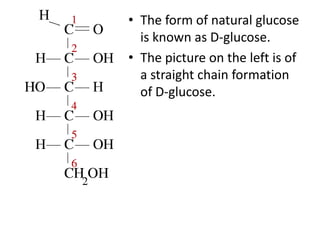
• The form of natural glucose
  is known as D-glucose.
• The picture on the left is of
  a straight chain formation
  of D-glucose.
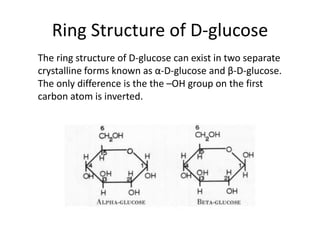
Ring Structure of D-glucose
The ring structure of D-glucose can exist in two separate
crystalline forms known as α-D-glucose and β-D-glucose.
The only difference is the the –OH group on the first
carbon atom is inverted.
Monosaccharides cont.
• Six-membered ring monosaccharides are
  known as pyranoses.
• Hexoses can also have a furanose structure
  where they have a five-membered ring
  containing an oxygen atom.
Polysaccharides
• Monosaccharides can undergo condensation
  reactions to form disaccharides and eventually
  polysaccharides.
Sucrose
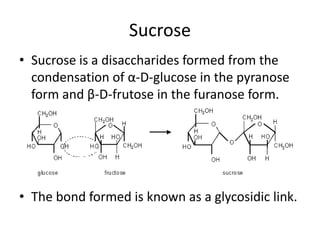
• Sucrose is a disaccharides formed from the
  condensation of α-D-glucose in the pyranose
  form and β-D-frutose in the furanose form.


• The bond formed is known as a glycosidic link.
Sucrose continued
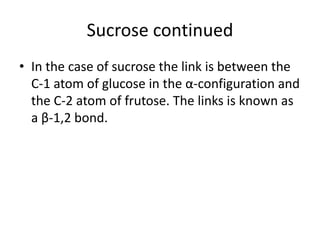
• In the case of sucrose the link is between the
  C-1 atom of glucose in the α-configuration and
  the C-2 atom of frutose. The links is known as
  a β-1,2 bond.
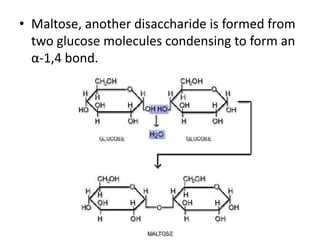
• Maltose, another disaccharide is formed from
  two glucose molecules condensing to form an
  α-1,4 bond.
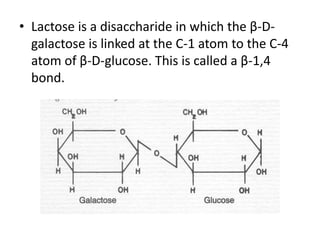
• Lactose is a disaccharide in which the β-D-
  galactose is linked at the C-1 atom to the C-4
  atom of β-D-glucose. This is called a β-1,4
  bond.
Starch
• Starch is one of the most important
  polysaccharides.
• Starch exists in two forms: amylose, which is
  water soluble and amylopectin, which is
  insoluble in water.
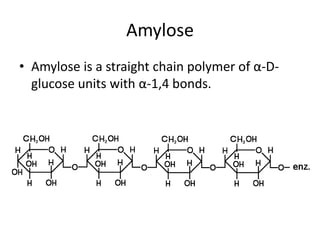
Amylose
• Amylose is a straight chain polymer of α-D-
  glucose units with α-1,4 bonds.
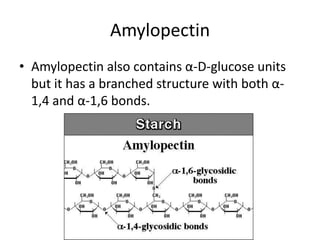
Amylopectin
• Amylopectin also contains α-D-glucose units
  but it has a branched structure with both α-
  1,4 and α-1,6 bonds.
• Most plants use starch as a store of carbohydrates
  and their energy.
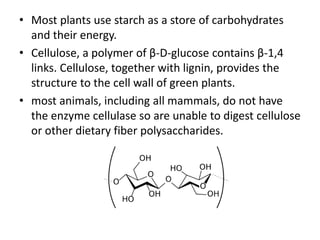
• Cellulose, a polymer of β-D-glucose contains β-1,4
  links. Cellulose, together with lignin, provides the
  structure to the cell wall of green plants.
• most animals, including all mammals, do not have
  the enzyme cellulase so are unable to digest cellulose
  or other dietary fiber polysaccharides.
Functions of Polysaccharides in the
                 Body
• To provide energy
  – Food such as
    bread, biscuits, cake, potatoes, pasta, and cereals
    are all high in carbohydrates.
• To store energy
  – Starch is stored in the livers of animals in the form
    of glycogen. Glycogen has almost the same
    chemical structure as amylopectin.
(cont.)
• As precursors
   – For other important biological molecules they are
     components of nucleic acids and thus play an
     important role in the biosynthesis of proteins.
• As dietary fiber
   – Dietary fiber is mainly plant material that is not
     hydrolysed by enzymes secreted by the human
     digestive tract by may be digested by microflora in the
     gut.
   – It may be helpful in preventing conditions such as
     diverticulosis, irritable bowel
     syndrome, obesity, Crohn’s disease, haemerrhoids and
     diabetes mellitus.

B2 Chemistry Presentation

  • 1.
  • 2.
    Monosaccharides • All monosaccharideshave the empirical formula CH2O. • They contain a carbonyl group in addition to this and at least two –OH groups. • They have between 3 and 6 carbon atoms.
  • 3.
    Types of Monosaccharides •Monosaccharides with the formula C5H10O5 are generally known as pentoses (ribose is an example of this). • Monosaccharides with the formula C6H12O6 are known as hexoses (glucose is an example of this).
  • 4.
    Monosaccaharides Structures • Manystructural isomers are possible. • In addition several carbon atoms are chiral (asymmetric) and give rise to optical isomerism. • Open chain structures and ring structures are also possible.
  • 5.
    • The formof natural glucose is known as D-glucose. • The picture on the left is of a straight chain formation of D-glucose.
  • 6.
    Ring Structure ofD-glucose The ring structure of D-glucose can exist in two separate crystalline forms known as α-D-glucose and β-D-glucose. The only difference is the the –OH group on the first carbon atom is inverted.
  • 7.
    Monosaccharides cont. • Six-memberedring monosaccharides are known as pyranoses. • Hexoses can also have a furanose structure where they have a five-membered ring containing an oxygen atom.
  • 8.
    Polysaccharides • Monosaccharides canundergo condensation reactions to form disaccharides and eventually polysaccharides.
  • 9.
    Sucrose • Sucrose isa disaccharides formed from the condensation of α-D-glucose in the pyranose form and β-D-frutose in the furanose form. • The bond formed is known as a glycosidic link.
  • 10.
    Sucrose continued • Inthe case of sucrose the link is between the C-1 atom of glucose in the α-configuration and the C-2 atom of frutose. The links is known as a β-1,2 bond.
  • 11.
    • Maltose, anotherdisaccharide is formed from two glucose molecules condensing to form an α-1,4 bond.
  • 12.
    • Lactose isa disaccharide in which the β-D- galactose is linked at the C-1 atom to the C-4 atom of β-D-glucose. This is called a β-1,4 bond.
  • 13.
    Starch • Starch isone of the most important polysaccharides. • Starch exists in two forms: amylose, which is water soluble and amylopectin, which is insoluble in water.
  • 14.
    Amylose • Amylose isa straight chain polymer of α-D- glucose units with α-1,4 bonds.
  • 15.
    Amylopectin • Amylopectin alsocontains α-D-glucose units but it has a branched structure with both α- 1,4 and α-1,6 bonds.
  • 16.
    • Most plantsuse starch as a store of carbohydrates and their energy. • Cellulose, a polymer of β-D-glucose contains β-1,4 links. Cellulose, together with lignin, provides the structure to the cell wall of green plants. • most animals, including all mammals, do not have the enzyme cellulase so are unable to digest cellulose or other dietary fiber polysaccharides.
  • 17.
    Functions of Polysaccharidesin the Body • To provide energy – Food such as bread, biscuits, cake, potatoes, pasta, and cereals are all high in carbohydrates. • To store energy – Starch is stored in the livers of animals in the form of glycogen. Glycogen has almost the same chemical structure as amylopectin.
  • 18.
    (cont.) • As precursors – For other important biological molecules they are components of nucleic acids and thus play an important role in the biosynthesis of proteins. • As dietary fiber – Dietary fiber is mainly plant material that is not hydrolysed by enzymes secreted by the human digestive tract by may be digested by microflora in the gut. – It may be helpful in preventing conditions such as diverticulosis, irritable bowel syndrome, obesity, Crohn’s disease, haemerrhoids and diabetes mellitus.