CARBOHYDRATES-
ITS FUNCTION AND
USES
• Biochemistry deals with naturally
occurring macro molecules
• Such as carbohydrates, proteins,
lipids, nucleic acids and vitamins
INTRO
• Synthesized by body from
simple molecules
• They are also the most
abundant biological
molecules
INTRO
To acquaint the audience about
carbohydrates and its uses
AIM
PHASE I
 Def of Carbohydrates
 Classification of Carbohydrates
 Monosaccharides
 Oligosaccharides
 Polysaccharides
SEQ
PHASE II
 Functions of Carbohydrates
 Diseases caused due to
deficiency of Carbohydrates
SEQ
• Hydrates of carbon
• Derives from the formula Cn (H2O)
• Polyhydroxy aldehydes
• Polyhydroxy ketones
Carbohydrates
• Synthesized by plants through
photosynthesis, from carbon dioxide
and water
• 6CO2 + 6H2O C6H12O6 + 6O2
Carbohydrates
Monosaccharides
(Monomers)
Oligosaccharides
Polysaccharides
(Polymers)
Classification
 Monomers
 Consist of 3 to 9 carbons
 White crystalline solids
Monosaccharide
 Simplest sugars which cannot be
hydrolyzed
 Easily soluble in water
 Sweet in taste
Monosaccharide
Monosacchardies
Functional
group
Number of C
Classification
Monosacchardies
Aldoses Ketoses
Functional Group
Examples
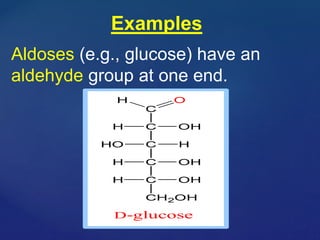
Aldoses (e.g., glucose) have an
aldehyde group at one end.
C
C OHH
C HHO
C OHH
C OHH
CH2OH
D-glucose
OH
 Ketoses (e.g., fructose) have a keto
group
Examples
 Trioses contain 3 Carbons
 Tetroses contain 4 Carbons
 Pentoses Contain 5 Carbons
 Hexoses Contain 6 Carbons
Number of C
Examples
 Oligosaccharides give 2 to 9 units
of monosaccharides on hydrolysis
Oligosaccharides
 They are classified as fol
 Disaccharides
 Trisaccharides
 Tetrasaccharides
Classification
 Also called dimers
 Two monosaccharides combine by
means of condensation
 Glycosidic bond
Disaccharides
 Maltose (Malt Sugar)
 Sucrose (Cane Sugar)
 Lactose (Milk Sugar)
Examples
Glucose + Glucose Maltose + water
Glucose + Fructose Sucrose + Water
Glucose + Galactose Lactose + Water
Formation of Dimers
Formation of Dimers
 White crystalline solids
 Easily soluble in water
 Sweet in taste
 Hydrolyzes into two
monosaccharide units
Properties
 Macromolecular carbohydrates
 Hundreds to thousands of
monosaccharide units
Polysaccharides
Polysacchardies
Homo
polysaccharides
Hetero
Polysaccharides
Classification
Homopolysaccharide
Starch Cellulose
Examples
Examples
Examples
Heteropolysaccharide
Glycosamine
Examples
Examples
 Amorphous solids
 Tasteless
 Insoluble in water
 Cannot be hydrolyzed to simple
sugars
Properties
Phase-II
 Source of energy in the form of
glucose
 Our brain uses energy in the form of
carbohydrates
 Regulate the amount of sugar level-
hypoglycemia
Functions of Carbohydrates
 Nutrients for bacteria
 Dietary fibers helps to keep the
bowel functioning properly
 Fibers lowers cholesterol level and
regulates blood pressure
Functions of Carbohydrates
 Protect our muscles from cramping
 Flavors to the diet
 Growth of certain desirable
bacteria in the small intestine
synthesize B-complex Vitamins
Functions of Carbohydrates
 Protein sparing function
 Cell wall structure of plants
 Glycoproteins and lipoproteins
maintain the shape of the body
Functions of Carbohydrates
 Muscle cramping
 Muscle fatigue
Diseases caused due to
deficiency
 Headache
 Dizziness
Diseases caused due to
deficiency
 Confusion
 Fast Heart beat
Diseases caused due to
deficiency
 Sweating
Diseases caused due to
deficiency
 Acidosis
Diseases caused due to
deficiency
{
Carbohydrate ,types and importance

Carbohydrate ,types and importance