Carbohydrates
The researcher: Mehrasa Nikandish
Subject : Biochemistry
Overview
Introduction
Monosaccharide
3 types of monosaccharide
Disaccharide
Oligosaccharide
Polysaccharide
3 types of polysaccharide
Carbohydrate deficiency diseases
Introduction
Carbohydrates are one of the four major classes of
biomolecules along with proteins, nucleic acids, and
lipids. Carbohydrates are compounds that contain at
least three carbon atoms, a number of hydroxyl
groups, and usually an aldehyde or ketone group.
They may contain phosphate, amino, or sulfate
groups.
First, carbohydrates serve as energy stores, fuels,
and metabolic intermediates.
Second, ribose and deoxyribose sugars form part of
the structural framework of RNA and DNA.
Third, polysaccharides are structural elements in the
cell walls of bacteria and plants
Monosaccharide
A monosaccharide is the most basic form of
carbohydrates. Monosaccharides can by combined
through glycosidic bonds to form larger
carbohydrates, known
as oligosaccharides or polysaccharides.
Monosaccharides have many functions within cells.
First and foremost, monosaccharides are used to
produce and store energy. Most organisms create
energy by breaking down the monosaccharide
glucose.
Other monosaccharides are used to form long fibers,
which can be used as a form of cellular structure.
Plants create cellulose to serve this function, while
some bacteria can produce a similar cell wall from
slightly different polysaccharides.
Glucose
The most abundant monosaccharide
found in nature is in fact glucose. It is
the most abundant organic compound
on earth. We can find glucose in varies
fruits, honey and even in starch and
cane sugar. We obtain a large part of
the energy in our bodies from glucose
through the foods we eat. It is an
aldohexose, which means it has six
carbon atoms in its molecule. Its
chemical formula is C6H12O6
Fructose
Fructose is a simple ketonic monosaccharide. We
mostly find fructose in plants and their fruits,
flowers and root vegetables, hence earning it a
moniker of fruit sugar. It is also abundantly present
in honey and corn syrup. Fructose was first
discovered by a French chemist Augustin – Pierre
Debrunfaut.
The chemical formula of fructose is
also C6H12O6 but the bonding of fructose is very
different than that of glucose. Fructose has a cyclic
structure. It has its carbonyl group at its number
two carbon (its a ketone function group). In its
cyclic form, it (generally) forms a five-member ring
which we call a Furanose ring.
Galactose
What is galactose?
Galactose is a simple sugar, which belongs to
simple carbohydrates. Galactose is composed of the
same elements as glucose, but has a different
arrangement of atoms.
Name origin: From the Greek gala = milk, and -
ose, which denotes sugar.
Is galactose an essential nutrient?
Galactose is not an essential nutrient, which means you
do not need to get it from food to be healthy; galactose
can be synthesized in the human body from glucose.
Galactose Functions in the Human Body
In the human body, most of the ingested galactose is
converted to glucose, which can provide 4.1 kilocalories
per gram of energy, which is about the same as sucrose
Disaccharides
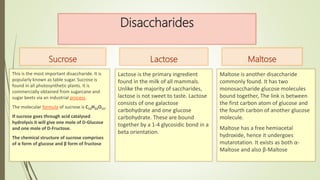
Sucrose
This is the most important disaccharide. It is
popularly known as table sugar. Sucrose is
found in all photosynthetic plants. It is
commercially obtained from sugarcane and
sugar beets via an industrial process.
The molecular formula of sucrose is C12H22O11.
If sucrose goes through acid catalysed
hydrolysis it will give one mole of D-Glucose
and one mole of D-Fructose.
The chemical structure of sucrose comprises
of α form of glucose and β form of fructose
Lactose
Lactose is the primary ingredient
found in the milk of all mammals.
Unlike the majority of saccharides,
lactose is not sweet to taste. Lactose
consists of one galactose
carbohydrate and one glucose
carbohydrate. These are bound
together by a 1-4 glycosidic bond in a
beta orientation.
Maltose
Maltose is another disaccharide
commonly found. It has two
monosaccharide glucose molecules
bound together, The link is between
the first carbon atom of glucose and
the fourth carbon of another glucose
molecule.
Maltose has a free hemiacetal
hydroxide, hence it undergoes
mutarotation. It exists as both α-
Maltose and also β-Maltose
Oligosaccharide
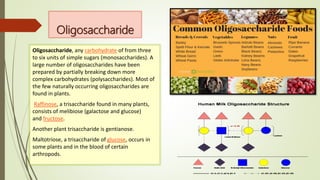
Oligosaccharide, any carbohydrate of from three
to six units of simple sugars (monosaccharides). A
large number of oligosaccharides have been
prepared by partially breaking down more
complex carbohydrates (polysaccharides). Most of
the few naturally occurring oligosaccharides are
found in plants.
Raffinose, a trisaccharide found in many plants,
consists of melibiose (galactose and glucose)
and fructose.
Another plant trisaccharide is gentianose.
Maltotriose, a trisaccharide of glucose, occurs in
some plants and in the blood of certain
arthropods.
polysaccharides
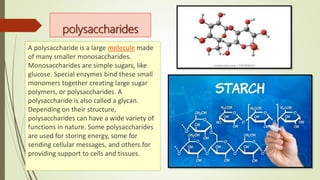
A polysaccharide is a large molecule made
of many smaller monosaccharides.
Monosaccharides are simple sugars, like
glucose. Special enzymes bind these small
monomers together creating large sugar
polymers, or polysaccharides. A
polysaccharide is also called a glycan.
Depending on their structure,
polysaccharides can have a wide variety of
functions in nature. Some polysaccharides
are used for storing energy, some for
sending cellular messages, and others for
providing support to cells and tissues.
Types of polysaccharide
Starch
It is the storage polysaccharide of
most plants. Human beings obtain it
from cereal grains (e.g., rice, wheat),
legumes (pea, gram, beans), potato,
tapioca, banana etc. Starch consists
of two components, amylose and
amylopectin . Amylose is more
soluble in water than amylopectin. In
general, 20-30% of starch consists of
amylose and the rest as amylopectin.
Glycogen
It is the polysaccharide food
reserve of animals, bacteria and
fungi. Glycogen is popularly called
animal starch. Glycogen is mainly
stored inside liver (up to 0.1 kg)
and muscles. It has about 30,000
glucose residues and a molecular
weight of about 4.8 million. There
are two types of linkages 1-4 α -
linkages in the straight part and 1-6
linkages in the area of branching.
Cellulose
It is fibrous homopolysaccharide of
high tensile strength which forms a
structural element of cell wall in all
plants, some fungi and protists.
Cellulose molecules have un-branched
and linear chains unlike the branched
and helical chains of starch and
glycogen. A chain of cellulose
molecule contains 6000 or more
glucose residues.
Carbohydrate deficiency
Definition
If deficient in carbohydrates, the body
will utilize protein and fats for energy.
Carbohydrates are the body’s most
preferred source of energy, and it is not
recommended to avoid this group of
foods when avoiding gluten. The body
is an efficient energy burner, and will
take or make glucose from other
sources and use it for energy. Ketosis
occurs in the absence of carbohydrates
when glycogen (glucose stores in the
liver) is depleted.
Symptoms
Lack of Energy: the main role of
carbohydrates is to provide your body,
particularly your brain and nervous
system, with energy. If you don't
consume enough carbohydrates, you'll
lack energy, which can make you feel
tired, weak and unable to think clearly.
Constipation
Nutritional Deficiencies
Nausea, Headache and Bad Breath
Thanks for your attention

Carbohydrate

  • 1.
    Carbohydrates The researcher: MehrasaNikandish Subject : Biochemistry
  • 2.
    Overview Introduction Monosaccharide 3 types ofmonosaccharide Disaccharide Oligosaccharide Polysaccharide 3 types of polysaccharide Carbohydrate deficiency diseases
  • 3.
    Introduction Carbohydrates are oneof the four major classes of biomolecules along with proteins, nucleic acids, and lipids. Carbohydrates are compounds that contain at least three carbon atoms, a number of hydroxyl groups, and usually an aldehyde or ketone group. They may contain phosphate, amino, or sulfate groups. First, carbohydrates serve as energy stores, fuels, and metabolic intermediates. Second, ribose and deoxyribose sugars form part of the structural framework of RNA and DNA. Third, polysaccharides are structural elements in the cell walls of bacteria and plants
  • 4.
    Monosaccharide A monosaccharide isthe most basic form of carbohydrates. Monosaccharides can by combined through glycosidic bonds to form larger carbohydrates, known as oligosaccharides or polysaccharides. Monosaccharides have many functions within cells. First and foremost, monosaccharides are used to produce and store energy. Most organisms create energy by breaking down the monosaccharide glucose. Other monosaccharides are used to form long fibers, which can be used as a form of cellular structure. Plants create cellulose to serve this function, while some bacteria can produce a similar cell wall from slightly different polysaccharides.
  • 5.
    Glucose The most abundantmonosaccharide found in nature is in fact glucose. It is the most abundant organic compound on earth. We can find glucose in varies fruits, honey and even in starch and cane sugar. We obtain a large part of the energy in our bodies from glucose through the foods we eat. It is an aldohexose, which means it has six carbon atoms in its molecule. Its chemical formula is C6H12O6
  • 6.
    Fructose Fructose is asimple ketonic monosaccharide. We mostly find fructose in plants and their fruits, flowers and root vegetables, hence earning it a moniker of fruit sugar. It is also abundantly present in honey and corn syrup. Fructose was first discovered by a French chemist Augustin – Pierre Debrunfaut. The chemical formula of fructose is also C6H12O6 but the bonding of fructose is very different than that of glucose. Fructose has a cyclic structure. It has its carbonyl group at its number two carbon (its a ketone function group). In its cyclic form, it (generally) forms a five-member ring which we call a Furanose ring.
  • 7.
    Galactose What is galactose? Galactoseis a simple sugar, which belongs to simple carbohydrates. Galactose is composed of the same elements as glucose, but has a different arrangement of atoms. Name origin: From the Greek gala = milk, and - ose, which denotes sugar. Is galactose an essential nutrient? Galactose is not an essential nutrient, which means you do not need to get it from food to be healthy; galactose can be synthesized in the human body from glucose. Galactose Functions in the Human Body In the human body, most of the ingested galactose is converted to glucose, which can provide 4.1 kilocalories per gram of energy, which is about the same as sucrose
  • 8.
    Disaccharides Sucrose This is themost important disaccharide. It is popularly known as table sugar. Sucrose is found in all photosynthetic plants. It is commercially obtained from sugarcane and sugar beets via an industrial process. The molecular formula of sucrose is C12H22O11. If sucrose goes through acid catalysed hydrolysis it will give one mole of D-Glucose and one mole of D-Fructose. The chemical structure of sucrose comprises of α form of glucose and β form of fructose Lactose Lactose is the primary ingredient found in the milk of all mammals. Unlike the majority of saccharides, lactose is not sweet to taste. Lactose consists of one galactose carbohydrate and one glucose carbohydrate. These are bound together by a 1-4 glycosidic bond in a beta orientation. Maltose Maltose is another disaccharide commonly found. It has two monosaccharide glucose molecules bound together, The link is between the first carbon atom of glucose and the fourth carbon of another glucose molecule. Maltose has a free hemiacetal hydroxide, hence it undergoes mutarotation. It exists as both α- Maltose and also β-Maltose
  • 9.
    Oligosaccharide Oligosaccharide, any carbohydrateof from three to six units of simple sugars (monosaccharides). A large number of oligosaccharides have been prepared by partially breaking down more complex carbohydrates (polysaccharides). Most of the few naturally occurring oligosaccharides are found in plants. Raffinose, a trisaccharide found in many plants, consists of melibiose (galactose and glucose) and fructose. Another plant trisaccharide is gentianose. Maltotriose, a trisaccharide of glucose, occurs in some plants and in the blood of certain arthropods.
  • 10.
    polysaccharides A polysaccharide isa large molecule made of many smaller monosaccharides. Monosaccharides are simple sugars, like glucose. Special enzymes bind these small monomers together creating large sugar polymers, or polysaccharides. A polysaccharide is also called a glycan. Depending on their structure, polysaccharides can have a wide variety of functions in nature. Some polysaccharides are used for storing energy, some for sending cellular messages, and others for providing support to cells and tissues.
  • 11.
    Types of polysaccharide Starch Itis the storage polysaccharide of most plants. Human beings obtain it from cereal grains (e.g., rice, wheat), legumes (pea, gram, beans), potato, tapioca, banana etc. Starch consists of two components, amylose and amylopectin . Amylose is more soluble in water than amylopectin. In general, 20-30% of starch consists of amylose and the rest as amylopectin. Glycogen It is the polysaccharide food reserve of animals, bacteria and fungi. Glycogen is popularly called animal starch. Glycogen is mainly stored inside liver (up to 0.1 kg) and muscles. It has about 30,000 glucose residues and a molecular weight of about 4.8 million. There are two types of linkages 1-4 α - linkages in the straight part and 1-6 linkages in the area of branching. Cellulose It is fibrous homopolysaccharide of high tensile strength which forms a structural element of cell wall in all plants, some fungi and protists. Cellulose molecules have un-branched and linear chains unlike the branched and helical chains of starch and glycogen. A chain of cellulose molecule contains 6000 or more glucose residues.
  • 12.
    Carbohydrate deficiency Definition If deficientin carbohydrates, the body will utilize protein and fats for energy. Carbohydrates are the body’s most preferred source of energy, and it is not recommended to avoid this group of foods when avoiding gluten. The body is an efficient energy burner, and will take or make glucose from other sources and use it for energy. Ketosis occurs in the absence of carbohydrates when glycogen (glucose stores in the liver) is depleted. Symptoms Lack of Energy: the main role of carbohydrates is to provide your body, particularly your brain and nervous system, with energy. If you don't consume enough carbohydrates, you'll lack energy, which can make you feel tired, weak and unable to think clearly. Constipation Nutritional Deficiencies Nausea, Headache and Bad Breath
  • 13.
    Thanks for yourattention