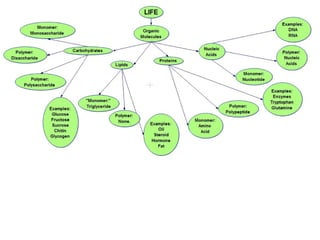
Biological Molecules
Objectives:
Describe the structure of the molecules that make
up living organisms
The chemicals found in living organisms
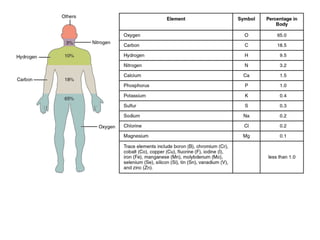
• What elements are you made of?
• Which 3 elements are most common in your body?
• You should know the answer to this!
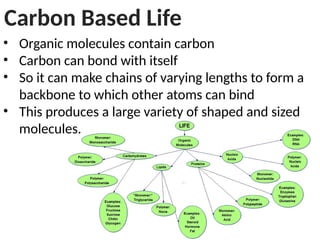
Carbon Based Life
• Organic molecules contain carbon
• Carbon can bond with itself
• So it can make chains of varying lengths to form a
backbone to which other atoms can bind
• This produces a large variety of shaped and sized
molecules.
How do these elements form compounds?
(eg sugar)
Forming Molecules
• Covalent bond: shared electrons, forms
molecules, very strong
• Ionic bond: opposite charges attract
between ions, weaker than covalent
• Hydrogen Bonds: hydrostatic forces formed
between uneven charges in polar molecules.
Weak individually, but may collectively alter
the properties of molecules.
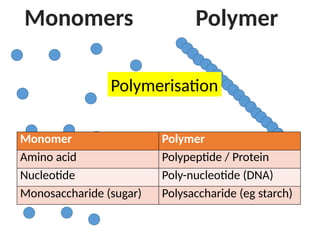
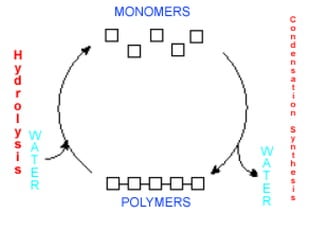
Monomers Polymer
Polymerisation
Monomer Polymer
Amino acid Polypeptide / Protein
Nucleotide Poly-nucleotide (DNA)
Monosaccharide (sugar) Polysaccharide (eg starch)
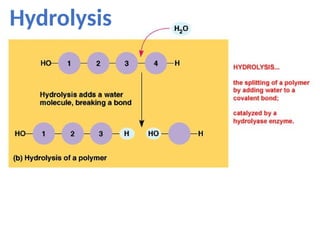
Hydrolysis
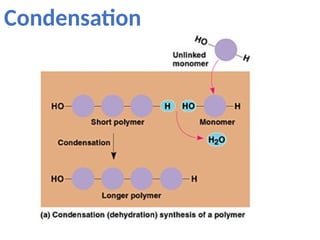
Condensation
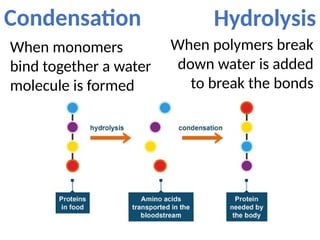
Condensation Hydrolysis
When monomers
bind together a water
molecule is formed
When polymers break
down water is added
to break the bonds
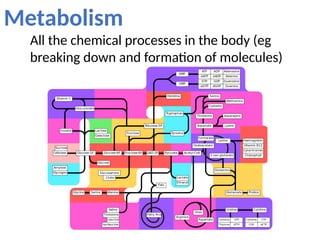
Metabolism
All the chemical processes in the body (eg
breaking down and formation of molecules)
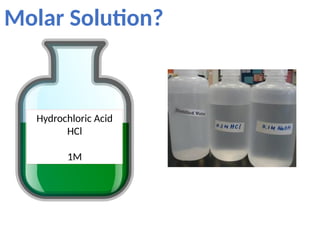
Molar Solution?
Hydrochloric Acid
HCl
1M
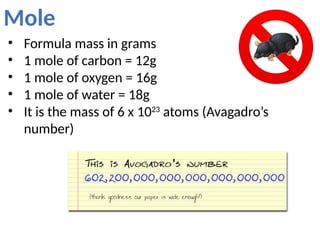
Mole
• Formula mass in grams
• 1 mole of carbon = 12g
• 1 mole of oxygen = 16g
• 1 mole of water = 18g
• It is the mass of 6 x 10²³
atoms (Avagadro’s
number)
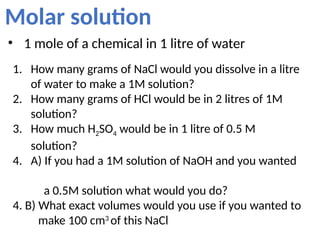
Molar solution
• 1 mole of a chemical in 1 litre of water
1. How many grams of NaCl would you dissolve in a litre
of water to make a 1M solution?
2. How many grams of HCl would be in 2 litres of 1M
solution?
3. How much H2SO4 would be in 1 litre of 0.5 M
solution?
4. A) If you had a 1M solution of NaOH and you wanted
a 0.5M solution what would you do?
4. B) What exact volumes would you use if you wanted to
make 100 cm3
of this NaCl
Carbohydrates
Objectives:
• Compare monosaccharides and disaccharides
• Describe how to test for reducing and non-
reducing sugars
Sugars
Starter: similarities and differences
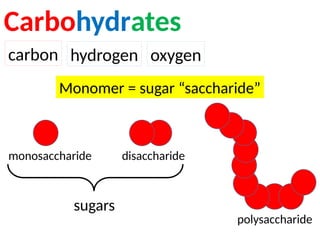
Carbohydrates
carbon hydrogen oxygen
Monomer = sugar “saccharide”
monosaccharide disaccharide
polysaccharide
sugars
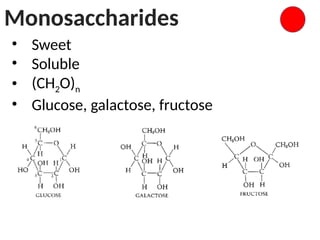
Monosaccharides
• Sweet
• Soluble
• (CH2O)n
• Glucose, galactose, fructose
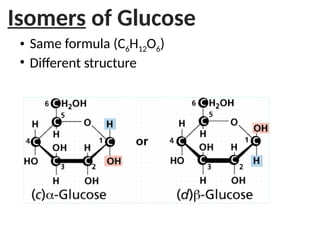
Isomers of Glucose
• Same formula (C6H12O6)
• Different structure
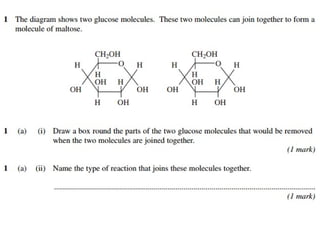
Disaccharides
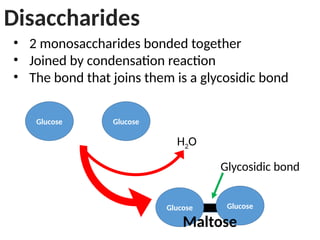
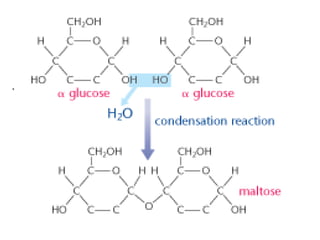
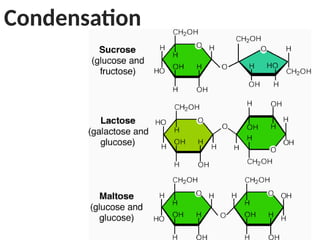
• 2 monosaccharides bonded together
• Joined by condensation reaction
• The bond that joins them is a glycosidic bond
Glucose Glucose
Glucose Glucose
H2O
Maltose
Glycosidic bond
Condensation
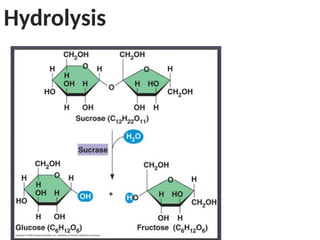
Hydrolysis
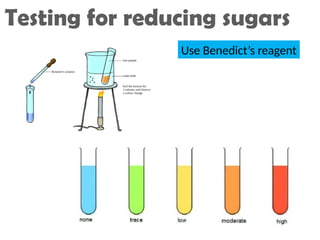
Testing for reducing sugars
Use Benedict’s reagent
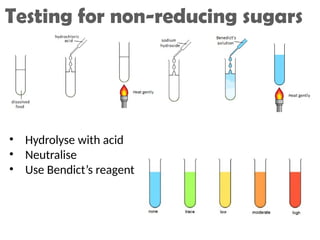
Testing for non-reducing sugars
• Hydrolyse with acid
• Neutralise
• Use Bendict’s reagent
Polysaccharides
• Describe how starch, cellulose and glycogen form
• Describe the test for starch
Objectives
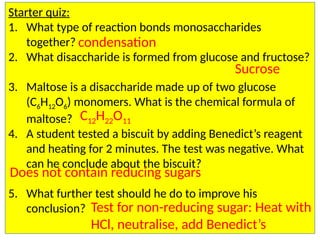
Starter quiz:
1. What type of reaction bonds monosaccharides
together?
2. What disaccharide is formed from glucose and fructose?
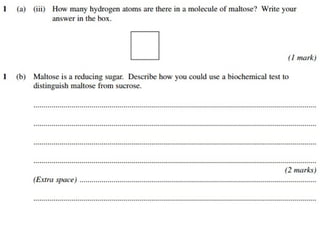
3. Maltose is a disaccharide made up of two glucose
(C6H12O6) monomers. What is the chemical formula of
maltose?
4. A student tested a biscuit by adding Benedict’s reagent
and heating for 2 minutes. The test was negative. What
can he conclude about the biscuit? What further test
should he do to improve his conclusion?
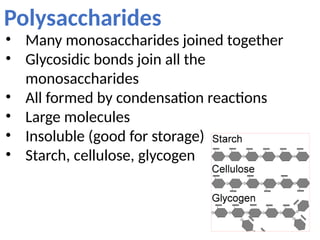
Starter quiz:
1. What type of reaction bonds monosaccharides
together?
2. What disaccharide is formed from glucose and fructose?
3. Maltose is a disaccharide made up of two glucose
(C6H12O6) monomers. What is the chemical formula of
maltose?
4. A student tested a biscuit by adding Benedict’s reagent
and heating for 2 minutes. The test was negative. What
can he conclude about the biscuit?
5. What further test should he do to improve his
conclusion?
condensation
Sucrose
C12H22O11
Does not contain reducing sugars
Test for non-reducing sugar: Heat with
HCl, neutralise, add Benedict’s
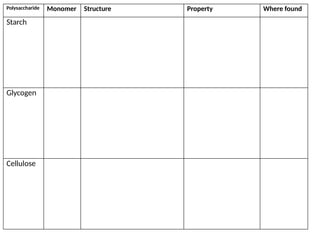
Polysaccharides
• Many monosaccharides joined together
• Glycosidic bonds join all the
monosaccharides
• All formed by condensation reactions
• Large molecules
• Insoluble (good for storage)
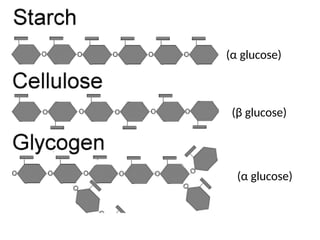
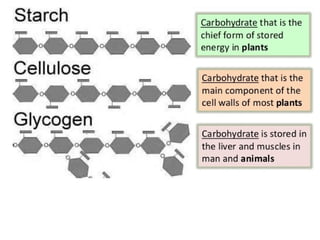
• Starch, cellulose, glycogen
Polysaccharide Monomer Structure Property Where found
Starch
Glycogen
Cellulose
(α glucose)
(α glucose)
(β glucose)
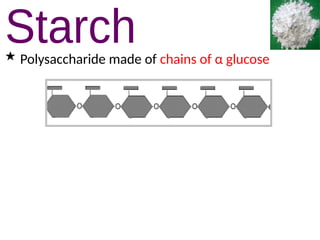
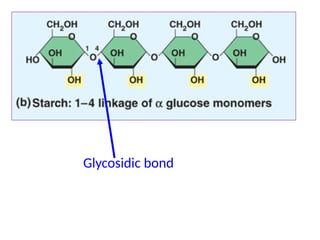
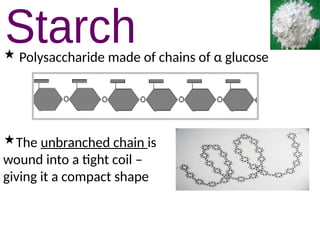
 Polysaccharide made of chains of α glucose
Glycosidic bond
 Polysaccharide made of chains of α glucose
The unbranched chain is
wound into a tight coil –
giving it a compact shape
1. Found in plant cells as small grains:
 Storage molecule (stores glucose for respiration)
 Found mainly in seeds and storage organs (eg
potato tubers)
2. Not found in animal cells – but is the main
source of energy in our diet
Function:
Why is starch such a good storage molecule?
1. It is insoluble so it will:
• not affect osmosis (eg will not draw water
into a cell when starch levels are high)
• not diffuse out of a cell
2. It is compact so a lot can be stored in a small place
3. It is hydrolysed to form α glucose – a molecule that
is easily transported and readily used in respiration
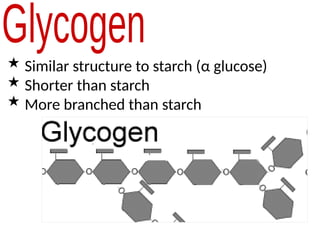
 Similar structure to starch (α glucose)
 Shorter than starch
 More branched than starch
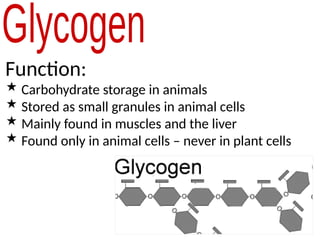
Function:
 Carbohydrate storage in animals
 Stored as small granules in animal cells
 Mainly found in muscles and the liver
 Found only in animal cells – never in plant cells
Why is glycogen a good storage molecule?
 All the same reasons as starch:
1. Insoluble
2. Compact
3. Easily hydrolysed
Plus
 the shorter chains make it even more readily
hydrolysed
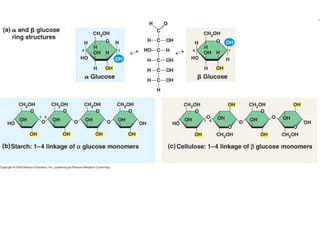
 Polysaccharide chain made of β glucose

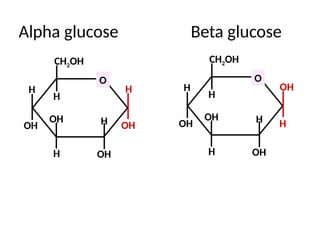
Alpha glucose Beta glucose
H
H
H
H
H
OH OH
OH
CH2OH
O
OH
H
H
H
H
H
OH
OH
OH
CH2OH
O
OH
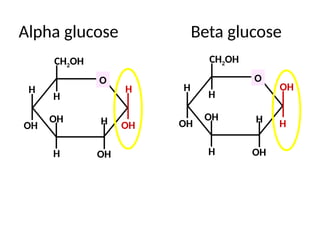
Alpha glucose Beta glucose
H
H
H
H
H
OH OH
OH
CH2OH
O
OH
H
H
H
H
H
OH
OH
OH
CH2OH
O
OH
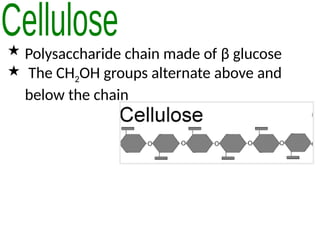
 Polysaccharide chain made of β glucose
 The CH2OH groups alternate above and
below the chain
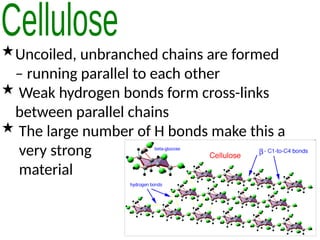
Uncoiled, unbranched chains are formed
– running parallel to each other
 Weak hydrogen bonds form cross-links
between parallel chains
 The large number of H bonds make this a
very strong
material
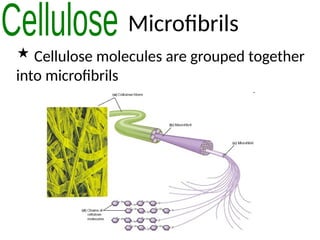
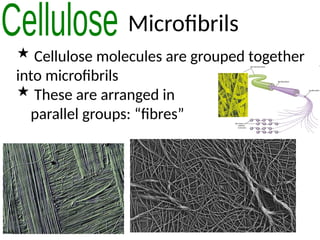
Microfibrils
 Cellulose molecules are grouped together
into microfibrils
Microfibrils
 Cellulose molecules are grouped together
into microfibrils
 These are arranged in
parallel groups: “fibres”
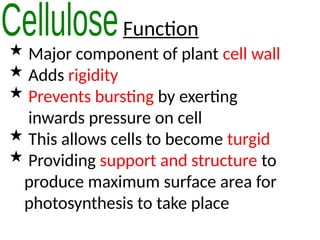
Function
 Major component of plant cell wall
 Adds rigidity
 Prevents bursting by exerting
inwards pressure on cell
 This allows cells to become turgid
 Providing support and structure to
produce maximum surface area for
photosynthesis to take place
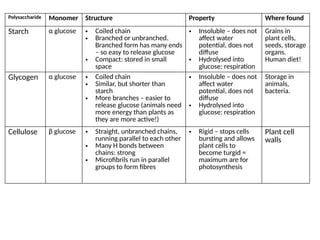
Polysaccharide Monomer Structure Property Where found
Starch α glucose • Coiled chain
• Branched or unbranched.
Branched form has many ends
– so easy to release glucose
• Compact: stored in small
space
• Insoluble – does not
affect water
potential, does not
diffuse
• Hydrolysed into
glucose: respiration
Grains in
plant cells,
seeds, storage
organs.
Human diet!
Glycogen α glucose • Coiled chain
• Similar, but shorter than
starch
• More branches – easier to
release glucose (animals need
more energy than plants as
they are more active!)
• Insoluble – does not
affect water
potential, does not
diffuse
• Hydrolysed into
glucose: respiration
Storage in
animals,
bacteria.
Cellulose β glucose • Straight, unbranched chains,
running parallel to each other
• Many H bonds between
chains: strong
• Microfibrils run in parallel
groups to form fibres
• Rigid – stops cells
bursting and allows
plant cells to
become turgid =
maximum are for
photosynthesis
Plant cell
walls
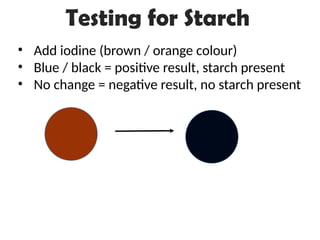
Testing for Starch
• Add iodine (brown / orange colour)
• Blue / black = positive result, starch present
• No change = negative result, no starch present
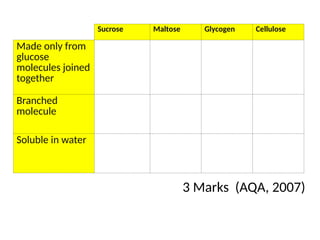
Sucrose Maltose Glycogen Cellulose
Made only from
glucose
molecules joined
together
Branched
molecule
Soluble in water
3 Marks (AQA, 2007)
Sucrose Maltose Glycogen Cellulose
Made only from
glucose
molecules joined
together
Branched
molecule
Soluble in water
3 Marks (AQA, 2007)
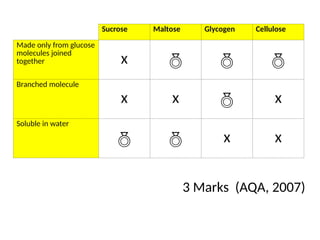
Sucrose Maltose Glycogen Cellulose
Made only from glucose
molecules joined
together x   
Branched molecule
x x  x
Soluble in water
  x x
3 Marks (AQA, 2007)
Lipids
Objective
• Link the structure of lipids to their function
• Describe how to test for lipids
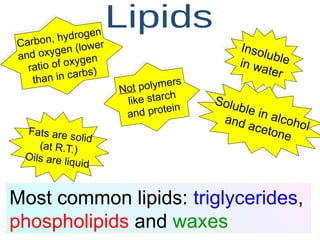
What are lipids like?
Carbon, hydrogen
and oxygen (lower
ratio of oxygen
than in carbs)
Insoluble
in water
Most common lipids: triglycerides,
phospholipids and waxes
Fats are solid
(at R.T.)
Oils are liquid
Not polymers
like starch
and protein
Soluble in alcohol
and acetone
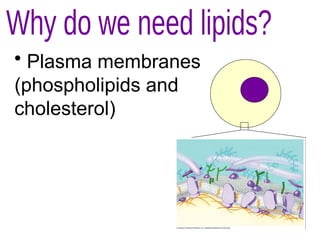
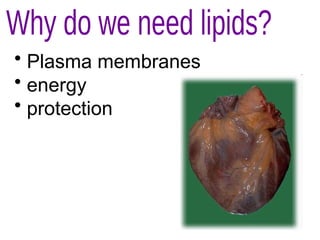
• Plasma membranes
(phospholipids and
cholesterol)
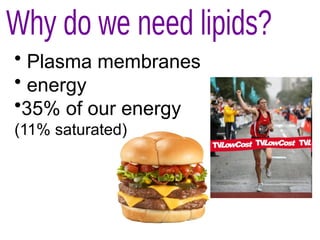
• Plasma membranes
• energy
•35% of our energy
(11% saturated)
• Plasma membranes
• energy
• protection
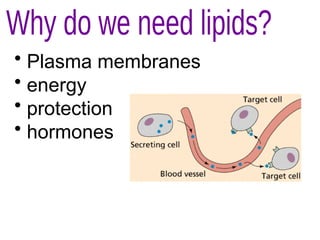
• Plasma membranes
• energy
• protection
• hormones
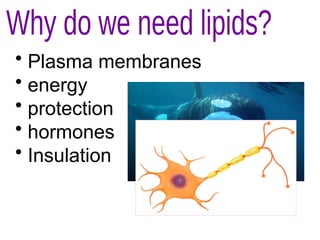
• Plasma membranes
• energy
• protection
• hormones
• Insulation
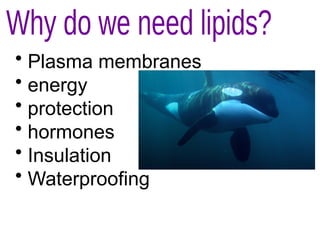
• Plasma membranes
• energy
• protection
• hormones
• Insulation
• Waterproofing
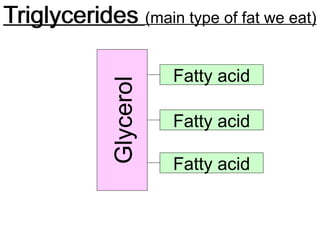
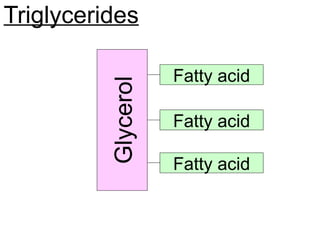
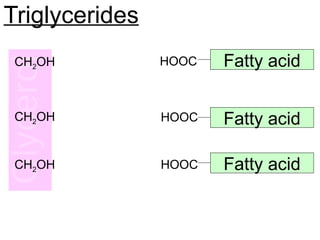
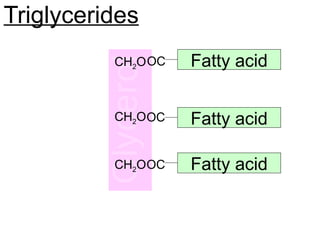
Triglycerides
Glycerol
Fatty acid
Fatty acid
Fatty acid
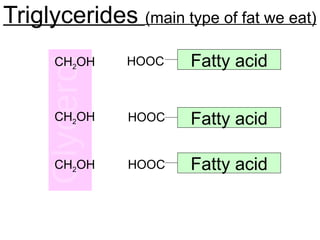
Triglycerides (main type of fat we eat)
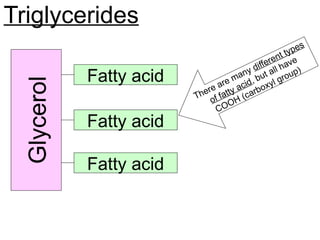
Triglycerides
Glycerol
Fatty acid
Fatty acid
Fatty acid
There are many different types
of fatty acid, but all have
COOH (carboxyl group)
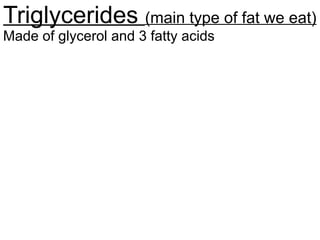
Triglycerides (main type of fat we eat)
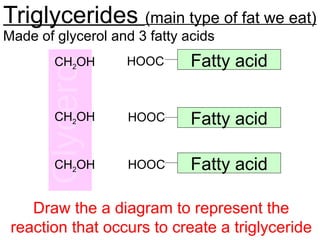
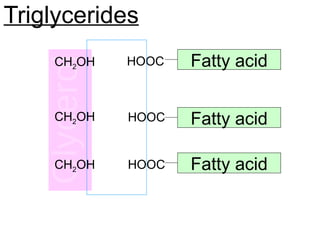
Made of glycerol and 3 fatty acids
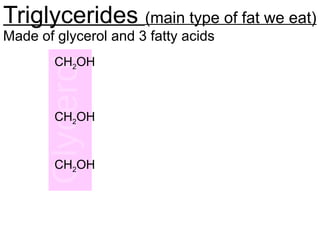
Triglycerides (main type of fat we eat)
Made of glycerol and 3 fatty acids
CH2OH
CH2OH
CH2OH
Triglycerides (main type of fat we eat)
Fatty acid
Fatty acid
Fatty acid
CH2OH
CH2OH
CH2OH
HOOC
HOOC
HOOC
Triglycerides (main type of fat we eat)
Made of glycerol and 3 fatty acids
CH2OH
CH2OH
CH2OH
Fatty acid
Fatty acid
Fatty acid
HOOC
HOOC
HOOC
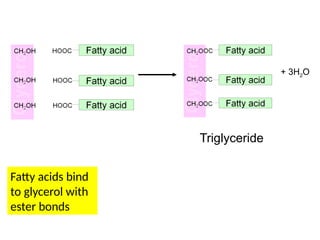
Draw the a diagram to represent the
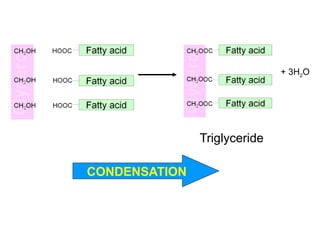
reaction that occurs to create a triglyceride
Triglycerides
Glycerol
Fatty acid
Fatty acid
Fatty acid
+ 3H2O
Triglyceride
CONDENSATION
Triglycerides
Fatty acid
Fatty acid
Fatty acid
CH2OH
CH2OH
CH2OH
HOOC
HOOC
HOOC
Triglycerides
Fatty acid
Fatty acid
Fatty acid
CH2OH
CH2OH
CH2OH
HOOC
HOOC
HOOC
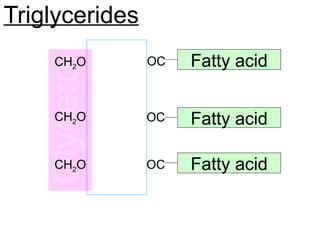
Triglycerides
Fatty acid
Fatty acid
Fatty acid
CH2O
CH2O
CH2O
OC
OC
OC
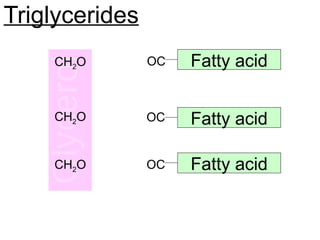
Triglycerides
Fatty acid
Fatty acid
Fatty acid
CH2O
CH2O
CH2O
OC
OC
OC
Triglycerides
Fatty acid
Fatty acid
Fatty acid
CH2O
CH2O
CH2O
OC
OC
OC
Triglycerides
Fatty acid
Fatty acid
Fatty acid
CH2O
CH2O
CH2O
OC
OC
OC
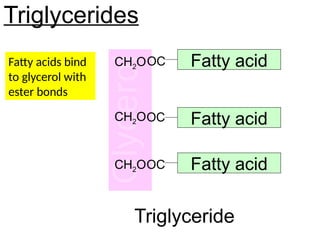
Triglyceride
Fatty acids bind
to glycerol with
ester bonds
+ 3H2O
Triglyceride
Fatty acids bind
to glycerol with
ester bonds
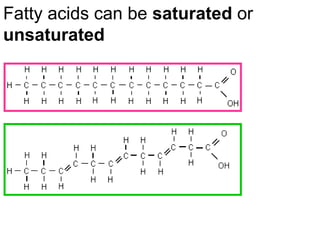
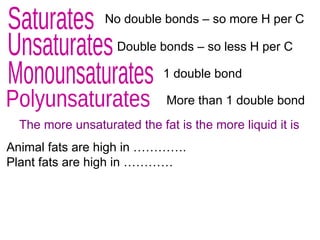
Fatty acids can be saturated or
unsaturated
No double bonds – so more H per C
Double bonds – so less H per C
1 double bond
More than 1 double bond
The more unsaturated the fat is the more liquid it is
Animal fats are high in ………….
Plant fats are high in …………
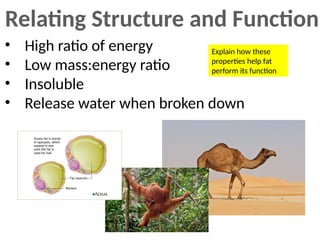
Relating Structure and Function
• High ratio of energy
• Low mass:energy ratio
• Insoluble
• Release water when broken down
Explain how these
properties help fat
perform its function
Phospholipids
Phospholipids
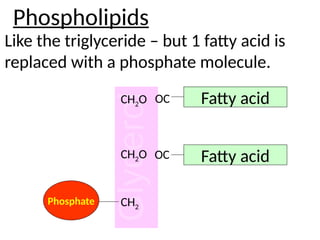
Like the triglyceride – but 1 fatty acid is
replaced with a phosphate molecule.
Phospholipids
Like the triglyceride – but 1 fatty acid is
replaced with a phosphate molecule.
Fatty acid
Fatty acid
CH2O
CH2O
CH2
OC
OC
Phosphate
Phospholipids
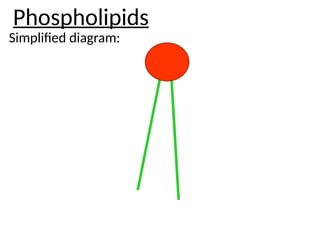
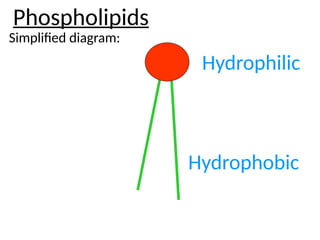
Simplified diagram:
Phospholipids
Simplified diagram:
Hydrophilic
Hydrophobic
Phospholipids
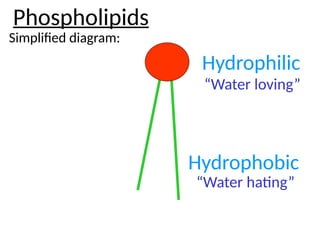
Simplified diagram:
Hydrophilic
Hydrophobic
“Water loving”
“Water hating”
Phospholipids
Simplified diagram:
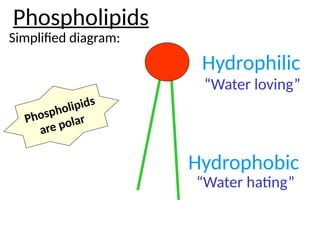
Hydrophilic
Hydrophobic
“Water loving”
“Water hating”
Phospholipids
are polar
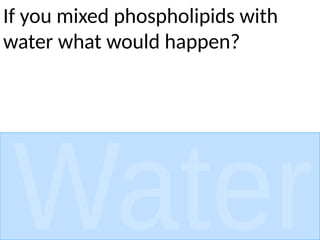
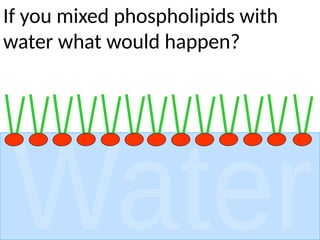
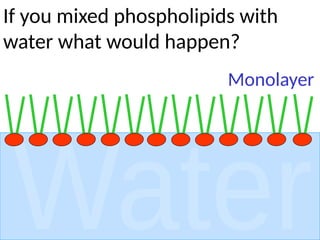
If you mixed phospholipids with
water what would happen?
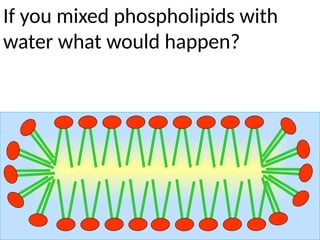
If you mixed phospholipids with
water what would happen?
If you mixed phospholipids with
water what would happen?
Monolayer
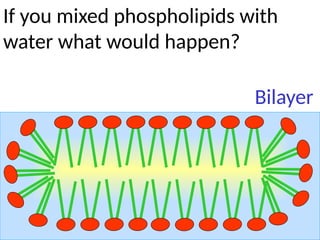
If you mixed phospholipids with
water what would happen?
If you mixed phospholipids with
water what would happen?
Bilayer
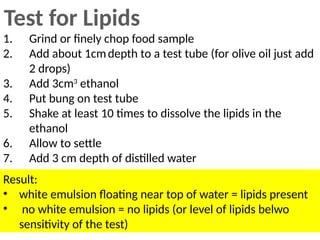
Test for Lipids
1. Grind or finely chop food sample
2. Add about 1cmdepth to a test tube (for olive oil just add
2 drops)
3. Add 3cm3
ethanol
4. Put bung on test tube
5. Shake at least 10 times to dissolve the lipids in the
ethanol
6. Allow to settle
7. Add 3 cm depth of distilled water
Result:
• white emulsion floating near top of water = lipids present
• no white emulsion = no lipids (or level of lipids belwo
sensitivity of the test)

biological-molecules.pptx biological molecules