CORRELATION
ANALYSIS
Major Points - Correlation
• Questions answered by correlation
• Scatterplots
• An example
• The correlation coefficient
• Other kinds of correlations
• Factors affecting correlations
• Testing for significance
The Question
• Are two variables related?
• Does one increase as the other increases?
• e. g. skills and income
• Does one decrease as the other increases?
• e. g. health problems and nutrition
• How can we get a numerical measure of the degree of
relationship?
Correlation
Finding the relationship between two quantitative variables
without being able to infer causal relationships
Correlation is a statistical technique used to determine the
degree to which two variables are related
Scatterplots
• Graphically depicts the relationship between two variables in
two dimensional space. Rectangular coordinate
• Two quantitative variables
• One variable is called independent (X) and the second is
called dependent (Y)
• Points are not joined
Y
* *
*
X
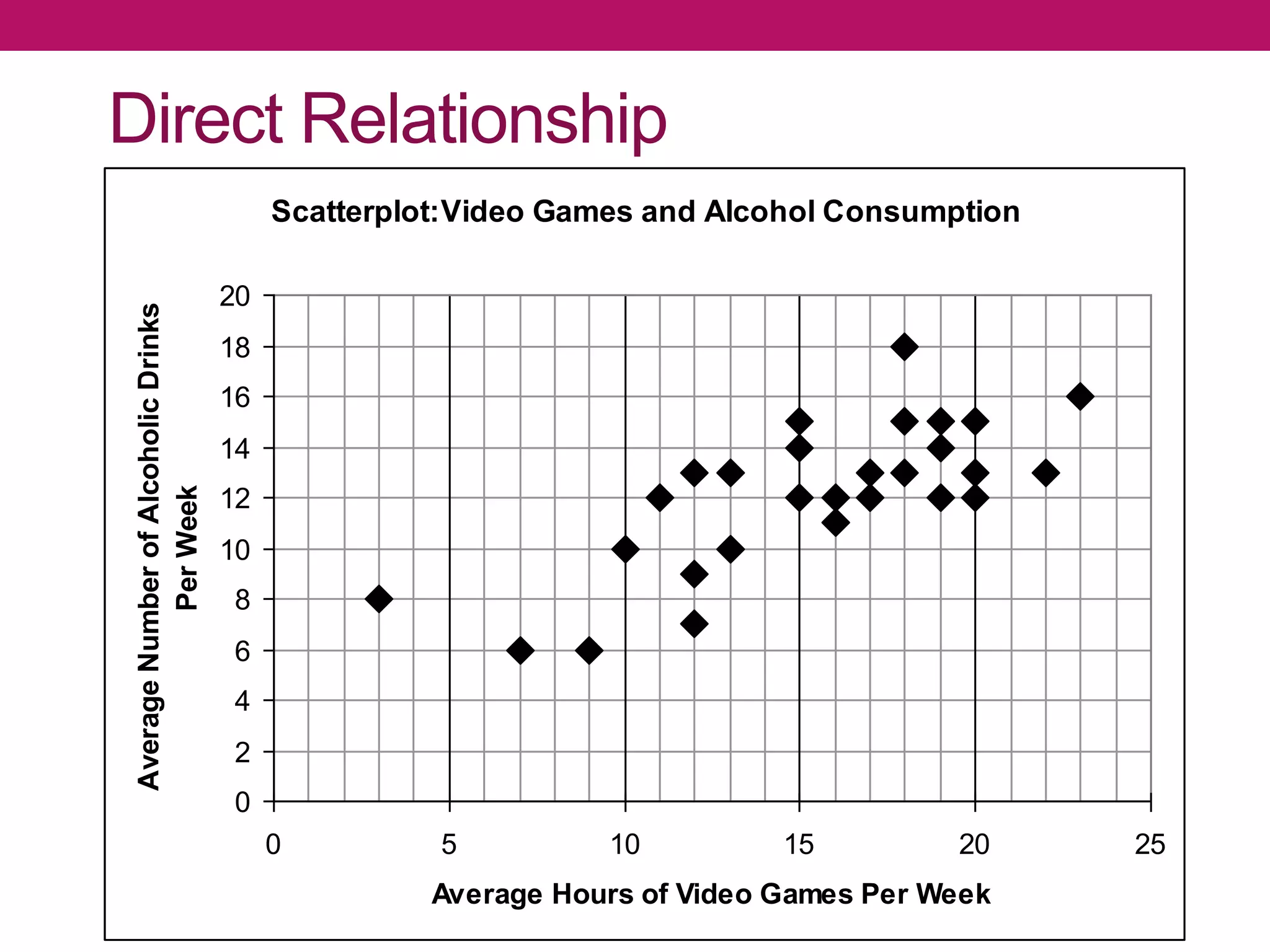
Scatterplot:Video Games and Alcohol Consumption
0
2
4
6
8
10
12
14
16
18
20
0 5 10 15 20 25
Average Hours of Video Games Per Week
AverageNumberofAlcoholicDrinks
PerWeek
Direct Relationship
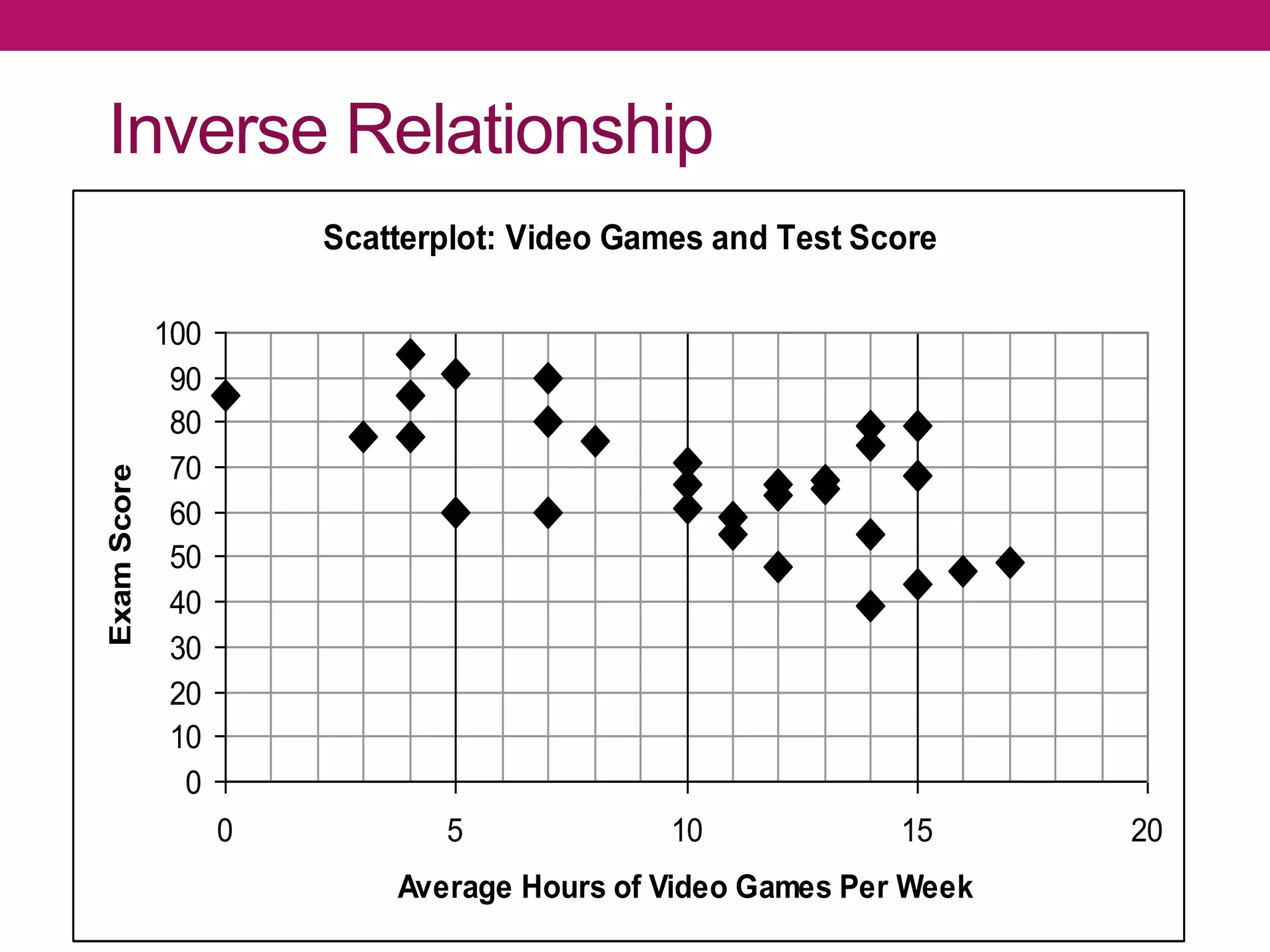
Scatterplot: Video Games and Test Score
0
10
20
30
40
50
60
70
80
90
100
0 5 10 15 20
Average Hours of Video Games Per Week
ExamScore
Inverse Relationship
An Example
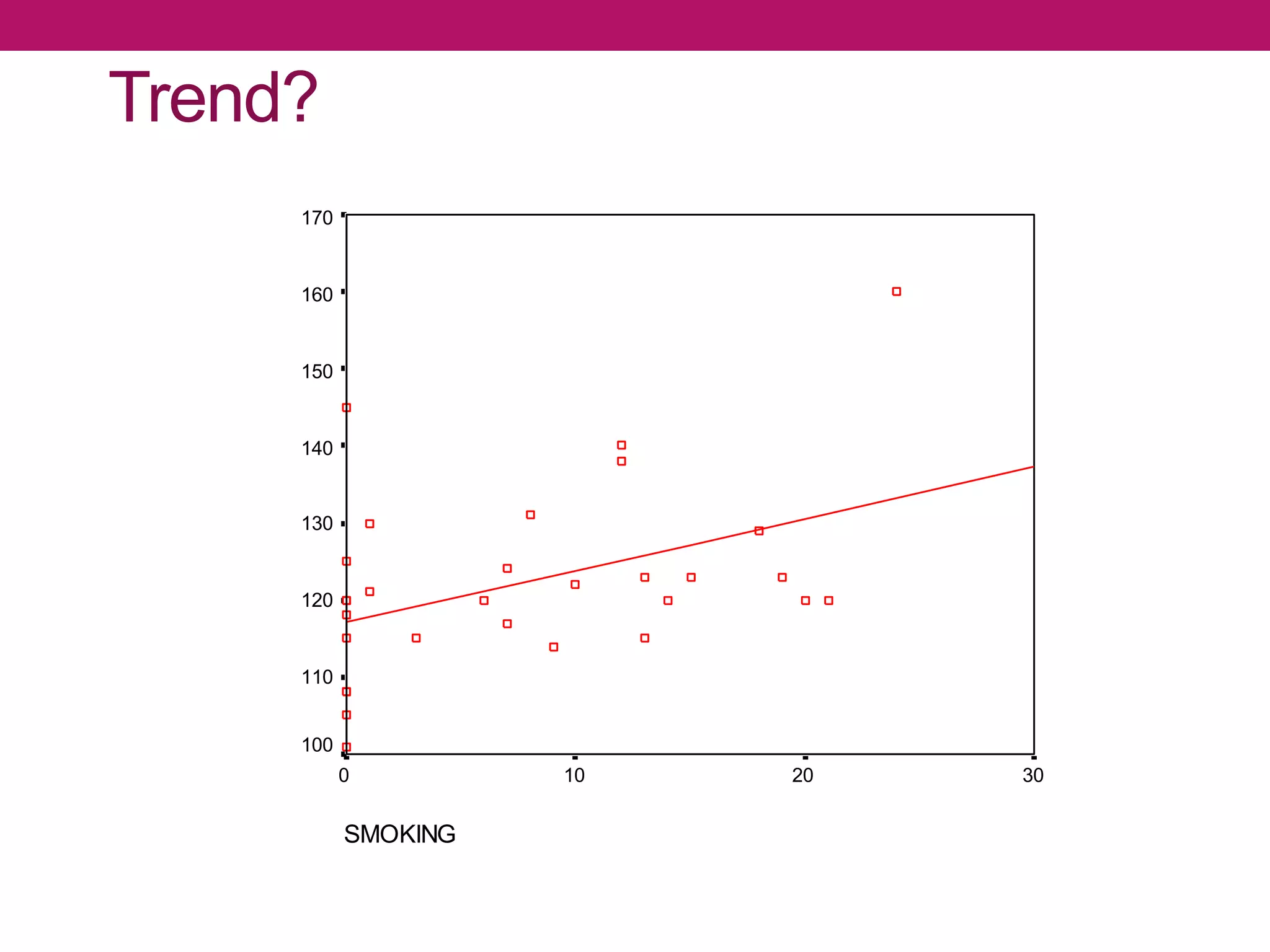
• Does smoking cigarettes increase systolic blood
pressure?
• Plotting number of cigarettes smoked per day against
systolic blood pressure
• Fairly moderate relationship
• Relationship is positive
Trend?
SMOKING
3020100
SYSTOLIC
170
160
150
140
130
120
110
100
Correlation
• Co-relation
• The relationship between two variables
• Measured with a correlation coefficient
• Most popularly seen correlation coefficient: Pearson
Product-Moment Correlation
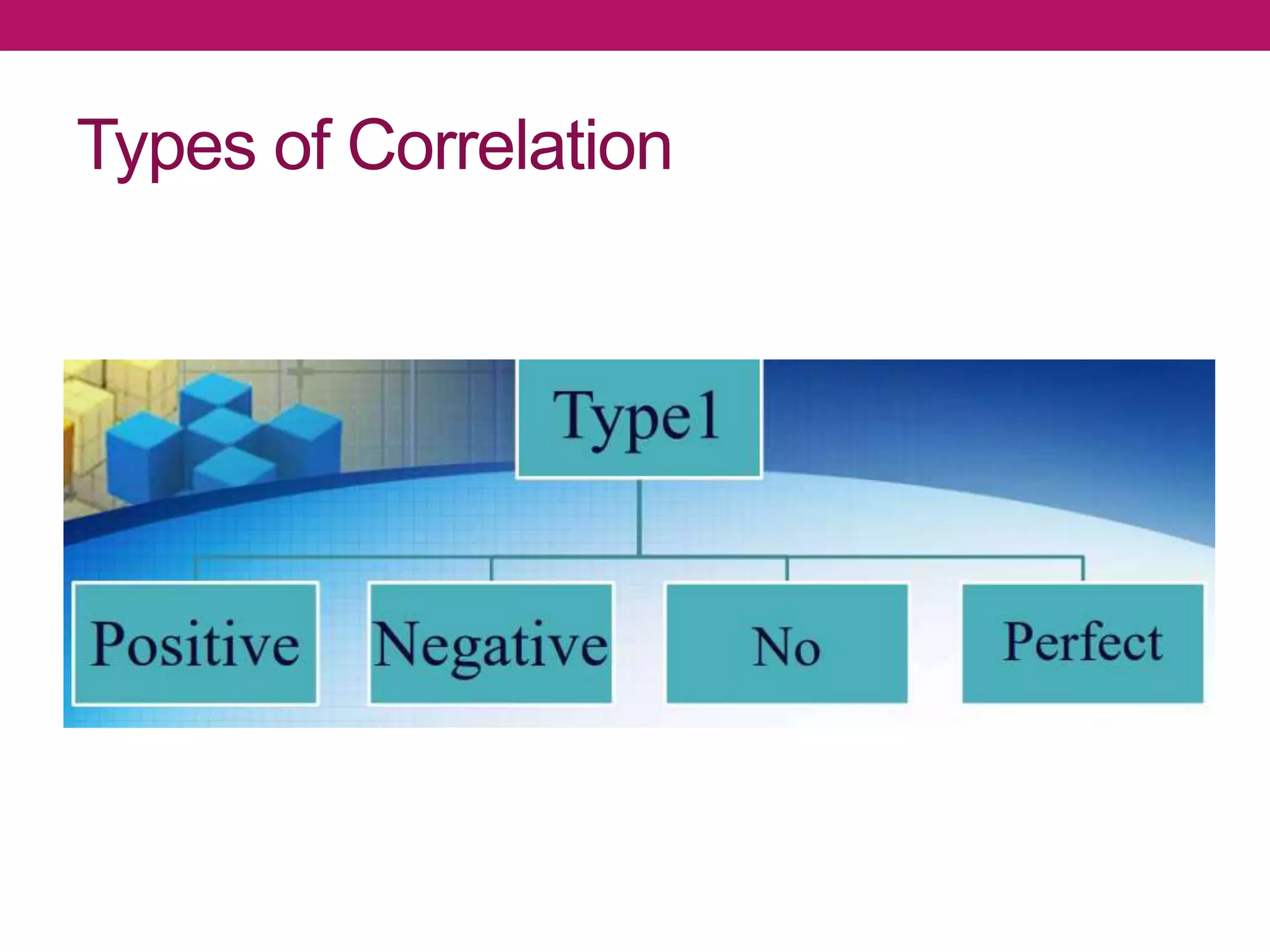
Types of Correlation
 Positive correlation
High values of X tend to be associated with high values of Y.
As X increases, Y increases
 Negative correlation
High values of X tend to be associated with low values of Y.
As X increases, Y decreases
 No correlation
 No consistent tendency for values on Y to increase or
decrease as X increases
Correlation Coefficient
 A measure of degree of relationship between two
variables.
 Between 1 and -1
 Sign refers to direction.
 Based on covariance
 Measure of degree to which large scores on X go with large
scores on Y, and small scores on X go with small scores on Y
 Think of it as variance, but with 2 variables instead of 1 (What
does that mean??)
13
Simple Correlation coefficient (r)
It is also called Pearson's correlation or product
moment correlation
coefficient.
It measures the nature and strength between two
variables of
the quantitative type.
The sign of r denotes the nature of
association
while the value of r denotes the
strength of association.
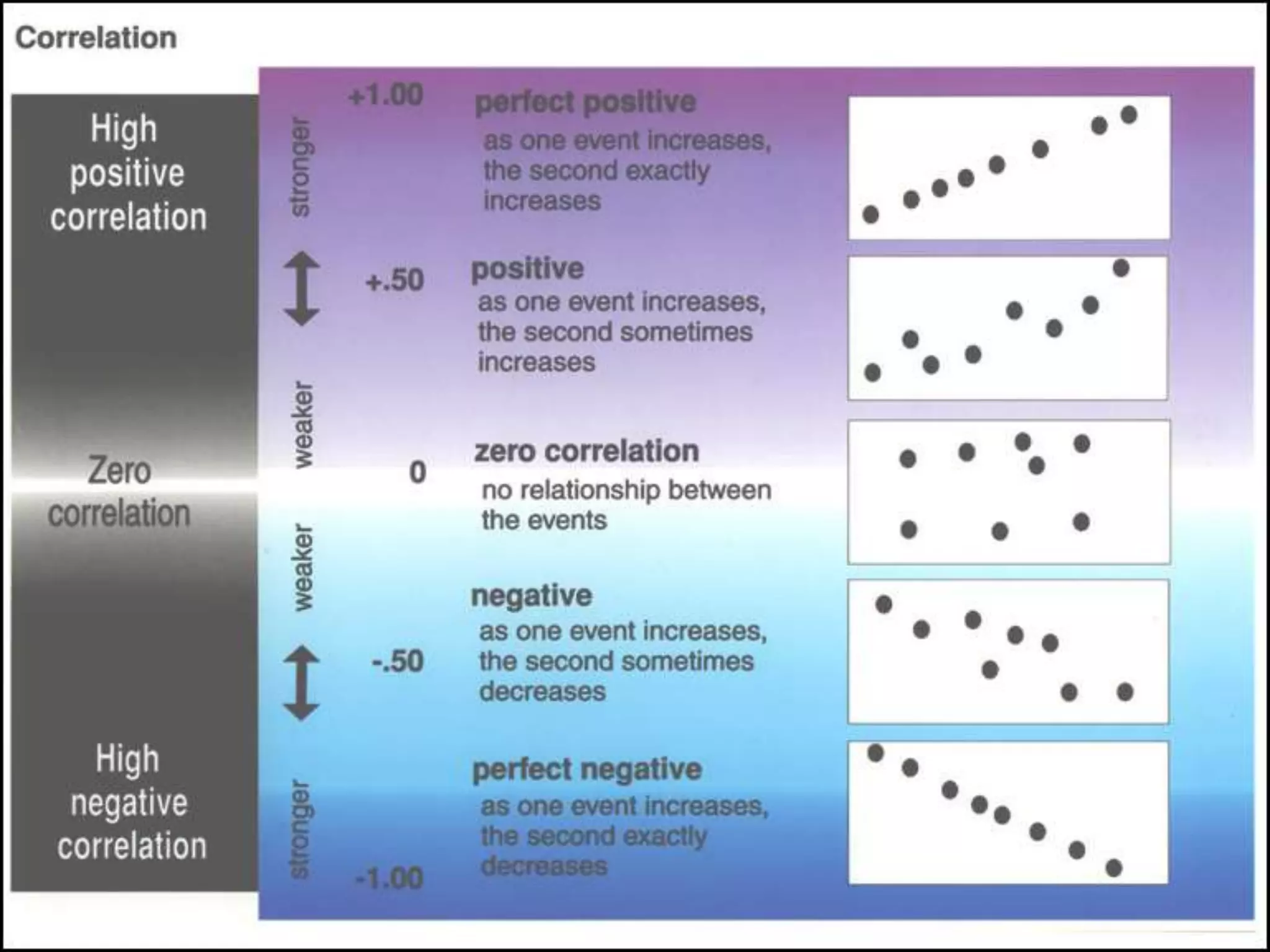
The value of r ranges between ( -1) and ( +1)
The value of r denotes the strength of the
association as illustrated
by the following diagram.
-1 10-0.25-0.75 0.750.25
strong strongintermediate intermediateweak weak
no relation
perfect
correlation
perfect
correlation
Directindirect
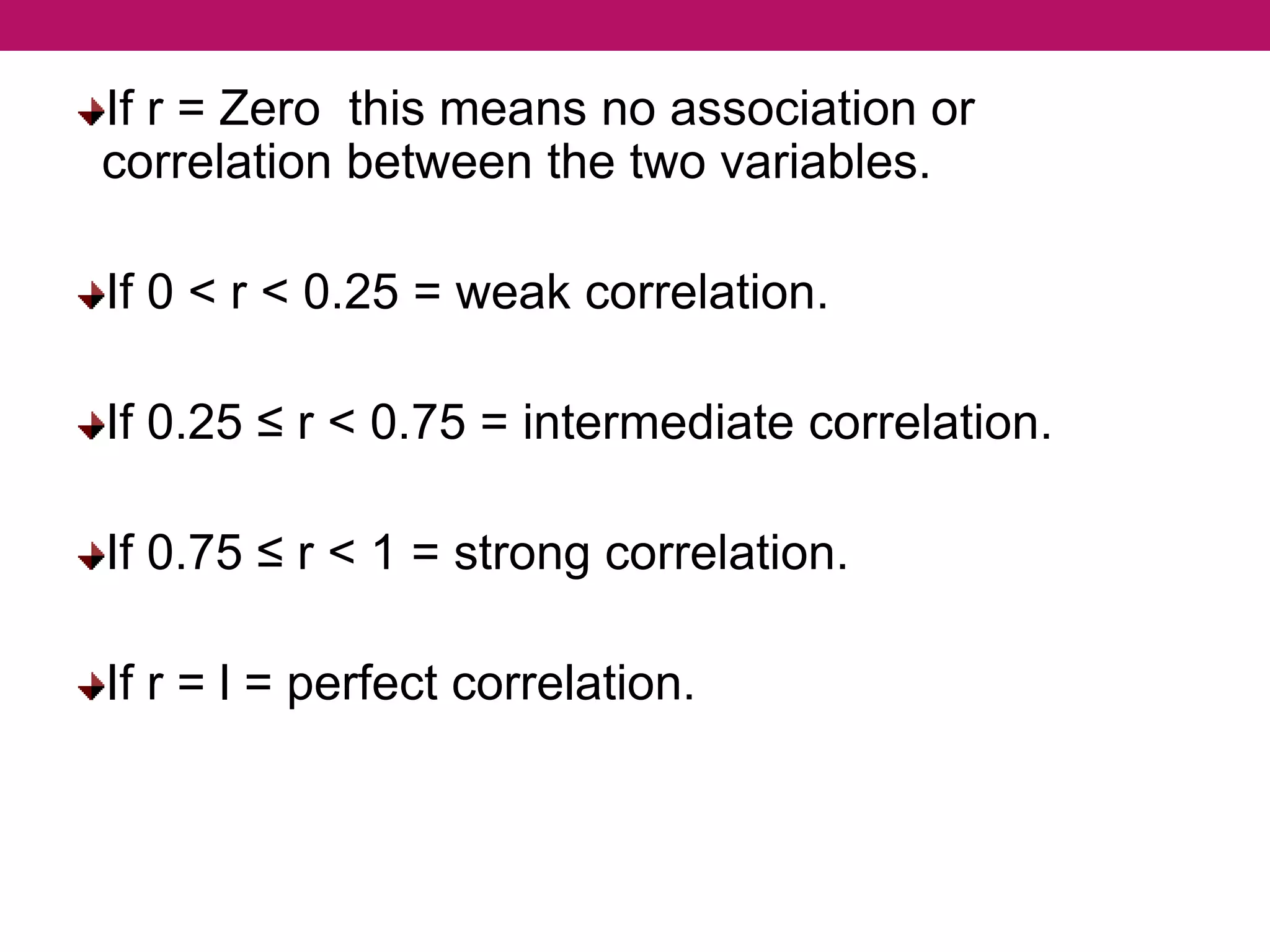
If r = Zero this means no association or
correlation between the two variables.
If 0 < r < 0.25 = weak correlation.
If 0.25 ≤ r < 0.75 = intermediate correlation.
If 0.75 ≤ r < 1 = strong correlation.
If r = l = perfect correlation.
Significance test
• Performing the Hypothesis Test
• Null hypothesis: H0: ρ = 0
• Alternate hypothesis: Ha: ρ ≠ 0
• What the Hypothesis Means in Words:
• Null hypothesis H0: The population correlation
coefficient is not significantly different from zero. There is
nota significant linear relationship (correlation)
between x and y in the population.
• Alternate hypothesis Ha: The population correlation
coefficient is significantly different from zero. There is a
significant linear relationship (correlation)
between x and y in the population.
Significance test
• Drawing a Conclusion:There are two methods to make a
conclusion. The two methods are equivalent and give the
same result.
• Method 1: Use the p-value.
• Method 2: Use a table of critical values.
METHOD 1: Using a p-Value to Make a
Decision
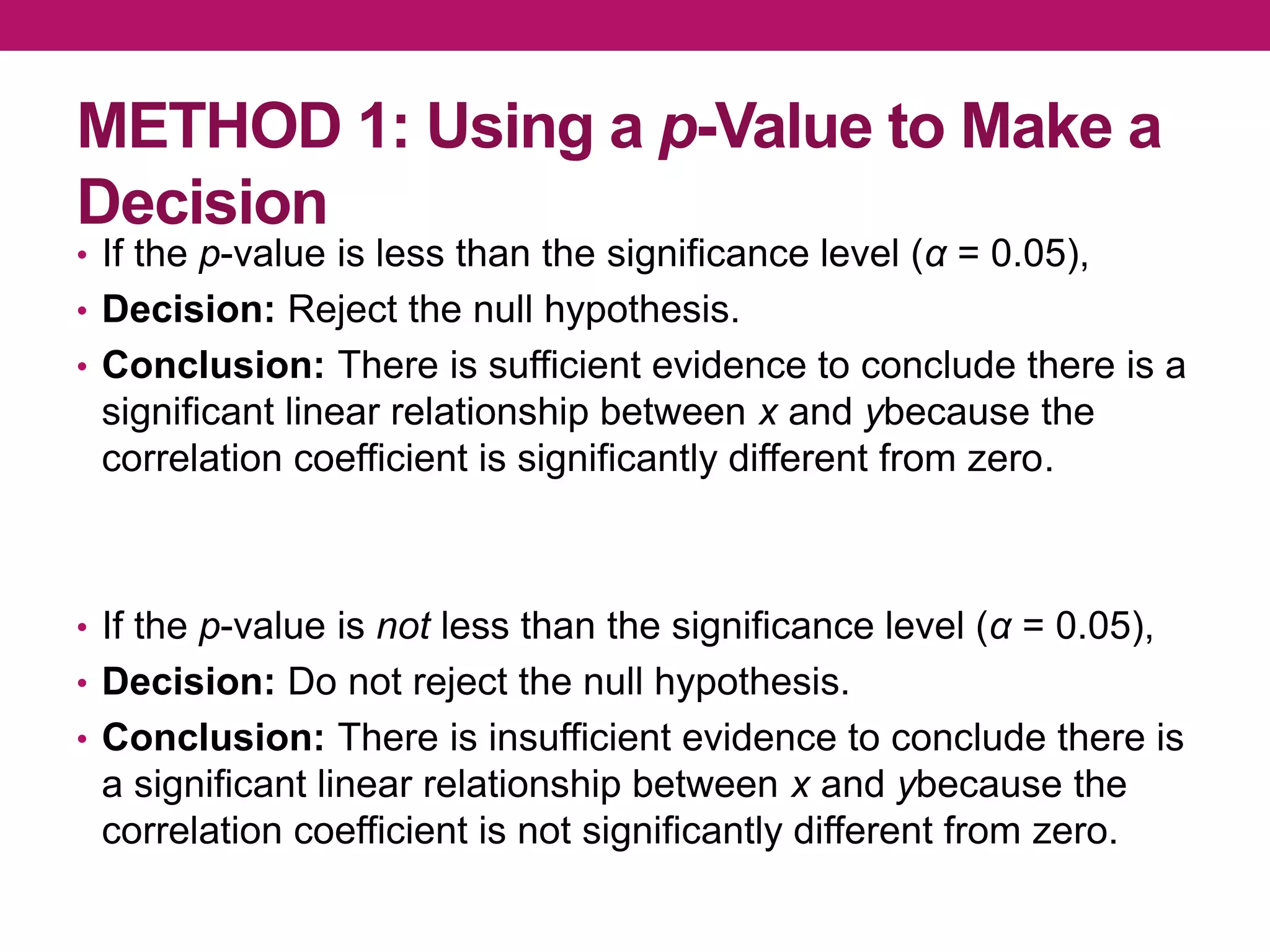
• If the p-value is less than the significance level (α = 0.05),
• Decision: Reject the null hypothesis.
• Conclusion: There is sufficient evidence to conclude there is a
significant linear relationship between x and ybecause the
correlation coefficient is significantly different from zero.
• If the p-value is not less than the significance level (α = 0.05),
• Decision: Do not reject the null hypothesis.
• Conclusion: There is insufficient evidence to conclude there is
a significant linear relationship between x and ybecause the
correlation coefficient is not significantly different from zero.
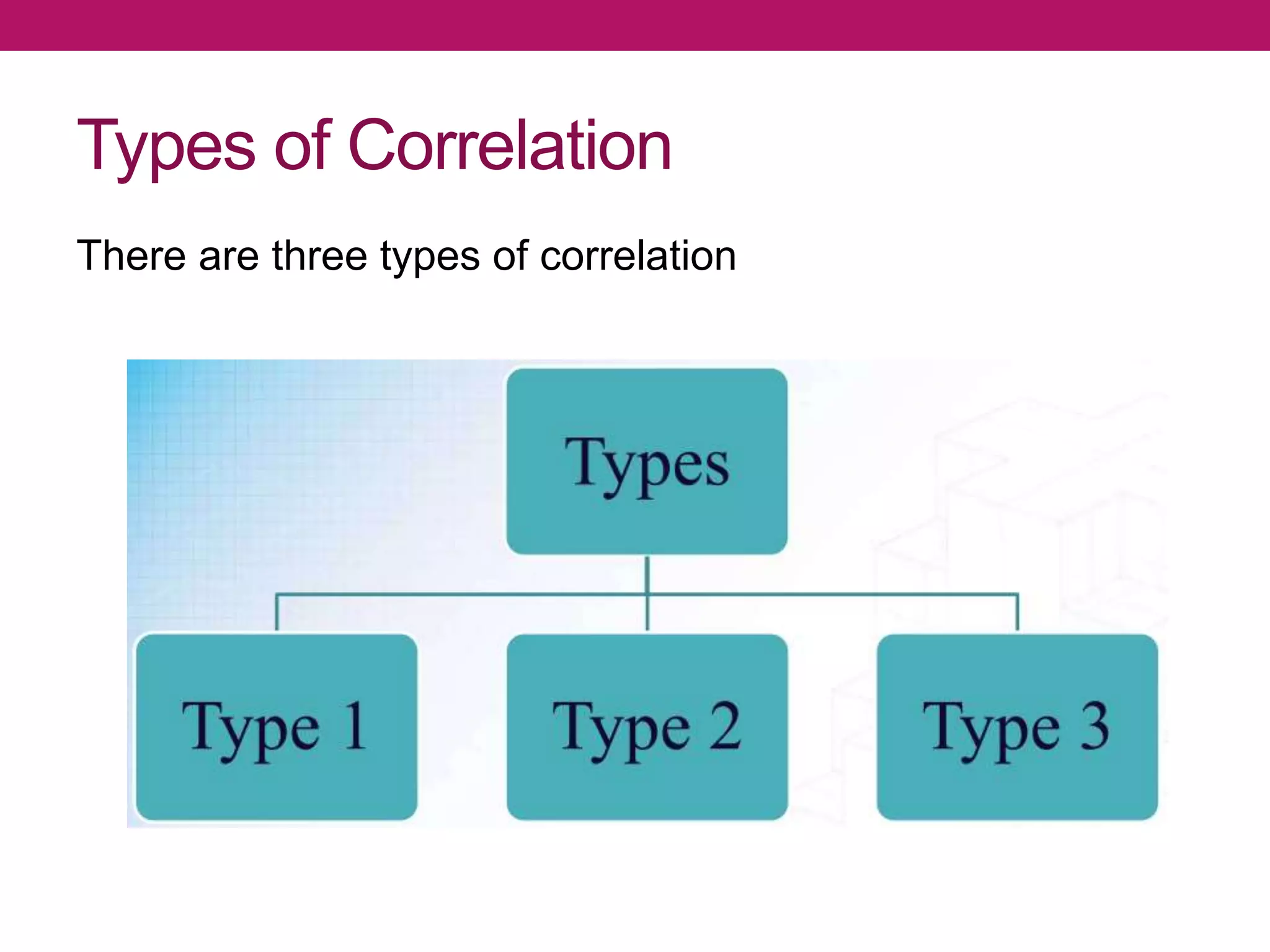
Types of Correlation
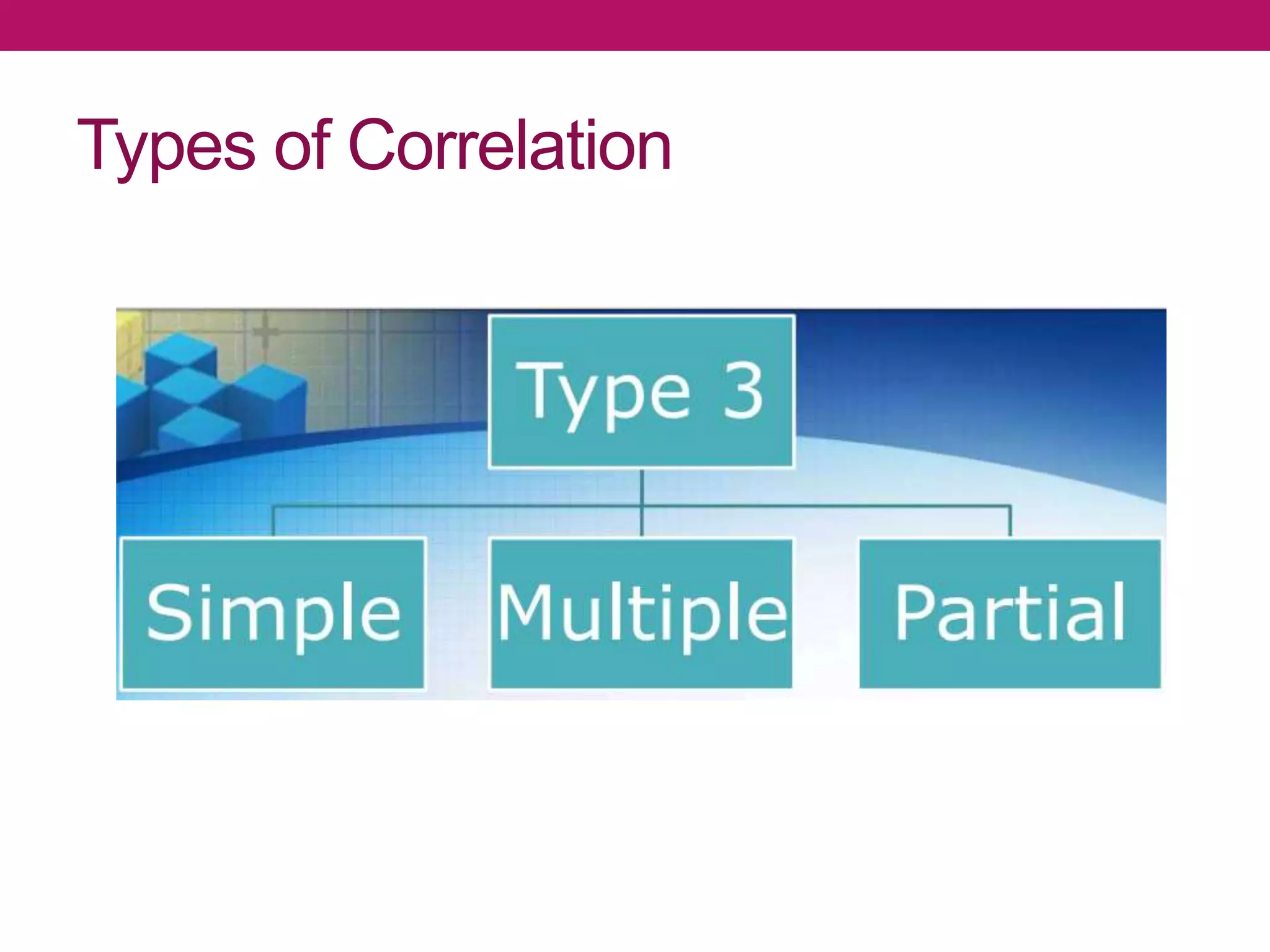
There are three types of correlation
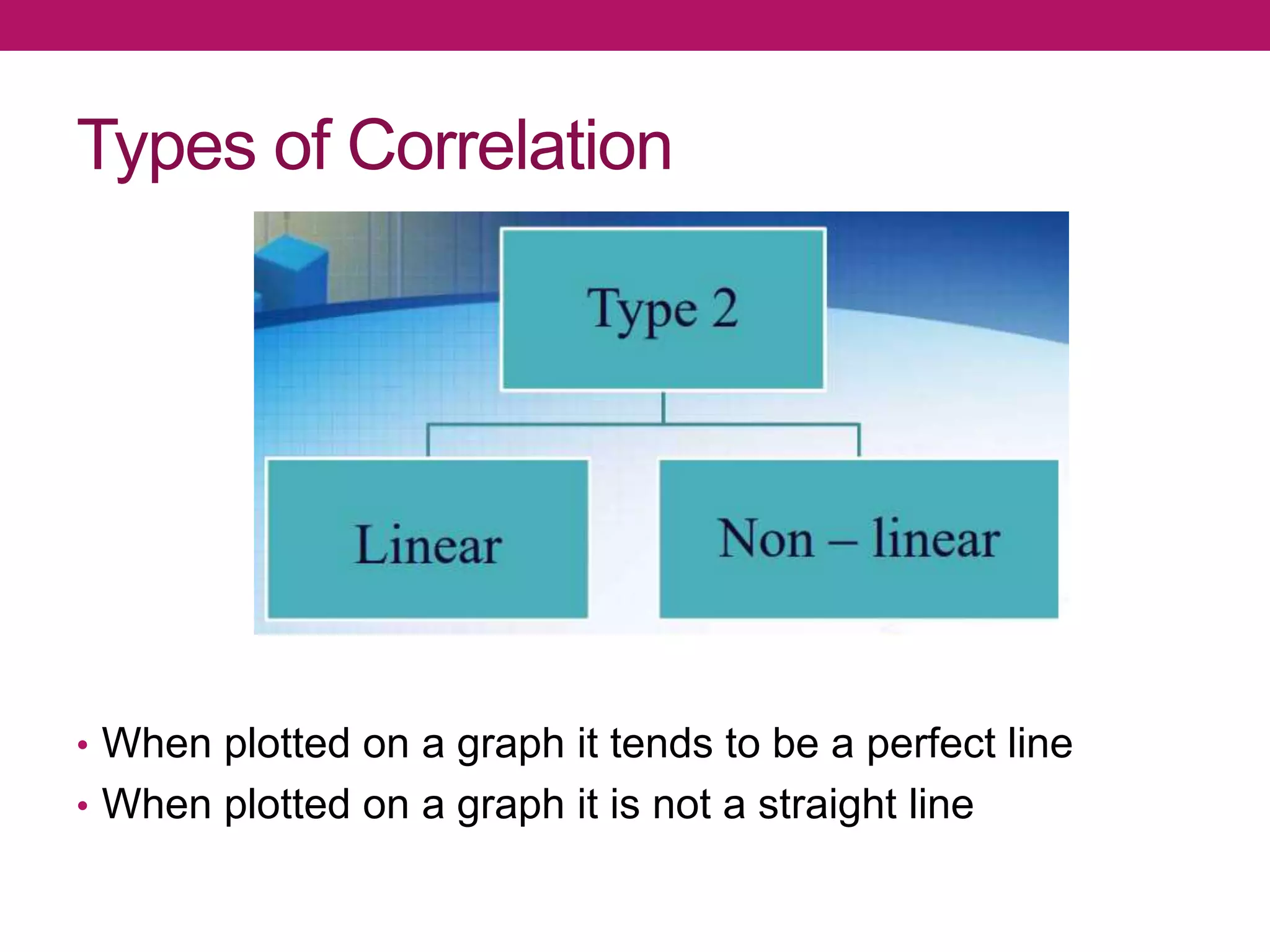
Types of Correlation
• When plotted on a graph it tends to be a perfect line
• When plotted on a graph it is not a straight line
Types of Correlation
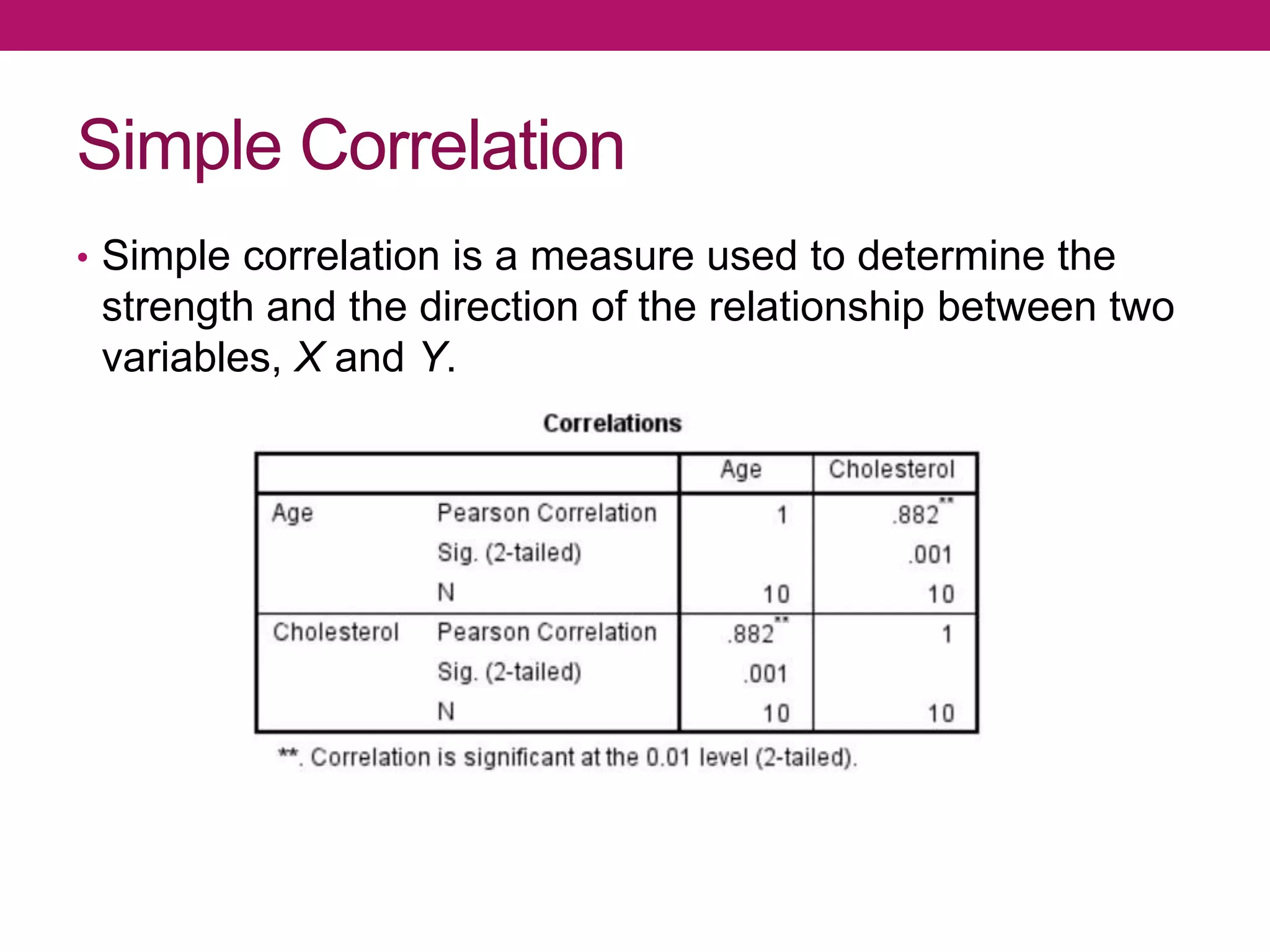
Simple Correlation
• Simple correlation is a measure used to determine the
strength and the direction of the relationship between two
variables, X and Y.
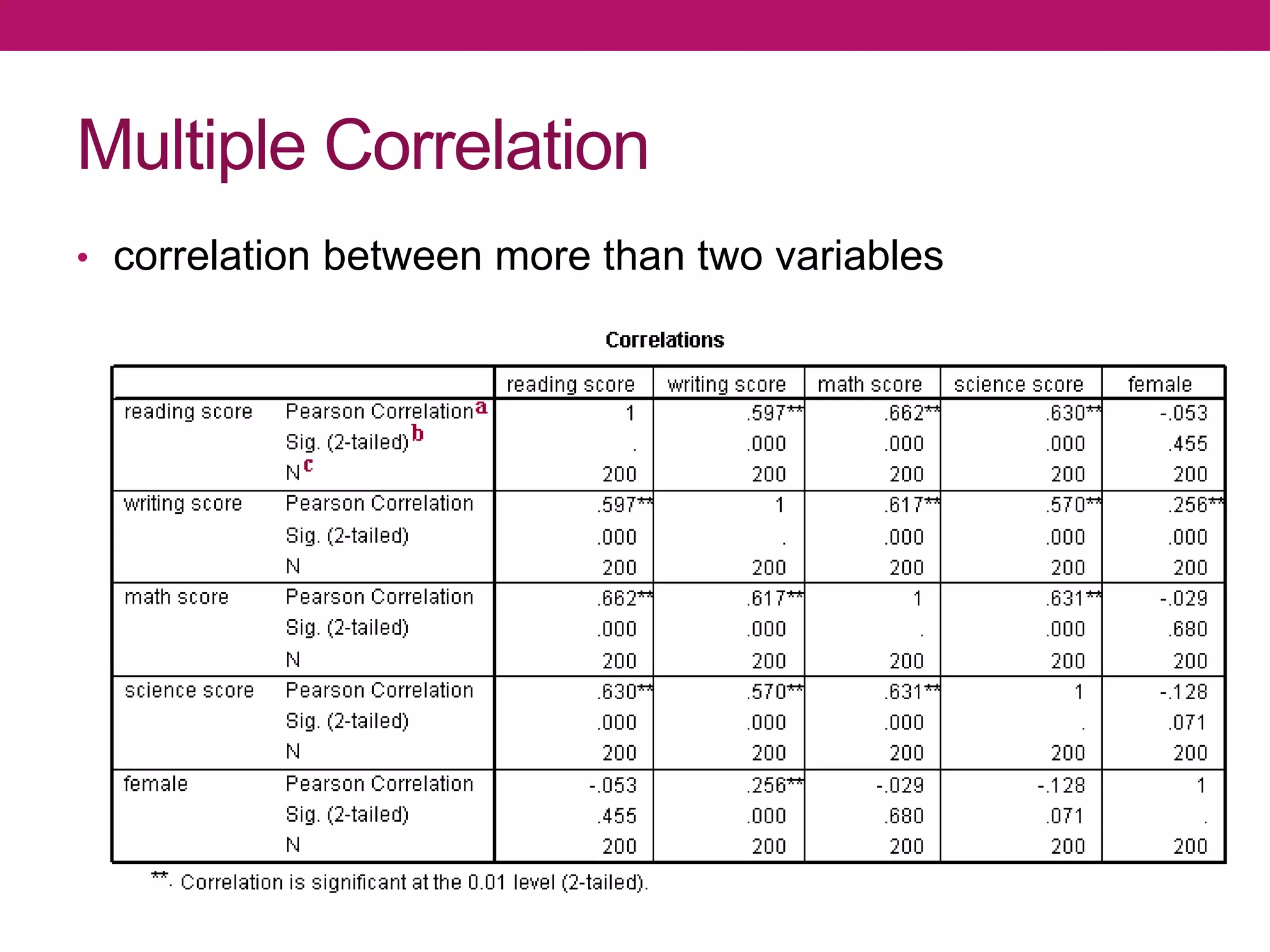
Multiple Correlation
• correlation between more than two variables
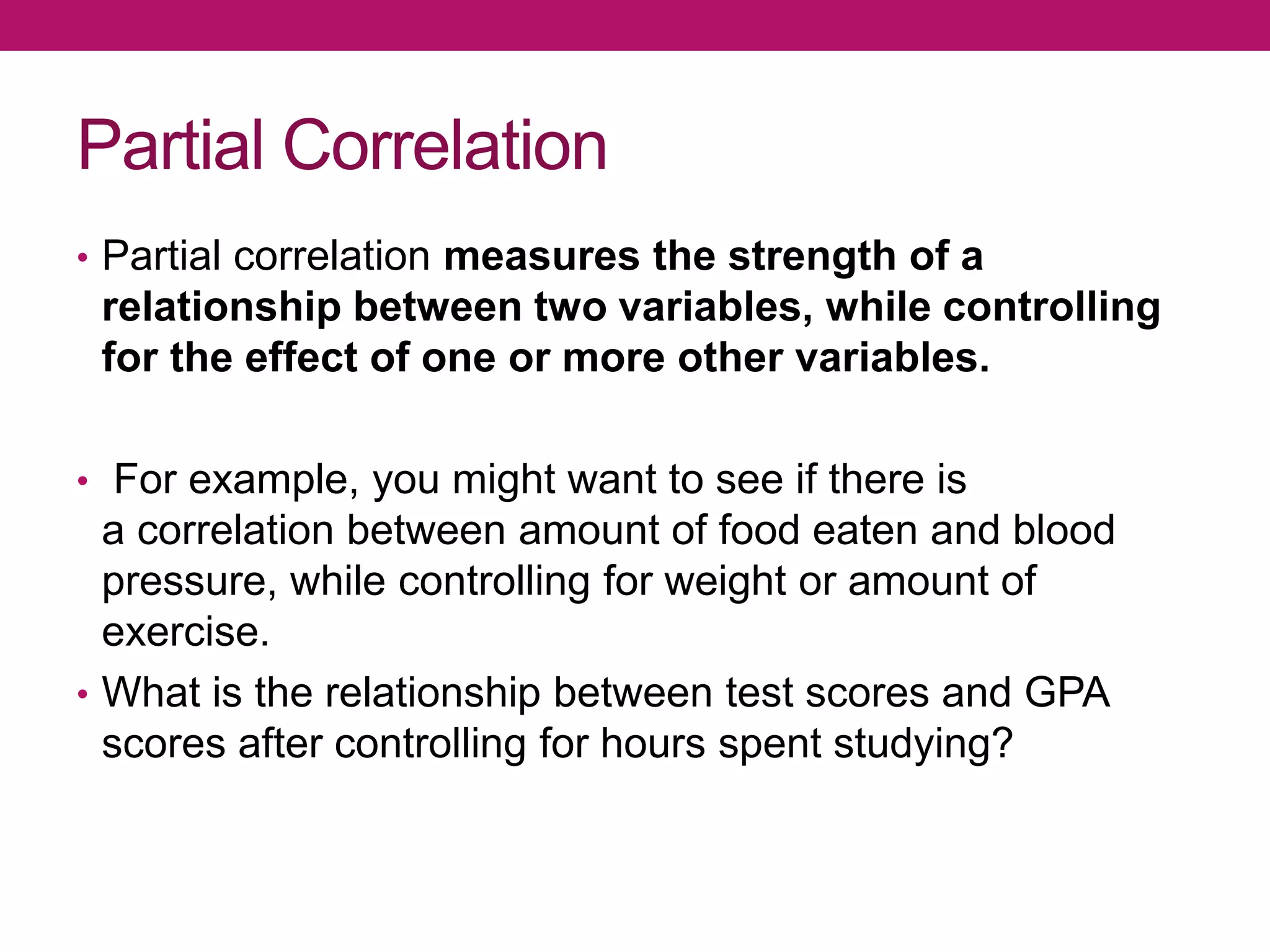
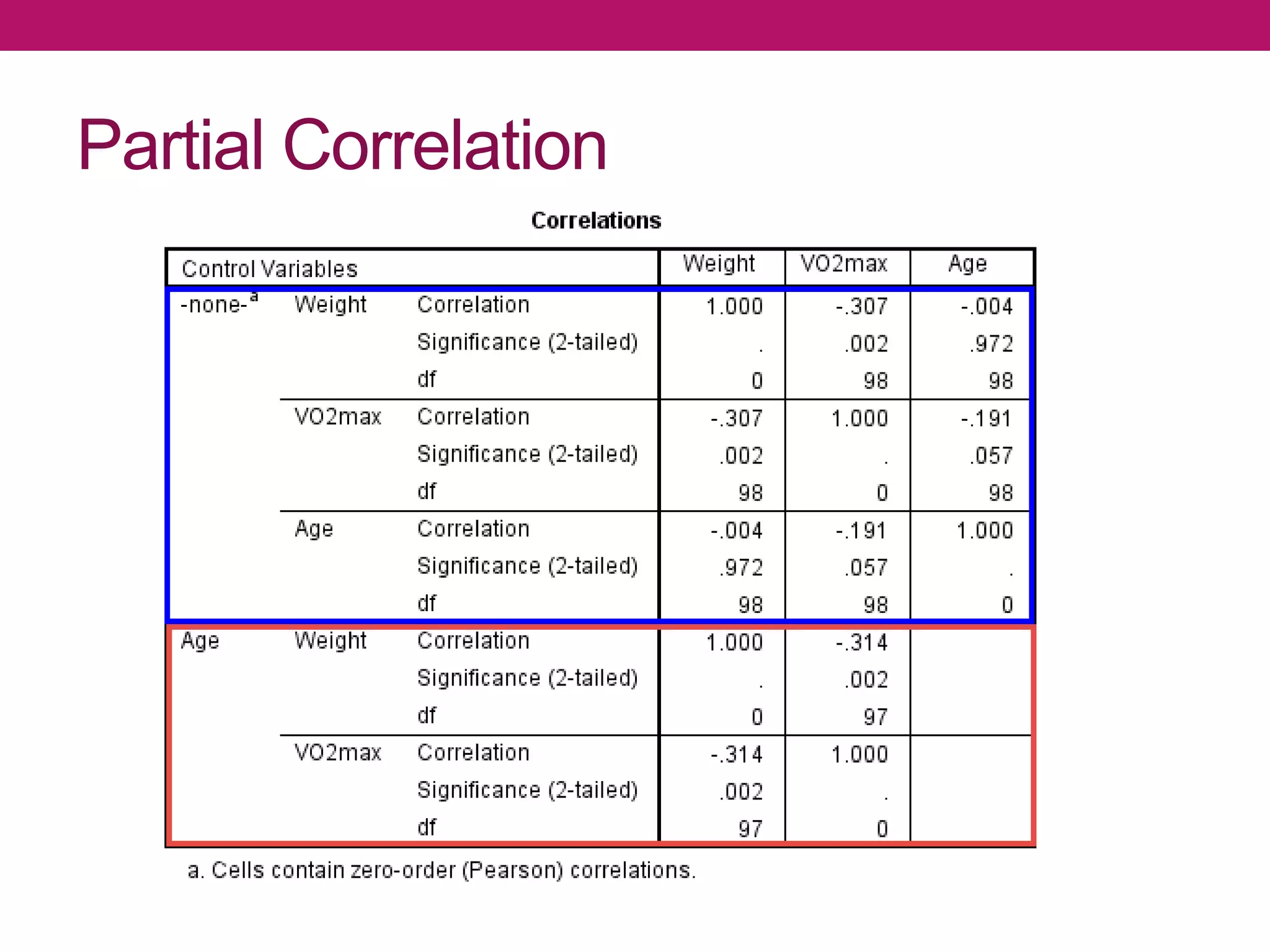
Partial Correlation
• Partial correlation measures the strength of a
relationship between two variables, while controlling
for the effect of one or more other variables.
• For example, you might want to see if there is
a correlation between amount of food eaten and blood
pressure, while controlling for weight or amount of
exercise.
• What is the relationship between test scores and GPA
scores after controlling for hours spent studying?
Partial Correlation
Autocorrelation
• Autocorrelation is a characteristic of data in which
the correlation between the values of the same variables
is based on related objects.
• It violates the assumption of instance independence,
which underlies most of the conventional models.
• It generally exists in those types of data-sets in which the
data, instead of being randomly selected, is from the
same source.
• It occurs mostly due to dependencies within the data.
Autocorrelation
• cross sectional and time series data
• In cross sectional data, if the change in the income of
a person A affects the savings of person B (a person
other than person A), then autocorrelation is present.
• In the case of time series data, if the observations
show inter-correlation, specifically in those cases
where the time intervals are small, then these inter-
correlations are given the term of autocorrelation.
INTERPRET
• Strength
• Direction
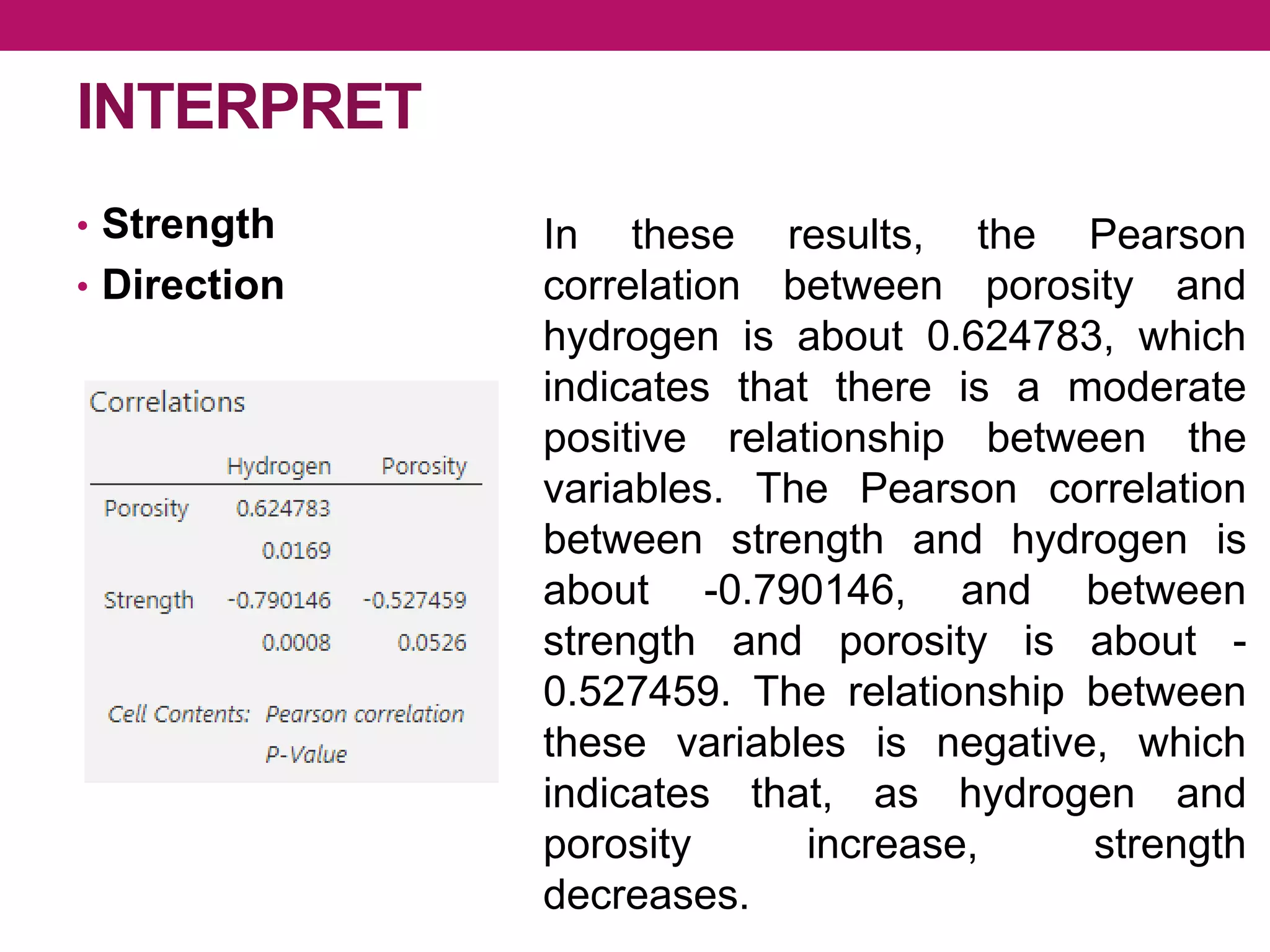
In these results, the Pearson
correlation between porosity and
hydrogen is about 0.624783, which
indicates that there is a moderate
positive relationship between the
variables. The Pearson correlation
between strength and hydrogen is
about -0.790146, and between
strength and porosity is about -
0.527459. The relationship between
these variables is negative, which
indicates that, as hydrogen and
porosity increase, strength
decreases.
INTERPRET
• Significance
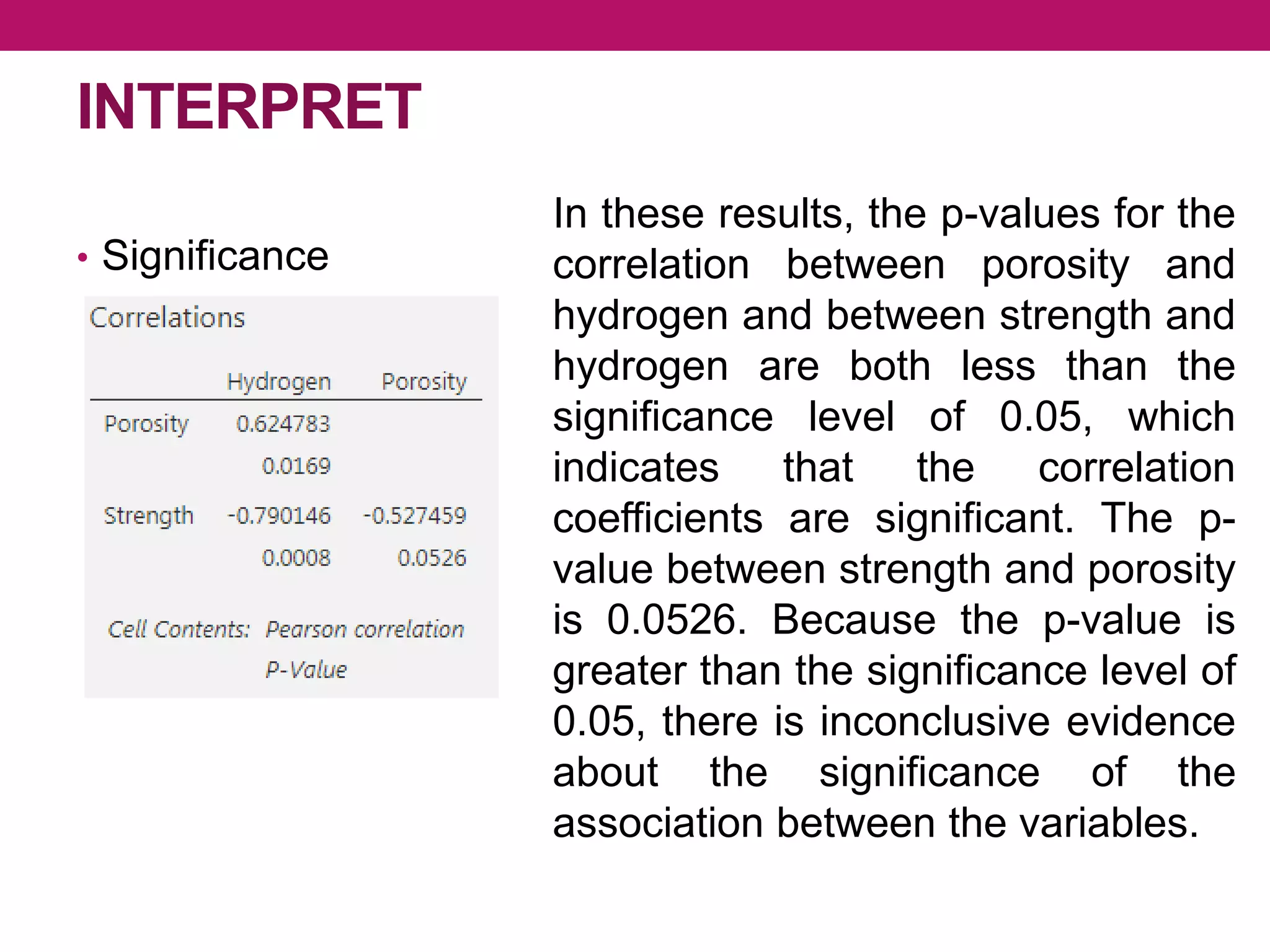
In these results, the p-values for the
correlation between porosity and
hydrogen and between strength and
hydrogen are both less than the
significance level of 0.05, which
indicates that the correlation
coefficients are significant. The p-
value between strength and porosity
is 0.0526. Because the p-value is
greater than the significance level of
0.05, there is inconclusive evidence
about the significance of the
association between the variables.

Correlation

  • 1.
  • 2.
    Major Points -Correlation • Questions answered by correlation • Scatterplots • An example • The correlation coefficient • Other kinds of correlations • Factors affecting correlations • Testing for significance
  • 3.
    The Question • Aretwo variables related? • Does one increase as the other increases? • e. g. skills and income • Does one decrease as the other increases? • e. g. health problems and nutrition • How can we get a numerical measure of the degree of relationship?
  • 4.
    Correlation Finding the relationshipbetween two quantitative variables without being able to infer causal relationships Correlation is a statistical technique used to determine the degree to which two variables are related
  • 5.
    Scatterplots • Graphically depictsthe relationship between two variables in two dimensional space. Rectangular coordinate • Two quantitative variables • One variable is called independent (X) and the second is called dependent (Y) • Points are not joined Y * * * X
  • 6.
    Scatterplot:Video Games andAlcohol Consumption 0 2 4 6 8 10 12 14 16 18 20 0 5 10 15 20 25 Average Hours of Video Games Per Week AverageNumberofAlcoholicDrinks PerWeek Direct Relationship
  • 7.
    Scatterplot: Video Gamesand Test Score 0 10 20 30 40 50 60 70 80 90 100 0 5 10 15 20 Average Hours of Video Games Per Week ExamScore Inverse Relationship
  • 8.
    An Example • Doessmoking cigarettes increase systolic blood pressure? • Plotting number of cigarettes smoked per day against systolic blood pressure • Fairly moderate relationship • Relationship is positive
  • 9.
  • 10.
    Correlation • Co-relation • Therelationship between two variables • Measured with a correlation coefficient • Most popularly seen correlation coefficient: Pearson Product-Moment Correlation
  • 11.
    Types of Correlation Positive correlation High values of X tend to be associated with high values of Y. As X increases, Y increases  Negative correlation High values of X tend to be associated with low values of Y. As X increases, Y decreases  No correlation  No consistent tendency for values on Y to increase or decrease as X increases
  • 12.
    Correlation Coefficient  Ameasure of degree of relationship between two variables.  Between 1 and -1  Sign refers to direction.  Based on covariance  Measure of degree to which large scores on X go with large scores on Y, and small scores on X go with small scores on Y  Think of it as variance, but with 2 variables instead of 1 (What does that mean??)
  • 13.
  • 14.
    Simple Correlation coefficient(r) It is also called Pearson's correlation or product moment correlation coefficient. It measures the nature and strength between two variables of the quantitative type.
  • 15.
    The sign ofr denotes the nature of association while the value of r denotes the strength of association.
  • 16.
    The value ofr ranges between ( -1) and ( +1) The value of r denotes the strength of the association as illustrated by the following diagram. -1 10-0.25-0.75 0.750.25 strong strongintermediate intermediateweak weak no relation perfect correlation perfect correlation Directindirect
  • 17.
    If r =Zero this means no association or correlation between the two variables. If 0 < r < 0.25 = weak correlation. If 0.25 ≤ r < 0.75 = intermediate correlation. If 0.75 ≤ r < 1 = strong correlation. If r = l = perfect correlation.
  • 18.
    Significance test • Performingthe Hypothesis Test • Null hypothesis: H0: ρ = 0 • Alternate hypothesis: Ha: ρ ≠ 0 • What the Hypothesis Means in Words: • Null hypothesis H0: The population correlation coefficient is not significantly different from zero. There is nota significant linear relationship (correlation) between x and y in the population. • Alternate hypothesis Ha: The population correlation coefficient is significantly different from zero. There is a significant linear relationship (correlation) between x and y in the population.
  • 19.
    Significance test • Drawinga Conclusion:There are two methods to make a conclusion. The two methods are equivalent and give the same result. • Method 1: Use the p-value. • Method 2: Use a table of critical values.
  • 20.
    METHOD 1: Usinga p-Value to Make a Decision • If the p-value is less than the significance level (α = 0.05), • Decision: Reject the null hypothesis. • Conclusion: There is sufficient evidence to conclude there is a significant linear relationship between x and ybecause the correlation coefficient is significantly different from zero. • If the p-value is not less than the significance level (α = 0.05), • Decision: Do not reject the null hypothesis. • Conclusion: There is insufficient evidence to conclude there is a significant linear relationship between x and ybecause the correlation coefficient is not significantly different from zero.
  • 21.
    Types of Correlation Thereare three types of correlation
  • 22.
  • 23.
    Types of Correlation •When plotted on a graph it tends to be a perfect line • When plotted on a graph it is not a straight line
  • 24.
  • 25.
    Simple Correlation • Simplecorrelation is a measure used to determine the strength and the direction of the relationship between two variables, X and Y.
  • 26.
    Multiple Correlation • correlationbetween more than two variables
  • 27.
    Partial Correlation • Partialcorrelation measures the strength of a relationship between two variables, while controlling for the effect of one or more other variables. • For example, you might want to see if there is a correlation between amount of food eaten and blood pressure, while controlling for weight or amount of exercise. • What is the relationship between test scores and GPA scores after controlling for hours spent studying?
  • 28.
  • 29.
    Autocorrelation • Autocorrelation isa characteristic of data in which the correlation between the values of the same variables is based on related objects. • It violates the assumption of instance independence, which underlies most of the conventional models. • It generally exists in those types of data-sets in which the data, instead of being randomly selected, is from the same source. • It occurs mostly due to dependencies within the data.
  • 30.
    Autocorrelation • cross sectionaland time series data • In cross sectional data, if the change in the income of a person A affects the savings of person B (a person other than person A), then autocorrelation is present. • In the case of time series data, if the observations show inter-correlation, specifically in those cases where the time intervals are small, then these inter- correlations are given the term of autocorrelation.
  • 31.
    INTERPRET • Strength • Direction Inthese results, the Pearson correlation between porosity and hydrogen is about 0.624783, which indicates that there is a moderate positive relationship between the variables. The Pearson correlation between strength and hydrogen is about -0.790146, and between strength and porosity is about - 0.527459. The relationship between these variables is negative, which indicates that, as hydrogen and porosity increase, strength decreases.
  • 32.
    INTERPRET • Significance In theseresults, the p-values for the correlation between porosity and hydrogen and between strength and hydrogen are both less than the significance level of 0.05, which indicates that the correlation coefficients are significant. The p- value between strength and porosity is 0.0526. Because the p-value is greater than the significance level of 0.05, there is inconclusive evidence about the significance of the association between the variables.