Regression
Analysis…
Regression Analysis: the study of the
relationship between variables
Regression Analysis: one of the most
commonly used tools for business analysis
Easy to use and applies to many situations
Regression Analysis
Regression
• The term regression as a statistical
technique to predict one variable from
another variable.
• It is a measure of the average
relationship between two or more
variables in terms of original units of
data.
• Correlation coefficient is measure of
degree of co-variability between X & Y
but the objective of Regression Analysis
is to study the ‘nature of relationship
between variables’
Types of Regression
• Linear and Non Linear Regression-
• If the given points are plotted on a
graph paper , the points so obtained on
the scatter diagram will more/less
concentrated round a curve called the
curve of Regression.
• If the regression curve is a straight line
then linear otherwise non linear/curved
regression.
Simple & Multiple
Regression
• It is confined with study of two
variables i.e one independent and
other dependent variable.
• It is confined with more than two
variables at a time. I.e two or more
independent variables and one
dependent variable.
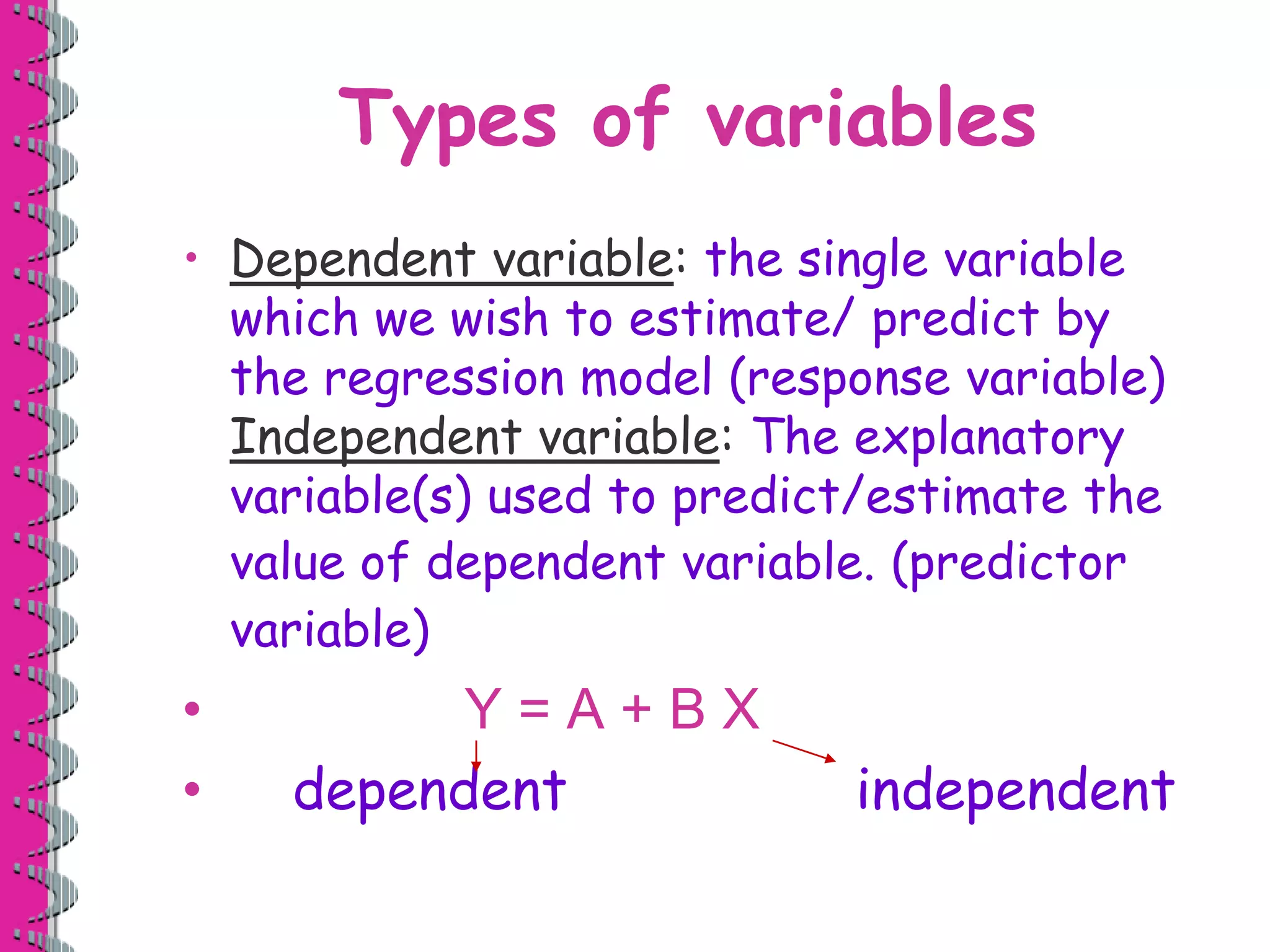
Types of variables
• Dependent variable: the single variable
which we wish to estimate/ predict by
the regression model (response variable)
Independent variable: The explanatory
variable(s) used to predict/estimate the
value of dependent variable. (predictor
variable)
• Y = A + B X
• dependent independent
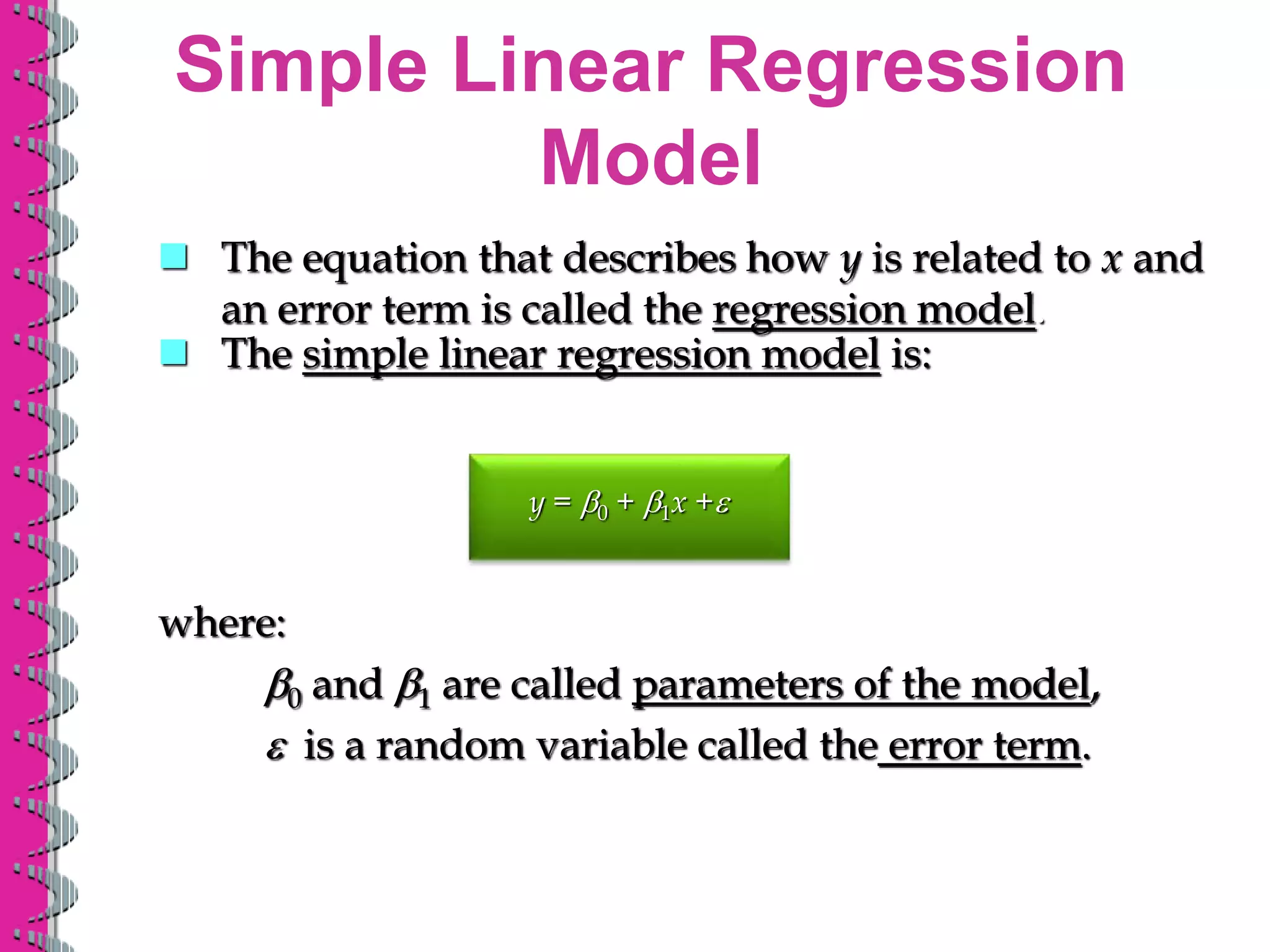
Simple Linear Regression
Model
y = b0 + b1x +e
where:
b0 and b1 are called parameters of the model,
e is a random variable called the error term.
 The simple linear regression model is:
 The equation that describes how y is related to x and
an error term is called the regression model.
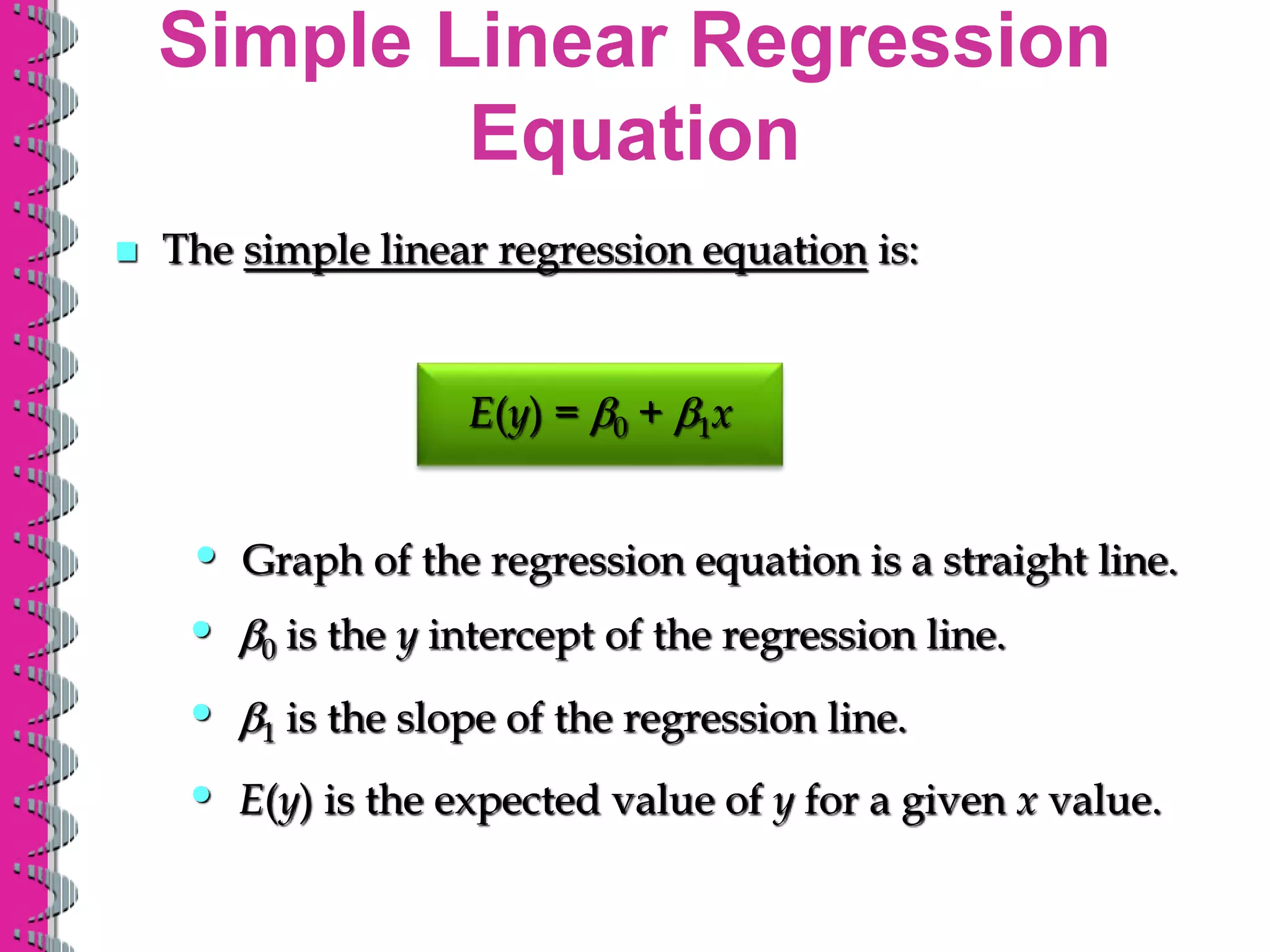
Simple Linear Regression
Equation
 The simple linear regression equation is:
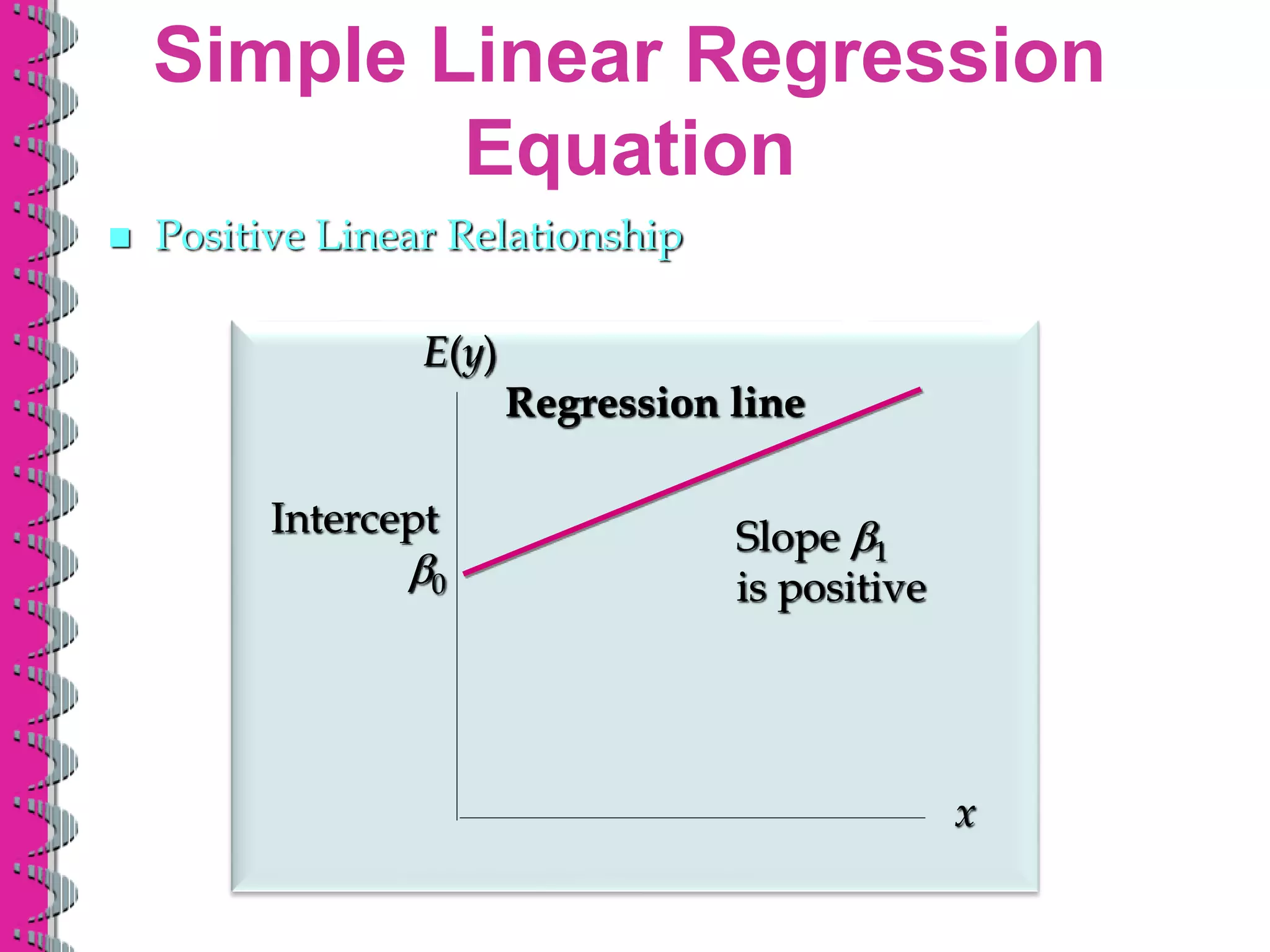
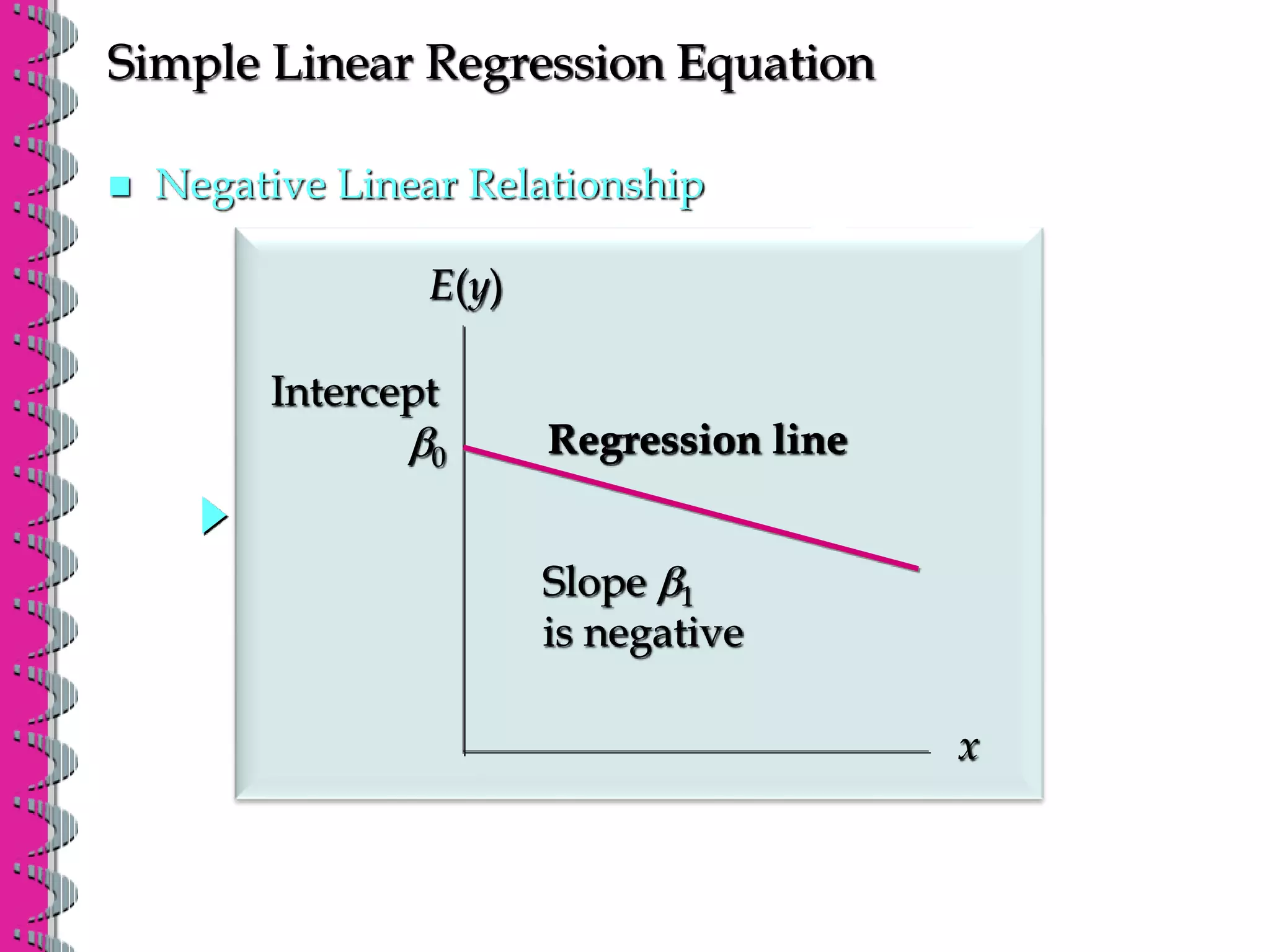
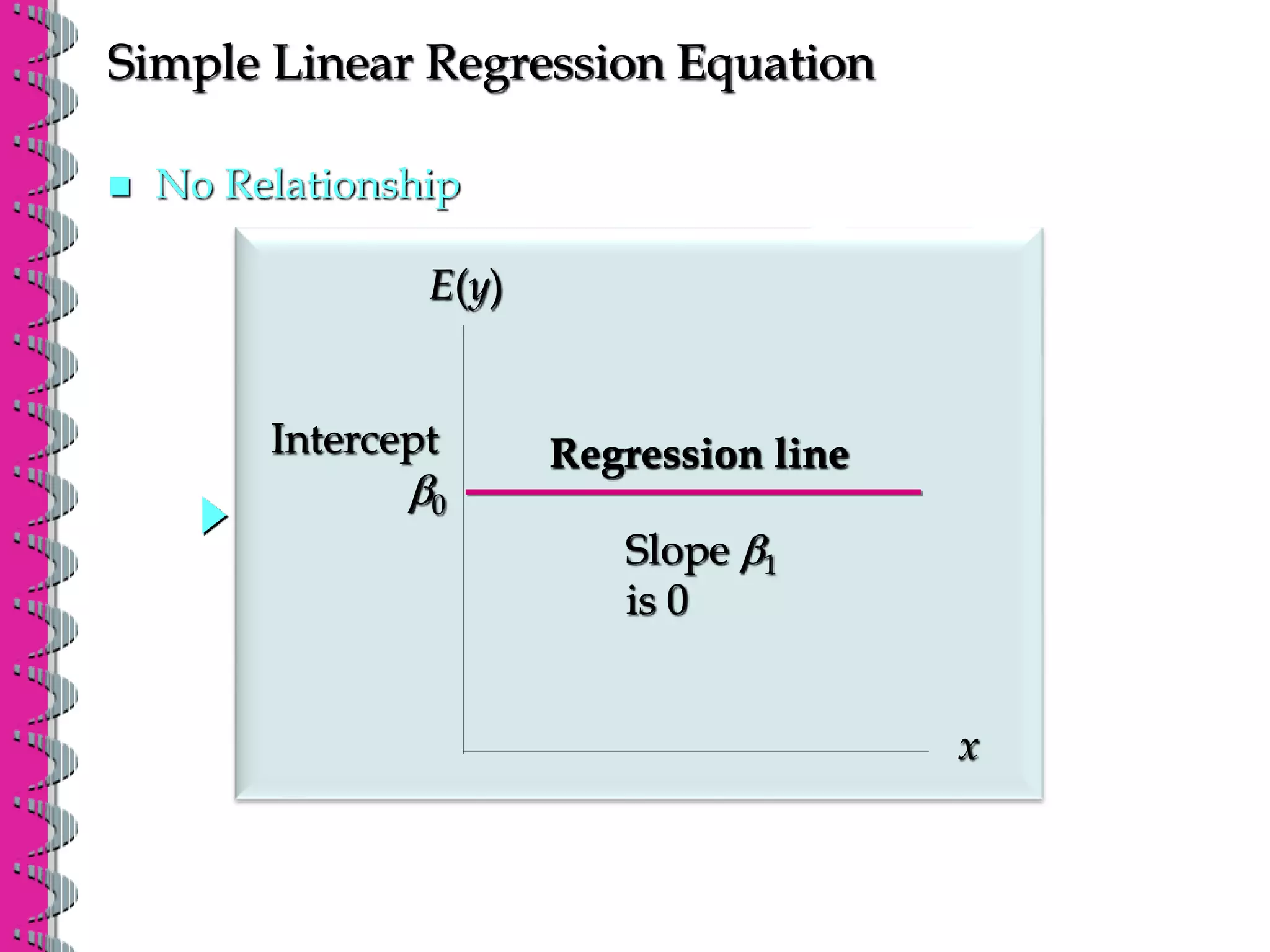
• E(y) is the expected value of y for a given x value.
• b1 is the slope of the regression line.
• b0 is the y intercept of the regression line.
• Graph of the regression equation is a straight line.
E(y) = b0 + b1x
Simple Linear Regression
Equation
 Positive Linear Relationship
E(y)
x
Slope b1
is positive
Regression line
Intercept
b0
Simple Linear Regression Equation
 Negative Linear Relationship
E(y)
x
Slope b1
is negative
Regression line
Intercept
b0
Simple Linear Regression Equation
 No Relationship
E(y)
x
Slope b1
is 0
Regression line
Intercept
b0
Estimated Simple Linear Regression Equation
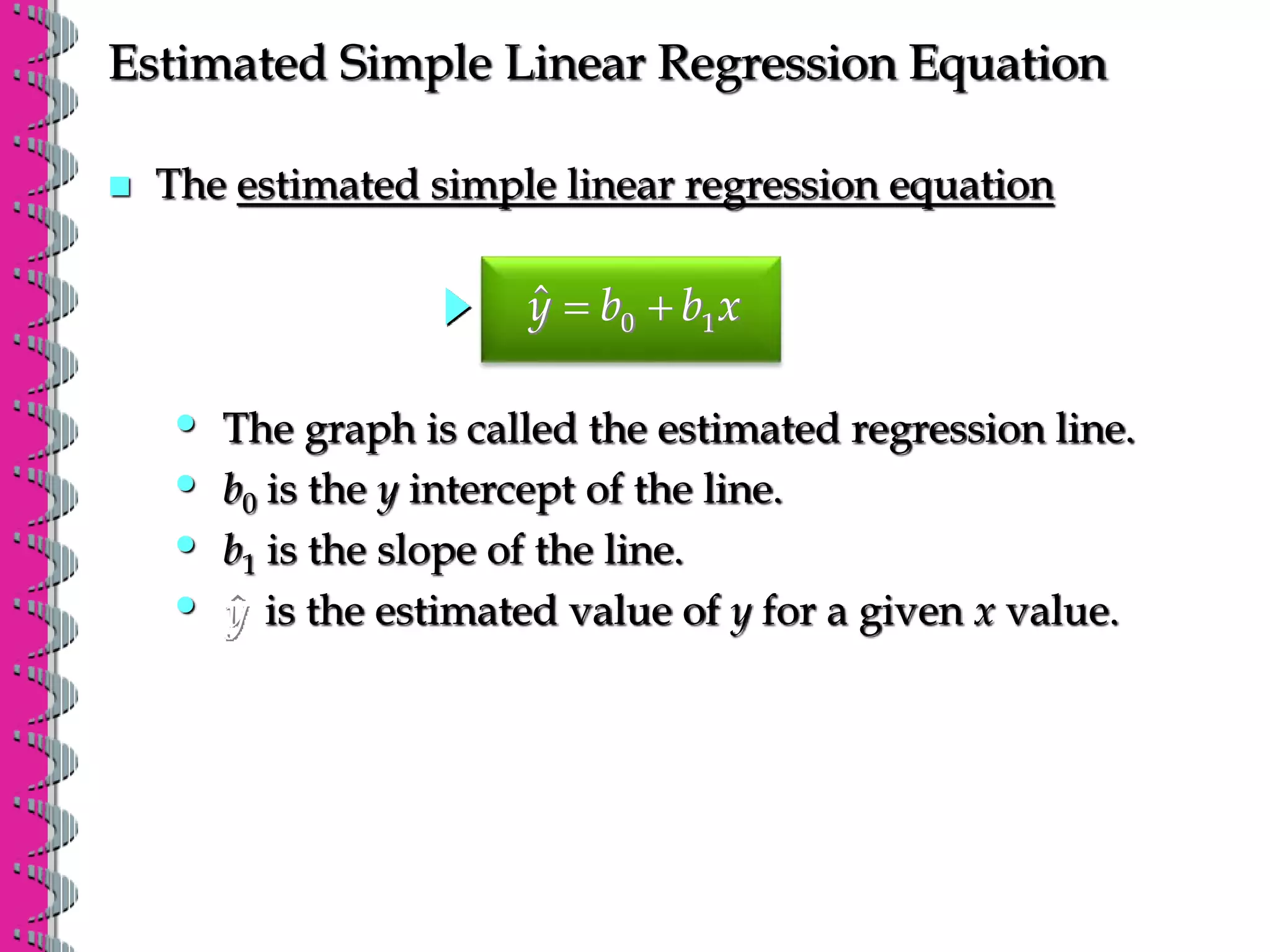
 The estimated simple linear regression equation
0 1
ŷ b b x
 
• is the estimated value of y for a given x value.
ŷ
• b1 is the slope of the line.
• b0 is the y intercept of the line.
• The graph is called the estimated regression line.
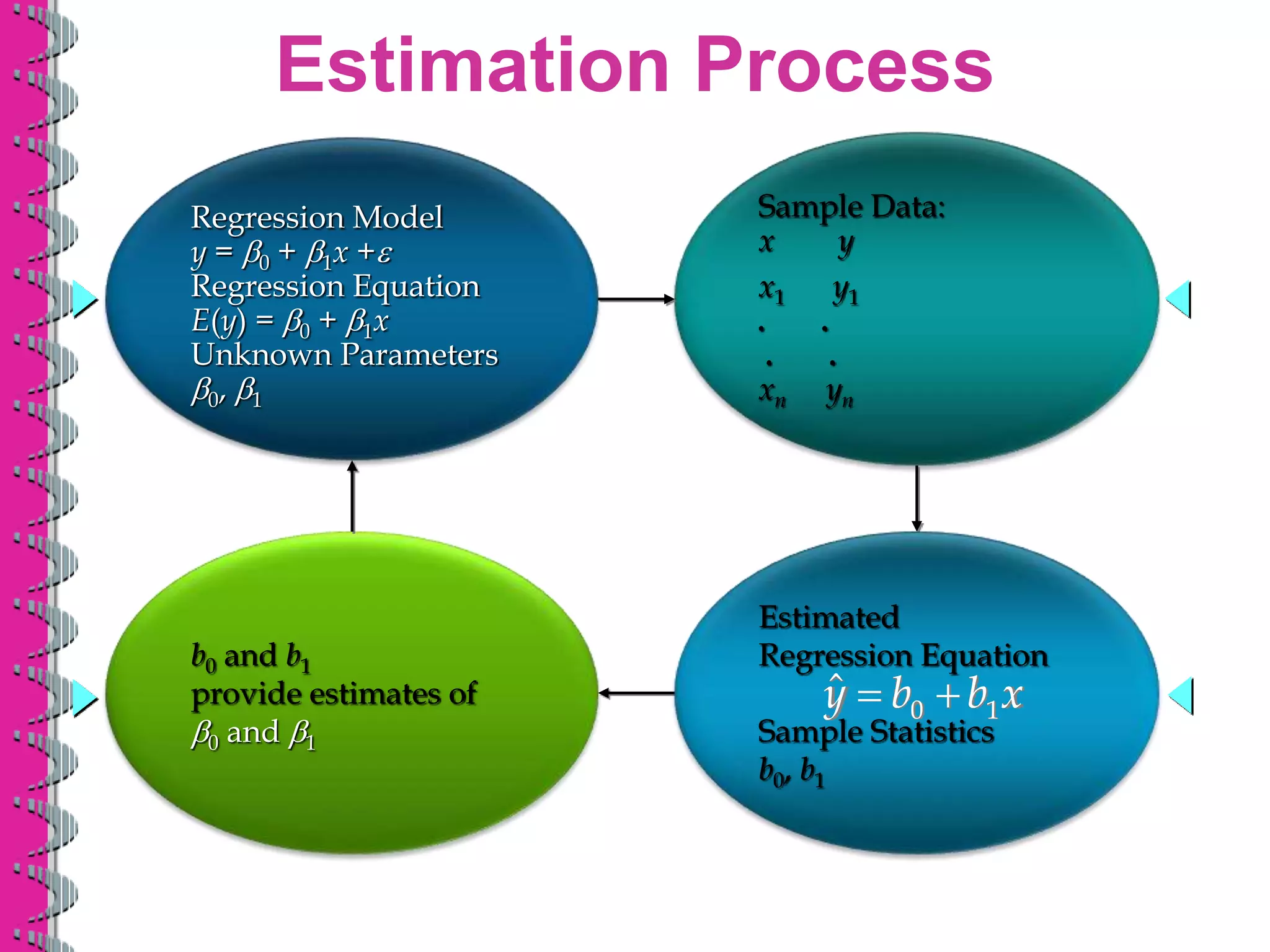
Estimation Process
Regression Model
y = b0 + b1x +e
Regression Equation
E(y) = b0 + b1x
Unknown Parameters
b0, b1
Sample Data:
x y
x1 y1
. .
. .
xn yn
b0 and b1
provide estimates of
b0 and b1
Estimated
Regression Equation
Sample Statistics
b0, b1
0 1
ŷ b b x
 
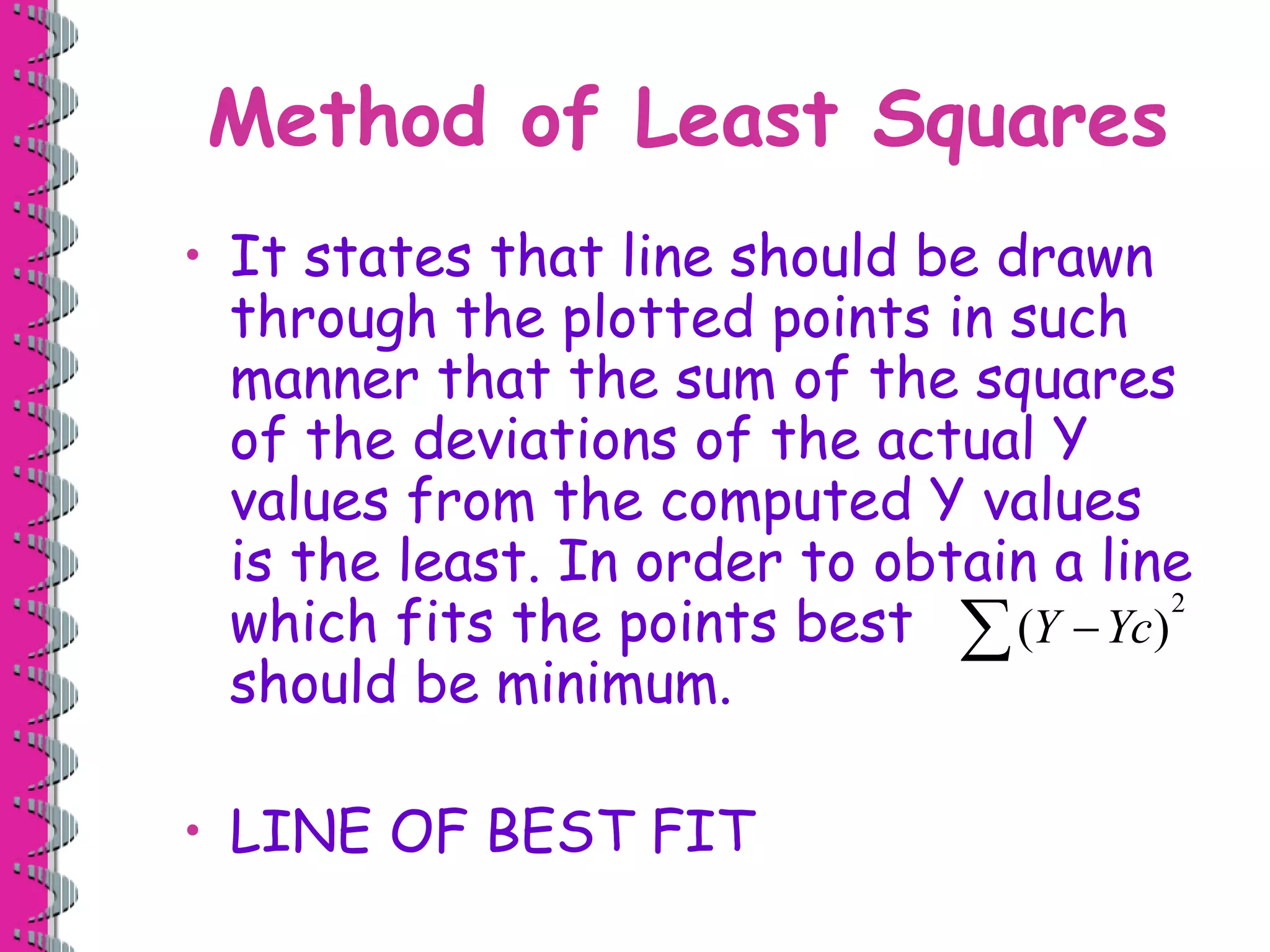
Method of Least Squares
• It states that line should be drawn
through the plotted points in such
manner that the sum of the squares
of the deviations of the actual Y
values from the computed Y values
is the least. In order to obtain a line
which fits the points best
should be minimum.
• LINE OF BEST FIT
2
( )
Y Yc


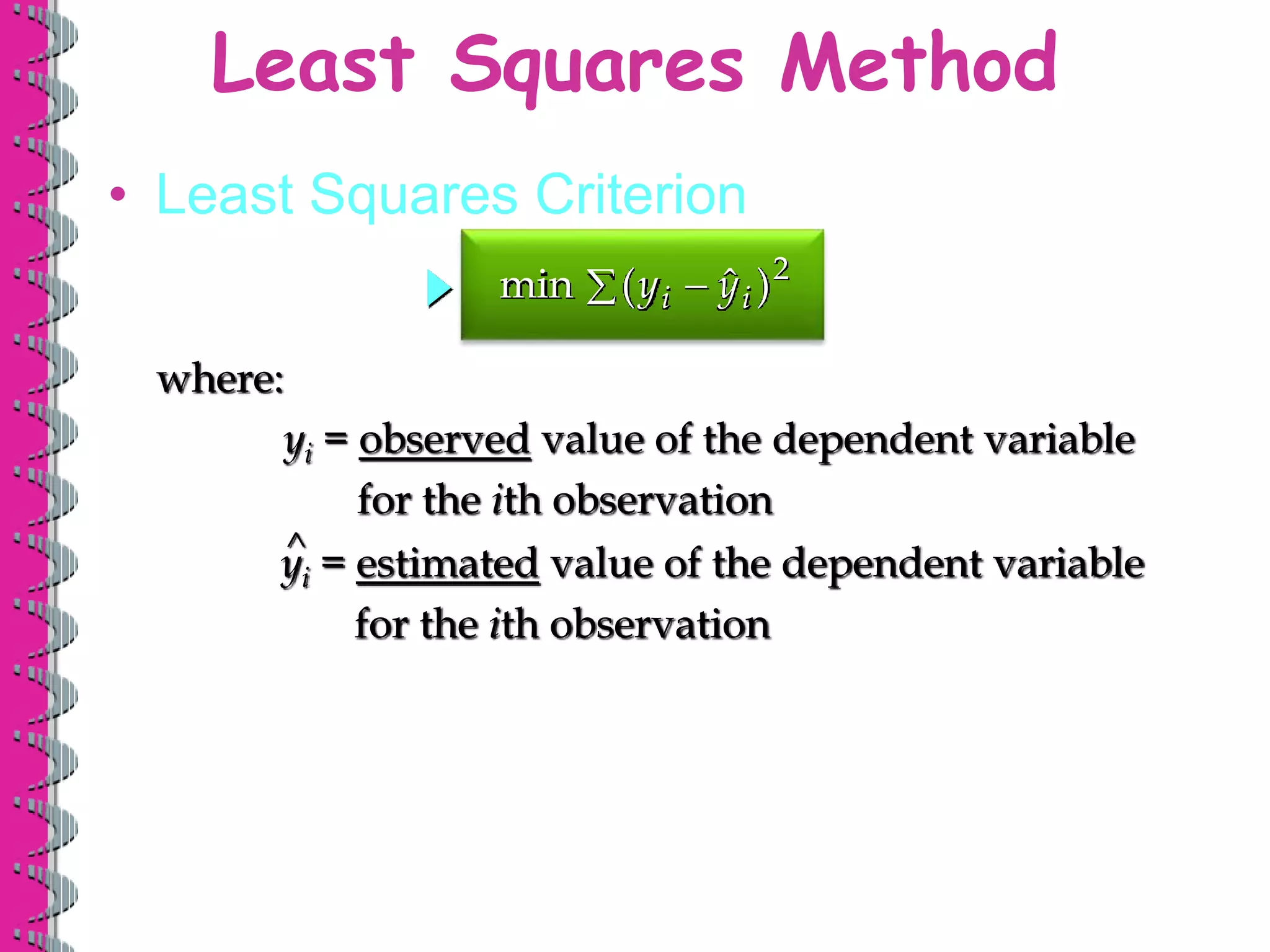
Least Squares Method
• Least Squares Criterion
min (y y
i i

  )2
where:
yi = observed value of the dependent variable
for the ith observation
^
yi = estimated value of the dependent variable
for the ith observation
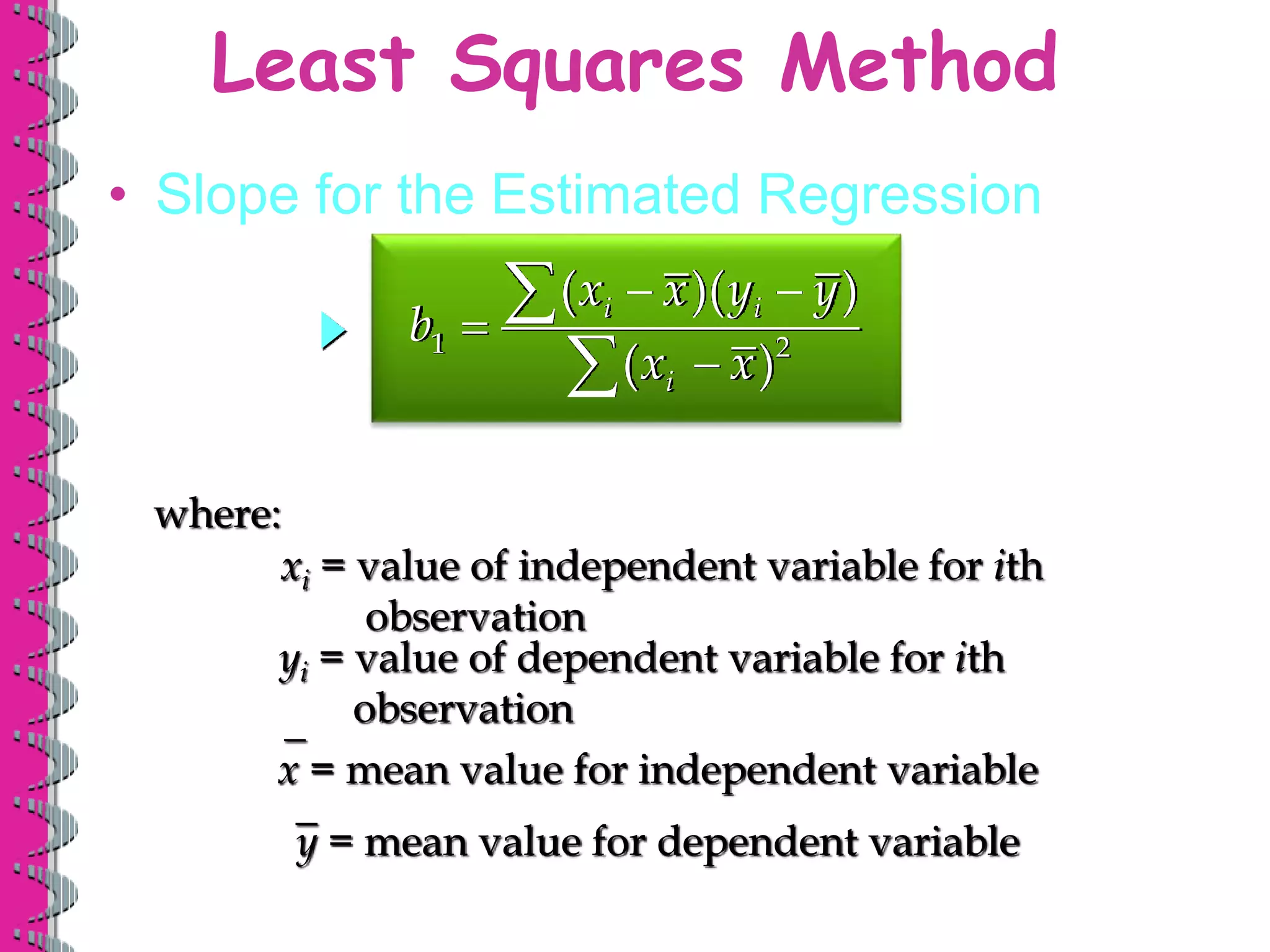
• Slope for the Estimated Regression
1 2
( )( )
( )
i i
i
x x y y
b
x x
 




Least Squares Method
where:
xi = value of independent variable for ith
observation
_
y = mean value for dependent variable
_
x = mean value for independent variable
yi = value of dependent variable for ith
observation
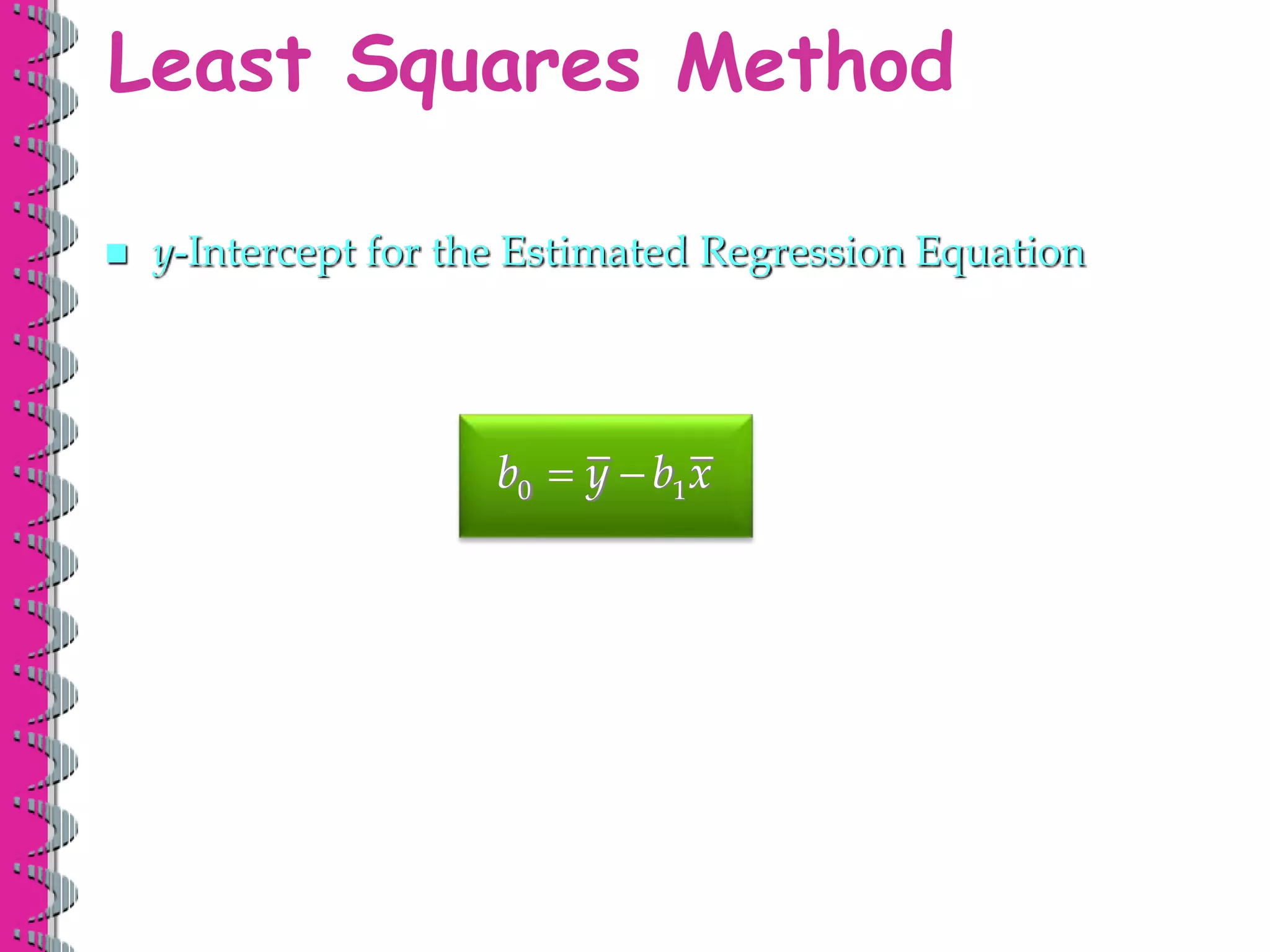
 y-Intercept for the Estimated Regression Equation
Least Squares Method
0 1
b y b x
 
Reed Auto periodically has a special
week-long sale.
As part of the advertising campaign Reed
runs one or
more television commercials during the
weekend
preceding the sale. Data from a sample
of 5 previous
sales are shown on the next slide.
Simple Linear Regression
 Example: Reed Auto Sales
Simple Linear Regression
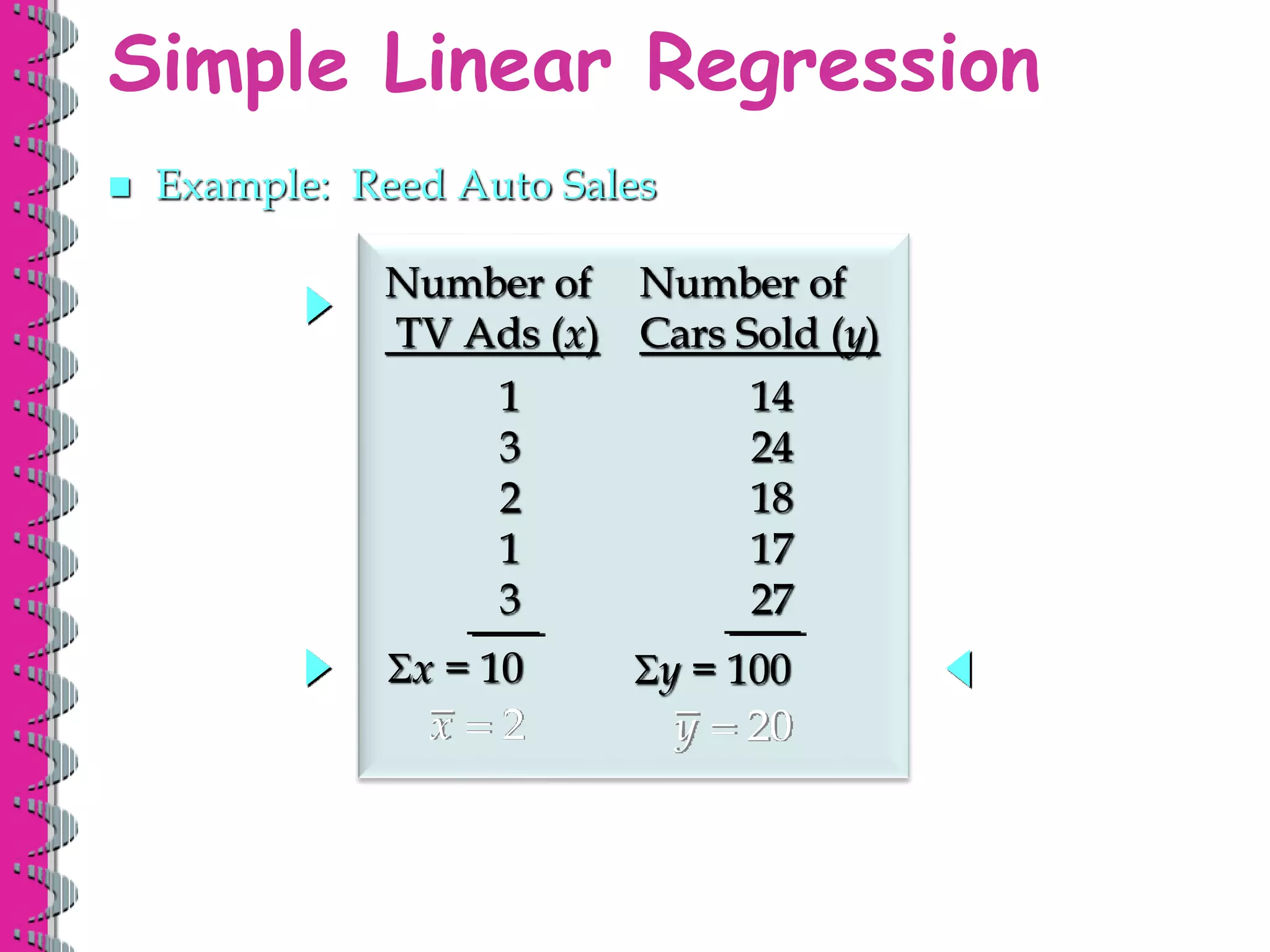
 Example: Reed Auto Sales
Number of
TV Ads (x)
Number of
Cars Sold (y)
1
3
2
1
3
14
24
18
17
27
Sx = 10 Sy = 100
2
x  20
y 
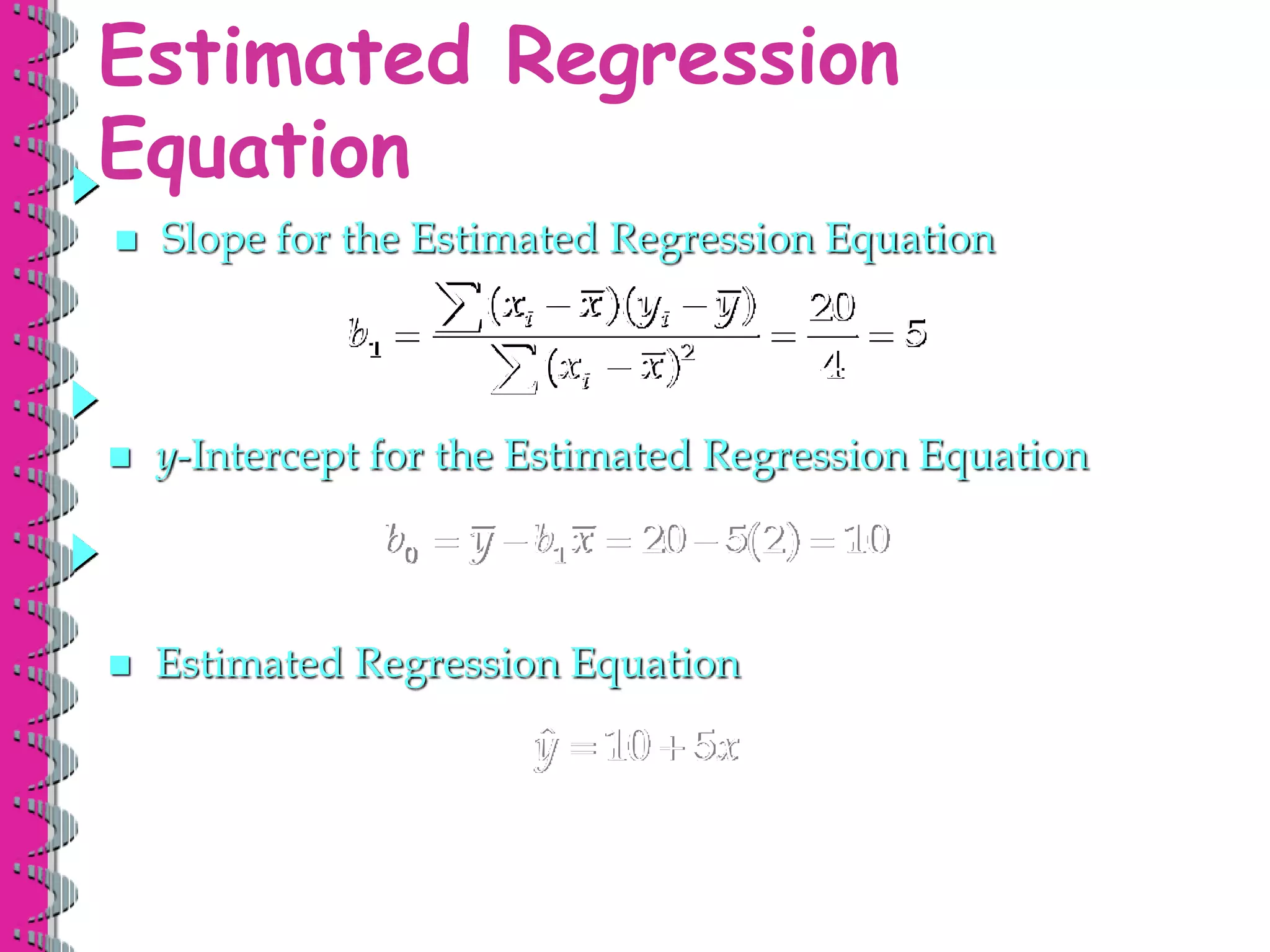
Estimated Regression
Equation
ˆ 10 5
y x
 
1 2
( )( ) 20
5
( ) 4
i i
i
x x y y
b
x x
 
  



0 1 20 5(2) 10
b y b x
    
 Slope for the Estimated Regression Equation
 y-Intercept for the Estimated Regression Equation
 Estimated Regression Equation
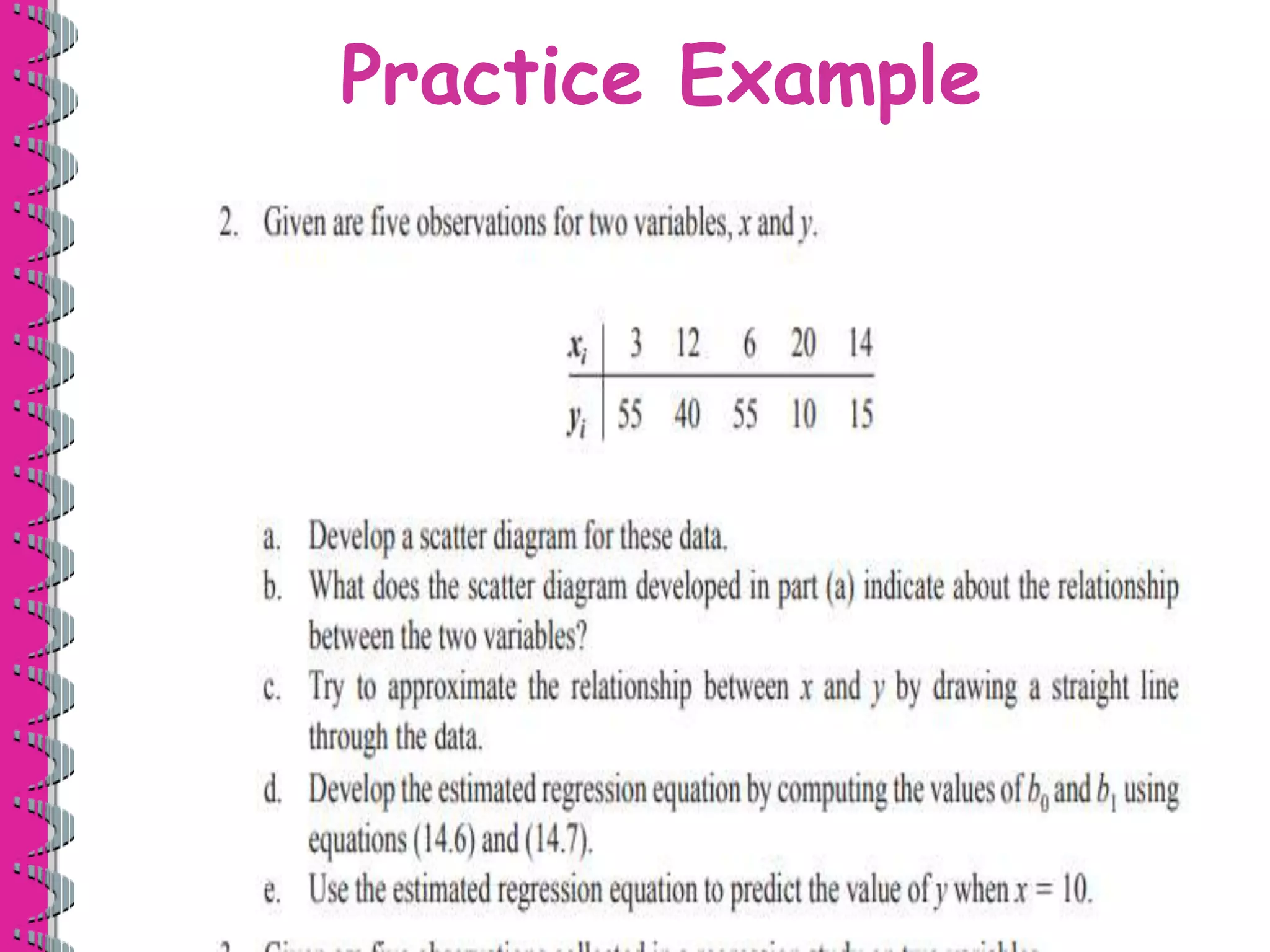
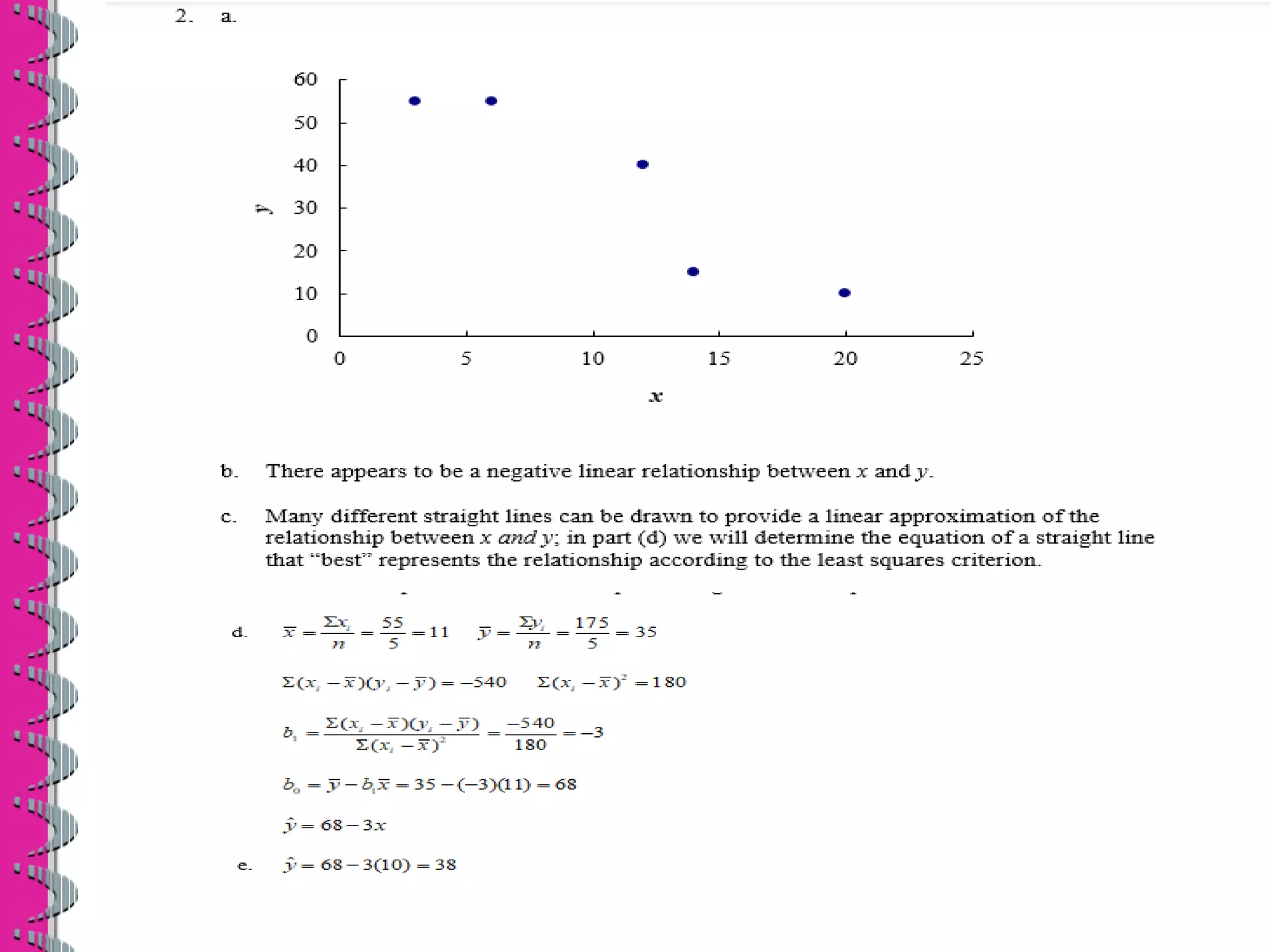
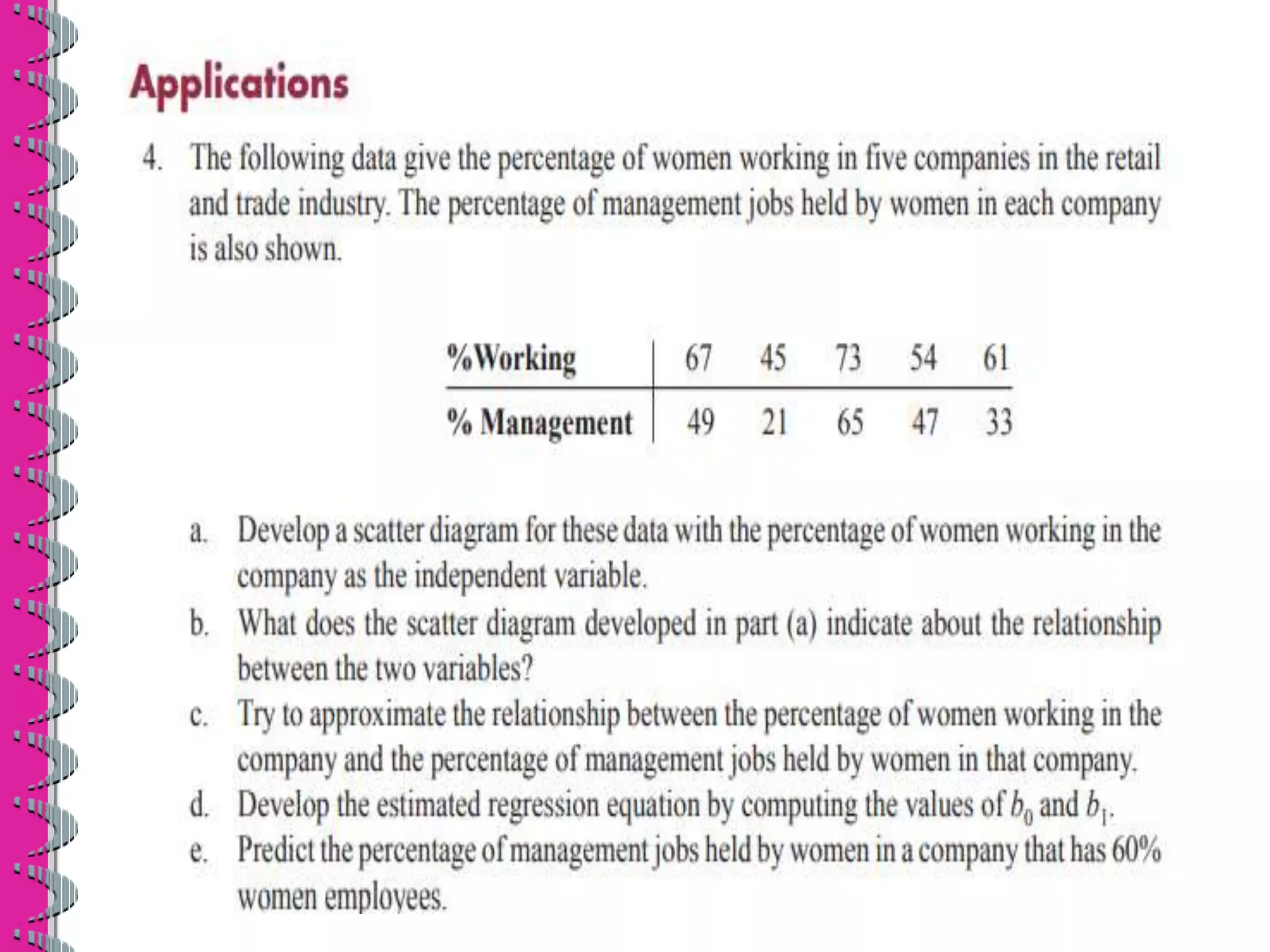
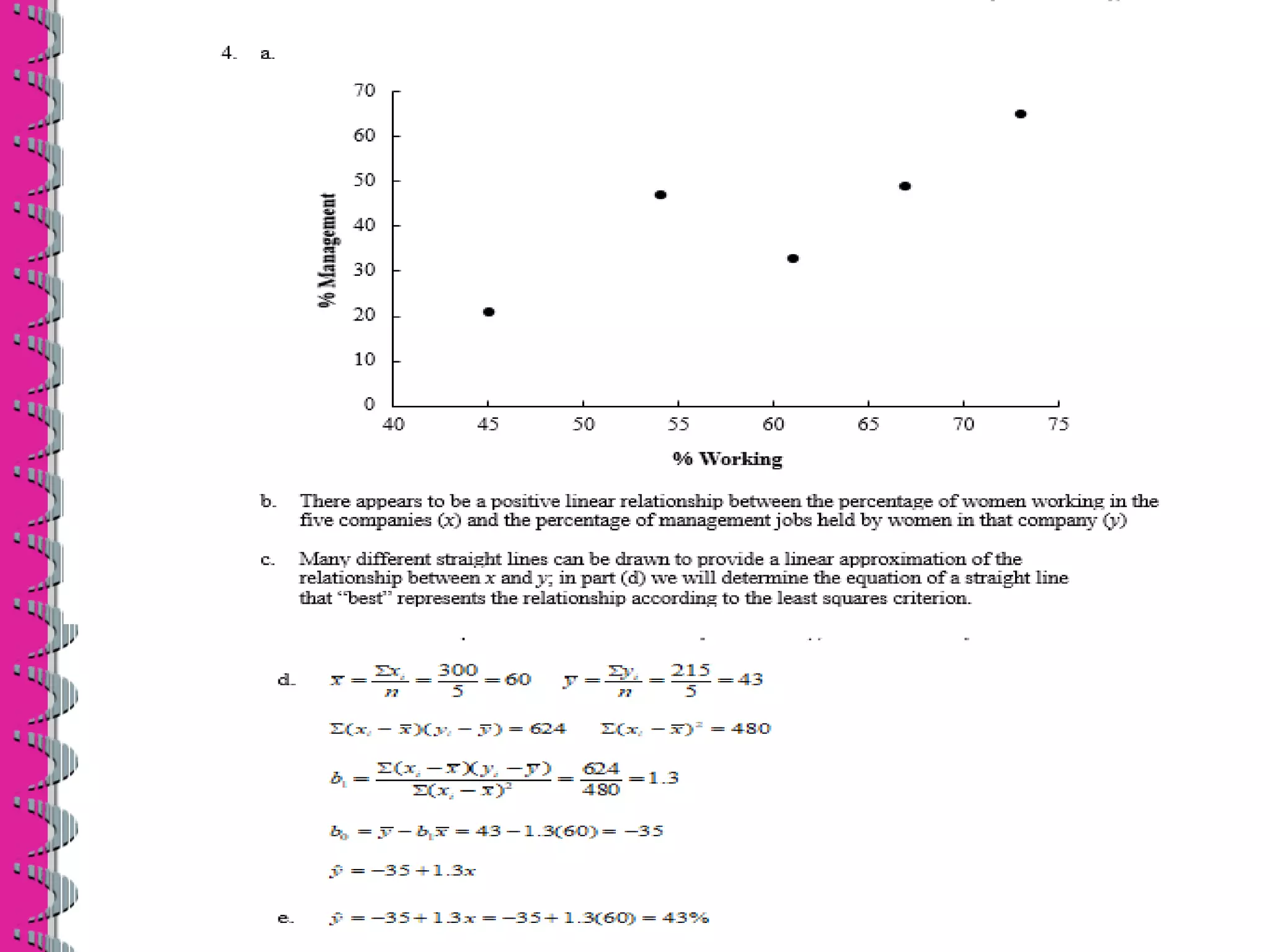
Practice Example
Practice HW
• Pg no. 609, q1
• Pg no. 610 q3, q5
• Pg no. 612 q7
Coefficient of Determination
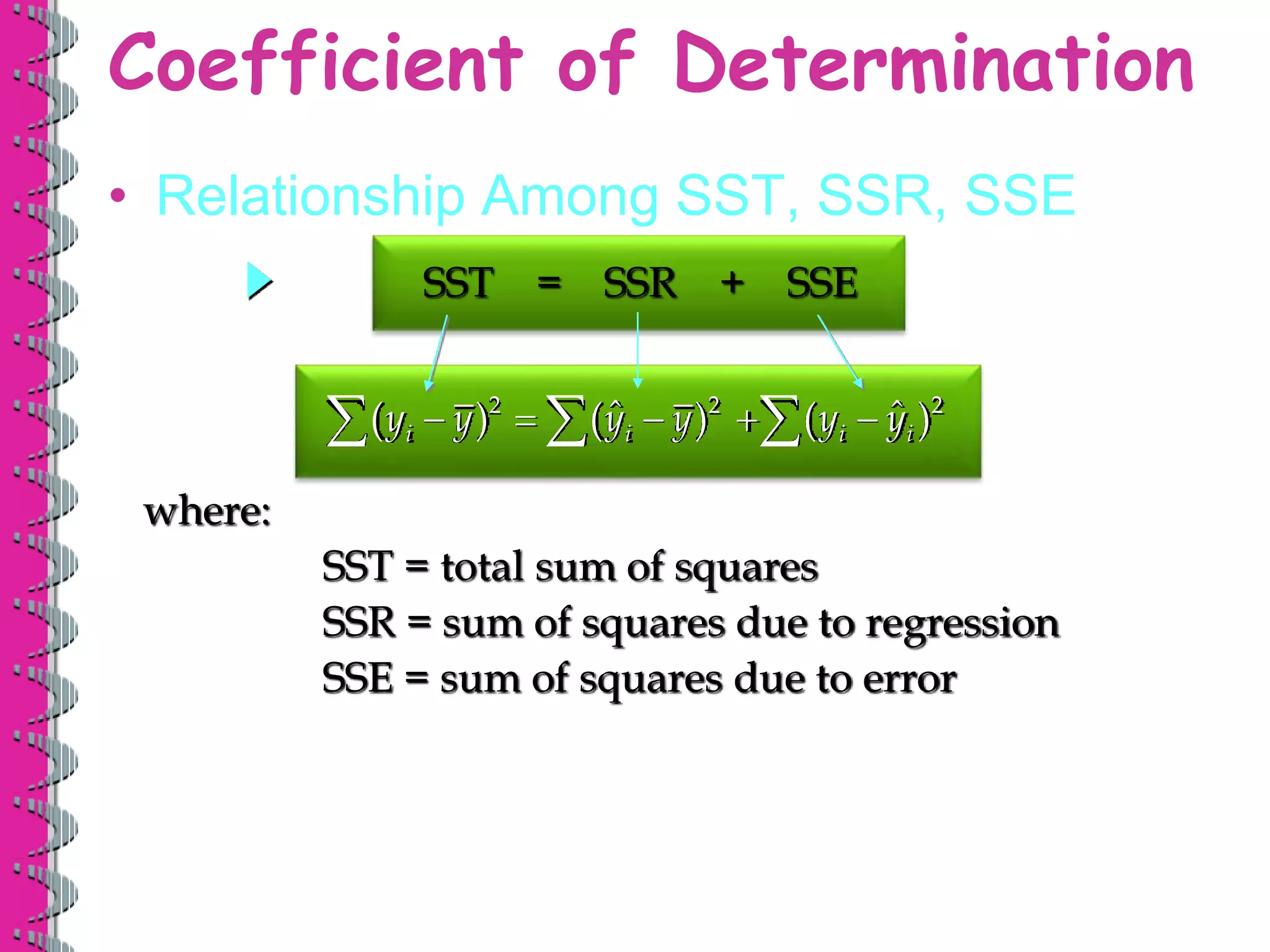
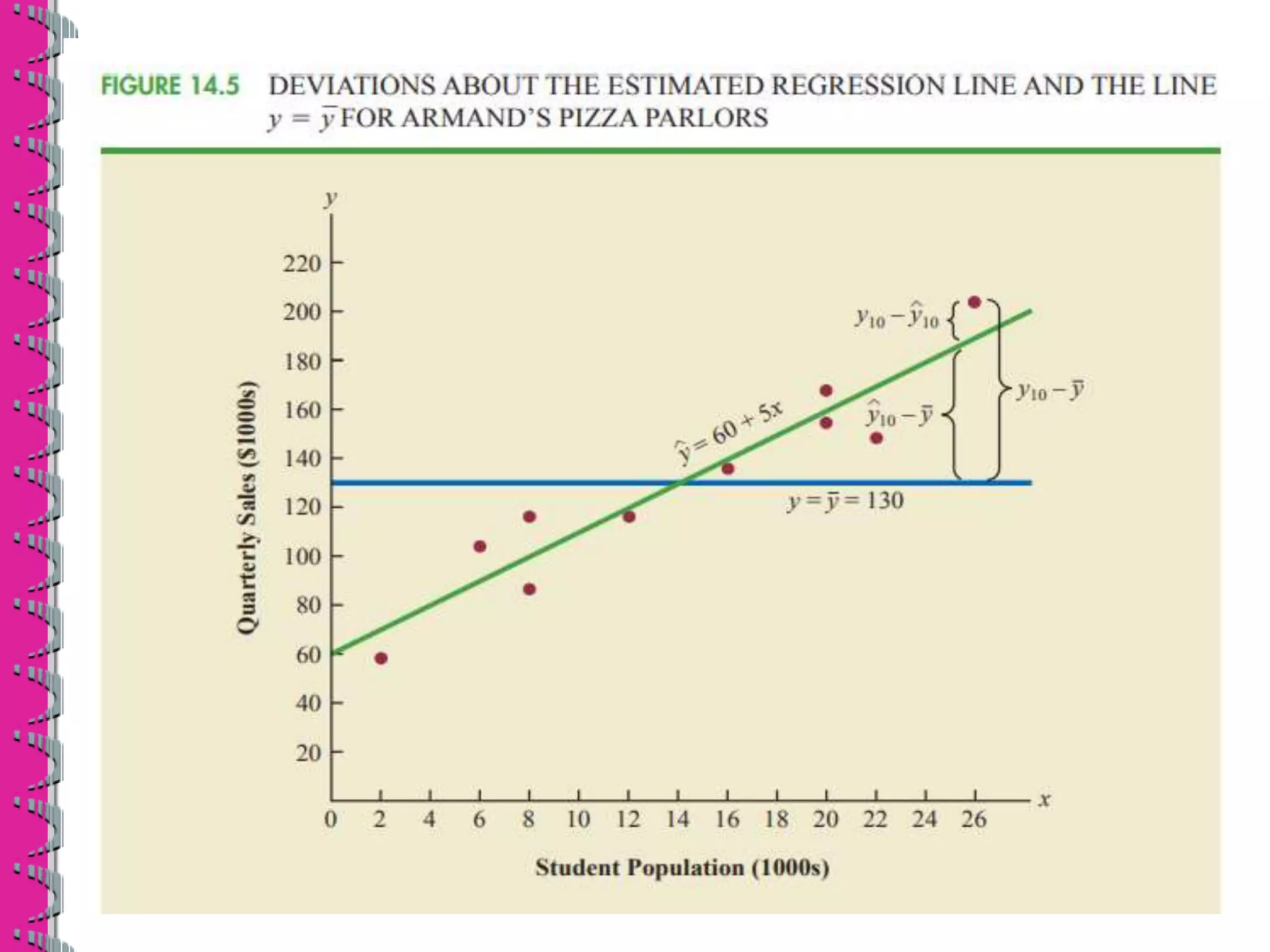
• Relationship Among SST, SSR, SSE
where:
SST = total sum of squares
SSR = sum of squares due to regression
SSE = sum of squares due to error
SST = SSR + SSE
2
( )
i
y y

 2
ˆ
( )
i
y y
 
 2
ˆ
( )
i i
y y
 

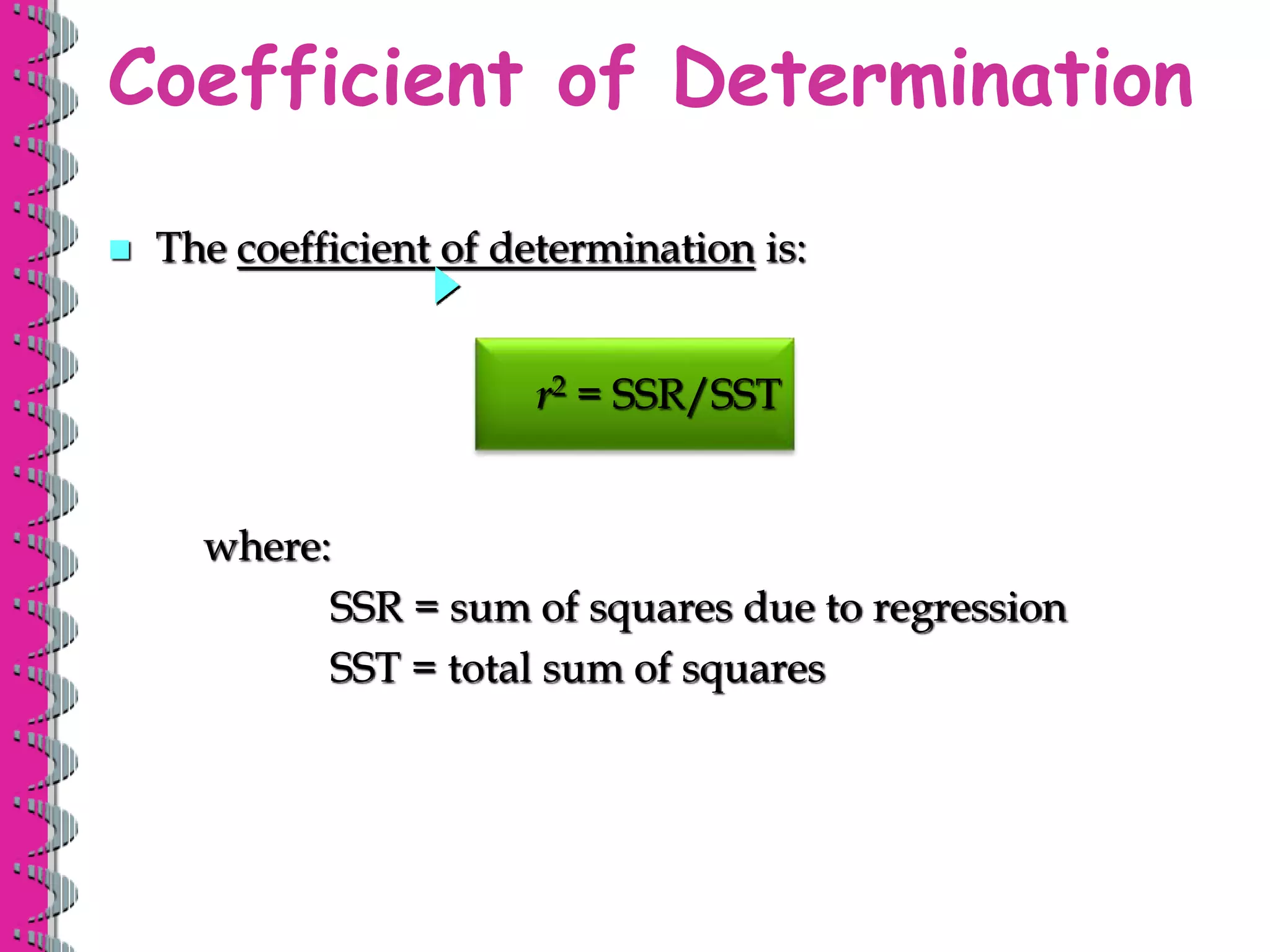
 The coefficient of determination is:
Coefficient of Determination
where:
SSR = sum of squares due to regression
SST = total sum of squares
r2 = SSR/SST
Coefficient of Determination
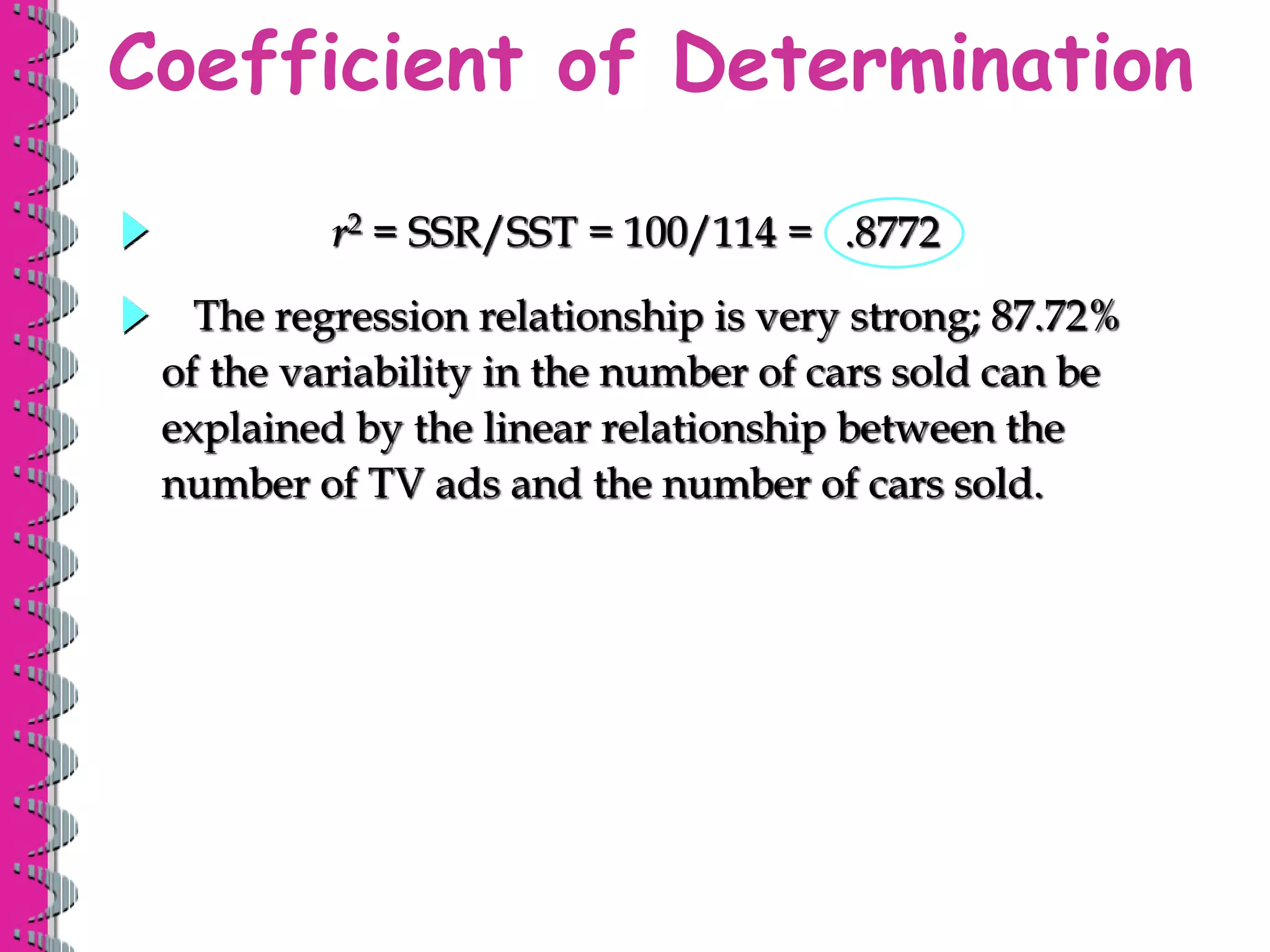
r2 = SSR/SST = 100/114 = .8772
The regression relationship is very strong; 87.72%
of the variability in the number of cars sold can be
explained by the linear relationship between the
number of TV ads and the number of cars sold.
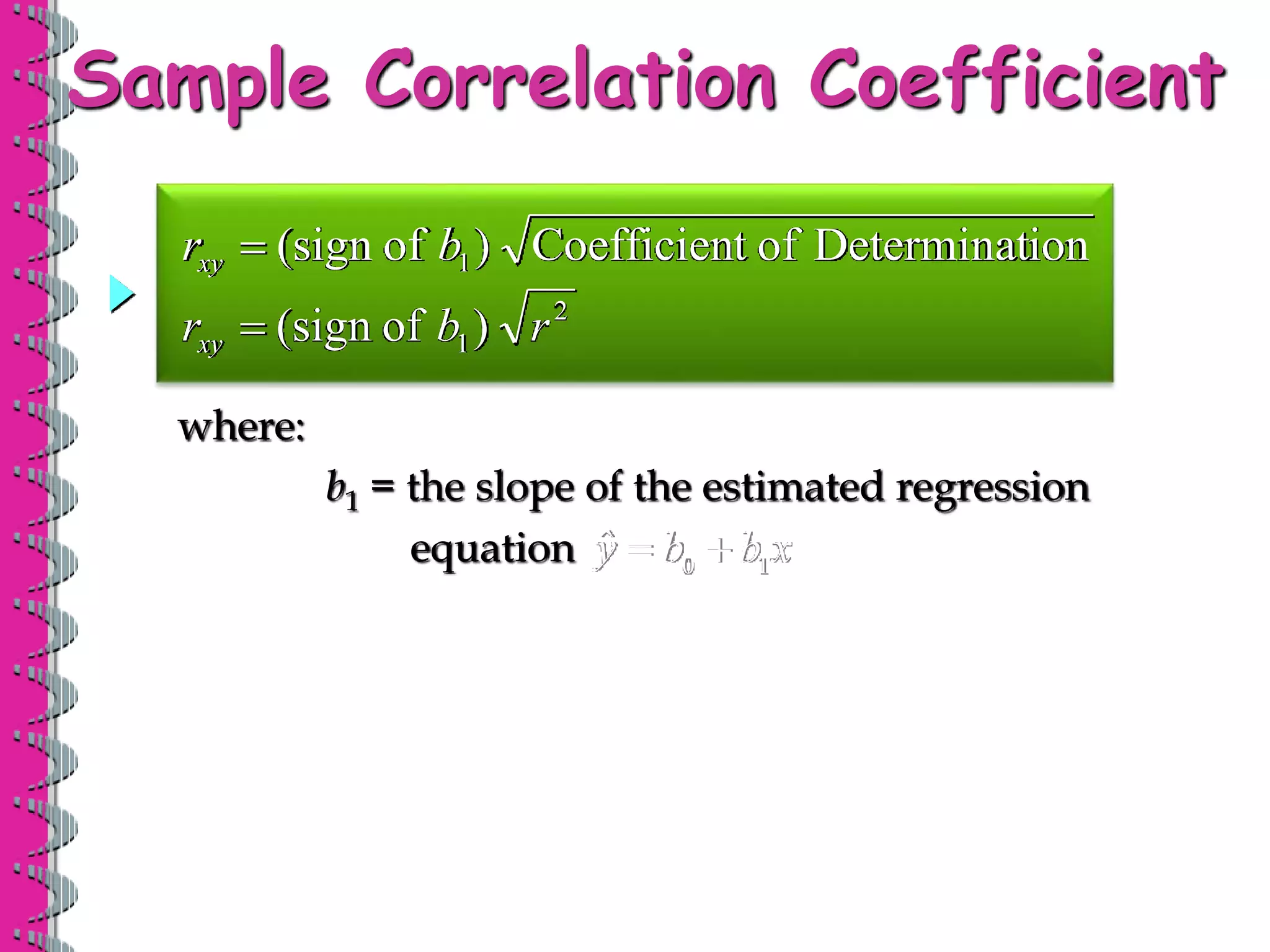
Sample Correlation Coefficient
2
1)
of
(sign r
b
rxy 
ion
Determinat
of
t
Coefficien
)
of
(sign 1
b
rxy 
where:
b1 = the slope of the estimated regression
equation x
b
b
y 1
0
ˆ 

2
1)
of
(sign r
b
rxy 
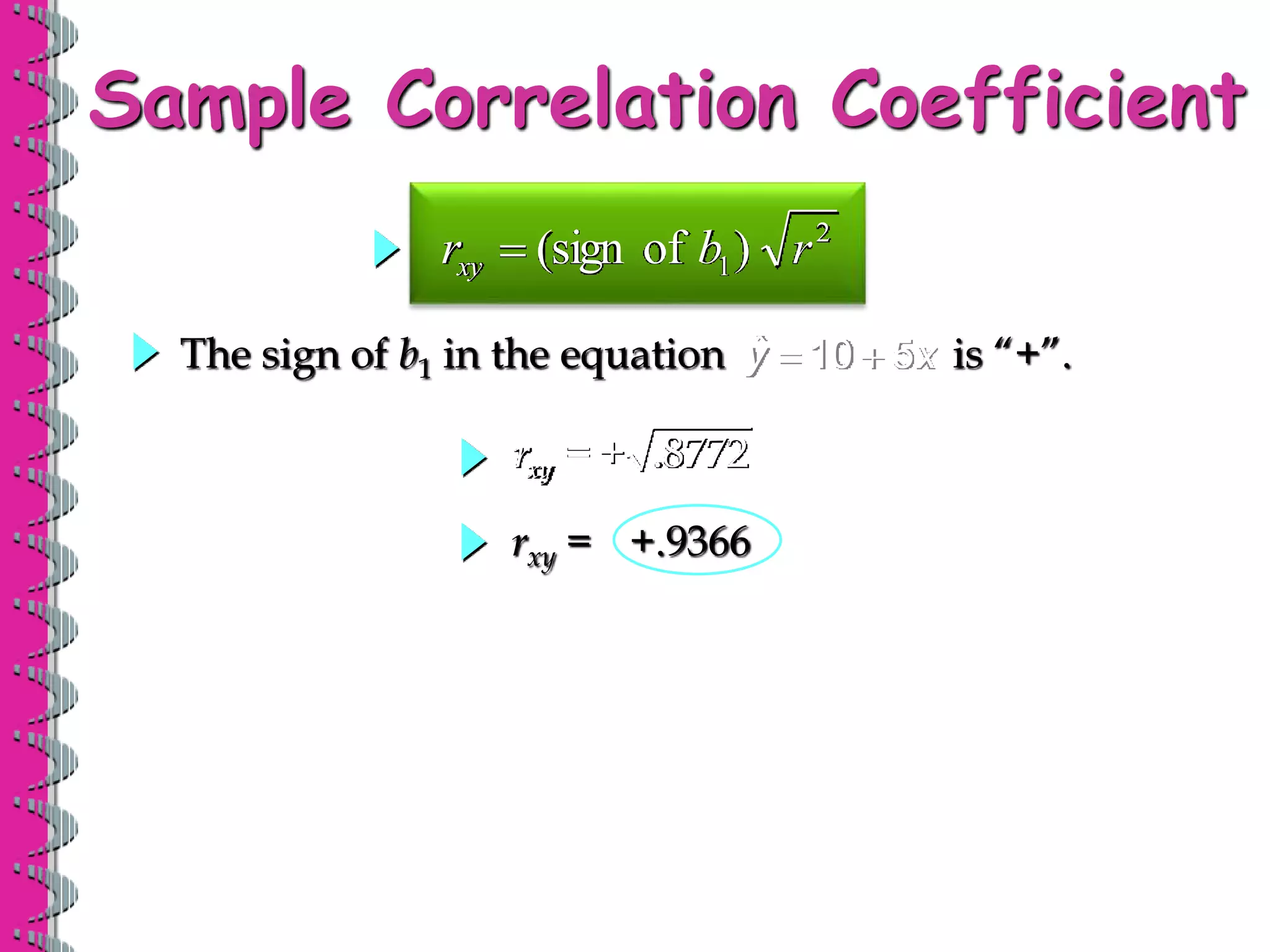
The sign of b1 in the equation is “+”.
ˆ 10 5
y x
 
= + .8772
xy
r
Sample Correlation Coefficient
rxy = +.9366
Regression Analysis.pptx

Regression Analysis.pptx

  • 1.
  • 2.
    Regression Analysis: thestudy of the relationship between variables Regression Analysis: one of the most commonly used tools for business analysis Easy to use and applies to many situations Regression Analysis
  • 3.
    Regression • The termregression as a statistical technique to predict one variable from another variable. • It is a measure of the average relationship between two or more variables in terms of original units of data. • Correlation coefficient is measure of degree of co-variability between X & Y but the objective of Regression Analysis is to study the ‘nature of relationship between variables’
  • 4.
    Types of Regression •Linear and Non Linear Regression- • If the given points are plotted on a graph paper , the points so obtained on the scatter diagram will more/less concentrated round a curve called the curve of Regression. • If the regression curve is a straight line then linear otherwise non linear/curved regression.
  • 5.
    Simple & Multiple Regression •It is confined with study of two variables i.e one independent and other dependent variable. • It is confined with more than two variables at a time. I.e two or more independent variables and one dependent variable.
  • 6.
    Types of variables •Dependent variable: the single variable which we wish to estimate/ predict by the regression model (response variable) Independent variable: The explanatory variable(s) used to predict/estimate the value of dependent variable. (predictor variable) • Y = A + B X • dependent independent
  • 7.
    Simple Linear Regression Model y= b0 + b1x +e where: b0 and b1 are called parameters of the model, e is a random variable called the error term.  The simple linear regression model is:  The equation that describes how y is related to x and an error term is called the regression model.
  • 8.
    Simple Linear Regression Equation The simple linear regression equation is: • E(y) is the expected value of y for a given x value. • b1 is the slope of the regression line. • b0 is the y intercept of the regression line. • Graph of the regression equation is a straight line. E(y) = b0 + b1x
  • 9.
    Simple Linear Regression Equation Positive Linear Relationship E(y) x Slope b1 is positive Regression line Intercept b0
  • 10.
    Simple Linear RegressionEquation  Negative Linear Relationship E(y) x Slope b1 is negative Regression line Intercept b0
  • 11.
    Simple Linear RegressionEquation  No Relationship E(y) x Slope b1 is 0 Regression line Intercept b0
  • 12.
    Estimated Simple LinearRegression Equation  The estimated simple linear regression equation 0 1 ŷ b b x   • is the estimated value of y for a given x value. ŷ • b1 is the slope of the line. • b0 is the y intercept of the line. • The graph is called the estimated regression line.
  • 13.
    Estimation Process Regression Model y= b0 + b1x +e Regression Equation E(y) = b0 + b1x Unknown Parameters b0, b1 Sample Data: x y x1 y1 . . . . xn yn b0 and b1 provide estimates of b0 and b1 Estimated Regression Equation Sample Statistics b0, b1 0 1 ŷ b b x  
  • 14.
    Method of LeastSquares • It states that line should be drawn through the plotted points in such manner that the sum of the squares of the deviations of the actual Y values from the computed Y values is the least. In order to obtain a line which fits the points best should be minimum. • LINE OF BEST FIT 2 ( ) Y Yc  
  • 15.
    Least Squares Method •Least Squares Criterion min (y y i i    )2 where: yi = observed value of the dependent variable for the ith observation ^ yi = estimated value of the dependent variable for the ith observation
  • 16.
    • Slope forthe Estimated Regression 1 2 ( )( ) ( ) i i i x x y y b x x       Least Squares Method where: xi = value of independent variable for ith observation _ y = mean value for dependent variable _ x = mean value for independent variable yi = value of dependent variable for ith observation
  • 17.
     y-Intercept forthe Estimated Regression Equation Least Squares Method 0 1 b y b x  
  • 18.
    Reed Auto periodicallyhas a special week-long sale. As part of the advertising campaign Reed runs one or more television commercials during the weekend preceding the sale. Data from a sample of 5 previous sales are shown on the next slide. Simple Linear Regression  Example: Reed Auto Sales
  • 19.
    Simple Linear Regression Example: Reed Auto Sales Number of TV Ads (x) Number of Cars Sold (y) 1 3 2 1 3 14 24 18 17 27 Sx = 10 Sy = 100 2 x  20 y 
  • 20.
    Estimated Regression Equation ˆ 105 y x   1 2 ( )( ) 20 5 ( ) 4 i i i x x y y b x x         0 1 20 5(2) 10 b y b x       Slope for the Estimated Regression Equation  y-Intercept for the Estimated Regression Equation  Estimated Regression Equation
  • 21.
  • 25.
    Practice HW • Pgno. 609, q1 • Pg no. 610 q3, q5 • Pg no. 612 q7
  • 26.
    Coefficient of Determination •Relationship Among SST, SSR, SSE where: SST = total sum of squares SSR = sum of squares due to regression SSE = sum of squares due to error SST = SSR + SSE 2 ( ) i y y   2 ˆ ( ) i y y    2 ˆ ( ) i i y y   
  • 28.
     The coefficientof determination is: Coefficient of Determination where: SSR = sum of squares due to regression SST = total sum of squares r2 = SSR/SST
  • 29.
    Coefficient of Determination r2= SSR/SST = 100/114 = .8772 The regression relationship is very strong; 87.72% of the variability in the number of cars sold can be explained by the linear relationship between the number of TV ads and the number of cars sold.
  • 30.
    Sample Correlation Coefficient 2 1) of (signr b rxy  ion Determinat of t Coefficien ) of (sign 1 b rxy  where: b1 = the slope of the estimated regression equation x b b y 1 0 ˆ  
  • 31.
    2 1) of (sign r b rxy  Thesign of b1 in the equation is “+”. ˆ 10 5 y x   = + .8772 xy r Sample Correlation Coefficient rxy = +.9366