HALLMARKS OF VIBAL
TEXTBOOK
Carlo Magno, PhD.
crlmgn@yahoo.com
Contemporary Perspectives in
Learning
 The Learner is a processor of information
 Learning is active and constructive
 Learning is cumulative
 Learning is self-regulated
 Learning is goal-oriented
 Learning is situated in social/cultural
practice
 Learning is individually…
The Textbook
 Source of
information
 Transmission of
facts
 Provides theory
 For reading
 Facilitates learning
 Builds higher order
thinking skills
 Provides real life
experiences and
current events
 Opportunity for self-
reflection
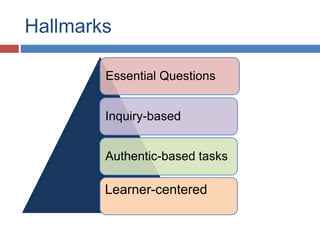
Hallmarks
Essential Questions
Inquiry-based
Authentic-based tasks
Learner-centered
Essential Question
Why do we ask questions at the
beginning of the lesson?
 Establishes the relevance of the content
 Provides expository exercises and challenges
to enhance critical thinking
 Focuses on what needs to be learned
Essential Question
 What provocative questions will foster inquiry,
understanding, and transfer of learning?
 Science
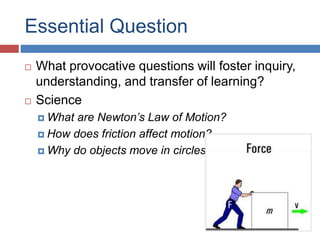
 What are Newton’s Law of Motion?
 How does friction affect motion?
 Why do objects move in circles?
Essential Question
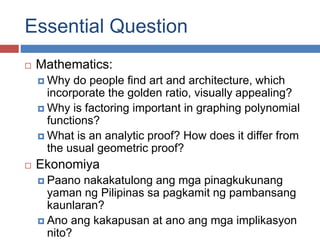
 Mathematics:
 Why do people find art and architecture, which
incorporate the golden ratio, visually appealing?
 Why is factoring important in graphing polynomial
functions?
 What is an analytic proof? How does it differ from
the usual geometric proof?
 Ekonomiya
 Paano nakakatulong ang mga pinagkukunang
yaman ng Pilipinas sa pagkamit ng pambansang
kaunlaran?
 Ano ang kakapusan at ano ang mga implikasyon
nito?
Inquiry-based Approach
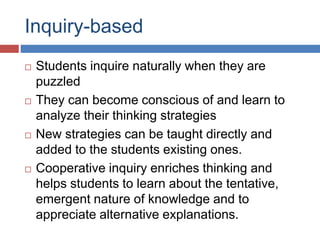
Inquiry-based
 Students inquire naturally when they are
puzzled
 They can become conscious of and learn to
analyze their thinking strategies
 New strategies can be taught directly and
added to the students existing ones.
 Cooperative inquiry enriches thinking and
helps students to learn about the tentative,
emergent nature of knowledge and to
appreciate alternative explanations.
Inquiry-based
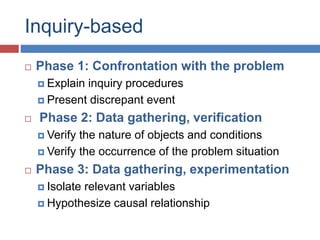
 Phase 1: Confrontation with the problem
 Explain inquiry procedures
 Present discrepant event
 Phase 2: Data gathering, verification
 Verify the nature of objects and conditions
 Verify the occurrence of the problem situation
 Phase 3: Data gathering, experimentation
 Isolate relevant variables
 Hypothesize causal relationship
Inquiry-based
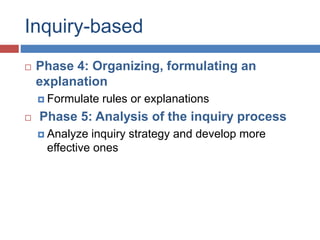
 Phase 4: Organizing, formulating an
explanation
 Formulate rules or explanations
 Phase 5: Analysis of the inquiry process
 Analyze inquiry strategy and develop more
effective ones
Inquiry-based
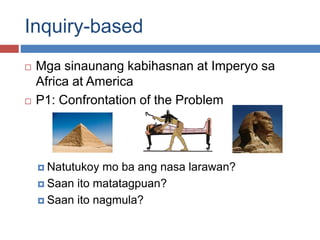
 Mga sinaunang kabihasnan at Imperyo sa
Africa at America
 P1: Confrontation of the Problem
 Natutukoy mo ba ang nasa larawan?
 Saan ito matatagpuan?
 Saan ito nagmula?
Inquiry-based
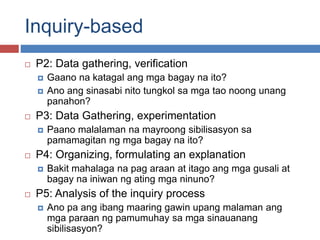
 P2: Data gathering, verification
 Gaano na katagal ang mga bagay na ito?
 Ano ang sinasabi nito tungkol sa mga tao noong unang
panahon?
 P3: Data Gathering, experimentation
 Paano malalaman na mayroong sibilisasyon sa
pamamagitan ng mga bagay na ito?
 P4: Organizing, formulating an explanation
 Bakit mahalaga na pag araan at itago ang mga gusali at
bagay na iniwan ng ating mga ninuno?
 P5: Analysis of the inquiry process
 Ano pa ang ibang maaring gawin upang malaman ang
mga paraan ng pamumuhay sa mga sinauanang
sibilisasyon?
Inquiry-based
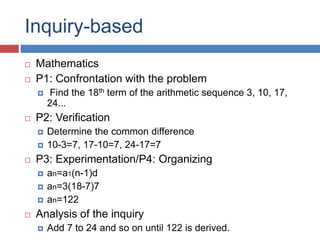
 Mathematics
 P1: Confrontation with the problem
 Find the 18th term of the arithmetic sequence 3, 10, 17,
24...
 P2: Verification
 Determine the common difference
 10-3=7, 17-10=7, 24-17=7
 P3: Experimentation/P4: Organizing
 an=a1(n-1)d
 an=3(18-7)7
 an=122
 Analysis of the inquiry
 Add 7 to 24 and so on until 122 is derived.
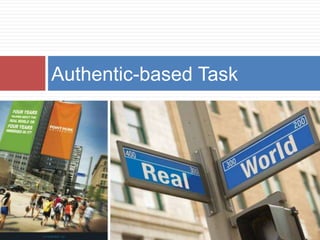
Authentic-based Task
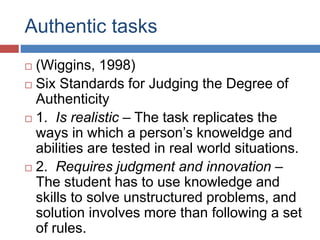
Authentic tasks
 (Wiggins, 1998)
 Six Standards for Judging the Degree of
Authenticity
 1. Is realistic – The task replicates the
ways in which a person’s knoweldge and
abilities are tested in real world situations.
 2. Requires judgment and innovation –
The student has to use knowledge and
skills to solve unstructured problems, and
solution involves more than following a set
of rules.
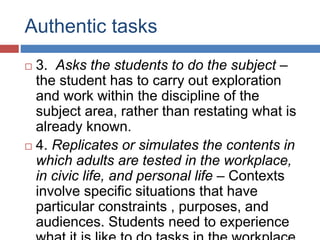
Authentic tasks
 3. Asks the students to do the subject –
the student has to carry out exploration
and work within the discipline of the
subject area, rather than restating what is
already known.
 4. Replicates or simulates the contents in
which adults are tested in the workplace,
in civic life, and personal life – Contexts
involve specific situations that have
particular constraints , purposes, and
audiences. Students need to experience
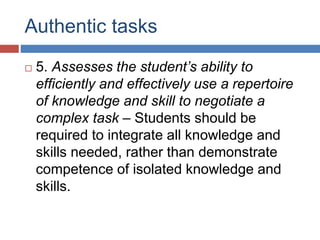
Authentic tasks
 5. Assesses the student’s ability to
efficiently and effectively use a repertoire
of knowledge and skill to negotiate a
complex task – Students should be
required to integrate all knowledge and
skills needed, rather than demonstrate
competence of isolated knowledge and
skills.
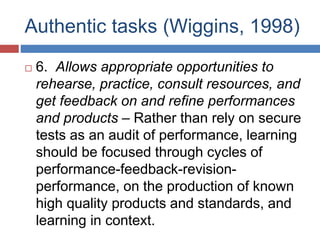
Authentic tasks (Wiggins, 1998)
 6. Allows appropriate opportunities to
rehearse, practice, consult resources, and
get feedback on and refine performances
and products – Rather than rely on secure
tests as an audit of performance, learning
should be focused through cycles of
performance-feedback-revision-
performance, on the production of known
high quality products and standards, and
learning in context.
Authentic Tasks
 Ekonomiks
 Pagkonsumo: Magbigay ng halimbawa na
nagpapakita ng ugnayan ng utility at kakapusan,
pagkonsumo, at eat-all you can.
 Science
 Earthquake: Prepare a list of items to be included
in an emergency bag that can be used during
natural disasters like earthquake.
 Prepare an earthquake logbook that highlight
some of the hazards we encounter in the
Philipines or in other countries.
Authentic tasks
 Literature: After reading The Analects of
Confucius versus from The Book of Tao and
The Wonderful Pear Tree, what lesson about
life and universe can be applied when dealing
with your friends in the following situations:
 A friend borrowing money
 A friend who forgot to bring art materials
 A friend who lost her money
Learner-Centered Framework
 McCombs (1999) have developed the Assessment for
Learner-centered Practices and the subscales include:
 Encourages Positive Relations - the ability to develop
positive interpersonal relationships with students and the
instructor’s ability to value and respect students as
persons.
 Honor’s Student Voices – The teachers appreciates the
learners point of view, gets feedback from students and
provides freedom for students to raise their ideas.
 Promotes Higher Order Thinking Skills - the
instructors ability to encourage students to monitor their
own learning process
 Adapts to Individual Differences and Developmental
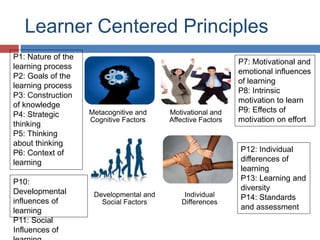
Learner Centered Principles
Metacognitive and
Cognitive Factors
Motivational and
Affective Factors
Individual
Differences
Developmental and
Social Factors
P1: Nature of the
learning process
P2: Goals of the
learning process
P3: Construction
of knowledge
P4: Strategic
thinking
P5: Thinking
about thinking
P6: Context of
learning
P7: Motivational and
emotional influences
of learning
P8: Intrinsic
motivation to learn
P9: Effects of
motivation on effort
P10:
Developmental
influences of
learning
P11: Social
Influences of
P12: Individual
differences of
learning
P13: Learning and
diversity
P14: Standards
and assessment
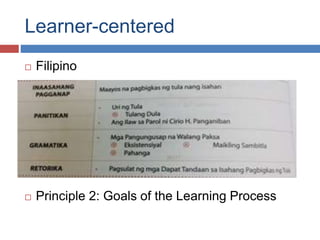
Learner-centered
 Filipino
 Principle 2: Goals of the Learning Process
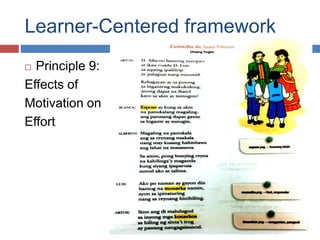
Learner-Centered framework
 Principle 9:
Effects of
Motivation on
Effort
Learner-centered Framework
 Principle 4: Thinking about thinking
 Paano isinulat ang usapan ng mga tauhan?
 Bakit may mga usapan sa akda? Magkakaugnay
ba ang mga ito?
 Principle 3: Construction of Knowledge
 Pokus na tanong
 Paano malalaman na ang isang tula ay nagsasadula?
 Bakit dapat pag-aralan ang mga tulang dula?
Learner-centered Framework
 Mathematics: Locating the Position of an
Object in a Data
 Principle 3: Construction of Knowledge
 Share what you know
 In your recent quarterly math exam, would it be more
desirable to earn a grade with a high or low quartile?
 After knowing all the descriptive measures of central
tendency in statistics such as mean, median, and
mode, do you think those measures gives ou an idea
on how the data is distributed around the center?
Learner-centered Framework
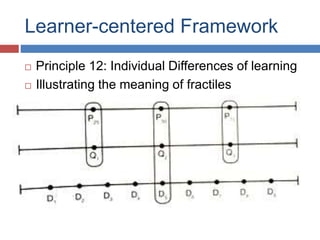
 Principle 12: Individual Differences of learning
 Illustrating the meaning of fractiles
Learner-centered framework
 Principle 14: Standards and Assessment
 Formative Assessments
 Let’s try
 Check your understanding (Formative assessment)
 Individual work
 Extend your understading
 Think about this
End of presentation
 www.slideshare.net
 crlmgn@yahoo.com

Hallmarks of textbook

  • 1.
    HALLMARKS OF VIBAL TEXTBOOK CarloMagno, PhD. crlmgn@yahoo.com
  • 2.
    Contemporary Perspectives in Learning The Learner is a processor of information  Learning is active and constructive  Learning is cumulative  Learning is self-regulated  Learning is goal-oriented  Learning is situated in social/cultural practice  Learning is individually…
  • 3.
    The Textbook  Sourceof information  Transmission of facts  Provides theory  For reading  Facilitates learning  Builds higher order thinking skills  Provides real life experiences and current events  Opportunity for self- reflection
  • 4.
  • 5.
    Essential Question Why dowe ask questions at the beginning of the lesson?  Establishes the relevance of the content  Provides expository exercises and challenges to enhance critical thinking  Focuses on what needs to be learned
  • 6.
    Essential Question  Whatprovocative questions will foster inquiry, understanding, and transfer of learning?  Science  What are Newton’s Law of Motion?  How does friction affect motion?  Why do objects move in circles?
  • 7.
    Essential Question  Mathematics: Why do people find art and architecture, which incorporate the golden ratio, visually appealing?  Why is factoring important in graphing polynomial functions?  What is an analytic proof? How does it differ from the usual geometric proof?  Ekonomiya  Paano nakakatulong ang mga pinagkukunang yaman ng Pilipinas sa pagkamit ng pambansang kaunlaran?  Ano ang kakapusan at ano ang mga implikasyon nito?
  • 8.
  • 9.
    Inquiry-based  Students inquirenaturally when they are puzzled  They can become conscious of and learn to analyze their thinking strategies  New strategies can be taught directly and added to the students existing ones.  Cooperative inquiry enriches thinking and helps students to learn about the tentative, emergent nature of knowledge and to appreciate alternative explanations.
  • 10.
    Inquiry-based  Phase 1:Confrontation with the problem  Explain inquiry procedures  Present discrepant event  Phase 2: Data gathering, verification  Verify the nature of objects and conditions  Verify the occurrence of the problem situation  Phase 3: Data gathering, experimentation  Isolate relevant variables  Hypothesize causal relationship
  • 11.
    Inquiry-based  Phase 4:Organizing, formulating an explanation  Formulate rules or explanations  Phase 5: Analysis of the inquiry process  Analyze inquiry strategy and develop more effective ones
  • 12.
    Inquiry-based  Mga sinaunangkabihasnan at Imperyo sa Africa at America  P1: Confrontation of the Problem  Natutukoy mo ba ang nasa larawan?  Saan ito matatagpuan?  Saan ito nagmula?
  • 13.
    Inquiry-based  P2: Datagathering, verification  Gaano na katagal ang mga bagay na ito?  Ano ang sinasabi nito tungkol sa mga tao noong unang panahon?  P3: Data Gathering, experimentation  Paano malalaman na mayroong sibilisasyon sa pamamagitan ng mga bagay na ito?  P4: Organizing, formulating an explanation  Bakit mahalaga na pag araan at itago ang mga gusali at bagay na iniwan ng ating mga ninuno?  P5: Analysis of the inquiry process  Ano pa ang ibang maaring gawin upang malaman ang mga paraan ng pamumuhay sa mga sinauanang sibilisasyon?
  • 14.
    Inquiry-based  Mathematics  P1:Confrontation with the problem  Find the 18th term of the arithmetic sequence 3, 10, 17, 24...  P2: Verification  Determine the common difference  10-3=7, 17-10=7, 24-17=7  P3: Experimentation/P4: Organizing  an=a1(n-1)d  an=3(18-7)7  an=122  Analysis of the inquiry  Add 7 to 24 and so on until 122 is derived.
  • 15.
  • 16.
    Authentic tasks  (Wiggins,1998)  Six Standards for Judging the Degree of Authenticity  1. Is realistic – The task replicates the ways in which a person’s knoweldge and abilities are tested in real world situations.  2. Requires judgment and innovation – The student has to use knowledge and skills to solve unstructured problems, and solution involves more than following a set of rules.
  • 17.
    Authentic tasks  3.Asks the students to do the subject – the student has to carry out exploration and work within the discipline of the subject area, rather than restating what is already known.  4. Replicates or simulates the contents in which adults are tested in the workplace, in civic life, and personal life – Contexts involve specific situations that have particular constraints , purposes, and audiences. Students need to experience
  • 18.
    Authentic tasks  5.Assesses the student’s ability to efficiently and effectively use a repertoire of knowledge and skill to negotiate a complex task – Students should be required to integrate all knowledge and skills needed, rather than demonstrate competence of isolated knowledge and skills.
  • 19.
    Authentic tasks (Wiggins,1998)  6. Allows appropriate opportunities to rehearse, practice, consult resources, and get feedback on and refine performances and products – Rather than rely on secure tests as an audit of performance, learning should be focused through cycles of performance-feedback-revision- performance, on the production of known high quality products and standards, and learning in context.
  • 20.
    Authentic Tasks  Ekonomiks Pagkonsumo: Magbigay ng halimbawa na nagpapakita ng ugnayan ng utility at kakapusan, pagkonsumo, at eat-all you can.  Science  Earthquake: Prepare a list of items to be included in an emergency bag that can be used during natural disasters like earthquake.  Prepare an earthquake logbook that highlight some of the hazards we encounter in the Philipines or in other countries.
  • 21.
    Authentic tasks  Literature:After reading The Analects of Confucius versus from The Book of Tao and The Wonderful Pear Tree, what lesson about life and universe can be applied when dealing with your friends in the following situations:  A friend borrowing money  A friend who forgot to bring art materials  A friend who lost her money
  • 22.
  • 23.
    Learner-Centered Framework  McCombs(1999) have developed the Assessment for Learner-centered Practices and the subscales include:  Encourages Positive Relations - the ability to develop positive interpersonal relationships with students and the instructor’s ability to value and respect students as persons.  Honor’s Student Voices – The teachers appreciates the learners point of view, gets feedback from students and provides freedom for students to raise their ideas.  Promotes Higher Order Thinking Skills - the instructors ability to encourage students to monitor their own learning process  Adapts to Individual Differences and Developmental
  • 24.
    Learner Centered Principles Metacognitiveand Cognitive Factors Motivational and Affective Factors Individual Differences Developmental and Social Factors P1: Nature of the learning process P2: Goals of the learning process P3: Construction of knowledge P4: Strategic thinking P5: Thinking about thinking P6: Context of learning P7: Motivational and emotional influences of learning P8: Intrinsic motivation to learn P9: Effects of motivation on effort P10: Developmental influences of learning P11: Social Influences of P12: Individual differences of learning P13: Learning and diversity P14: Standards and assessment
  • 25.
    Learner-centered  Filipino  Principle2: Goals of the Learning Process
  • 26.
    Learner-Centered framework  Principle9: Effects of Motivation on Effort
  • 27.
    Learner-centered Framework  Principle4: Thinking about thinking  Paano isinulat ang usapan ng mga tauhan?  Bakit may mga usapan sa akda? Magkakaugnay ba ang mga ito?  Principle 3: Construction of Knowledge  Pokus na tanong  Paano malalaman na ang isang tula ay nagsasadula?  Bakit dapat pag-aralan ang mga tulang dula?
  • 28.
    Learner-centered Framework  Mathematics:Locating the Position of an Object in a Data  Principle 3: Construction of Knowledge  Share what you know  In your recent quarterly math exam, would it be more desirable to earn a grade with a high or low quartile?  After knowing all the descriptive measures of central tendency in statistics such as mean, median, and mode, do you think those measures gives ou an idea on how the data is distributed around the center?
  • 29.
    Learner-centered Framework  Principle12: Individual Differences of learning  Illustrating the meaning of fractiles
  • 30.
    Learner-centered framework  Principle14: Standards and Assessment  Formative Assessments  Let’s try  Check your understanding (Formative assessment)  Individual work  Extend your understading  Think about this
  • 31.
    End of presentation www.slideshare.net  crlmgn@yahoo.com