Interventions-
Based Assessment:
Ensuring every
learner a reader
Carlo Magno
cladasia2015@gmail.com
@carlo2020feb
Center for Learning and Assessment Development Asia
USAID – Technical Adviser
Objectives
•Use the specific learning competencies to determine the areas that
learners need further help.
•Organize results of literacy and numeracy assessment based on
competencies to inform instruction.
DepEd Order
DepEd order 34 s. 2022
Status of learners
The UNESCO, World Bank, and MICS
Foundation even reported that larger
losses are also observed among
socioeconomically disadvantaged
students.
The Philippines, classified under lower to
middle income country, was reported
that about 0 to 15% of 10 years old
children could not read a simple text.
The UNESCO Global Monitoring closure
has shown that about 26,950,258 Filipino
learners were affected due to school
closure.
Status of learners
Grade 10
Random Effects (parameter estimates)
School=5.06
Location=.26
Random Effects (parameter estimates)
School=2.42
Location=.13
[CELLRANGE],
24.18
[CELLRANGE],
20.77
20
21
22
23
24
25
2018-2019 F2F 2020-2021 Remote
FIxed Effect of Modality on Math Performance for
Grade 10, Paremeter estimate=3.99 (p=.00)
[CELLRANGE],
24.99
[CELLRANGE],
22.66
20
21
22
23
24
25
2018-2019 F2F 2020-2021 Remote
Fixed Effect of Modality on English Performance
for Grade 10, Parameter estimate=2.43 (p=.00)
Status of learners
Grade 1
Random Effects (parameter estimates)
School=3.39
Location=.15
Random Effects (parameter estimates)
School=9.71
Location=.11
[CELLRANGE],
24.16
[CELLRANGE],
38.61
16
18
20
22
24
26
28
30
32
34
36
38
40
2018-2019 F2F 2020-2021 Remote
FIxed Effect of Modality on Math Performance for
Grade 1, Paremeter estimate=-13.42 (p=.00)
[CELLRANGE],
17.54
[CELLRANGE],
20.54
16
18
20
22
24
26
28
30
32
34
36
38
40
2018-2019 F2F 2020-2021 Remote
FIxed Effect of Modality on English Performance
for Grade 1, Paremeter estimate=-5.97 (p=.00)
Status of learners
In Region 5, the grade 1 to grade 3 learners were
assessed using the Comprehensive Rapid Literacy
Assessment provided by the ABC+ and USAID.
The assessment results showed that about
65.5% of the grade 1 learners are in the full
refresher level (able to identify letters only)
52% of the grade 2 and 18%-28%% of the grade 1
learners are still in the full refresher level
Grade 1 literacy results
Grade 2 literacy results
Grade 3 literacy results
The UNESCO has developed the Global
Proficiency Framework for Reading (by age of
7)
A. Comprehension of Spoken Language:
 Comprehend spoken and signed language at the word or phrase level
 Recognize the meaning of common grade-level words in a short, grade-
level continuous text read to or signed for the learner
 Retrieve explicit information in a short grade-level continuous text read to
or signed for the learner
B. Decoding
 Identify symbol-sound/fingerspelling and/or symbol-morpheme
correspondences
 Decode isolated words
C. Reading Comprehension
 Recognize the meaning of common grade-level words
Grade 1 Reading and Literacy
C. Comprehending and Analyzing Text
 Read sentences with appropriate speed, accuracy, and expression
(Q3-Q4)
 Note important details in stories (character, setting, and events). (Q2-
Q4)
 Sequence events in stories. (Q2-Q4)
 Infer the character's feelings and traits. (Q2-Q4)
 Predict possible ending. (Q2-Q4)
 Relate story events to one’s experience.
 Identify cause and effect of events.(Q3-Q4)
 Identify problem and solution in stories. (Q3-Q4)
Percent of Grade 2 Learners for Each
Proficiency Level in Literacy in English
Cannot identify alphabet
Can identify letters and
sounds
Can blend letters and
recognize words
Can read with
comprehension
Percent of Grade 2 Learners for Each
Proficiency Level in Literacy in Filipino
Cannot identify alphabet
Can identify letters and
sounds
Can blend letters and
recognize words
Can read with
comprehension
Percent of Grade 2 Learners for Each
Proficiency Level in Numeracy
RNA Proficiency Level
Proficiency Level Skill Involved
Stage 0: Emergent The student is unable to consistently count a given number of
objects because they lack knowledge of counting sequences
and/or one-to-one correspondence.
Stage 1: One-to-one
counting
The student is able to count a set of objects or form sets of objects
but cannot solve problems that involve joining and separating sets.
Stage 2: Counting from one
on materials
The student is able to count a set of objects or form sets of objects
to solve simple addition and subtraction problems.
The student solves problems by counting all the objects.
Stage 3: Counting from one
by imaging
The student is able to isualize sets of objects to solve simple
addition and subtraction problems.
The student solves problems by counting all the objects.
Stage 4: Advanced counting The student uses counting on or counting back to solve simple
addition or subtraction tasks.
RNA Proficiency Level
Stage 5: Early additive part-
whole
The student uses a limited range of mental strategies to estimate answers
and solve addition or subtraction problems. These strategies involve
deriving the answer from known basic facts, (e. g. doubles, fives, making
tens).
Stage 6: Advanced
additive/early multiplicative
part-whole
The student can estimate answers and solve addition and subtraction tasks
involving whole numbers mentally by choosing appropriately from a broad
range of advanced mental strategies (eg. Place value positioning, rounding
and compensating or reversibility).
The student uses a combination of known facts and a limited range of mental
strategies to derive answers to multiplication and division problems, (eg.
Doubling, rounding or reversibility).
Stage 7: Advanced
multiplicative part-whole
The student is able to choose appropriately from a broad range of mental
strategies to estimate answers and solve multiplication and division
problems. These strategies involve partitioning one or more of the factors,
(eg. Place value partitioning, rounding and compensating, reversibility).
Stage 8: Advanced proportional
part-whole
The student can estimate answers and solve problems involving the
multiplication and division of fractions and decimals using mental strategies.
These strategies involve recognizing the effect of number size on the answer
and converting decimals to fractions where appropriate. These students
have strongly developed number sense and algebraic thinking.
Learning Recovery Plan
NIET (2021) Academic Innovation and
Performance New
Classrooms Innovation
Partners for Learning (2021)
UNICEF, UNESCO, and the
World Bank (April, 2022)
• Landscape
analysis
• Strategies will
best support
learning recovery
and accelerate
learning
• Identify key
personnel and
build buy-in
• Create a budget
• Skill map
• Diagnostic tools
• Prioritization on a
strategic mix of skills
• Regular assessments
• Meaningful parent
engagement
• Incorporating key
program design
(1) Reach every child and
retain them in school
(2) Assess current learning
levels
(3) Prioritize fundamentals
(4) Increase catch-up
learning
(5) Develop psychosocial
health and wellbeing
Region 5
Area 1 Improving the delivery of
curriculum, assessment, and
instruction
A regionwide assessment of literacy and
numeracy for grades 1 to 3 determined the
learning gaps that will be addressed.
Area 2 Developing the capacity of
teachers
Learning and development of teachers in the
conduct of blended learning, individualized
instruction and integrating literacy and numeracy
skills in other subject areas.
Area 3 Academic support for the
learning at home and in the
community
Support for the teachers’ instruction from other
stakeholders are established such as home based
learning programs, orientation for parents, home
visitations, capacitating volunteers to teach
learners in the community, and monitoring
learners performance with the help of other
community volunteers.
Area 4 Allocation of budget for the
learning recovery
A budget is allocated to the schools’ divisions to
support the implementation of the learning
recovery plans and programs.
NCR
Effective delivery of
instruction and learners
performance
Learning and
development
Budget for instructional
acceleration
*Student Performance
(Literacy, Numeracy,
LAMP)
*Number of MELCs
implemented against the
intended curriculum
Budget of Work
compliance
Number of modules
distributed
Quality delivery of
learning modalities
Quality of Literacy and
Numeracy programs
implemented
Faculty Outcomes (COT
Performance)
L & D Ratings
(Reactions, Behavior &
Learning Phase)
Number of teachers
trained
Number of L & D
attended
Budget for the Upskilling
and Reskilling of
Teachers
Budget for the
Instructional Materials
Allocation for allowable
expenditures for
Learning Recovery
Programs
Interventions with impact
Learning Recovery
Intervention
Result
Extended school year 0.1 sd improvement on reading and math and 0.15 on
writing
Extended school period and
days
Double instruction time increased 25% in algebra
performance
Looping Parents and school heads interviewed gave the advantages
of looping
Tutoring 20 times more effective in math, 15 times more effective in
reading
Individualized learning plans Several factors achieved on students’ academic
performance and social and emotional competencies after
one school year.
After school programs High score of students who participated than the district
average
Acceleration academies Significant improvement in math and reading
Summer learning programs 90 mins of math and 120 mins of English daily for 5 weeks
increased students’ performance
Recommendations
Proficiency Level Strategies
Non-reader  Marungko/DSTAR
 Home learning support: Use flashcards showing letters and
CV/VC blends
Beginning Readers  Left to right decoding
 Phonics pattern (Fuller model)
 Stretch the word (additional blends)
 Successive blending
 Illustrating/check for meaning
Emerging Reader  Guided reading
 Language experience approach
 Pre-reading tasks (brainstorming, topic discussion)
 During reading tasks (think alouds)
 Post-reading tasks (summarizing, illustrating, mapping)
Full Reader  Metacognitive comprehension strategies
 Introduce informative text for reading
 Writing generated ideas
Later on: Match the learning resource
with the student literacy profile
2nd edition
With
exercises
The Expanded Reader: An
Instructional Resource
for Reading Remediation
After the Full
Reader Level
Recommendations
Numeracy Stages Strategies
Stage 0: Emergent
 Start with rote counting
 Practice counting objects
Stage 1: One-to-one counting
 Illustrate variety of ways for adding
 Use counters to show quantities
Stage 2: Counting from one on materials
 Illustrate how subtraction is done
 Show strategies to solve subtraction
Stage 3: Counting from one by imaging  Show that multiple addition is equal to
multiplication
 Use counters to multiply
Stage 4: Advanced counting
Stage 5: Early additive part-whole  Show division of exact quantities is
reversible with multiplication
 Use counters to divide
 Teacher trial and error in grouping counters
Stage 6: Advanced additive/early multiplicative
part-whole
Stage 7: Advanced multiplicative part-whole
 Practice sets of operations to enhance
mental computation
 Illustrate problems for comprehension
Stage 8: Advanced proportional part-whole
 Use objects to illustrate factions of objects
with operations
Assessment for learning
How do we use assessment results to help
students learn better?
Assessment is used to determine:
◦ What students can do and cannot do
◦ What students know and do not know
◦ Misconceptions of students
◦ Confusion
Provide teachers information on what to do next to
bring students forward in their learning
Assessment-based
intervention
The results need to show the specific competency not being met by the
learner/s
All the competencies covered in the assessment should be the major
category when presenting the results rather than proficiency levels
Proficiency levels needs to have specific descriptors what learners can
do and cannot do
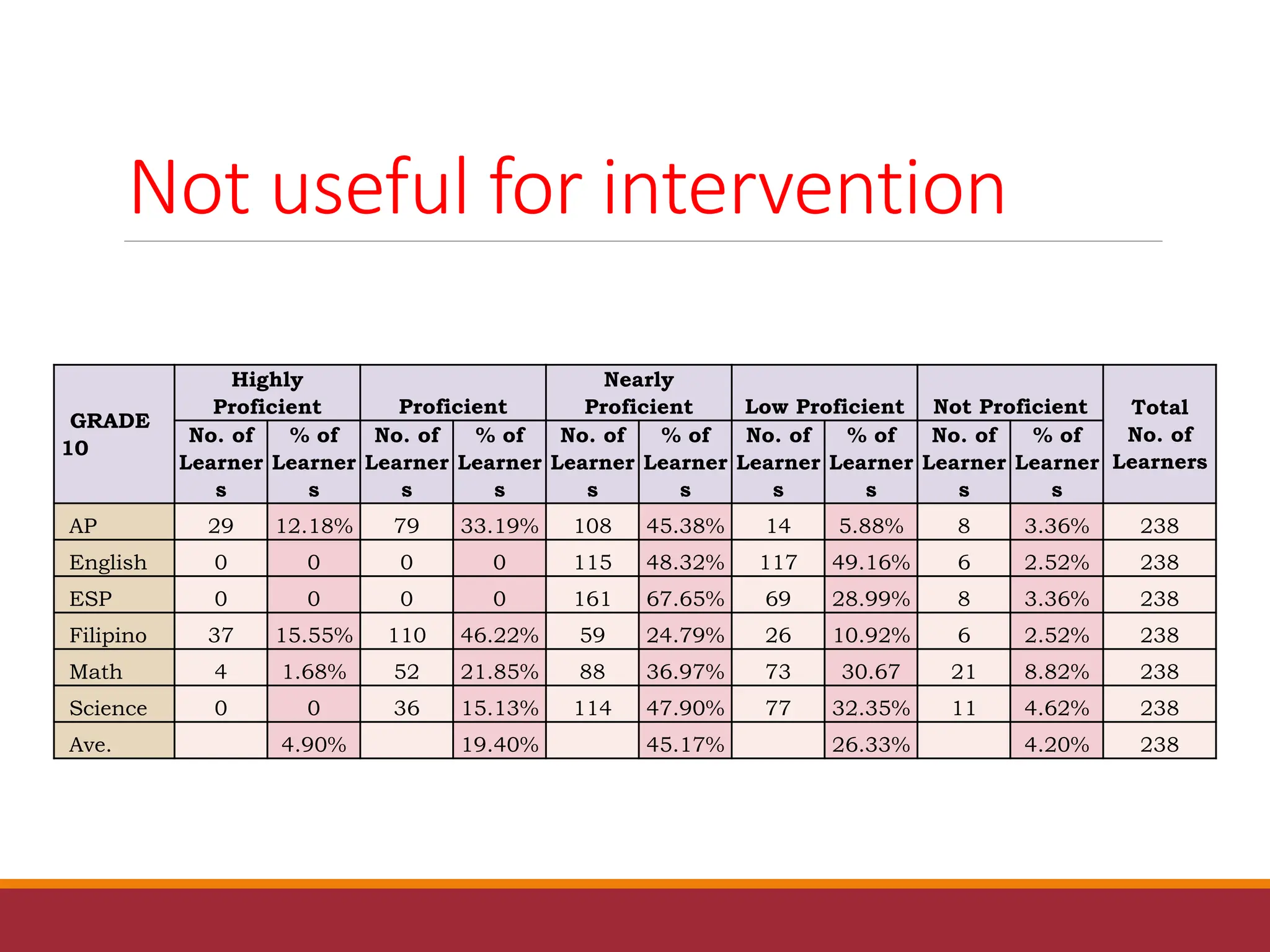
Not useful for intervention
POST TEST
Skill Level
Number of
Learners
Needs Major
Support
1911 or 36.58%
Anchoring 500 or 9.57%
Developing 1220 or 23.35%
Emerging 565 or 10.82%
Transforming 1028 or 19.68%
TOTAL 5224 Examinees
RATING OF NUMERACY SKILL
Numeracy Skill
POST TEST
Rating Skill Level
Knowing and
Understanding
78.05 A
Computing and Solving 92.14 T
Estimating 68.57 NMS
Visualizing and
Modeling
55.16 NMS
Representing and
Communicating
79.64 A
Conjecturing
and Reasoning
69.36 NMS
Proving and Decision
Making
63.48 NMS
Applying and
Connecting
87.33 D
Overall 72.25
Needs Major
Support
Not useful for intervention
GRADE
10
Highly
Proficient Proficient
Nearly
Proficient Low Proficient Not Proficient Total
No. of
Learners
No. of
Learner
s
% of
Learner
s
No. of
Learner
s
% of
Learner
s
No. of
Learner
s
% of
Learner
s
No. of
Learner
s
% of
Learner
s
No. of
Learner
s
% of
Learner
s
AP 29 12.18% 79 33.19% 108 45.38% 14 5.88% 8 3.36% 238
English 0 0 0 0 115 48.32% 117 49.16% 6 2.52% 238
ESP 0 0 0 0 161 67.65% 69 28.99% 8 3.36% 238
Filipino 37 15.55% 110 46.22% 59 24.79% 26 10.92% 6 2.52% 238
Math 4 1.68% 52 21.85% 88 36.97% 73 30.67 21 8.82% 238
Science 0 0 36 15.13% 114 47.90% 77 32.35% 11 4.62% 238
Ave. 4.90% 19.40% 45.17% 26.33% 4.20% 238
STUDENT PERFORMANCE REPORT
Learning Competencies of Grade 3 in English Individual
Score
Percent
correct for the
class level
1. Note details regarding character, setting and plot 1 70.97
2. Note details regarding character, setting and plot 0 22.58
3. Sequence 3 events 0 6.45
4. Distinguish fact from opinion 0 16.13
9. Identify cause and effect 0 25.81
10. Distinguish sentences from non-sentences 0 35.48
11. Distinguish declarative from an interrogative sentence 0 32.26
13. Use proper punctuation for declarative and interrogative sentences 1
29.03
14. Use proper punctuation for declarative and interrogative sentences 1
41.94
15. Identify an exclamatory sentence 0 25.81
16. Identify an imperative sentence 0 22.58
17. Use nouns (e.g. people, animals, places,, things events) in simple
sentences
0
45.16
18. Use common and proper nouns 1 58.06
Source: Center for Learning and Assessment Development-Asia
Organizing assessment results
(Interpreting)
Prioritizing: Arrange the results per competency of each class/student
Example:
Add similar fractions 30%
Solve problems involving similar and dissimilar fractions 30%
Add dissimilar fractions 32%
Differentiate similar and dissimilar fractions 90%
Which competency do students need more learning?
How did I teach this competency?
Did I cover this competency in my class?
Which competency are the students good at?
Rapid Assessment
Identify the fundamental
skills needed to be assessed
Use a framework to identify
these fundamental skills
Match these skills in the
national curriculum
Convert the fundamental
skills into an assessment
task
Administration mechanics
Online Administration
Literacy Fundamental skills
1. Alphabet knowledge – recognize alphabets with capital and small letters.
2. Phonological Awareness: Phonological awareness refers to the ability or
skill to hear, identify and manipulate sounds of speech.
3. Phonics: Sometimes called the alphabetic principle, phonics involves the
relationship between letters of written language and the sounds of spoken language.
4. Blending vowels and consonants
5. Word recognition – Can read words with appropriate blending of sounds
5. Fluency: Fluency is the ability to read quickly and correctly with accurate
phrasing, expression, and comprehension.
6. Reading Comprehension: Reading comprehension is the ability to
understand and interpret what has been read. Proficient readers understand the
purpose of their reading- they monitor their understanding and use strategies such
as predicting and inferring to make sense of what was read.
Reading and Literacy
Rapid Literacy Assessment
Percent of Grade 2 Learners for Each
Proficiency Level in Literacy in English (NCR)
Cannot identify alphabet
Can identify letters and
sounds
Can blend letters and
recognize words
Can read with
comprehension
Skill Detection
Understand the underlying
skills before intervention
Match the proficiency levels with
the interventions
Proficiency Level Strategies
Non-reader  Marungko/DSTAR
 Home learning support: Use flashcards showing letters and
CV/VC blends
Beginning Readers  Left to right decoding
 Phonics pattern (Fuller model)
 Stretch the word (additional blends)
 Successive blending
 Illustrating/check for meaning
Emerging Reader  Guided reading
 Language experience approach
 Pre-reading tasks (brainstorming, topic discussion)
 During reading tasks (think alouds)
 Post-reading tasks (summarizing, illustrating, mapping)
Full Reader  Metacognitive comprehension strategies
 Introduce informative text for reading
 Writing generated ideas
Cannot identify alphabet
Can identify letters and
sounds
Can blend letters and
recognize words
Can read with
comprehension
https://drive.google.com/file/d/13EjQJrgJxgcNf1IN0g8npgZ3
44AqJZ37/view?usp=sharing
Numeracy Fundamental Skills
Construct Item Competency
T
a
s
k
1
Cou
ntin
g
1.1 K-G1: Counting on from a given one-digit number
G2-G3: Counting on from a given four-digit number
1.2 K-G1: Counting on through ten and hundreds
G2-G3: Counting on through thousands
1.3 K-G12: Naming numbers before and after ones to
hundreds place value
G2-G3: Naming numbers before and after thousands
place value
1.4 K-G3: Step counting in a simple pattern
Numeracy Fundamental Skills
T
a
s
k
2
Place
Value
2.1 K-2: Uses five as a counting unit
G1-G3: Uses ten as a counting unit
2.2 K-G1: Identifies one to three-digit numerals
G1-G3: Identifies four-digit numerals
2.3 K-G1: Identifies the smallest (or largest) of four 1 to 3-digit
numerals
G1-G3: Identifies the smallest (or largest) of four 4-digit
numerals
2.4 K-G1: Identifies the largest (or smallest) of one to two digit
amounts of money
G1-G3: Identifies the largest (or smallest) of four digit
amounts of money
Numeracy Fundamental Skills
Addition
&
Subtracti
on
3.1 G1: Demonstrates addition of 2-digit numbers using counters
G2: Demonstrates addition of 3-digit numbers using counters
G3: Demonstrates addition of 4-digit numbers using counters
3.2 G1: Adds a 2-digit number without using counters.
G2: Adds a 3-digit number without using counters.
G3: Adds a 4-digit number without using counters.
3.3 G1: Calculates the difference between a 4-digit and a 2-digit
number
G2: Calculates the difference between a 4-digit and a 3-digit
number
G3: Calculates the difference between a 4-digit and a 4-digit
number
3.4 G1: Applies subtraction of two 2-digit numbers to a word problem
G2: Applies subtraction of two 3-digit numbers to a word problem
G3: Applies subtraction of two 4-digit numbers to a word problem
Numeracy Fundamental Skills
T
a
s
k
4
Multiplic
ation &
Division
4.1 G2-G3: Applies multiplication facts to contextual word
problem
4.2 G2-G3: Uses number sense to calculate a product
4.3 G2-G3: Uses knowledge of multiplication tables to divides
a 2-digit number by a 1-digit number
4.4 G2-G3: Applies multiplication tables knowledge to a word
problem involving sharing.
Numeracy Fundamental Skills
T
a
s
k
5
Statistics
&
Probabilit
y
5.1 G1-G3: Identifies the categories represented in a
pictograph
5.2 G1-G3: Calculates the frequency for one category in a
pictograph
5.3 G1-G3: Calculates the difference in frequencies for
two categories in a pictograph
5.4 G1-G3:Identifies the most likely outcome for tossing
objects.
Numeracy Fundamental Skills
T
a
s
k
6
Geometry
&
Measure
ment
6.1 G1-G3: Selects a shape from a picture of other shapes
6.2 G1-G3: Identifies the number of sides (or corners) of
the shape
6.3 G1-G3: Folds a paper to demonstrate an alternative
line of symmetry
6.4 G1-G3: Calculates the perimeter of a square (or
rectangle) for a word problem and diagram, with
correct units.
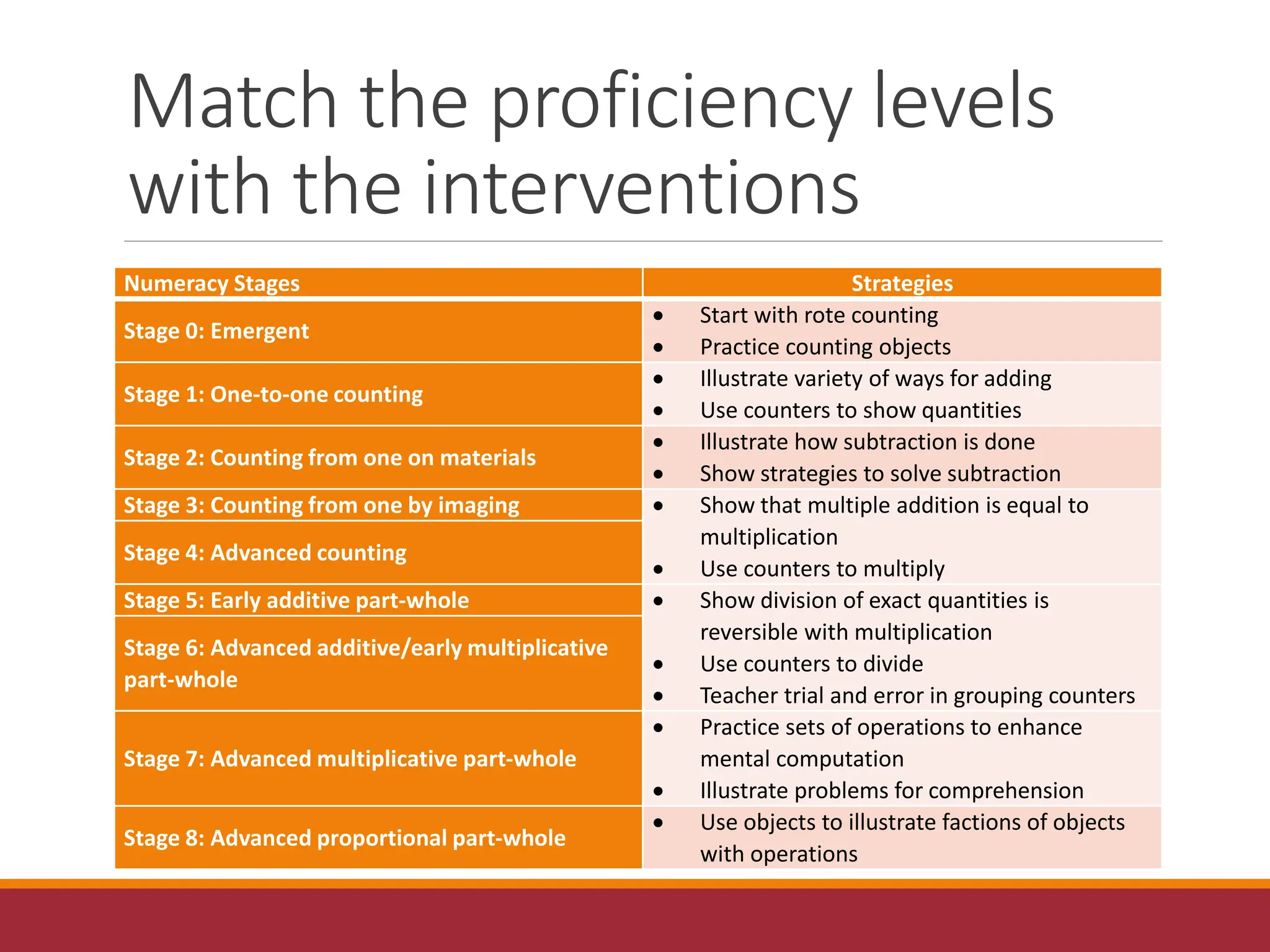
Match the proficiency levels
with the interventions
Numeracy Stages Strategies
Stage 0: Emergent
 Start with rote counting
 Practice counting objects
Stage 1: One-to-one counting
 Illustrate variety of ways for adding
 Use counters to show quantities
Stage 2: Counting from one on materials
 Illustrate how subtraction is done
 Show strategies to solve subtraction
Stage 3: Counting from one by imaging  Show that multiple addition is equal to
multiplication
 Use counters to multiply
Stage 4: Advanced counting
Stage 5: Early additive part-whole  Show division of exact quantities is
reversible with multiplication
 Use counters to divide
 Teacher trial and error in grouping counters
Stage 6: Advanced additive/early multiplicative
part-whole
Stage 7: Advanced multiplicative part-whole
 Practice sets of operations to enhance
mental computation
 Illustrate problems for comprehension
Stage 8: Advanced proportional part-whole
 Use objects to illustrate factions of objects
with operations
Details of the rapid
assessment
https://cladasia2015.wixsite.com/cladasia/rapid
DepEd Order
DepEd order 34 s. 2022
Instragram
@carlo2020feb
Task
Select the grade level that you have an assessment data
Disaggregate the contents of the assessment by identifying
the learning competency of each item.
Count the number of learners in the entire grade level who
are able to answer correctly and incorrectly.
Select priority competencies that you will have to reteach.
Indicate how you will do the TA and monitoring –
Indicate the strategy.
Workshop task
Grade level: 1
Subject: Math
List of competencies
Learning Competencies How many
got correct
(percent)
How many
got incorrect
(percent)
illustrates that addition and subtraction are inverse
operations.
35% 75%
Subtracts one-digit numbers with minuends through 18
(basic facts)
85% 15%
Subtracts one- to two-digit numbers with minuends up to
99 without regrouping
80% 20%
Subtracts one- to two-digit numbers with minuends up to
99 with regrouping
80% 20%
Subtraction of whole numbers including money with
minuends up to 99 with and without regrouping using
appropriate problem solving strategies and tools.
20% 80%
Technical Assistance Plan
Priority competencies
illustrates that addition and subtraction are inverse operations.
Subtraction of whole numbers including money with minuends up to 99 with and without regrouping
using appropriate problem solving strategies and tools.
Plan for the TA and monitoring:
Summer remediation numeracy from July to August
How to do the TA:
Illustrates inverse operation:
Use counters to illustrate inverse operations
PS: Conversing about the problem before answering
Drawing the problem
How to monitor:
Use checklist in using illustrators,
Brainstor,ming on problem solving strategies
Copy of the slides can be request thru instagram
@carlo2020feb
Email
cladasia2015@gmail.com
pemea.org

Intervetntions-based assessment - supevisors - private schools.pptx

  • 1.
    Interventions- Based Assessment: Ensuring every learnera reader Carlo Magno cladasia2015@gmail.com @carlo2020feb Center for Learning and Assessment Development Asia USAID – Technical Adviser
  • 2.
    Objectives •Use the specificlearning competencies to determine the areas that learners need further help. •Organize results of literacy and numeracy assessment based on competencies to inform instruction.
  • 3.
  • 4.
    Status of learners TheUNESCO, World Bank, and MICS Foundation even reported that larger losses are also observed among socioeconomically disadvantaged students. The Philippines, classified under lower to middle income country, was reported that about 0 to 15% of 10 years old children could not read a simple text. The UNESCO Global Monitoring closure has shown that about 26,950,258 Filipino learners were affected due to school closure.
  • 5.
    Status of learners Grade10 Random Effects (parameter estimates) School=5.06 Location=.26 Random Effects (parameter estimates) School=2.42 Location=.13 [CELLRANGE], 24.18 [CELLRANGE], 20.77 20 21 22 23 24 25 2018-2019 F2F 2020-2021 Remote FIxed Effect of Modality on Math Performance for Grade 10, Paremeter estimate=3.99 (p=.00) [CELLRANGE], 24.99 [CELLRANGE], 22.66 20 21 22 23 24 25 2018-2019 F2F 2020-2021 Remote Fixed Effect of Modality on English Performance for Grade 10, Parameter estimate=2.43 (p=.00)
  • 6.
    Status of learners Grade1 Random Effects (parameter estimates) School=3.39 Location=.15 Random Effects (parameter estimates) School=9.71 Location=.11 [CELLRANGE], 24.16 [CELLRANGE], 38.61 16 18 20 22 24 26 28 30 32 34 36 38 40 2018-2019 F2F 2020-2021 Remote FIxed Effect of Modality on Math Performance for Grade 1, Paremeter estimate=-13.42 (p=.00) [CELLRANGE], 17.54 [CELLRANGE], 20.54 16 18 20 22 24 26 28 30 32 34 36 38 40 2018-2019 F2F 2020-2021 Remote FIxed Effect of Modality on English Performance for Grade 1, Paremeter estimate=-5.97 (p=.00)
  • 7.
    Status of learners InRegion 5, the grade 1 to grade 3 learners were assessed using the Comprehensive Rapid Literacy Assessment provided by the ABC+ and USAID. The assessment results showed that about 65.5% of the grade 1 learners are in the full refresher level (able to identify letters only) 52% of the grade 2 and 18%-28%% of the grade 1 learners are still in the full refresher level
  • 8.
  • 9.
  • 10.
  • 11.
    The UNESCO hasdeveloped the Global Proficiency Framework for Reading (by age of 7) A. Comprehension of Spoken Language:  Comprehend spoken and signed language at the word or phrase level  Recognize the meaning of common grade-level words in a short, grade- level continuous text read to or signed for the learner  Retrieve explicit information in a short grade-level continuous text read to or signed for the learner B. Decoding  Identify symbol-sound/fingerspelling and/or symbol-morpheme correspondences  Decode isolated words C. Reading Comprehension  Recognize the meaning of common grade-level words
  • 12.
    Grade 1 Readingand Literacy C. Comprehending and Analyzing Text  Read sentences with appropriate speed, accuracy, and expression (Q3-Q4)  Note important details in stories (character, setting, and events). (Q2- Q4)  Sequence events in stories. (Q2-Q4)  Infer the character's feelings and traits. (Q2-Q4)  Predict possible ending. (Q2-Q4)  Relate story events to one’s experience.  Identify cause and effect of events.(Q3-Q4)  Identify problem and solution in stories. (Q3-Q4)
  • 13.
    Percent of Grade2 Learners for Each Proficiency Level in Literacy in English Cannot identify alphabet Can identify letters and sounds Can blend letters and recognize words Can read with comprehension
  • 14.
    Percent of Grade2 Learners for Each Proficiency Level in Literacy in Filipino Cannot identify alphabet Can identify letters and sounds Can blend letters and recognize words Can read with comprehension
  • 15.
    Percent of Grade2 Learners for Each Proficiency Level in Numeracy
  • 16.
    RNA Proficiency Level ProficiencyLevel Skill Involved Stage 0: Emergent The student is unable to consistently count a given number of objects because they lack knowledge of counting sequences and/or one-to-one correspondence. Stage 1: One-to-one counting The student is able to count a set of objects or form sets of objects but cannot solve problems that involve joining and separating sets. Stage 2: Counting from one on materials The student is able to count a set of objects or form sets of objects to solve simple addition and subtraction problems. The student solves problems by counting all the objects. Stage 3: Counting from one by imaging The student is able to isualize sets of objects to solve simple addition and subtraction problems. The student solves problems by counting all the objects. Stage 4: Advanced counting The student uses counting on or counting back to solve simple addition or subtraction tasks.
  • 17.
    RNA Proficiency Level Stage5: Early additive part- whole The student uses a limited range of mental strategies to estimate answers and solve addition or subtraction problems. These strategies involve deriving the answer from known basic facts, (e. g. doubles, fives, making tens). Stage 6: Advanced additive/early multiplicative part-whole The student can estimate answers and solve addition and subtraction tasks involving whole numbers mentally by choosing appropriately from a broad range of advanced mental strategies (eg. Place value positioning, rounding and compensating or reversibility). The student uses a combination of known facts and a limited range of mental strategies to derive answers to multiplication and division problems, (eg. Doubling, rounding or reversibility). Stage 7: Advanced multiplicative part-whole The student is able to choose appropriately from a broad range of mental strategies to estimate answers and solve multiplication and division problems. These strategies involve partitioning one or more of the factors, (eg. Place value partitioning, rounding and compensating, reversibility). Stage 8: Advanced proportional part-whole The student can estimate answers and solve problems involving the multiplication and division of fractions and decimals using mental strategies. These strategies involve recognizing the effect of number size on the answer and converting decimals to fractions where appropriate. These students have strongly developed number sense and algebraic thinking.
  • 18.
    Learning Recovery Plan NIET(2021) Academic Innovation and Performance New Classrooms Innovation Partners for Learning (2021) UNICEF, UNESCO, and the World Bank (April, 2022) • Landscape analysis • Strategies will best support learning recovery and accelerate learning • Identify key personnel and build buy-in • Create a budget • Skill map • Diagnostic tools • Prioritization on a strategic mix of skills • Regular assessments • Meaningful parent engagement • Incorporating key program design (1) Reach every child and retain them in school (2) Assess current learning levels (3) Prioritize fundamentals (4) Increase catch-up learning (5) Develop psychosocial health and wellbeing
  • 19.
    Region 5 Area 1Improving the delivery of curriculum, assessment, and instruction A regionwide assessment of literacy and numeracy for grades 1 to 3 determined the learning gaps that will be addressed. Area 2 Developing the capacity of teachers Learning and development of teachers in the conduct of blended learning, individualized instruction and integrating literacy and numeracy skills in other subject areas. Area 3 Academic support for the learning at home and in the community Support for the teachers’ instruction from other stakeholders are established such as home based learning programs, orientation for parents, home visitations, capacitating volunteers to teach learners in the community, and monitoring learners performance with the help of other community volunteers. Area 4 Allocation of budget for the learning recovery A budget is allocated to the schools’ divisions to support the implementation of the learning recovery plans and programs.
  • 20.
    NCR Effective delivery of instructionand learners performance Learning and development Budget for instructional acceleration *Student Performance (Literacy, Numeracy, LAMP) *Number of MELCs implemented against the intended curriculum Budget of Work compliance Number of modules distributed Quality delivery of learning modalities Quality of Literacy and Numeracy programs implemented Faculty Outcomes (COT Performance) L & D Ratings (Reactions, Behavior & Learning Phase) Number of teachers trained Number of L & D attended Budget for the Upskilling and Reskilling of Teachers Budget for the Instructional Materials Allocation for allowable expenditures for Learning Recovery Programs
  • 21.
    Interventions with impact LearningRecovery Intervention Result Extended school year 0.1 sd improvement on reading and math and 0.15 on writing Extended school period and days Double instruction time increased 25% in algebra performance Looping Parents and school heads interviewed gave the advantages of looping Tutoring 20 times more effective in math, 15 times more effective in reading Individualized learning plans Several factors achieved on students’ academic performance and social and emotional competencies after one school year. After school programs High score of students who participated than the district average Acceleration academies Significant improvement in math and reading Summer learning programs 90 mins of math and 120 mins of English daily for 5 weeks increased students’ performance
  • 22.
    Recommendations Proficiency Level Strategies Non-reader Marungko/DSTAR  Home learning support: Use flashcards showing letters and CV/VC blends Beginning Readers  Left to right decoding  Phonics pattern (Fuller model)  Stretch the word (additional blends)  Successive blending  Illustrating/check for meaning Emerging Reader  Guided reading  Language experience approach  Pre-reading tasks (brainstorming, topic discussion)  During reading tasks (think alouds)  Post-reading tasks (summarizing, illustrating, mapping) Full Reader  Metacognitive comprehension strategies  Introduce informative text for reading  Writing generated ideas
  • 23.
    Later on: Matchthe learning resource with the student literacy profile 2nd edition With exercises
  • 24.
    The Expanded Reader:An Instructional Resource for Reading Remediation After the Full Reader Level
  • 25.
    Recommendations Numeracy Stages Strategies Stage0: Emergent  Start with rote counting  Practice counting objects Stage 1: One-to-one counting  Illustrate variety of ways for adding  Use counters to show quantities Stage 2: Counting from one on materials  Illustrate how subtraction is done  Show strategies to solve subtraction Stage 3: Counting from one by imaging  Show that multiple addition is equal to multiplication  Use counters to multiply Stage 4: Advanced counting Stage 5: Early additive part-whole  Show division of exact quantities is reversible with multiplication  Use counters to divide  Teacher trial and error in grouping counters Stage 6: Advanced additive/early multiplicative part-whole Stage 7: Advanced multiplicative part-whole  Practice sets of operations to enhance mental computation  Illustrate problems for comprehension Stage 8: Advanced proportional part-whole  Use objects to illustrate factions of objects with operations
  • 26.
    Assessment for learning Howdo we use assessment results to help students learn better? Assessment is used to determine: ◦ What students can do and cannot do ◦ What students know and do not know ◦ Misconceptions of students ◦ Confusion Provide teachers information on what to do next to bring students forward in their learning
  • 27.
    Assessment-based intervention The results needto show the specific competency not being met by the learner/s All the competencies covered in the assessment should be the major category when presenting the results rather than proficiency levels Proficiency levels needs to have specific descriptors what learners can do and cannot do
  • 28.
    Not useful forintervention POST TEST Skill Level Number of Learners Needs Major Support 1911 or 36.58% Anchoring 500 or 9.57% Developing 1220 or 23.35% Emerging 565 or 10.82% Transforming 1028 or 19.68% TOTAL 5224 Examinees RATING OF NUMERACY SKILL Numeracy Skill POST TEST Rating Skill Level Knowing and Understanding 78.05 A Computing and Solving 92.14 T Estimating 68.57 NMS Visualizing and Modeling 55.16 NMS Representing and Communicating 79.64 A Conjecturing and Reasoning 69.36 NMS Proving and Decision Making 63.48 NMS Applying and Connecting 87.33 D Overall 72.25 Needs Major Support
  • 29.
    Not useful forintervention GRADE 10 Highly Proficient Proficient Nearly Proficient Low Proficient Not Proficient Total No. of Learners No. of Learner s % of Learner s No. of Learner s % of Learner s No. of Learner s % of Learner s No. of Learner s % of Learner s No. of Learner s % of Learner s AP 29 12.18% 79 33.19% 108 45.38% 14 5.88% 8 3.36% 238 English 0 0 0 0 115 48.32% 117 49.16% 6 2.52% 238 ESP 0 0 0 0 161 67.65% 69 28.99% 8 3.36% 238 Filipino 37 15.55% 110 46.22% 59 24.79% 26 10.92% 6 2.52% 238 Math 4 1.68% 52 21.85% 88 36.97% 73 30.67 21 8.82% 238 Science 0 0 36 15.13% 114 47.90% 77 32.35% 11 4.62% 238 Ave. 4.90% 19.40% 45.17% 26.33% 4.20% 238
  • 30.
    STUDENT PERFORMANCE REPORT LearningCompetencies of Grade 3 in English Individual Score Percent correct for the class level 1. Note details regarding character, setting and plot 1 70.97 2. Note details regarding character, setting and plot 0 22.58 3. Sequence 3 events 0 6.45 4. Distinguish fact from opinion 0 16.13 9. Identify cause and effect 0 25.81 10. Distinguish sentences from non-sentences 0 35.48 11. Distinguish declarative from an interrogative sentence 0 32.26 13. Use proper punctuation for declarative and interrogative sentences 1 29.03 14. Use proper punctuation for declarative and interrogative sentences 1 41.94 15. Identify an exclamatory sentence 0 25.81 16. Identify an imperative sentence 0 22.58 17. Use nouns (e.g. people, animals, places,, things events) in simple sentences 0 45.16 18. Use common and proper nouns 1 58.06 Source: Center for Learning and Assessment Development-Asia
  • 31.
    Organizing assessment results (Interpreting) Prioritizing:Arrange the results per competency of each class/student Example: Add similar fractions 30% Solve problems involving similar and dissimilar fractions 30% Add dissimilar fractions 32% Differentiate similar and dissimilar fractions 90% Which competency do students need more learning? How did I teach this competency? Did I cover this competency in my class? Which competency are the students good at?
  • 32.
    Rapid Assessment Identify thefundamental skills needed to be assessed Use a framework to identify these fundamental skills Match these skills in the national curriculum Convert the fundamental skills into an assessment task
  • 33.
  • 34.
  • 35.
    Literacy Fundamental skills 1.Alphabet knowledge – recognize alphabets with capital and small letters. 2. Phonological Awareness: Phonological awareness refers to the ability or skill to hear, identify and manipulate sounds of speech. 3. Phonics: Sometimes called the alphabetic principle, phonics involves the relationship between letters of written language and the sounds of spoken language. 4. Blending vowels and consonants 5. Word recognition – Can read words with appropriate blending of sounds 5. Fluency: Fluency is the ability to read quickly and correctly with accurate phrasing, expression, and comprehension. 6. Reading Comprehension: Reading comprehension is the ability to understand and interpret what has been read. Proficient readers understand the purpose of their reading- they monitor their understanding and use strategies such as predicting and inferring to make sense of what was read.
  • 36.
  • 37.
  • 38.
  • 39.
  • 40.
    Percent of Grade2 Learners for Each Proficiency Level in Literacy in English (NCR) Cannot identify alphabet Can identify letters and sounds Can blend letters and recognize words Can read with comprehension
  • 41.
  • 42.
  • 43.
    Match the proficiencylevels with the interventions Proficiency Level Strategies Non-reader  Marungko/DSTAR  Home learning support: Use flashcards showing letters and CV/VC blends Beginning Readers  Left to right decoding  Phonics pattern (Fuller model)  Stretch the word (additional blends)  Successive blending  Illustrating/check for meaning Emerging Reader  Guided reading  Language experience approach  Pre-reading tasks (brainstorming, topic discussion)  During reading tasks (think alouds)  Post-reading tasks (summarizing, illustrating, mapping) Full Reader  Metacognitive comprehension strategies  Introduce informative text for reading  Writing generated ideas Cannot identify alphabet Can identify letters and sounds Can blend letters and recognize words Can read with comprehension
  • 44.
  • 45.
    Numeracy Fundamental Skills ConstructItem Competency T a s k 1 Cou ntin g 1.1 K-G1: Counting on from a given one-digit number G2-G3: Counting on from a given four-digit number 1.2 K-G1: Counting on through ten and hundreds G2-G3: Counting on through thousands 1.3 K-G12: Naming numbers before and after ones to hundreds place value G2-G3: Naming numbers before and after thousands place value 1.4 K-G3: Step counting in a simple pattern
  • 46.
    Numeracy Fundamental Skills T a s k 2 Place Value 2.1K-2: Uses five as a counting unit G1-G3: Uses ten as a counting unit 2.2 K-G1: Identifies one to three-digit numerals G1-G3: Identifies four-digit numerals 2.3 K-G1: Identifies the smallest (or largest) of four 1 to 3-digit numerals G1-G3: Identifies the smallest (or largest) of four 4-digit numerals 2.4 K-G1: Identifies the largest (or smallest) of one to two digit amounts of money G1-G3: Identifies the largest (or smallest) of four digit amounts of money
  • 47.
    Numeracy Fundamental Skills Addition & Subtracti on 3.1G1: Demonstrates addition of 2-digit numbers using counters G2: Demonstrates addition of 3-digit numbers using counters G3: Demonstrates addition of 4-digit numbers using counters 3.2 G1: Adds a 2-digit number without using counters. G2: Adds a 3-digit number without using counters. G3: Adds a 4-digit number without using counters. 3.3 G1: Calculates the difference between a 4-digit and a 2-digit number G2: Calculates the difference between a 4-digit and a 3-digit number G3: Calculates the difference between a 4-digit and a 4-digit number 3.4 G1: Applies subtraction of two 2-digit numbers to a word problem G2: Applies subtraction of two 3-digit numbers to a word problem G3: Applies subtraction of two 4-digit numbers to a word problem
  • 48.
    Numeracy Fundamental Skills T a s k 4 Multiplic ation& Division 4.1 G2-G3: Applies multiplication facts to contextual word problem 4.2 G2-G3: Uses number sense to calculate a product 4.3 G2-G3: Uses knowledge of multiplication tables to divides a 2-digit number by a 1-digit number 4.4 G2-G3: Applies multiplication tables knowledge to a word problem involving sharing.
  • 49.
    Numeracy Fundamental Skills T a s k 5 Statistics & Probabilit y 5.1G1-G3: Identifies the categories represented in a pictograph 5.2 G1-G3: Calculates the frequency for one category in a pictograph 5.3 G1-G3: Calculates the difference in frequencies for two categories in a pictograph 5.4 G1-G3:Identifies the most likely outcome for tossing objects.
  • 50.
    Numeracy Fundamental Skills T a s k 6 Geometry & Measure ment 6.1G1-G3: Selects a shape from a picture of other shapes 6.2 G1-G3: Identifies the number of sides (or corners) of the shape 6.3 G1-G3: Folds a paper to demonstrate an alternative line of symmetry 6.4 G1-G3: Calculates the perimeter of a square (or rectangle) for a word problem and diagram, with correct units.
  • 54.
    Match the proficiencylevels with the interventions Numeracy Stages Strategies Stage 0: Emergent  Start with rote counting  Practice counting objects Stage 1: One-to-one counting  Illustrate variety of ways for adding  Use counters to show quantities Stage 2: Counting from one on materials  Illustrate how subtraction is done  Show strategies to solve subtraction Stage 3: Counting from one by imaging  Show that multiple addition is equal to multiplication  Use counters to multiply Stage 4: Advanced counting Stage 5: Early additive part-whole  Show division of exact quantities is reversible with multiplication  Use counters to divide  Teacher trial and error in grouping counters Stage 6: Advanced additive/early multiplicative part-whole Stage 7: Advanced multiplicative part-whole  Practice sets of operations to enhance mental computation  Illustrate problems for comprehension Stage 8: Advanced proportional part-whole  Use objects to illustrate factions of objects with operations
  • 55.
    Details of therapid assessment https://cladasia2015.wixsite.com/cladasia/rapid
  • 56.
  • 58.
  • 59.
    Task Select the gradelevel that you have an assessment data Disaggregate the contents of the assessment by identifying the learning competency of each item. Count the number of learners in the entire grade level who are able to answer correctly and incorrectly. Select priority competencies that you will have to reteach. Indicate how you will do the TA and monitoring – Indicate the strategy.
  • 60.
    Workshop task Grade level:1 Subject: Math List of competencies Learning Competencies How many got correct (percent) How many got incorrect (percent) illustrates that addition and subtraction are inverse operations. 35% 75% Subtracts one-digit numbers with minuends through 18 (basic facts) 85% 15% Subtracts one- to two-digit numbers with minuends up to 99 without regrouping 80% 20% Subtracts one- to two-digit numbers with minuends up to 99 with regrouping 80% 20% Subtraction of whole numbers including money with minuends up to 99 with and without regrouping using appropriate problem solving strategies and tools. 20% 80%
  • 61.
    Technical Assistance Plan Prioritycompetencies illustrates that addition and subtraction are inverse operations. Subtraction of whole numbers including money with minuends up to 99 with and without regrouping using appropriate problem solving strategies and tools. Plan for the TA and monitoring: Summer remediation numeracy from July to August How to do the TA: Illustrates inverse operation: Use counters to illustrate inverse operations PS: Conversing about the problem before answering Drawing the problem How to monitor: Use checklist in using illustrators, Brainstor,ming on problem solving strategies
  • 62.
    Copy of theslides can be request thru instagram @carlo2020feb Email cladasia2015@gmail.com
  • 63.

Editor's Notes

  • #8 The assessment used is the comprehensive literacy assessment. This tool is similar to the EGRA and measures literacy skills on alphabet knowledge, phonemic awareness and decoding. The tool was administered at the opening of the school year in 2021. It was adnministed to 3,157 schools in region 5 with 131,732 grade 1 pupils, 132,413 grade 2 pupils and 141,016 grade 2 pupils.
  • #9 Grade Ready – student has attained alphabet knowledge, phonemic awareness and decoding skills. Light Refresher – student has attained alphabet knowledge and phonemic awareness Moderate Refresher – student has attained alphabet knowledge Full Refresher – student could not identify alphabets
  • #10 Grade Ready – student has attained alphabet knowledge, phonemic awareness and decoding skills. Light Refresher – student has attained alphabet knowledge and phonemic awareness Moderate Refresher – student has attained alphabet knowledge Full Refresher – student could not identify alphabets
  • #11 Grade Ready – student has attained alphabet knowledge, phonemic awareness and decoding skills. Light Refresher – student has attained alphabet knowledge and phonemic awareness Moderate Refresher – student has attained alphabet knowledge Full Refresher – student could not identify alphabets
  • #14 The CRLA of the USAID tool was improved with a wider range of literacy skills and was administered to selected divisions in the NCR. The Rapid Literacy Assessment – English (developed by CLAD-Asia) is closer to the components of the EGRA that includes alphabet knowledge, phonemic awareness, blending, word recognition, sentence fluency, reading comprehension and writing. The RLA-E has a version in Filipino language. The RLA-E form for grade 2 was adminisitered to 6 division in the NCR with 41,416 pupils from May to June 2022. It was administered to grade 2 because they have been in remote learning since the start of the pandemic and mostly affected by learning loss. Interpretation: Non readers – could not recognize alphabets, beginning readers – can recognize alphabets, give sounds of letters, and blend CVC, emerging readers - can recognize alphabets, give sounds of letters, blend CVC, and read sentences with sentences with fluency. Full readers - can recognize alphabets, give sounds of letters, blend CVC, and read sentences with sentences with fluency and comprehension. Can read and write – attained all reading compoments and can write a phrase or sentence. About one third of the grade 2 learners are readers and can write (37%). About one fourth of the grade 2 learners are still in the beginning and emerging reader level with percent of 23.81% and 23.49% respectively. There are only 1.87% who are non-readers. Half of the learners who took the assessment has not yet completed the basic range of literacy skills.
  • #15 The Filipino version of the Rapid literacy assessment (RLA-F) was also administered to 41,416 grade 2 pupils (administered from May to June 2022). More than half of the grade 2 learners are readers and can write in Filipino (58.71%) and 20.61% are full readers. A small percentage of the grade 2 learners are still in the beginning and emerging reader level with percent of 8.68% and 10.71% respectively. There are only 1.30% who are non-readers. About one fourth of the learners who took the assessment has not yet completed the basic range of literacy skills in Filipino.
  • #16 The Rapid Numeracy assessment (RNA, developed by CLAD-Asia) is also contextualized from the EGMA with skills aligned with the Most essential learning competencies of DepEd. The contents include 6 tasks: Counting, place value, addition and subtraction, multiplications and division, statistics and probability, and geometry and measurement. Each tasks contains 4 learning competencies. The overall score is interpreted on 8 numeracy stages. Majority of the grade 2 learners (N=41,416, administered from May to June 2022), about one fourth, are in the stage 4 advance counting stage. There are very few learners in the with less than 15% in the Stage 5: Early additive part-whole, Stage 6: Advanced additive/early multiplicative part-whole, Stage 7: Advanced multiplicative part-whole, and Stage 8: Advanced proportional part-whole.
  • #17 There are eight stages in the identification of the numeracy proficiency level of the learners. The stage 0 to 3 includes counting, place value, and statistics and probability, stage 4 and 5 involves addition and subtraction, stage 6 and 7 includes multiplication and division, and stage 8 involves geometry and measurement.
  • #41 The CRLA of the USAID tool was improved with a wider range of literacy skills and was administered to selected divisions in the NCR. The Rapid Literacy Assessment – English (developed by CLAD-Asia) is closer to the components of the EGRA that includes alphabet knowledge, phonemic awareness, blending, word recognition, sentence fluency, reading comprehension and writing. The RLA-E has a version in Filipino language. The RLA-E form for grade 2 was adminisitered to 6 division in the NCR with 41,416 pupils from May to June 2022. It was administered to grade 2 because they have been in remote learning since the start of the pandemic and mostly affected by learning loss. Interpretation: Non readers – could not recognize alphabets, beginning readers – can recognize alphabets, give sounds of letters, and blend CVC, emerging readers - can recognize alphabets, give sounds of letters, blend CVC, and read sentences with sentences with fluency. Full readers - can recognize alphabets, give sounds of letters, blend CVC, and read sentences with sentences with fluency and comprehension. Can read and write – attained all reading compoments and can write a phrase or sentence. About one third of the grade 2 learners are readers and can write (37%). About one fourth of the grade 2 learners are still in the beginning and emerging reader level with percent of 23.81% and 23.49% respectively. There are only 1.87% who are non-readers. Half of the learners who took the assessment has not yet completed the basic range of literacy skills.