Dr. Carlo Magno
Center for Learning andAssessment Development - Asia
crlmgn@yahoo.com
 Quality of instructional leadership facilitates
quality instruction in schools.
 Quality instruction contributes to student
learning
 Trends in International Mathematics and
Science Survey (TIMSS)
 NationalAchievementTest
 Dropout rates in public schools
 Prioritizing
 Decades of research confirm that those principals who place
academics as a priority experience increased student
achievement (Bartell, 1990; Cotton, 2000; Johnson & Asera,
1999; Short & Spencer, 1990).
 With instructional improvement at the top of that prioritized
list, principals have the power to organize so that those main
concerns (i. e., improved primary grade reading instruction, are
addressed).
 Principals can arrange instructional schedules
 Set aside time for grade-level teams to meet
 Provide released time for teachers to attend professional
development
 Monitor progress and implementation to ensure that
scientifically based instruction implemented schoolwide.
 Aligning
 Principals must impart upon teachers the importance of
aligning curriculum, instruction, and assessment to the
standards.
 The principal must also guide teachers in effective
alignment practices.
 Study groups or departmental meetings can be
established with the expectation that teachers will work
together:
▪ to interpret the standards,
▪ study the scope and sequence of the curriculum,
▪ share effective instructional strategies,
▪ examine released assessment items,
▪ analyze student work to determine instructional effectiveness.
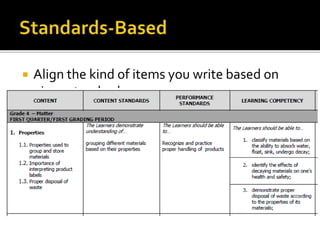
 Align the kind of items you write based on
given standards.
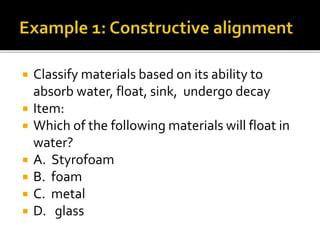
 Classify materials based on its ability to
absorb water, float, sink, undergo decay
 Item:
 Which of the following materials will float in
water?
 A. Styrofoam
 B. foam
 C. metal
 D. glass
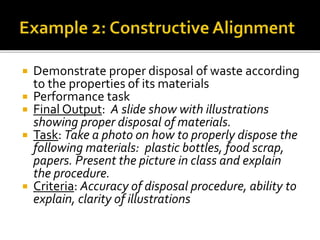
 Demonstrate proper disposal of waste according
to the properties of its materials
 Performance task
 Final Output: A slide show with illustrations
showing proper disposal of materials.
 Task: Take a photo on how to properly dispose the
following materials: plastic bottles, food scrap,
papers. Present the picture in class and explain
the procedure.
 Criteria: Accuracy of disposal procedure, ability to
explain, clarity of illustrations
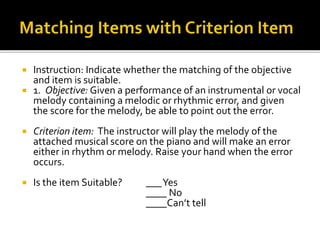
 Instruction: Indicate whether the matching of the objective
and item is suitable.
 1. Objective: Given a performance of an instrumental or vocal
melody containing a melodic or rhythmic error, and given
the score for the melody, be able to point out the error.
 Criterion item: The instructor will play the melody of the
attached musical score on the piano and will make an error
either in rhythm or melody. Raise your hand when the error
occurs.
 Is the item Suitable? ___Yes
____ No
____Can’t tell
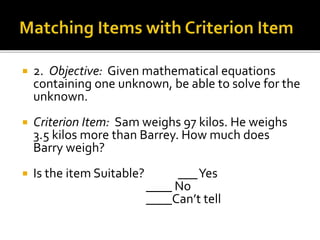
 2. Objective: Given mathematical equations
containing one unknown, be able to solve for the
unknown.
 Criterion Item: Sam weighs 97 kilos. He weighs
3.5 kilos more than Barrey. How much does
Barry weigh?
 Is the item Suitable? ___Yes
____ No
____Can’t tell
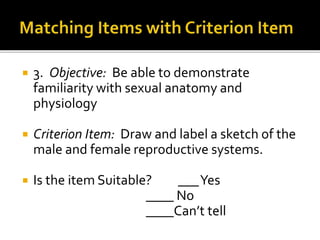
 3. Objective: Be able to demonstrate
familiarity with sexual anatomy and
physiology
 Criterion Item: Draw and label a sketch of the
male and female reproductive systems.
 Is the item Suitable? ___Yes
____ No
____Can’t tell
 4. Objective: Given any one of the computers in our
product line, in its original carton, be able to install
and adjust the machine, preparing it for use. Criteria:
The machine shows normal indication, and the area is
free of debris and cartons
 Criterion item: Select one of the cartons containing
one of our model XX computers, and install it for the
secretary in Room 45. Make sure it is ready for use and
the area is left clean.
 Is the item Suitable? ___Yes
____ No
____Can’t tell
 5. Objective: When given a set of paragraphs
(that use words within your vocabulary), some of
which are missing topic sentences, be able to
identify the paragraph without topic sentences.
 Criterion Item: Turn to page 29 in your copy of
Silas Marner. Underline the topic sentence of
each paragraph on that page.
 Is the item Suitable? ___Yes
____ No
____Can’t tell
 Assessing
 The principal plays a key role in selection of schoolwide
assessment instruments.
 The administration, scoring, reporting, and appropriate
use of assessment data should be stressed by the school
leader as a critical element of increased student
achievement.
 Principals should regularly analyze student achievement
data to inform decisions regarding policy, programs, and
professional development.
 Teachers may need guidance to effectively administer,
score, interpret, and analyze the data and also to utilize
the data in making instructional changes.
 The principal is responsible for ensuring that the teachers
receive the guidance they require.
 Assessment needs to be based on specific
competencies in order to help teachers and
students work on the skill
 What skill is the student weak at?
 What skills can be done?
 What will be the implication of weak and poor
skills on teachers planning
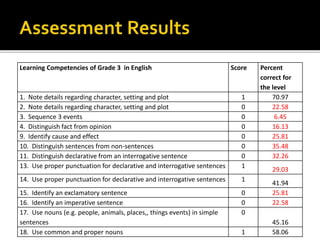
Learning Competencies of Grade 3 in English Score Percent
correct for
the level
1. Note details regarding character, setting and plot 1 70.97
2. Note details regarding character, setting and plot 0 22.58
3. Sequence 3 events 0 6.45
4. Distinguish fact from opinion 0 16.13
9. Identify cause and effect 0 25.81
10. Distinguish sentences from non-sentences 0 35.48
11. Distinguish declarative from an interrogative sentence 0 32.26
13. Use proper punctuation for declarative and interrogative sentences 1
29.03
14. Use proper punctuation for declarative and interrogative sentences 1
41.94
15. Identify an exclamatory sentence 0 25.81
16. Identify an imperative sentence 0 22.58
17. Use nouns (e.g. people, animals, places,, things events) in simple
sentences
0
45.16
18. Use common and proper nouns 1 58.06
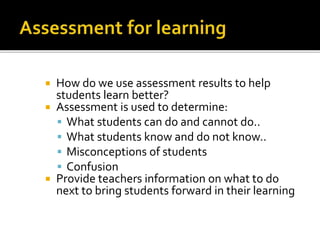
 How do we use assessment results to help
students learn better?
 Assessment is used to determine:
 What students can do and cannot do..
 What students know and do not know..
 Misconceptions of students
 Confusion
 Provide teachers information on what to do
next to bring students forward in their learning
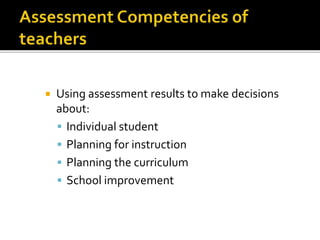
 Using assessment results to make decisions
about:
 Individual student
 Planning for instruction
 Planning the curriculum
 School improvement
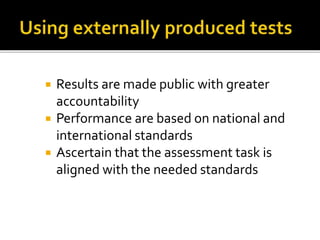
 Results are made public with greater
accountability
 Performance are based on national and
international standards
 Ascertain that the assessment task is
aligned with the needed standards
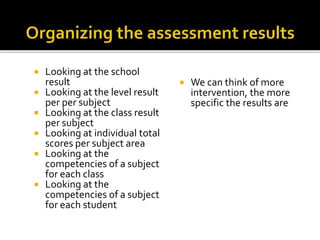
 Looking at the school
result
 Looking at the level result
per per subject
 Looking at the class result
per subject
 Looking at individual total
scores per subject area
 Looking at the
competencies of a subject
for each class
 Looking at the
competencies of a subject
for each student
 We can think of more
intervention, the more
specific the results are
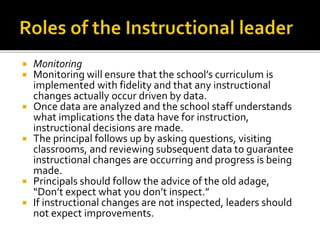
 Monitoring
 Monitoring will ensure that the school’s curriculum is
implemented with fidelity and that any instructional
changes actually occur driven by data.
 Once data are analyzed and the school staff understands
what implications the data have for instruction,
instructional decisions are made.
 The principal follows up by asking questions, visiting
classrooms, and reviewing subsequent data to guarantee
instructional changes are occurring and progress is being
made.
 Principals should follow the advice of the old adage,
“Don’t expect what you don’t inspect.”
 If instructional changes are not inspected, leaders should
not expect improvements.
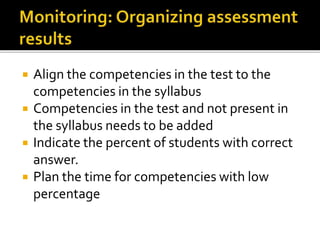
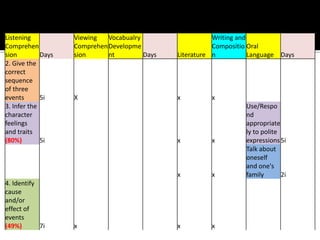
 Align the competencies in the test to the
competencies in the syllabus
 Competencies in the test and not present in
the syllabus needs to be added
 Indicate the percent of students with correct
answer.
 Plan the time for competencies with low
percentage
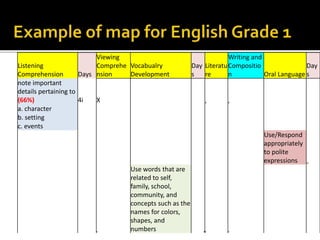
Listening
Comprehension Days
Viewing
Comprehe
nsion
Vocabualry
Development
Day
s
Literatu
re
Writing and
Compositio
n Oral Language
Day
s
note important
details pertaining to
(66%) 4i X X X
a. character
b. setting
c. events
Use/Respond
appropriately
to polite
expressions 3i
x
Use words that are
related to self,
family, school,
community, and
concepts such as the
names for colors,
shapes, and
numbers 4x x
Listening
Comprehen
sion Days
Viewing
Comprehen
sion
Vocabualry
Developme
nt Days Literature
Writing and
Compositio
n
Oral
Language Days
2. Give the
correct
sequence
of three
events 5i X x x
3. Infer the
character
feelings
and traits
(80%) 5i x x
Use/Respo
nd
appropriate
ly to polite
expressions5i
x x
Talk about
oneself
and one's
family 2i
4. Identify
cause
and/or
effect of
events
(49%) 7i x x x
 How do I improve the quality of instruction
in my school?
 How much time do teachers need for
students to attain mastery?
 Did my teachers prepare assessment tasks
tapping directly the needed
competencies?
 Did the teachers look at the national
curriculum to guide then in formulating the
learning plans?
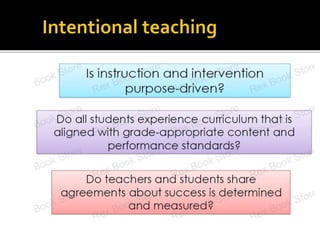
 IntentionalTeaching – teach directly the
competencies needed for the future assessment
 Assessment for learning – use assessment results
to help students
 Use formative assessment
 Feedback
 Create similar assessment tasks in the classroom
 Supervising curriculum and assessment
 Devote time on essential skills that are
indicated in the standards (teaching is aligned
with standards)
 Established success criteria
 Use a subject-matter budget to see how
many standards can be mastered within a
quarter
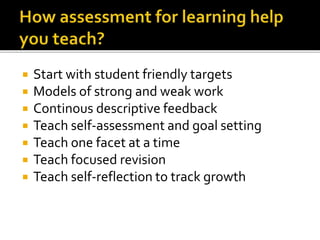
 Start with student friendly targets
 Models of strong and weak work
 Continous descriptive feedback
 Teach self-assessment and goal setting
 Teach one facet at a time
 Teach focused revision
 Teach self-reflection to track growth
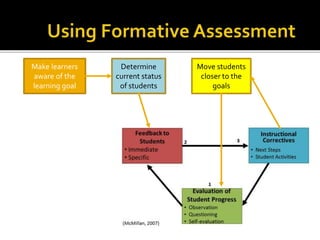
Make learners
aware of the
learning goal
Determine
current status
of students
Move students
closer to the
goals
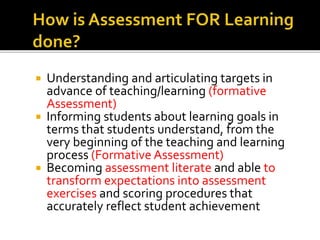
 Understanding and articulating targets in
advance of teaching/learning (formative
Assessment)
 Informing students about learning goals in
terms that students understand, from the
very beginning of the teaching and learning
process (Formative Assessment)
 Becoming assessment literate and able to
transform expectations into assessment
exercises and scoring procedures that
accurately reflect student achievement
 Using classroom assessment to build students’
confidence in themselves as learners and help
them take responsibility for their own learning
 Translating classroom assessment results into
frequent descriptive feedback, providing
students with specific insights as to how to
improve
 Continuously adjusting instruction based on the
results of classroom assessment
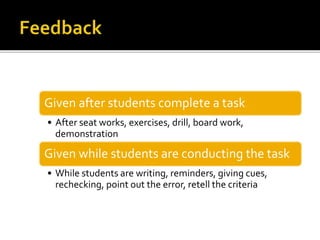
Given after students complete a task
• After seat works, exercises, drill, board work,
demonstration
Given while students are conducting the task
• While students are writing, reminders, giving cues,
rechecking, point out the error, retell the criteria
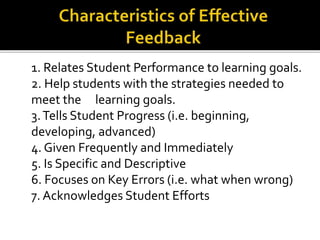
1. Relates Student Performance to learning goals.
2. Help students with the strategies needed to
meet the learning goals.
3.Tells Student Progress (i.e. beginning,
developing, advanced)
4. Given Frequently and Immediately
5. Is Specific and Descriptive
6. Focuses on Key Errors (i.e. what when wrong)
7. Acknowledges Student Efforts
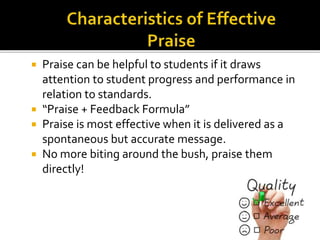
 Praise can be helpful to students if it draws
attention to student progress and performance in
relation to standards.
 “Praise + Feedback Formula”
 Praise is most effective when it is delivered as a
spontaneous but accurate message.
 No more biting around the bush, praise them
directly!
 Prepare assessment tasks in advance
 Diagnostic
 Formative
 Summative
 Assessment tasks are directly aligned with the
competencies and standards.
 Formative and summative assessment needs to be
parallel
 School leaders are accountable on quality of
instruction in the school
 Ensures that competencies are delivered and
developed
 Observes and monitors instuction
 Learning
 As the school leader works to improve student
achievement, the principal collaborates with teachers
on alignment, instruction, and assessment issues;
 Offers constructive feedback and support to teachers.
 Principals have an obligation to be well informed
about the professional development teachers are
receiving.
 Providing teachers time for professional growth and
personally attending those professional development
sessions reinforces the principal’s conviction in the
positive aspects of a continuous learning
environment.
 Driving the initiative, followed by inevitable
implementation problems, the conclusion
that the reform has failed to bring about the
desired results, abandonment of the reform,
and the launch of a new search for the next
promising initiative.
 Big Idea 1: Ensure that students learn
 Big idea 2: A culture of collaboration
 Big Idea 3: Focus on Results
 What do I need to commit to ensure student
learning in my school?
 What should I do to promote better student
achievement in my school?

Accountability in Developing Student Learning

  • 1.
    Dr. Carlo Magno Centerfor Learning andAssessment Development - Asia crlmgn@yahoo.com
  • 2.
     Quality ofinstructional leadership facilitates quality instruction in schools.  Quality instruction contributes to student learning
  • 3.
     Trends inInternational Mathematics and Science Survey (TIMSS)  NationalAchievementTest  Dropout rates in public schools
  • 4.
     Prioritizing  Decadesof research confirm that those principals who place academics as a priority experience increased student achievement (Bartell, 1990; Cotton, 2000; Johnson & Asera, 1999; Short & Spencer, 1990).  With instructional improvement at the top of that prioritized list, principals have the power to organize so that those main concerns (i. e., improved primary grade reading instruction, are addressed).  Principals can arrange instructional schedules  Set aside time for grade-level teams to meet  Provide released time for teachers to attend professional development  Monitor progress and implementation to ensure that scientifically based instruction implemented schoolwide.
  • 5.
     Aligning  Principalsmust impart upon teachers the importance of aligning curriculum, instruction, and assessment to the standards.  The principal must also guide teachers in effective alignment practices.  Study groups or departmental meetings can be established with the expectation that teachers will work together: ▪ to interpret the standards, ▪ study the scope and sequence of the curriculum, ▪ share effective instructional strategies, ▪ examine released assessment items, ▪ analyze student work to determine instructional effectiveness.
  • 6.
     Align thekind of items you write based on given standards.
  • 7.
     Classify materialsbased on its ability to absorb water, float, sink, undergo decay  Item:  Which of the following materials will float in water?  A. Styrofoam  B. foam  C. metal  D. glass
  • 8.
     Demonstrate properdisposal of waste according to the properties of its materials  Performance task  Final Output: A slide show with illustrations showing proper disposal of materials.  Task: Take a photo on how to properly dispose the following materials: plastic bottles, food scrap, papers. Present the picture in class and explain the procedure.  Criteria: Accuracy of disposal procedure, ability to explain, clarity of illustrations
  • 9.
     Instruction: Indicatewhether the matching of the objective and item is suitable.  1. Objective: Given a performance of an instrumental or vocal melody containing a melodic or rhythmic error, and given the score for the melody, be able to point out the error.  Criterion item: The instructor will play the melody of the attached musical score on the piano and will make an error either in rhythm or melody. Raise your hand when the error occurs.  Is the item Suitable? ___Yes ____ No ____Can’t tell
  • 10.
     2. Objective:Given mathematical equations containing one unknown, be able to solve for the unknown.  Criterion Item: Sam weighs 97 kilos. He weighs 3.5 kilos more than Barrey. How much does Barry weigh?  Is the item Suitable? ___Yes ____ No ____Can’t tell
  • 11.
     3. Objective:Be able to demonstrate familiarity with sexual anatomy and physiology  Criterion Item: Draw and label a sketch of the male and female reproductive systems.  Is the item Suitable? ___Yes ____ No ____Can’t tell
  • 12.
     4. Objective:Given any one of the computers in our product line, in its original carton, be able to install and adjust the machine, preparing it for use. Criteria: The machine shows normal indication, and the area is free of debris and cartons  Criterion item: Select one of the cartons containing one of our model XX computers, and install it for the secretary in Room 45. Make sure it is ready for use and the area is left clean.  Is the item Suitable? ___Yes ____ No ____Can’t tell
  • 13.
     5. Objective:When given a set of paragraphs (that use words within your vocabulary), some of which are missing topic sentences, be able to identify the paragraph without topic sentences.  Criterion Item: Turn to page 29 in your copy of Silas Marner. Underline the topic sentence of each paragraph on that page.  Is the item Suitable? ___Yes ____ No ____Can’t tell
  • 14.
     Assessing  Theprincipal plays a key role in selection of schoolwide assessment instruments.  The administration, scoring, reporting, and appropriate use of assessment data should be stressed by the school leader as a critical element of increased student achievement.  Principals should regularly analyze student achievement data to inform decisions regarding policy, programs, and professional development.  Teachers may need guidance to effectively administer, score, interpret, and analyze the data and also to utilize the data in making instructional changes.  The principal is responsible for ensuring that the teachers receive the guidance they require.
  • 15.
     Assessment needsto be based on specific competencies in order to help teachers and students work on the skill  What skill is the student weak at?  What skills can be done?  What will be the implication of weak and poor skills on teachers planning
  • 16.
    Learning Competencies ofGrade 3 in English Score Percent correct for the level 1. Note details regarding character, setting and plot 1 70.97 2. Note details regarding character, setting and plot 0 22.58 3. Sequence 3 events 0 6.45 4. Distinguish fact from opinion 0 16.13 9. Identify cause and effect 0 25.81 10. Distinguish sentences from non-sentences 0 35.48 11. Distinguish declarative from an interrogative sentence 0 32.26 13. Use proper punctuation for declarative and interrogative sentences 1 29.03 14. Use proper punctuation for declarative and interrogative sentences 1 41.94 15. Identify an exclamatory sentence 0 25.81 16. Identify an imperative sentence 0 22.58 17. Use nouns (e.g. people, animals, places,, things events) in simple sentences 0 45.16 18. Use common and proper nouns 1 58.06
  • 17.
     How dowe use assessment results to help students learn better?  Assessment is used to determine:  What students can do and cannot do..  What students know and do not know..  Misconceptions of students  Confusion  Provide teachers information on what to do next to bring students forward in their learning
  • 18.
     Using assessmentresults to make decisions about:  Individual student  Planning for instruction  Planning the curriculum  School improvement
  • 19.
     Results aremade public with greater accountability  Performance are based on national and international standards  Ascertain that the assessment task is aligned with the needed standards
  • 20.
     Looking atthe school result  Looking at the level result per per subject  Looking at the class result per subject  Looking at individual total scores per subject area  Looking at the competencies of a subject for each class  Looking at the competencies of a subject for each student  We can think of more intervention, the more specific the results are
  • 21.
     Monitoring  Monitoringwill ensure that the school’s curriculum is implemented with fidelity and that any instructional changes actually occur driven by data.  Once data are analyzed and the school staff understands what implications the data have for instruction, instructional decisions are made.  The principal follows up by asking questions, visiting classrooms, and reviewing subsequent data to guarantee instructional changes are occurring and progress is being made.  Principals should follow the advice of the old adage, “Don’t expect what you don’t inspect.”  If instructional changes are not inspected, leaders should not expect improvements.
  • 22.
     Align thecompetencies in the test to the competencies in the syllabus  Competencies in the test and not present in the syllabus needs to be added  Indicate the percent of students with correct answer.  Plan the time for competencies with low percentage
  • 23.
    Listening Comprehension Days Viewing Comprehe nsion Vocabualry Development Day s Literatu re Writing and Compositio nOral Language Day s note important details pertaining to (66%) 4i X X X a. character b. setting c. events Use/Respond appropriately to polite expressions 3i x Use words that are related to self, family, school, community, and concepts such as the names for colors, shapes, and numbers 4x x
  • 24.
    Listening Comprehen sion Days Viewing Comprehen sion Vocabualry Developme nt DaysLiterature Writing and Compositio n Oral Language Days 2. Give the correct sequence of three events 5i X x x 3. Infer the character feelings and traits (80%) 5i x x Use/Respo nd appropriate ly to polite expressions5i x x Talk about oneself and one's family 2i 4. Identify cause and/or effect of events (49%) 7i x x x
  • 25.
     How doI improve the quality of instruction in my school?  How much time do teachers need for students to attain mastery?  Did my teachers prepare assessment tasks tapping directly the needed competencies?  Did the teachers look at the national curriculum to guide then in formulating the learning plans?
  • 26.
     IntentionalTeaching –teach directly the competencies needed for the future assessment  Assessment for learning – use assessment results to help students  Use formative assessment  Feedback  Create similar assessment tasks in the classroom  Supervising curriculum and assessment
  • 27.
     Devote timeon essential skills that are indicated in the standards (teaching is aligned with standards)  Established success criteria  Use a subject-matter budget to see how many standards can be mastered within a quarter
  • 29.
     Start withstudent friendly targets  Models of strong and weak work  Continous descriptive feedback  Teach self-assessment and goal setting  Teach one facet at a time  Teach focused revision  Teach self-reflection to track growth
  • 30.
    Make learners aware ofthe learning goal Determine current status of students Move students closer to the goals
  • 31.
     Understanding andarticulating targets in advance of teaching/learning (formative Assessment)  Informing students about learning goals in terms that students understand, from the very beginning of the teaching and learning process (Formative Assessment)  Becoming assessment literate and able to transform expectations into assessment exercises and scoring procedures that accurately reflect student achievement
  • 32.
     Using classroomassessment to build students’ confidence in themselves as learners and help them take responsibility for their own learning  Translating classroom assessment results into frequent descriptive feedback, providing students with specific insights as to how to improve  Continuously adjusting instruction based on the results of classroom assessment
  • 33.
    Given after studentscomplete a task • After seat works, exercises, drill, board work, demonstration Given while students are conducting the task • While students are writing, reminders, giving cues, rechecking, point out the error, retell the criteria
  • 34.
    1. Relates StudentPerformance to learning goals. 2. Help students with the strategies needed to meet the learning goals. 3.Tells Student Progress (i.e. beginning, developing, advanced) 4. Given Frequently and Immediately 5. Is Specific and Descriptive 6. Focuses on Key Errors (i.e. what when wrong) 7. Acknowledges Student Efforts
  • 35.
     Praise canbe helpful to students if it draws attention to student progress and performance in relation to standards.  “Praise + Feedback Formula”  Praise is most effective when it is delivered as a spontaneous but accurate message.  No more biting around the bush, praise them directly!
  • 36.
     Prepare assessmenttasks in advance  Diagnostic  Formative  Summative  Assessment tasks are directly aligned with the competencies and standards.  Formative and summative assessment needs to be parallel
  • 37.
     School leadersare accountable on quality of instruction in the school  Ensures that competencies are delivered and developed  Observes and monitors instuction
  • 38.
     Learning  Asthe school leader works to improve student achievement, the principal collaborates with teachers on alignment, instruction, and assessment issues;  Offers constructive feedback and support to teachers.  Principals have an obligation to be well informed about the professional development teachers are receiving.  Providing teachers time for professional growth and personally attending those professional development sessions reinforces the principal’s conviction in the positive aspects of a continuous learning environment.
  • 39.
     Driving theinitiative, followed by inevitable implementation problems, the conclusion that the reform has failed to bring about the desired results, abandonment of the reform, and the launch of a new search for the next promising initiative.  Big Idea 1: Ensure that students learn  Big idea 2: A culture of collaboration  Big Idea 3: Focus on Results
  • 40.
     What doI need to commit to ensure student learning in my school?  What should I do to promote better student achievement in my school?