HOPE YOU DIWALI WAS AS
SATISFYING AS JENNIFER
ANISTON’S
Visual acuity and contrast senstivity
Presentor - Dr Vishy Srivastava
Moderator - Dr Anubha Mittal
VISUAL ACUITY
 Visual assessment in adults
 Visual assessment in children
CONTRAST SENSTIVITY
1. Examination of Vision
Assessment of visual function
 Forms of visual perception are form
sense , the field of vision, the light
sense and the colour sense .
Dark adaptation – measurement of least
luminance required to produce a visual
sensation
Contrast sensitivity – is measurement of
the smallest distinguishable contrast ,it is
assessment of quality of vision
Colour vision –with lantern test (Edridge
green lantern) and Isochromatic charts
6
Visual Acuity
 The principal of assessment and measurement of spatial resolution
of the eye i.e. an estimation of ability of eye to discriminate between
two points.
DISTANCE VISION
Two distance point can be visible as separate
only when they subtend an angle of 1 minute
at the nodal point of eye.
7
Visual Acuity
-Measure of the smallest retinal image which
can be appreciated with reference to its shape
and size .
- Measure of form sense.
- Subjective examination
- Central or direct vision
- Distance vision - Snellen test type
- Near vision - Snellen test type or Jaeger’s
test type
9
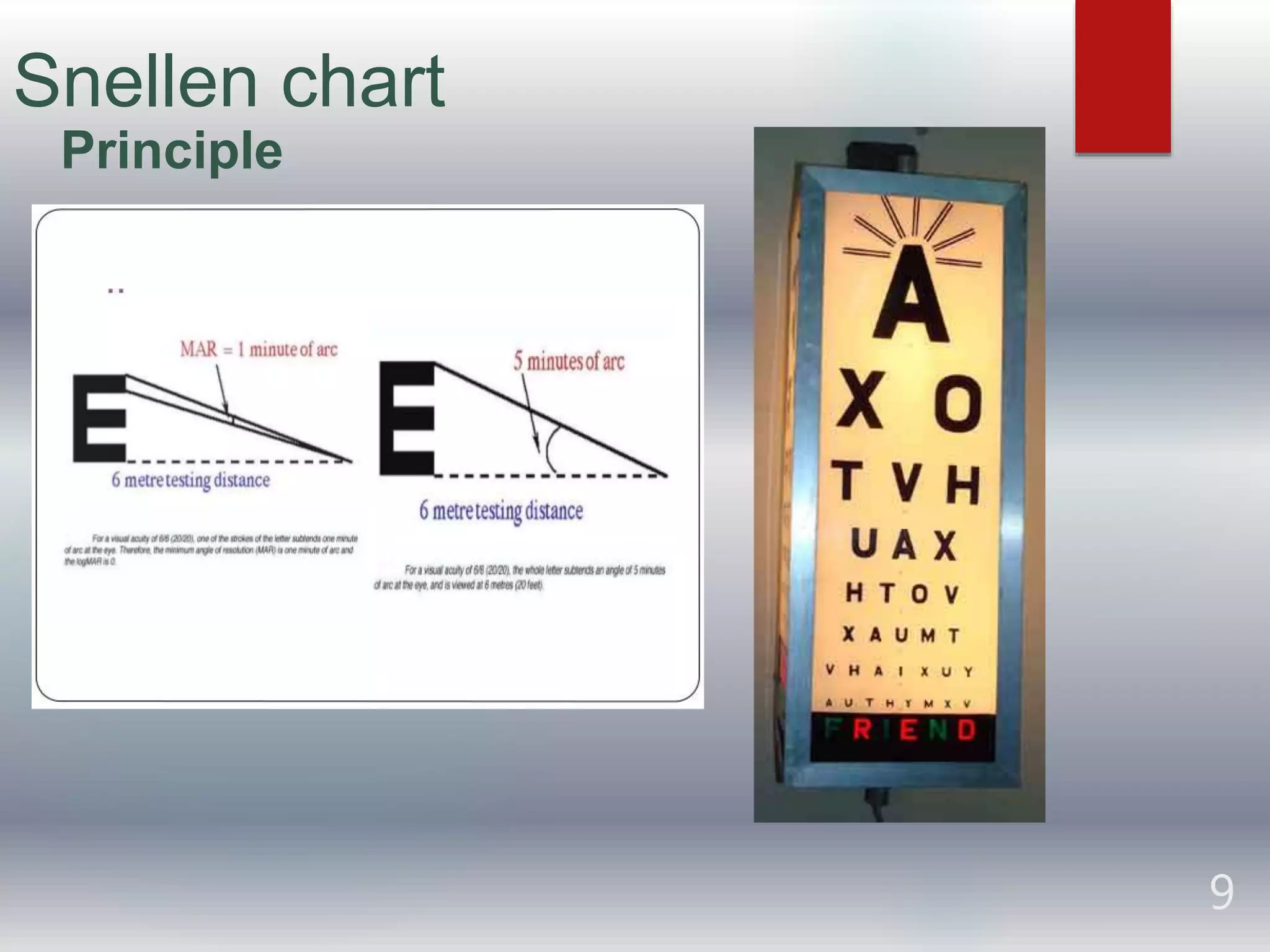
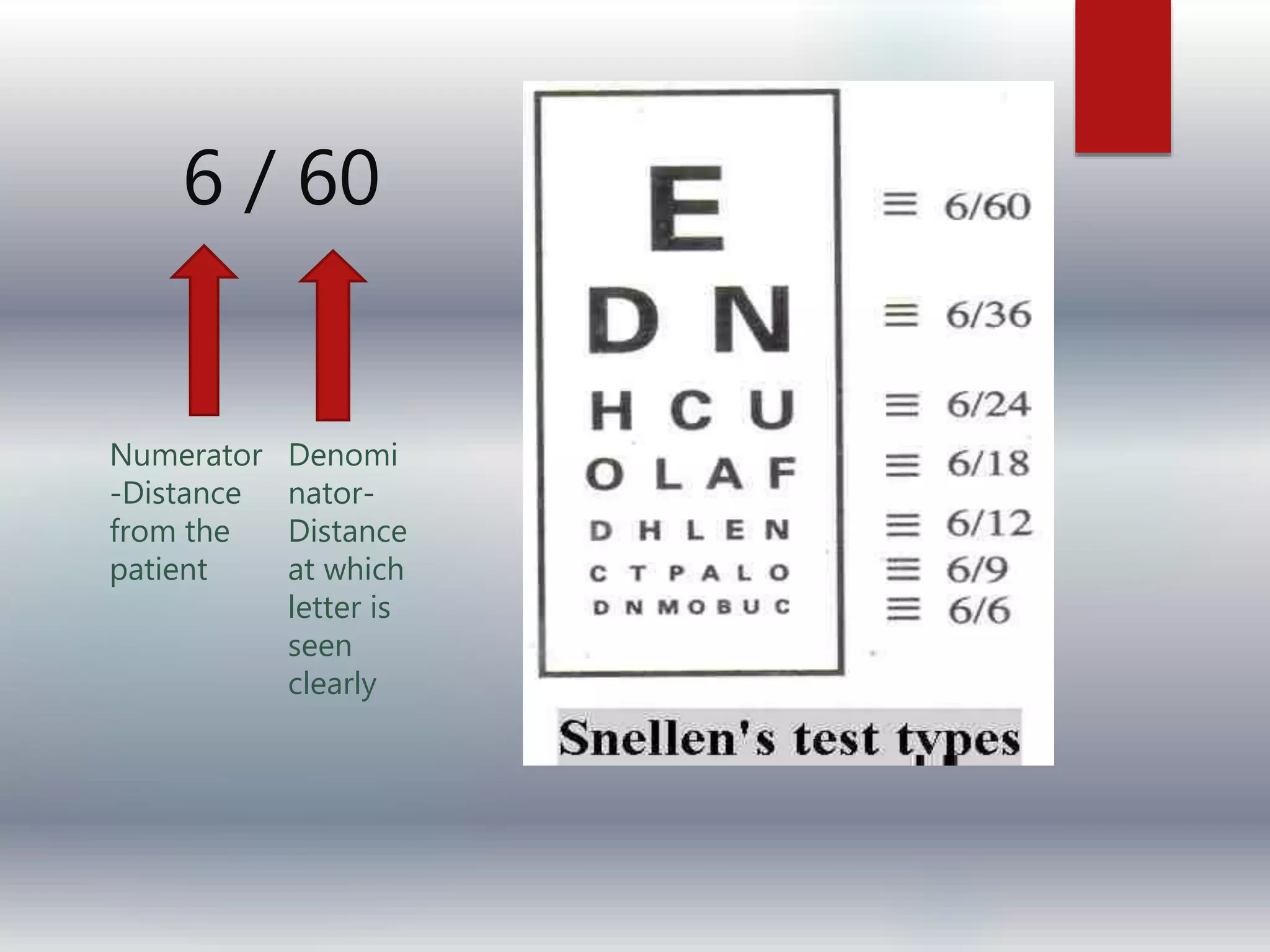
Snellen chart
Principle
6 / 60
Numerator
-Distance
from the
patient
Denomi
nator-
Distance
at which
letter is
seen
clearly
1
1
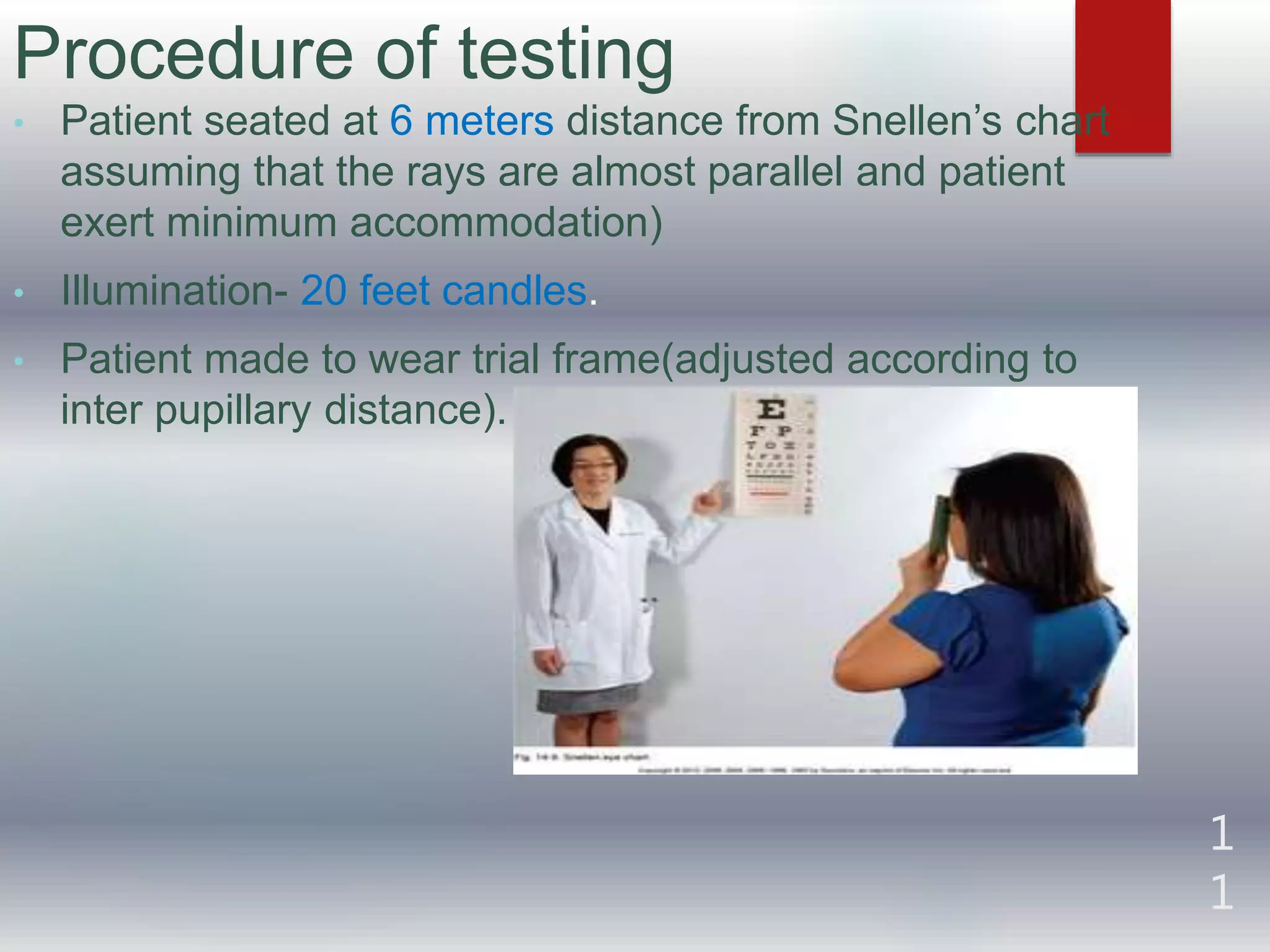
Procedure of testing
• Patient seated at 6 meters distance from Snellen’s chart
assuming that the rays are almost parallel and patient
exert minimum accommodation)
• Illumination- 20 feet candles.
• Patient made to wear trial frame(adjusted according to
inter pupillary distance).
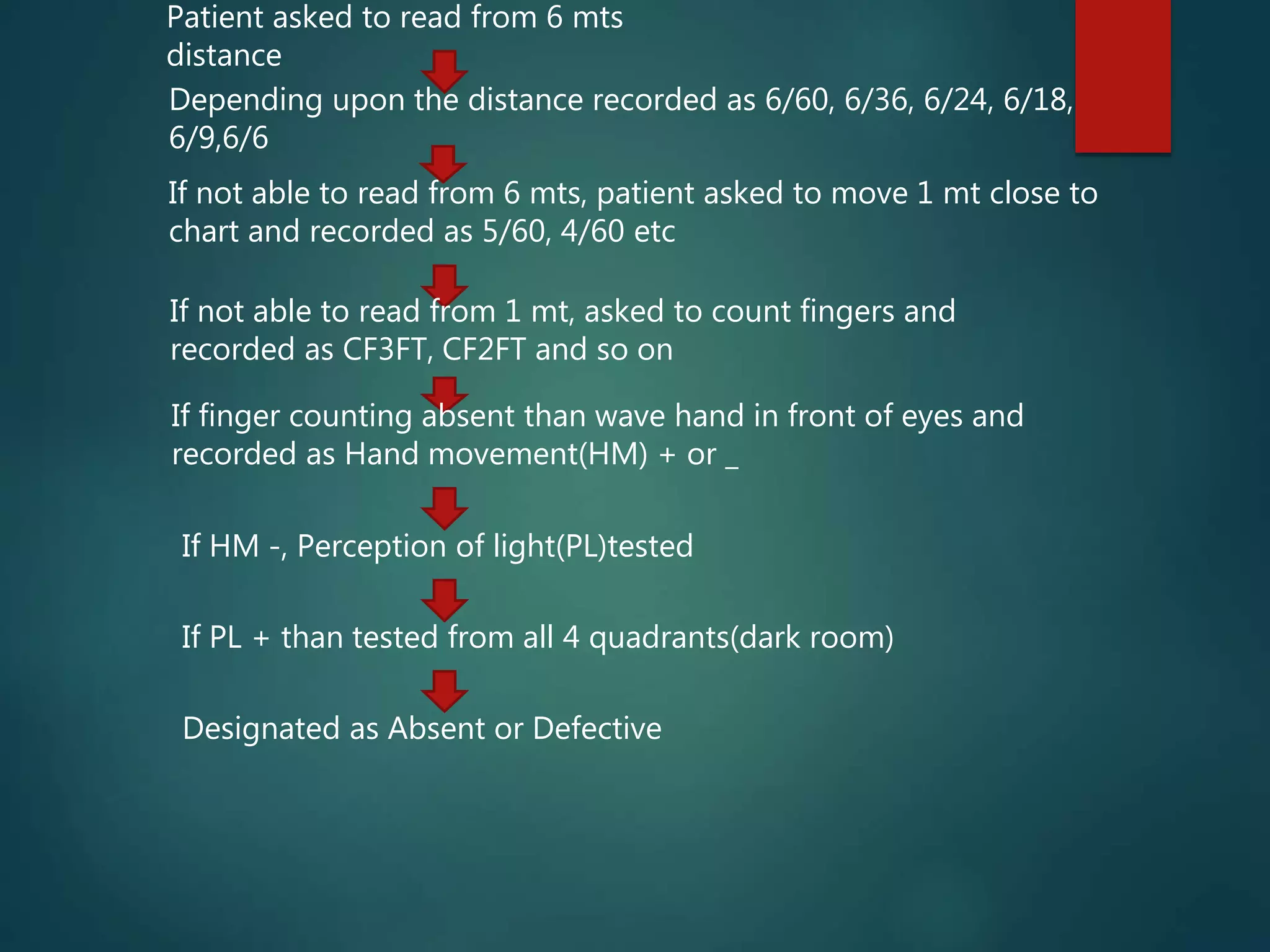
Patient asked to read from 6 mts
distance
Depending upon the distance recorded as 6/60, 6/36, 6/24, 6/18,
6/9,6/6
If not able to read from 6 mts, patient asked to move 1 mt close to
chart and recorded as 5/60, 4/60 etc
If not able to read from 1 mt, asked to count fingers and
recorded as CF3FT, CF2FT and so on
If finger counting absent than wave hand in front of eyes and
recorded as Hand movement(HM) + or _
If HM -, Perception of light(PL)tested
If PL + than tested from all 4 quadrants(dark room)
Designated as Absent or Defective
4 November 2016
Dr Sanjay Shrivastava
1
3
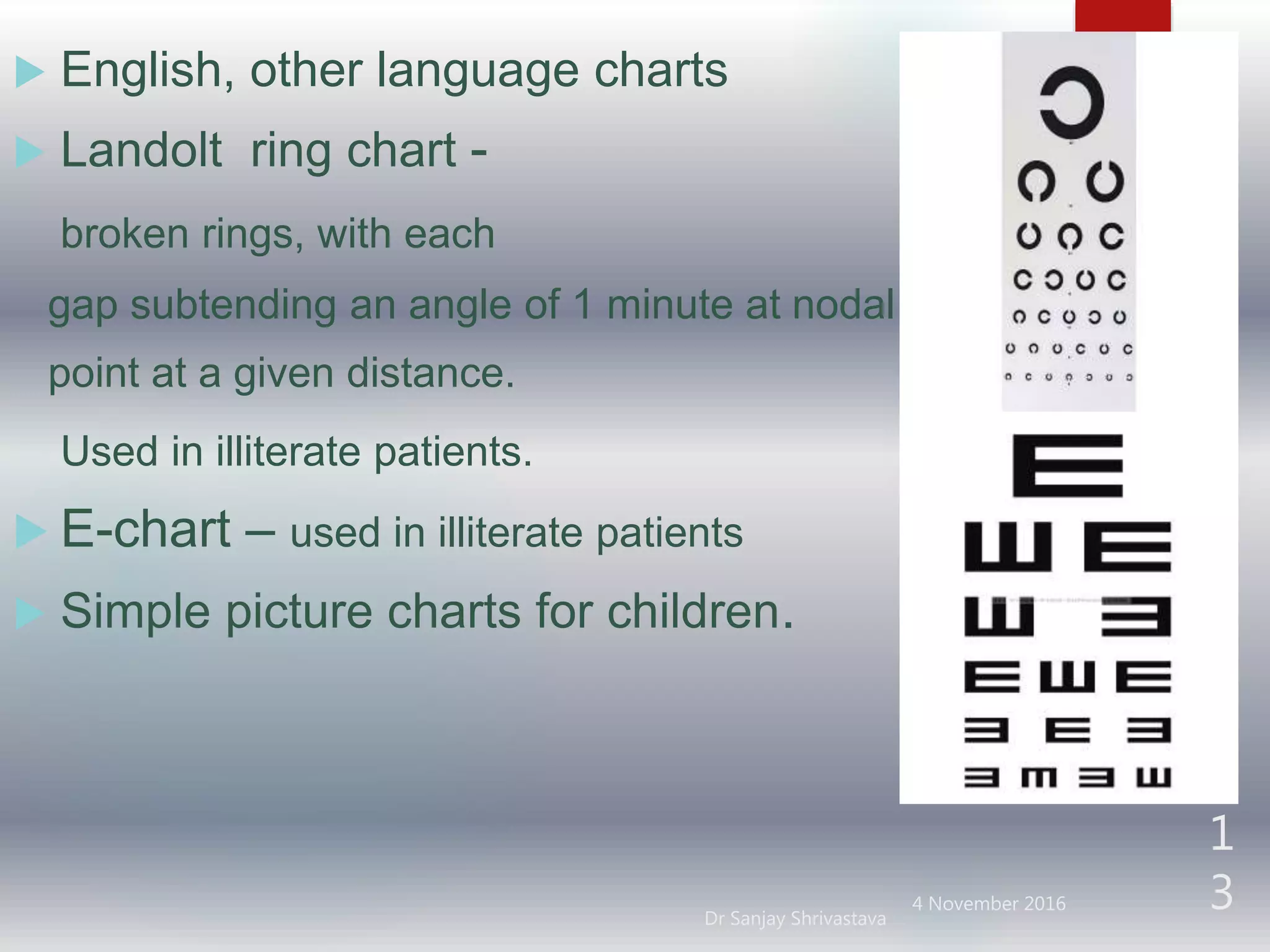
 English, other language charts
 Landolt ring chart -
broken rings, with each
gap subtending an angle of 1 minute at nodal
point at a given distance.
Used in illiterate patients.
 E-chart – used in illiterate patients
 Simple picture charts for children.
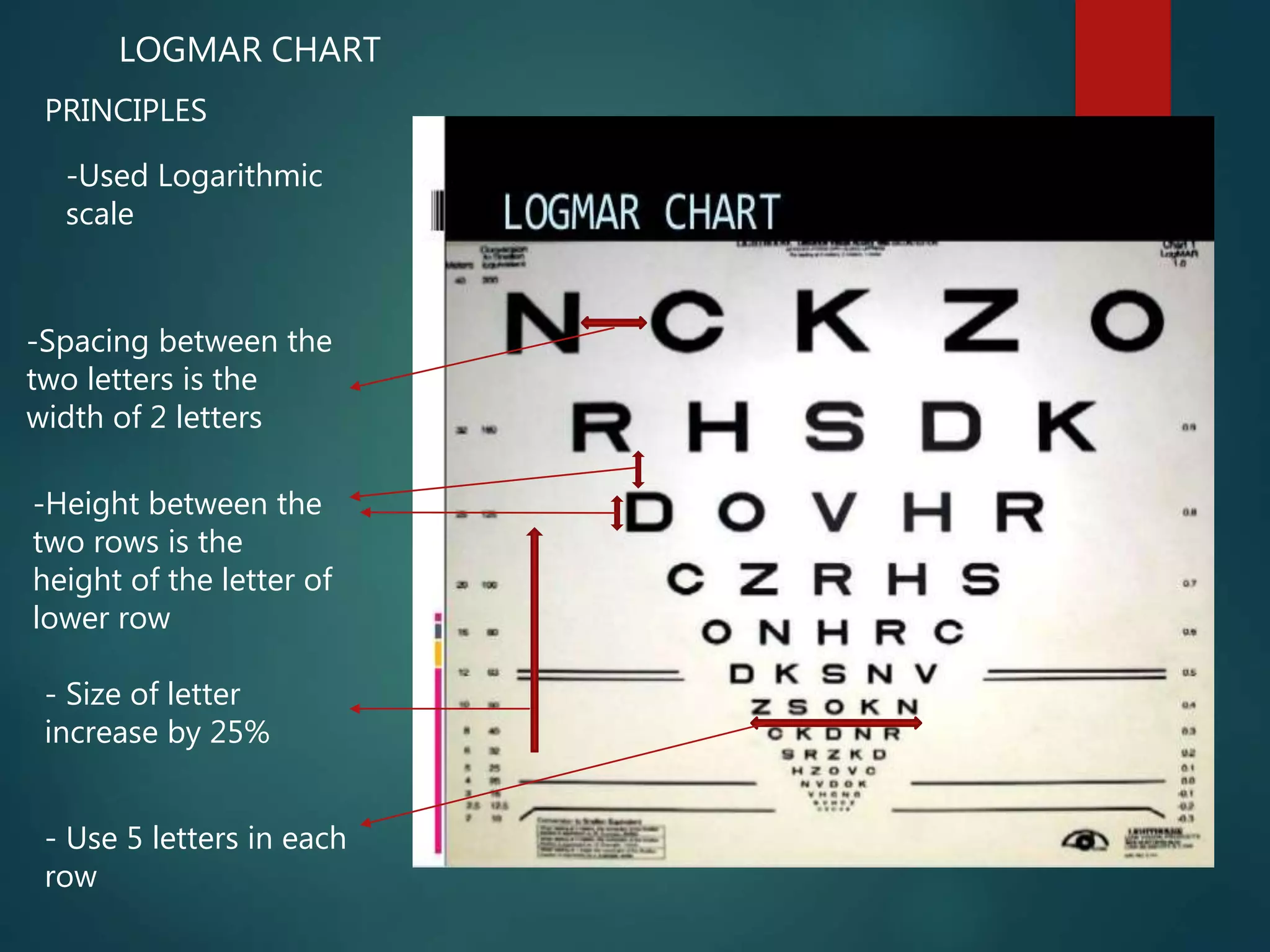
LOGMAR CHART
-Used Logarithmic
scale
-Spacing between the
two letters is the
width of 2 letters
-Height between the
two rows is the
height of the letter of
lower row
- Size of letter
increase by 25%
- Use 5 letters in each
row
PRINCIPLES
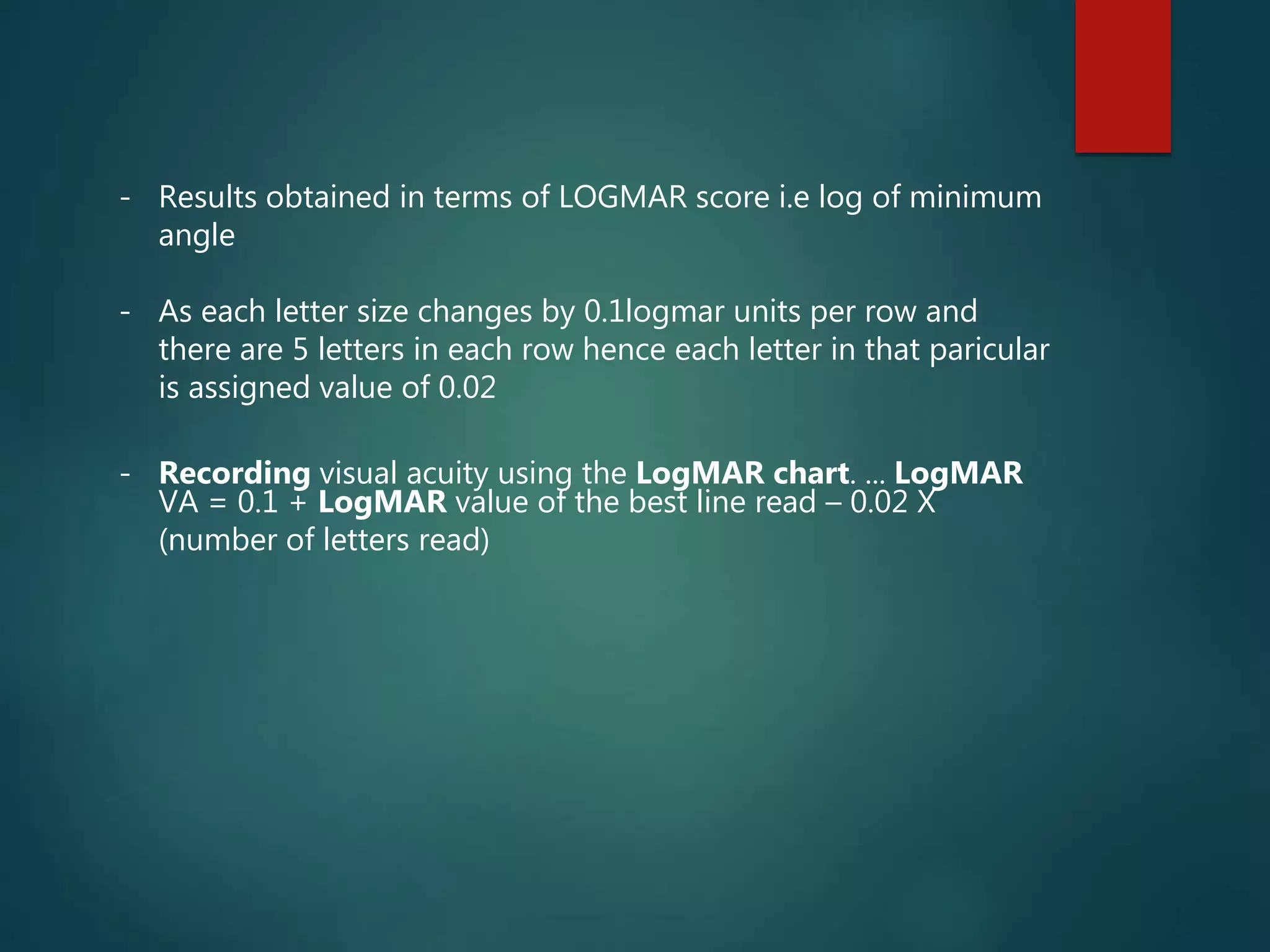
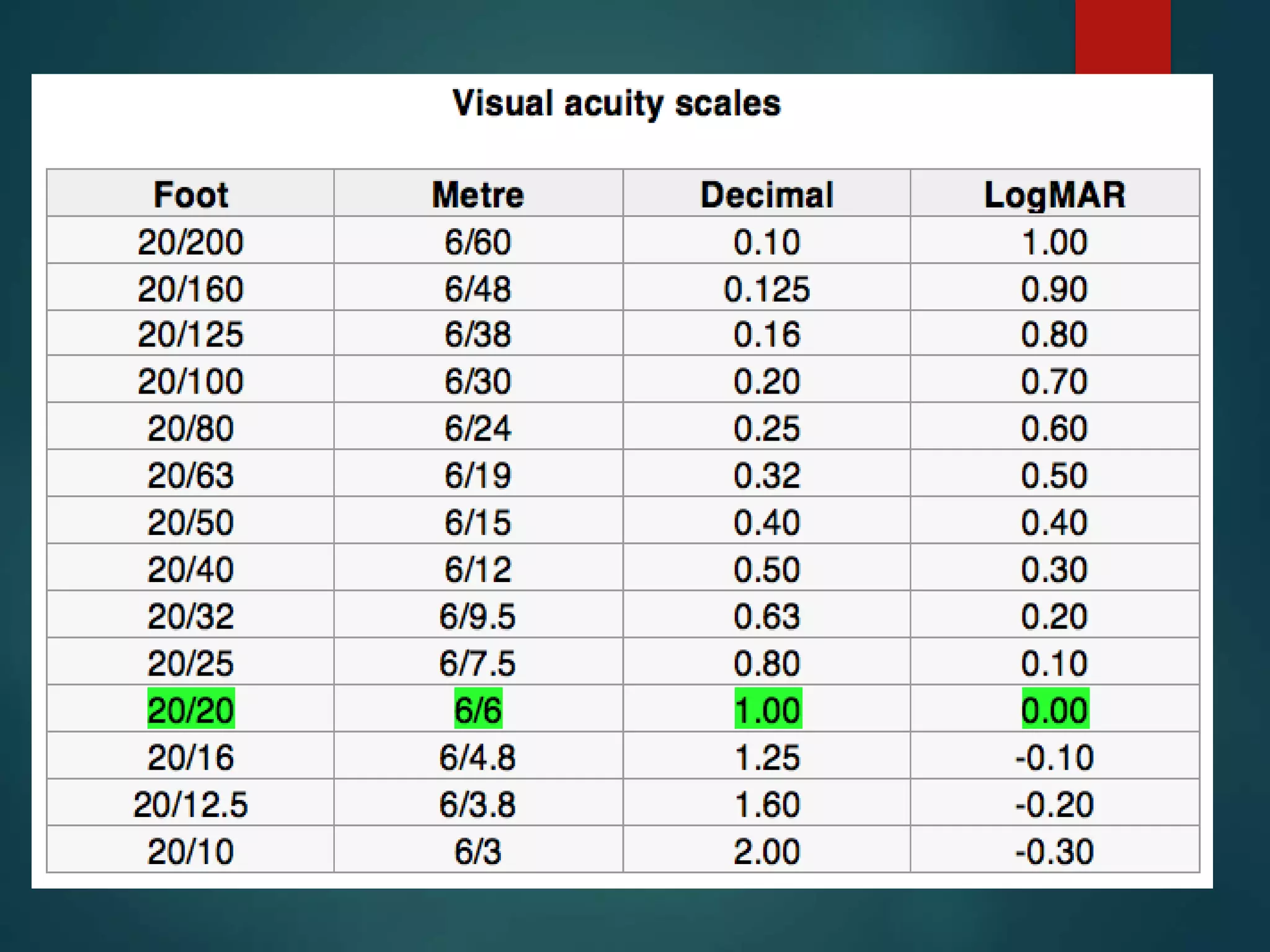
- Results obtained in terms of LOGMAR score i.e log of minimum
angle
- As each letter size changes by 0.1logmar units per row and
there are 5 letters in each row hence each letter in that paricular
is assigned value of 0.02
- Recording visual acuity using the LogMAR chart. ... LogMAR
VA = 0.1 + LogMAR value of the best line read – 0.02 X
(number of letters read)
CATRACT is the 2nd most frequently spoken term in an Eye
Hospital
1st is still “BABA BADE AANKH KHOLO
AMMA LINE MAIN LAGO”
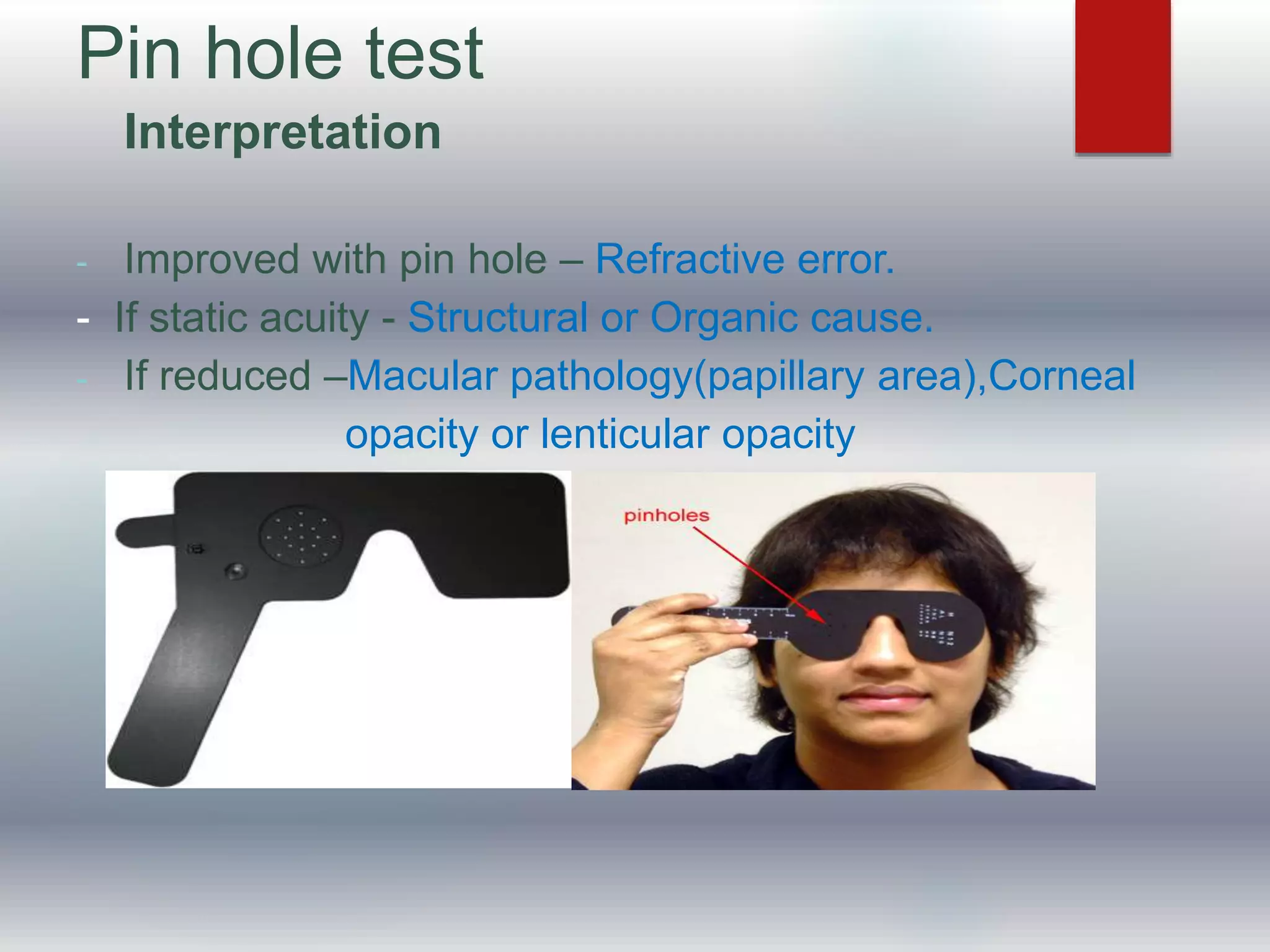
Pin hole test
Interpretation
- Improved with pin hole – Refractive error.
- If static acuity - Structural or Organic cause.
- If reduced –Macular pathology(papillary area),Corneal
opacity or lenticular opacity
1
9
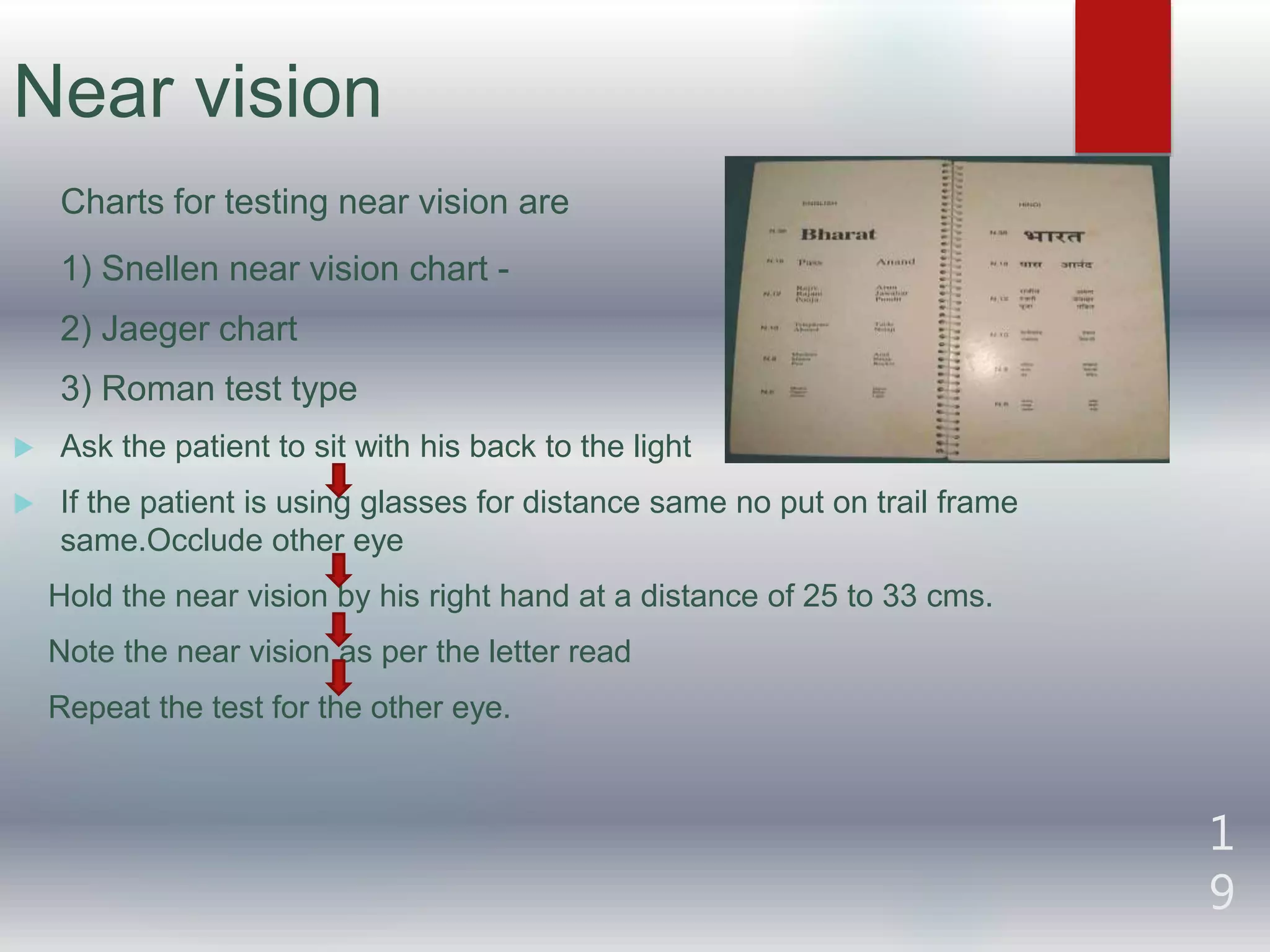
Near vision
Charts for testing near vision are
1) Snellen near vision chart -
2) Jaeger chart
3) Roman test type
 Ask the patient to sit with his back to the light
 If the patient is using glasses for distance same no put on trail frame
same.Occlude other eye
Hold the near vision by his right hand at a distance of 25 to 33 cms.
Note the near vision as per the letter read
Repeat the test for the other eye.
Visual Assessment in Children
 Preliminary Tests :
 Preliminary Tests Begin with general observation of the child.
 Hirschberg’s Test: Gross check of ocular alignment.
 Pupils: size, shape, reaction.
 Ocular motility.
 Fixation pattern.
MEASURMENT OF VISUAL ACUITY IN INFANTS
1- Prefrential looking test
Child presented with two visual field : Striped and plain
background
Child look at the striped pattern for longer time
Location of strip moved from right to left
Fineness of strip reduced till child can no longer differentiate
between the two
2- Optokinetic Nystagmus
Nystagmus is elicited by passing a drum with
black and white stripes. If normal vision- rail-road nystagmus
(involuntary, rapid, rhythmic of eye ball)
3- Visually Evoked Response:
-In infants.
- Electroencephalographic recording from the occipital
in response to visual stimuli.
-Determines the integrity of macular and visual pathway
functions.
-Pattern depends on form sense
4-Indirect assessment of VA:
Blink reflex in response to sound.
Menace reflex i.e. closure of eyes on approaching of
if vision is normal.
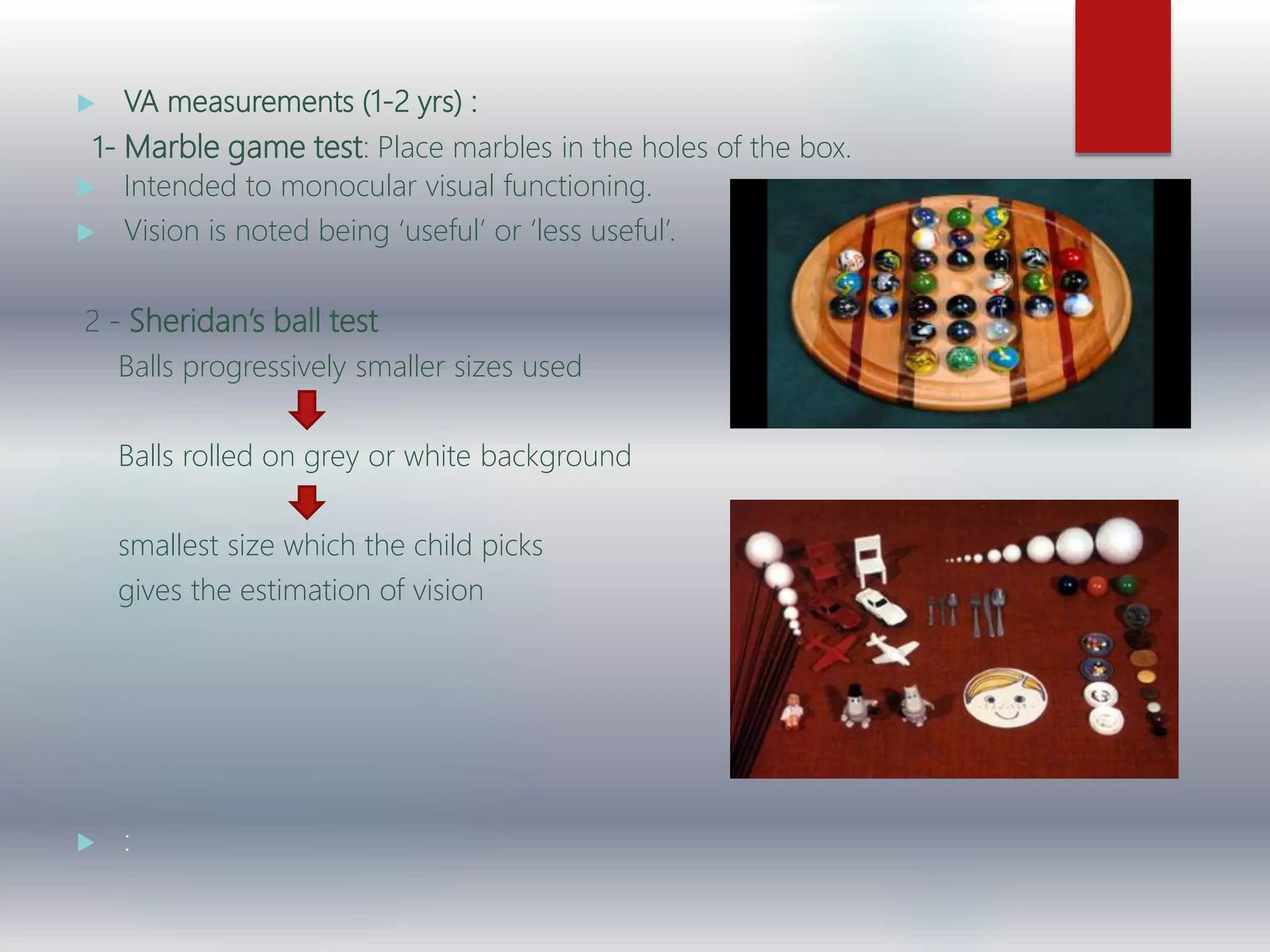
 VA measurements (1-2 yrs) :
1- Marble game test: Place marbles in the holes of the box.
 Intended to monocular visual functioning.
 Vision is noted being ‘useful’ or ‘less useful’.
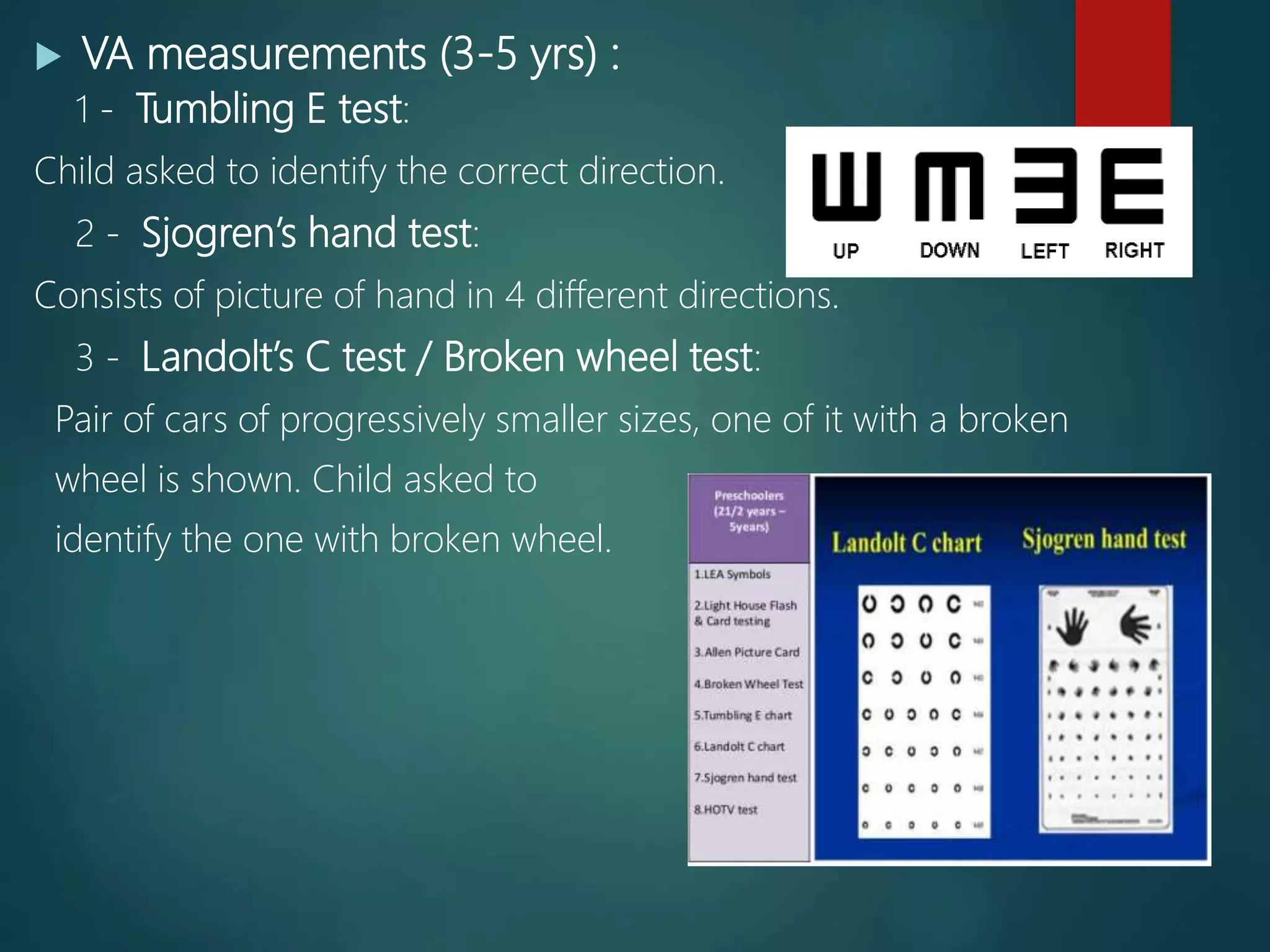
2 - Sheridan’s ball test
Balls progressively smaller sizes used
Balls rolled on grey or white background
smallest size which the child picks
gives the estimation of vision
 :
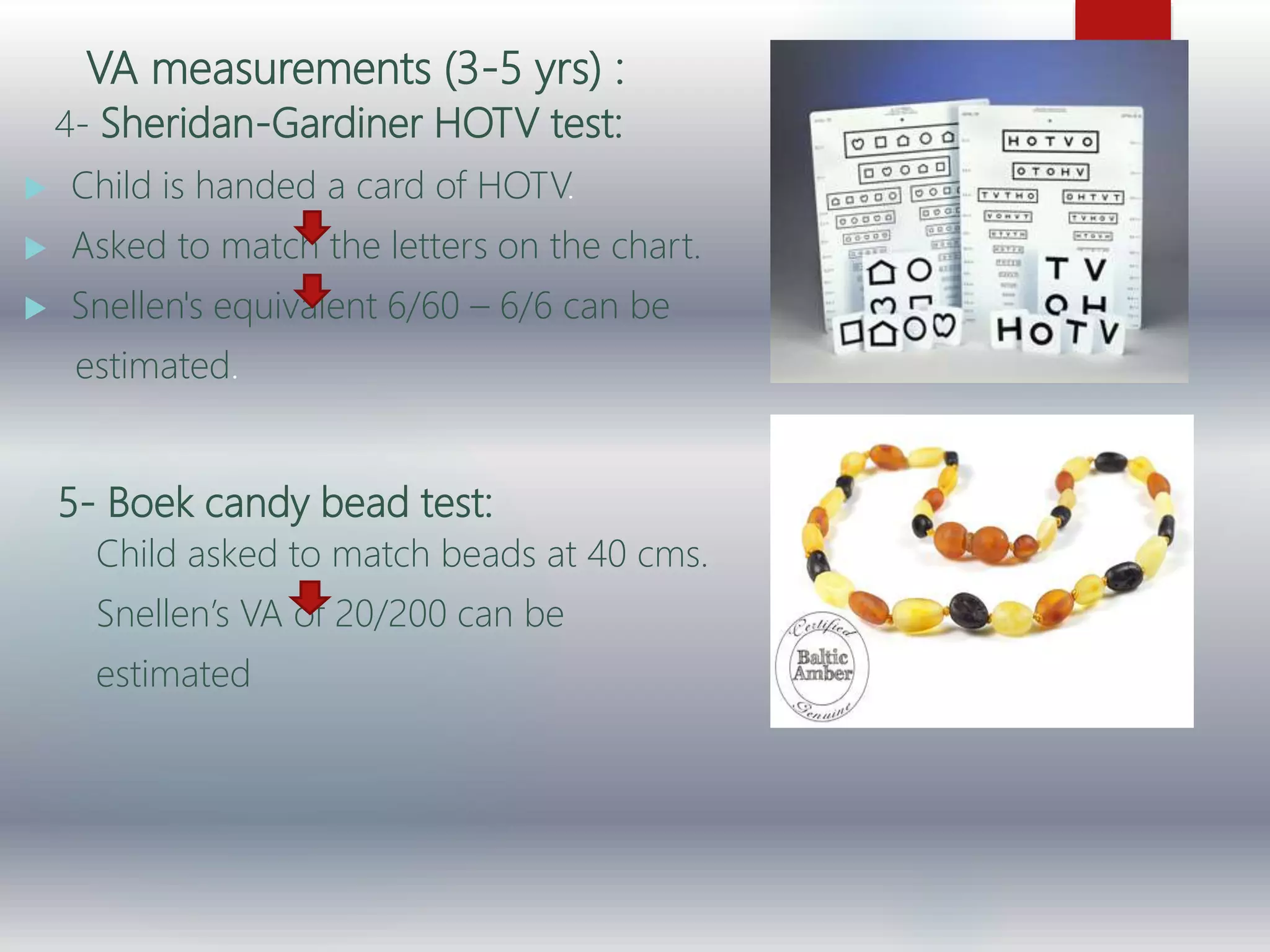
 VA measurements (3-5 yrs) :
1 - Tumbling E test:
Child asked to identify the correct direction.
2 - Sjogren’s hand test:
Consists of picture of hand in 4 different directions.
3 - Landolt’s C test / Broken wheel test:
Pair of cars of progressively smaller sizes, one of it with a broken
wheel is shown. Child asked to
identify the one with broken wheel.
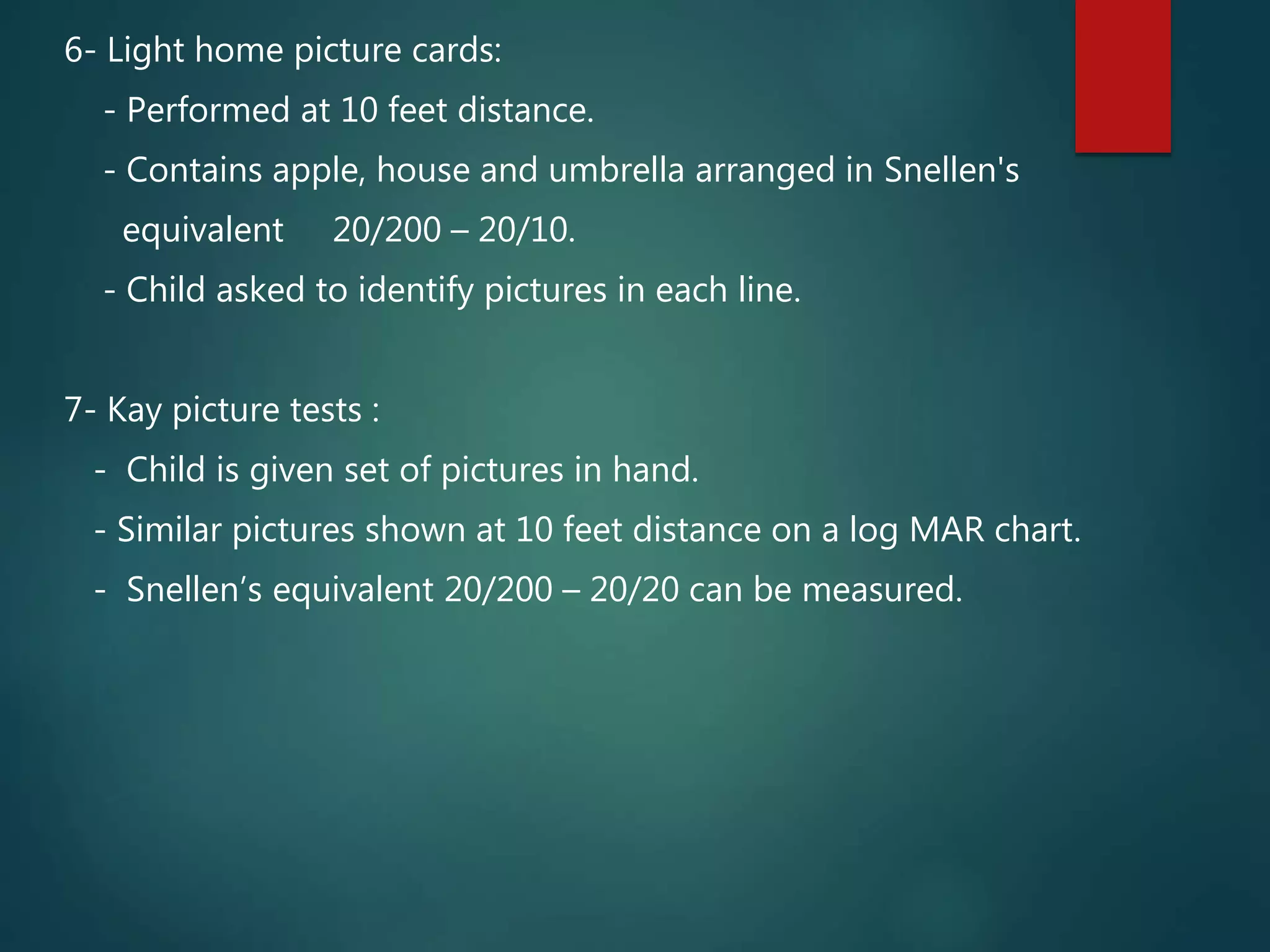
VA measurements (3-5 yrs) :
4- Sheridan-Gardiner HOTV test:
 Child is handed a card of HOTV.
 Asked to match the letters on the chart.
 Snellen's equivalent 6/60 – 6/6 can be
estimated.
5- Boek candy bead test:
Child asked to match beads at 40 cms.
Snellen’s VA of 20/200 can be
estimated
6- Light home picture cards:
- Performed at 10 feet distance.
- Contains apple, house and umbrella arranged in Snellen's
equivalent 20/200 – 20/10.
- Child asked to identify pictures in each line.
7- Kay picture tests :
- Child is given set of pictures in hand.
- Similar pictures shown at 10 feet distance on a log MAR chart.
- Snellen’s equivalent 20/200 – 20/20 can be measured.
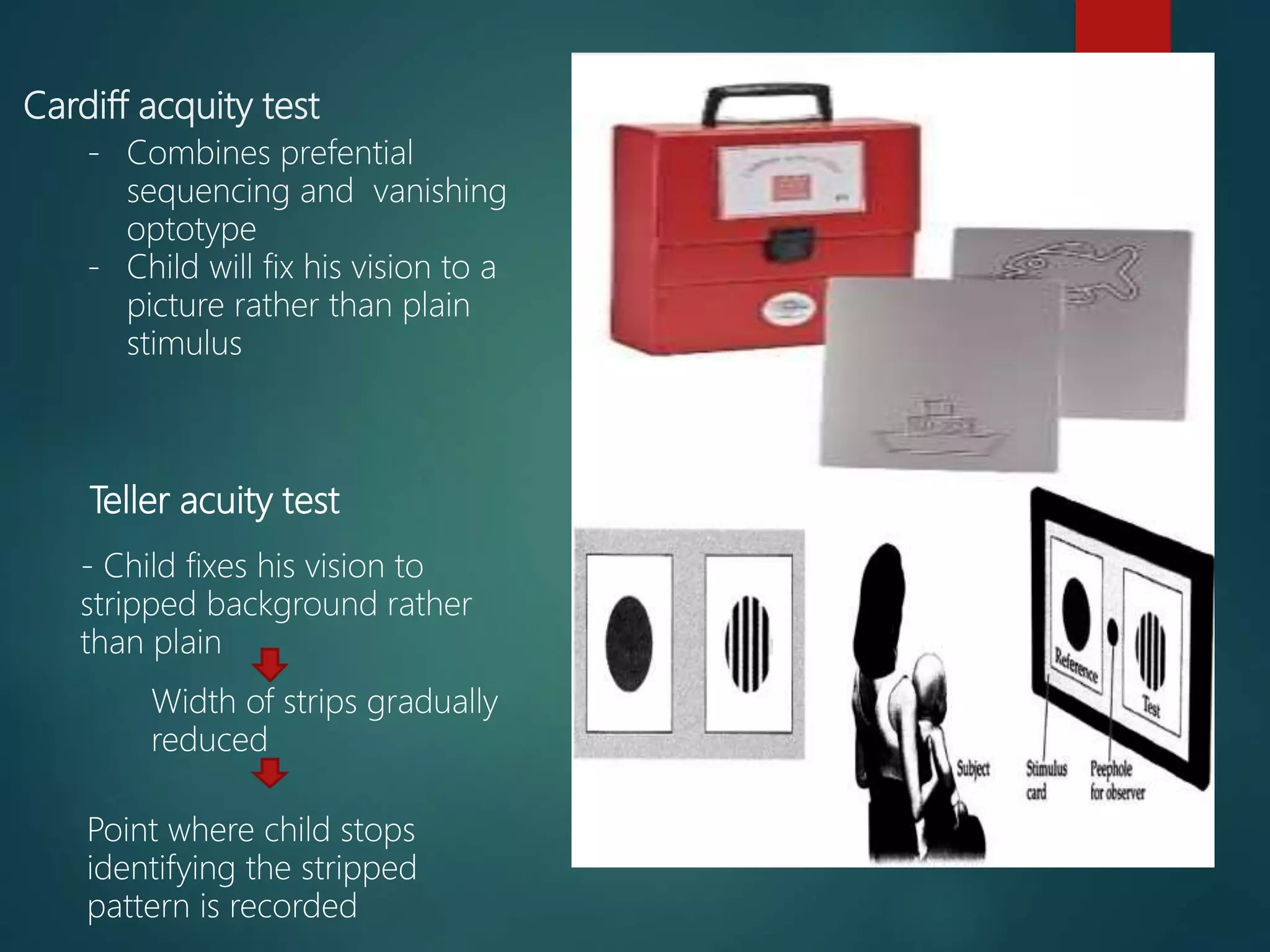
Cardiff acquity test
Teller acuity test
- Combines prefential
sequencing and vanishing
optotype
- Child will fix his vision to a
picture rather than plain
stimulus
- Child fixes his vision to
stripped background rather
than plain
Width of strips gradually
reduced
Point where child stops
identifying the stripped
pattern is recorded
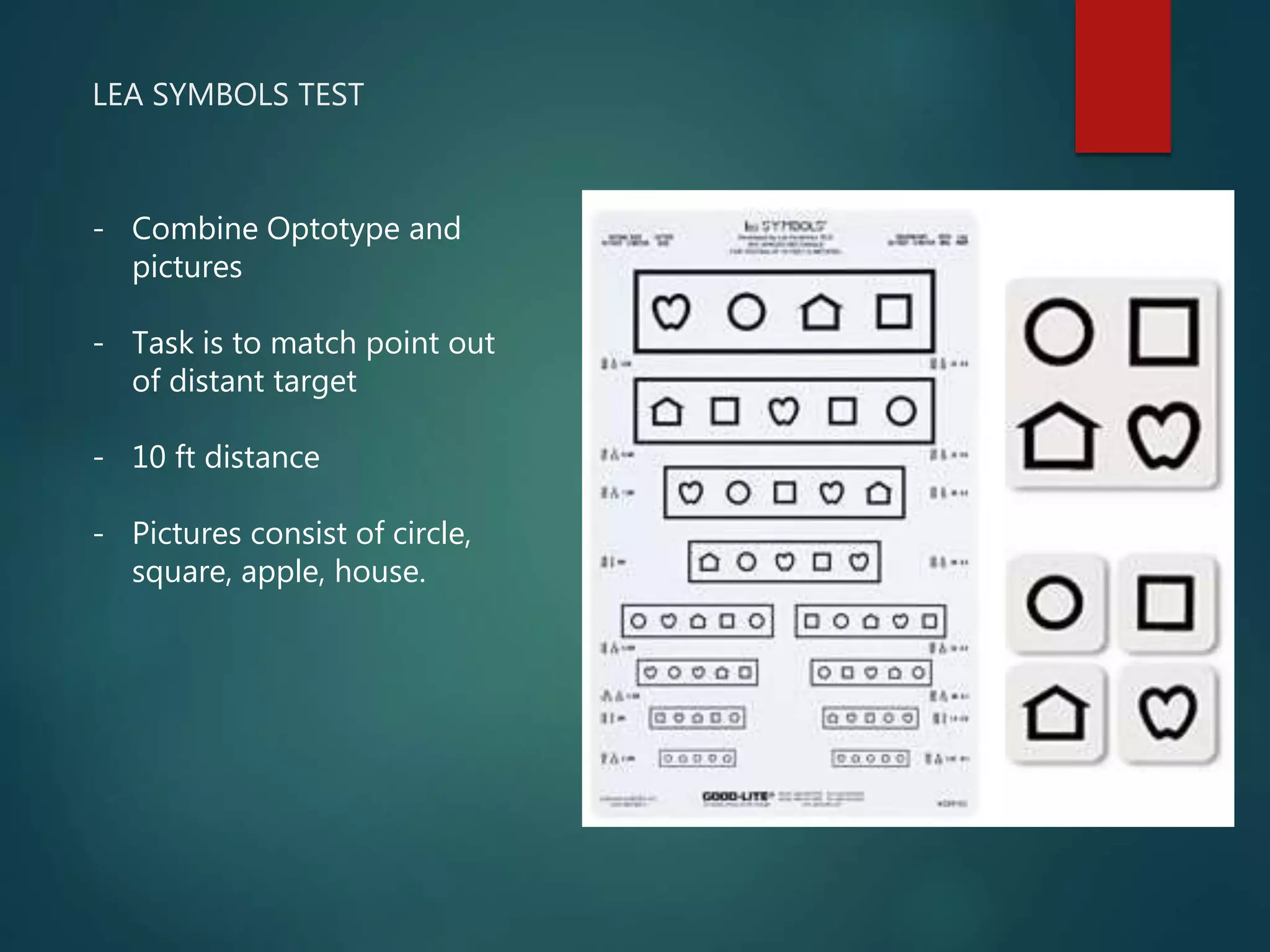
LEA SYMBOLS TEST
- Combine Optotype and
pictures
- Task is to match point out
of distant target
- 10 ft distance
- Pictures consist of circle,
square, apple, house.
CONTRAST
SENSITIVITYTHE SURGICAL STRIKE
Definition:
 Contrast
degree of blackness to whiteness of target.
 Contrast threshold
smallest amount of contrast required to be able to
see the target.
 Contrast sensitivity
reciprocal of the contrast threshold.
CONTRAST SENSITIVITY
 The ability to perceive slight changes in luminance between
regions which are not separated by definite borders and is just as
important as the ability to perceive sharp outlines of relatively
small objects.
SNELLENS VISUAL ACUITY VERSUS
CONTRAST SENSITIVITY
Person may have good VA in snellen chart due to high
contrast but low contrast senstivity in day to day work
Vision drops in the situation of low contrast
Hence contrast senstivity is the better predictor of vision
CONTRAST SENSITIVITY FUNCTION
- Subjective measurement
- Ability to detect a low contrast pattern
stimuli.
- Give a more accurate representation of
the eyes' visual performance.
- Depends on spatial frequency
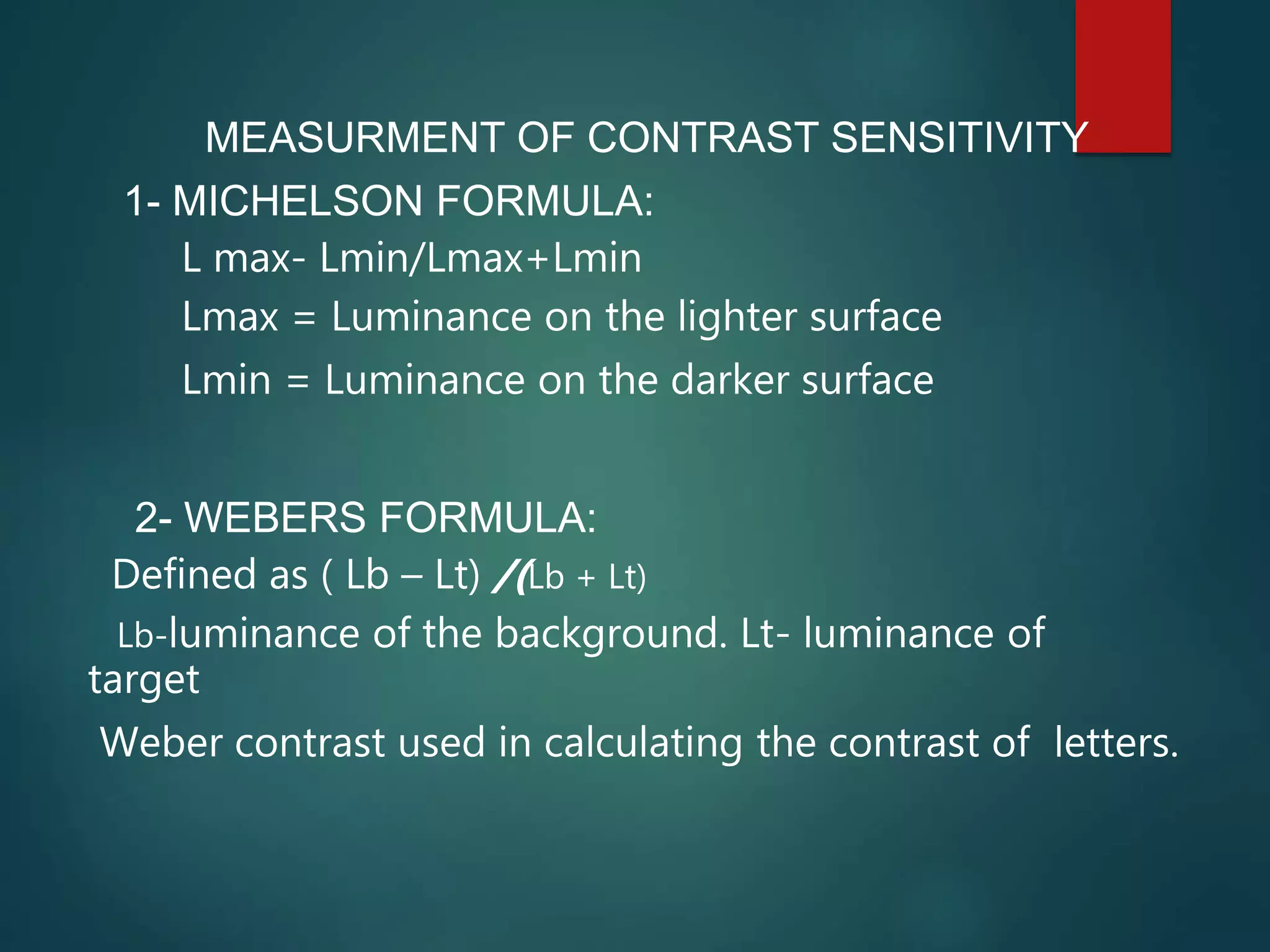
MEASURMENT OF CONTRAST SENSITIVITY
1- MICHELSON FORMULA:
L max- Lmin/Lmax+Lmin
Lmax = Luminance on the lighter surface
Lmin = Luminance on the darker surface
2- WEBERS FORMULA:
Defined as ( Lb – Lt) /(Lb + Lt)
Lb-luminance of the background. Lt- luminance of
target
Weber contrast used in calculating the contrast of letters.
TYPES OF CONTRAST SENSITIVITY:
1. Spatial contrast sensitivity
2. Temporal contrast sensitivity
SPATIAL CONTRAST SENSITIVITY
- Detection of striped pattern at various levels of
contrast and spatial frequency.
- Sine wave gratings of parallel light and dark bands.
- Width of the bar is defined as spatial frequency
- High spatial frequency- narrow bars.
- low spatial frequency- wide bars.
TEMPORAL CONTRAST SENSTIVITY
Contrast sensitivity function is generated for the time
related processing in the visual system by presenting
a uniform target field modulated sinusoidal in time.
The shape of the contrast sensitivity function varies with factors:
 Luminance
 Target size
 Grating motion
 Grating shape
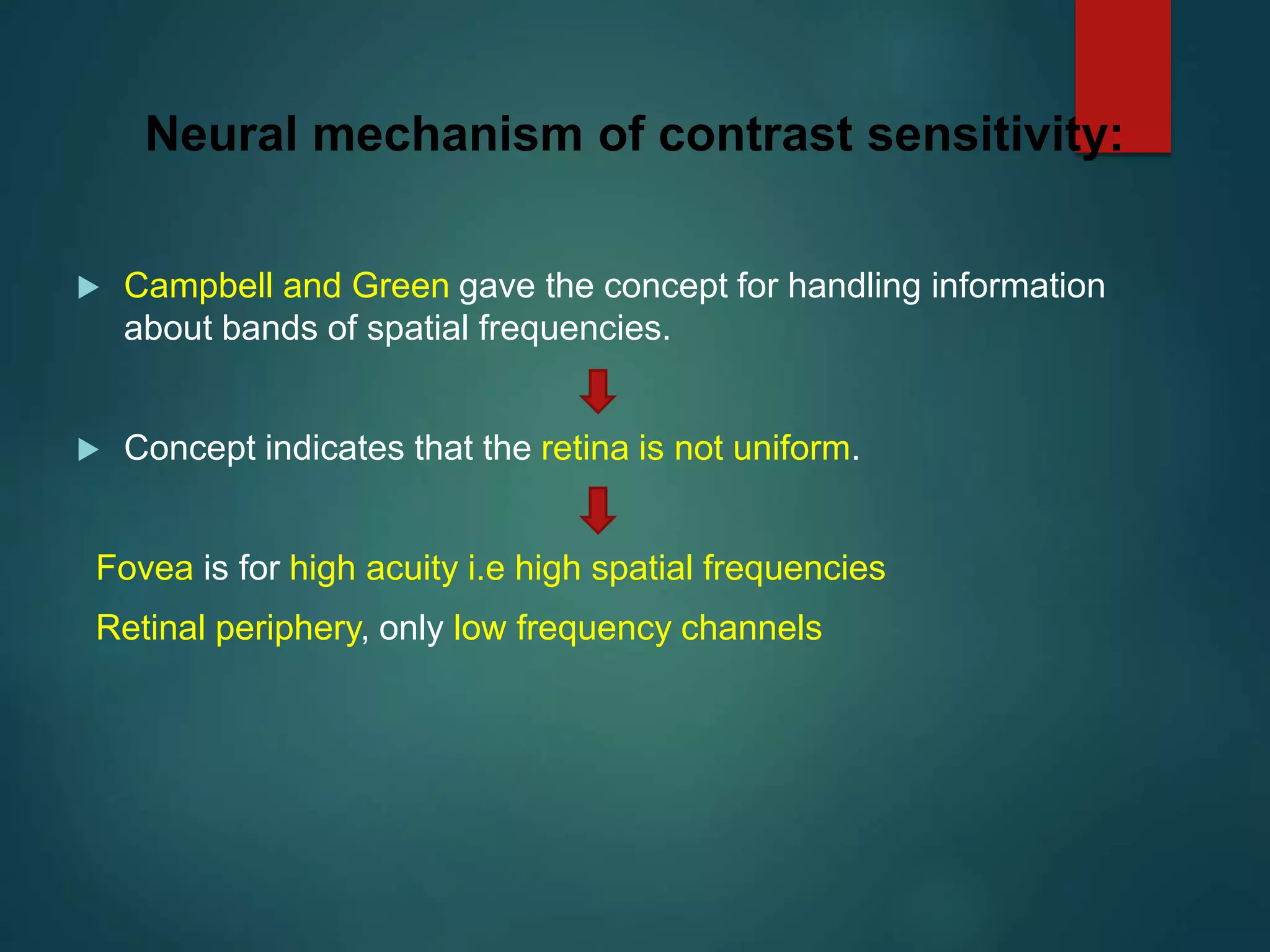
Neural mechanism of contrast sensitivity:
 Campbell and Green gave the concept for handling information
about bands of spatial frequencies.
 Concept indicates that the retina is not uniform.
Fovea is for high acuity i.e high spatial frequencies
Retinal periphery, only low frequency channels
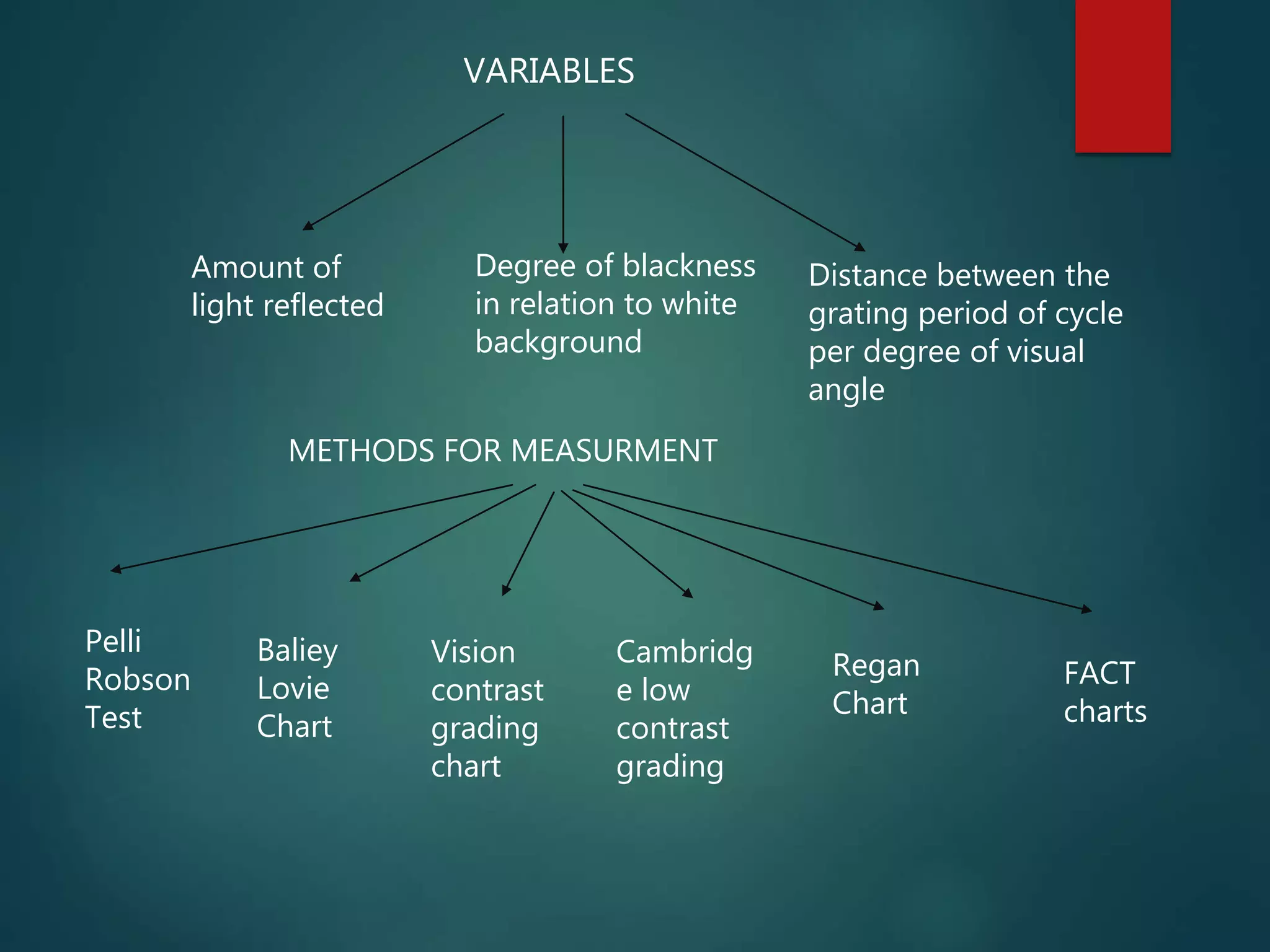
VARIABLES
Amount of
light reflected
Degree of blackness
in relation to white
background
Distance between the
grating period of cycle
per degree of visual
angle
METHODS FOR MEASURMENT
Pelli
Robson
Test
Baliey
Lovie
Chart
Vision
contrast
grading
chart
Cambridg
e low
contrast
grading
Regan
Chart
FACT
charts
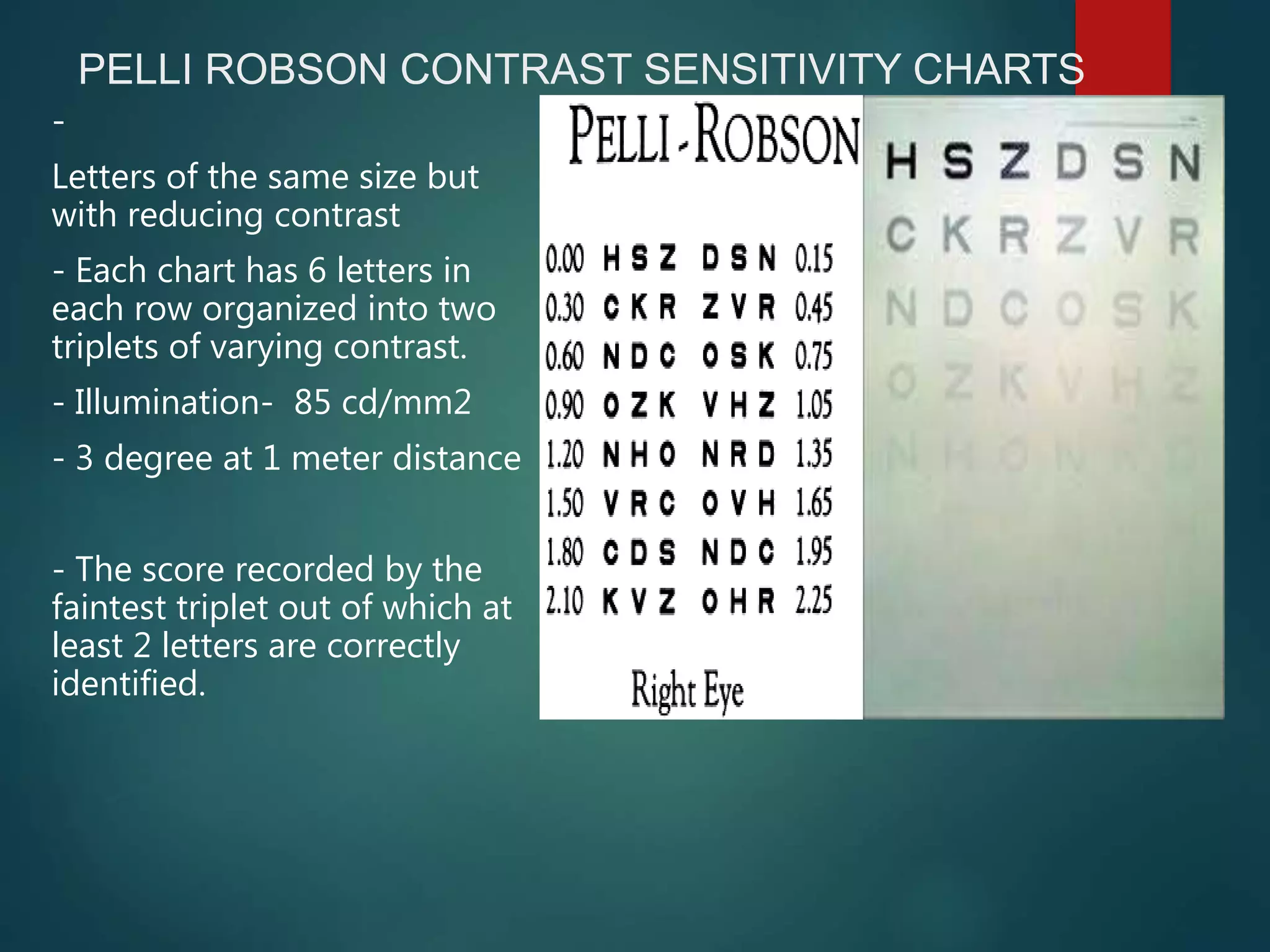
PELLI ROBSON CONTRAST SENSITIVITY CHARTS
-
Letters of the same size but
with reducing contrast
- Each chart has 6 letters in
each row organized into two
triplets of varying contrast.
- Illumination- 85 cd/mm2
- 3 degree at 1 meter distance
- The score recorded by the
faintest triplet out of which at
least 2 letters are correctly
identified.
CAMBRIDGE LOW CONTRAST GRADINGS
- Performed at 6mt distance
- Comprise 12 pairs of plate with varying contrast
- 1st for proper demonstration, rest numbered from 1-10
- Plates changed sequentially starting from plate 1.
Results interpreted from table
 The plates are changed sequentially starting from plate
1 till the patient fails to respond.
 Then a new series is begun starting 4 plates prior to
where the patient failed to respond.
 Four such series are completed and the score of each
series is noted (numbered as per the number of plate
read) and added.
 The final total value is converted into contrast
sensitivity from the provided table.
BAILEY LOVIE CHART
 Low contrast acuity testing in presence of glare.
 Each row has same no. of symbols & constant spacing is used
between rows & letters.
 Chart is based on visual acuity of minimum angle of resolution
on logMAR.
- Comprises of a chart with sine-wave gratings of varying
frequencies
- The chart tests five spatial frequencies (sizes) and nine levels of
contrast
- The Contrast varies in a row, decrease from left to right
FUNCTIONAL ACUITY CONTRAST TESTING(FACT)
- Spatial frequencies increase as one move down the various
columns from top to bottom.
- Performed at a distance of 10 feet.
- The patient determines the last grating seen for each row (A, B, C,
D and E) and reports the orientation of the grating: right, up or left.
- Readings plotted on a contrast sensitivity curve.
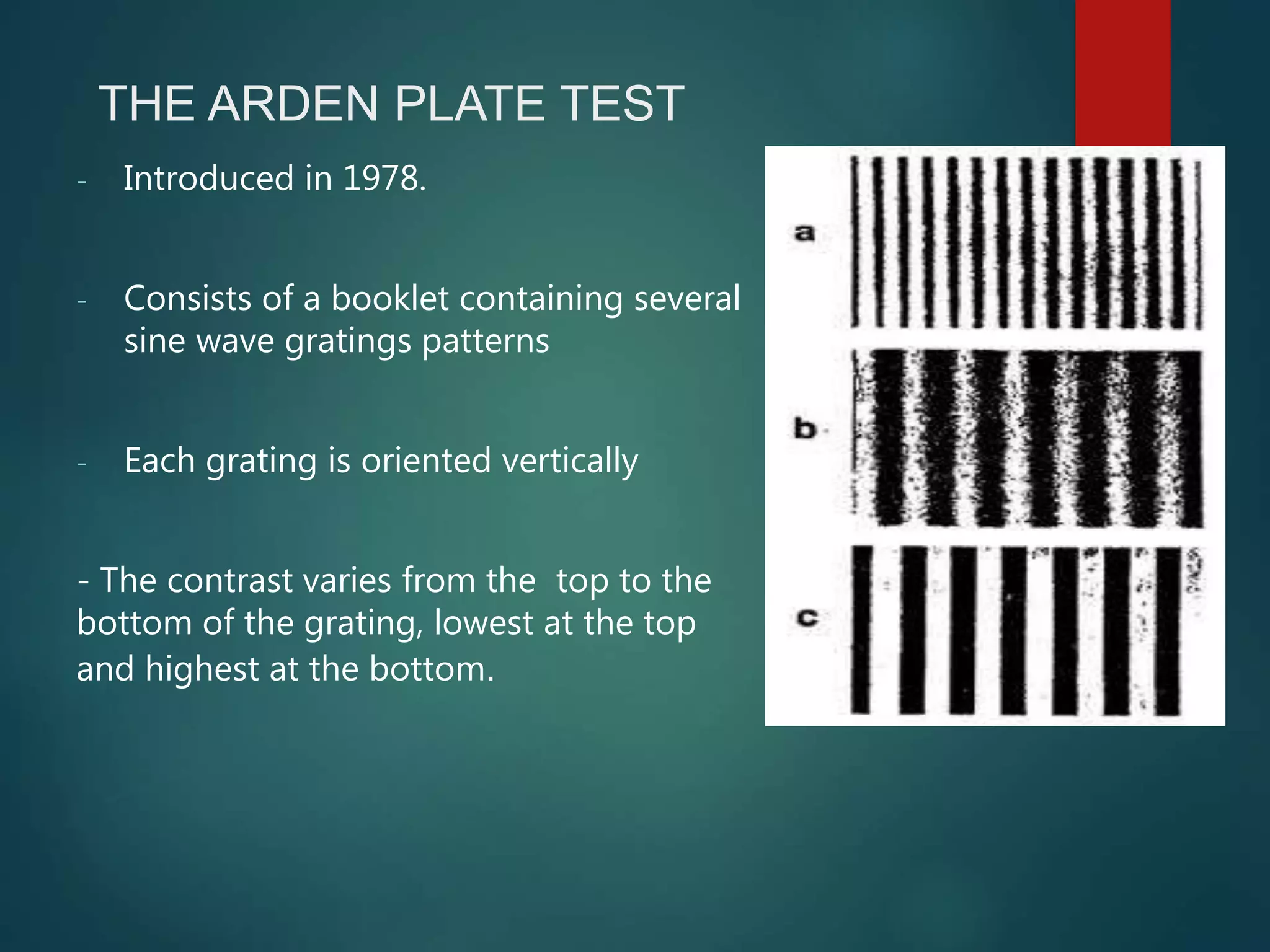
THE ARDEN PLATE TEST
- Introduced in 1978.
- Consists of a booklet containing several
sine wave gratings patterns
- Each grating is oriented vertically
- The contrast varies from the top to the
bottom of the grating, lowest at the top
and highest at the bottom.
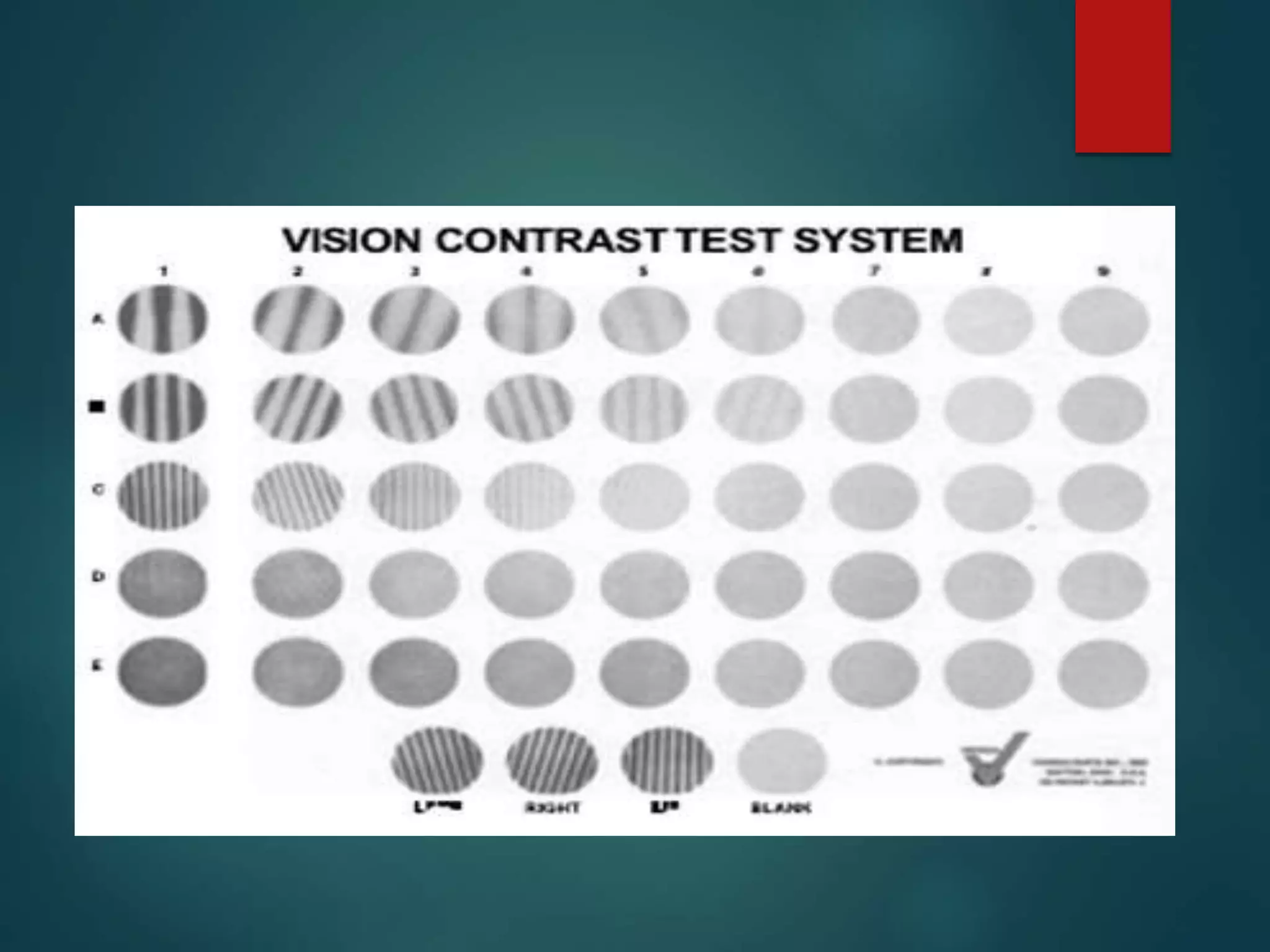
VISTECH CONTRAST SENSITIVITY TEST
 These charts consist of sine wave gratings. Each chart contains five
rows and nine columns of circular photographic plate
 Contrast within the row reduces from left to right.

 The gratings are presented in three orientations: vertical 90 degrees,
15 degrees clockwise or anticlockwise.
REGAN LOW CONTRAST LETTER CHARTS
 Consists of three letter charts, printed on white cardboard having
contrast of 97%, 7% and 4%
 3 meter with eight letters in each line
 Patients are instructed to start at the top and to continue reading
until they can correctly identify no letters on a line.
 For one chart letter size goes on reducing and contrast remains
constant
1. Refractive errors.
2. Age
3.Cataract
4.Contact lenses
5.Refractive surgery.
6.Glaucoma.
7.Diabetic retinopathy.
8.Optic neruopathies
9.Pituitary adenoma.
10.Drugs.
11.Toxic chemicals
FACTORS AFFECTING CONTRAST SENSTIVITY
THANK YOU

Visual aquity and contrast sensitivity

  • 1.
    HOPE YOU DIWALIWAS AS SATISFYING AS JENNIFER ANISTON’S
  • 2.
    Visual acuity andcontrast senstivity Presentor - Dr Vishy Srivastava Moderator - Dr Anubha Mittal
  • 3.
    VISUAL ACUITY  Visualassessment in adults  Visual assessment in children CONTRAST SENSTIVITY
  • 4.
    1. Examination ofVision Assessment of visual function  Forms of visual perception are form sense , the field of vision, the light sense and the colour sense .
  • 5.
    Dark adaptation –measurement of least luminance required to produce a visual sensation Contrast sensitivity – is measurement of the smallest distinguishable contrast ,it is assessment of quality of vision Colour vision –with lantern test (Edridge green lantern) and Isochromatic charts
  • 6.
    6 Visual Acuity  Theprincipal of assessment and measurement of spatial resolution of the eye i.e. an estimation of ability of eye to discriminate between two points. DISTANCE VISION Two distance point can be visible as separate only when they subtend an angle of 1 minute at the nodal point of eye.
  • 7.
    7 Visual Acuity -Measure ofthe smallest retinal image which can be appreciated with reference to its shape and size . - Measure of form sense. - Subjective examination - Central or direct vision - Distance vision - Snellen test type - Near vision - Snellen test type or Jaeger’s test type
  • 9.
  • 10.
    6 / 60 Numerator -Distance fromthe patient Denomi nator- Distance at which letter is seen clearly
  • 11.
    1 1 Procedure of testing •Patient seated at 6 meters distance from Snellen’s chart assuming that the rays are almost parallel and patient exert minimum accommodation) • Illumination- 20 feet candles. • Patient made to wear trial frame(adjusted according to inter pupillary distance).
  • 12.
    Patient asked toread from 6 mts distance Depending upon the distance recorded as 6/60, 6/36, 6/24, 6/18, 6/9,6/6 If not able to read from 6 mts, patient asked to move 1 mt close to chart and recorded as 5/60, 4/60 etc If not able to read from 1 mt, asked to count fingers and recorded as CF3FT, CF2FT and so on If finger counting absent than wave hand in front of eyes and recorded as Hand movement(HM) + or _ If HM -, Perception of light(PL)tested If PL + than tested from all 4 quadrants(dark room) Designated as Absent or Defective
  • 13.
    4 November 2016 DrSanjay Shrivastava 1 3  English, other language charts  Landolt ring chart - broken rings, with each gap subtending an angle of 1 minute at nodal point at a given distance. Used in illiterate patients.  E-chart – used in illiterate patients  Simple picture charts for children.
  • 14.
    LOGMAR CHART -Used Logarithmic scale -Spacingbetween the two letters is the width of 2 letters -Height between the two rows is the height of the letter of lower row - Size of letter increase by 25% - Use 5 letters in each row PRINCIPLES
  • 15.
    - Results obtainedin terms of LOGMAR score i.e log of minimum angle - As each letter size changes by 0.1logmar units per row and there are 5 letters in each row hence each letter in that paricular is assigned value of 0.02 - Recording visual acuity using the LogMAR chart. ... LogMAR VA = 0.1 + LogMAR value of the best line read – 0.02 X (number of letters read)
  • 17.
    CATRACT is the2nd most frequently spoken term in an Eye Hospital 1st is still “BABA BADE AANKH KHOLO AMMA LINE MAIN LAGO”
  • 18.
    Pin hole test Interpretation -Improved with pin hole – Refractive error. - If static acuity - Structural or Organic cause. - If reduced –Macular pathology(papillary area),Corneal opacity or lenticular opacity
  • 19.
    1 9 Near vision Charts fortesting near vision are 1) Snellen near vision chart - 2) Jaeger chart 3) Roman test type  Ask the patient to sit with his back to the light  If the patient is using glasses for distance same no put on trail frame same.Occlude other eye Hold the near vision by his right hand at a distance of 25 to 33 cms. Note the near vision as per the letter read Repeat the test for the other eye.
  • 20.
    Visual Assessment inChildren  Preliminary Tests :  Preliminary Tests Begin with general observation of the child.  Hirschberg’s Test: Gross check of ocular alignment.  Pupils: size, shape, reaction.  Ocular motility.  Fixation pattern.
  • 21.
    MEASURMENT OF VISUALACUITY IN INFANTS 1- Prefrential looking test Child presented with two visual field : Striped and plain background Child look at the striped pattern for longer time Location of strip moved from right to left Fineness of strip reduced till child can no longer differentiate between the two 2- Optokinetic Nystagmus Nystagmus is elicited by passing a drum with black and white stripes. If normal vision- rail-road nystagmus (involuntary, rapid, rhythmic of eye ball)
  • 22.
    3- Visually EvokedResponse: -In infants. - Electroencephalographic recording from the occipital in response to visual stimuli. -Determines the integrity of macular and visual pathway functions. -Pattern depends on form sense 4-Indirect assessment of VA: Blink reflex in response to sound. Menace reflex i.e. closure of eyes on approaching of if vision is normal.
  • 23.
     VA measurements(1-2 yrs) : 1- Marble game test: Place marbles in the holes of the box.  Intended to monocular visual functioning.  Vision is noted being ‘useful’ or ‘less useful’. 2 - Sheridan’s ball test Balls progressively smaller sizes used Balls rolled on grey or white background smallest size which the child picks gives the estimation of vision  :
  • 24.
     VA measurements(3-5 yrs) : 1 - Tumbling E test: Child asked to identify the correct direction. 2 - Sjogren’s hand test: Consists of picture of hand in 4 different directions. 3 - Landolt’s C test / Broken wheel test: Pair of cars of progressively smaller sizes, one of it with a broken wheel is shown. Child asked to identify the one with broken wheel.
  • 25.
    VA measurements (3-5yrs) : 4- Sheridan-Gardiner HOTV test:  Child is handed a card of HOTV.  Asked to match the letters on the chart.  Snellen's equivalent 6/60 – 6/6 can be estimated. 5- Boek candy bead test: Child asked to match beads at 40 cms. Snellen’s VA of 20/200 can be estimated
  • 26.
    6- Light homepicture cards: - Performed at 10 feet distance. - Contains apple, house and umbrella arranged in Snellen's equivalent 20/200 – 20/10. - Child asked to identify pictures in each line. 7- Kay picture tests : - Child is given set of pictures in hand. - Similar pictures shown at 10 feet distance on a log MAR chart. - Snellen’s equivalent 20/200 – 20/20 can be measured.
  • 27.
    Cardiff acquity test Telleracuity test - Combines prefential sequencing and vanishing optotype - Child will fix his vision to a picture rather than plain stimulus - Child fixes his vision to stripped background rather than plain Width of strips gradually reduced Point where child stops identifying the stripped pattern is recorded
  • 28.
    LEA SYMBOLS TEST -Combine Optotype and pictures - Task is to match point out of distant target - 10 ft distance - Pictures consist of circle, square, apple, house.
  • 29.
  • 30.
    Definition:  Contrast degree ofblackness to whiteness of target.  Contrast threshold smallest amount of contrast required to be able to see the target.  Contrast sensitivity reciprocal of the contrast threshold.
  • 31.
    CONTRAST SENSITIVITY  Theability to perceive slight changes in luminance between regions which are not separated by definite borders and is just as important as the ability to perceive sharp outlines of relatively small objects.
  • 32.
    SNELLENS VISUAL ACUITYVERSUS CONTRAST SENSITIVITY Person may have good VA in snellen chart due to high contrast but low contrast senstivity in day to day work Vision drops in the situation of low contrast Hence contrast senstivity is the better predictor of vision
  • 33.
    CONTRAST SENSITIVITY FUNCTION -Subjective measurement - Ability to detect a low contrast pattern stimuli. - Give a more accurate representation of the eyes' visual performance. - Depends on spatial frequency
  • 34.
    MEASURMENT OF CONTRASTSENSITIVITY 1- MICHELSON FORMULA: L max- Lmin/Lmax+Lmin Lmax = Luminance on the lighter surface Lmin = Luminance on the darker surface 2- WEBERS FORMULA: Defined as ( Lb – Lt) /(Lb + Lt) Lb-luminance of the background. Lt- luminance of target Weber contrast used in calculating the contrast of letters.
  • 35.
    TYPES OF CONTRASTSENSITIVITY: 1. Spatial contrast sensitivity 2. Temporal contrast sensitivity
  • 36.
    SPATIAL CONTRAST SENSITIVITY -Detection of striped pattern at various levels of contrast and spatial frequency. - Sine wave gratings of parallel light and dark bands. - Width of the bar is defined as spatial frequency - High spatial frequency- narrow bars. - low spatial frequency- wide bars. TEMPORAL CONTRAST SENSTIVITY Contrast sensitivity function is generated for the time related processing in the visual system by presenting a uniform target field modulated sinusoidal in time.
  • 37.
    The shape ofthe contrast sensitivity function varies with factors:  Luminance  Target size  Grating motion  Grating shape
  • 38.
    Neural mechanism ofcontrast sensitivity:  Campbell and Green gave the concept for handling information about bands of spatial frequencies.  Concept indicates that the retina is not uniform. Fovea is for high acuity i.e high spatial frequencies Retinal periphery, only low frequency channels
  • 39.
    VARIABLES Amount of light reflected Degreeof blackness in relation to white background Distance between the grating period of cycle per degree of visual angle METHODS FOR MEASURMENT Pelli Robson Test Baliey Lovie Chart Vision contrast grading chart Cambridg e low contrast grading Regan Chart FACT charts
  • 40.
    PELLI ROBSON CONTRASTSENSITIVITY CHARTS - Letters of the same size but with reducing contrast - Each chart has 6 letters in each row organized into two triplets of varying contrast. - Illumination- 85 cd/mm2 - 3 degree at 1 meter distance - The score recorded by the faintest triplet out of which at least 2 letters are correctly identified.
  • 41.
    CAMBRIDGE LOW CONTRASTGRADINGS - Performed at 6mt distance - Comprise 12 pairs of plate with varying contrast - 1st for proper demonstration, rest numbered from 1-10 - Plates changed sequentially starting from plate 1. Results interpreted from table
  • 42.
     The platesare changed sequentially starting from plate 1 till the patient fails to respond.  Then a new series is begun starting 4 plates prior to where the patient failed to respond.  Four such series are completed and the score of each series is noted (numbered as per the number of plate read) and added.  The final total value is converted into contrast sensitivity from the provided table.
  • 43.
    BAILEY LOVIE CHART Low contrast acuity testing in presence of glare.  Each row has same no. of symbols & constant spacing is used between rows & letters.  Chart is based on visual acuity of minimum angle of resolution on logMAR. - Comprises of a chart with sine-wave gratings of varying frequencies - The chart tests five spatial frequencies (sizes) and nine levels of contrast - The Contrast varies in a row, decrease from left to right FUNCTIONAL ACUITY CONTRAST TESTING(FACT)
  • 44.
    - Spatial frequenciesincrease as one move down the various columns from top to bottom. - Performed at a distance of 10 feet. - The patient determines the last grating seen for each row (A, B, C, D and E) and reports the orientation of the grating: right, up or left. - Readings plotted on a contrast sensitivity curve.
  • 45.
    THE ARDEN PLATETEST - Introduced in 1978. - Consists of a booklet containing several sine wave gratings patterns - Each grating is oriented vertically - The contrast varies from the top to the bottom of the grating, lowest at the top and highest at the bottom.
  • 46.
    VISTECH CONTRAST SENSITIVITYTEST  These charts consist of sine wave gratings. Each chart contains five rows and nine columns of circular photographic plate  Contrast within the row reduces from left to right.   The gratings are presented in three orientations: vertical 90 degrees, 15 degrees clockwise or anticlockwise.
  • 48.
    REGAN LOW CONTRASTLETTER CHARTS  Consists of three letter charts, printed on white cardboard having contrast of 97%, 7% and 4%  3 meter with eight letters in each line  Patients are instructed to start at the top and to continue reading until they can correctly identify no letters on a line.  For one chart letter size goes on reducing and contrast remains constant
  • 49.
    1. Refractive errors. 2.Age 3.Cataract 4.Contact lenses 5.Refractive surgery. 6.Glaucoma. 7.Diabetic retinopathy. 8.Optic neruopathies 9.Pituitary adenoma. 10.Drugs. 11.Toxic chemicals FACTORS AFFECTING CONTRAST SENSTIVITY
  • 50.