UTTAR PRADESH UNIVERSITY OF MEDICAL SCIENCES
Saifai, Etawah (U.P)
Topic- Contrast Sensitivity
Presented by- Rajat Bansal Guided by - Dr Kamal Pant
B.Optom Intern HOD( Department of optometry) &
Dean (Faculty of Paramedical Sciences
Date- 23/06/2020
OUTLINE-
 Introduction
 Snellen’s Visual Acuity and Contrast Sensitivity
 Contrast Sensitivity Function
 Measurement of contrast Sensitivity
 Benefits of C.S testing
 Gratings
 Types of contrast Sensitivity
 Neural mechanism of contrast sensitivity
 Symptoms of Low C.S.
 Methods of measuring C.S.
 Factors affecting Contrast Sensitivity
 Study
Contrast
• Degree of blackness to whiteness of
target
Contrast threshold
• Smallest amount of contrast required
to see the target
Contrast sensitivity
• Reciprocal of Contrast sensitivity
DEFINITION
Ability to perceive slight
change in luminance between
regions which are not
separated by definite borders
Ability o perceive sharp
outlines of relatively small
objects
Ability to detect separation of
the area of different contrast
level
Snellen’s Visual Acuity versus Contrast sensitivity
Person may have good V.A in
Snellen’s chart due to high
contrast but low contrast in
day to day life
Vision drop in the situation of
low Contrast
C.S IS better predictor of
vision then V.A.
 Some patient can have normal visual acuity and reduced
contrast sensitivity such as those-
 Optic neuritis .
 Multiple sclerosis
 Parkinson’s disease
 Papilloedema
 Primary open angel glaucoma
 Diabetic retinopathy
 Compressive lesions of visual pathways
Contrast Sensitivity function
 Subjective Measurement
 Detailed contrast sensitivity measurements that include both size (spatial frequency)
and contrast
 Ability to detect a low contrast pattern stimuli.
 Give more accurate representation of the eye Visual performance.
 Depend upon spatial frequency which is given in cycles/degree.
 CSF has a peak value of 1 to 8 cycles/degree.
The shape of the contrast sensitivity function varies with factors:
 Luminance
 Target size
 Grating motion
 Grating shape
Measurement of Contrast Sensitivity
 Michelson Formula
Lmax – Lmin/ Lmax+Lmin
Where, Lmax = Luminance of lighter surface
Lmin = Luminance of darker surface
 Weber’s Formula
(Lb-Lt) / (Lb+Lt)
Where, Lb=Luminance of background
Lt= Luminance of target
Note- Weber’s contrast used in calculating the contrast of letters
Benefits of C.S testing
early detection of serious eye diseases
It also offers important information in the fitting of contact
lens
Contrast sensitivity testing assists in more precise
assessments of patients prior to surgery and post-
operatively.
measuring more subtle vision losses due to problems with
spectacle lenses and contact lenses
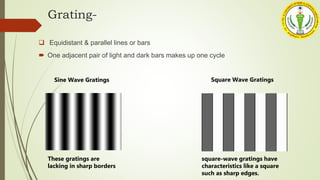
Grating-
 Equidistant & parallel lines or bars
 One adjacent pair of light and dark bars makes up one cycle
Sine Wave Gratings Square Wave Gratings
These gratings are
lacking in sharp borders
square-wave gratings have
characteristics like a square
such as sharp edges.
Types of contrast sensitivity:
Spatial contrast sensitivity
Temporal contrast sensitivity
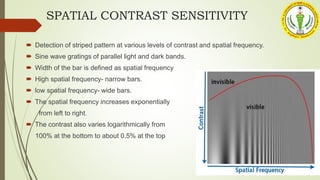
SPATIAL CONTRAST SENSITIVITY
 Detection of striped pattern at various levels of contrast and spatial frequency.
 Sine wave gratings of parallel light and dark bands.
 Width of the bar is defined as spatial frequency
 High spatial frequency- narrow bars.
 low spatial frequency- wide bars.
 The spatial frequency increases exponentially
from left to right.
 The contrast also varies logarithmically from
100% at the bottom to about 0.5% at the top
TEMPORAL CONTRAST SENSITIVITY
 Temporal contrast sensitivity is measured with gratings that reverse contrast at various
rates over time. (Modulation depth)
 here contrast sensitivity function is generated for the time related processing in the visual
system by presenting a uniform target field modulated sinusoidal in time.
 Both the system provides more complete and systemic data on the status of visual
performance.
Neural mechanism of contrast sensitivity
 Campbell and Green gave the concepts that the retina is not uniform.
 Fovea is specialized for high acuity and is responsible for high spatial frequencies.
 In the retinal periphery, only low frequency channels are represented.
 For coarse grating ,central and peripheral retina have equal CS, but larger the retina is
stimulated greater is the CS.
 Thus CS is reduced in peripheral retinal diseases & use of low frequency grating provide
rapid check of peripheral retinal function.
What are
symptoms of
low C.S ?
Have
problems
with night
driving,
Missing
gestures
Their eyes may
become tired
when they
or watch
television
inability to
see traffic
lights
Not being able
to see spots on
clothes,
counters, or
dishes
May require
extra light to
read
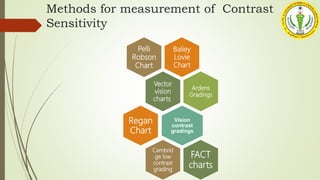
Methods for measurement of Contrast
Sensitivity
Baliey
Lovie
Chart
Pelli
Robson
Chart
Vector
vision
charts
Ardens
Gradings
Vision
contrast
gradings
Regan
Chart
Cambrid
ge low
contrast
grading
FACT
charts
What are the points we kept in mind before
testing Contrast Sensitivity?
Pelli-Robson contrast sensitivity charts
 It is simply of quickly measured and provides a reliable measurement of low spatial
frequency contrast sensitivity ( 0.5 – 2 cycles)
 Most widely used
Method:
 Sit the patient 1m from the chart with his or her correction if needs
 Occlude one eye or with both eye
 With both eyes result high with 0.15 log units
 Asked patient to read lowest letter that can see
 Letters of the same size but with
reducing contrast
 Each chart has 6 letters in each row
organized into two triplets of varying
contrast.
 Illumination- 85 cd/mm2 - 3 degree at
1 meter distance
 The score recorded by the faintest
triplet out of which at least 2 letters
are correctly identified
 Record the contrast sensitivity score
in log units Results
Cambridge Low Contrast Gratings-
 rapid and simple screening test for contrast sensitivity.
 Performed at a distance of 6m.
 It comprises of 12 pair of plates consisting of stripes of varying contrast.
 First one is for demonstration and rest are for the proper testing and are numbered
from 1-10.
 The plates are changed sequentially starting from plate 1 till the patient fails to
respond.
 Then a new series is begun starting 4 plates prior to where the patient failed to
respond.
 Four such series are completed and the score of each series is noted (numbered
as per the number of plate read) and added.
 The final total value is converted into contrast sensitivity from the provided table.
Functional Acuity Contrast Testing(FACT)
 FACT charts were developed by Dr. Arthur Ginsburg.
 FACT comprises of a chart with sine-wave gratings of varying contrast as well as
varying spatial frequencies.
 It is an accurate and comprehensive grating chart that tests functional visual acuity.
 This test is performed at a distance of 10 feet.
 The chart tests five spatial frequencies (sizes) and nine levels of contrast
 The Contrast varies in a row, decrease from left to right
 Spatial frequencies increase as one move down the various columns from top to
bottom.
 The patient determines the last grating seen for each row (A, B, C, D and E) and
reports the orientation of the grating: right, up or left.
 The last correct grating seen for each spatial frequency is plotted on a contrast
sensitivity curve.
The Arden Plates Test
 Introduced in 1978.
 Studied at 57 cm
 Consists of a booklet containing 7 plates(1 screening, 6
diagnostic) with spatial frequency increasing from 0.2 cpd
to 6.4 cpd
 Each grating is oriented vertically
 The contrast changes from top to bottom lowest at the top
and highest at the bottom
 Score 1-20 for each plate
Bailey Lovie Chart
 Low contrast acuity testing & acuity
testing in presence of glare.
 Each row has same no. of symbols &
constant spacing is used between
rows & letters.
 Chart is logarithmic based & visual
acuity is based on log of minimum
angle of resolution or logMAR.
CSV-1000 E
 It is widely used in the world
 This test provides four rows of sine-
wave gratings
 The test distant 2.5 meters
 these gratings test the spatial
frequencies of 3,7,12,and 18
cycles/degree
 Good for evaluation eye disease
CSV 1000 S—Used for
cataract evaluation
CSV 1000- RS-- Used for screening
refractive surgery patient
Used to evaluate both C.S
And Contrast acuity
CSV 1000 LAN C—Used for
illiterate person
CSV 1000 – 1.5 Food and
drug administration clinical
trials
FACTORS AFFECTING CONTRAST SENSITIVITY
 Pupil size
 miotic pupils =diffraction reduce contrast sensitivity
 Dilated pupils leads to optical aberration
 distortion or edema.
 Lens changes due cataract leads to decrease contrast sensitivity.
 Retinal pathology may affect contrast sensitivity.
 Retinitis pigmentosa.
 Central serous retinopathy.
 Macular degeneration.
 Glaucoma.
 Retrobulber optic neuritis.
 Amblyopia.
What can be done about poor contrast sensitivity?
 yellow filter to improve your ability to discern
contrast.
 anti-reflective coating,
 wave front lenses sometimes can improve
contrast sensitivity and night vision.
 In some cases, custom or wave front
LASIK can reduce higher-order aberrations
and improve contrast sensitivity.
 premium intraocular lenses (IOLs) that have
been designed with wave front technology
Eyewear with specially tinted
lenses can improve contrast.
Shown here is the Anime style
with yellow lenses, by Gunnar
Optiks
STUDY
 Measurements were made at distance (with Vistech charts), at near (with Arden
gratings), and with a pinhole to control pupil size.
 Under all conditions, when visual acuity was reduced by spherical lenses, there
was a loss of contrast sensitivity over a broad range of spatial frequencies.
 There occurs a definite decrease in contrast sensitivity with increasing age
Marmor MF, Gawande A Eeffectof visual blur on contrast sensitivity. Clinical
implication. Ophthalmology 1988 Jan;95(1):139-43.
References-
 Marmor MF, Gawande A Eeffectof visual blur on contrast sensitivity. Clinical
implication. Ophthalmology 1988 Jan;95(1):139-43.
 Wilkins, Arnold et al. (1988). Age-related norms for the Cambridge Low Contrast
Gratings, including details concerning their design and use. Clinical Vision Sciences. 2.
201-212
 Channa A. Do the Pelli Robson and test chart 2000 Xpert demonstrate comparable
contrast sensitivity results. Br Ir Orthopt J. 2014: 11:28-33
 Thakur S, et al. Assessment of contrast sensitivity by Spaeth Richman contrast sensitivity
test and Pelli Robson chart test in patient with varying severity of glaucoma. Eye (Lond)
2018 Aug 32(8).
 https://www.slideshare.net/laxmieyeinstitute/contrast-sensitivity
 https://www.slideshare.net/vishysrivastava/visual-aquity-and-contrast-sensitivity
Contrast Senstivity

Contrast Senstivity

  • 1.
    UTTAR PRADESH UNIVERSITYOF MEDICAL SCIENCES Saifai, Etawah (U.P) Topic- Contrast Sensitivity Presented by- Rajat Bansal Guided by - Dr Kamal Pant B.Optom Intern HOD( Department of optometry) & Dean (Faculty of Paramedical Sciences Date- 23/06/2020
  • 2.
    OUTLINE-  Introduction  Snellen’sVisual Acuity and Contrast Sensitivity  Contrast Sensitivity Function  Measurement of contrast Sensitivity  Benefits of C.S testing  Gratings  Types of contrast Sensitivity  Neural mechanism of contrast sensitivity  Symptoms of Low C.S.  Methods of measuring C.S.  Factors affecting Contrast Sensitivity  Study
  • 3.
    Contrast • Degree ofblackness to whiteness of target Contrast threshold • Smallest amount of contrast required to see the target Contrast sensitivity • Reciprocal of Contrast sensitivity
  • 4.
    DEFINITION Ability to perceiveslight change in luminance between regions which are not separated by definite borders Ability o perceive sharp outlines of relatively small objects Ability to detect separation of the area of different contrast level
  • 5.
    Snellen’s Visual Acuityversus Contrast sensitivity Person may have good V.A in Snellen’s chart due to high contrast but low contrast in day to day life Vision drop in the situation of low Contrast C.S IS better predictor of vision then V.A.
  • 6.
     Some patientcan have normal visual acuity and reduced contrast sensitivity such as those-  Optic neuritis .  Multiple sclerosis  Parkinson’s disease  Papilloedema  Primary open angel glaucoma  Diabetic retinopathy  Compressive lesions of visual pathways
  • 7.
    Contrast Sensitivity function Subjective Measurement  Detailed contrast sensitivity measurements that include both size (spatial frequency) and contrast  Ability to detect a low contrast pattern stimuli.  Give more accurate representation of the eye Visual performance.  Depend upon spatial frequency which is given in cycles/degree.  CSF has a peak value of 1 to 8 cycles/degree.
  • 8.
    The shape ofthe contrast sensitivity function varies with factors:  Luminance  Target size  Grating motion  Grating shape
  • 9.
    Measurement of ContrastSensitivity  Michelson Formula Lmax – Lmin/ Lmax+Lmin Where, Lmax = Luminance of lighter surface Lmin = Luminance of darker surface  Weber’s Formula (Lb-Lt) / (Lb+Lt) Where, Lb=Luminance of background Lt= Luminance of target Note- Weber’s contrast used in calculating the contrast of letters
  • 10.
    Benefits of C.Stesting early detection of serious eye diseases It also offers important information in the fitting of contact lens Contrast sensitivity testing assists in more precise assessments of patients prior to surgery and post- operatively. measuring more subtle vision losses due to problems with spectacle lenses and contact lenses
  • 11.
    Grating-  Equidistant &parallel lines or bars  One adjacent pair of light and dark bars makes up one cycle Sine Wave Gratings Square Wave Gratings These gratings are lacking in sharp borders square-wave gratings have characteristics like a square such as sharp edges.
  • 12.
    Types of contrastsensitivity: Spatial contrast sensitivity Temporal contrast sensitivity
  • 13.
    SPATIAL CONTRAST SENSITIVITY Detection of striped pattern at various levels of contrast and spatial frequency.  Sine wave gratings of parallel light and dark bands.  Width of the bar is defined as spatial frequency  High spatial frequency- narrow bars.  low spatial frequency- wide bars.  The spatial frequency increases exponentially from left to right.  The contrast also varies logarithmically from 100% at the bottom to about 0.5% at the top
  • 14.
    TEMPORAL CONTRAST SENSITIVITY Temporal contrast sensitivity is measured with gratings that reverse contrast at various rates over time. (Modulation depth)  here contrast sensitivity function is generated for the time related processing in the visual system by presenting a uniform target field modulated sinusoidal in time.  Both the system provides more complete and systemic data on the status of visual performance.
  • 15.
    Neural mechanism ofcontrast sensitivity  Campbell and Green gave the concepts that the retina is not uniform.  Fovea is specialized for high acuity and is responsible for high spatial frequencies.  In the retinal periphery, only low frequency channels are represented.  For coarse grating ,central and peripheral retina have equal CS, but larger the retina is stimulated greater is the CS.  Thus CS is reduced in peripheral retinal diseases & use of low frequency grating provide rapid check of peripheral retinal function.
  • 16.
    What are symptoms of lowC.S ? Have problems with night driving, Missing gestures Their eyes may become tired when they or watch television inability to see traffic lights Not being able to see spots on clothes, counters, or dishes May require extra light to read
  • 17.
    Methods for measurementof Contrast Sensitivity Baliey Lovie Chart Pelli Robson Chart Vector vision charts Ardens Gradings Vision contrast gradings Regan Chart Cambrid ge low contrast grading FACT charts
  • 18.
    What are thepoints we kept in mind before testing Contrast Sensitivity?
  • 19.
    Pelli-Robson contrast sensitivitycharts  It is simply of quickly measured and provides a reliable measurement of low spatial frequency contrast sensitivity ( 0.5 – 2 cycles)  Most widely used Method:  Sit the patient 1m from the chart with his or her correction if needs  Occlude one eye or with both eye  With both eyes result high with 0.15 log units  Asked patient to read lowest letter that can see
  • 20.
     Letters ofthe same size but with reducing contrast  Each chart has 6 letters in each row organized into two triplets of varying contrast.  Illumination- 85 cd/mm2 - 3 degree at 1 meter distance  The score recorded by the faintest triplet out of which at least 2 letters are correctly identified  Record the contrast sensitivity score in log units Results
  • 23.
    Cambridge Low ContrastGratings-  rapid and simple screening test for contrast sensitivity.  Performed at a distance of 6m.  It comprises of 12 pair of plates consisting of stripes of varying contrast.  First one is for demonstration and rest are for the proper testing and are numbered from 1-10.  The plates are changed sequentially starting from plate 1 till the patient fails to respond.  Then a new series is begun starting 4 plates prior to where the patient failed to respond.  Four such series are completed and the score of each series is noted (numbered as per the number of plate read) and added.  The final total value is converted into contrast sensitivity from the provided table.
  • 25.
    Functional Acuity ContrastTesting(FACT)  FACT charts were developed by Dr. Arthur Ginsburg.  FACT comprises of a chart with sine-wave gratings of varying contrast as well as varying spatial frequencies.  It is an accurate and comprehensive grating chart that tests functional visual acuity.  This test is performed at a distance of 10 feet.  The chart tests five spatial frequencies (sizes) and nine levels of contrast  The Contrast varies in a row, decrease from left to right  Spatial frequencies increase as one move down the various columns from top to bottom.
  • 26.
     The patientdetermines the last grating seen for each row (A, B, C, D and E) and reports the orientation of the grating: right, up or left.  The last correct grating seen for each spatial frequency is plotted on a contrast sensitivity curve.
  • 27.
    The Arden PlatesTest  Introduced in 1978.  Studied at 57 cm  Consists of a booklet containing 7 plates(1 screening, 6 diagnostic) with spatial frequency increasing from 0.2 cpd to 6.4 cpd  Each grating is oriented vertically  The contrast changes from top to bottom lowest at the top and highest at the bottom  Score 1-20 for each plate
  • 28.
    Bailey Lovie Chart Low contrast acuity testing & acuity testing in presence of glare.  Each row has same no. of symbols & constant spacing is used between rows & letters.  Chart is logarithmic based & visual acuity is based on log of minimum angle of resolution or logMAR.
  • 29.
    CSV-1000 E  Itis widely used in the world  This test provides four rows of sine- wave gratings  The test distant 2.5 meters  these gratings test the spatial frequencies of 3,7,12,and 18 cycles/degree  Good for evaluation eye disease
  • 30.
    CSV 1000 S—Usedfor cataract evaluation CSV 1000- RS-- Used for screening refractive surgery patient Used to evaluate both C.S And Contrast acuity CSV 1000 LAN C—Used for illiterate person CSV 1000 – 1.5 Food and drug administration clinical trials
  • 31.
    FACTORS AFFECTING CONTRASTSENSITIVITY  Pupil size  miotic pupils =diffraction reduce contrast sensitivity  Dilated pupils leads to optical aberration  distortion or edema.  Lens changes due cataract leads to decrease contrast sensitivity.  Retinal pathology may affect contrast sensitivity.  Retinitis pigmentosa.  Central serous retinopathy.  Macular degeneration.  Glaucoma.  Retrobulber optic neuritis.  Amblyopia.
  • 32.
    What can bedone about poor contrast sensitivity?  yellow filter to improve your ability to discern contrast.  anti-reflective coating,  wave front lenses sometimes can improve contrast sensitivity and night vision.  In some cases, custom or wave front LASIK can reduce higher-order aberrations and improve contrast sensitivity.  premium intraocular lenses (IOLs) that have been designed with wave front technology Eyewear with specially tinted lenses can improve contrast. Shown here is the Anime style with yellow lenses, by Gunnar Optiks
  • 33.
    STUDY  Measurements weremade at distance (with Vistech charts), at near (with Arden gratings), and with a pinhole to control pupil size.  Under all conditions, when visual acuity was reduced by spherical lenses, there was a loss of contrast sensitivity over a broad range of spatial frequencies.  There occurs a definite decrease in contrast sensitivity with increasing age Marmor MF, Gawande A Eeffectof visual blur on contrast sensitivity. Clinical implication. Ophthalmology 1988 Jan;95(1):139-43.
  • 34.
    References-  Marmor MF,Gawande A Eeffectof visual blur on contrast sensitivity. Clinical implication. Ophthalmology 1988 Jan;95(1):139-43.  Wilkins, Arnold et al. (1988). Age-related norms for the Cambridge Low Contrast Gratings, including details concerning their design and use. Clinical Vision Sciences. 2. 201-212  Channa A. Do the Pelli Robson and test chart 2000 Xpert demonstrate comparable contrast sensitivity results. Br Ir Orthopt J. 2014: 11:28-33  Thakur S, et al. Assessment of contrast sensitivity by Spaeth Richman contrast sensitivity test and Pelli Robson chart test in patient with varying severity of glaucoma. Eye (Lond) 2018 Aug 32(8).  https://www.slideshare.net/laxmieyeinstitute/contrast-sensitivity  https://www.slideshare.net/vishysrivastava/visual-aquity-and-contrast-sensitivity