CONTINUOUS & COMPREHENSIVE EVALUATION
By
Dr. Abhishek srivastava
Continuous and comprehensive evaluation is a school based
assessment with the coverage of all aspects of students’
development.
सतत और व्यापक मूलयाांकन एक स्कू ल आधाररत मूलयाांकन है जो छात्रों के
विकास के सभी पहलुओां की किरेज के साथ है।
CONTINUOUS & COMPREHENSIVE EVALUATION
4
The term “Continuous’ defines that it puts stress on the process of evaluation in teaching
learning and thus spread over the entire span of an academic session.
"कां टीन्यूअस" शब्द पररभावित करता है कक यह शशक्षण शशक्षण में मूलयाांकन की प्रकिया पर जोर देता है और
इस तरह यह एक शैक्षणणक सत्र के पूरे कालखांड में फै ल गया।
छात्रों की िृद्धध और विकास के धिन्न्हत पहलुओां के मूलयाांकन पर जोर देने के शलए ननरांतर साधन यह एक
घटना के बजाय एक सतत प्रकिया है, जो कु ल शशक्षण शशक्षण प्रकिया से सांबांधधत है।
Continuous means to emphasize the evaluation of identified aspects of students’ growth and
development. It is a continuous process rather than an event, related with the total teaching
learning process.
CONTINUOUS
5
The term “comprehensive’ means that it assesses the all-round development
of the child’s personality which cover both the scholastic and co scholastic
aspects of the child’s growth and development.
"व्यापक 'शब्द का अर्थ है कक यह बच्चे के व्यकित्व के सवाांगीण कवकास का आकलन करता है जो बच्चे के
कवकास और कवकास के शैकिक और सह-शैकिक दोनों पहलुओं को कवर करता है।
COMPREHENSIVE
6
To make evaluation an integral part of teaching-learning process.
मूलयाांकन को शशक्षण-अधधगम प्रकिया का अशभन्न अांग बनाना।
To use evaluation for improvement of students’ achievement through diagnosis and
remediation.
ननदान और उपिार के माध्यम से छात्रों की उपलन्ब्ध में सुधार के शलए मूलयाांकन का
उपयोग करना।
To make sound judgment and take timely decisions for learner ’s growth, learning
process, learning pace and learning environment.
ध्िनन ननणणय लेने और सीखने के विकास, सीखने की प्रकिया, सीखने की गनत और सीखने के
िातािरण के शलए समय पर ननणणय लेने के शलए।
OBJECTIVES OF CCE
7
To maintain desired standard of attainment.
To provide scope for self-evaluation.
प्रान्तत के िाांनछत मानक बनाए रखने के शलए।
स्ि-मूलयाांकन के शलए गुांजाइश प्रदान करने के शलए।
• Examination is the crucial process of our education system to
determine the effectiveness of teaching learning process but
today’s examination are not effective as they are to be in order to
bring the quality improvement educational evaluation. Various
committees and commissions like:
• शशक्षण सीखने की प्रकिया की प्रभािशीलता को ननधाणररत करने के शलए
परीक्षा हमारी शशक्षा प्रणाली की महत्िपूणण प्रकिया है, लेककन आज की परीक्षा
प्रभािी नहीां है क्योंकक िे गुणित्ता में सुधार शैक्षक्षक मूलयाांकन लाने के शलए होनी
िाहहए। विशभन्न सशमनतयााँ और आयोग जैसे:
HISTORICAL BACKGROUND OF CCE
. 8
• सैडलर कमीशन (1917-19)
• हाटोग कमेटी की ररपोटण (1929)
• साजेंट ररपोटण (1944)
• मुदशलयार आयोग (1952-53)
• हांटर कमीशन (1982)
• हमारी परीक्षा प्रणाली में बदलाि के शलए शसफाररश की है
• Sadler Commission (1917-19)
• Hartog Committee Report (1929)
• Sargent Report (1944)
• Mudaliar Commission (1952-53)
• Hunter Commission (1982)
• Have recommended for the change in our examination system
“This internal assessment or evaluation conducted by the schools is of
greater significance and should be given equal importance. It
should be comprehensive, evaluating all those aspects of students’
growth and development that are measured by the external
examination and also those personality traits, interests and
attitudes which cannot be assessed by it.”
“स्कूलों द्वारा आयोकजत यह आंतररक मूलयांकन या मूलयांकन अकिक महत्व का है और इसे समान महत्व कदया जाना
चाकहए। यह व्यापक होना चाकहए, जो छात्रों की वृकि और कवकास के उन सभी पहलुओं का मूलयांकन करता है कजन्हें
बाहरी परीिा द्वारा मापा जाता है और उन व्यकित्व लिणों, रुकचयों और दृकिकोणों का मूलयांकन ककया जाता है कजन्हें
इसके द्वारा मूलयांकन नहीं ककया जा सकता है। "
EDUCATION COMMISSION (1964 – 66)
9
“Continuous and Comprehensive Evaluation that incorporates
both scholastic and co-scholastic aspects of evaluation,
spread over the span of instructional time.”
"सतत और व्यापक मूलयांकन जो अनुदेशात्मक समय की अवकि में फैले हुए मूलयांकन के कवद्वानों और सह-
कवद्वानों दोनों पहलुओं को शाकमल करता है।"
THE NATIONAL POLICY ON EDUCATION - 1986
10
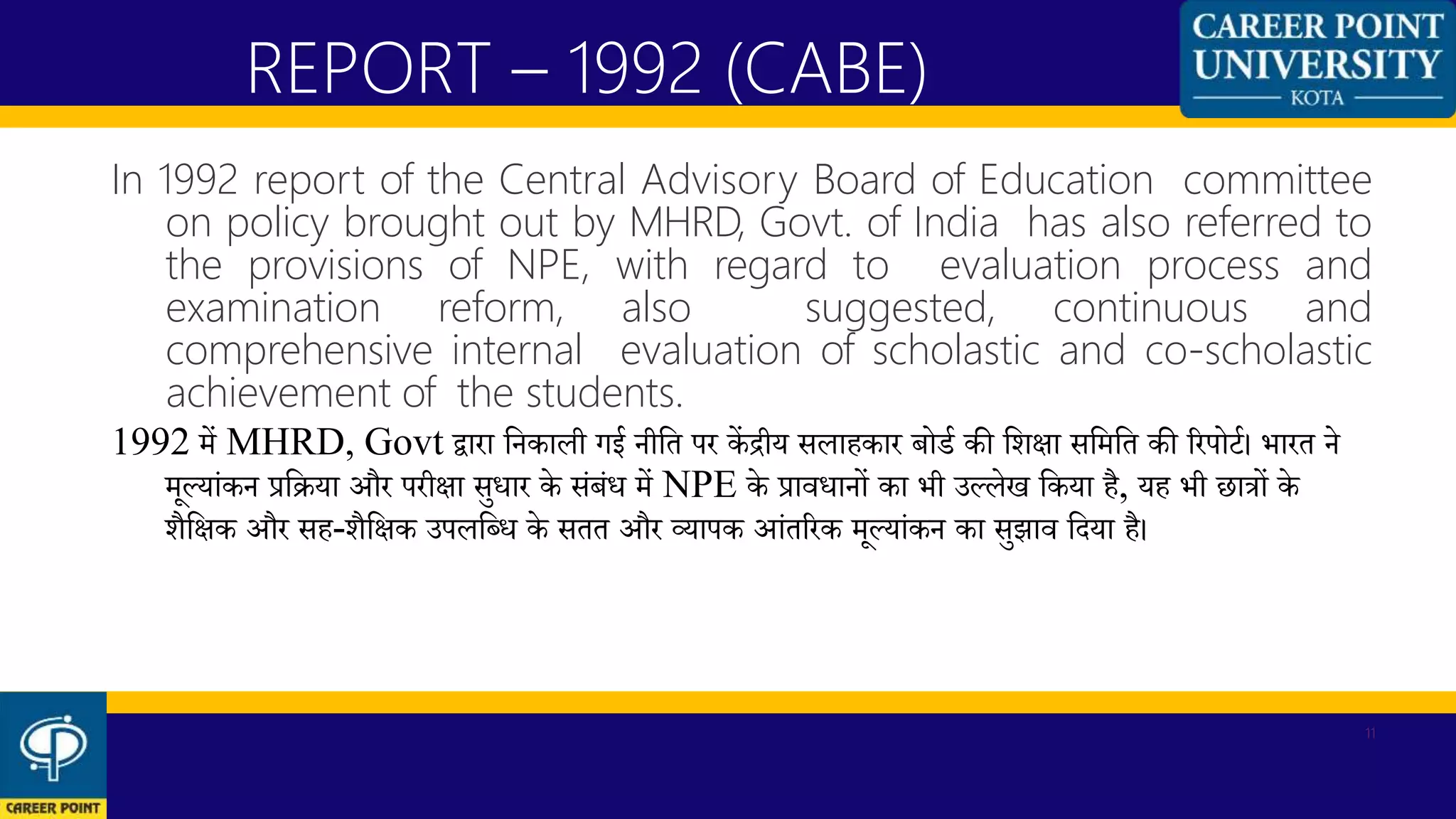
In 1992 report of the Central Advisory Board of Education committee
on policy brought out by MHRD, Govt. of India has also referred to
the provisions of NPE, with regard to evaluation process and
examination reform, also suggested, continuous and
comprehensive internal evaluation of scholastic and co-scholastic
achievement of the students.
1992 में MHRD, Govt द्वारा कनकाली गई नीकत पर कें द्रीय सलाहकार बोर्थ की कशिा सकमकत की ररपोर्थ। भारत ने
मूलयांकन प्रकिया और परीिा सुिार के संबंि में NPE के प्राविानों का भी उललेख ककया है, यह भी छात्रों के
शैकिक और सह-शैकिक उपलकब्ि के सतत और व्यापक आंतररक मूलयांकन का सुझाव कदया है।
REPORT – 1992 (CABE)
11
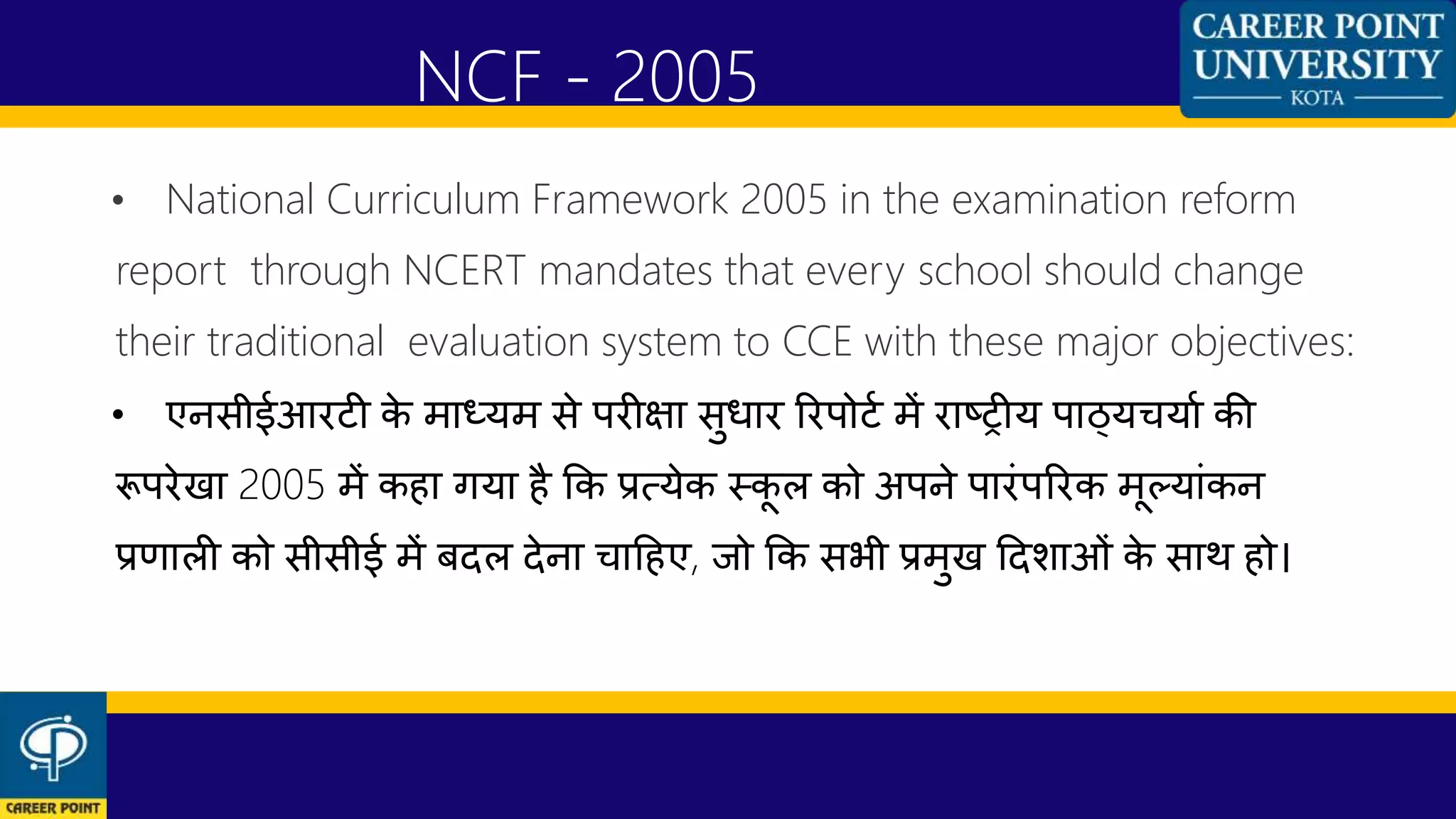
• National Curriculum Framework 2005 in the examination reform
report through NCERT mandates that every school should change
their traditional evaluation system to CCE with these major objectives:
• एनसीईआरटी के माध्यम से परीक्षा सुधार ररपोटण में राष्ट्रीय पाठ्यियाण की
रूपरेखा 2005 में कहा गया है कक प्रत्येक स्कू ल को अपने पारांपररक मूलयाांकन
प्रणाली को सीसीई में बदल देना िाहहए, जो कक सभी प्रमुख हदशाओां के साथ हो।
NCF - 2005
• बच्िों पर तनाि कम करें
• मूलयाांकन प्रणाली ननयशमत और व्यापक होनी िाहहए
• रिनात्मक शशक्षण के शलए शशक्षक के शलए स्थान प्रदान करें
• ननदान का एक उपकरण प्रदान करें और अधधक से अधधक कौशल के साथ सीखने का ननमाणण करें
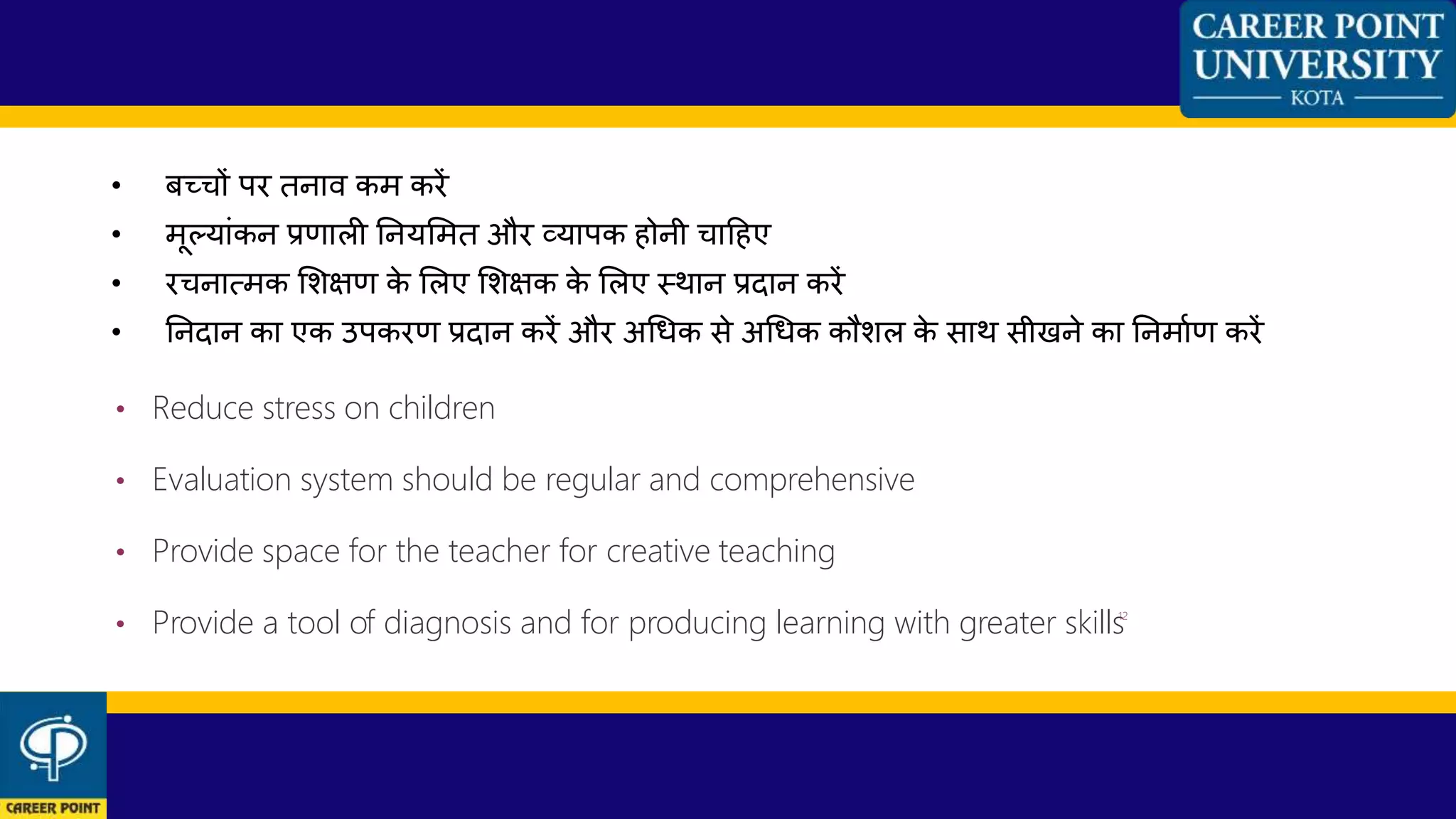
• Reduce stress on children
• Evaluation system should be regular and comprehensive
• Provide space for the teacher for creative teaching
• Provide a tool of diagnosis and for producing learning with greater skills12
18
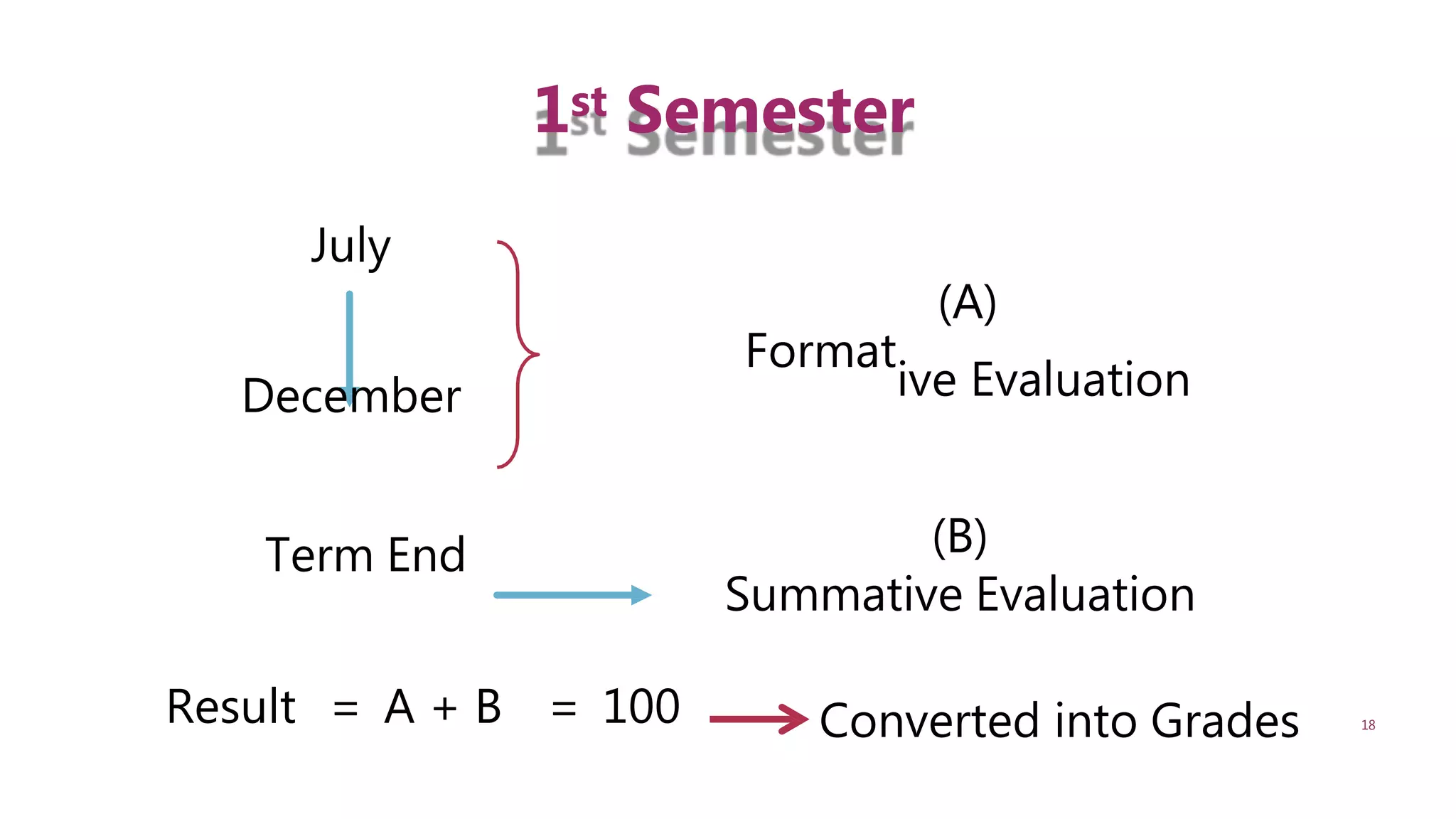
July
December
Term End
Result = A + B = 100
Format
(A)
ive Evaluation
(B)
Summative Evaluation
Converted into Grades
1st Semester
19
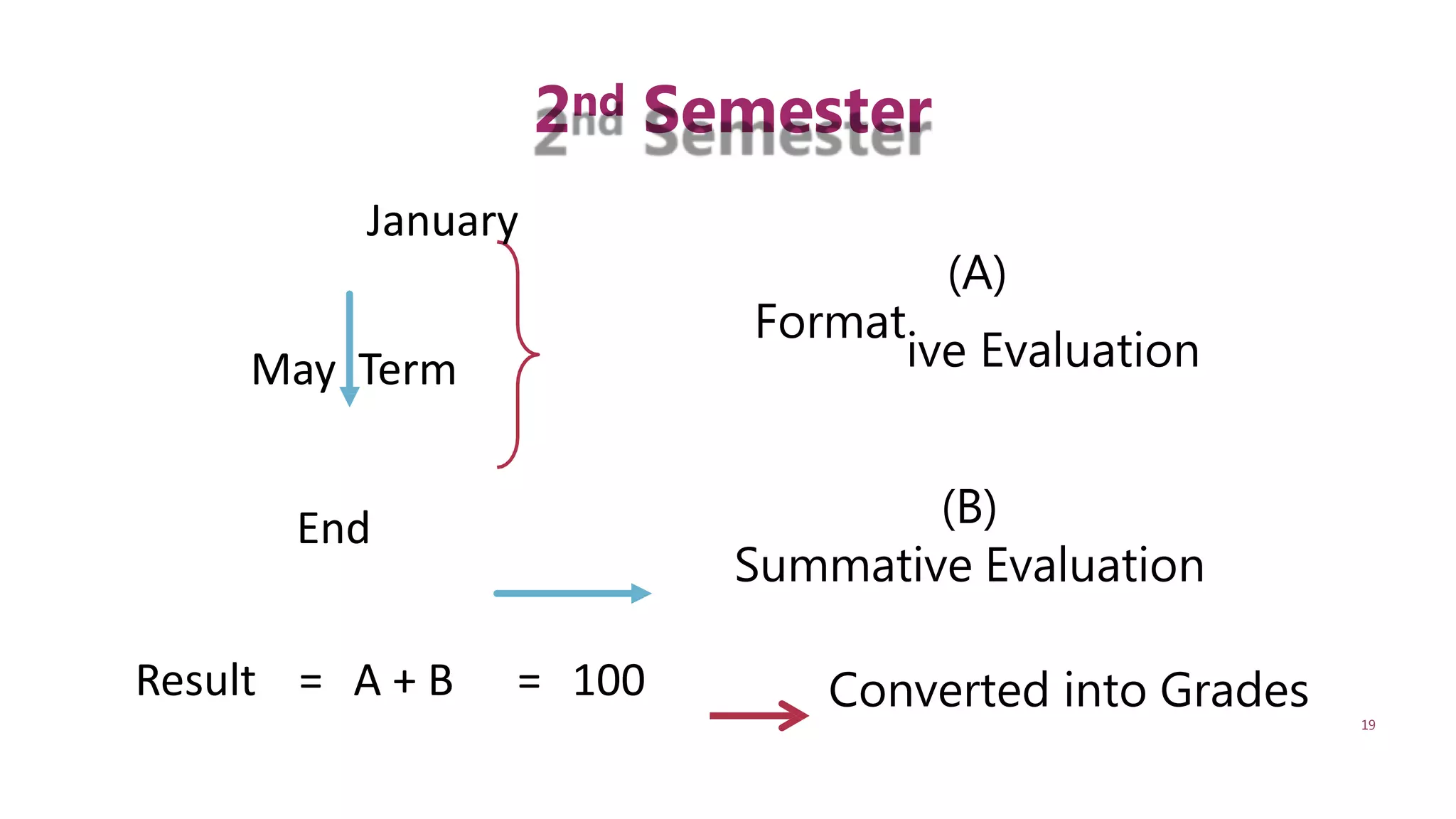
2nd Semester
January
May Term
End
Result = A + B = 100
Format
(A)
ive Evaluation
(B)
Summative Evaluation
Converted into Grades
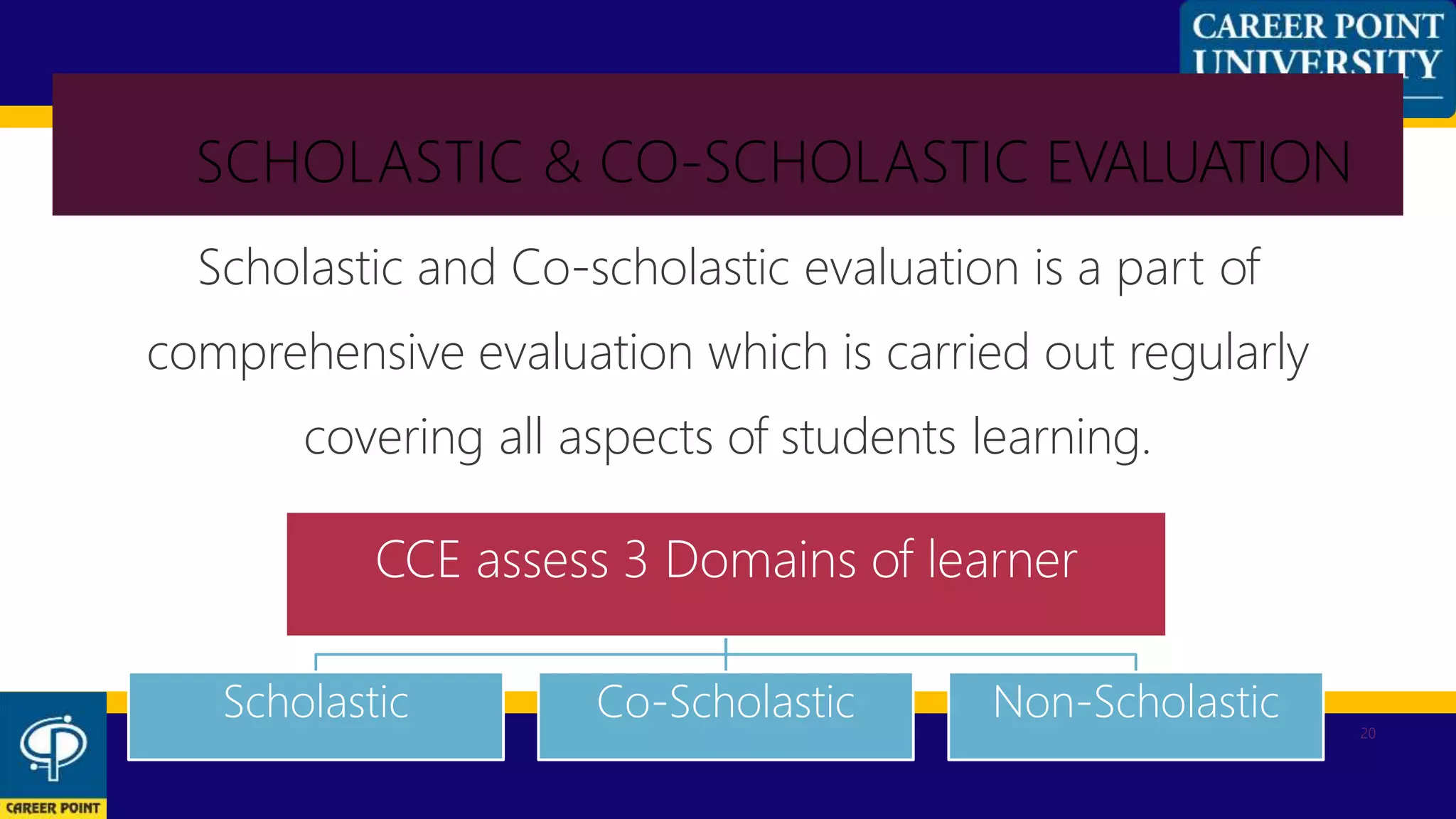
SCHOLASTIC & CO-SCHOLASTIC EVALUATION
20
Scholastic and Co-scholastic evaluation is a part of
comprehensive evaluation which is carried out regularly
covering all aspects of students learning.
CCE assess 3 Domains of learner
Scholastic Co-Scholastic Non-Scholastic
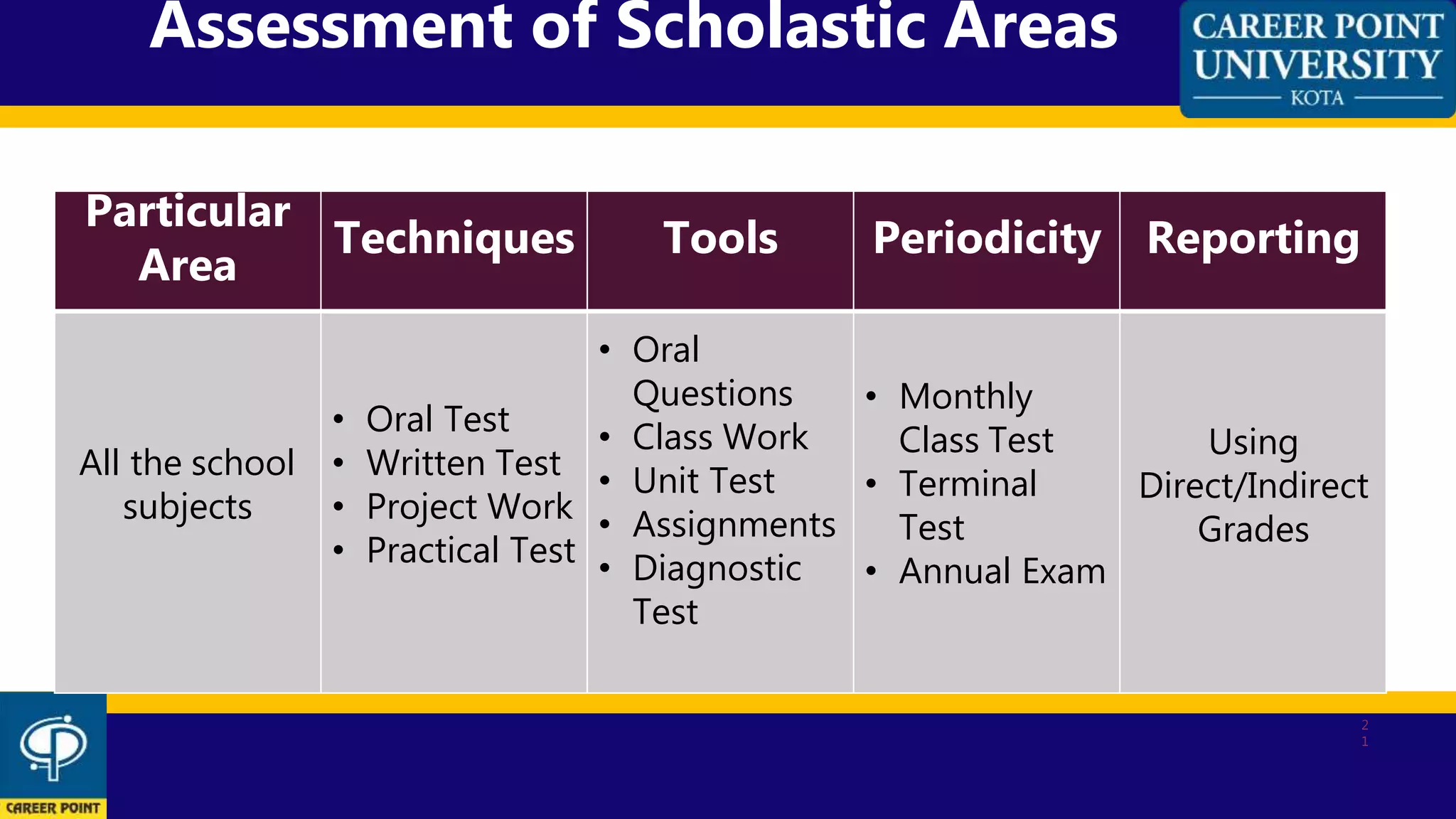
2
1
Particular
Area
Techniques Tools Periodicity Reporting
All the school
subjects
• Oral Test
• Written Test
• Project Work
• Practical Test
• Oral
Questions
• Class Work
• Unit Test
• Assignments
• Diagnostic
Test
• Monthly
Class Test
• Terminal
Test
• Annual Exam
Using
Direct/Indirect
Grades
Assessment of Scholastic Areas
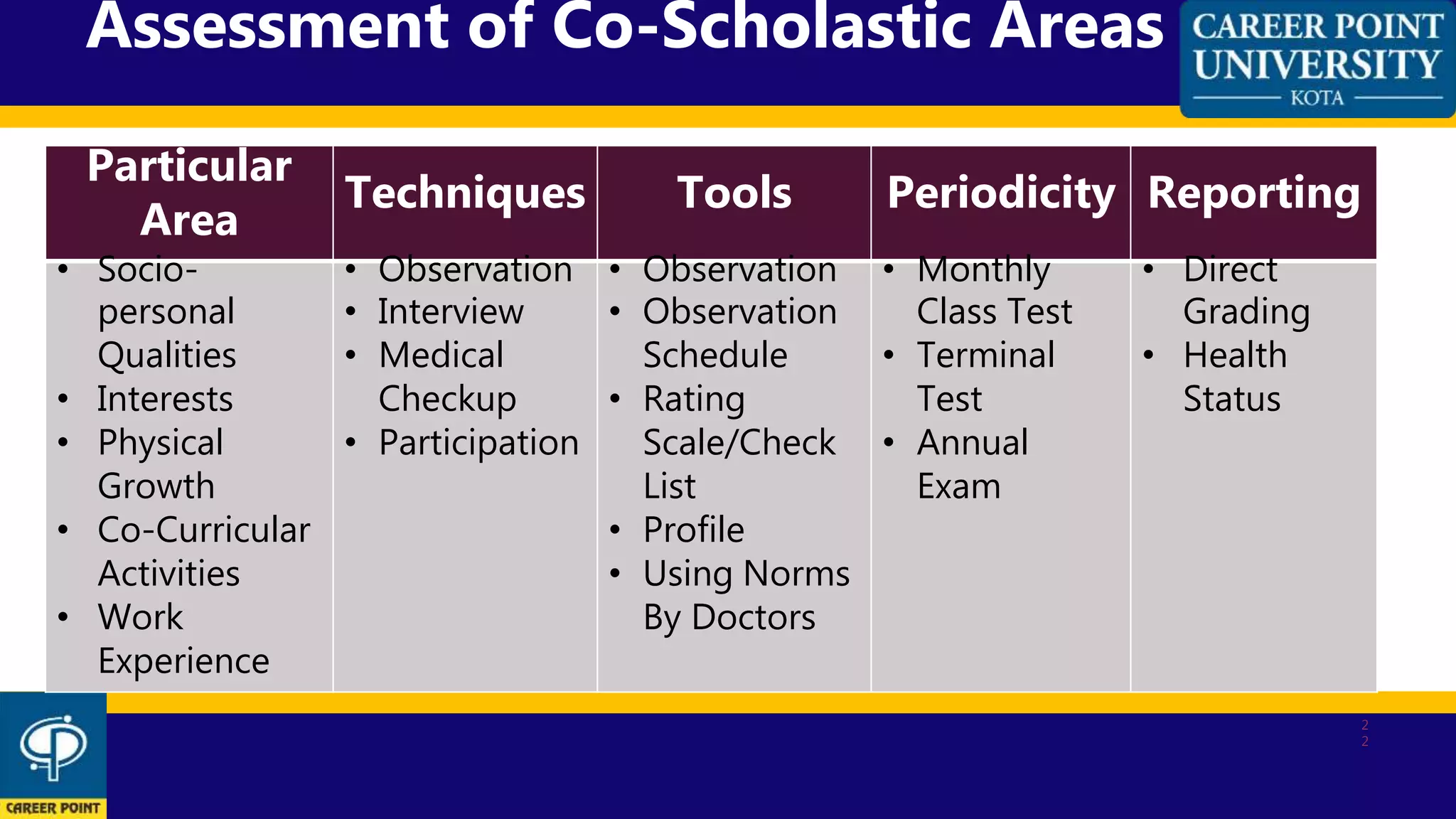
2
2
Particular
Area
Techniques Tools Periodicity Reporting
• Socio-
personal
Qualities
• Interests
• Physical
Growth
• Co-Curricular
Activities
• Work
Experience
• Observation
• Interview
• Medical
Checkup
• Participation
• Observation
• Observation
Schedule
• Rating
Scale/Check
List
• Profile
• Using Norms
By Doctors
• Monthly
Class Test
• Terminal
Test
• Annual
Exam
• Direct
Grading
• Health
Status
Assessment of Co-Scholastic Areas
• Assess the performance of the learner.
• Use variety of techniques to collect information about learners’
learning and progress in different subjects.
• Continuous collection and record of information.
• शशक्षाथी के प्रदशणन का आकलन करें।
• विशभन्न विियों में शशक्षाधथणयों के सीखने और प्रगनत के बारे में जानकारी एकत्र करने के
शलए विशभन्न तकनीकों का उपयोग करें।
• जानकारी का ननरांतर सांग्रह और ररकॉडण।
NEED OF CCE
23
• Give importance to every learner ’s way of responding and learning
and the time taken for learning.
• Provide feedback that will lead to positive action and help the
learners to do better.
• प्रनतसाद देने िाले और सीखने के हर तरीके और सीखने के समय को महत्ि दें।
• प्रनतकिया दें जो सकारात्मक कारणिाई को बढािा देगा और शशक्षाधथणयों को बेहतर
करने में मदद करेगा।
• It helps to develop the three domain skills of the learner
• i.e. cognitive, affective and psychomotor.
• It encourages the learners to develop their thought process in place of repetition learning or
memorization of things.
• It helps the learners to know that evaluation is an integral part of their teaching learning process.
यह सीखने वाले के तीन र्ोमेन कौशल कवककसत करने में मदद करता है
यानी संज्ञानात्मक, भावात्मक और मनोकवशेषज्ञ।
यह कशिाकर्थयों को दोहराव सीखने या चीजों को याद रखने के स्र्ान पर उनकी कवचार प्रकिया को कवककसत करने के कलए प्रोत्साकहत करता है।
यह सीखने वालों को यह जानने में मदद करता है कक मूलयांकन उनकी कशिण सीखने की प्रकिया का एक अकभन्न अंग है।
BENEFITS OF CCE
24
25
• It helps the learners to improve their achievement on the
basis of regular diagnosis followed by remedial measures.
• It helps the teachers to use evaluation as a quality control
devise to raise standards of performance.
• It takes decisions about the learner, learning process and
learning environment by determining social utility, desirability
and effectiveness of the program.
• It makes the teaching learning process a learner centered
• Teachers find it difficult to execute CCE in large classes as they are not able to give individual attention in
each class.
• There was lack of appropriate training among the school teachers for the smooth execution of CCE.
• शशक्षकों को बडी कक्षाओां में सीसीई को ननष्ट्पाहदत करना मुन्ककल लगता है क्योंकक िे प्रत्येक कक्षा में व्यन्क्तगत ध्यान देने में सक्षम
नहीां हैं।
• सीसीई के सुिारू ननष्ट्पादन के शलए स्कू ल के शशक्षकों के बीि उपयुक्त प्रशशक्षण का अभाि था।
• सीसीई के बारे में छात्रों में गांभीरता की कमी थी क्योंकक िे इस तथ्य से अिगत थे कक िे अकादशमक में पयाणतत प्रयास ककए बबना पास हो
जाएांगे
• There was a lack of seriousness among the students regarding CCE as they were aware of the fact that they will
pass without making enough effort in academic
PROBLEMS IN IMPLEMENTING CCE (SINGHAL – 2012):
.
26
• Many teachers stated that CCE was time consuming and there were many financial constrains
associated with it that does not suit the pocket of every student.
• Teachers felt that there was lack of adequate infrastructural facilities and teaching materials
that made execution of CCE a difficult task in the classroom.
• Most importantly, teachers were over burdened with the increased volume of work that affect their
teaching effectivenes2s7 in the classroom.
• कई कशिकों ने कहा कक सीसीई समय लेने वाला र्ा और इसके सार् कई कवत्तीय बािाएं जुडी हुई र्ीं जो हर छात्र की जेब पर कनभथर नहीं करतीं।
• कशिकों ने महसूस ककया कक पयाथप्त बुकनयादी सुकविाओं और कशिण सामग्री का अभाव र्ा, कजसने किा में सीसीई के कनष्पादन को ककिन कायथ बना कदया।
• सबसे महत्वपूणथ बात यह है कक कशिकों के काम की बढ़ती मात्रा के सार् उन पर बोझ र्ा जो किा में उनके कशिण प्रभाव को प्रभाकवत करते हैं।
• To give individual attention to students in large classes, the number of students in classes should not
be more than 30-40.
• To make the teachers aware about its proper implementation. They should provide proper training
through workshops and training programs.
• In Govt. schools proper infrastructure and teaching materials should also be provided to teachers to
facilitate their teaching learning process.
बडी किाओं में छात्रों पर व्यकिगत ध्यान देने के कलए, किाओं में छात्रों की संख्या 30-40 से अकिक नहीं होनी चाकहए।
इसके उकचत कायाथन्वयन के बारे में कशिकों को जागरूक करना। उन्हें कायथशालाओं और प्रकशिण कायथिमों के माध्यम से उकचत प्रकशिण देना चाकहए।
सरकार में। कशिकों को उनके कशिण अकिगम प्रकिया को सुकविाजनक बनाने के कलए स्कूलों को उकचत बुकनयादी ढााँचा और कशिण सामग्री भी प्रदान की जानी चाकहए।
SOLUTIONS FOR SMOOTH IMPLEMENTATION OF CCE
28
• For better knowledge, understanding, application and skill performance by the learners, careful
selection, specification and examination of the course should be there.
• शशक्षाधथणयों द्िारा बेहतर ज्ञान, समझ, आिेदन और कौशल प्रदशणन के शलए, पाठ्यिम का सािधानीपूिणक ियन, विननदेश
और परीक्षा होनी िाहहए।
• शशक्षाधथणयों की योग्यता के साथ-साथ व्यन्क्तत्ि लक्षण और दृन्ष्ट्टकोण का आकलन करने के शलए मानदांड व्यापक
आधाररत मूलयाांकन बेहतर है।
• अशभलेखों के रखरखाि के शलए शशक्षकों की वित्तीय आिकयकता होती है
• Criterion comprehensive based evaluation is better for assessing learners’ competencies as well as
personality traits and attitudes.
• 29
• For the maintenance of records teachers need financial
Thanks

Continuous and comprehensive evaluation सतत और व्यापक मूल्यांकन

  • 1.
    CONTINUOUS & COMPREHENSIVEEVALUATION By Dr. Abhishek srivastava
  • 2.
    Continuous and comprehensiveevaluation is a school based assessment with the coverage of all aspects of students’ development. सतत और व्यापक मूलयाांकन एक स्कू ल आधाररत मूलयाांकन है जो छात्रों के विकास के सभी पहलुओां की किरेज के साथ है। CONTINUOUS & COMPREHENSIVE EVALUATION 4
  • 3.
    The term “Continuous’defines that it puts stress on the process of evaluation in teaching learning and thus spread over the entire span of an academic session. "कां टीन्यूअस" शब्द पररभावित करता है कक यह शशक्षण शशक्षण में मूलयाांकन की प्रकिया पर जोर देता है और इस तरह यह एक शैक्षणणक सत्र के पूरे कालखांड में फै ल गया। छात्रों की िृद्धध और विकास के धिन्न्हत पहलुओां के मूलयाांकन पर जोर देने के शलए ननरांतर साधन यह एक घटना के बजाय एक सतत प्रकिया है, जो कु ल शशक्षण शशक्षण प्रकिया से सांबांधधत है। Continuous means to emphasize the evaluation of identified aspects of students’ growth and development. It is a continuous process rather than an event, related with the total teaching learning process. CONTINUOUS 5
  • 4.
    The term “comprehensive’means that it assesses the all-round development of the child’s personality which cover both the scholastic and co scholastic aspects of the child’s growth and development. "व्यापक 'शब्द का अर्थ है कक यह बच्चे के व्यकित्व के सवाांगीण कवकास का आकलन करता है जो बच्चे के कवकास और कवकास के शैकिक और सह-शैकिक दोनों पहलुओं को कवर करता है। COMPREHENSIVE 6
  • 5.
    To make evaluationan integral part of teaching-learning process. मूलयाांकन को शशक्षण-अधधगम प्रकिया का अशभन्न अांग बनाना। To use evaluation for improvement of students’ achievement through diagnosis and remediation. ननदान और उपिार के माध्यम से छात्रों की उपलन्ब्ध में सुधार के शलए मूलयाांकन का उपयोग करना। To make sound judgment and take timely decisions for learner ’s growth, learning process, learning pace and learning environment. ध्िनन ननणणय लेने और सीखने के विकास, सीखने की प्रकिया, सीखने की गनत और सीखने के िातािरण के शलए समय पर ननणणय लेने के शलए। OBJECTIVES OF CCE 7
  • 6.
    To maintain desiredstandard of attainment. To provide scope for self-evaluation. प्रान्तत के िाांनछत मानक बनाए रखने के शलए। स्ि-मूलयाांकन के शलए गुांजाइश प्रदान करने के शलए।
  • 7.
    • Examination isthe crucial process of our education system to determine the effectiveness of teaching learning process but today’s examination are not effective as they are to be in order to bring the quality improvement educational evaluation. Various committees and commissions like: • शशक्षण सीखने की प्रकिया की प्रभािशीलता को ननधाणररत करने के शलए परीक्षा हमारी शशक्षा प्रणाली की महत्िपूणण प्रकिया है, लेककन आज की परीक्षा प्रभािी नहीां है क्योंकक िे गुणित्ता में सुधार शैक्षक्षक मूलयाांकन लाने के शलए होनी िाहहए। विशभन्न सशमनतयााँ और आयोग जैसे: HISTORICAL BACKGROUND OF CCE . 8
  • 8.
    • सैडलर कमीशन(1917-19) • हाटोग कमेटी की ररपोटण (1929) • साजेंट ररपोटण (1944) • मुदशलयार आयोग (1952-53) • हांटर कमीशन (1982) • हमारी परीक्षा प्रणाली में बदलाि के शलए शसफाररश की है • Sadler Commission (1917-19) • Hartog Committee Report (1929) • Sargent Report (1944) • Mudaliar Commission (1952-53) • Hunter Commission (1982) • Have recommended for the change in our examination system
  • 9.
    “This internal assessmentor evaluation conducted by the schools is of greater significance and should be given equal importance. It should be comprehensive, evaluating all those aspects of students’ growth and development that are measured by the external examination and also those personality traits, interests and attitudes which cannot be assessed by it.” “स्कूलों द्वारा आयोकजत यह आंतररक मूलयांकन या मूलयांकन अकिक महत्व का है और इसे समान महत्व कदया जाना चाकहए। यह व्यापक होना चाकहए, जो छात्रों की वृकि और कवकास के उन सभी पहलुओं का मूलयांकन करता है कजन्हें बाहरी परीिा द्वारा मापा जाता है और उन व्यकित्व लिणों, रुकचयों और दृकिकोणों का मूलयांकन ककया जाता है कजन्हें इसके द्वारा मूलयांकन नहीं ककया जा सकता है। " EDUCATION COMMISSION (1964 – 66) 9
  • 10.
    “Continuous and ComprehensiveEvaluation that incorporates both scholastic and co-scholastic aspects of evaluation, spread over the span of instructional time.” "सतत और व्यापक मूलयांकन जो अनुदेशात्मक समय की अवकि में फैले हुए मूलयांकन के कवद्वानों और सह- कवद्वानों दोनों पहलुओं को शाकमल करता है।" THE NATIONAL POLICY ON EDUCATION - 1986 10
  • 11.
    In 1992 reportof the Central Advisory Board of Education committee on policy brought out by MHRD, Govt. of India has also referred to the provisions of NPE, with regard to evaluation process and examination reform, also suggested, continuous and comprehensive internal evaluation of scholastic and co-scholastic achievement of the students. 1992 में MHRD, Govt द्वारा कनकाली गई नीकत पर कें द्रीय सलाहकार बोर्थ की कशिा सकमकत की ररपोर्थ। भारत ने मूलयांकन प्रकिया और परीिा सुिार के संबंि में NPE के प्राविानों का भी उललेख ककया है, यह भी छात्रों के शैकिक और सह-शैकिक उपलकब्ि के सतत और व्यापक आंतररक मूलयांकन का सुझाव कदया है। REPORT – 1992 (CABE) 11
  • 12.
    • National CurriculumFramework 2005 in the examination reform report through NCERT mandates that every school should change their traditional evaluation system to CCE with these major objectives: • एनसीईआरटी के माध्यम से परीक्षा सुधार ररपोटण में राष्ट्रीय पाठ्यियाण की रूपरेखा 2005 में कहा गया है कक प्रत्येक स्कू ल को अपने पारांपररक मूलयाांकन प्रणाली को सीसीई में बदल देना िाहहए, जो कक सभी प्रमुख हदशाओां के साथ हो। NCF - 2005
  • 13.
    • बच्िों परतनाि कम करें • मूलयाांकन प्रणाली ननयशमत और व्यापक होनी िाहहए • रिनात्मक शशक्षण के शलए शशक्षक के शलए स्थान प्रदान करें • ननदान का एक उपकरण प्रदान करें और अधधक से अधधक कौशल के साथ सीखने का ननमाणण करें • Reduce stress on children • Evaluation system should be regular and comprehensive • Provide space for the teacher for creative teaching • Provide a tool of diagnosis and for producing learning with greater skills12
  • 14.
    18 July December Term End Result =A + B = 100 Format (A) ive Evaluation (B) Summative Evaluation Converted into Grades 1st Semester
  • 15.
    19 2nd Semester January May Term End Result= A + B = 100 Format (A) ive Evaluation (B) Summative Evaluation Converted into Grades
  • 16.
    SCHOLASTIC & CO-SCHOLASTICEVALUATION 20 Scholastic and Co-scholastic evaluation is a part of comprehensive evaluation which is carried out regularly covering all aspects of students learning. CCE assess 3 Domains of learner Scholastic Co-Scholastic Non-Scholastic
  • 17.
    2 1 Particular Area Techniques Tools PeriodicityReporting All the school subjects • Oral Test • Written Test • Project Work • Practical Test • Oral Questions • Class Work • Unit Test • Assignments • Diagnostic Test • Monthly Class Test • Terminal Test • Annual Exam Using Direct/Indirect Grades Assessment of Scholastic Areas
  • 18.
    2 2 Particular Area Techniques Tools PeriodicityReporting • Socio- personal Qualities • Interests • Physical Growth • Co-Curricular Activities • Work Experience • Observation • Interview • Medical Checkup • Participation • Observation • Observation Schedule • Rating Scale/Check List • Profile • Using Norms By Doctors • Monthly Class Test • Terminal Test • Annual Exam • Direct Grading • Health Status Assessment of Co-Scholastic Areas
  • 19.
    • Assess theperformance of the learner. • Use variety of techniques to collect information about learners’ learning and progress in different subjects. • Continuous collection and record of information. • शशक्षाथी के प्रदशणन का आकलन करें। • विशभन्न विियों में शशक्षाधथणयों के सीखने और प्रगनत के बारे में जानकारी एकत्र करने के शलए विशभन्न तकनीकों का उपयोग करें। • जानकारी का ननरांतर सांग्रह और ररकॉडण। NEED OF CCE 23
  • 20.
    • Give importanceto every learner ’s way of responding and learning and the time taken for learning. • Provide feedback that will lead to positive action and help the learners to do better. • प्रनतसाद देने िाले और सीखने के हर तरीके और सीखने के समय को महत्ि दें। • प्रनतकिया दें जो सकारात्मक कारणिाई को बढािा देगा और शशक्षाधथणयों को बेहतर करने में मदद करेगा।
  • 21.
    • It helpsto develop the three domain skills of the learner • i.e. cognitive, affective and psychomotor. • It encourages the learners to develop their thought process in place of repetition learning or memorization of things. • It helps the learners to know that evaluation is an integral part of their teaching learning process. यह सीखने वाले के तीन र्ोमेन कौशल कवककसत करने में मदद करता है यानी संज्ञानात्मक, भावात्मक और मनोकवशेषज्ञ। यह कशिाकर्थयों को दोहराव सीखने या चीजों को याद रखने के स्र्ान पर उनकी कवचार प्रकिया को कवककसत करने के कलए प्रोत्साकहत करता है। यह सीखने वालों को यह जानने में मदद करता है कक मूलयांकन उनकी कशिण सीखने की प्रकिया का एक अकभन्न अंग है। BENEFITS OF CCE 24
  • 22.
    25 • It helpsthe learners to improve their achievement on the basis of regular diagnosis followed by remedial measures. • It helps the teachers to use evaluation as a quality control devise to raise standards of performance. • It takes decisions about the learner, learning process and learning environment by determining social utility, desirability and effectiveness of the program. • It makes the teaching learning process a learner centered
  • 23.
    • Teachers findit difficult to execute CCE in large classes as they are not able to give individual attention in each class. • There was lack of appropriate training among the school teachers for the smooth execution of CCE. • शशक्षकों को बडी कक्षाओां में सीसीई को ननष्ट्पाहदत करना मुन्ककल लगता है क्योंकक िे प्रत्येक कक्षा में व्यन्क्तगत ध्यान देने में सक्षम नहीां हैं। • सीसीई के सुिारू ननष्ट्पादन के शलए स्कू ल के शशक्षकों के बीि उपयुक्त प्रशशक्षण का अभाि था। • सीसीई के बारे में छात्रों में गांभीरता की कमी थी क्योंकक िे इस तथ्य से अिगत थे कक िे अकादशमक में पयाणतत प्रयास ककए बबना पास हो जाएांगे • There was a lack of seriousness among the students regarding CCE as they were aware of the fact that they will pass without making enough effort in academic PROBLEMS IN IMPLEMENTING CCE (SINGHAL – 2012): . 26
  • 24.
    • Many teachersstated that CCE was time consuming and there were many financial constrains associated with it that does not suit the pocket of every student. • Teachers felt that there was lack of adequate infrastructural facilities and teaching materials that made execution of CCE a difficult task in the classroom. • Most importantly, teachers were over burdened with the increased volume of work that affect their teaching effectivenes2s7 in the classroom. • कई कशिकों ने कहा कक सीसीई समय लेने वाला र्ा और इसके सार् कई कवत्तीय बािाएं जुडी हुई र्ीं जो हर छात्र की जेब पर कनभथर नहीं करतीं। • कशिकों ने महसूस ककया कक पयाथप्त बुकनयादी सुकविाओं और कशिण सामग्री का अभाव र्ा, कजसने किा में सीसीई के कनष्पादन को ककिन कायथ बना कदया। • सबसे महत्वपूणथ बात यह है कक कशिकों के काम की बढ़ती मात्रा के सार् उन पर बोझ र्ा जो किा में उनके कशिण प्रभाव को प्रभाकवत करते हैं।
  • 25.
    • To giveindividual attention to students in large classes, the number of students in classes should not be more than 30-40. • To make the teachers aware about its proper implementation. They should provide proper training through workshops and training programs. • In Govt. schools proper infrastructure and teaching materials should also be provided to teachers to facilitate their teaching learning process. बडी किाओं में छात्रों पर व्यकिगत ध्यान देने के कलए, किाओं में छात्रों की संख्या 30-40 से अकिक नहीं होनी चाकहए। इसके उकचत कायाथन्वयन के बारे में कशिकों को जागरूक करना। उन्हें कायथशालाओं और प्रकशिण कायथिमों के माध्यम से उकचत प्रकशिण देना चाकहए। सरकार में। कशिकों को उनके कशिण अकिगम प्रकिया को सुकविाजनक बनाने के कलए स्कूलों को उकचत बुकनयादी ढााँचा और कशिण सामग्री भी प्रदान की जानी चाकहए। SOLUTIONS FOR SMOOTH IMPLEMENTATION OF CCE 28
  • 26.
    • For betterknowledge, understanding, application and skill performance by the learners, careful selection, specification and examination of the course should be there. • शशक्षाधथणयों द्िारा बेहतर ज्ञान, समझ, आिेदन और कौशल प्रदशणन के शलए, पाठ्यिम का सािधानीपूिणक ियन, विननदेश और परीक्षा होनी िाहहए। • शशक्षाधथणयों की योग्यता के साथ-साथ व्यन्क्तत्ि लक्षण और दृन्ष्ट्टकोण का आकलन करने के शलए मानदांड व्यापक आधाररत मूलयाांकन बेहतर है। • अशभलेखों के रखरखाि के शलए शशक्षकों की वित्तीय आिकयकता होती है • Criterion comprehensive based evaluation is better for assessing learners’ competencies as well as personality traits and attitudes. • 29 • For the maintenance of records teachers need financial
  • 27.