 The Government of India set-up this Commission by a
resolution in July, 1964 to give necessary advice to the
govt. to improve the quality and quantity of
education.
 The scope of the commission was very wide i.e all
issues and problems of Indian education from the
primary up to the university level.
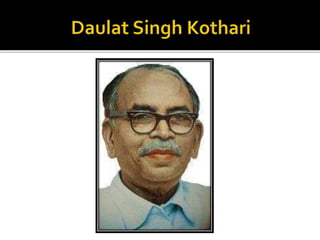
 Prof. D.S.Kothari, the chairman of the University
Grant Commission, New Delhi, was appointed as the
Chairman of the Commission.
 The commission consisted of seventeen members.
 The volumnous report consisting of about 900 pages
considered as the Magna Carta of Indian Education.
 The commissions clearly specified the five important
aims of educations in India.
 1.EDUCATION AND PRODUCTIVITY
• Science education as an integral part of school course.
•Work experience as an important aspect of general
educations.
•Vocational education especially at the secondary
school stage to meet the needs of industry, agriculture
and commerce.
• Improvement of scientific and technical education and
research at the university stage.
 2. SOCIAL AND NATIONAL INTEGRATION
 According to the commission common school system,
social service, NSS,NCC teaching languages,
Literatures, philosophy and history of India would go a
long way in promoting national integration.
 3. EDUCATION AND MODERNISATION
Another important aim of education is modernization.
Education should awaken curiosity, Interests,
Attitudes and sense of values and skills in the pupils.
 4. DEVELOPMENTOF DEMOCRASY
India is the largest democracy in the world. The
success of democracy depends upon the education
of the masses.
 5. SOCIAL AND SPIRITUALVALUES
Education system should emphasize the
development of fundamental, Social, Moral and
Spiritual values.
 Pre-school education otherwise known as pre-
primary education of one to three year which is not
mandatory.
 It is desirable to have at least one year of pre-
primary education for all children of age 5-6 years.
This stage will become preparatory for formal
school education.
 A 10 years period of general education which
may be sub-divided into a primary stage of 7 to 8
years (a lower primary stage of 4 to 5 years and
higher primary stage of 3 or 2 years) and a lower
secondary stage 3 or 2 years general education.
 Lower primary (upto to class V) absolutely free for
all and upper primary education (upto to Class
VIII) should also made free for all (In Tamil Nadu
this has been achieved decades ago).
 A higher secondary stage of 2 years (age group 16
to 18 years) of general education or one to three
years of vocational education (the enrolments in
vocational education being raised to 50% of the
total – the preparatory stage for Higher and
Professional Degree Education)
 Higher education stage having a course of 3
years and followed by courses of varying durations
for the post graduate and research degrees.
 The age of admission to class I should ordinarily be
not less than 6+.
 The first public external examination should come
at the end of the first ten years of schooling.
 The system of streaming in schools of general
education, no specialization be made till the end
of class X.
 Secondary schools should be of two types – High
schools providing a ten year course and higher
secondary schools providing a course of 12 years.
 Thus Kothari Education Commission’s Report
paved the way for adopting a uniform pattern of
education i.e 10+2+3 throughout India.
 Teachers have to play an important role in
improving the standard of education. Their
quantity, qualification and character should
be up to the mark. The socio-economic and
professional status of teachers must be
improved.
 Common school system of public education –
irrespective of caste, creed, community, religion,
economic conditions or social status.
 School should maintain adequate standards, no
tuition fee, meet the needs of average earning
parents.
 Uniform pattern of education is required for the
whole country so as to maintain common
standards in education in all provinces of the
country which will in turn be helpful for the easy
migration of pupils from one region to another.
 Secondary education should be vocationalized in
large measures, and enrolment in vocational
courses raised to 20% of the total enrolment at
the lower secondary stage and 50% of total
enrolment at the higher secondary stage by
1986.
 A variety of part time and full time facilities in
vocational education should be available at both
these stages to meet the needs of boys and girls, in
urban and rural areas.
 In the first 10 years of school education, work
experience should be included as an integral part of
the curriculum.
 There should be 10 years of general education,
followed by 2 years of higher secondary education
consisting of Academic and Vocational streams. At
least 50% of higher secondary students should be in
the vocational streams.
 The central government should provide special
grants to state governments in the centrally
sponsored sector for the vocationalization of
secondary education.
 Headmasters with constant enthusiasm to uplift
the quality of education provided, teachers highly
proficient in the subject content, quality text books
and other instructional materials and aids are the
other key factors for raising the educational
standards.
 Guidance and counselling should be regarded as
an integral part of education, meant for all
students and aimed at assisting the individual to
make decisions and judgments from time to time.
 TEXT BOOKS AND STUDY METERIALS
 A comprehensive programme of text book
production at national level should be
implemented.
 SCHOOL BUILDING
Since the accommodation in most of the school is
unsatisfactory the commission recommended the
construction of new school buildings keeping in
view the economy and local condition.
 Summer schools should be organized for talented
pupils, steps should be taken to diagnose the
causes for backwardness / underachievement and
to formulate and implement remedial programmes
within the school system.
 Evaluation: Evaluation is a continuous process,
forms an integral part of the total system of
education. It only measures the students outcome,
it helps to improve the teaching methods, which
improve the quality of education.
 Emphasis should also be laid on establishing
separate schools for girls, provision of
hostels and scholarships and part-time and
full time vocational courses.
 School curricula should be upgraded through
research in curriculum development undertaken
by university department of education, training
colleges, state institute of education and board of
school education.
 School should be given the freedom to device and
experiment with new curricula suited to their
needs.
 Ordinary and advanced curricula should be
prepared by state board of school education in all
subjects and introduced in a phased manner in
schools which fulfill certain conditions of staff and
facilities.
 The formation of Subject Teacher Association in
the different school subjects will help to stimulate
experimentation and in the upgrading of curricula.
 Hindi as the official language of the Union enjoys
an importance next only to that of mother tongue.
 A working knowledge of English will continue to
be an asset to students.
 The most suitable stage for learning three
languages in the lower secondary class (VIII-X).
 At no stage should the learning of four languages
be made compulsory.
 In the lower primary classes science teaching
should be related to the child’s environment .
 At the higher primary stage emphasis should be on
the acquisition of knowledge and the ability to
think logically, to draw conclusion and to make
decisions at a higher level
 A science corner in lower primary schools and
laboratory –cum-lecture room in higher primary
schools are the minimum essential requirements.
 At the lower secondary stage, science should be
developed as a discipline of the mind. The answer
concepts of physics, chemistry and biology and
the experimental approach to the learning of
science should be stressed.
 Science courses at un advanced level may be
provided for talented students in selected lower
secondary schools with necessary facilities of staff
and laboratory.
 Science teaching should be linked to agriculture
in rural areas and to technology in urban areas.
But the levels of attainment and avenues to higher
education should be the same in both types of
schools.
 Removing the isolation of Teacher Education from
University life.
 School of Education should be established in
selected universities to develop programmes in
teacher education and studies and research in
education, in collaboration with other university
disciplines .
 New Pattern of Education: 10+2+3
 Vocational education at Higher secondary level:
 Science EDUCATION:
 Textbook
 Revision of Pay scales for teachers:
 National and Social Services:
 Imp. of Curricula, methods of teaching, Evaluation:
 Quality ofTeachers:
 Correspondence Courses:
 National Institute of Educational Planning and
Administration
 National Policy 1968
 The Indian Commission has been presented
highlighting the national goals of education, and
means of achieving them, the recommendation
uniform educational pattern, vocationalisation of
education, problems in teacher education, girls
education etc highlighted in the report. The
suggestions and recommendations which helped
us to improve the standard of Indian education
system.

Kothari education commission's report

  • 3.
     The Governmentof India set-up this Commission by a resolution in July, 1964 to give necessary advice to the govt. to improve the quality and quantity of education.  The scope of the commission was very wide i.e all issues and problems of Indian education from the primary up to the university level.  Prof. D.S.Kothari, the chairman of the University Grant Commission, New Delhi, was appointed as the Chairman of the Commission.  The commission consisted of seventeen members.  The volumnous report consisting of about 900 pages considered as the Magna Carta of Indian Education.
  • 4.
     The commissionsclearly specified the five important aims of educations in India.  1.EDUCATION AND PRODUCTIVITY • Science education as an integral part of school course. •Work experience as an important aspect of general educations. •Vocational education especially at the secondary school stage to meet the needs of industry, agriculture and commerce. • Improvement of scientific and technical education and research at the university stage.
  • 5.
     2. SOCIALAND NATIONAL INTEGRATION  According to the commission common school system, social service, NSS,NCC teaching languages, Literatures, philosophy and history of India would go a long way in promoting national integration.  3. EDUCATION AND MODERNISATION Another important aim of education is modernization. Education should awaken curiosity, Interests, Attitudes and sense of values and skills in the pupils.
  • 6.
     4. DEVELOPMENTOFDEMOCRASY India is the largest democracy in the world. The success of democracy depends upon the education of the masses.  5. SOCIAL AND SPIRITUALVALUES Education system should emphasize the development of fundamental, Social, Moral and Spiritual values.
  • 7.
     Pre-school educationotherwise known as pre- primary education of one to three year which is not mandatory.  It is desirable to have at least one year of pre- primary education for all children of age 5-6 years. This stage will become preparatory for formal school education.  A 10 years period of general education which may be sub-divided into a primary stage of 7 to 8 years (a lower primary stage of 4 to 5 years and higher primary stage of 3 or 2 years) and a lower secondary stage 3 or 2 years general education.
  • 8.
     Lower primary(upto to class V) absolutely free for all and upper primary education (upto to Class VIII) should also made free for all (In Tamil Nadu this has been achieved decades ago).  A higher secondary stage of 2 years (age group 16 to 18 years) of general education or one to three years of vocational education (the enrolments in vocational education being raised to 50% of the total – the preparatory stage for Higher and Professional Degree Education)
  • 9.
     Higher educationstage having a course of 3 years and followed by courses of varying durations for the post graduate and research degrees.  The age of admission to class I should ordinarily be not less than 6+.  The first public external examination should come at the end of the first ten years of schooling.  The system of streaming in schools of general education, no specialization be made till the end of class X.
  • 10.
     Secondary schoolsshould be of two types – High schools providing a ten year course and higher secondary schools providing a course of 12 years.  Thus Kothari Education Commission’s Report paved the way for adopting a uniform pattern of education i.e 10+2+3 throughout India.
  • 11.
     Teachers haveto play an important role in improving the standard of education. Their quantity, qualification and character should be up to the mark. The socio-economic and professional status of teachers must be improved.
  • 12.
     Common schoolsystem of public education – irrespective of caste, creed, community, religion, economic conditions or social status.  School should maintain adequate standards, no tuition fee, meet the needs of average earning parents.  Uniform pattern of education is required for the whole country so as to maintain common standards in education in all provinces of the country which will in turn be helpful for the easy migration of pupils from one region to another.
  • 13.
     Secondary educationshould be vocationalized in large measures, and enrolment in vocational courses raised to 20% of the total enrolment at the lower secondary stage and 50% of total enrolment at the higher secondary stage by 1986.  A variety of part time and full time facilities in vocational education should be available at both these stages to meet the needs of boys and girls, in urban and rural areas.
  • 14.
     In thefirst 10 years of school education, work experience should be included as an integral part of the curriculum.  There should be 10 years of general education, followed by 2 years of higher secondary education consisting of Academic and Vocational streams. At least 50% of higher secondary students should be in the vocational streams.  The central government should provide special grants to state governments in the centrally sponsored sector for the vocationalization of secondary education.
  • 15.
     Headmasters withconstant enthusiasm to uplift the quality of education provided, teachers highly proficient in the subject content, quality text books and other instructional materials and aids are the other key factors for raising the educational standards.  Guidance and counselling should be regarded as an integral part of education, meant for all students and aimed at assisting the individual to make decisions and judgments from time to time.
  • 16.
     TEXT BOOKSAND STUDY METERIALS  A comprehensive programme of text book production at national level should be implemented.  SCHOOL BUILDING Since the accommodation in most of the school is unsatisfactory the commission recommended the construction of new school buildings keeping in view the economy and local condition.
  • 17.
     Summer schoolsshould be organized for talented pupils, steps should be taken to diagnose the causes for backwardness / underachievement and to formulate and implement remedial programmes within the school system.  Evaluation: Evaluation is a continuous process, forms an integral part of the total system of education. It only measures the students outcome, it helps to improve the teaching methods, which improve the quality of education.
  • 18.
     Emphasis shouldalso be laid on establishing separate schools for girls, provision of hostels and scholarships and part-time and full time vocational courses.
  • 19.
     School curriculashould be upgraded through research in curriculum development undertaken by university department of education, training colleges, state institute of education and board of school education.  School should be given the freedom to device and experiment with new curricula suited to their needs.
  • 20.
     Ordinary andadvanced curricula should be prepared by state board of school education in all subjects and introduced in a phased manner in schools which fulfill certain conditions of staff and facilities.  The formation of Subject Teacher Association in the different school subjects will help to stimulate experimentation and in the upgrading of curricula.
  • 21.
     Hindi asthe official language of the Union enjoys an importance next only to that of mother tongue.  A working knowledge of English will continue to be an asset to students.  The most suitable stage for learning three languages in the lower secondary class (VIII-X).  At no stage should the learning of four languages be made compulsory.
  • 22.
     In thelower primary classes science teaching should be related to the child’s environment .  At the higher primary stage emphasis should be on the acquisition of knowledge and the ability to think logically, to draw conclusion and to make decisions at a higher level  A science corner in lower primary schools and laboratory –cum-lecture room in higher primary schools are the minimum essential requirements.
  • 23.
     At thelower secondary stage, science should be developed as a discipline of the mind. The answer concepts of physics, chemistry and biology and the experimental approach to the learning of science should be stressed.  Science courses at un advanced level may be provided for talented students in selected lower secondary schools with necessary facilities of staff and laboratory.
  • 24.
     Science teachingshould be linked to agriculture in rural areas and to technology in urban areas. But the levels of attainment and avenues to higher education should be the same in both types of schools.
  • 25.
     Removing theisolation of Teacher Education from University life.  School of Education should be established in selected universities to develop programmes in teacher education and studies and research in education, in collaboration with other university disciplines .
  • 26.
     New Patternof Education: 10+2+3  Vocational education at Higher secondary level:  Science EDUCATION:  Textbook  Revision of Pay scales for teachers:  National and Social Services:  Imp. of Curricula, methods of teaching, Evaluation:  Quality ofTeachers:  Correspondence Courses:  National Institute of Educational Planning and Administration  National Policy 1968
  • 27.
     The IndianCommission has been presented highlighting the national goals of education, and means of achieving them, the recommendation uniform educational pattern, vocationalisation of education, problems in teacher education, girls education etc highlighted in the report. The suggestions and recommendations which helped us to improve the standard of Indian education system.