Sarva Shiksha Abhiyaan (SSA) Dr. C.Thanavathi
 It is part of the universalization of elementary education.
 Launched by the Government Of India in 2002.
 Its aim to provide useful and relevant
elementary education for all children in the 6 to 14 age
group range by
2010.
 This program has time-bound objectives.
 SSA is an effort to improve the performance of the school
system. It aims to provide quality elementary education
with community involvement.
What is SSA
 It aspires to bridge gender and social disparities in
elementary education.
 It has a special focus on the educational needs of girls,
SCs, STs, children with disabilities and disadvantaged
children.
 It covers other programs like District Primary Education,
Lok Jumbish, Operation Blackboard, etc.
 SSA would not disturb existing structures of education
in states and districts.
Sarva Shiksha Abhiyan (SSA) is a comprehensive and integrated flagship programme of Government of India to attain Universal
Elementary Education (UEE), covering the entire country in a mission mode. SSA has been launched in 2001-2002 in
partnership with the State Governments and Local Self Governments. The programme aims to provide useful and
relevant, elementary education to all children in the 6 to 14 age group by 2010.
Genesis of SSA
After the adoption of the National Policy on Education 1986, the Central Government launched several schemes for the
elementary education sector, and also some of these schemes covered most parts of the country. However, all these schemes, such
as OB, Teacher Education, NFE, DPEP and the MDM programme were specific intervention programmes, not a programme for
universalising elementary education in the country.
A conference of the State Education Ministers held on 23 October 1998 recommended that should be pursued in a mission
mode with full collaboration between the Central and State governments.
In 1999, a Committee comprised with state education minister under the chairmanship of UMHRD, Murli Manhoar joshi was set
up to discuss the measure to achieve the UEE.
The committee took the decision to implement UEE in mission mode and time bound framework. The multi programme
approach should be avoid and a holistic approach should be developed.
in 2001, the Central Government launched the SSA as the first ever nationwide programme for achieving UEE within a
prescribed time frame.
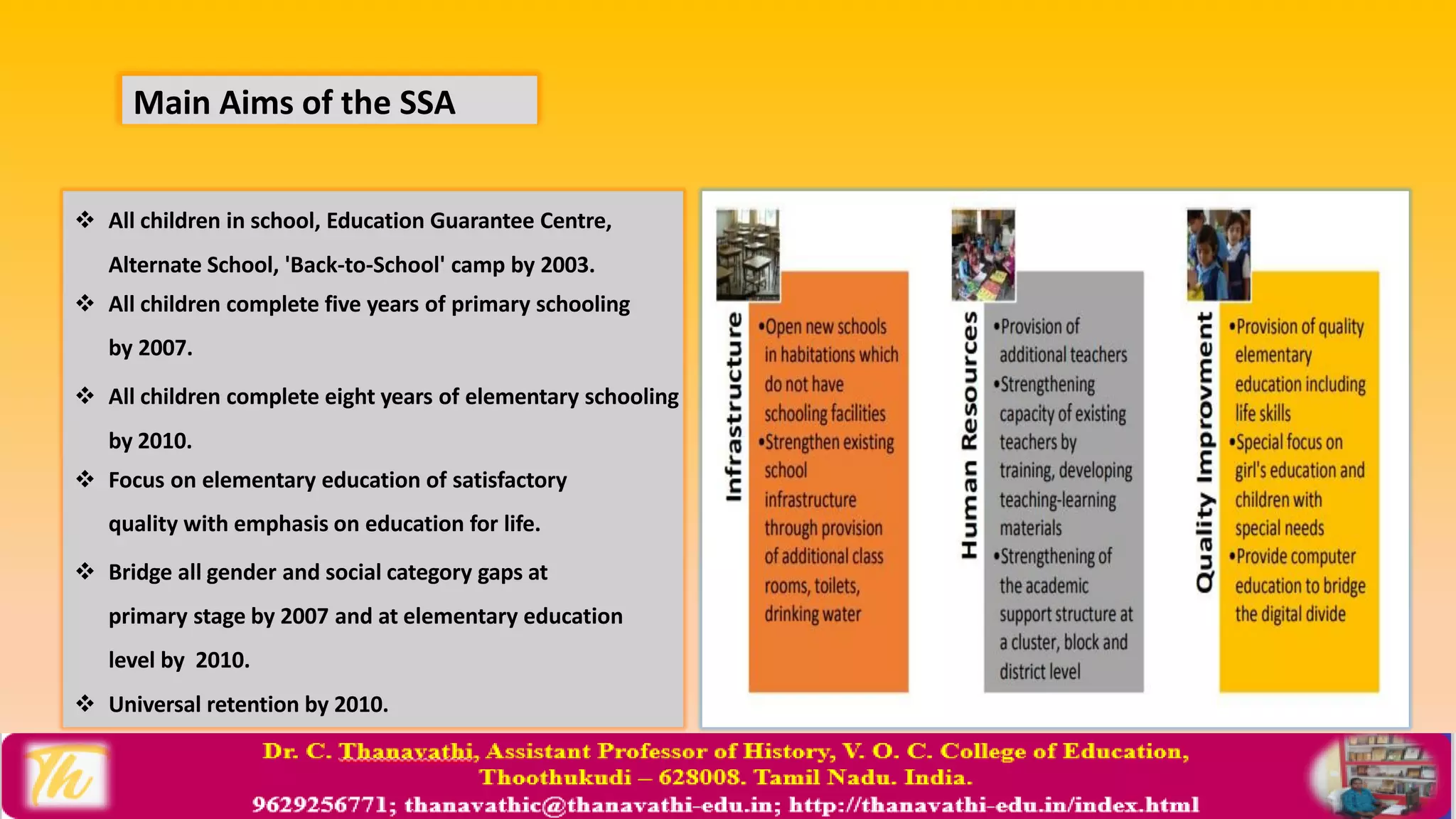
Main Aims of the SSA
 All children in school, Education Guarantee Centre,
Alternate School, 'Back-to-School' camp by 2003.
 All children complete five years of primary schooling
by 2007.
 All children complete eight years of elementary schooling
by 2010.
 Focus on elementary education of satisfactory
quality with emphasis on education for life.
 Bridge all gender and social category gaps at
primary stage by 2007 and at elementary education
level by 2010.
 Universal retention by 2010.
1. all children in school, Education Guarantee Centre, Alternative School, ‘Back-to-School’ camp by 2003
(later amended to 2005);
2. all children complete five years of primary schooling by 2007;
3. all children complete eight years of elementary schooling by 2010;
4. focus on elementary education of satisfactory quality with emphasis on education for life;
5. bridge all gender and social category gaps at the primary and upper primary stage by 2007; and
6. universal retention by 2010.
Objectives of SSA
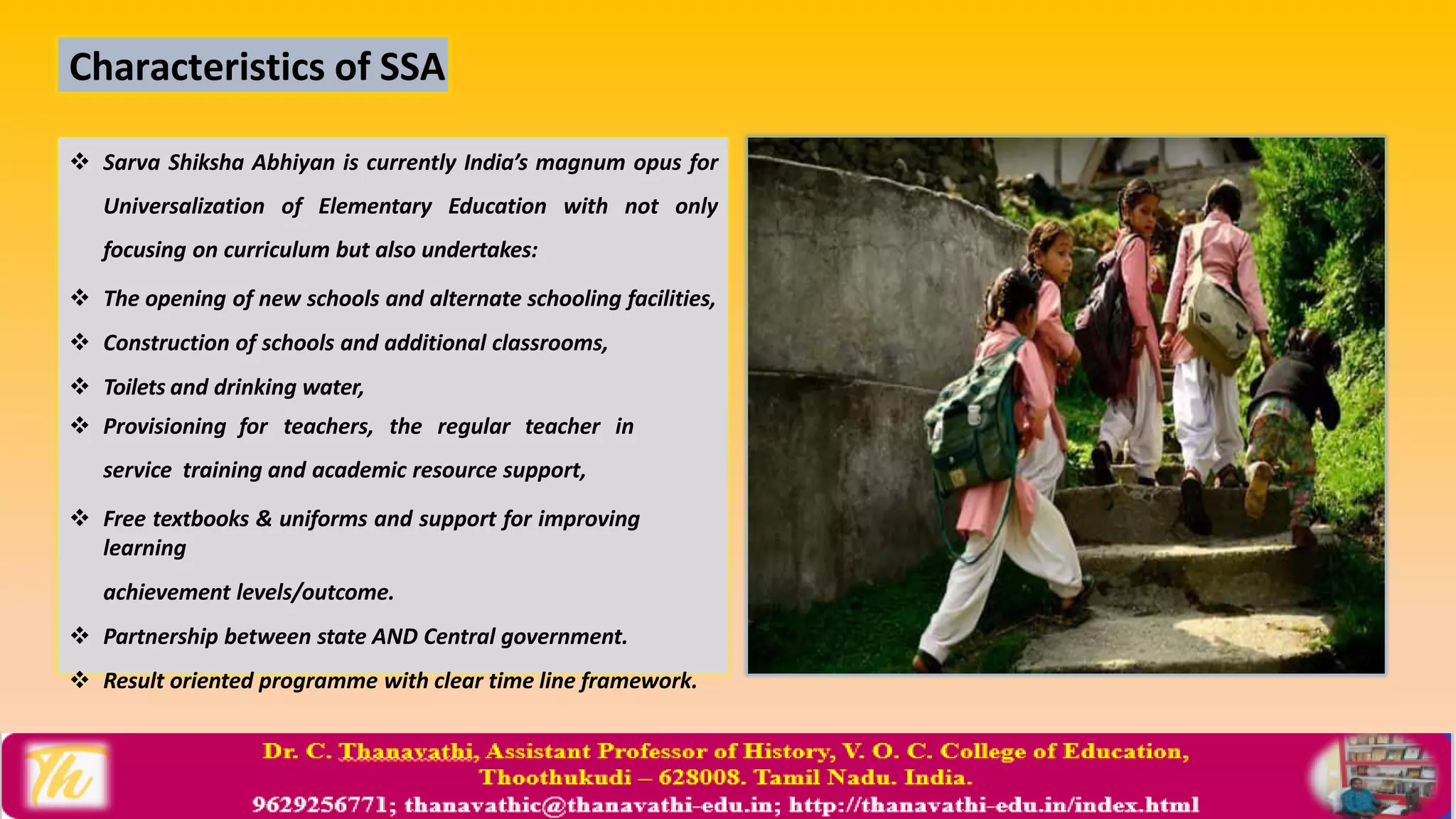
 Sarva Shiksha Abhiyan is currently India’s magnum opus for
Universalization of Elementary Education with not only
focusing on curriculum but also undertakes:
 The opening of new schools and alternate schooling facilities,
 Construction of schools and additional classrooms,
 Toilets and drinking water,
 Provisioning for teachers, the regular teacher in
service training and academic resource support,
 Free textbooks & uniforms and support for improving
learning
achievement levels/outcome.
 Partnership between state AND Central government.
 Result oriented programme with clear time line framework.
Characteristics of SSA
Major Areas of Interventions in SSA
 Education of out-of-school children
(Educational Guarantee Scheme and
Alternative & Innovative Education)
 Quality Improvement
 Special Focus Groups
 Research and Evaluation
 Management Structure and Institutional Capacity
Building
 Community Mobilization
 Civil Works
 Monitoring and MIS
 Financial Management and Procurement
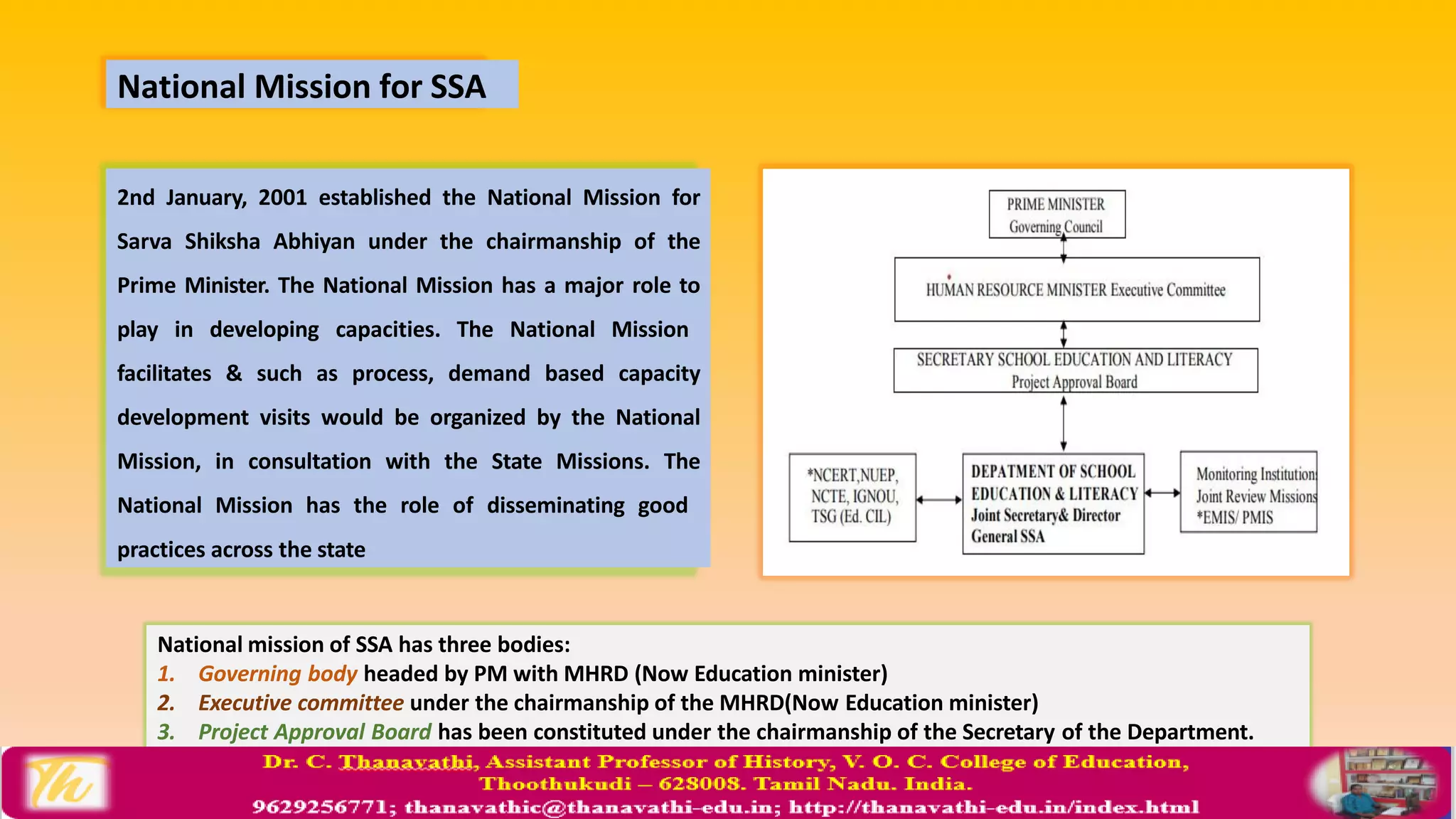
National Mission for SSA
2nd January, 2001 established the National Mission for
Sarva Shiksha Abhiyan under the chairmanship of the
Prime Minister. The National Mission has a major role to
play in developing capacities. The National Mission
facilitates & such as process, demand based capacity
development visits would be organized by the National
Mission, in consultation with the State Missions. The
National Mission has the role of disseminating good
practices across the state
National mission of SSA has three bodies:
1. Governing body headed by PM with MHRD (Now Education minister)
2. Executive committee under the chairmanship of the MHRD(Now Education minister)
3. Project Approval Board has been constituted under the chairmanship of the Secretary of the Department.
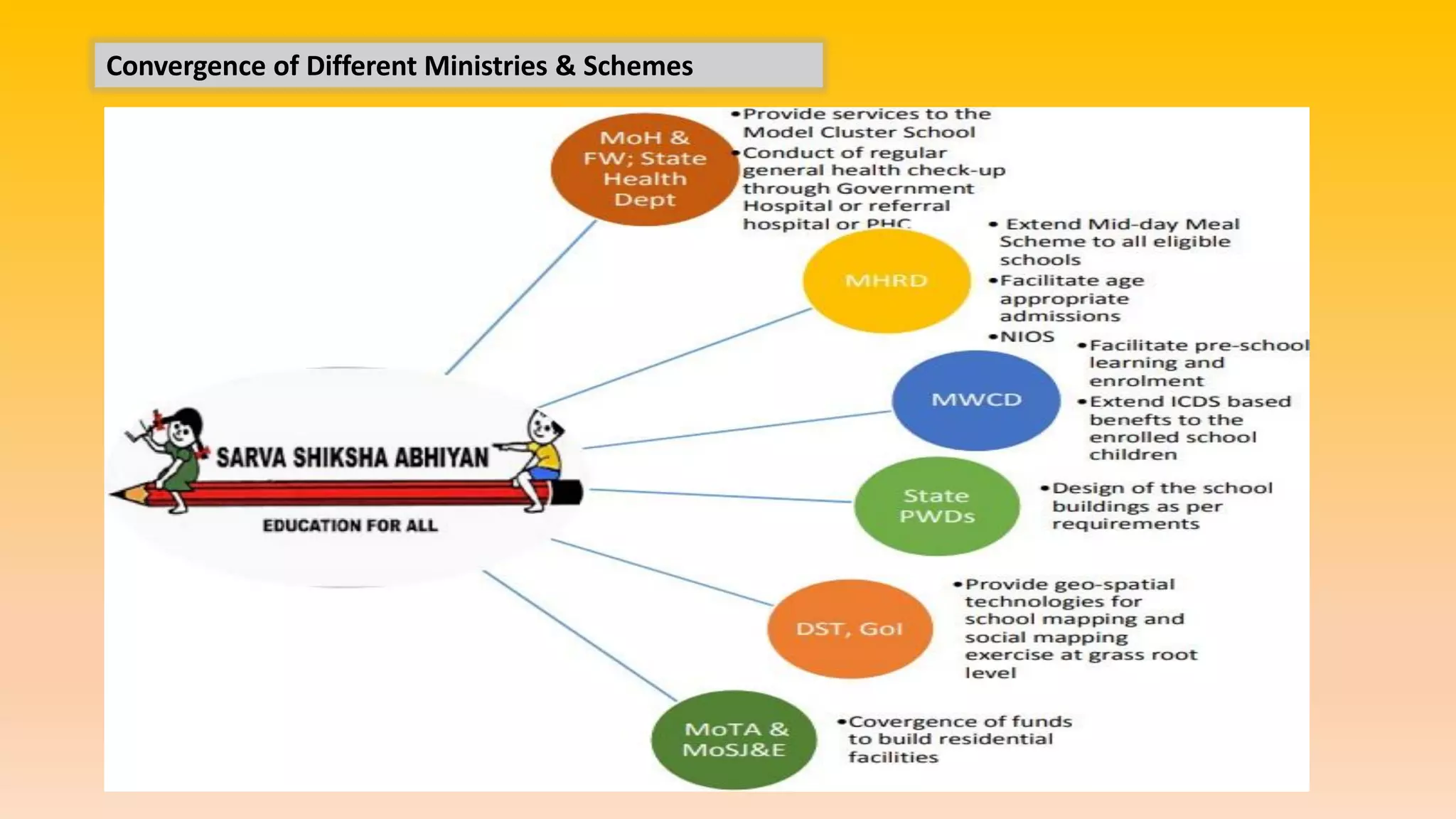
Convergence of Different Ministries & Schemes
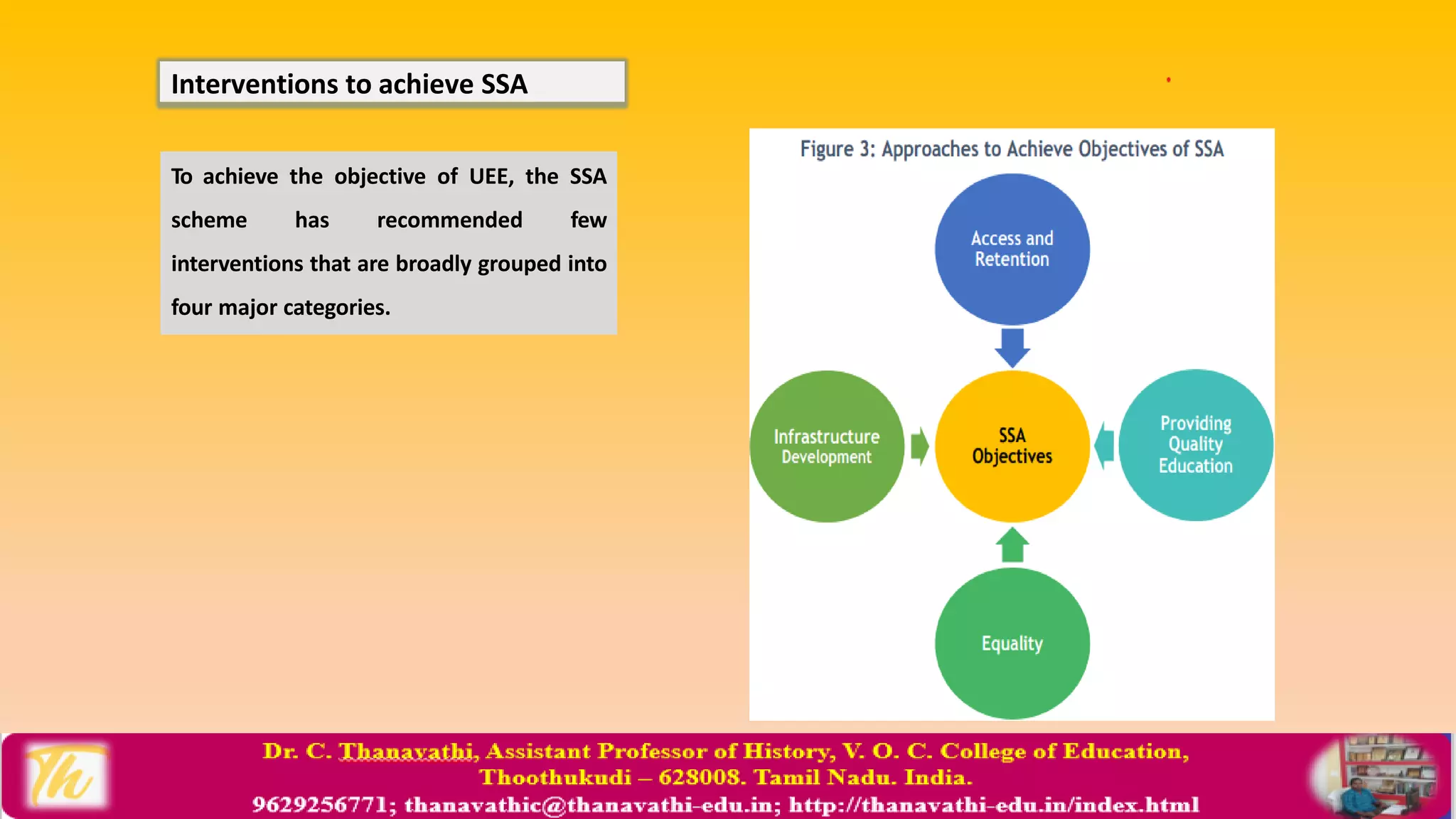
To achieve the objective of UEE, the SSA
scheme has recommended few
interventions that are broadly grouped into
four major categories.
Interventions to achieve SSA
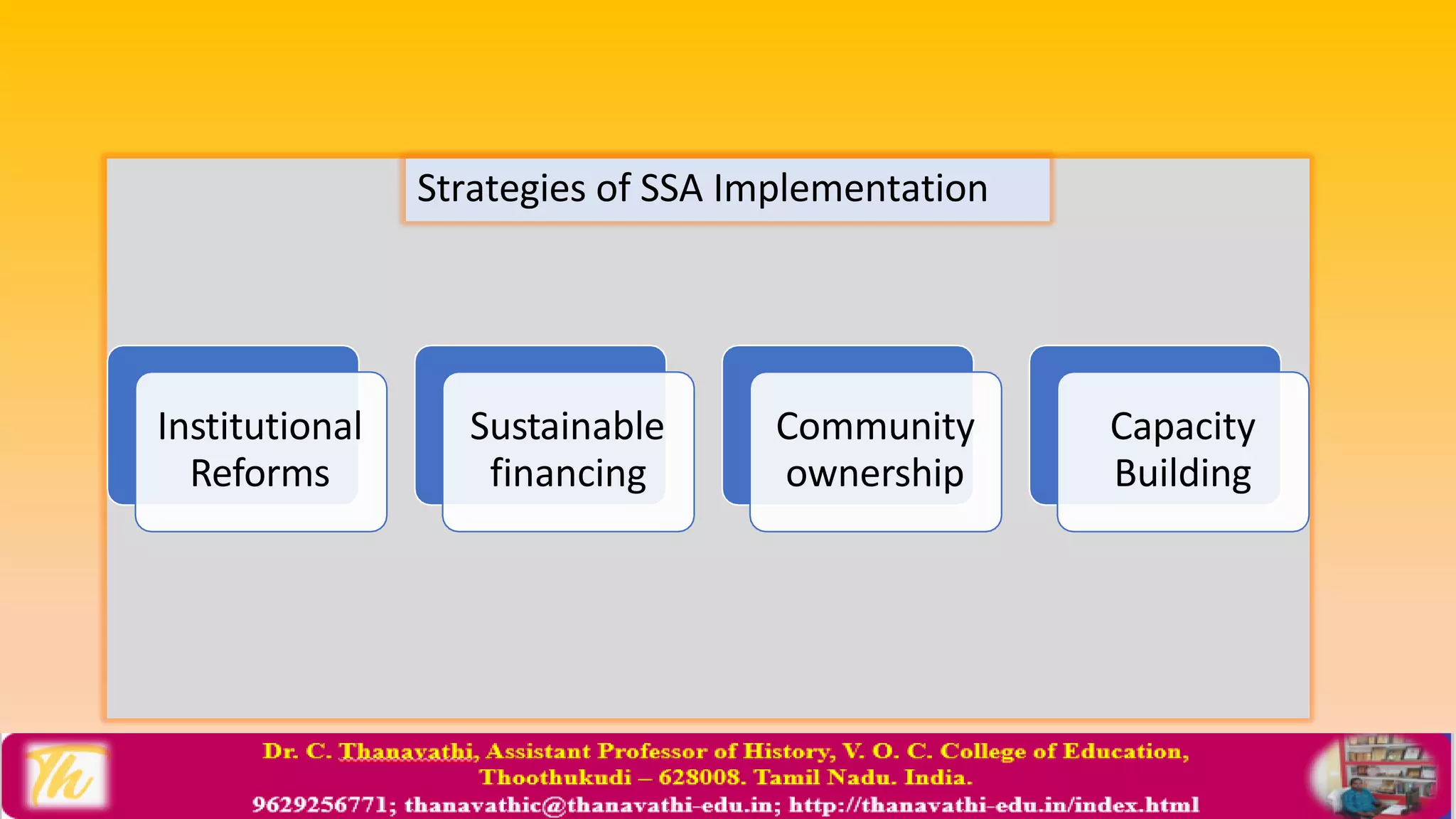
Institutional
Reforms
Sustainable
financing
Community
ownership
Capacity
Building
Strategies of SSA Implementation
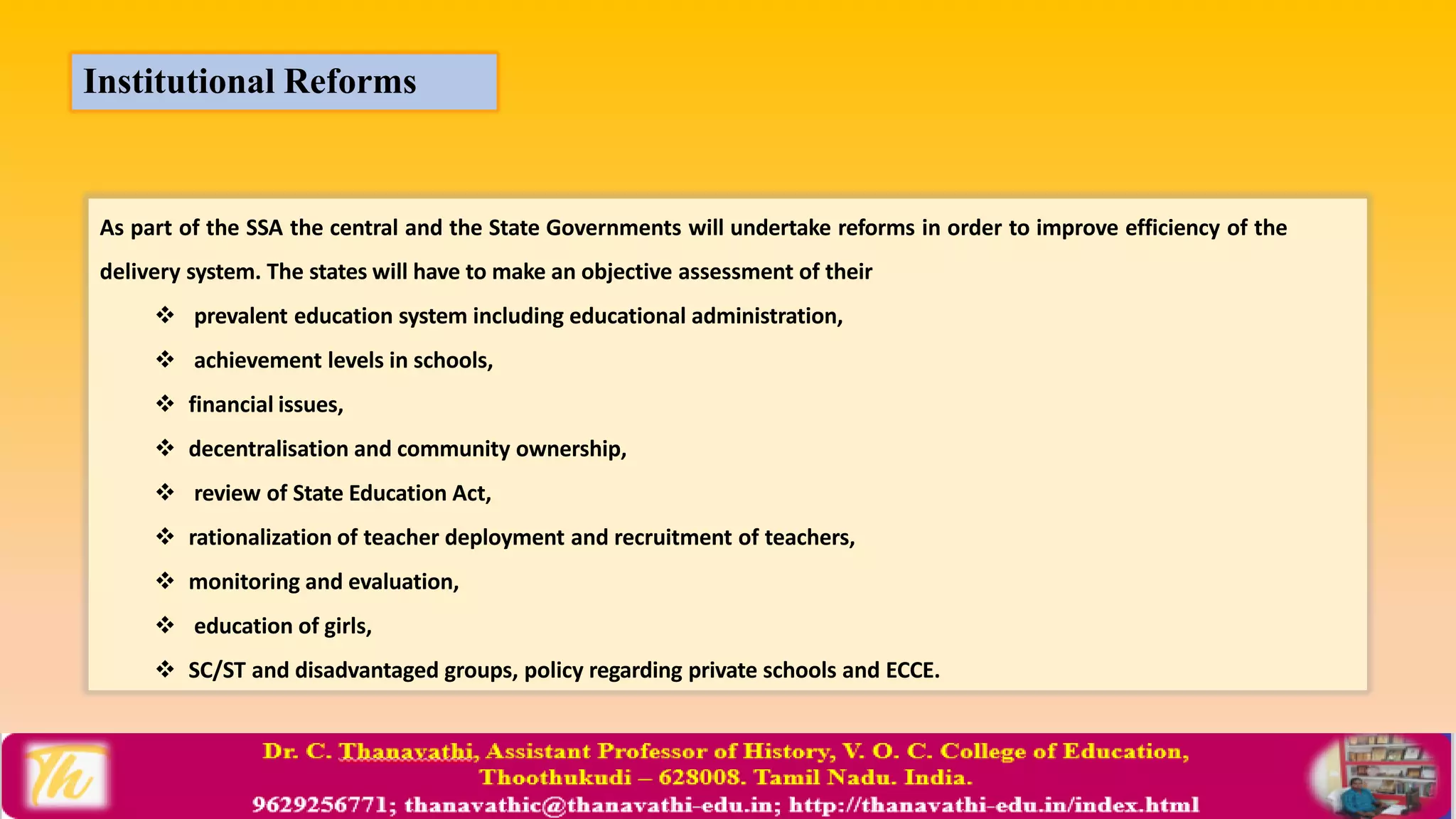
As part of the SSA the central and the State Governments will undertake reforms in order to improve efficiency of the
delivery system. The states will have to make an objective assessment of their
 prevalent education system including educational administration,
 achievement levels in schools,
 financial issues,
 decentralisation and community ownership,
 review of State Education Act,
 rationalization of teacher deployment and recruitment of teachers,
 monitoring and evaluation,
 education of girls,
 SC/ST and disadvantaged groups, policy regarding private schools and ECCE.
Institutional Reforms
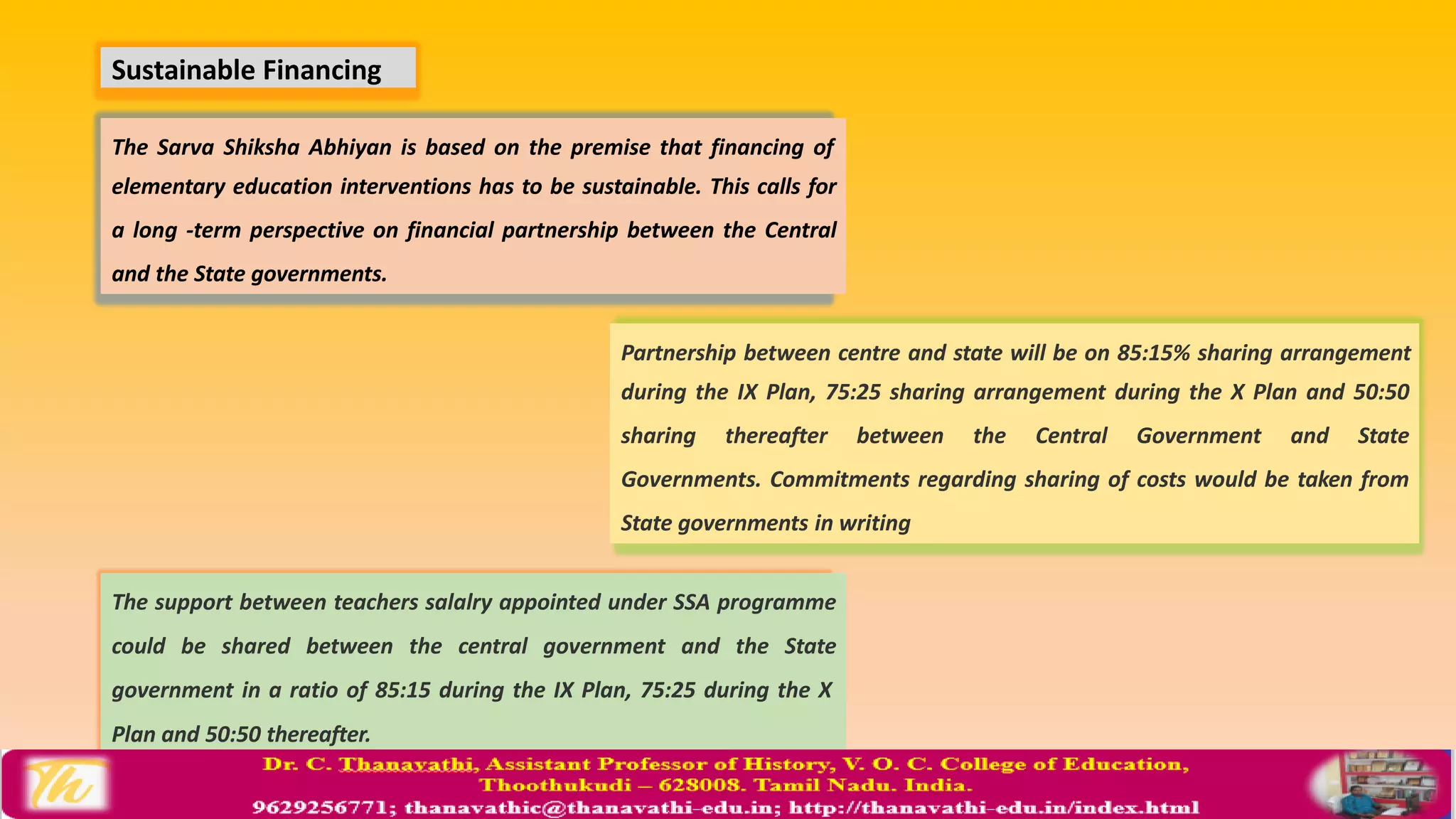
The Sarva Shiksha Abhiyan is based on the premise that financing of
elementary education interventions has to be sustainable. This calls for
a long -term perspective on financial partnership between the Central
and the State governments.
Partnership between centre and state will be on 85:15% sharing arrangement
during the IX Plan, 75:25 sharing arrangement during the X Plan and 50:50
sharing thereafter between the Central Government and State
Governments. Commitments regarding sharing of costs would be taken from
State governments in writing
Sustainable Financing
The support between teachers salalry appointed under SSA programme
could be shared between the central government and the State
government in a ratio of 85:15 during the IX Plan, 75:25 during the X
Plan and 50:50 thereafter.
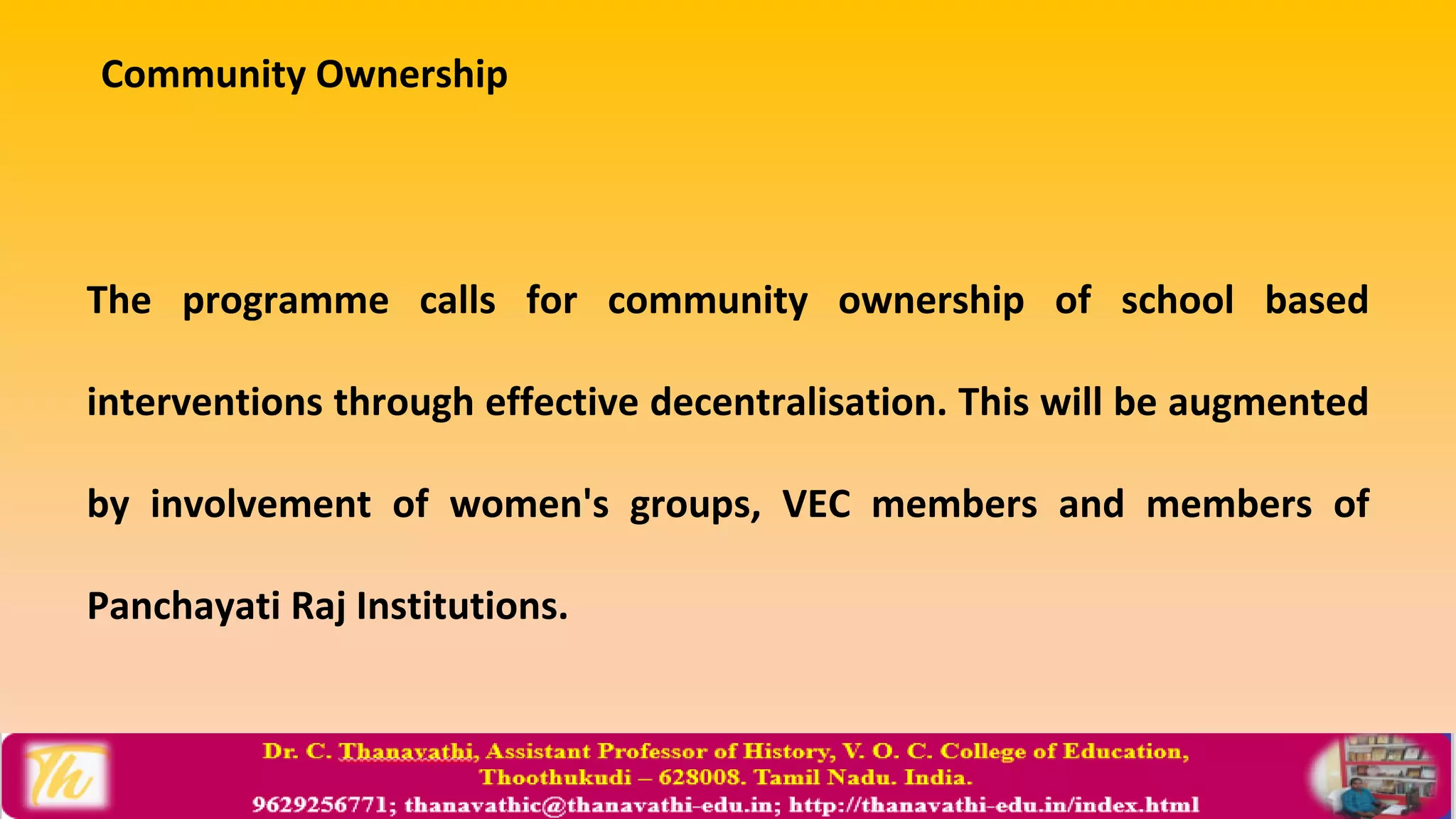
Community Ownership
The programme calls for community ownership of school based
interventions through effective decentralisation. This will be augmented
by involvement of women's groups, VEC members and members of
Panchayati Raj Institutions.
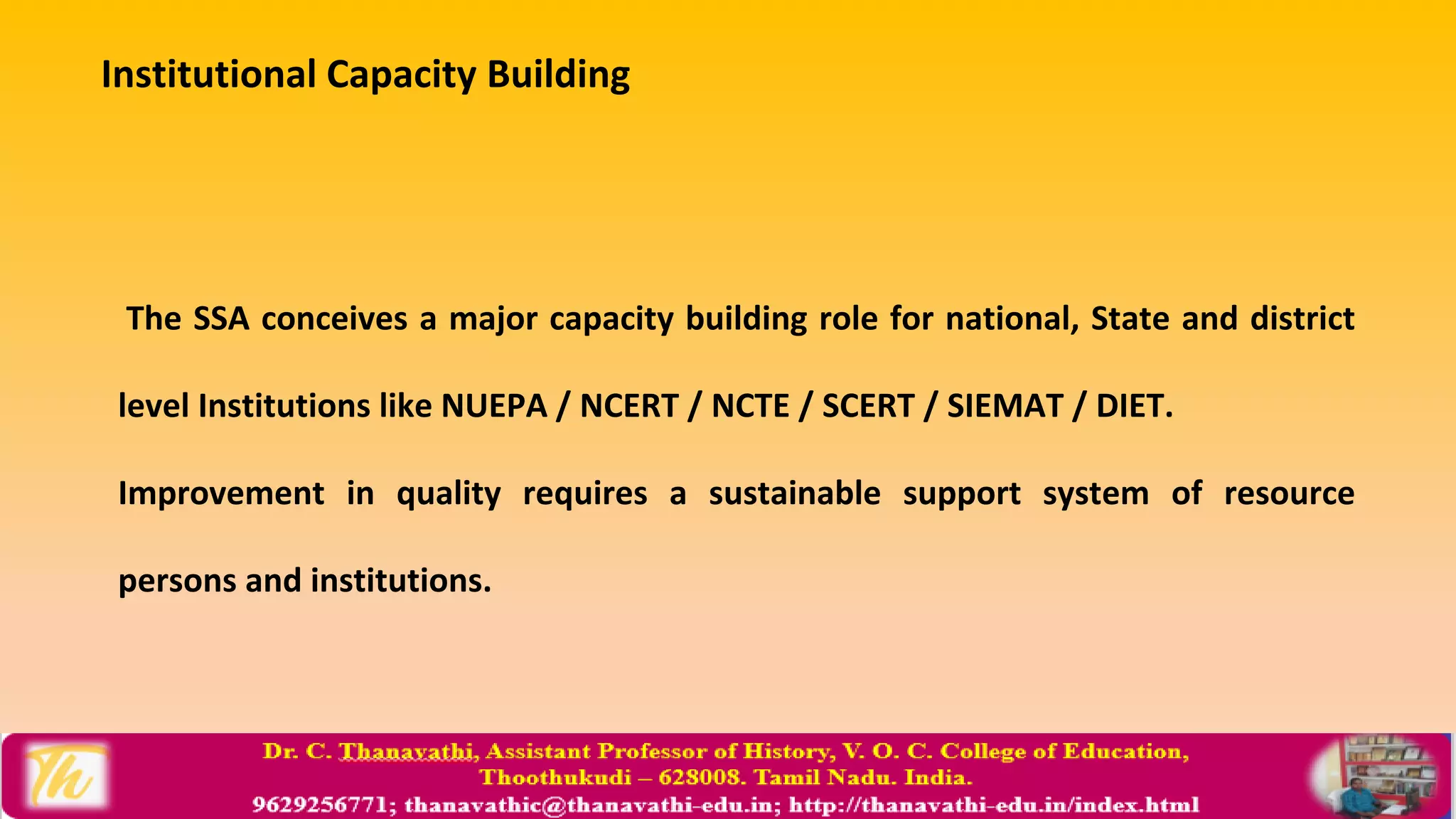
Institutional Capacity Building
The SSA conceives a major capacity building role for national, State and district
level Institutions like NUEPA / NCERT / NCTE / SCERT / SIEMAT / DIET.
Improvement in quality requires a sustainable support system of resource
persons and institutions.
 As per Unified District Information System for Education (UDISE) data for 2014-15, Gross
enrolment ratio (GER) stands at 98.85% for boys and 101.43% for girls which indicates universal
enrolment at primary level. At upper primary level the GER is 87.71% for boys and 95.29% for girls.
 Total enrolment in elementary schools has risen from 18.7 crore in 2009 to 19.76 crore in 2014-15.
 The pupil teacher ratio (PTR) has risen from 32 in 2009-10 to 25 in 2014-15. Also, nearly 63% of
government schools have PTR as per RTE norms i.e. 30:1 for primary level and 35:1 for upper
primary.
 Number of out of school children has come down from 134 lakhs in 2005 to 61 lakhs in 2013.
 As per UDISE 2014-15, the average annual dropout rate has come down from 6.76% in 2009 to 4.34% in 2014 at
primary level.
Achievements of SSA
 As per UDISE 2014-15, the transition rate from primary to upper primary has gone up from 85% in
2009 to 90% in 2014.
 The gender parity index has reached at 1.02 at primary level and 1.06 at upper primary level.
 At elementary level the enrolment of SC children stands at 19.80% which is more than their share in
population (16.6% as per census, 2011).
 Similarly, at 10.47% the enrolment level for ST children is higher than their share in population.
 As per UDISE 2014-15 around 23.18 lakh children with special needs have been brought into the fold of
education (in formal schools, or through home based tutoring, or by school readiness programmes). The
SSA focuses on teacher training, aids and appliances for children with special needs.
 Under the Kasturba Gandhi Balika Vidyalaya (KGBV) component of SSA, 3600 schools have been
opened specifically targeting drop out girls from regions with low literacy levels and regions with high
share of minority and SC/ST population. These schools today enroll close to 3.5 lakh girls.
Challenges of SSA
 Despite these achievements of the SSA, keeping students in schools throughout their schooling career is a
challenge as dictated by high dropouts’ rates. Nationally 29% of students’ dropout before completing five years of
primary schooling and 43% dropout before finishing upper primary school. The high school completion rate is
only 42%. These figures sum up to reveal that India has 1.4 million out of school children in the age group of 6-11.
 There is vast challenge of teachers across all the levels. The primary schools need additional 689000 teachers to
fulfill the RTE norms for pupil teacher ratio. Even though under the Swacch Vidyalaya Mission (Sub mission
under Swacch Bharat Mission) all schools now have a designated girls’ and boys’ toilet, a closer scrutiny reveals
that only 53% of such girls’ toilets are functional.
 The provisions of SSA and the RTE have some under most severe criticism for poor quality of learning across all
levels of schooling. As per Pratham’s ASER reports, close to 78% students in Class III and 50% students of class
V cannot read a class II text. Only 25% of class III students are able to solve a two-digit subtraction problem.
Alarmingly, about 20% of class II students cannot recognize numbers up to 9. There is lack of accountability
under SSA which manifests itself in poor learning outcomes and poor attendance rates of teachers.
Sarva Shiksha Abhiyaan (SSA) Dr. C.Thanavathi

Sarva shiksha abhiyaan (ssa)

  • 1.
    Sarva Shiksha Abhiyaan(SSA) Dr. C.Thanavathi
  • 2.
     It ispart of the universalization of elementary education.  Launched by the Government Of India in 2002.  Its aim to provide useful and relevant elementary education for all children in the 6 to 14 age group range by 2010.  This program has time-bound objectives.  SSA is an effort to improve the performance of the school system. It aims to provide quality elementary education with community involvement. What is SSA  It aspires to bridge gender and social disparities in elementary education.  It has a special focus on the educational needs of girls, SCs, STs, children with disabilities and disadvantaged children.  It covers other programs like District Primary Education, Lok Jumbish, Operation Blackboard, etc.  SSA would not disturb existing structures of education in states and districts. Sarva Shiksha Abhiyan (SSA) is a comprehensive and integrated flagship programme of Government of India to attain Universal Elementary Education (UEE), covering the entire country in a mission mode. SSA has been launched in 2001-2002 in partnership with the State Governments and Local Self Governments. The programme aims to provide useful and relevant, elementary education to all children in the 6 to 14 age group by 2010.
  • 3.
    Genesis of SSA Afterthe adoption of the National Policy on Education 1986, the Central Government launched several schemes for the elementary education sector, and also some of these schemes covered most parts of the country. However, all these schemes, such as OB, Teacher Education, NFE, DPEP and the MDM programme were specific intervention programmes, not a programme for universalising elementary education in the country. A conference of the State Education Ministers held on 23 October 1998 recommended that should be pursued in a mission mode with full collaboration between the Central and State governments. In 1999, a Committee comprised with state education minister under the chairmanship of UMHRD, Murli Manhoar joshi was set up to discuss the measure to achieve the UEE. The committee took the decision to implement UEE in mission mode and time bound framework. The multi programme approach should be avoid and a holistic approach should be developed. in 2001, the Central Government launched the SSA as the first ever nationwide programme for achieving UEE within a prescribed time frame.
  • 4.
    Main Aims ofthe SSA  All children in school, Education Guarantee Centre, Alternate School, 'Back-to-School' camp by 2003.  All children complete five years of primary schooling by 2007.  All children complete eight years of elementary schooling by 2010.  Focus on elementary education of satisfactory quality with emphasis on education for life.  Bridge all gender and social category gaps at primary stage by 2007 and at elementary education level by 2010.  Universal retention by 2010.
  • 5.
    1. all childrenin school, Education Guarantee Centre, Alternative School, ‘Back-to-School’ camp by 2003 (later amended to 2005); 2. all children complete five years of primary schooling by 2007; 3. all children complete eight years of elementary schooling by 2010; 4. focus on elementary education of satisfactory quality with emphasis on education for life; 5. bridge all gender and social category gaps at the primary and upper primary stage by 2007; and 6. universal retention by 2010. Objectives of SSA
  • 6.
     Sarva ShikshaAbhiyan is currently India’s magnum opus for Universalization of Elementary Education with not only focusing on curriculum but also undertakes:  The opening of new schools and alternate schooling facilities,  Construction of schools and additional classrooms,  Toilets and drinking water,  Provisioning for teachers, the regular teacher in service training and academic resource support,  Free textbooks & uniforms and support for improving learning achievement levels/outcome.  Partnership between state AND Central government.  Result oriented programme with clear time line framework. Characteristics of SSA
  • 7.
    Major Areas ofInterventions in SSA  Education of out-of-school children (Educational Guarantee Scheme and Alternative & Innovative Education)  Quality Improvement  Special Focus Groups  Research and Evaluation  Management Structure and Institutional Capacity Building  Community Mobilization  Civil Works  Monitoring and MIS  Financial Management and Procurement
  • 8.
    National Mission forSSA 2nd January, 2001 established the National Mission for Sarva Shiksha Abhiyan under the chairmanship of the Prime Minister. The National Mission has a major role to play in developing capacities. The National Mission facilitates & such as process, demand based capacity development visits would be organized by the National Mission, in consultation with the State Missions. The National Mission has the role of disseminating good practices across the state National mission of SSA has three bodies: 1. Governing body headed by PM with MHRD (Now Education minister) 2. Executive committee under the chairmanship of the MHRD(Now Education minister) 3. Project Approval Board has been constituted under the chairmanship of the Secretary of the Department.
  • 9.
    Convergence of DifferentMinistries & Schemes
  • 10.
    To achieve theobjective of UEE, the SSA scheme has recommended few interventions that are broadly grouped into four major categories. Interventions to achieve SSA
  • 11.
  • 12.
    As part ofthe SSA the central and the State Governments will undertake reforms in order to improve efficiency of the delivery system. The states will have to make an objective assessment of their  prevalent education system including educational administration,  achievement levels in schools,  financial issues,  decentralisation and community ownership,  review of State Education Act,  rationalization of teacher deployment and recruitment of teachers,  monitoring and evaluation,  education of girls,  SC/ST and disadvantaged groups, policy regarding private schools and ECCE. Institutional Reforms
  • 13.
    The Sarva ShikshaAbhiyan is based on the premise that financing of elementary education interventions has to be sustainable. This calls for a long -term perspective on financial partnership between the Central and the State governments. Partnership between centre and state will be on 85:15% sharing arrangement during the IX Plan, 75:25 sharing arrangement during the X Plan and 50:50 sharing thereafter between the Central Government and State Governments. Commitments regarding sharing of costs would be taken from State governments in writing Sustainable Financing The support between teachers salalry appointed under SSA programme could be shared between the central government and the State government in a ratio of 85:15 during the IX Plan, 75:25 during the X Plan and 50:50 thereafter.
  • 14.
    Community Ownership The programmecalls for community ownership of school based interventions through effective decentralisation. This will be augmented by involvement of women's groups, VEC members and members of Panchayati Raj Institutions.
  • 15.
    Institutional Capacity Building TheSSA conceives a major capacity building role for national, State and district level Institutions like NUEPA / NCERT / NCTE / SCERT / SIEMAT / DIET. Improvement in quality requires a sustainable support system of resource persons and institutions.
  • 17.
     As perUnified District Information System for Education (UDISE) data for 2014-15, Gross enrolment ratio (GER) stands at 98.85% for boys and 101.43% for girls which indicates universal enrolment at primary level. At upper primary level the GER is 87.71% for boys and 95.29% for girls.  Total enrolment in elementary schools has risen from 18.7 crore in 2009 to 19.76 crore in 2014-15.  The pupil teacher ratio (PTR) has risen from 32 in 2009-10 to 25 in 2014-15. Also, nearly 63% of government schools have PTR as per RTE norms i.e. 30:1 for primary level and 35:1 for upper primary.  Number of out of school children has come down from 134 lakhs in 2005 to 61 lakhs in 2013.  As per UDISE 2014-15, the average annual dropout rate has come down from 6.76% in 2009 to 4.34% in 2014 at primary level. Achievements of SSA
  • 18.
     As perUDISE 2014-15, the transition rate from primary to upper primary has gone up from 85% in 2009 to 90% in 2014.  The gender parity index has reached at 1.02 at primary level and 1.06 at upper primary level.  At elementary level the enrolment of SC children stands at 19.80% which is more than their share in population (16.6% as per census, 2011).  Similarly, at 10.47% the enrolment level for ST children is higher than their share in population.  As per UDISE 2014-15 around 23.18 lakh children with special needs have been brought into the fold of education (in formal schools, or through home based tutoring, or by school readiness programmes). The SSA focuses on teacher training, aids and appliances for children with special needs.  Under the Kasturba Gandhi Balika Vidyalaya (KGBV) component of SSA, 3600 schools have been opened specifically targeting drop out girls from regions with low literacy levels and regions with high share of minority and SC/ST population. These schools today enroll close to 3.5 lakh girls.
  • 19.
    Challenges of SSA Despite these achievements of the SSA, keeping students in schools throughout their schooling career is a challenge as dictated by high dropouts’ rates. Nationally 29% of students’ dropout before completing five years of primary schooling and 43% dropout before finishing upper primary school. The high school completion rate is only 42%. These figures sum up to reveal that India has 1.4 million out of school children in the age group of 6-11.  There is vast challenge of teachers across all the levels. The primary schools need additional 689000 teachers to fulfill the RTE norms for pupil teacher ratio. Even though under the Swacch Vidyalaya Mission (Sub mission under Swacch Bharat Mission) all schools now have a designated girls’ and boys’ toilet, a closer scrutiny reveals that only 53% of such girls’ toilets are functional.  The provisions of SSA and the RTE have some under most severe criticism for poor quality of learning across all levels of schooling. As per Pratham’s ASER reports, close to 78% students in Class III and 50% students of class V cannot read a class II text. Only 25% of class III students are able to solve a two-digit subtraction problem. Alarmingly, about 20% of class II students cannot recognize numbers up to 9. There is lack of accountability under SSA which manifests itself in poor learning outcomes and poor attendance rates of teachers.
  • 20.
    Sarva Shiksha Abhiyaan(SSA) Dr. C.Thanavathi